Showing posts with label Woman In The Moon. Show all posts

Saturday, October 1, 2022

Silent Movie Day 2022: On the joys of combining silent film music with long-haul trucking

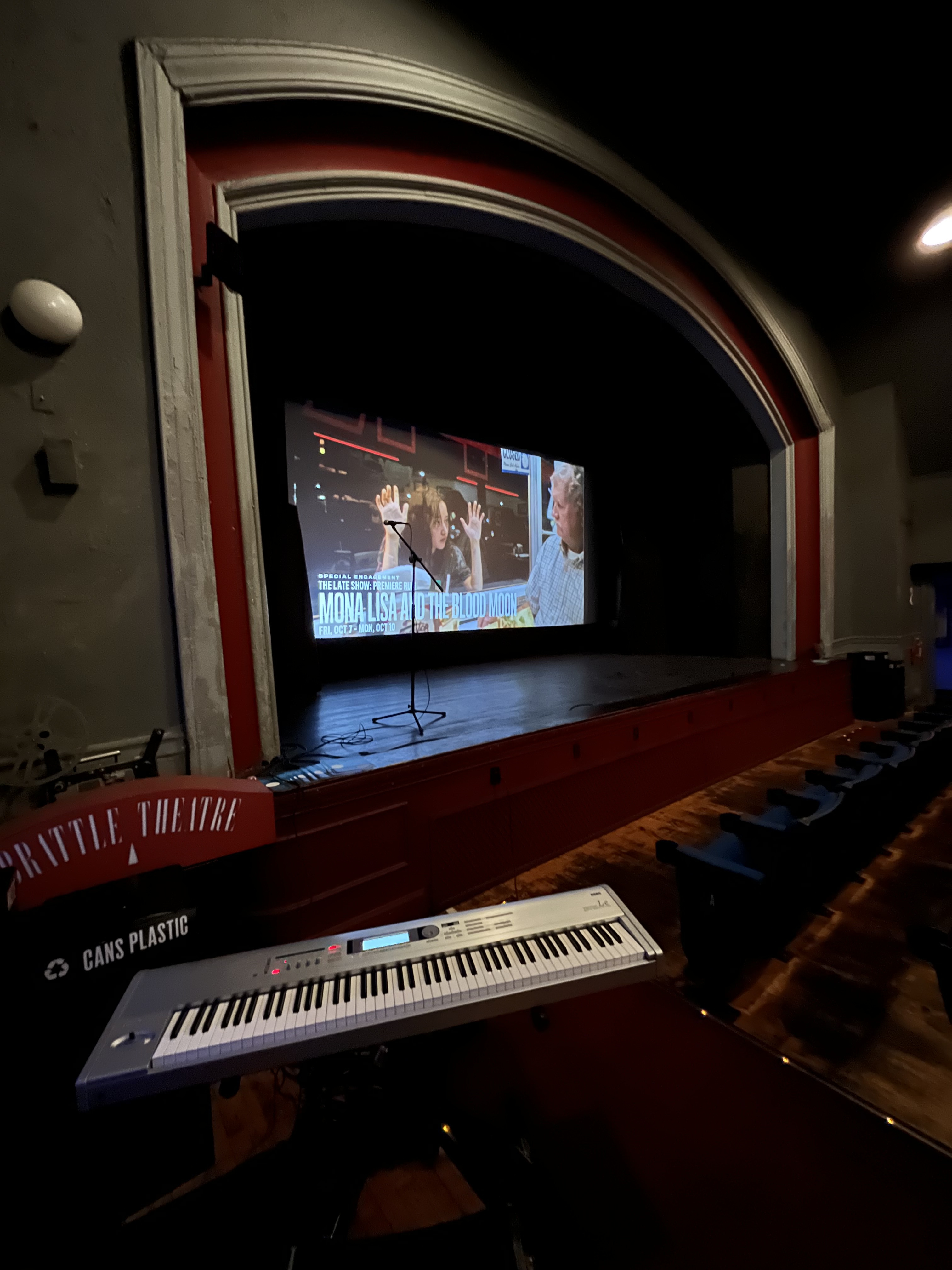
My set-up at the Brattle, just before embarking on a 4½-hour journey with Fritz Lang's 'Dr. Mabuse, Der Spieler.'

Well, that put the "odd" in odyssey!

I'm just back after a silent film swing that took me to screenings in Cambridge, Mass., Detroit and Cleveland, and then back again—all in less than three days.

This was all in support of this year's 'Silent Movie Day' on Thursday, Sept. 29, but which in my case also involved accompanying extra screenings on the days before and after it.

So for me, Silent Movie Day was actually three days in a row, each featuring a BIG (meaning lengthy) title.

First up: On Wednesday, Sept. 28, I left home in New Hampshire at 4 p.m. to make the one hour drive to Cambridge, Mass. 

That evening, the venerable Brattle Cinema (just off Harvard Square) screened Fritz Lang's 'Dr. Mabuse, The Gambler' (1922), the sprawling two-part crime thriller that clocks in at 4½ hours. Yes, I played for it all, starting at 6 p.m. and ending just before 11 p.m.

After that, I loaded my keyboard and sound gear back onto the Forester, then hopped on the Massachusetts Turnpike (a.k.a. I-90) and headed west for Detroit, Mich. Buoyed by a brief catnap at a rest area in Utica, N.Y., I pulled into the Motor City in mid-afternoon.

At Cinema Detroit, where masks are still required out of an abundance of caution.

That night (Thursday, Sept. 29), Cinema Detroit celebrated Silent Movie Day with another sprawling Lang epic, 'Woman in the Moon' (1929), with live accompaniment by me. Clocking in at 2¾ hours, it seemed like a short subject compared to 'Mabuse.'

The next day (Friday, Sept. 30), I backtracked to Cleveland, where that evening I did live music for the the Cleveland Cinematheque's screening of another silent epic: Erich von Stroheim's 'Greed' (1924).

Talk about length! Von Stroheim originally planned an eight-hour running time, and then created a four-our version before the studio finally took it from him and released a version that runs about 2½ hours, which is what we saw at the Cinematheque.

Strangely, at that length, 'Greed' turned out to be the shortest feature of the trip.

Also on the bill at Cleveland: a newly discovered industrial promotion film, 'The Heart of Cleveland' (1924), a half-hour commercial for the wonders of electricity that was filmed and shown in the city. 

What a surprise! Featuring shots of a family touring giant industrial facilities, it anticipated Dziga Vertov's 'Man With The Movie Camera' by several years. More on the film (and a link to the video) is here. 

The Cinematheque audience just before Friday night's screenings. Taken from the keyboard with the fisheye lens on my new iPhone 13.

Afterwards, I loaded my gear and pointed the Forester east on I-90 to take me back home via the N.Y. State Thruway. After a brief catnap (again in Utica, N.Y.), I arrived home at 10:30 a.m.—exactly 66½ hours and 1,705 miles later.

Out of those 66½ hours, I was at the keyboard improvising music for more than 10 of them. That's a lot of music to spin out in live performance over three days. 

The only concession to the sheer quantity of scoring needed was that I allowed myself to use some common motifs that worked for all three films. Usually I'd try to avoid recycling material,

What motifs? The most common was a simple sequence of three descending notes: D, C#, G, with the last being held. You can build amazing things with this! (Only now do I realize it's a slight twisting of the opening notes of Rachmaninoff's very familiar 'Prelude in C# minor.')

Okay, now for the big question: Why do a stunt like this? Why combine silent film accompaniment with the romance of long-haul trucking?

Well, partly to challenge myself, and to see if I really could do it. Did I have the mental and physical stamina to get through this marathon?

Turns out I did, mostly. Only twice did I catch myself going into a mild "swoon" state on the piano bench: once near the start of Part II of 'Dr. Mabuse' (about three hours into the movie), and then near the end of 'Greed.'

Both times I felt a wave of wooziness wash over me, and so did a mental check to make sure it wasn't the symptom of some larger Fred-Sanford-like attack coming on. ("It's the big one, Weezy, I'm coming to join yez!") 

In both cases, while being so absorbed in creating music, I had apparently stopped breathing. So I began breathing again, and all was well.

Otherwise, everything about this escapade fell into place quite nicely. No giant traffic delays, no car troubles, no unexpected weather.

The main cast of Fritz Lang's lunar voyage epic, 'Woman in the Moon' (1929).

The only concern came at Cinema Detroit, where the heat was cranked up prior to 'Woman in the Moon,' making the house way to warm for me to survive 2¾ hours in live improv mode. 

I was preparing to strategically disrobe if necessary, but they turned off the heat before the show started and all went fine.

Another reason to do this was to take advantage of 'Silent Movie Day' (which only started last year) to engineer something of a deep dive for myself: to do music for a series of longer films to see how that would affect the music-making, if at all.

I find a longer film of any type often affords enough running room to thoroughly explore whatever musical material I'm working with. With films that run two, three or four hours, you do things that just aren't possible with a film that runs an hour and change. 

Counter-intuitively, I find shorter films far more demanding to score effectively, as everything's more tightly wound, especially with comedies. Often there's just no slack to lose yourself and come up with natural and effective scoring, at least the way I do it.

Talk about trances: a scene from 'Dr. Mabuse, Der Spieler.'

So my mini-marathon of 10 hours was a chance to push myself as deeply as one can go into the wide open spaces of improv. And it did just that: near the end of Part 1 of  'Mabuse,' I was so completely absorbed when I realized I had no idea what the actual time was.

The Brattle has a wall clock up above where I was sitting, so I glanced up and saw: 8:35 p.m. So something like half-way through, with hours still to go. And I then dove back into the trance-like state, once again completely absorbed in translating images into music to help the film cast its spell.

I can't speak for other accompanists, but I love those rare times when a movie absorbs you so completely that you lose sight of the beginning and the end. You always know they're there, of course, but the movie is so big that both start and finish lie well beyond the horizon. 

It's those times when I feel free to do what I think is my best work—where all the second-guessing subsides and the music flows naturally, as if in a dream. It's always underpinned by constant calculating and anticipation and so on, but all that becomes second nature in a way that never happens when you're playing, say, a one-reel Snub Pollard comedy. 

So in terms of losing myself, I have to say I got ample doses of that with all three films. But 'Mabuse' stands out as unique, in that the sheer quantity of time to be playing live, and then knowing that I would launch myself westward in the wee hours of the morning, creating a sense of being alive and in the moment that made 'Silent Film Day' worth all the effort. 

A scene from 'Dr. Mabuse, Der Spieler.'

Audiences were generous with their reactions both during the screenings and afterwards. The Brattle Mabuse marathon attracted about 35 people (more than expected) who were welcomed by creative director Ned Hinkle as the "hard core."

Ned mentioned that he'd wanted to program the whole Mabuse saga in one big gulp, and the film's 100th anniversary plus Silent Film Day seemed to be the right occasion for it. 

However, at first he hadn't considered live music because he couldn't imagine anyone wanting to tackle the whole thing in one evening. Little did he know!

As far as I could tell, everyone at the Brattle stayed to the end, at which point they lustily cheered the film. In fact, we seem to have ended with significantly more people than when we started. 

Afterwards, I spoke with several people who had no idea they were in for such a long haul. It's one thing to see "270 minutes" in the listing, but quite another to do math.

I also talked with a young guy who turned out to be a visiting student from China who'd been in the U.S. for all of three weeks. He could not be more enthusiastic about the programming at the Brattle, which he's apparently attended every evening since his arrival.

I was glad to hear this, but couldn't help thinking he's not quite getting a very accurate impression of life in America.

At Cinema Detroit, a good-sized crowd remained engaged and reacted noisily throughout 'Woman in the Moon.' A high point was when the Walter Turner character played by Fritz Rasp does his "quick change" into another character and back again right before our eyes, which produced bursts of astonished laughter.

I think one thing that helped was that for the first time ever, I had a distinct musical signature for this character that I used only when he was on screen, and then never again except for that one moment when he reappears as if by magic. 

With its one-of-a-kind mix of prescient sci-fi and completely erroneous assumptions about space travel, 'Woman in the Moon' produced the "gaping mouths" reaction that only it can do. 

The one thing I forgot to mention beforehand was that although the film is a serious drama, it contains a great deal of comedy that was intended to break the tension. For modern audiences who often don't know what to make of what they're seeing, it helps to give people permission to laugh.

But the Cinema Detroit audience seemed to get this without any prompting. Several big laugh moments stand out in my mind as highlights of the communal experience.

In Cleveland, 'Greed' attracted something like 80 people, which Cinematheque director John Ewing observed was the largest in-person attendance of any screening since the pandemic. 

(That's John at left, at the podium, which renders him invisible where I sit below at the keyboard.)

Fortified by a meal at 'L'Albatross,' my favorite restaurant in all of North America (no kidding!), and knowing I was in the home stretch of my marathon, I pushed myself to rise to the challenge of scoring von Stroheim's legendary lost masterwork. 

And that's all I remember. Well, not really, but kinda sorta. It takes awhile to awaken from that dream state.

The next thing I knew, I was on I-90, heading east through Ashtabula, Ohio, and wondering if it had all been a dream. In other words, success!

Many thanks to the many people who made this Silent Movie Day oddysey possible, especially Ned Hinkle and Ivy Molan of the Brattle Cinema in Cambridge, Mass.; Paula and Tim Guthat at Cinema Detroit; and John Ewing and Genevieve Schwartz at the Cleveland Cinematheque. 

(And a special thanks to Genevieve for joining me on the L'Albatross pilgrimage, which included visiting a side street paved with wood.)

All of these people remain willing to include silent film with live music as part of their programming—not just on Silent Movie Day, but at any time. I think that's something worth celebrating all year long.

Well...after a phenomenally busy September full of challenging live performances, I'll be taking a bit of a break now. As I said earlier this month to the audience after doing live music for Louis Feuillade's 'Les Vampires' (1915), which is 7½ hours long: "I'm going to lie down now."

But look out, as here comes Halloween! This year's schedule is highlighted by numerous screenings of 'Nosferatu' (1922) to mark the 100th anniversary of its release.

There's also a rare three-screenings-in-one-day on Saturday, Oct. 29, when I'll do 'Nosferatu' in the afternoon in Jaffrey, N.H., then 'Der Golem' in the evening in Ogunquit, Maine, and then a midnight screening of the reconstructed 'London After Midnight' at the Coolidge Corner Cinema in Brookline, Mass. 

One day, three screenings, three states. 

Anyone want to book a morning screening in Rhode Island that day to make it four?

If we start at 6 a.m., we can fit in the entire 'Dr. Mabuse' saga, with plenty of time for lunch...

Friday, September 23, 2022

New on the schedule: 'Dr. Mabuse' epic on Wednesday, Sept. 28 at the Brattle Cinema

Rudolf Klein-Rogge stars as the title character in Frtiz Lang's 'Dr. Mabuse, The Gambler' (1922).

Greetings from Iola, Kansas, where I'm looking forward to this weekend's 'Buster Keaton Celebration.' More about that in just a bit.

Right now, I'm super-excited to announce that a last-minute addition turned this year's 'Silent Film Day' (coming up on Thursday, Sept. 29) into something of an event for this accompanist. 

Just yesterday, the venerable Brattle Cinema in Cambridge gave the go-ahead to add live music (by me) to their planned screening of 'Dr. Mabuse, the Gambler' (1922) on Wednesday, Sept. 28.

Yes! I was hoping they would, as Fritz Lang's first 'Mabuse' is rarely programmed (one reason: it's 4½ hours long!) and the chance to do live music for it is a rare opportunity for an accompanist.

But the call has come, and thus I'm spreading the word to one and all: join us on Wednesday, Sept. 28 at 6 p.m. (note the early start time) for a cinematic experience you will not forget. 

The full press release for the 'Dr. Mabuse' screening is pasted in below. There's a lot about this film that I find fascinating, and I hope you'll be on hand at the Brattle to experience it as intended: in a theater, on the big screen, with live music, and (most importantly!) an audience. 

 And 'Dr. Mabuse' is added to a 'Silent Movie Day' performance schedule that finds me at Cinema Detroit the very next day to do live music for another great Lang epic: 'Woman in the Moon' (1929). It's known as 'Frau im Mond' in German, as in the poster at right.

And at just 2¾ hours, it's a relative trifle compared to 'Mabuse.' 

Actually, it's another terrifically ambitious movie that will blow the minds of people who have not yet seen it. And it's full of wonderful opportunities for music to augment the story and add to the experience. The screening starts at 7 p.m.

And after that, on Friday, Sept. 30, I'm at the Cleveland Cinematheque to do music for Erich von Stroheim's legendary epic 'Greed' (1924), which the director planned to run 8 hours before the studio took control and cut it down to a more manageable 2½ hours. 

(Various edits and reconstructions of 'Greed' have been produced over the years. The version being shown in Cleveland runs a tight 109 minutes.)

Gilbert Gowland (center) stars in 'Greed' (1924).

The Cinematheque screening also includes a local curiosity: 'The Heart of Cleveland, a recently rediscovered silent promotional film in which some 1920s farm children living without modern conveniences outside of Cleveland travel to the big city to learn what electricity can do.

The Cleveland "re-premiere" of 'The Heart of Cleveland' starts at 6:30 p.m., with 'Greed' to follow at 7 p.m. 

You know your doing your part to honor Silent Film Day when, over three days, the shortest film you're accompanying is von Stroheim's 'Greed.'

So that's the news from Iola, where tomorrow I'll accompany two Keaton features: 'The Cameraman' (1928) and 'Steamboat Bill, Jr. (1928). If you're in the southeastern Kansas area, stop by! If you're anywhere else, you have a whole day to get here!

Here's the press release for the screening of 'Dr. Mabuse, Der Spieler' (1922) on Wednesday, Sept. 28, at 6 p.m. at the Brattle:

*   *   *

Pick a disguise: the many faces of Dr. Mabuse.

FRIDAY, SEPT. 23, 2022 / FOR IMMEDIATE RELEASE
Contact Jeff Rapsis • (603) 236-9237 • jeffrapsis@gmail.com

Live music added to Brattle Cinema's 9/28 screening of early epic thriller 'Dr. Mabuse'

Pioneering four-hour silent drama about criminal mastermind to run on Wednesday, Sept. 28 in honor of 'Silent Film Day'

CAMBRIDGE, Mass.—It's a story so big, it takes more than four hours to tell.

It's 'Dr. Mabuse, the Gambler,' a landmark crime thriller that pushed the boundaries of cinema and story-telling when it hit theaters in 1922.

The rarely screened early masterpiece from German director Fritz Lang will be presented at the Brattle Cinema on Wednesday, Sept. 28 starting at 6 p.m.

Admission is $14 per person; $12 for members, seniors, children, and students.

An original improvised musical score for 'Dr. Mabuse' will be performed by silent film accompanist Jeff Rapsis of Bedford, N.H.

"Live music makes any screening of a silent film a one-of-a-kind event," said Rapsis, who will play continuously during the four-hour-plus epic.

Rapsis aims to use music to bring out the story's many shifts and turns, and also enhance the dark atmosphere that permeates Lang's sprawling film.

The Brattle has scheduled 'Dr. Mabuse' as part of a three-day observance of this year's Silent Film Day, which falls on Thursday, Sept. 29.

Other screenings include a program of short comedies starring Buster Keaton on Thursday, Sept. 29 and the early horror classic 'Nosferatu' (1922) on Friday, Sept. 30.


'Dr. Mabuse' was a daring project by director Fritz Lang, who would later helm 'Metropolis' (1927) and a host of early screen classics, including two sequels to the Mabuse story.

Based on a contemporary novel by Norbert Jacques, 'Dr. Mabuse' (pronounced "ma-BOO-seh") tells the story of a criminal mastermind who uses disguises and hypnosis to defraud and control his wealthy victims.

Set in Germany after World War I, the movie aimed to capture the chaotic and unreal nature of life in Berlin at the time.

It also became the template for the criminal espionage film genre, with its atmosphere of intrigue, treachery and deceit among sophisticated high society.

'Dr. Mabuse' was created at a time when European cinema was not subject to now-accepted constraints of length or scope.

Lang's completed film runs an extraordinary 4½ hours and is divided into two parts.

The first part, 'The Great Gambler: A Picture of the Time,' introduces Dr. Mabuse and his criminal enterprises, which include extortion, stock market manipulation, and swindling the wealthy elite.

The second part, 'Inferno: A Game for the People of our Age,' continues the story, which includes assassination, a scene of mass hypnosis in a theater, a daring escape through sewers, and a melodramatic climax.

"This is filmmaking on a grand scale," said Rapsis, who will improvise a musical score using new material he's composed for the Brattle screening. .

"For movie fans, the rare chance to see Lang's ground-breaking film on the big screen with live music is not to be missed."

'Dr. Mabuse' stars actor Rudolf Klein-Rogge in the title role. Klein-Rogge frequently collaborated with Lang, playing the iconic role of scientist Rotwang in 'Metropolis' and criminal mastermind Haghi in Lang's 'Spies' (1928).

During production, 'Dr. Mabuse' had its share of behind-the-scenes drama. Lang began an affair with screenwriter Thea von Harbou, who at the time was married to Klein-Rogge. Her separation from Klein-Rogge was amicable, however, and did not interfere with the film. Ultimately, Lang married von Harbou; the three then worked on several subsequent films.

Upon its release, critics hailed 'Dr. Mabuse' as an example of cinema's story-telling and artistic potential.

The Berliner Zeitung called the first part "the attempt to create an image of our chaotic times" and went on to state that it "will give people fifty or one hundred years from now an idea of an age that they could hardly comprehend without such a document."

Film-Kurier praised Klein-Rogge's "brilliant performance" and Lang's "sensitive yet experienced" direction.

'Dr. Mabuse' wasn't released in the United States until 1927, and then only in an edited-down two-hour version that proved unsuccessful.

Today, contemporary critics recognize the original 'Dr. Mabuse' as Lang's earliest masterpiece and a lasting achievement.

"Mabuse remains memorable for the darkly brooding atmosphere that Lang creates, a disturbing compound of hysteria and fatalistic passivity.”
– John Wakeman, World Film Directors Volume 1.

Both parts of 'Dr. Mabuse, The Gambler' (1922) will be shown on Wednesday, Sept. 28 at 6 p.m. at the Brattle Cinema, 40 Brattle St., Cambridge, Mass. (Please note the early start time.)

Admission is $14 per person; $12 for members, seniors, children, and students. To buy tickets online, visit www.brattlefilm.org or contact the box office at (617) 876-6837.


Sunday, October 11, 2020

Yesterday, the Moon and UFO Festival; today, 'Caligari' in Natick, Mass., then 'Wings' in Wilton, N.H. later this week

It's not easy being green. For some reason, you just don't fit in.

It's a beautiful Columbus Day weekend here in northern New England. The foliage is at its peak, but there's also spectacular color inside, such as this alien glimpsed as part of the Greater New England UFO Conference in Wilton, N.H. (More on that below.)

First up: this afternoon (Sunday, Oct. 11) it's 'The Cabinet of Dr. Caligari' (1920) at the Center for the Arts, 14 Summer St. in Natick, Mass. Screening time is 6 p.m., so guess it's technically this evening. 

I haven't promoted this one heavily because the Center, like all venues in Massachusetts, is limited to just 25 people due to Covid-19 restrictions. But if you'd like to go, check www.natickarts.org, as tickets are available only online and in advance.

But then we swing back to New Hampshire later this week with a screening of the epic World War I picture 'Wings' (1927) on Thursday, Oct. 15. Showtime is 7:30 p.m. at the Town Hall Theatre in Wilton, N.H., and it's the opening title in a three-day festival of classics brought to you by the Aviation Museum of N.H.

More on 'Wings' and the festival below. Before that, let's tackle the alien. (Not literally, as he may have a raygun, or be sticky.) He/she/it was spotted in the Town Hall Theatre lobby as part of, yes, the Greater New England UFO Conference, which is taking place this weekend.

In fact, it's still going on today: Sunday, Oct. 11. So there's still time to check it out if you're within driving or bicycling distance to Wilton, N.H. Among other attractions, the theater is enforcing social distancing by placing blow-up aliens (similar to the one above) in selected seats.

As an incentive, it's also a confab of "Big Foot" fans, one of whom can make plaster casts for you to take home:

Casting call: Take home your very own big feet!

I wish to apologize to all Bigfoot fans, plus the Native American community in general, for mistakenly referring to Big Foot in my opening remarks as "Sacajawea" instead of "Sasquatch." Wow, I'm turning into my malaprop-prone mother. God rest her soul. (Apologies to her, too, by the way. Just because.)

Anyway: I love doing music for Lang's 'Frau im Mond' (the original German title) because it's such a surprise for audiences, and also because the whole story and treatment are a good fit for the kind of music I make: that of the big gesture. 

Things always start off with a bang due to a flashback near the beginning: Prof. Manfeldt is seen more than three decades earlier, lecturing on his "gold on the moon" theory to fellow academics, who promptly riot. Lang then shows close-ups of a bell being rung and a whistle being blown to quell the fracas: literally, bells and whistles!

And that's what I use: my grandmother's old brass school bell, and a referee's whistle, to kick up a nice sonic riot to go with Lang's visuals. And it's really effective, I think, especially when the flashback ends and Lang dissolves back to Prof. Manfeldt, now impoverished and living in a garret: all the noise dies down and I just leave soft high note sustained, hanging there.

When I accompany 'Woman in the Moon,' the entire score is built out of original motifs for characters and situations. You need material to hold together a nearly three-hour film. But also, in just one instance, I use an identifiable tune that I think helps the film's emotional line.

The tune: 'Gaudeamus igitur,' the classic student anthem. I work it in during Manfeldt's flashback lecture to establish atmosphere, and then we don't hear it again until much later, when he reaches the moon and actually finds, yes, GOLD! 

Lang illustrates the moment visually by showing the Professor's shouts echoing among the lunar caverns, and I add a note of musical triumph by folding in the chords to 'Gaudeamus' on top of the by-then-rhythmic accompaniment in the bass. 

Lot of interesting comments from the 30 or so people who attended the screening. One I'd never heard before: "NASA could use you to add drama to their launches."

By the way, I mentioned bicycling because after yesterday's trip to the moon, I got on my trusty road bike and pedaled a late afternoon loop from the theater into the hills of bucolic Lyndeborough, N.H. (Pronounced "line-boro" for all you flatlanders.) 

And I mean hills. It was all up, up, up to what's called "Lyndeborough Center," with its meetinghouse and parsonage and open fields and views for miles. And then, as dusk gathered, I enjoyed my own rocket ship ride down the road to a place called "Fitch's Corner" in Milford, then back to the theater.

Distance was only about 15 miles, but the uphills made for slow going, while the downhills couldn't be taken advantage of entirely because it was getting dark and you have to be careful on these back roads.

But the air was still warm, even in the growing twilight, so it made for a spectacular communion with this year's foliage, which will be gone soon enough. 

Okay, here's more info about 'Wings' on Thursday and the other classic aviation films we're showing later this week. See you at the theater!

*   *   *

'Wings' to be screened with live music on Thursday, Oct. 15 at the Town Hall Theatre.

WEDNESDAY, SEPT. 30, 2020 / FOR IMMEDIATE RELEASE
Contact Jeff Rapsis • (603) 236-9237 • jrapsis@nhahs.org

Three-day festival of classic aviation adventure films coming to Wilton, N.H.

John Wayne, Jimmy Stewart among stars featured in Academy Award-winning pictures presented by Aviation Museum of N.H.

WILTON, N.H.—Fly off to high-altitude adventure with a festival of classic aviation films at the Town Hall Theatre, 40 Main St., Wilton, N.H.

The three-day event, which runs from Thursday, Oct. 15 through Saturday, Oct. 17, gives local audiences a chance to see timeless aviation movies as they were intended—on the big screen and in a theater.

The festival will include four large-scale features from Hollywood's Golden Age, ranging from the classic World War I aviation drama 'Wings' (1927) to the all-star wide-screen desert survival blockbuster 'The Flight of the Phoenix' (1965).

Other titles include '12 O'Clock High' (1949), an intense thriller about U.S. pilots in World War II, and 'The High and the Mighty' (1954), a ground-breaking airborne drama about a stricken commercial airliner starring John Wayne.

All films in the festival were nominated for multiple Academy Awards. Each captures the public's fascination with flight in a different setting, as pilots and passengers alike face danger in the sky and also on the ground. Aviation buffs will enjoy the vintage aircraft featured in each production.

All screenings are free and open to the public. Donations will be accepted, with all proceeds used to support the education outreach program of the Aviation Museum of N.H.

The Town Hall Theatre is observing procedures to comply with all state and CDC public health guidelines, including reduced seating capacity. For complete information about the venue's safety protocols, visit www.wiltontownhalltheatre.com.


• On Thursday, Oct. 15 at 7:30 p.m., the festival opens with the silent classic 'Wings' (1927), a drama about World War I aviation that won 'Best Picture' at the very first Academy Awards ceremony. The film stars Clara Bow, Charles 'Buddy' Rogers, and Richard Arlen. Live music for 'Wings' will be provided by Jeff Rapsis, a silent film accompanist and also executive director of the Aviation Museum of New Hampshire.


• On Friday, Oct. 16 at 7:30 p.m. brings '12 O'Clock High' (1949), a classic bout aircrews in the United States Army's Eighth Air Force, who flew daylight bombing missions against Nazi Germany and occupied France during the early days of American involvement in World War II. Starring Gregory Peck, '12 O'Clock High' received four Academy Award nominations, winning Best Supporting Actor for co-star Dean Jagger and Best Sound Recording.


• Saturday, Oct. 17 at 2 p.m., it's 'The High and the Mighty' (1954), a drama about a troubled commercial flight starring John Wayne and Robert Stack. With its intertwined stories of passengers on a doomed commercial flight, 'The High and the Mighty' served as a template for the Hollywood 'disaster' genre. The film earned six Academy Award nominations, winning for composer Dmitri Tiomkin's dramatic musical score.


• Saturday, Oct. 17 at 7:30 p.m., the festival concludes with 'The Flight of the Phoenix' (1965), a drama about survivors of a plane crash in the Sahara Desert. Starring Jimmy Stewart, Peter Finch, and Ernest Borgnine, 'The Flight of the Phoenix' was nominated for two Academy Awards: Ian Bannen for Supporting Actor and Michael Luciano for Film Editing.

"These are all terrific pictures with great stories set in the earlier days of aviation, before air travel became commonplace for so many people," said Jeff Rapsis, the Aviation Museum's executive director.

"They're a great way to recapture the romance and excitement of flight, and the Aviation Museum's festival is a rare chance to see them as intended: on a big screen and in a movie theater," Rapsis said.

The Aviation Museum of N.H., located at 27 Navigator Road, Londonderry, N.H., is a non-profit 501(c)3 tax-exempt organization. Housed in the vintage 1937 passenger terminal at Manchester-Boston Regional Airport, the Aviation Museum is dedicated to preserving the Granite State's rich aviation past, and also inspiring today's students to become the aviation pioneers of tomorrow.

For more information about the Aviation Museum, visit www.aviationmuseumofnh.org or call (603) 669-4820. Follow the Aviation Museum on social media at www.facebook.com/nhahs.

For more about the Town Hall Theatre, visit www.wiltontownhalltheatre.com or call (603) 654-3456.

Monday, October 5, 2020

This weekend: from 'A Woman in Grey' to 'Woman in the Moon' at New England UFO Conference

Exploring the lunar surface in 'Woman in the Moon' (1929).

Coming this weekend: we blast off as part of the "Greater New England UFO Conference and Film Festival," with a screening of Fritz Lang's lunar epic 'Woman in the Moon' (1929).

Screening is on Saturday, Oct. 10 at 2 p.m. at the Town Hall Theatre, 40 Main St., Wilton, N.H.  Admission to the screening is free, with donations accepted to help defray expenses. (The rest of the UFO festival requires purchase of a ticket.) 

More on all that below. For now, here's a report on an experiment we tried this past weekend at the same venue: over two days, we ran all 15 chapters of 'A Woman in Grey' (1920), a rare example of a silent-era serial that survives complete. 

Arline Pretty gives a restrained performance in 'A Woman in Grey.' 

At about 15 minutes per chapter, that's nearly four hours of film! So we broke it into two parts: the first eight chapters ran on Saturday, with the final seven (including the thrilling climax!) on Sunday.

These were never intended to be shown back-to-back, of course. But by doing so, I think we created a new form of cinematic story-telling: every 15 minutes or so, leading lady Arline Pretty would get into some kind of life-threatening peril, at which the whole thing would stop.

And we'd see the same "see the next episode" title, and then a momentary black screen, and then the opening titles for the next chapter. And then we'd get a synopsis of the action so far, and then a few scenes from "last week" to bring us up to speed. 

It was a weird kind of ritualistic experience, in that the rhythms of the story were chained to this climax-every-15-minutes rhythm in a way you don't usually see. 

I wanted to do this partly just to try it, and also because I didn't think running the 15-part story one chapter at a time would work very well in any venue where I regularly perform, where the pace is generally once a month at best. 

I also wanted to do it because 'A Woman in Grey' was filmed in the area of Wilkes-Barre, Penn. by the Serico Producing Co., which promptly went bankrupt after completing this, its one big production. A hundred years later, I thought that's an achievement worth celebrating by running it on the big screen.

For the music, I created a mysterious-sounding main theme that would serve to underscore the opening titles of every episode, and which could be adapted to the action and character interplay as needed. 

So at the end of each episode, just when leading lady Arline Pretty was about to fall to her death or be run over by a train, I'd stop the big dramatic agitato underscoring. Beneath the "don't miss next week's episode" title, I'd finish out the cadence quietly and bring things to a halt.

And then, whatever key I ended up in, when the opening titles for the next chapter appeared, I'd go up a half-step and start the main theme, which otherwise would be played exactly the same way each time, chapter after chapter after chapter.

I have to say, the cumulative effect of this was really quite special. Every chapter, here we go again! It almost seemed to say, without words, to the audience: "You are watching something that is designed solely to manipulate you," which of course was self-evident in any case. 

But the repetitive title music seemed to celebrate that somehow: to make it worth reveling in, submitting to, just letting it happen. It almost became ritualistic, if really anything can be ritualistic within the span of a few hours. 

How did the audience react? We had about 25 brave souls who turned out for both days. (A few only saw Day 1, and two people came only for Day 2.) Reaction was quite strong: lots of laughter at some of the more improbable goings-on, but I sensed genuine engagement throughout as the somewhat tangled plot unfurled.

I think seeing a repeated synopsis of what happened so far was really helpful in keeping track of who was doing what to whom. In today's age of short attention spans, maybe it's something that contemporary films could try doing. Every 15 minutes, remind everyone what's happened so we're better able to follow the story. 

The most interesting thing, to me: each day, after the first chapter ended, the audience burst out laughing at the notion that we'd have to wait until "next week" to see what happens. After that, the convention was just accepted for the rest of the afternoon. That told me that people were engaged in the film to the point where the "wait until next week" break did actually come as something of a surprise, at least at first. 

The sense I felt with the laughter was "okay, now I see what they're doing."

One thing about our screening was disc problems caused some tense moments as we tried to smooth out some rough spots where the image kept freezing. So it was even more of a cliffhanger than we anticipated!

But overall, it was a worthwhile experiment, and everyone who attended said they'd be interested in seeing another one in that format. So if you'd like to experience this, I'll probably do another one sometime later next year. As they say in another medium, stay tuned!

Okay, looking ahead: screenings this weekend of 'Woman in the Moon' (1929) on Saturday, Oct. 10 at 2 p.m. at the Town Hall Theatre in Wilton, N.H., and then 'The Cabinet of Dr. Caligari' (1919) on Sunday, Oct. 11 at 6 p.m. at the Center for the Arts in Natick, Mass.

The Natick screening of 'Caligari' is limited to 25 people per Massachusetts Covid-19 pre-cautions, and tickets are available only online and in advance at their Web site.

For 'Woman in the Moon' on Saturday, Oct. 10: yes, it's part of the "Greater New England UFO Conference and Film Festival," an event I've only just heard about. As an extra bonus, it also celebrates the legendary "Big Foot" creature. 

For details on the whole three-day gathering, check out www.newenglandufo.com. 

As for 'Woman in the Moon,' it's one of my favorite silents, and also one of my favorites to accompany, as the story, tone, and action all seem to fit the kind of music I do. 

If you'd like to attend, below is the press release with way more information. Hope t osee you there, unless you get abducted by a UFO or Big Foot...

*     *     *

Original German poster for 'Woman in the Moon' (1929). 

MONDAY, OCT. 5, 2020 / FOR IMMEDIATE RELEASE
Contact Jeff Rapsis • (603) 236-9237 • jeffrapsis@gmail.com 

Silent sci-fi adventure thriller on Saturday, Oct. 10 at Town Hall Theatre in Wilton, N.H.

'Woman in the Moon,' Fritz Lang's pioneer space drama about mankind's first lunar voyage, to be screened with live musical accompaniment during three-day UFO festival

WILTON, N.H.—A sci-fi adventure hailed as the first feature film to depict realistic space travel will be screened as part of a three-day UFO/Big Foot Film Festival this weekend at the Town Hall Theatre in Wilton, N.H.

'Woman in the Moon' (1929), directed by German filmmaker Fritz Lang ('Metropolis,' 1927), will be screened with live music on Saturday, Oct. 10 at 2 p.m. at the Town Hall Theatre, 40 Main St., Wilton, N.H.

Admission is free and the screening is open to the public; a donation of $10 per person is suggested to help defray expenses.

The screening is part of the Greater New England UFO Conference and Film Festival, which runs from Friday, Oct. 9 through Sunday, Oct. 11 at the Town Hall Theatre. For more information on the three-day festival, which also focuses on the legendary 'Big Foot' creature, visit www.newenglandufo.com.

The rarely seen full-length version of 'Woman in the Moon' follows an intrepid band of space pioneers as they attempt mankind's first voyage to the lunar surface, where they hope to find large deposits of gold.

The film, made with German rocket experts as technical advisers, anticipated many of the techniques used by NASA for the Apollo moon launch program 40 years later. For example, a multi-stage rocket is employed to escape Earth's gravity, and a separate capsule is used to reach the lunar surface.

The film is also noted for introducing the idea of a dramatic "countdown" prior to launch, which later became standard procedure in actual space flight. Critics regard the film's extended launch sequence as a masterpiece of editing and dramatic tension.


The cast of 'Woman in the Moon' awaits lunar touchdown.

But 'Woman in the Moon,' with its melodramatic plot, also stands as the forerunner of many sci-fi soap opera elements that quickly became clichés: the brilliant but misunderstood professor; a love triangle involving a female scientist and her two male crewmates; a plucky young boy who yearns to join the expedition; fistfights and gunfire and treachery on the lunar surface.

Added to the mix is a vision of the moon (created entirely on a massive studio set in Berlin, Germany) that features a breathable atmosphere, giant sand dunes, distant mountain peaks, and bubbling mud pits.

"This is a great and at-times bizarre film, one that must be seen to be believed," said Jeff Rapsis, a New Hampshire-based silent film accompanist who will create live music for the screening.

"It's as entertaining as any spy-thriller," Rapsis said. "And as a past vision of a future that didn't quite come to be, it really gets you thinking of time and how we perceive it."

Rapsis, a resident of Bedford, N.H., will improvise live musical accompaniment during the screening, using a digital synthesizer to recreate the sound of a full orchestra and other more exotic textures.

'Woman in the Moon,' a full-length feature than runs more than 2½ hours, should not be confused with the much earlier film 'A Trip to Moon,' a primitive "trick" short movie made by French filmmaker George Méliès in 1902 and famous for the image of a space capsule hitting the eye of an imaginary moon man.

"Unlike the Méliès film, there's nothing primitive about 'Woman in the Moon,' " Rapsis said. "It's silent film story-telling at the peak of its eloquence, with lively performances, imaginative camera angles, and superb photography."


Exploring the lunar surface, as created on a huge indoor stage in Berlin, Germany.

Director Fritz Lang, responsible for the groundbreaking sci-fi epic 'Metropolis' (1927), planned 'Woman in the Moon' as another step in his quest to stretch cinema's visual, story-telling, and imaginative capabilities.

Bad timing is one reason that 'Woman in the Moon' (titled 'Frau im Mond' in German) is not as well known today as 'Metropolis,' its legendary predecessor. Lang completed 'Woman in the Moon' just as the silent film era was coming to a close.

As one of the last silent films of German cinema, 'Woman in the Moon' was unable to compete with new talking pictures then in theaters, making it a box office flop at its premiere in October, 1929.

However, German rocket scientist Hermann Oberth worked as an adviser on the movie, and it developed cult status among the rocket scientists in Wernher von Braun's circle starting in the 1930s. During World War II, the first successfully launched V-2 rocket at the German rocket facility in Peenemünde had the "Woman in the Moon" logo painted on its base.

During the war, the Nazis tried to recall and destroy all prints of 'Woman in the Moon' due to its detailed depiction of state-of-the-art rocket propulsion technology; in later years, this served to make the film even more hard to find. For many years, the film was available only in cut-down 16mm versions that ran as short as one hour.

But pristine and complete 35mm copies of 'Woman in the Moon' did survive in several European archives. Today, restored prints are amazingly clear and sharp, Rapsis said.

" 'Woman in the Moon' is technically one of the best-looking silent films I've ever seen," he said. "If you think all silent films are grainy and scratchy-looking, 'Woman in the Moon' will change your mind. It's like an Ansel Adams photograph come to life."

"Although 'Woman in the Moon' is available for home viewing, this is a motion picture that should be experienced as intended: on the big screen, with live music, and with an audience," Rapsis said. "There's nothing like it."

‘Woman in the Moon’ will be shown with live music on Saturday, Oct. 10 at 2 p.m. at the Town Hall Theatre, 40 Main St., Wilton, N.H. Admission is free and the screening is open to the public; a donation of $10 per person is suggested to help defray expenses. For more info, visit www.wiltontownhalltheatre.com or call (603) 654-3456.

Wednesday, July 24, 2019

Tonight (Wednesday, 7/24) in Arlington, Mass.: One last voyage to the moon at Regent Theatre

Prepare for launch, 1929-style.

Never mind the Apollo astronauts. I've been to the moon no less than four times in the last 10 days!

Take that, Richard Branson and Elon Musk and Jeff Bezos and all you other billionaire wannabees!

And I make my final voyage tonight, when the Regent Theatre in Arlington, Mass. screens Fritz Lang's epic moon journey pic, 'Woman in the Moon' (1929) at 7 p.m.

Details are in the press release below.

Yes, it's the fourth time I've blasted off for the moon since earlier this month: Saturday, July 13 in Brandon, Vt.; Wednesday, July 17 in Ogunquit, Maine; Thursday, July 18 in Concord, N.H., and now tonight in Ahh-lington, Mass.

That's a lot of space travel. Wish I got frequent flier credit for all these journeys.

Lots more coming up but wanted to make sure: your last chance to travel with me to the lunar surface (until anyone asks me to accompany 'Woman in the Moon' again) is tonight at the Regent in Arlington.

See you there! We blast off at 7 p.m.

* * *

Original German poster for 'Woman in the Moon' (1929).

THURSDAY, JULY 15, 2019 / FOR IMMEDIATE RELEASE
Contact Jeff Rapsis • (603) 236-9237 • jeffrapsis@gmail.com

Regent Theatre to mark Apollo 11 anniversary with vintage lunar voyage masterpiece

'Woman in the Moon,' early sci-fi fantasy about mankind's first space mission, to be screened Wednesday, July 24 with live music

ARLINGTON, Mass.—A sci-fi adventure hailed as the first feature film to depict realistic space travel will be screened this month at the Regent Theatre in honor of the 50th anniversary of Apollo 11.

'Woman in the Moon' (1929), directed by German filmmaker Fritz Lang ('Metropolis,' 1927), will be shown with live music on Wednesday, July 24 at 7 p.m. at the Regent Theatre, 7 Medford St., Arlington, Mass.

The screening is open to the public. Admission is $10 per person in advance, or $12 on day of show. Tickets may be booked online at www.regenttheatre.com.

"We felt it was worth marking this important milestone by sampling visions of space travel before the Apollo program put mankind on the moon," said Leland Stein of the Regent Theatre. "And what better way to do that was to go back to the silent era and 'Woman in the Moon,' an epic fantasy about the German space program that never happened."

The rarely seen full-length version of 'Woman in the Moon' follows an intrepid band of space pioneers as they attempt mankind's first voyage to the lunar surface, where they hope to find large deposits of gold.

The film, made with German rocket experts as technical advisers, anticipated many of the techniques used by NASA for the Apollo moon launch program 40 years later. For example, a multi-stage rocket is employed to escape Earth's gravity, and a separate capsule is used to reach the lunar surface.

The film is also noted for introducing the idea of a dramatic "countdown" prior to launch, which later became standard procedure in actual space flight. Critics regard the film's extended launch sequence as a masterpiece of editing and dramatic tension.

Visiting the moon is no day at the beach, although both places features a lot of sand.

But 'Woman in the Moon,' with its melodramatic plot, also stands as the forerunner of many sci-fi soap opera elements that quickly became clichés: the brilliant but misunderstood professor; a love triangle involving a female scientist and her two male crewmates; a plucky young boy who yearns to join the expedition; fistfights and gunfire and treachery on the lunar surface.

Added to the mix is a vision of the moon (created entirely on a massive studio set in Berlin, Germany) that features a breathable atmosphere, giant sand dunes, distant mountain peaks, and bubbling mud pits.

The film's showing at the Regent coincides with the 50th anniversary to the day (July 24) that Apollo 11 astronauts Neil Armstrong, Buzz Aldrin, and Michael Collins splashed down after their successful voyage to the moon. It's also the 90th anniversary of the original theatrical release of 'Woman in the Moon.'

"This is a great and at-times bizarre film, one that must be seen to be believed," said Jeff Rapsis, a New Hampshire-based silent film accompanist who will create live music for the Regent's screening. "It's as entertaining as any spy-thriller. And as a past vision of a future that didn't quite come to be, it really gets you thinking of time and how we perceive it."

Rapsis will improvise live musical accompaniment during the screening, using a digital synthesizer to recreate the sound of a full orchestra and other more exotic textures.

'Woman in the Moon,' a full-length feature than runs more than 2½ hours, should not be confused with the much earlier film 'A Trip to Moon,' a primitive "trick" short movie made by French filmmaker George Méliès in 1902 and famous for the image of a space capsule hitting the eye of an imaginary moon man.

"Unlike the Méliès film, there's nothing primitive about 'Woman in the Moon,' " Rapsis said. "It's silent film story-telling at the peak of its eloquence, with lively performances, imaginative camera angles, and superb photography."

Director Fritz Lang, responsible for the groundbreaking sci-fi epic 'Metropolis' (1927), planned 'Woman in the Moon' as another step in his quest to stretch cinema's visual, story-telling, and imaginative capabilities.

When traveling to the moon, big windows make a lot of sense.

Bad timing is one reason that 'Woman in the Moon' (titled 'Frau im Mond' in German) is not as well known today as 'Metropolis,' its legendary predecessor. Lang completed 'Woman in the Moon' just as the silent film era was coming to a close.

As one of the last silent films of German cinema, 'Woman in the Moon' was unable to compete with new talking pictures then in theaters, making it a box office flop at its premiere in October, 1929.

However, German rocket scientist Hermann Oberth worked as an adviser on the movie, and it developed cult status among the rocket scientists in Wernher von Braun's circle starting in the 1930s. During World War II, the first successfully launched V-2 rocket at the German rocket facility in Peenemünde had the "Woman in the Moon" logo painted on its base.

During the war, the Nazis tried to recall and destroy all prints of 'Woman in the Moon' due to its detailed depiction of state-of-the-art rocket propulsion technology; in later years, this served to make the film even more hard to find. For many years, the film was available only in cut-down 16mm versions that ran as short as one hour.

But pristine and complete 35mm copies of 'Woman in the Moon' did survive in several European archives. Today, restored prints are amazingly clear and sharp, Rapsis said.

" 'Woman in the Moon' is technically one of the best-looking silent films I've ever seen," he said. "If you think all silent films are grainy and scratchy-looking, 'Woman in the Moon' will change your mind. It's like an Ansel Adams photograph come to life."

"Although 'Woman in the Moon' is available for home viewing, this is a motion picture that should be experienced as intended: on the big screen, with live music, and with an audience," Rapsis said. "There's nothing like it."

‘Woman in the Moon’ will be shown with live music on Wednesday, July 24 at 7 p.m. at the Regent Theatre, 7 Medford St., Arlington, Mass. The screening is open to the public. Admission is $10 per person in advance, or $12 on day of show. Tickets may be booked online at www.regenttheatre.com.

For more info on the music, visit www.jeffrapsis.com.

Sunday, July 14, 2019

Tonight Last night in Brandon, Vt.: the first of a quartet of 'Woman in the Moon' screenings

The journey to Brandon, Vt. is not quite as long as the lunar voyage in 'Woman in the Moon.' But sometimes...

This is a little late in posting, but it's been that kind of a month.

It was actually last night that I accompanied 'Woman in the Moon' in Brandon, Vt.

It was the first of four screenings of the Fritz Lang epic that I'm doing in honor of the upcoming 50th anniversary of the Apollo 11 lunar landing.

And I just realized: each of the screenings is in a different state!

Last night was Vermont; next Wednesday it's the Leavitt Theater in Ogunquit, Maine; then on Thursday it's Red River Theatres in Concord, N.H., then next week it's the Regent Theatre in Arlington, Mass.

Last night, the Brandon screening went really well. It was a milestone of sorts, too, as it marked the first performance of a new keyboard I recently acquired.

I say new, but it's actually another Korg Triton LE 88, the same model I've been using since I started accompanying silent films regularly about 15 years ago.

The Korg Triton LE 88. Random pic from online. Right now mine's at home in the garage.

It's actually now regarded as a vintage synthesizer, having not been sold new since the mid-2000s. I've tried others, but nothing matches the Korg's weighted action keyboard. (Or maybe it's just that I'm used to it.)

And they're very durable, but then I really beat on mine. I play it aggressively, and I also drag it all around creation without a case.

So I'm guilty of Korg abuse. After a while, the screws holding the thing together begin to vibrate loose. I try to keep track of this, and tighten them as I go, but occasionally one falls out and I don't notice it.

Just last night, when setting up for Brandon, I found one of the screws on the floor from an earlier performance!

And also, because I don't put it in a case (as I've never had one), the keyboard gradually accumulates a patina of road dirt and pollen and God-knows-what that doesn't help things. (Unless this accumulated grime acts as a protective coating.)

So under my inept and unforgiving stewardship, a Korg has a lifespan of about five years at most. That's about how long I've had my up-until-now current model, and sure enough, in the last month it's been making signs of giving up the ghost.

For one thing, the main panel LCD display is lighting up only intermittently. Also tones are getting "stuck" with increasing frequency. By "stuck," I mean they keep sounding even when the key isn't pressed. The only way to stop is to switch to another sound patch and then back, hopefully without the audience noticing.

But if the LCD panel isn't lit up, I can't see which setting I'm on, and so during a live performance it's hard to make this switcheroo. During a recent 'Safety Last' screening, I tried the "switch out and back" maneuver, and with the display panel not lit, I came back with some kind of bossa nova setting—not what I usually go for when Harold is climbing a skyscraper.

So time for a new Korg. And amazingly, I found a practically brand new example on Craigslist, and with a hard case as well. It was in the Albany, N.Y. area, so I trekked out there last week and it was the real deal, so I bought it.

Thus do I have a "new" vintage Korg Triton LE 88, and a case, that I took with me to Brandon for the first time last night.

All went well: the instrument plays like a dream, with all buttons and dials working. It even has a full-sized "ON/OFF" button, which has been missing from my now-ex road model since I bought it from a guy in Rhode Island, and so it felt weird not putting my finger into the hole and pressing the model prong in there.

So the old Korg will be set aside and be cannibalized for parts as needed.

With the new one, it's great to have a case, but the whole thing is so enormously big and heavy, I'm not sure I'll be using it very often, except for long road trips. We'll see.

'Woman in the Moon' got a big-time reaction from the crowd last night at Brandon Town Hall, and stayed with it despite the lack of air conditioning. It wasn't quite Bikram Yoga-style silent film, but it was pretty warm in there. Credit Fritz Lang's film for holding an audience in less-than-ideal conditions.

If you'd like to see 'Woman in the Moon' (1929), I'm doing it three more times in the next couple of weeks.

Here's the press release for the screening this Wednesday, July 17 at the Leavitt Theatre in Ogunquit, Maine. Hope to see you there, or at the others in Concord, N.H. and Arlington, Mass.


An original poster for 'Frau im Mond,' or 'Woman in the Moon.

* * *
MONDAY, JULY 8, 2019 / FOR IMMEDIATE RELEASE
Contact Jeff Rapsis • (603) 236-9237 • jeffrapsis@gmail.com

Leavitt Theatre to mark Apollo 11 anniversary on 7/17 with vintage lunar voyage masterpiece

'Woman in the Moon,' early sci-fi adventure fantasy about mankind's first space mission, to be screened Wednesday, July 17 with live music

OGUNQUIT, Maine—A sci-fi adventure hailed as the first feature film to depict realistic space travel will be screened at the Leavitt Theatre in honor of the 50th anniversary of Apollo 11.

'Woman in the Moon' (1929), directed by German filmmaker Fritz Lang ('Metropolis,' 1927), will be shown with live music on Wednesday, July 17 at 7 p.m. at the Leavitt Fine Arts Theatre, 259 Main St., Route 1, Ogunquit, Maine.

The screening is open to the public. Tickets are $10 per person, general admission.

The screening, the latest in the Leavitt's silent film series, will feature live accompaniment by Jeff Rapsis, a New Hampshire-based composer who specializes in creating music for silent films.

"We felt it was worth marking this important milestone by sampling visions of space travel before the Apollo program put mankind on the moon," said Max Clayton of the Leavitt Theatre. "And what better way to do that than go back to the silent era and 'Woman in the Moon,' an epic fantasy about the German space program that never happened."

The rarely seen full-length version of 'Woman in the Moon' follows an intrepid band of space pioneers as they attempt mankind's first voyage to the lunar surface, where they hope to find deposits of gold.

The film, made with German rocket experts as technical advisers, anticipated many of the techniques used by NASA for the Apollo moon launch program 40 years later. For example, a multi-stage rocket is employed to escape Earth's gravity, and a separate capsule is used to reach the lunar surface.

The film is also noted for introducing the idea of a dramatic "countdown" prior to launch, which later became standard procedure in actual space flight. Critics regard the film's extended launch sequence as a masterpiece of editing and dramatic tension.

Who needs mission control? Willy Fritsch gets ready to pull the lever.

But 'Woman in the Moon,' with its melodramatic plot, also stands as the forerunner of many sci-fi soap opera elements that quickly became clichés: the brilliant but misunderstood professor; a love triangle involving a female scientist and her two male crewmates; a plucky young boy who yearns to join the expedition; fistfights and gunfire and treachery on the lunar surface.

Added to the mix is a vision of the moon (created entirely on a massive studio set in Berlin, Germany) that features a breathable atmosphere, giant sand dunes, distant mountain peaks, and bubbling mud pits.

The film's showing at the Leavitt coincides with the 50th anniversary of the voyage that took Apollo 11 astronauts Neil Armstrong, Buzz Aldrin, and Michael Collins to the moon in advance of the landing, which occurred on July 20, 1969. It's also the 90th anniversary of the original theatrical release of 'Woman in the Moon.'

"This is a great and at-times bizarre film, one that must be seen to be believed," said Jeff Rapsis, a New Hampshire-based silent film accompanist who will create live music for the Leavitt's screening. "It's as entertaining as any spy-thriller. And as a past vision of a future that didn't quite come to be, it really gets you thinking of time and how we perceive it."

Hey, why didn't NASA include picture windows for the Apollo astronauts?

Rapsis will improvise live musical accompaniment during the screening, using a digital synthesizer to recreate the sound of a full orchestra and other more exotic textures.

'Woman in the Moon,' a full-length feature than runs more than 2½ hours, should not be confused with the much earlier film 'A Trip to Moon,' a primitive "trick" short movie made by French filmmaker George Méliès in 1902 and famous for the image of a space capsule hitting the eye of an imaginary moon man.

"Unlike the Méliès film, there's nothing primitive about 'Woman in the Moon,' " Rapsis said. "It's silent film story-telling at the peak of its eloquence, with lively performances, imaginative camera angles, and superb photography."

Director Fritz Lang, responsible for the groundbreaking sci-fi epic 'Metropolis' (1927), planned 'Woman in the Moon' as another step in his quest to stretch cinema's visual, story-telling, and imaginative capabilities.

Bad timing is one reason that 'Woman in the Moon' (titled 'Frau im Mond' in German) is not as well known today as 'Metropolis,' its legendary predecessor. Lang completed 'Woman in the Moon' just as the silent film era was coming to a close.

As one of the last silent films of German cinema, 'Woman in the Moon' was unable to compete with new talking pictures then in theaters, making it a box office flop at its premiere in October, 1929.

However, German rocket scientist Hermann Oberth worked as an adviser on the movie, and it developed cult status among the rocket scientists in Wernher von Braun's circle starting in the 1930s. During World War II, the first successfully launched V-2 rocket at the German rocket facility in Peenemünde had the "Woman in the Moon" logo painted on its base.

During the war, the Nazis tried to recall and destroy all prints of 'Woman in the Moon' due to its detailed depiction of state-of-the-art rocket propulsion technology; in later years, this served to make the film even more hard to find. For many years, the film was available only in cut-down 16mm versions that ran as short as one hour.

But pristine and complete 35mm copies of 'Woman in the Moon' did survive in several European archives. Today, restored prints are amazingly clear and sharp, Rapsis said.

" 'Woman in the Moon' is technically one of the best-looking silent films I've ever seen," he said. "If you think all silent films are grainy and scratchy-looking, 'Woman in the Moon' will change your mind. It's like an Ansel Adams photograph come to life."

"Although 'Woman in the Moon' is available for home viewing, this is a motion picture that should be experienced as intended: on the big screen, with live music, and with an audience," Rapsis said. "There's nothing like it."

After 'Woman in the Moon,' other programs in this year's Leavitt silent film series include:

• Thursday, Aug. 15, 7 p.m.: 'Paths to Paradise' (1925). Two competing would-be jewel thieves reluctantly team up to pull off a major heist. Starring Raymond Griffith, a leading comedian for Paramount Pictures whose popularity rivaled Chaplin and Keaton in the 1920s,

• Wednesday, Aug. 28, 7 p.m.: 'The Beloved Rogue' (1926) starring John Barrymore. Epic costume adventure based on the life of the 15th century French poet, François Villon. Wrongly banished from the Royal Court and sentenced to death, can the patriotic poet save France from an evil plot?

• Saturday, Oct. 26, 7 p.m.: 'The Hunchback of Notre Dame' (1923) starring Lon Chaney. Just in time for Halloween, our annual "Chiller Theatre" presentation! Lon Chaney stars in the original screen adaptation of Victor Hugo's classic novel about a deformed bellringer in medieval Paris.

‘Woman in the Moon’ will be shown with live music on Wednesday, July 17 at 7 p.m. at the Leavitt Fine Arts Theatre, 259 Main St. Route 1, Ogunquit, Maine; (207) 646-3123; admission is $10 per person, general seating. For more information, visit www.leavittheatre.com.

Wednesday, February 20, 2019

How playing tuba in a youth orchestra
led to some unconventional sci-fi music

Prof. Georg Manfeldt: what music goes with this guy?

So there I was, in the middle of creating live music to the nearly three-hour-long silent sci-fi epic 'Woman in the Moon' (1929), when I became inspired by a tuba part I'd played several weeks ago.

Which tuba part? That of the 'Academic Festival Overture' by Johannes Brahms, which was on the program of a Feb. 2 concert at the Manchester (N.H.) Community Music School, where I sometimes help out when competent tuba players aren't available.

How did this aid me in scoring a 90-year-old German movie about mankind's first voyage to the moon? Let me explain, as I think it's a good example of how improv-based music can surprise even the person doing it.

Here's the deal: one of the first characters we meet in 'Woman in the Moon' is an impoverished old professor, bounced out of the academic fraternity long ago for his outrageous ideas about mountains of gold on the lunar surface and the space travel required to retrieve it.

For this character, Prof. Georg Manfeldt, I've developed a skittering chromatic theme that I feel captures his prolonged isolation, and also his roots in science and pedantry. It serves as his "leitmotif" for the entire picture.

However, an accompanist for 'Woman in the Moon' is challenged early on by a flashback to 30 years earlier, when Prof. Manfredt was a respected academic, so much so that he's seen sharing his controversial ideas to a lecture room filled with distinguished colleagues.
Manfeldt as a much younger man. Actor Klaus Pohl was actually only in his 40s, but was made up to look much older as Prof. Manfeldt for most of 'Woman in the Moon.'

Music can and should (I think) help reinforce the idea that in this flashback, we're suddenly in a different time and place in this character's life. In past 'Woman in the Moon' screenings, I would try and transform the skittering chromatic melody into something bolder and more confident, and it was okay, but it never seemed to feel quite right.

So last Sunday evening, at the annual Boston Sci-Fi Marathon, I decided to take another route. And Brahms came to mind.

You may know the composer's aforementioned 'Academic Festival Overture' is built with student and university tunes popular in the 19th century. One of the most prominent is 'Gaudeamus Igitur,' the still-popular commencement and drinking song that goes like this. Pretty catchy, right?

To me, this music sounds like college in a classic, abstract kind of way. Whether you partied all four years or spent them all in the library or never set foot on a campus, 'Gaudeamus Igitur' conjures up "university" in the same manner as Elgar's 'Pomp and Circumstance.'

An excerpt of the exciting tuba part for the 'Academic Festival Overture.'

And I had just played it, or at least the tuba part, as orchestrated by Brahms for his overture's big finale. So it was kind of in my head.

Thus, when director Fritz Lang made the flashback leap from the "present" (meaning 1926) back to 1896, I made the snap decision to make Prof. Manfredt's music change to something completely different as well.

And out came 'Gaudeamus Igitur,' played as underscoring to the professor addressing his colleagues. To my mind, it instantly captured both the change in time and situation, but also conveyed an atmosphere of stuffy academia—the milieu that was about to reject the upstart professor and his outlandish notions of spaceships and lunar gold.

Lang's orderly lecture hall quickly gives way to a chaotic (and visual) uproar, with close-ups of a proctor ringing a bell and another blowing a whistle, sound effects both recreated live by me.

So 'Gaudeamus Igitur' gets swallowed up by me ringing my grandmother's school bell and also blowing a referee's whistle, my left hand still working the keyboard, all making a tremendous racket until Lang fades us back into the present, with the professor's original melody just drifting along high and unaccompanied.

And that's the end of the Brahms, right? It served its purpose, but then the film shifted back to the present, and so did I. No more musty 19th century academic anthems, right?

Well, more than two hours later, 'Woman in the Moon' is in the process of reaching its multi-stage climax. Against all odds, Prof. Manfeldt has actually made his long-dreamed-about journey to the lunar surface. (Spoiler alert!) There, while using a diving rod (!) to find water, he stumbles across a huge deposit of gold, proving his theory correct after so much personal suffering and sacrifice.

For the now-joyous and awestruck professor, it's a moment of supreme vindication, even though he's all alone. How to communicate that musically? Without thinking, I found myself shifting back into 'Gaudeamus Igitur,' but now more like Brahms treated it: with a dash of triumph in its simple structure and chords.

And it also felt right, I think because it brought it all back to his original lecture hall humiliation. It's something that Lang didn't depict visually at that point (no flashbacks), but which the music could bring out all on its own.

Alas, the professor's triumph is short-lived, and so is the reprise of 'Gaudeamus Igitur.' But to me, this turned out to be one of the dramatic highlights of the screening. I was delighted how it fell into place: a reprise more than two hours later that effectively book-ended the film, or at least one of the story's major threads.

Afterwards, several people commented about how effective it was—and I hadn't even planned it!

And that's how playing tuba in a youth orchestra can lead to unexpected and wonderful things. So when offered the chance to do so, never turn it down.

As for the screening itself: my long-awaited chance to do music for 'Woman in the Moon' for the Marathon audience earned me a very gratifying standing ovation from the discerning attendees. (These are serious film-goers, folks. Some even carry rayguns!)

And it was a all the more satisfying because the two days leading up to this long-awaited show was a time of close calls and compromises.

A blurry selfie taken while setting up my keyboard prior to 'Woman in the Moon' at this past weekend's annual 24-hour Boston Science Fiction Marathon.

Due to a mix-up, the digital restoration was never sent from Germany. So a last-minute substitute had to be made by way of a standard DVD edition, which looked reasonably okay on the Somerville's giant screen.

And then, in hooking up my digital keyboard to the Somerville's terrific house sound system, a crucial component for one of the lines was discovered missing. So we had to go with a mono output, and although it worked, the whole character of the sound was very different from what I'm used to in that house.

But you know what? Once the lights went down, none of it mattered. The audience was into it: all 169 minutes, which is a long flick by marathon standards.

Funny: one of the reasons 'Woman in the Moon' had never played the 'Thon before was because it was thought of as "too long." I could never understand that, as we're talking about a 24-hour-long-marathon, folks.

But we did it. Thanks to Garen Daly and everyone with the marathon, and Ian Judge and David Kornfeld of the Somerville Theatre, and all those in my entourage, especially Ariana Cohen-Halberstam, for all the help and support.

The ovation was for all of us—and for Fritz Lang and Johannes Brahms, too!