Showing posts with label Dana Stevens. Show all posts

Monday, April 11, 2022

Keaton's 'The General' at Coolidge Corner on Wednesday, 4/13, plus a question of volume

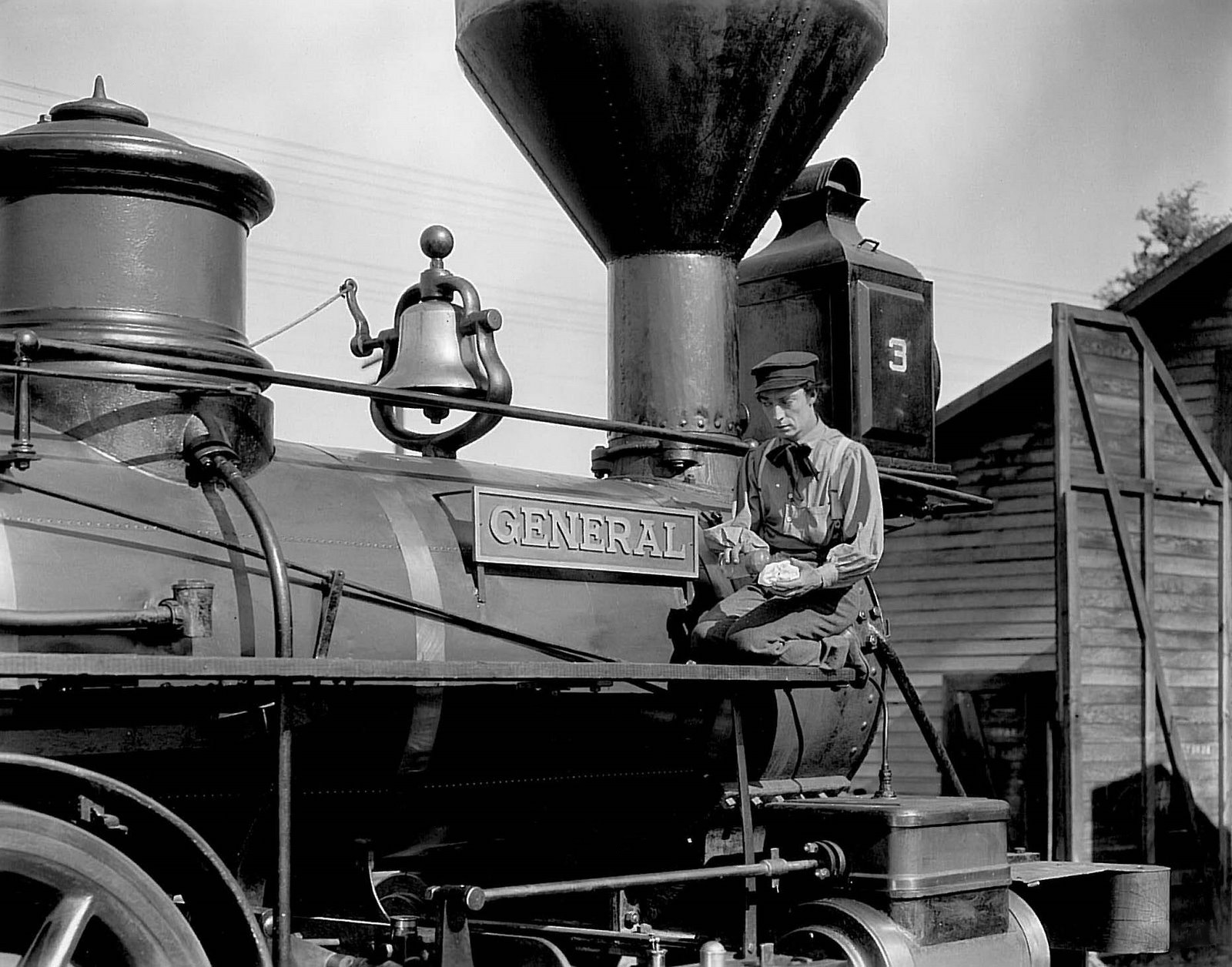
Buster and co-star in 'The General' (1926).

Coming up: I'll be doing live music for a screening of Buster Keaton's 'The General' (1926) at the Coolidge Corner Theatre on Wednesday, April 13. 

It's a special occasion because Slate film critic Dana Stevens, author of a new book on Keaton, will be on hand for a Q & A after the show. It'll be moderated by local film guru Ty Burr.

'Camera Man,' which came out a few months ago, has been rapturously received, and has led to a host of Keaton screenings this year. (I had the privilege of doing an earlier one with Stevens in Newport, R.I. this past February.)

So march on down to the Coolidge Corner to see Keaton's masterpiece on the big screen, and meet the author of a brand new book that puts Keaton's work in the context of his early-20th-century times.

More details in the press release below. 

For now, a few thoughts about volume inspired by yesterday's screening of 'Ben Hur' (1925) at the new Showroom venue of the Colonial Theatre in Keene, N.H.

This is a surprisingly touchy subject, as there's apparently a vast range of perceptions of what's appropriate volume for silent film accompaniment.

Yesterday, I arrived early to set up and work with the house tech to set the sound levels. Each house is different, and the Showroom is a venue I've only played once before, so it's important to take time to set up the audio.

Keeping my keyboard volume output at mid-range, we worked out the levels, checking each of my synth settings to make sure everything was acceptable in the house. I felt it sounded a bit dry, so just a touch of reverb was added to the main orchestral setting I planned to use. Great!

(The reason to keep my synth output at mid-range is because I need that level to make use of the various volume levels the touch-sensitive keyboard is capable of producing. I find I can't do that effectively if the output is below mid-range: level 5 out of 10.)

We also have to account for the fact that in most places with house sound (such as the Showroom), a good amount of sound volume passes over my head (down at front) and so audiences can sometimes receive significantly more volume than I hear.

Okay, fine. Because I work primarily in improv and create the accompaniment live and in the moment, it's my preference to sit at the keyboard for at least a half-hour before a show: warming up, working through material, and just getting into the zone. For me, it's hard to start a film just cold—it's not like pressing a button.

But because people are filing into the theater, during this time I've found it's helpful to temporarily take my volume output down to about 2 out of 10 as a courtesy. That way people can hear each other talking, while I can still do my thing, even though it's not the volume I'll be working with for the film.

The Colonial Theatre's new "Showroom" venue, set up for silent film.

So this is what I was doing yesterday when I noticed it was 10 minutes to showtime, and I hadn't thought to yet use the bathroom. (Very important in advance of a 2½-hour film.) So I switched to some synth-generated pattern music and got up to take care of business.

That's when someone from the theater came up to me with a concerned look on her face. People were complaining, she said, that the music was much too loud and that we needed to take the volume down somewhat.

Really? I've gotta tell you, I like to think I'm easy-going and welcome feedback and would do whatever it takes to accommodate an audience. But right in front of creating live music for a challenging and marathon-length film, this is not the thing to hear. 

(Even worse: a few years ago, someone came down to the keyboard in the middle of a show in progress at the Leavitt Theatre in Ogunquit, Maine and placed a folded-up note on the keyboard, for Pete's sake. Using one hand, I opened it to read "MUSIC TOO LOUD!")

Maybe it's a weakness on my part, but I find this kind of thing really throws me when it comes right before I'm about to commit to an improv accompaniment journey of some length, and which will require some concentration—especially after we've taken time to set levels that everyone agreed were acceptable. 

And it's especially discouraging when I've deliberately been playing at a quiet level as a courtesy, and then to be told it's still too loud

Would people stop a tightrope walker just before he or she steps out on the wire above Niagara Falls to tell them they don't approve of the type of wood being used in the balance pole?

I strive not to be the temperamental artist type, but jeez. This is me, baring my soul in music in hopes of bringing to life a worthy cinematic experience, and I'm being told to keep it down lest it interfere with someone's enjoyment of the film?

Well, why don't I just stop playing altogether? Maybe then everyone will be happy? 

Of course I didn't speak those words. I told the theater woman we'd see what we could do. In introducing the film, I addressed it openly: we'd had some complaints, but here's the situation. This is a BIG film, I said, and at times the music will be BIG as well. 

However, it's still a new venue to me, I said, so I'll do my best to keep things at a level we can all find generally acceptable. But people have to understand: this is not background music. At its best (if I'm doing it effectively) it's a crucial part of the experience.

I think I run into trouble when people new to the experience expect the accompaniment to be background music, or (even worse) something that's optional or just decoration.

Well, no. In silent film, although music generally shouldn't be noticed on its own, it's often a full player in the overall experience. That was true then, and it's still true now. 

So while it shouldn't gratuitously call attention to itself, the music should have a presence. And in some cases, it really should be pretty darned big and bold.

Take 'Ben Hur.' You really can't play quiet stuff during the sea battle scene or the famous chariot race. So if I'm at the keyboard, it's going to be loud, exciting, dramatic, and all that.

In the end, I was able to pull it together yesterday. No one covered their ears or walked out that I'm aware of, anyway. When it was over, we had nice comments and good questions. I made my usual joke about checking with the Diocese of Manchester to confirm that attending a screening of 'Ben Hur' did not count as attending Mass. Thank you and have a good night!

I don't know. Maybe I'm looking at this wrong way. Maybe I should really amp up the volume, and then supplement my income by selling over-priced ear plugs. Or possibly sell stationery so people can write me letters to be delivered in the middle of a performance.

Even if I go ahead with those ideas, they won't be ready in time for Wednesday's screening of 'The General' at the Coolidge Corner. Here's the promised press release with all the details!

*   *   *

Buster Keaton in 'The General.' 

MONDAY, APRIL 4, 2022 / FOR IMMEDIATE RELEASE
Contact Jeff Rapsis • (603) 236-9237 • jeffrapsis@gmail.com

Buster Keaton's 'The General' with live music at Coolidge Corner on Wednesday, April 13

Civil War railroading comedy/adventure film lauded as stone-faced comic moviemaker's masterpiece

Screening includes Q & A with Dana Stevens, author of 'Camera Man,' newly published Keaton book.

BROOKLINE, Mass.— He never smiled on camera, earning him the nickname of "the Great Stone Face." But Buster Keaton's comedies rocked Hollywood's silent era with laughter throughout the 1920s.

See for yourself with a screening of 'The General' (1926), one of Keaton's landmark feature films, on Wednesday, April 13 at 7 p.m. at the Coolidge Corner Theatre, 290 Harvard St., Brookline, Mass.

The screening will feature live music for the movie by silent film accompanist Jeff Rapsis. General admission is $23 per person.

The show is the latest in the Coolidge Corner's acclaimed 'Sounds of Silents' series, which gives audiences the opportunity to experience early cinema as it was intended: on the big screen, with live music, and with an audience.

The screening will be followed by a Q & A with Slate film critic Dana Stevens, author of 'Camera Man,' a newly published book exploring Keaton's work in the context of 20th century history.

Stevens’s book will be for sale after the screening, courtesy of Brookline Booksmith. The Q & A will be moderated by Boston-based critic Ty Burr.

'The General,' set during the U.S. Civil War, tells the story of a southern locomotive engineer (Keaton) whose engine (named 'The General') is hijacked by Northern spies with his girlfriend onboard.

Keaton, commandeering another train, races north in pursuit behind enemy lines. Can he rescue his girl? And can he recapture his locomotive and make it back to warn of a coming Northern attack?

Critics call 'The General' Keaton's masterpiece, praising its authentic period detail, ambitious action and battle sequences, and its overall integration of story, drama, and comedy.

It's also regarded as one of Hollywood's great railroad films, with much of the action occurring on or around moving steam locomotives.

Accompanist Jeff Rapsis will improvise an original musical score for 'The General' live as the film is shown.

"When the score gets made up on the spot, it creates a special energy that's an important part of the silent film experience," said Rapsis, who uses a digital synthesizer to recreate the texture of a full orchestra for the accompaniment.

With Center for the Art's screening of 'The General,' audiences will get a chance to experience silent film as it was meant to be seen—in a high quality print, on a large screen, with live music, and with an audience.

"All those elements are important parts of the silent film experience," Rapsis said. "Recreate those conditions, and the classics of early Hollywood leap back to life in ways that can still move audiences today."

Rapsis performs on a digital keyboard that reproduces the texture of the full orchestra and creates a traditional "movie score" sound.

Keaton, along with Charlie Chaplin and Harold Lloyd, stands today as one of the silent screen's three great clowns. Some critics regard Keaton as the best of all; Roger Ebert wrote in 2002 that "in an extraordinary period from 1920 to 1929, (Keaton) worked without interruption on a series of films that make him, arguably, the greatest actor-director in the history of the movies."

A remarkable pantomime artist, Keaton naturally used his whole body to communicate emotions from sadness to surprise. And in an era with no post-production special effects, Keaton's acrobatic talents enabled him to perform all his own stunts.

Critics review 'The General':

"The most insistently moving picture ever made, its climax is the most stunning visual event ever arranged for a film comedy."
—Walter Kerr, author of 'The Silent Clowns'

"An almost perfect entertainment!"
—Dave Kehr, Chicago Reader

"What makes the film so special is the way the timing, audacity and elegant choreography of its sight gags, acrobatics, pratfalls and dramatic incidents is matched by Buster's directorial artistry, his acute observational skills working alongside the physical élan and sweet subtlety of his own performance."
—Time Out (London)

‘The General’ (1926) starring Buster Keaton will be shown with live music on Wednesday, April 13 at 7 p.m. at the Coolidge Corner Theatre, 290 Harvard St., Brookline, Mass. as part of the theater's 'Sounds of Silents' series. Admission is $23 per person. For more info and to buy tickets, visit www.coolidge.org or call (617) 734-2500. For more about the music, visit www.jeffrapsis.com.

Saturday, February 12, 2022

Tonight: 'Straight is the Way' in Campton, N.H., plus report on 'The General' in Newport, R.I.

Exhibitor trade journal ad promoting 'Straight is the Way' (1921).

Tonight the "Homecoming Tour" of the silent comedy/drama 'Straight is the Way' (1921) continues with a screening in Campton, N.H. for the Campton Historical Society, complete with pot luck supper starting at 5 p.m.

The film, reissued last year via a Kickstarter campaign organized by Ed Lorusso, has the distinction of being the only silent feature film I know of with a story set specifically in New Hampshire.

Hence the "Homecoming Tour" of Granite State screenings, which is up to two so far: the "world re-premiere" of 'Straight is the Way' in the big city (and state capital) of Concord, and now tonight's screening in genuinely small-town New Hampsha'.

And never mind that the movie, set in "Hampton Center, N.H.," was actually filmed in either Long Island or New Jersey. It's still an interesting look at how the nation regarded small-town New Hampshire long before Yankee Magazine started publishing (in 1935) or Thornton Wilder's play 'Our Town.' (in 1938).

Even back then, on the cusp of the Roaring '20s, we were country bumpkins. Citizens consulted their Ouija boards to communicate with long-dead ancestors, and the local constable rode around town in a horse and buggy. Har! 

Well, here we are again, on the cusp of another '20s, although it's hard to say if they'll be "roaring" or anything else. And New Hampshire is still regarded as a slightly backwards place, complete with pot luck suppers and all that.

The press release for the screening, with a lot more info, is pasted in below.

This past Thursday, a journeyed to a new venue for me—the Jane Pickens Theater and Event Center in downtown Newport, R.I, site of a book-signing and film show celebrating the publication of 'Camera Man,' a new Buster Keaton book by Slate critic Dana Stevens. 

I had a ball accompanying 'The General' in this wonderful vintage one-screen theater, which has somehow remained intact and functioning for a century. It's really the perfect venue for silent film with live accompaniment, and I'm pleased to say that response was strong enough to merit possible future screenings. We'll see.

The interior of the Jane Pickens Theatre, a 1920s moviehouse in Newport, R.I. that looks remarkably like the movie theater in Buster Keaton's 'Sherlock Jr.' (1924), columns and all:

It was a pleasure to meet a lot of people: author Dana Stevens, of course, but also Steve Iwanski of Charter Books, which organized the event, and Alex Whitney, the theater's operations manager. Everyone could not have been more helpful, and audience reaction was strong throughout.

Looking ahead: this week I'm in for a rare mid-winter run of five screenings five days in a row. (This usually only happens in the summer, when I'm doing seasonal series in several venues.) It starts on Wednesday, Feb. 16 with Greta Garbo in 'The Temptress' (1926) at the Flying Monkey Moviehouse and Performance Center in Plymouth, N.H. 

Subsequent evenings see screenings in Manchester, N.H.; Arlington, Mass., Brattleboro, Vt.; and Wilton, N.H. It's like I'm in training for the Kansas Silent Film Festival, which happens at the end of this month. 

But for now, bring a dish with you and attend tonight's pot luck supper / screening of 'Straight is the Way' (1921) at the Campton Historical Society in Campton, N.H. Details below!

*    *    *

A vintage sedan sports a N.H. license plate in 'Straight is the Way' (1921).

TUESDAY, FEB. 1, 2022 / FOR IMMEDIATE RELEASE

Contact Jeff Rapsis • (603) 236-9237 • jeffrapsis@gmail.com

Vintage feature film with story set in N.H. to be screened on Saturday, Feb. 12

Rare surviving comedy/drama 'Straight is the Way' (1921) to be shown with live music at Campton Historical Society

CAMPTON, N.H. — It's a film that's not been seen in theaters since its original release more than a century ago. And it's set in fictional 'Hampton Center, N.H.,' a small town where a pair of big-city crooks hide out from the law.

It's 'Straight is the Way,' a Paramount release that proved a modest box office success in the spring of 1921.

The film then completely disappeared—until now.

This month, the Campton Historical Society will host a screening of 'Straight is the Way,' which boasts a screenplay by two-time Academy Award-winning writer Frances Marion.

The event, which is free and open to all, takes place at Campton Town Hall, 529 Route 175, Campton, N.H.

It starts with a pot luck dinner at 5 p.m., with the film program to begin at 6 p.m.

Those attending the pot luck dinner are asked to bring one of the following: soup, bread, salad, main dish, dessert or beverage.

Live music for the silent film program will be provided by silent film accompanist Jeff Rapsis.

The story of 'Straight is the Way' follows two burglars who flee to rural "Hampton Center, N.H." to hide out in the unused wing of a mansion, where an impoverished family faces eviction.

Exposed to small town values, the pair resolve to change their ways.

'Straight is the Way' was promoted with the tagline: "They came to lift the silver, but they stayed to lift the mortgage."

"It should be a fun screening because the filmmakers depict 'Hampton Center' as a small rural Granite State community—rather like Campton today," Rapsis said.

The film, a comedy/drama, features scenes in which a Ouija board is used to contact the spirits of long-dead relatives.

Ouija boards had become popular in the years following World War I, when 'Straight is the Way' was released.

How does a film disappear for 100 years, and then resurface?

Produced by Cosmopolitan Pictures, 'Straight is the Way' was one of dozens of titles on Paramount's 1921 release schedule. After its initial run, the film was never reissued or rereleased.

This was the fate of nearly all motion pictures of the era, most of which were lost to neglect, decay, or accident. Today, about 75 percent of all silent films no longer exist in any form.

But 'Straight is the Way' is among the survivors. A single 35mm print of the film is in the collection of the U.S. Library of Congress. The print was part of a hoard of film material donated long ago by 1920s star Marion Davies, whose pictures were produced by Cosmopolitan.

However, the print is on fragile and flammable nitrate cellulose film stock, meaning it can't be safely projected or loaned out. To keep the film from deteriorating, the print is kept in long-term storage at the Library of Congress media center in Culpeper, Va.

In 2021, Maine-based film archivist Ed Lorusso organized an online Kickstarter program to raise funds to transfer the surviving print of 'Straight is the Way' to digital media. The fundraiser was successful, and the transfer was completed earlier this year.

Lorusso made the film available on DVD to fellow vintage film enthusiasts, including accompanist Rapsis, who felt the film's Granite State setting merited a revival, complete with live music.

The film's "world re-premiere" took place in December 2021 at Red River Theatres in Concord, N.H., which hosted the first theatrical showing of the film since its original run.

"Very few films are set in New Hampshire, then or now," Rapsis said. "What's interesting about 'Straight is the Way' is that it shows how the state was viewed at the time—a place of small towns and old-fashioned ways, including a constable patrolling the town in a horse and buggy."

Although 'Straight is the Way' contains authentic details such as New Hampshire license plates on the few autos that appear, Lorusso has found no evidence that any part of the film was shot in the state.

Instead, 'Straight is the Way' was produced in New York City, where Cosmopolitan Pictures was based, and which continued to host film production even after most movie-making moved to California in the 1910s.

'Straight is the Way' features several location shots of Manhattan scenes such as Washington Square in Greenwich Village as it appeared in 1921.


Another car in 'Straight is the Way'—sporting the same identical license plate as the other vehicle above!) 

Lorusso believes the New Hampshire scenes were most likely filmed in the rural countryside of Long Island or New Jersey, just outside the city, as was common practice at the time.

Lorusso has identified one location: the mansion shown in the film is the summer home of author Ethel Watts Mumford in Sands Point, Long Island. Mumford wrote 'The Manifestations of Henry Ort,' on which 'Straight is the Way' was based.

The screenplay was by Frances Marion, the one recognizable name associated with the production.

Marion, a prolific writer, authored more than 300 screenplays in a career that spanned three decades. Her credits include silent classics such as 'The Wind' (1928); she would later win Academy Awards for writing the prison drama 'The Big House' (1930) and the iconic boxing story 'The Champ' (1931).

'Straight is the Way' features a cast of solid performers, all unknown today: Matt Moore, Mabel Bert, Gladys Leslie, George Parsons, Henry Sedley, Van Dyke Brooke, and Emily Fitzroy.

The film was directed by Robert Vignola; the following year, he would direct Marion Davies in 'When Knighthood Was in Flower' (1922) a big budget costume drama.

Rapsis said the Campton Historical Society screening of 'Straight is the Way' is a rare chance to see the film as it was meant to be experienced—on the big screen, with live music, and with an audience.

'Straight is the Way' (1921), a silent comedy/drama set in New Hampshire, will be screened with live music at Campton Town Hall, 529 Route 175, Campton, on Saturday, Feb. 12 at 6 p.m. 

The screening is free and open to the public, with donations accepted to support the Campton Historical Society.

The program will be preceded by a pot luck supper starting at 5 p.m. Those attending the pot luck dinner are asked to bring one of the following: soup, bread, salad, main dish, dessert or beverage.

For more information, visit www.camptonhistorical.org.

Tuesday, February 8, 2022

Small state, big occasion: Accompanying 'The General' in Rhode Island at Keaton book-signing

Buster leans into his art in 'The General' (1926), to be screened on Thursday, Feb. 10 in Newport, R.I.

I sometimes think that Buster Keaton's feature films have become the Beethoven symphonies of silent cinema. 

Individually, each has its own characteristics and place in Keaton's body of work. Taken as a whole, they form a rich world—one that had a major influence on what followed.

In Beethoven's case, his influence was on concert music, and the overall "romantic" movement in the general sense. (The General! Ha!) With Keaton, it was movies, up to and including Jackie Chan films.

And if all that's true, then 'The General' is probably the equivalent of Beethoven's 5th: the one everyone seems to know about, and which gets played most frequently. 

And so it is that I've been asked to head down to Newport, R.I. to accompany 'The General' as part of a book tour event promoting Camera Man: Buster Keaton, the Dawn of Cinema, and the Invention of the Twentieth Century, a recently published Buster Keaton book by critic Dana Stevens.

The event, organized by Charter Books of Newport and held at the Jane Pickens Theatre, includes an on-stage interview with the author. It's Thursday, Feb. 10 at 7:30 p.m. I encourage you to attend if you're in the area. 

First up will be 'The General,' followed by an on-stage conversation between Stevens and Prof. Matt Ramsey, head of the film department at Salve Regina University. Admission is $12; for $40, you also get a signed copy of the book. The theater is at 49 Touro St. in Newport.  

From what I understand, Stevens' book is a look at Keaton in the context of the rapidly changing world of the early 20th century. It's gotten good reviews, and I'm looking forward to reading it.

The Stevens book is one of two recently published about Keaton. The other, a more traditional biography, is 'Buster Keaton: A Filmmaker's Life' by James Curtis that's due out mid-February. I'm looking forward to this one as well.

For more info, here's a recent New York Times review of both volumes.

Two Buster Keaton books at once! I guess I know what I'll be doing when not watching or accompanying films at the upcoming Kansas Silent Film Festival in Topeka later this month. 

And so if Buster's 'The General' is the equivalent of Beethoven's 5th Symphony, which of Buster's films is the Keaton equivalent of Beethoven's 9th?

Your comments, please.