Showing posts with label When Knighthood Was in Flower. Show all posts

Monday, February 21, 2022

Red River Theatres to screen 'The Flying Ace,' silent 'race' drama for Black History Month

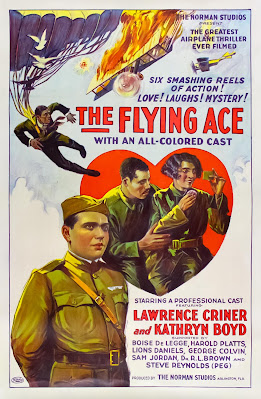
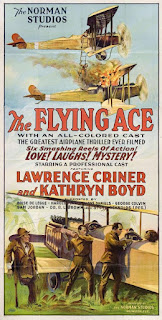
A poster for 'The Flying Ace' (1926), screening with live music at Red River Theatres in Concord, N.H. 

I've just finished a five-shows-in-five-days marathon, and boy are my fingers tired. 

Actually, not really—foe me, silent film accompaniment is more mentally taxing than physically demanding.

So, to borrow a phrase from Monty Python: "Oooh, my brain hurts!"

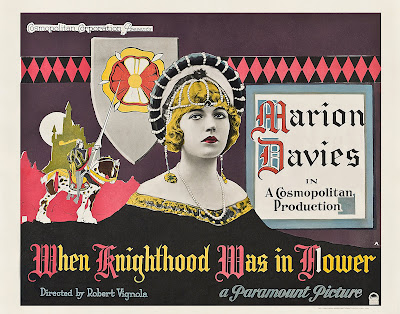
Yesterday's screening of 'When Knighthood Was in Flower' (1922) at the Town Hall Theater in Wilton, N.H. drew raves from the 40 or so people who attended.

Starring Marion Davies, it's quite the movie and holds up well. You can see why it was the year's second-highest grossing picture, exceeded only by Douglas Fairbanks in 'Robin Hood,' another adventure set in Merrie Old England.

'Knighthood' would not have been available at all if not for Ben Model's rescue project a few years ago, which got the film out of the Library of Congress vaults, transferred to digital media, and then restored for enjoyment and exhibition. 

I was delighted to contribute to the Kickstarter effort that made the film's reissue possible. Thanks to Ben and everyone else who worked on this edition. 

So what's next for me?

On Wednesday, I do music for 'The Flying Ace' (1926), a "race" drama being screened at Red River Theatres in Concord, N.H. 

Then it's off to the three-day Kansas Silent Film Festival, where I'll accompany Oscar Micheaux's 'Within Our Gates' (1921) and a passel of short comedies. 

No rest for the wicked. So I must be very wicked indeed.

For now, here's the press release about the Red River screening of 'The Flying Ace,' with a lot more info about the film, which was recently added to the National Film Registry by the Library of Congress.

It's worth seeing, as it's an artifact from a time not that long ago when it was common for movie theaters in some parts of the U.S. to be segregated by race. 

Water fountains, too. 

What were they thinking? 

See you in Concord on Wednesday night, or in Topeka next weekend!

*  *  *
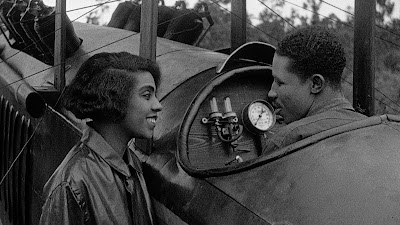
Kathryn Boyd and Laurence Criner in 'The Flying Ace' (1926).

MONDAY, FEB. 14, 2022 / FOR IMMEDIATE RELEASE
Contact Jeff Rapsis • (603) 236-9237 • jeffrapsis@gmail.com

Honoring Black History Month

Red River Theatres to screen rare vintage crime melodrama with all-Black cast

'The Flying Ace' (1926), recently added to U.S. National Film Registry, to be shown with live music on Wednesday, Feb. 23

CONCORD, N.H. — Can discrimination exist in an America where everyone is Black?

That's among the questions posted by 'The Flying Ace' (1926), a rare surviving example of movies produced early in the 20th century for Black audiences in segregated cinemas.

'The Flying Ace,' recently named to the U.S. National Film Registry, will be screened in honor of Black History Month on Wednesday, Feb. 23 at 7 p.m. at Red River Theatres, 11 South Main St., Concord.

General admission is $12 per person, $10 for Red River members.

The screening will feature live music by Jeff Rapsis, a New Hampshire-based silent film accompanist.

'The Flying Ace' was produced by Norman Studios in Jacksonville, Fla., using professionals such as Laurence Criner, a veteran of Harlem’s prestigious all-black theater troupe the Lafayette Players, but also many non-professionals for minor roles.

In 'The Flying Ace,' Criner plays Capt. Billy Stokes, a World War I fighter pilot known as "The Flying Ace" because of his downing of seven enemy aircraft in France.

Returning home to resume his former job as a railroad detective, he's assigned to locate a stationmaster who's gone missing along with the $25,000 company payroll.

While investigating, Stokes begins romancing the stationmaster's daughter Ruth (Kathryn Boyd), causing a rivalry with another suitor which leads to a break in the case.

With Ruth's safety now at risk, Stokes' dogged pursuit of the suspects leads to climax highlighted by a dramatic airborne chase which calls upon his piloting prowess.

Films such as 'The Flying Ace' were shown specifically to African-American audiences in areas of the U.S. where theaters were segregated.
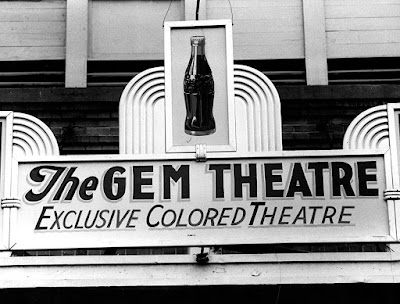
A segregated movie theater in Waco, Texas in 1939.

Norman Studios was among the nation's top film production companies making feature length and short films for this market from the 1920s to the 1940s.

Featuring all-Black casts in stories meant to inspire and uplift, such films were popular with African-American audiences at the time. In Norman Studios films, the stories often took place in a world without the racial barriers that existed at the time.

In 'The Flying Ace,' Capt. Stokes is a pilot returning home from serving honorably in World War I—but Blacks were not allowed to fly aircraft in the U.S. military until 1940.
In an essay for the San Francisco Silent Film Festival, critic Megan Pugh wrote that Capt. Billy Stokes "...is a model for the ideals of racial uplift, fulfilling aspirations that Black Americans were not yet allowed to achieve."

"At a time when Hollywood employed white actors in blackface to play shuffling servants and mammies, the Norman Film Manufacturing Company...hired all-black casts to play dignified roles."

"Instead of tackling discrimination head-on in his films, Norman created a kind of segregated dream world where whites—and consequently, racism—didn’t even exist," Pugh wrote.

"While it’s impossible to measure the influence The Flying Ace had on its viewers, it is reasonable to assume that audiences found its lead character inspirational. Billy Stokes was a black male hero who would have never made it onscreen in a Hollywood movie of the time," Pugh wrote.

Filmed in the Arlington area of Jacksonville, Fla., 'The Flying Ace' is a unique aviation melodrama in that no airplanes actually leave the ground. The mid-air scenes were filmed in a studio in front of neutral backdrops.

Although 'The Flying Ace' may appear crudely made to modern audiences, in 2021 the movie was named to the U.S. National Film Registry by the Library of Congress as being "culturally, historically, or aesthetically significant."

Of films produced for Black-only audiences in segregated theaters, very few survive. 'The Flying Ace' is unusual in that it survives complete, and in pristine condition. The film was included in 'Pioneers of African American Cinema," a DVD collection released in 2016 by Kino-Lorber.

A live musical score for 'The Flying Ace' will be created by accompanist Jeff Rapsis, a New Hampshire-based performer who specializes in music for silent film presentations.

Rapsis said the Red River screening is a rare chance to see the film as it was meant to be experienced—on the big screen, with live music, and with an audience.

'The Flying Ace' (1926), a silent crime melodrama with an all-Black cast, will be shown in honor of Black History Month on Wednesday, Feb. 23 at 7 p.m. at Red River Theatres, 11 South Main St. in Concord.

Tickets are general admission $12; Red River Theatres members $10. For more info and to purchase advance tickets, visit www.redrivertheatres.org or call (603) 224-4600. 


Sunday, February 20, 2022

'When Knighthood Was in Flower' (1922) on Sunday, 2/20 at Town Hall Theatre, Wilton, N.H.

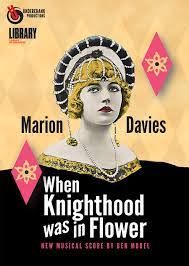
Promotional artwork for 'When Knighthood Was in Flower' (1922).

This afternoon's screening of 'When Knighthood in Flower' is the finale of a five-days-in-a-row series of screenings that saw me doing music for five films in venues across three states.

But what an ending! The Marion Davies costume epic, set during the reign of England's King Henry VIII, was produced on a grand scale. Released in 1922, it was the year's second-highest grossing film.

It's part of our ongoing series at the Town Hall Theatre in Wilton, N.H. celebrating the 100th anniversaries of motion pictures that came out that year. Lots more info in the press release I've pasted in below.

For now, let me report that last night's screening of 'The Last Command' (1928) in Brattleboro, Vt. resulted in some unexpected drama before the film could begin.

In late afternoon, a wall of heavy squalls moved across northern New England, laying down an unexpected coating of snow across the region. 

Brattleboro would normally be a 90-minute drive, so I left around 5 p.m. to arrive in time to set up for the screening, which was scheduled to start at 8 p.m. The snow had cleared out, so I figured that the timing had worked out well.

Well, it hadn't. The main highway (Route 101) across southern N.H. isn't far from my house, and almost immediately traffic on this busy road came to a complete stop. In a weird meteorological phenomenon, somehow the snow had adhered to the pavement, creating a coating of sheer ice that was impossible to drive on.

Seriously! Cars were off the road in both directions, and the rest of us were lined up and moving at a glacial pace, if at all. It took a half hour to just go a couple of miles. 

Stuck in this situation, with no real alternative routes that would be any better, I kept watching my arrival time slip further into the future.

I began pinging Jamie Mohr, who runs the Epsilon Spires venue where I would accompany 'The Last Command,' with updates, wondering if I would ever make it out there. (Jamie said she would get some Chinese food, which gave me confidence.)

My GPS indicated that conditions seemed normal for most of the route ahead, so I held out hope as I crawled along, trying not to slide off into the woods. After awhile, conditions did improve and traffic began to move at a more normal pace. 

Apparently the squalls had seen fit to sock just the area where I lived, as the rest of the ride to Brattleboro was uneventful. But the first five miles had taken 45 minutes, meaning I arrived with just enough time to set up things. 

And the next thing you know, I'm at the organ console, doing music for 'The Last Command,' aided by the digital synthesizer to produce drums and percussion where needed, plus a piano in a couple of key scenes. Oh—and also a brass school bell for when a bell is prominently rung in one scene.

The film, directed by Josef von Sternberg and starring Emil Jannings in an Academy Award-winning performance, drew the usual strong reaction—it's one of the truly great silent dramas, I think, produced when the form was at the peak of its eloquence. 

But this screening brought a new wrinkle: afterwards, people said it was a little unsettling to take in all the Russian military scenes as the present situation unfolds with Russia and Ukraine. I didn't see the parallel, but I could understand how it would be on people's minds.

Well, this afternoon's screening of 'When Knighthood Was in Flower' should provoke no such unease, as King Henry VIII has been off the throne for about 500 years.

I want to point out that the only reason we can show 'Knighthood' is because of the restoration recently released by Ben Model and Undercrank Productions. Ben and his colleagues did a terrific job.

Ben was recently in touch and shared a few notes about the effort that went into reissuing the film, which I had mistakenly called a transfer. I think it's worth including here, and I'll also mention it at this afternoon's screening:

"...the Undercrank edition is a restoration, and not a transfer. Stabilization and clean-up and grading was done on the nitrate scan. 

Also, the tints weren't added to look the way silents did – we reinstated the tinting and hand-coloring to exactly what was seen in theaters in 1922. There are tinting slugs at the heads and tails of several of the reels indicating "light pink", "amber", "light amber" and "blue tone/biscuit" (a combination of tinting and toning). 

We also found a review from Robert E. Sherwood that talks about the hand-coloring of the torches, and ads in the trades for the guy who did the hand-coloring; and so I got Jack Theakston to replicate this digitally, frame-by-frame.

So, you can tell your audience that they're seeing what people saw in the film's original release of the full-length road-show edition (the general release version was about 25 mins shorter). 

And, had Marion Davies not had a print struck of this in the mid-1930s, and then donated all her 35mm nitrate prints to the LoC in the 1950s, we would not be able to see this at all. :)

Who knew...Marion was also a film conservationist!

Thanks so much! Have a great show!

If you'd like more info about the restoration of 'Knighthood,' check out this post from Ben. 

Okay, hope your Sunday plans include a trip back to the splendors of medieval England via 'When Knighthood Was in Flower' starring Marion Davies. The show begins at 2 p.m. More info about the film in the press release below.

*   *   *

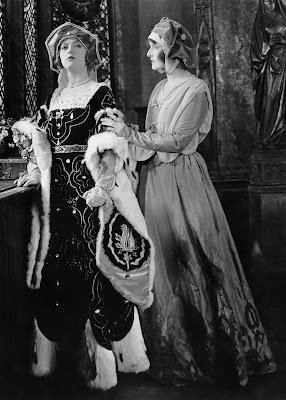
Marion Davies (left) in 'When Knighthood Was in Flower' (1922).

TUESDAY, FEB. 8, 2022 / FOR IMMEDIATE RELEASE
Contact Jeff Rapsis • (603) 236-9237 • jeffrapsis@gmail.com

Marion Davies costume epic 'When Knighthood Was in Flower' to screen at Wilton Town Hall Theatre

Set during the reign of Henry VIII, silent film blockbuster to be shown with live music on Sunday, Feb. 20 to celebrate 100th anniversary of release

WILTON, N.H.—It was a movie that transported audiences back to the reign of England's King Henry VIII, scoring an enormous box office success.

It was 'When Knighthood Was in Flower' (1922), a costume epic starring Marion Davies that became the year's second-highest-grossing film. 

See what all the royal fuss was about when the picture is shown with live music on Sunday, Feb. 20 at 2 p.m. at the Town Hall Theatre, 40 Main St., Wilton, N.H.

Admission is free, with a suggested donation of $10 per person to help support the theater's silent film series.

The classic Tudor-era drama will be shown with live music by silent film accompanist Jeff Rapsis.

In 'When Knighthood Was in Flower,' Marion Davies plays Mary Tudor, younger sister of England's King Henry VIII, who falls in love with a guardsman below her class.

Unfortunately, Mary is already betrothed to the aged King Louis XII of France. Her illicit romance thus touches off a furor with international complications.

Planned from the start as a big budget spectacle, 'When Knighthood Was in Flower' cost $1.8 million to produce, making it among the most expensive movies of the silent era.

The film was directed by Robert G. Vignola and based on a popular 1898 novel by Charles Major. 

A lobby card for 'When Knighthood Was in Flower.'

'When Knighthood Was in Flower' was produced by William Randolph Hearst (through his Cosmopolitan Productions) for Marion Davies and distributed by Paramount Pictures. 

Davies, longtime mistress of publishing magnate Hearst, would go on to become one of the most popular leading ladies of the silent era. 

For 'When Knighthood Was in Flower,' she spent four months learning to fence in order to convincingly perform her own on-screen swordfighting.

Although some exteriors were shot on location at England's Windsor Castle, most of the film was actually made in Connecticut and New York City, where Cosmopolitan was based at the time. 

Ziegfeld Follies designer Joseph Urban planned so many lavish sets, Hearst had to rent space at two other New York studios to complete the film and hire 3,000 extras for the crowd scenes. 
 
For Davies' 15 gowns, Urban's daughter, Gretl Urban Thurlow, duplicated outfits originally worn by Mary Tudor.

The edition of 'When Knighthood Was in Flower' that will be presented is a new digital restoration from Undercrank Productions/Library of Congress.

The screening is part of the Town Hall Theatre's ongoing series honoring the 100th anniversary of significant motion pictures that debuted in 1922.

Programs will include all of 1922's five highest-grossing titles, each shown on the big screen with live music, as well as century-old oddities, short films, cartoons, and more.

"Putting these films back on the big screen is a great way to celebrate the 100th anniversaries of some terrific motion pictures," said Rapsis, the silent film accompanist who will create live music for all screenings.

"These are films that set the standard for Hollywood, and still retain their power to entertain, especially when shown in a theater with live music and an audience," Rapsis said.

Upcoming programs in the Town Hall's 100th anniversary series include:

• Sunday, March 13, 2022 at 2 p.m.: Norma Talmadge in 'Smilin' Through' In honor of St. Patrick's Day, a 1922 romantic drama set in the Emerald Isle.

• Sunday, March 27, 2022 at 2 p.m.: Douglas Fairbanks in 'Robin Hood' Celebrate the 100th anniversary of this blockbuster adaptation. Massive sets, great action, and Doug Fairbanks in the lead made this the top grossing film of 1922!

• Sunday, April 3, 2022 at 2 p.m.: Chaney/Houdini Double Feature. In 'Flesh and Blood' (1922), escaped convict Lon Chaney hides out in Chinatown and plots revenge. In 'The Man From Beyond' (1922) illusionist Harry Houdini plays an Arctic adventurer frozen for 100 years!

• Sunday, April 17, 2022 at 2 p.m.: Emil Jannings in 'Othello' The Bard's immortal tragedy brought to the screen in this early German version. Silent Shakespeare in honor of the author's 458th birthday.

‘When Knighthood Was in Flower' (1922) will be shown live music on Sunday, Feb. 20 at 2 p.m. at the Town Hall Theatre, 40 Main St., Wilton, N.H.

Admission is free, with a suggested donation of $10 per person to help defray expenses. For more info, call (603) 654-3456 or visit www.wiltontownhalltheatre.com.