Showing posts with label The Last Command. Show all posts

Saturday, August 2, 2025

Why you should see Emil Jannings in 'The Last Command' (1928) on Sunday, 8/3 in Natick, Mass.

Original poster art promoting 'The Last Command' (1928).

If a person wants to experience a great example of the story-telling power of silent film, I would point said person to 'The Last Command' (1928).

It has everything: an imaginative story, inventive camera-work, intense drama, and a great cast highlighted by a towering performance by Emil Jannings that helped him win the first-ever Academy Award for Best Actor.

'The Last Command' is not an art film—it was a standard-issue drama on Paramount's 1928 release schedule. 

At the same time, it's an example of silent film technique at its height. As directed by Josef von Sternberg, the movie makes fluent use of the vocabulary of visual story-telling.

What's especially impressive to me is how the film uses its specific dramatic material to explore universal questions such as the nature of power, the value of loyalty, the meaning of patriotism, the role of chance, and many other issues people have grappled with throughout human experience.

In doing so, I think 'The Last Command' transcends mere entertainment and becomes timeless art. It's a great example of how the best silent cinema can stand alongside the best literature, paintings, sculpture, drama, and music. 

You may find this surprising due to silent film's limitations as an art form, such as no dialogue. But I think these limitations are what prompted the best silent filmmakers to produce work that "speaks" to us today.

If can't wait to experience this silent masterwork as intended—on the big screen, with live music, and with an audience—then you're in luck. It's screening on Sunday, Aug. 3 at 4 p.m. at the Center for the Arts in Natick, Mass., with me accompanying.

Press release is below with a lot more info about the film and the screening. Hope to see you there!

*    *    *

Emil Jannings romances Evelyn Brent in 'The Last Command' (1928).

TUESDAY, JULY 1, 2025 / FOR IMMEDIATE RELEASE
Contact Jeff Rapsis • (603) 236-9237 • jeffrapsis@gmail.com

Silent epic 'The Last Command' with live music at Natick Center for Arts on Sunday, Aug. 3

Josef von Sternberg's groundbreaking psychological drama won 'Best Actor' for Emil Jannings at first-ever Academy Awards

NATICK, Mass.—'The Last Command' (1928), a silent film drama that won Emil Jannings 'Best Actor' honors at the first-ever Academy Awards, will be screened with live music on Sunday, Aug. 3 at 4 p.m. at TCAN Center for the Arts, 14 Summer St., Natick, Mass.

The screening, the latest in the Center for the Art's silent film series, will feature live accompaniment by Jeff Rapsis, a New Hampshire-based composer who specializes in creating music for silent films.

Admission is $12 per person for members; $14 for non-members. Tickets are available online at www.natickarts.org or at the door.

'The Last Command,' directed by Josef von Sternberg, tells the sweeping story of a powerful general in Czarist Russia (Jannings) forced to flee his homeland during the Bolshevik Revolution. He emigrates to America, where he is reduced to living in poverty.

Finding work as an extra at a Hollywood studio, the former general lands the part of a commanding officer in a movie about the Revolution, causing flashbacks to his traumatic experiences. The conflict leads to a spectacular climax and a towering performance that earned Jannings 'Best Actor' honors.

The film takes audiences on a journey through big emotions as well as issues of history, time, power, and especially a man's duty to his country and to his fellow citizens—and what happens when the two obligations diverge.

'The Last Command' is also one of early Hollywood's most creative and challenging looks at the global conflicts that contributed to World War I.

The film also stars a young William Powell as a Hollywood movie director who crosses paths with the general during the Revolution, and 1920s starlet Evelyn Brent as a seductive Russian revolutionary.

Rapsis, the accompanist, will create the film's score live as the movie is shown.

"Making up the music on the spot is kind of a high wire act," Rapsis said. "But there's nothing like the energy and excitement that comes with improvised live performance, especially when accompanying a silent film."

Critic Leonard Maltin hailed 'The Last Command' as "a stunning silent drama...a fascinating story laced with keen observations of life and work in Hollywood." Time Out of London called it "the first Sternberg masterpiece, expertly poised between satire and 'absurd' melodrama. The cast are fully equal to it; Jannings, in particular, turns the characteristic role of the general into an indelible portrait of arrogance, fervor and dementia."

Director Sternberg, a master of lighting and black-and-white photography, created 'The Last Command' as a visual tour de force. The film is often cited as a prime example of the emotional range and visual accomplishment of silent films at their height, just prior to the coming of pictures with recorded soundtracks.

Rapsis said great silent film dramas such as 'The Last Command' told stories that concentrate on the "big" emotions such as Love, Despair, Anger, and Joy. Because of this, audiences continue to respond to them in the 21st century, especially if they're presented as intended—in a theater on the big screen, with a live audience and live music.

"Dramas such as 'The Last Command' were created to be consumed as a communal experience," Rapsis said. "With an audience and live music, they come to life as their creators intended them to. This screening at TCAN is a great chance to experience films that first caused people to fall in love with the movies."

'The Last Command' (1928) will be screened with live music on Sunday, Aug. 3 at 4 p.m. at TCAN Center for the Arts, 14 Summer St., Natick, Mass.

Admission is $12 per person for members; $14 for non-members. Tickets available online at www.natickarts.org or at the door. For more info, call (508) 647-0097. 

Monday, March 11, 2024

On Friday, 3/15: at the Cleveland Cinematheque to do music for 'The Last Command' (1928)

Original promotional art for Emil Jannings in 'The Last Command' (1928).

Just a few notes prior to heading out to Cleveland to do music this Friday for 'The Last Command' (1928), one of the greatest silents (in my opinion) and which, surprisingly, they've never run at the Cinematheque.

I say surprisingly because the guy who's managed the Cinematheque for nearly 40 years, John Ewing, has an encyclopedic knowledgeable about cinema and often includes silent film programs in the venue's schedule.

Somehow, director Josef von Sternberg's most powerful silent, featuring a towering performance by Emil Jannings that helped him win the very first Academy Award for Best Actor, never made it to the Cinematheque's screen.

Well, that omission will be rectified on Friday, March 15—and just in time, too, as John is retiring this spring after almost four decades of service to Cleveland-area cinephiles. 

It's been my pleasure to accompany Cinematheque programs over the years. And I appreciate the opportunity to head out for one last show during John's storied tenure.

Storied? Indeed—his impending retirement made headline news all over Ohio: here, and here, and here.

Happy trails, John! But not until I head out to Cleveland for one last round-up, which starts at 7 p.m. on Friday, March 15, and which includes not only 'The Last Command' but also a French film I've never heard of before: 'Menilmontant' (1926) from director Dimitri Kirsanoff.

Although it's my last screening under John's watch, it won't be my last visit to Cleveland as an accompanist. I'm already booked to do music on Saturday, Jan. 18, 2025 for 'The Lost World' (1925) at the 50th annual 36-hour sci-fi marathon at Case Western Reserve University, which is just a few blocks down Euclid Ave. from the Cinematheque. 

Okay, see you in Cleveland. But before I leave, a quick glance back at recent screenings, which included a seasonally and locationally appropriate showing of 'Way Down East' (1920) on Wednesday, March 6 at the Flying Monkey Moviehouse in Plymouth, N.H.

I saw "seasonally" because the film's climax takes place in New England at this time of year. And "locationally" because the Flying Monkey is not that far from the part of the Connecticut River Valley where the many of the film's exteriors were shot, including the sequence with Lillian Gish adrift on the ice floes.

We showed the 1931 re-release version of the film, which is about 40 minutes shorter than director D.W. Griffith's original cut. People seemed to enjoy it, and cheered when Gish was rescued by Richard Barthelmess just as she was about to go over the falls. 

But somehow, to me it lacked the full-length version's monumental quality. The climax seemed to come too fast. Once again, I'm reminded that Griffith really knew what he was doing.

In other news, a screening of the silent version of 'Peter Pan' (1924) in my hometown on Sunday, March 10 brought familiar faces to the Bedford (N.H.) Public Library. One woman asked me about a weekly column that I used to write for the local paper—which I stopped writing nearly 20 years ago now!

Pre-show remarks at the Blazing Star Grange Hall in Danbury, N.H.

But the real highlight of the past week was my now-annual appearance at the Blazing Star Grange Hall in Danbury, N.H., where a capacity crowd enjoyed Buster Keaton and Ernest Torrence in 'Steamboat Bill, Jr.' (1928).

New Hampshire towns are full of former Grange Hall buildings that no longer house Grange chapters. But not Danbury, where the local Grange still maintains its own hall, which I think looks very much like it might have 100 years ago.

Although the programming includes a silent film program each year at about mud season, that doesn't mean new ideas aren't welcome. In that vein, last Saturday night saw the debut of a new "soup and bread supper" option to go along with movie night.

I was busy setting up, and I'd already eaten, so I didn't get downstairs until most of the soup was gone. Here's the impressive line-up:

This one seemed especially ambitious. Or maybe it was just the high tech crockpot used to serve it.

 And if the soup didn't fill you up, a makeshift concessions counter upstairs was ready for movie-goers.

The paper bags contain popcorn, freshly popped. Alas, Grange members sold only a handful of bags—maybe because everyone was full of soup!

And it was a conversation after the screening that gave me confidence that this was one Grange chapter that hadn't lost touch with its agricultural base.

What would happen to the uneaten and unsold popcorn? "The pigs would love it!"

Tuesday, January 2, 2024

Coming up next: 'The Last Command' on Sunday, Jan. 21 at Town Hall Theatre in Wilton, N.H.

Evelyn Brent and Emil Jannings in 'The Last Command' (1928).

When asked which silent film is my favorite, I'm sometimes tempted to say 'The Last Command' (1928). For sheer story-telling audacity, there's nothing quite like it. 

Plus it's really something to see Emil Jannings go berzerk at the end of this movie. No surprise that he took home the first-ever 'Best Actor' Academy Award that year.

So I'm pleased to say that up next is 'The Last Command' (1928), which I'll be accompanying on Sunday, Jan. 21 at 2 p.m. at the Town Hall Theatre in Wilton, N.H. 

More details are in the press release below. For now, here's a report from the New Year's Day screening of Chaplin's 'The Gold Rush' (1925) that I accompanied at the Garden Cinemas in Greenfield, Mass.

You never know what kind of promotion will be in place for silent film screenings in Greenfield. Here, a sidewalk blackboard is of interest to a passing canine. Too bad it wasn't a Rin Tin Tin film!

We've been doing silent films in Greenfield for a couple of years now—enough to build up an audience to the point where we get 50 to 60 people for each screening. 

I wasn't sure if the pattern would hold for a screening on New Year's Day, but it did. What's more, they were not shy about reacting. Right from the start, at Chaplin's first entrance, the laughs came easily. 

One really cool thing is that after years of fumbling around, I stumbled on a way to effectively accompany the climactic "hanging cabin" sequence. 

To my way of thinking, the music should help support suspense and comedy at the same time, similar to what's called for when Harold Lloyd is climbing around the upper floors of that building in 'Safety Last.' What kind of music can communicate these contradictory moods?

Greenfield Garden Cinemas owner Isaac Mass welcomes audience members to our screening of 'The Gold Rush' (1925).

Last night, it occurred to me: the well-known "Morning Mood" melody from Grieg's Peer Gynt incidental music. As familiar and hackneyed as it is, it really does fit the scene when Chaplin and then Mack Swain awaken.

It could be that although we are aware of their predicament, they aren't. And so the music carries a double layer of meaning: a normal morning to them,anything but normal to us. The music is instantly ironic commentary.

But then, as Chaplin and Swain gradually discover the peril they're in, the "Morning Mood" melody can be transformed in various ways to continue heightening the tension. Sometimes faster, sometimes slower, sometimes in the minor key or other mode, sometimes with off notes in the harmony or punctuated with dissonant chords or ominous pedal tones.

And then there's always our good friend silence to really rivet an audience's attention. After which Grieg's melody can reassert itself in even creepier fashion.

All these elements combined to create a really satisfying accompaniment. I felt it augmented how Chaplin presented the sequence. Audience response to this sequence was the strongest that I can recall—for the first time in my experience, the film elicited shrieks and gasps among the laughs.

And the payoff: a hearty cheer (spoiler alert!) when Chaplin leaps from the cabin and lands on solid ground. Yes!

If you'd like to experience this for yourself, I'll be doing 'The Gold Rush' again on Saturday, Feb. 3 at the Campton (N.H.) Historical Society. For more info, check the listings under the 'Upcoming Silent Film Screenings' link on the upper right corner of this page.

The screening, by the way, is part of a pot luck supper—ironic for a film in which so much of the comedy stems from starvation. 

But for now, here's all you'll need to catch 'The Last Command' (1928) on Sunday, Jan. 21 in Wilton. See you there!

*  *  *  

Poster featuring Emil Jannings in 'The Last Command' (1928).
 
TUESDAY, JAN. 2, 2024 / FOR IMMEDIATE RELEASE
Contact Jeff Rapsis • (603) 236-9237 • jeffrapsis@gmail.com

Silent epic 'The Last Command' with live music at Town Hall Theatre on Sunday, Jan. 21

Josef von Sternberg's groundbreaking psychological drama won 'Best Actor' for Emil Jannings at first-ever Academy Awards

WILTON, N.H.—'The Last Command' (1928), a silent film drama that won Emil Jannings 'Best Actor' honors at the first-ever Academy Awards, will be screened with live music on Sunday, Jan. 21, 2024 at 2 p.m. at the Town Hall Theatre, 40 Main St., Wilton, N.H.

Admission is free; donations are accepted, with $10 per person suggested to defray expenses.

The screening, the latest in the venue's silent film series, will feature live accompaniment by Jeff Rapsis, a New Hampshire-based composer who specializes in creating music for silent films.

'The Last Command,' directed by Josef von Sternberg, tells the sweeping story of a powerful general in Czarist Russia (Jannings) forced to flee his homeland during the Bolshevik Revolution. He emigrates to America, where he is reduced to living in poverty.

Finding work as an extra at a Hollywood studio, the former general lands the part of a commanding officer in a movie about the Revolution, causing flashbacks to his traumatic experiences. The conflict leads to a spectacular climax and a towering performance that earned Jannings 'Best Actor' honors.

Emil Jannings in 'The Last Command' (1928).

The film takes audiences on a journey through big emotions as well as issues of history, time, power, and especially a man's duty to his country and to his fellow citizens—and what happens when the two obligations diverge.

'The Last Command' is also one of early Hollywood's most creative and challenging looks at the global conflicts that contributed to World War I.

The film also stars a young William Powell as a Hollywood movie director who crosses paths with the general during the Revolution, and 1920s starlet Evelyn Brent as a seductive Russian revolutionary.

Rapsis, the accompanist, will create the film's score live as the movie is shown.

"Making up the music on the spot is kind of a high wire act," Rapsis said. "But there's nothing like the energy and excitement that comes with improvised live performance, especially when accompanying a silent film."

Critic Leonard Maltin hailed 'The Last Command' as "a stunning silent drama...a fascinating story laced with keen observations of life and work in Hollywood." Time Out of London called it "the first Sternberg masterpiece, expertly poised between satire and 'absurd' melodrama. The cast are fully equal to it; Jannings, in particular, turns the characteristic role of the general into an indelible portrait of arrogance, fervor and dementia."

Director Sternberg, a master of lighting and black-and-white photography, created 'The Last Command' as a visual tour de force. The film is often cited as a prime example of the emotional range and visual accomplishment of silent films at their height, just prior to the coming of pictures with recorded soundtracks.

Rapsis said great silent film dramas such as 'The Last Command' told stories that concentrate on the "big" emotions such as Love, Despair, Anger, and Joy. Because of this, audiences continue to respond to them in the 21st century, especially if they're presented as intended—in a theater on the big screen, with a live audience and live music.

"Dramas such as 'The Last Command' were created to be consumed as a communal experience," Rapsis said. "With an audience and live music, they come to life as their creators intended them to. This screening at the Town Hall Theatre is a great chance to experience films that first caused people to fall in love with the movies."

'The Last Command' (1928) will be screened with live music on Sunday, Jan. 21, 2024 at 2 p.m. at the Town Hall Theatre, 40 Main St., Wilton, N.H.

Admission is free; donations are accepted, with $10 per person suggested to defray expenses. For more information, call the theater at (603) 654-3456.

Sunday, February 20, 2022

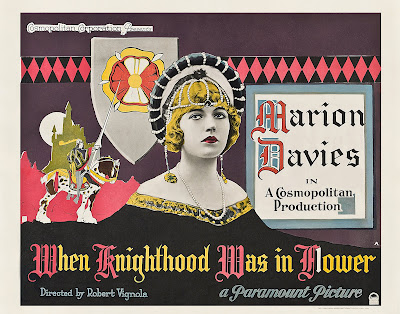
'When Knighthood Was in Flower' (1922) on Sunday, 2/20 at Town Hall Theatre, Wilton, N.H.

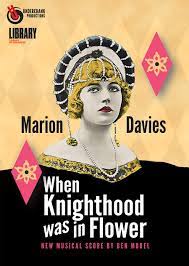
Promotional artwork for 'When Knighthood Was in Flower' (1922).

This afternoon's screening of 'When Knighthood in Flower' is the finale of a five-days-in-a-row series of screenings that saw me doing music for five films in venues across three states.

But what an ending! The Marion Davies costume epic, set during the reign of England's King Henry VIII, was produced on a grand scale. Released in 1922, it was the year's second-highest grossing film.

It's part of our ongoing series at the Town Hall Theatre in Wilton, N.H. celebrating the 100th anniversaries of motion pictures that came out that year. Lots more info in the press release I've pasted in below.

For now, let me report that last night's screening of 'The Last Command' (1928) in Brattleboro, Vt. resulted in some unexpected drama before the film could begin.

In late afternoon, a wall of heavy squalls moved across northern New England, laying down an unexpected coating of snow across the region. 

Brattleboro would normally be a 90-minute drive, so I left around 5 p.m. to arrive in time to set up for the screening, which was scheduled to start at 8 p.m. The snow had cleared out, so I figured that the timing had worked out well.

Well, it hadn't. The main highway (Route 101) across southern N.H. isn't far from my house, and almost immediately traffic on this busy road came to a complete stop. In a weird meteorological phenomenon, somehow the snow had adhered to the pavement, creating a coating of sheer ice that was impossible to drive on.

Seriously! Cars were off the road in both directions, and the rest of us were lined up and moving at a glacial pace, if at all. It took a half hour to just go a couple of miles. 

Stuck in this situation, with no real alternative routes that would be any better, I kept watching my arrival time slip further into the future.

I began pinging Jamie Mohr, who runs the Epsilon Spires venue where I would accompany 'The Last Command,' with updates, wondering if I would ever make it out there. (Jamie said she would get some Chinese food, which gave me confidence.)

My GPS indicated that conditions seemed normal for most of the route ahead, so I held out hope as I crawled along, trying not to slide off into the woods. After awhile, conditions did improve and traffic began to move at a more normal pace. 

Apparently the squalls had seen fit to sock just the area where I lived, as the rest of the ride to Brattleboro was uneventful. But the first five miles had taken 45 minutes, meaning I arrived with just enough time to set up things. 

And the next thing you know, I'm at the organ console, doing music for 'The Last Command,' aided by the digital synthesizer to produce drums and percussion where needed, plus a piano in a couple of key scenes. Oh—and also a brass school bell for when a bell is prominently rung in one scene.

The film, directed by Josef von Sternberg and starring Emil Jannings in an Academy Award-winning performance, drew the usual strong reaction—it's one of the truly great silent dramas, I think, produced when the form was at the peak of its eloquence. 

But this screening brought a new wrinkle: afterwards, people said it was a little unsettling to take in all the Russian military scenes as the present situation unfolds with Russia and Ukraine. I didn't see the parallel, but I could understand how it would be on people's minds.

Well, this afternoon's screening of 'When Knighthood Was in Flower' should provoke no such unease, as King Henry VIII has been off the throne for about 500 years.

I want to point out that the only reason we can show 'Knighthood' is because of the restoration recently released by Ben Model and Undercrank Productions. Ben and his colleagues did a terrific job.

Ben was recently in touch and shared a few notes about the effort that went into reissuing the film, which I had mistakenly called a transfer. I think it's worth including here, and I'll also mention it at this afternoon's screening:

"...the Undercrank edition is a restoration, and not a transfer. Stabilization and clean-up and grading was done on the nitrate scan. 

Also, the tints weren't added to look the way silents did – we reinstated the tinting and hand-coloring to exactly what was seen in theaters in 1922. There are tinting slugs at the heads and tails of several of the reels indicating "light pink", "amber", "light amber" and "blue tone/biscuit" (a combination of tinting and toning). 

We also found a review from Robert E. Sherwood that talks about the hand-coloring of the torches, and ads in the trades for the guy who did the hand-coloring; and so I got Jack Theakston to replicate this digitally, frame-by-frame.

So, you can tell your audience that they're seeing what people saw in the film's original release of the full-length road-show edition (the general release version was about 25 mins shorter). 

And, had Marion Davies not had a print struck of this in the mid-1930s, and then donated all her 35mm nitrate prints to the LoC in the 1950s, we would not be able to see this at all. :)

Who knew...Marion was also a film conservationist!

Thanks so much! Have a great show!

If you'd like more info about the restoration of 'Knighthood,' check out this post from Ben. 

Okay, hope your Sunday plans include a trip back to the splendors of medieval England via 'When Knighthood Was in Flower' starring Marion Davies. The show begins at 2 p.m. More info about the film in the press release below.

*   *   *

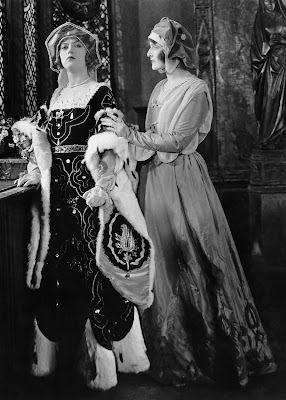
Marion Davies (left) in 'When Knighthood Was in Flower' (1922).

TUESDAY, FEB. 8, 2022 / FOR IMMEDIATE RELEASE
Contact Jeff Rapsis • (603) 236-9237 • jeffrapsis@gmail.com

Marion Davies costume epic 'When Knighthood Was in Flower' to screen at Wilton Town Hall Theatre

Set during the reign of Henry VIII, silent film blockbuster to be shown with live music on Sunday, Feb. 20 to celebrate 100th anniversary of release

WILTON, N.H.—It was a movie that transported audiences back to the reign of England's King Henry VIII, scoring an enormous box office success.

It was 'When Knighthood Was in Flower' (1922), a costume epic starring Marion Davies that became the year's second-highest-grossing film. 

See what all the royal fuss was about when the picture is shown with live music on Sunday, Feb. 20 at 2 p.m. at the Town Hall Theatre, 40 Main St., Wilton, N.H.

Admission is free, with a suggested donation of $10 per person to help support the theater's silent film series.

The classic Tudor-era drama will be shown with live music by silent film accompanist Jeff Rapsis.

In 'When Knighthood Was in Flower,' Marion Davies plays Mary Tudor, younger sister of England's King Henry VIII, who falls in love with a guardsman below her class.

Unfortunately, Mary is already betrothed to the aged King Louis XII of France. Her illicit romance thus touches off a furor with international complications.

Planned from the start as a big budget spectacle, 'When Knighthood Was in Flower' cost $1.8 million to produce, making it among the most expensive movies of the silent era.

The film was directed by Robert G. Vignola and based on a popular 1898 novel by Charles Major. 

A lobby card for 'When Knighthood Was in Flower.'

'When Knighthood Was in Flower' was produced by William Randolph Hearst (through his Cosmopolitan Productions) for Marion Davies and distributed by Paramount Pictures. 

Davies, longtime mistress of publishing magnate Hearst, would go on to become one of the most popular leading ladies of the silent era. 

For 'When Knighthood Was in Flower,' she spent four months learning to fence in order to convincingly perform her own on-screen swordfighting.

Although some exteriors were shot on location at England's Windsor Castle, most of the film was actually made in Connecticut and New York City, where Cosmopolitan was based at the time. 

Ziegfeld Follies designer Joseph Urban planned so many lavish sets, Hearst had to rent space at two other New York studios to complete the film and hire 3,000 extras for the crowd scenes. 
 
For Davies' 15 gowns, Urban's daughter, Gretl Urban Thurlow, duplicated outfits originally worn by Mary Tudor.

The edition of 'When Knighthood Was in Flower' that will be presented is a new digital restoration from Undercrank Productions/Library of Congress.

The screening is part of the Town Hall Theatre's ongoing series honoring the 100th anniversary of significant motion pictures that debuted in 1922.

Programs will include all of 1922's five highest-grossing titles, each shown on the big screen with live music, as well as century-old oddities, short films, cartoons, and more.

"Putting these films back on the big screen is a great way to celebrate the 100th anniversaries of some terrific motion pictures," said Rapsis, the silent film accompanist who will create live music for all screenings.

"These are films that set the standard for Hollywood, and still retain their power to entertain, especially when shown in a theater with live music and an audience," Rapsis said.

Upcoming programs in the Town Hall's 100th anniversary series include:

• Sunday, March 13, 2022 at 2 p.m.: Norma Talmadge in 'Smilin' Through' In honor of St. Patrick's Day, a 1922 romantic drama set in the Emerald Isle.

• Sunday, March 27, 2022 at 2 p.m.: Douglas Fairbanks in 'Robin Hood' Celebrate the 100th anniversary of this blockbuster adaptation. Massive sets, great action, and Doug Fairbanks in the lead made this the top grossing film of 1922!

• Sunday, April 3, 2022 at 2 p.m.: Chaney/Houdini Double Feature. In 'Flesh and Blood' (1922), escaped convict Lon Chaney hides out in Chinatown and plots revenge. In 'The Man From Beyond' (1922) illusionist Harry Houdini plays an Arctic adventurer frozen for 100 years!

• Sunday, April 17, 2022 at 2 p.m.: Emil Jannings in 'Othello' The Bard's immortal tragedy brought to the screen in this early German version. Silent Shakespeare in honor of the author's 458th birthday.

‘When Knighthood Was in Flower' (1922) will be shown live music on Sunday, Feb. 20 at 2 p.m. at the Town Hall Theatre, 40 Main St., Wilton, N.H.

Admission is free, with a suggested donation of $10 per person to help defray expenses. For more info, call (603) 654-3456 or visit www.wiltontownhalltheatre.com.

Saturday, February 19, 2022

Tonight: Emil Jannings in 'The Last Command' at Epsilon Spires in Brattleboro, Vt., w/pipe organ

Original promotional art for Josef von Sternberg's 'The Last Command' (1928).

Quick post in advance of heading out to Brattleboro, Vt., where tonight I'll accompany the great Josef Sternberg drama 'The Last Command' (1928).

Come join us! The show starts at 8 p.m. at Epsilon Spires performance space, with music on the venue's Estey pipe organ augmented by digital synthesizer. 

It's worth attending, as the performance of Emil Jannings is one for the ages. Playing a deposed Czarist general forced to act out his personal drama on a Hollywood set, it's really something to see him go completely berzerk.

See for yourself. More info in the press release below.

For now, let me thank Leland Stein and the staff at the Regent Theater in Arlington, Mass. for their willingness to screen 'The Flying Ace' (1926) in observance of Black History Month.

Last night's show attracted a small audience, which surprised me. 'The Flying Ace' was recently added to the National Film Registry by the Library of Congress. As a rare surviving "race drama" intended for segregated movie theaters, you'd think it would be of more interest. After all these years, I think it has a lot to say to us

Well—I'll accompany it again on Wednesday, Feb. 23 up at Red River Theatres in Concord, N.H. But right now I have to hit the road to make it through snow squalls over the river (the Connecticut River) and through the woods to Brattleboro and 'The Last Command.' 

See you there tonight!

*   *   *

Evelyn Brent and Emil Jannings in 'The Last Command' (1928).
 
MONDAY, FEB. 7, 2022 / FOR IMMEDIATE RELEASE
Contact Jeff Rapsis • (603) 236-9237 • jeffrapsis@gmail.com

Silent epic 'The Last Command' with live pipe organ score at Epsilon Spires on Saturday, Feb. 19

Josef von Sternberg's groundbreaking psychological drama won 'Best Actor' for Emil Jannings at first-ever Academy Awards

BRATTLEBORO, Vt.—'The Last Command' (1928), a silent film drama that won Emil Jannings 'Best Actor' honors at the first-ever Academy Awards, will be screened with live music on Saturday, Feb. 19 at 8 p.m. at Epsilon Spires, 190 Main St., Brattleboro, Vt.

Admission is $15 per person. Tickets may be purchased in advance at www.epsilonspires.org or at the door.

The screening will feature live accompaniment on the venue's Estey pipe organ by Jeff Rapsis, a New Hampshire-based silent film musician.

'The Last Command,' directed by Josef von Sternberg, tells the sweeping story of a powerful general in Czarist Russia (Jannings) forced to flee his homeland during the Bolshevik Revolution. He emigrates to America, where he is reduced to living in poverty.

Finding work as an extra at a Hollywood studio, the former general lands the part of a commanding officer in a movie about the Revolution, causing flashbacks to his traumatic experiences. The conflict leads to a spectacular climax and a towering performance that earned Jannings 'Best Actor' honors.

The film takes audiences on a journey through big emotions as well as issues of history, time, power, and especially a man's duty to his country and to his fellow citizens—and what happens when the two obligations diverge.

'The Last Command' is also one of early Hollywood's most creative and challenging looks at the global conflicts that contributed to World War I.

The film also stars a young William Powell as a Hollywood movie director who crosses paths with the general during the Revolution, and 1920s starlet Evelyn Brent as a seductive Russian revolutionary.

Rapsis, the accompanist, will create the film's score live as the movie is shown by improvising on the venue's historic Estey pipe organ, built in Brattleboro and installed in 1906.

"Making up the music on the spot is kind of a high wire act," Rapsis said. "But there's nothing like the energy and excitement that comes with improvised live performance, especially when accompanying a silent film."

Critic Leonard Maltin hailed 'The Last Command' as "a stunning silent drama...a fascinating story laced with keen observations of life and work in Hollywood." Time Out of London called it "the first Sternberg masterpiece, expertly poised between satire and 'absurd' melodrama. The cast are fully equal to it; Jannings, in particular, turns the characteristic role of the general into an indelible portrait of arrogance, fervor and dementia."

Director Sternberg, a master of lighting and black-and-white photography, created 'The Last Command' as a visual tour de force. The film is often cited as a prime example of the emotional range and visual accomplishment of silent films at their height, just prior to the coming of pictures with recorded soundtracks.

Rapsis said great silent film dramas such as 'The Last Command' told stories that concentrate on the "big" emotions such as Love, Despair, Anger, and Joy. Because of this, audiences continue to respond to them in the 21st century, especially if they're presented as intended—in a theater on the big screen, with a live audience and live music.

"Dramas such as 'The Last Command' were created to be consumed as a communal experience," Rapsis said. "With an audience and live music, they come to life as their creators intended them to. This screening at Epsilon Spires is a great chance to experience films that first caused people to fall in love with the movies."

The non-profit Epsilon Spires, housed in Brattleboro's former Baptist church, builds connections between art and science by offering provocative performances and events, interactive art installations, and opportunities to engage in civil discourse by addressing current topics through the integration of diverse forms of expression. 

'The Last Command' (1928) will be screened with live music on Saturday, Feb. 19 at 8 p.m. at Epsilon Spires, 190 Main St., Brattleboro, Vt. Admission is $15 per person. Tickets may be purchased in advance at www.epsilonspires.org or at the door.


Monday, June 24, 2019

Thursday, June 27: 'The Last Command'; film won Emil Jannings first-ever 'Best Actor'

Emil Jannings dominates a poster for 'The Last Command' (1928).

June may no longer be busting, but it sure is just about all over.

And what a month! Too much going on these days to find time to keep up with posting basic info about silent film screenings.

But then again, I've started a more methodical approach in sending out press materials, and it seems to be paying off.

Example: getting press materials out well ahead, and resending them at the beginning of each week, resulted in full-page play in some of the local newspapers promoting a screening of 'Metropolis' last Sunday afternoon.

And that paid off with perhaps the biggest turn-out ever for the monthly silent film series at the Town Hall Theater in Wilton, N.H. We had well over 100 people!

But it's time to get the blog back in action, starting with info about this weekend's screenings, which take me from a seaside Maine vacation resort out to the San Francisco Bay area and then back to gritty urban Somerville, Mass.

I feel like a boomerang!

First up: Emil Jannings in 'The Last Command' (1928) on Thursday, June 27 at 7 p.m. at the historic Leavitt Theater in Ogunquit, Maine. (More details below in the press release.)

Then it's out to San Francisco to accompany Chaplin's 'Shoulder Arms' (1918) on Friday, June 28 at 7:30 p.m. It's all part of this year's "Charlie Chaplin Days" celebration at the Niles Essenay Silent Film Museum in Niles, Calif.

How strange to play a full program in Maine on Thursday night, and then another out in northern California. What an age we live in!

And then, it's BACK TO BOSTON, just like Buster Keaton as Willie Canfield, Jr., in 'Steamboat Bill Jr.,' although for me it's to accompany not Buster but Harold Lloyd. Thus: on Sunday, June 30 at 7:30 p.m., it's 'Safety Last' (1923) at the Aeronaut Brewing Co. in Somerville, Mass.

More on that later this week.

For now, here's the press release all about 'The Last Command' (1928), which helped Emil Jannings win the first-ever Best Actor award. Hope to see you Thursday night in Maine!

* * *

The lovely Evelyn Brent is romanced by the lovely-on-the-inside Emil Jannings.

TUESDAY, JUNE 18, 2019 / FOR IMMEDIATE RELEASE
Contact Jeff Rapsis • (603) 236-9237 • jeffrapsis@gmail.com

Silent epic 'The Last Command' with live music at Leavitt Theatre on Thursday, June 27


Russian Revolution picture from 1928 won 'Best Actor' for Emil Jannings at first-ever Academy Awards

OGUNQUIT, Maine—'The Last Command' (1928), a silent film drama that won Emil Jannings 'Best Actor' honors at the first-ever Academy Awards, will be screened with live music on Thursday, June 27 at 7 p.m. at the historic Leavitt Fine Arts Theatre, 259 Main St., Route 1 in Ogunquit, Maine.

Admission is $10 per person. The Leavitt's in-theatre lounge will be open for drinks and dining at 6 p.m., and will remain open after the movie.

The screening will feature live accompaniment by Jeff Rapsis, a New Hampshire-based silent film musician.

'The Last Command,' directed by Josef von Sternberg, tells the sweeping story of a powerful general in Czarist Russia (Jannings) forced to flee his homeland during the Bolshevik Revolution. He emigrates to America, where he is reduced to living in poverty.

Finding work as an extra at a Hollywood studio, the former general lands the part of a commanding officer in a movie about the Revolution, causing flashbacks to his traumatic experiences. The conflict leads to a spectacular climax and a towering performance that earned Jannings 'Best Actor' honors.

The film takes audiences on a journey through big emotions as well as issues of history, time, power, and especially a man's duty to his country and to his fellow citizens—and what happens when the two obligations diverge.

'The Last Command' is also one of early Hollywood's most creative and challenging looks at the global conflicts that contributed to World War I.

The film also stars a young William Powell as a Hollywood movie director who crosses paths with the general during the Revolution, and 1920s starlet Evelyn Brent as a seductive Russian revolutionary.

Rapsis, the accompanist, will create the film's score live as the movie is shown by improvising music based on original melodies created beforehand.

"Making up the music on the spot is kind of a high wire act," Rapsis said. "But there's nothing like the energy and excitement that comes with improvised live performance, especially when accompanying a silent film."

Rapsis accompanies films using a digital synthesizer to recreate the texture of a full orchestra.

Critic Leonard Maltin hailed 'The Last Command' as "a stunning silent drama...a fascinating story laced with keen observations of life and work in Hollywood." Time Out of London called it "the first Sternberg masterpiece, expertly poised between satire and 'absurd' melodrama. The cast are fully equal to it; Jannings, in particular, turns the characteristic role of the general into an indelible portrait of arrogance, fervour and dementia."

Director Sternberg, a master of lighting and black-and-white photography, created 'The Last Command' as a visual tour de force. The film is often cited as a prime example of the emotional range and visual accomplishment of silent films at their height, just prior to the coming of pictures with recorded soundtracks.

Rapsis said great silent film dramas such as 'The Last Command' told stories that concentrate on the "big" emotions such as Love, Despair, Anger, and Joy. Because of this, audiences continue to respond to them in the 21st century, especially if they're presented as intended—in a theater on the big screen, with a live audience and live music.

"Dramas such as 'The Last Command' were created to be consumed as a communal experience," Rapsis said. "With an audience and live music, they come to life as their creators intended them to. This screening at the Leavitt is a great chance to experience films that first caused people to fall in love with the movies."

After 'The Last Command' on Thursday, June 27 at 7 p.m., other programs in this year's Leavitt silent film series include:

• Wednesday, July 17, 7 p.m.: 'Woman in the Moon' (1929). In honor of the 50th anniversary of Apollo 11, Fritz Lang's epic sci-fi adventure film about mankind's first-ever journey to the moon. See the German space program that never was! (Note Wednesday night screening date.)

• Thursday, Aug. 15, 7 p.m.: 'Paths to Paradise' (1925). Two competing would-be jewel thieves reluctantly team up to pull off a major heist. Starring Raymond Griffith, a leading comedian for Paramount Pictures whose popularity rivaled Chaplin and Keaton in the 1920s,

• Thursday, Aug. 29, 7 p.m.: 'The Beloved Rogue' (1926) starring John Barrymore. Epic costume adventure based on the life of the 15th century French poet, François Villon. Wrongly banished from the Royal Court and sentenced to death, can the patriotic poet save France from an evil plot?

• Saturday, Oct. 26, 7 p.m.: 'The Hunchback of Notre Dame' (1923) starring Lon Chaney. Just in time for Halloween, our annual "Chiller Theatre" presentation! Lon Chaney stars in the original screen adaptation of Victor Hugo's classic novel about a deformed bellringer in medieval Paris.

'The Last Command' (1928) will be screened with live music on Thursday, June 27 at 7 p.m. at the Leavitt Fine Arts Theatre, 259 Main St. Route 1, Ogunquit, Maine; (207) 646-3123; admission is $10 per person, general seating. For more information, visit www.leavittheatre.com. For more info on the music, visit www.jeffrapsis.com.

Thursday, September 27, 2018

From Russia to Chicago: a geographically diverse double-header of silents this weekend


Let's hear it for cartographical diversity!

On Saturday, I'll accompany 'The Last Command' (1928), a Russian Revolution drama, at fitting venue: the Museum of Russian Icons in Clinton, Mass. (More about that in a bit.) Showtime is at 2 p.m.; the press release with more info is pasted in below.

And then on Sunday, it's the original silent film version of 'Chicago' (1927), which is this month's silent film show at the Town Hall Theatre in Wilton, N.H.


For this one, I plan on using the theater's acoustic piano for some important scenes in which a player piano cranks along in the background. For the rest of the score, it'll be the usual full orchestra texture from the digital synthesizer. But in the "live effects" department, I'll also use jingly bells at a few points where they play a significant on-screen role.

Showtime for 'Chicago' is 4:30 p.m. and admission is free, with donations kindly accepted.

As different as these films are, I'm looking forward to both. 'The Last Command,' with a towering performance from Emil Jannings, is one of the best films of any period. it's always a thrill to accompany it, but it's especially cool to be doing so at the Museum of Russian Icons.


What is the Museum of Russian Icons, you may ask? Well, even if you didn't, let me tell you: it's a wonderful museum in an old mill building that houses a spectacular assemblage of Russian icons, the core of which was assembled by a local collector, as well as many other things.

They run a wide range of programming, and that includes movies. Earlier this year, I was approached by an Icon Museum staffer who asked about doing a silent film with live music. We got talking about the "Russian Revolution" sub-genre of silent dramas, romantic and otherwise, and here we are.

And what's great about this, I think, is that the audience is likely to be people who have never seen or experienced this film, or any silent film of any kind. What an introduction to the timeless power and eloquence of this art form!

Phyllis Haver tears up the screen—and the room—in 'Chicago.'

And then 'Chicago'—well, that's just going to be a hoot and a half. In this case, it's a story that most people know already from the long-running Broadway musical or the 2002 movie, which won 'Best Picture.'

So what a surprise to find that there's a silent film version of the story, and that it's a crackerjack ripped-from-the-headlines adaptation of the original play that started it all! What's more, it was made right in the era the story is set, so it has an unmatched immediacy and authenticity that's still palpable even today.

Hope to see you at the Wilton Town Hall Theatre on Sunday at 4:30 p.m.

And if you'd like more info on 'The Last Command' at the Museum of Russian Icons, here's the press release.

* * *

Emil Jannings won the first-ever 'Best Actor' Academy Award in part for his performance in 'The Last Command.'

WEDNESDAY, SEPT. 19, 2018 / FOR IMMEDIATE RELEASE
Contact Jeff Rapsis • (603) 236-9237 • jeffrapsis@gmail.com

Silent epic 'The Last Command' with live music at Museum of Russian Icons on Saturday, Sept. 29

Russian Revolution picture from 1928 won 'Best Actor' for Emil Jannings at first-ever Academy Awards

CLINTON, Mass.—'The Last Command' (1928), a silent film drama that won Emil Jannings 'Best Actor' honors at the first-ever Academy Awards, will be screened with live music on Saturday, Sept. 29 at 2 p.m. at the Museum of Russian Icons, 203 Union St., Clinton, Mass.

Admission is $12 for members, $18 for non-members. Register by calling (978) 598-5000 ext. 121 or pay at the door.

'The Last Command,' directed by Josef von Sternberg, tells the sweeping story of a powerful general in Czarist Russia (Jannings) forced to flee his homeland during the Bolshevik Revolution. He emigrates to America, where he is reduced to living in poverty.

Evelyn Brent and Emil Jannings in 'The Last Command,' the 'Before' picture...

Finding work as an extra at a Hollywood studio, the former general lands the part of a commanding officer in a movie about the Revolution, causing flashbacks to his traumatic experiences. The conflict leads to a spectacular climax and a towering performance that earned Jannings 'Best Actor' honors.

The film takes audiences on a journey through big emotions as well as issues of history, time, power, and especially a man's duty to his country and to his fellow citizens—and what happens when the two obligations diverge.

...and now, the 'After' picture.

'The Last Command' is also one of early Hollywood's most creative and challenging looks at the global conflicts that contributed to World War I, which ended 100 years ago this fall.

The film also stars a young William Powell as a Hollywood movie director who crosses paths with the general during the Revolution, and 1920s starlet Evelyn Brent as a seductive Russian revolutionary.

Live music for the screening will be provided by Jeff Rapsis, a New Hampshire-based musician recognized as one of the nation's leading silent film accompanists.

Rapsis will create the film's score live as the movie is shown by improvising music based on original melodies created beforehand.

"Making up the music on the spot is kind of a high wire act," Rapsis said. "But there's nothing like the energy and excitement that comes with improvised live performance, especially when accompanying a silent film."

Rapsis accompanies films using a digital synthesizer to recreate the texture of a full orchestra.

Critic Leonard Maltin hailed 'The Last Command' as "a stunning silent drama...a fascinating story laced with keen observations of life and work in Hollywood." Time Out of London called it "the first Sternberg masterpiece, expertly poised between satire and 'absurd' melodrama. The cast are fully equal to it; Jannings, in particular, turns the characteristic role of the general into an indelible portrait of arrogance, fervour and dementia."

Director Sternberg, a master of lighting and black-and-white photography, created 'The Last Command' as a visual tour de force. The film is often cited as a prime example of the emotional range and visual accomplishment of silent films at their height, just prior to the coming of pictures with recorded soundtracks.

Rapsis said great silent film dramas such as 'The Last Command' told stories that concentrate on the "big" emotions such as Love, Despair, Anger, and Joy. Because of this, audiences continue to respond to them in the 21st century, especially if they're presented as intended—in a theater on the big screen, with a live audience and live music.

"Dramas such as 'The Last Command' were created to be consumed as a communal experience," Rapsis said. "With an audience and live music, they come to life as their creators intended them to. This screening at the Museum of Russian Icons is a great chance to experience films that first caused people to fall in love with the movies."

'The Last Command' (1928) will be screened with live music on Saturday, Sept. 29 at 2 p.m. at the Museum of Russian Icons, 203 Union St., Clinton, Mass. Admission is members $12, non-members $18. Register by calling (978) 598-5000 ext. 121 or pay at the door. For more info, visit visit www.museumofrussianicons.org. For more information about the music, visit www.jeffrapsis.com.

Tuesday, August 19, 2014

It's like seeing your kid ride a bike
for the first time without training wheels

Okay, some thoughts on this past weekend, which saw me do music for three silent film screenings in three states in three days.

Each program couldn't have been more different: the films were (in order) a drama set during the Russian Revolution; a frothy Hollywood backstage comedy; and a German sci-fi epic about mankind's first voyage to the moon.

But after each one, I found myself with similar thoughts. How is this possible? Read on.

Emil Jannings in 'The Last Command' (1928).

Friday, Aug. 15: 'The Last Command' (1928) at Red River Theatres, Concord, N.H.

Nothing like starting a weekend by watching Emil Jannings go berzerk! Even with just 19 paid admissions, this multi-layered Josef Sternberg drama delivered its usual impact, with Jannings in a towering performance that helped earn him the first-ever Best Actor Academy Award.

Doing music for 'The Last Command' was very gratifying and satisfying, allowing me to play with the Czarist-era Russian National Anthem and also to uncork my inner Mussorgsky.

Inspired by earlier screenings, I've scribbled quite a bit of detailed analysis on 'The Last Command.' But I also recall saying that it's the kind of film that prompts new new thoughts and questions every time I encounter it.

Well, that's what happened in Concord. This time, I realized another interesting thing about 'The Last Command' is how important the then-brand-new motion picture industry itself to the whole structure of the tale.

Although most of the film takes place during the Russian Revolution of 1917 and has nothing whatsoever to do with the movie biz, the story is bookended by scenes that take place in present-day (that is, 1928) Hollywood.

These sequences, set behind the scenes in a motion picture studio, provide a crucial framing device that gives 'The Last Command' a multi-faceted and fascinating complexity.

Last Friday, it struck me how dependent the story of 'The Last Command' is on cinema itself. It's not an adaptation or retelling of a tale from Shakespeare or Dickens. It's original to the movies, and it had to be, because the movies themselves play an important role in giving the story its dramatic power.

And I think that's big, as it goes to the core of one of the reasons I find the era of silent cinema so engrossing. I love the idea of people such as director Sternberg and his collaborators exploring the unique power and properties of film, and using it to reinvent and reshape reality and present it to us in ways never been seen before.

The story really was original to the times, and drawn from real-life events of the time. German director Ernst Lubitsch knew of a former Russian general who had come to the U.S. after the Revolution to open a restaurant. He then later encountered the ex-general trying to find work as a movie extra. Lubitsch mentioned the man's tale to screenwriter Lajos Bíró, who used it as the basis for 'The Last Command.'

So it shows the movies spreading their wings, and I get a lot from seeing that in so many films of the silent era. Another good example is Keaton's 'The Cameraman,' which also used the new medium of the movies to reimagine and comment on reality in ways no one had ever done before in quite the same way.

They were very much works that spoke for their era, but also for the human condition of all time. And I find myself moved by that: seeing the possibilities of this new art form made manifest right before my eyes.

It's related to the feeling you get when, say, you witness a child ride a bicycle without training wheels for the first time. As Stephen Sondheim has George Seurat say in 'Sunday in the Park with George': "So many possibilities." Like I said, it's big.

William Haines and Marion Davies encounter Charlie Chaplin, sans moustache, in 'Show People' (1928).

Saturday, Aug. 16: 'Show People' (1928) at Brandon Town Hall, Brandon, Vt.

Here's a late silent that still packs a lot of entertainment value, even if most of the cameo appearances of 1920s mega-stars go unrecognized by today's audience. (Elinor Glyn? Who's that?)

To help things along, we had a capacity crowd (more than 100 people) at Brandon Town Hall, where 'Show People' was the featured attraction for Saturday night's show.

The score came together nicely, I thought, all based on a fairly simple "show biz" melody that lent itself to being reshaped to match the tempo and pacing of the film's sequences.

Alas, it exposed me to yet another hazard of live performance: the meal that doesn't agree with you.

In this case, I hadn't eaten much all day, so indulged in a fairly big meal at this Italian place I like in Rutland, Vt., which is on the way, about 20 minutes before Brandon.

Then, seemingly right after, I was up in Brandon sitting at the keyboard. I had finished the meal—but the problem was, the meal hadn't finished with me!

Really: about half-way through 'Show People,' I felt myself all but under attack from the inside. There was no getting up to do anything about it. So all I could do was what my dear departed grandmother would probably describe as "clamping down my innards." Ah, the glamor of showbiz!

I managed to get through the film, but that wasn't the end of the evening's ordeal. Afterwards, a young girl (one of my biggest fans in Brandon! came up to give me a big hug. I got through that, but then she followed this gesture by snapping the band of her handmade bracelet, causing all the baubles to scatter under the stage.

She immediately burst into tears, of course. Somehow I got onto my hands and knees and began searching for precious bits of plastic and ceramic to help reconstitute the ruined bracelet, all the while trying NOT to pass enormous amounts of pent-up gas.

Geez! I didn't read about moments like these in the memoirs of Berlioz!

To keep from focusing on the wrong things, I kept reminding myself about how 'Show People' was such a fun romp through the movie business. I've come to think of it as director King Vidor's Valentine to an era that everybody knew was just about over. And, like 'The Last Command,' it made extensive use of the movie business itself to get most of its energy, and to tell a story that played with our notions of what's real and what's pretend.

Two very different movies, but both making use of the then-new business of motion pictures—and its unique properties—as an indispensable part of their stories. Once again I found myself thinking that a lot of the fascination I have with the silent era comes from seeing filmmakers stretch their legs and discover new possibilities in the medium.

Also, I couldn't escape this other realization: If you're going to eat a big meal, do it after a screening, not before.

The cast of 'Woman in the Moon' (1929) searches the lunar surface not for cheese, but gold.

Sunday, Aug. 17: 'Woman in the Moon' (1929) at Harvard Film Archive, Cambridge, Mass.

By attending this screening, my two college-era friends from New York City thought they would easily take the "came from the farthest distance" award.

But they were blown out of the water by a Lang fanatic who came all the way from Germany, he said, and solely to see this screening of 'Woman in the Moon.'

Seriously! His first time in the U.S., and just to be present for this rarely shown late silent sci-fi epic from the director of 'Metropolis' (1927).

And it gets better. "Leon" was actually from South Africa; he had only just arrived in Germany on holiday when he learned of the 'Woman in the Moon' screening, prompting him to buy a trans-Atlantic ticket and somehow get a U.S. visa on extremely short notice.

Wow! That's hardcore.

But then true Lang fans are a hardy bunch, I've found. It's like they know Lang's films (at least the big silent epics) won't be everyone's cup of tea, so they take it upon themselves to be faithful and loyal advocates all the more.

Case in point: also present for Sunday night's screening was an extremely knowledgeable film buff I know whose opinions deserve to be taken seriously. And yet this guy can't stand most of Lang's films (the silent ones, anyway). And sure enough, he felt 'Woman in the Moon' was as bad as the rest: overblown, preachy, nonsensical, and so on.

Wow! This is a film I've been fascinated by since discovering it a few years ago. I've come to think of it as a surprising (and neglected) major work by an important director. And as Lang's final silent film, and one of the last major ones ever made, I see it as a kind of mind-bending finale to the whole era. A three-hour silent film epic about cardboard characters going to moon to seek gold, carrying all their love triangles and hidden agendas on board the 1920s-era spacecraft.

And with this guy, the kindest thing he had to say about Lang's space opera was praise for the suit worn by actor Willy Fritsch in the first part of the film. (This is before Fritsch changes into his Alpine mountaineering outfit for the moon journey. Okay, so Lang didn't nail every detail about space travel.)

I can't disagree with my friend's opinion: 'Woman in the Moon' is not a "great" film by any traditional measures. So this got me thinking about why I'm such a fan. What is it about Lang's final silent that I respond so strongly to?

One thing is that to me, the movie is a convincing statement about how much vitality the silent film still had. Right up to the end, new possibilities were being explored. I'm really moved by that sense of discovery that I sense in 'Woman in the Moon.' If you'll allow me a poetic leap, I think it's a cousin to the basic human desire to voyage to the moon, "and do the other things," as John F. Kennedy phrased it: not because they're easy, but because they're hard.

What Lang did was hard. You try creating a three-hour epic story about space travel from scratch.

And yes, success isn't guaranteed, in neither cinema nor space travel. But I applaud Lang's audacity in bringing this wild tale to the screen. I'm responding to that, I think, while the quality of the actual finished film is something else altogether.

So perhaps I'm reacting not so much to the film itself, but to the context in which it was created. Lang clearly wanted to blow our minds, and he wasn't afraid to shoot the moon, so to speak. I love that spirit of inventiveness and creativity, which I sense throughout 'Woman in the Moon.' The desire to create something totally new and strange.

And that takes me back to the notion of seeing a kid ride without training wheels. Lang was way beyond that. In his amazing last three silents—'Metropolis' (1927), 'Spies' (1928), and 'Woman in the Moon' (1929)—Lang was using film to create whole new worlds.

In terms of the "training wheels" analogy, Lang's 'Woman in the Moon' is more akin to a professional cyclist in the Tour de France.

And yes, even they take their share of spills.

Tuesday, August 12, 2014

Smoke 'em if you got 'em: 'The Last Command'
on Friday, Aug. 15 at Red River, Concord, N.H.

Evelyn Brent lights up in 'The Last Command' (1928).

Smoking may not be good for you. But it's great for certain silent films.

That's what I'm thinking as I prepare to do music for 'The Last Command' (1928), being screened on Friday, Aug. 15 at Red River Theatres in Concord, N.H.

The story of a Czarist General whose life changes forever during the Russian Revolution, it's an epic picture that won Emil Jannings (that's him below) the first-ever Best Actor Academy Award.

It's also a fitting way to commemorate this summer's 100th anniversary of the events that plunged Europe and then the world into what we now call World War I.

So with all that going for it, why cigarettes?

Because cigarettes, and the various ways they're handled, are an important method of communication in 'The Last Command.' If you join us for this marvelous film (and I hope you do), watch for how cigarettes are used to show the changing relationships between the characters.

That's all I'll say for now. But I point it out because it's something I didn't notice when I first encountered this film, perhaps because (like everyone else these days) I'm not really literate in reading a film visually in the way that the best silent films demand. Or maybe I'm just slow on the uptake.

Either way, it's a great example of how the limitations of silent film (no dialogue) prompted directors to find purely visual ways to tell their stories on the big screen. The fewer intertitles (words on the screen), the better.

Keep in mind that Josef Sternberg, director of 'The Last Command,' had a background in painting and the visual arts. So he was particularly attuned to how on on-screen image was arranged and lit, and how the eye consumed it. And all that is used to great effect in 'The Last Command.'

And then there's that Best Actor award. There are few moments in cinema more electrifying than watching Emil Jannings go berserk at the climax of 'The Last Command.' So come see it!

How about another cigarette reference? No butts about it!

For more info, check out the press release below...

* * *

THURSDAY, AUG. 7, 2014 / FOR IMMEDIATE RELEASE
Contact Jeff Rapsis • (603) 236-9237 • jeffrapsis@gmail.com

Silent epic 'The Last Command' with live music
at Red River on Friday, Aug. 15


War picture from 1928 won 'Best Actor' for Emil Jannings at first-ever Academy Awards

CONCORD, N.H.—'The Last Command' (1928), a silent film drama that won Emil Jannings 'Best Actor' honors at the first-ever Academy Awards, will be screened with live music on Friday, Aug. 15 at 7 p.m. at Red River Theatres, 11 South Main st., Concord, N.H.

Admission is $10 per person.

Live music for the screening will be provided by Jeff Rapsis, a New Hampshire-based musician recognized as one of the nation's leading silent film accompanists.

Rapsis will create the film's score live as the movie is shown by improvising music based on original melodies created beforehand.

"Making up the music on the spot is kind of a high wire act," Rapsis said. "But there's nothing like the energy and excitement that comes with improvised live performance, especially when accompanying a silent film."

Rapsis accompanies films using a digital synthesizer to recreate the texture of a full orchestra. He has performed live film scores at events ranging from the Kansas Silent Film Festival to the Cinefest vintage film convention in Syracuse, N.Y., and last year collaborated with Academy Award-winning film historian Kevin Brownlow on a silent film program at the University of Arkansas at Fayetteville.

'The Last Command,' directed by Josef von Sternberg, tells the sweeping story of a powerful general in Czarist Russia (Jannings) forced to flee his homeland during the Bolshevik revolution. He emigrates to America, where he is reduced to living in poverty.

Finding work as an extra at a Hollywood studio, the former general lands the part of a commanding officer in a movie about the revolution, causing flashbacks to his traumatic experiences. The conflict leads to a spectacular climax and a towering performance that earned Jannings 'Best Actor' honors.

The film takes audiences on a journey through big emotions as well as issues of history, time, power, and especially a man's duty to his country and to his fellow citizens—and what happens when the two obligations diverge. 'The Last Command' is also one of early Hollywood's most creative and challenging looks at the conflicts of World War I, which began 100 years ago this summer.

The film also stars a young William Powell as a Hollywood movie director who crosses paths with the general during the Revolution, and 1920s starlet Evelyn Brent as a seductive Russian revolutionary.

Evelyn Brent and Emil Jannings get to know one another in 'The Last Command' (1928).

Critic Leonard Maltin hailed 'The Last Command' as "a stunning silent drama...a fascinating story laced with keen observations of life and work in Hollywood." Time Out of London called it "the first Sternberg masterpiece, expertly poised between satire and 'absurd' melodrama. The cast are fully equal to it; Jannings, in particular, turns the characteristic role of the general into an indelible portrait of arrogance, fervour and dementia."

Director Sternberg, a master of lighting and black-and-white photography, created 'The Last Command' as a visual tour de force. The film is often cited as a prime example of the emotional range and visual accomplishment of silent films at their height, just prior to the coming of pictures with recorded soundtracks.

Rapsis said great silent film dramas such as 'The Last Command' told stories that concentrate on the "big" emotions such as Love, Despair, Anger, and Joy. Because of this, audiences continue to respond to them in the 21st century, especially if they're presented as intended—in a theater on the big screen, with a live audience and live music.

"Dramas such as 'The Last Command' were created to be consumed as a communal experience," Rapsis said. "With an audience and live music, they still come to life as their creators intended them to. This screening at Molloy College is a great chance to experience films that first caused people to fall in love with the movies."

Red River Theatres, an independent cinema, is a non-profit 501(c)(3) organization dedicated to screening a diverse program of first-run independent films, cult favorites, classics, local and regional film projects, and foreign films.

The member-supported theater’s mission is to present film and the discussion of film as a way to entertain, broaden horizons and deepen appreciation of life for New Hampshire audiences of all ages.

Upcoming events in Red River's silent film programming include:

• Friday, Oct. 24 at 7 p.m.: 'Nosferatu' (1922). Celebrate Halloween by experiencing the original silent film adaptation of Bram Stoker's famous 'Dracula' story. Still scary after all these years—in fact, some critics believe this version is not only the best ever done, but has actually become creepier with the passage of time.

• Friday, Nov. 28 at 7 p.m.: 'Charlie Chaplin Comedy Night.' Spend part of Thanksgiving weekend with the Little Tramp on the 100th anniversary of his first screen appearances. The whole family will enjoy restored prints of some of Chaplin's most popular comedies shown the way they were intended: on the big screen, with live music, and an audience.

'The Last Command' (1928) will be screened with live music on Friday, Aug. 15 at 7 p.m. at Red River Theatres, 11 South Main st., Concord, N.H. Admission is $10 per person; for more info, call (603) 224-4600 or visit www.redrivertheatres.org. For more information about the music, visit www.jeffrapsis.com.