Showing posts with label National Film Registry. Show all posts

Sunday, September 11, 2022

Coming up: 'The Flying Ace,' then 'Les Vampyres' complete, then off to Kansas, Detroit, Cleveland

Brandon Town Hall in Brandon, Vt., where I accompanied 'The Flying Ace' yesterday. The film will also be screened on Wednesday, Sept. 14 in Ogunquit, Maine.

A bit of a lull in screenings around Labor Day weekend. But things pick up in a big way with screenings hither and thither, near and far, as we approach Silent Movie Day (Thursday, Sept. 29) and then the mad steeplechase of Halloween.

Coming up next is 'The Flying Ace' (1926), a crime thriller that was named last year to the National Film Registry. It's a rare surviving all-Black "race" film produced for segregated theaters. 

It's Wednesday, Sept. 14 at 7 p.m. at the Leavitt Theatre in Ogunquit, Maine. More details in the press release below. 

This coming weekend, I tackle something fairly ambitious: the entire series of films known as 'Les Vampyres,' which run over 7 hours and which were produced in France in 1915 by Louis Feuillade. 

They'll be shown at the Town Hall Theatre in Wilton, N.H. in two gulps: the first six films on Saturday, Sept. 17, and then the final four on Sunday, Sept. 18. Both programs start at 2 p.m.

This is a rare chance to see the series in its entirety on the big screen and with live music. I'm looking forward to seeing what kind of audience we get, and also what the cumulative effect of the films will be.

Later this month, I head out to Iola, Kansas from Sept. 22 to Sept. 25 for the latest iteration of the long-running Keaton Celebration, held annually in honor of Buster's nearby birthplace of Piqua, Kansas.

The original Keaton Celebration, which had an academic focus, faded out in recent years, but the folks at the Bowlus Center for the Arts (the Celebration's longtime venue) have decided to reinvent it as a more community-minded event.

So this year's event will be highlighted by a local filmmaker competition, a window display content among local businesses, and more. 

One carryover from the original Keaton Celebration is a theme linking Keaton with other entertainment luminaries. This year's theme is one that's been discussed before and is now finally happening: Keaton and Hollywood dance icon Gene Kelley.

Subtitled "Gotta Dance," the program will bring Kelly's widow, Patricia Kelly, to town for a talk about her late husband, plus an exploration of the Keaton/Kelly connection, which is more substantial than you might think.

A highlight for me will be on Saturday, Sept. 24, when fellow silent film accompanist Ben Model will explore (via video link) similarities between Keaton's wistful walk in the rain in 'The Cameraman' (1928) and Kelly's famous scene in 'Singin' in the Rain' (1952). 

I'll get to accompany 'The Cameraman' as well as 'Steamboat Bill Jr.' (1928) live, plus a few shorts. Also on the bill is author Dana Stevens, who's coming to Iola to discuss her book "Camera Man," published earlier this year. 

The week after that, I head out to Cinema Detroit, where they're celebrating Silent Film Day (and also the Artemis project) with Fritz Lang's silent sci-fi epic 'Woman in the Moon' (1929). The next day, it's 'Greed' (1924) at the Cleveland Cinematheque.

So lots to look forward to. But first, it's 'The Flying Ace' (1926) this Wednesday, Sept. 14 at the Leavitt Theatre in Ogunquit, Maine. For more details, check out the press release below. 

 *   *   *

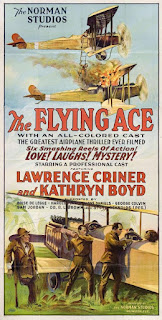
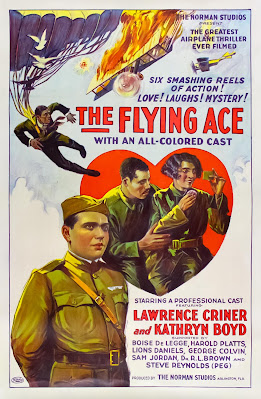
An original release poster promoting 'The Flying Ace' (1926).

MONDAY, SEPT. 5, 2022 / FOR IMMEDIATE RELEASE
Contact Jeff Rapsis • (603) 236-9237 • jeffrapsis@gmail.com

Leavitt Theatre to screen rare vintage crime melodrama with all-Black cast

'The Flying Ace' (1926), recently added to U.S. National Film Registry, to be shown with live music on Wednesday, Sept. 14

OGUNQUIT, Maine — Can discrimination exist in an America where everyone is Black?

That's among the questions posted by 'The Flying Ace' (1926), a rare surviving example of movies produced early in the 20th century for Black audiences in segregated cinemas.

'The Flying Ace,' recently named to the U.S. National Film Registry, will be screened on Wednesday, Sept. 14 at 7 p.m. at the historic Leavitt Theatre, 259 Main St., Route 1, in Ogunquit, Maine.

General admission is $12 per person.

The rarely screened movie will be shown with live music by silent film accompanist Jeff Rapsis, a New Hampshire-based performer and composer who specializes in scoring and presenting silent films.

'The Flying Ace' was produced by Norman Studios in Jacksonville, Fla., using professionals such as Laurence Criner, a veteran of Harlem’s prestigious all-Black theater troupe the Lafayette Players, but also many non-professionals for minor roles.

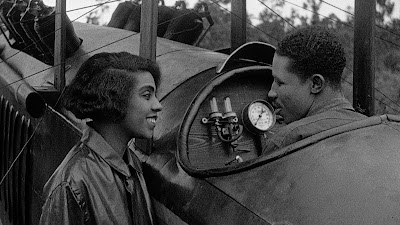
Laurence Criner and Kathryn Boyd star in 'The Flying Ace' (1926).

In 'The Flying Ace,' Criner plays Capt. Billy Stokes, a World War I fighter pilot known as "The Flying Ace" because of his downing of seven enemy aircraft in France.

Returning home to resume his former job as a railroad detective, he's assigned to locate a stationmaster who's gone missing along with the $25,000 company payroll.

While investigating, Stokes begins romancing the stationmaster's daughter Ruth (Kathryn Boyd), causing a rivalry with another suitor which leads to a break in the case.

With Ruth's safety now at risk, Stokes' dogged pursuit of the suspects leads to climax highlighted by a dramatic airborne chase which calls upon his piloting prowess.

Films such as 'The Flying Ace' were shown specifically to African-American audiences in areas of the U.S. where theaters were segregated.

Norman Studios was among the nation's top film production companies making feature length and short films for this market from the 1920s to the 1940s.

Featuring all-Black casts in stories meant to inspire and uplift, such films were popular with African-American audiences at the time. In Norman Studios films, the stories often took place in a world without the racial barriers that existed at the time.

In 'The Flying Ace,' Capt. Stokes is a pilot returning home from serving honorably in World War I—but Blacks were not allowed to fly aircraft in the U.S. military until 1940.

In an essay for the San Francisco Silent Film Festival, critic Megan Pugh wrote that Capt. Billy Stokes "...is a model for the ideals of racial uplift, fulfilling aspirations that Black Americans were not yet allowed to achieve."

"At a time when Hollywood employed white actors in blackface to play shuffling servants and mammies, the Norman Film Manufacturing Company...hired all-Black casts to play dignified roles."

"Instead of tackling discrimination head-on in his films, Norman created a kind of segregated dream world where whites—and consequently, racism—didn’t even exist," Pugh wrote.

"While it’s impossible to measure the influence The Flying Ace had on its viewers, it is reasonable to assume that audiences found its lead character inspirational. Billy Stokes was a black male hero who would have never made it onscreen in a Hollywood movie of the time," Pugh wrote.

Filmed in the Arlington area of Jacksonville, Fla., 'The Flying Ace' is a unique aviation melodrama in that no airplanes actually leave the ground. The mid-air scenes were filmed in a studio in front of neutral backdrops.

A scene from 'The Flying Ace.'

Although 'The Flying Ace' may appear crudely made to modern audiences, in 2021 the movie was named to the U.S. National Film Registry by the Library of Congress as being "culturally, historically, or aesthetically significant."

Of films produced for Black-only audiences in segregated theaters, very few survive. 'The Flying Ace' is unusual in that it survives complete, and in pristine condition. The film was included in 'Pioneers of African American Cinema," a DVD collection released in 2016 by Kino-Lorber.

A live musical score for 'The Flying Ace' will be created by accompanist Jeff Rapsis, a New Hampshire-based performer who specializes in music for silent film presentations.

Rapsis said the Leavitt Theatre screening is a rare chance to see the film as it was meant to be experienced—on the big screen, with live music, and with an audience.

The Leavitt, a summer-only moviehouse, opened in 1923 at the height of the silent film era, and has been showing movies for nearly a century.

The silent film series honors the theater's long service as a moviehouse that has entertained generations of Seacoast residents and visitors, in good times and in bad.

Following 'The Flying Ace' on Wednesday, Sept. 14 at 7 p.m., other programs in this year's Leavitt silent film series include:

• Saturday, Oct. 29 at 7 p.m.: 'Der Golem' (1920). Prepare for Halloween with one very weird flick! In 16th-century Prague, a rabbi creates a giant creature from clay, called the Golem. Using sorcery, he brings the creature to life in order to protect the Jews of Prague from persecution.

The all-Black crime melodrama 'The Flying Ace' will be shown on Wednesday, Sept. 14 at 7 p.m. at the historic Leavitt Theatre, 259 Main St, Route 1 in Ogunquit, Maine.

Admission is $12 per person, general seating. For more info, call (207) 646-3123 or visit www.leavittheatre.com.

Monday, February 21, 2022

Red River Theatres to screen 'The Flying Ace,' silent 'race' drama for Black History Month

A poster for 'The Flying Ace' (1926), screening with live music at Red River Theatres in Concord, N.H. 

I've just finished a five-shows-in-five-days marathon, and boy are my fingers tired. 

Actually, not really—foe me, silent film accompaniment is more mentally taxing than physically demanding.

So, to borrow a phrase from Monty Python: "Oooh, my brain hurts!"

Yesterday's screening of 'When Knighthood Was in Flower' (1922) at the Town Hall Theater in Wilton, N.H. drew raves from the 40 or so people who attended.

Starring Marion Davies, it's quite the movie and holds up well. You can see why it was the year's second-highest grossing picture, exceeded only by Douglas Fairbanks in 'Robin Hood,' another adventure set in Merrie Old England.

'Knighthood' would not have been available at all if not for Ben Model's rescue project a few years ago, which got the film out of the Library of Congress vaults, transferred to digital media, and then restored for enjoyment and exhibition. 

I was delighted to contribute to the Kickstarter effort that made the film's reissue possible. Thanks to Ben and everyone else who worked on this edition. 

So what's next for me?

On Wednesday, I do music for 'The Flying Ace' (1926), a "race" drama being screened at Red River Theatres in Concord, N.H. 

Then it's off to the three-day Kansas Silent Film Festival, where I'll accompany Oscar Micheaux's 'Within Our Gates' (1921) and a passel of short comedies. 

No rest for the wicked. So I must be very wicked indeed.

For now, here's the press release about the Red River screening of 'The Flying Ace,' with a lot more info about the film, which was recently added to the National Film Registry by the Library of Congress.

It's worth seeing, as it's an artifact from a time not that long ago when it was common for movie theaters in some parts of the U.S. to be segregated by race. 

Water fountains, too. 

What were they thinking? 

See you in Concord on Wednesday night, or in Topeka next weekend!

*  *  *

Kathryn Boyd and Laurence Criner in 'The Flying Ace' (1926).

MONDAY, FEB. 14, 2022 / FOR IMMEDIATE RELEASE
Contact Jeff Rapsis • (603) 236-9237 • jeffrapsis@gmail.com

Honoring Black History Month

Red River Theatres to screen rare vintage crime melodrama with all-Black cast

'The Flying Ace' (1926), recently added to U.S. National Film Registry, to be shown with live music on Wednesday, Feb. 23

CONCORD, N.H. — Can discrimination exist in an America where everyone is Black?

That's among the questions posted by 'The Flying Ace' (1926), a rare surviving example of movies produced early in the 20th century for Black audiences in segregated cinemas.

'The Flying Ace,' recently named to the U.S. National Film Registry, will be screened in honor of Black History Month on Wednesday, Feb. 23 at 7 p.m. at Red River Theatres, 11 South Main St., Concord.

General admission is $12 per person, $10 for Red River members.

The screening will feature live music by Jeff Rapsis, a New Hampshire-based silent film accompanist.

'The Flying Ace' was produced by Norman Studios in Jacksonville, Fla., using professionals such as Laurence Criner, a veteran of Harlem’s prestigious all-black theater troupe the Lafayette Players, but also many non-professionals for minor roles.

In 'The Flying Ace,' Criner plays Capt. Billy Stokes, a World War I fighter pilot known as "The Flying Ace" because of his downing of seven enemy aircraft in France.

Returning home to resume his former job as a railroad detective, he's assigned to locate a stationmaster who's gone missing along with the $25,000 company payroll.

While investigating, Stokes begins romancing the stationmaster's daughter Ruth (Kathryn Boyd), causing a rivalry with another suitor which leads to a break in the case.

With Ruth's safety now at risk, Stokes' dogged pursuit of the suspects leads to climax highlighted by a dramatic airborne chase which calls upon his piloting prowess.

Films such as 'The Flying Ace' were shown specifically to African-American audiences in areas of the U.S. where theaters were segregated.

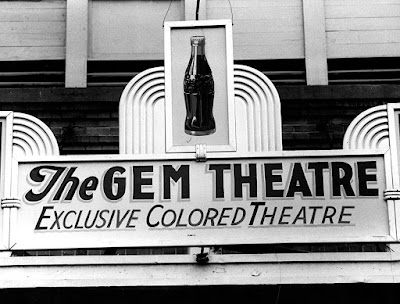
A segregated movie theater in Waco, Texas in 1939.

Norman Studios was among the nation's top film production companies making feature length and short films for this market from the 1920s to the 1940s.

Featuring all-Black casts in stories meant to inspire and uplift, such films were popular with African-American audiences at the time. In Norman Studios films, the stories often took place in a world without the racial barriers that existed at the time.

In 'The Flying Ace,' Capt. Stokes is a pilot returning home from serving honorably in World War I—but Blacks were not allowed to fly aircraft in the U.S. military until 1940.

In an essay for the San Francisco Silent Film Festival, critic Megan Pugh wrote that Capt. Billy Stokes "...is a model for the ideals of racial uplift, fulfilling aspirations that Black Americans were not yet allowed to achieve."

"At a time when Hollywood employed white actors in blackface to play shuffling servants and mammies, the Norman Film Manufacturing Company...hired all-black casts to play dignified roles."

"Instead of tackling discrimination head-on in his films, Norman created a kind of segregated dream world where whites—and consequently, racism—didn’t even exist," Pugh wrote.

"While it’s impossible to measure the influence The Flying Ace had on its viewers, it is reasonable to assume that audiences found its lead character inspirational. Billy Stokes was a black male hero who would have never made it onscreen in a Hollywood movie of the time," Pugh wrote.

Filmed in the Arlington area of Jacksonville, Fla., 'The Flying Ace' is a unique aviation melodrama in that no airplanes actually leave the ground. The mid-air scenes were filmed in a studio in front of neutral backdrops.

Although 'The Flying Ace' may appear crudely made to modern audiences, in 2021 the movie was named to the U.S. National Film Registry by the Library of Congress as being "culturally, historically, or aesthetically significant."

Of films produced for Black-only audiences in segregated theaters, very few survive. 'The Flying Ace' is unusual in that it survives complete, and in pristine condition. The film was included in 'Pioneers of African American Cinema," a DVD collection released in 2016 by Kino-Lorber.

A live musical score for 'The Flying Ace' will be created by accompanist Jeff Rapsis, a New Hampshire-based performer who specializes in music for silent film presentations.

Rapsis said the Red River screening is a rare chance to see the film as it was meant to be experienced—on the big screen, with live music, and with an audience.

'The Flying Ace' (1926), a silent crime melodrama with an all-Black cast, will be shown in honor of Black History Month on Wednesday, Feb. 23 at 7 p.m. at Red River Theatres, 11 South Main St. in Concord.

Tickets are general admission $12; Red River Theatres members $10. For more info and to purchase advance tickets, visit www.redrivertheatres.org or call (603) 224-4600. 


Saturday, February 19, 2022

Tonight: Emil Jannings in 'The Last Command' at Epsilon Spires in Brattleboro, Vt., w/pipe organ

Original promotional art for Josef von Sternberg's 'The Last Command' (1928).

Quick post in advance of heading out to Brattleboro, Vt., where tonight I'll accompany the great Josef Sternberg drama 'The Last Command' (1928).

Come join us! The show starts at 8 p.m. at Epsilon Spires performance space, with music on the venue's Estey pipe organ augmented by digital synthesizer. 

It's worth attending, as the performance of Emil Jannings is one for the ages. Playing a deposed Czarist general forced to act out his personal drama on a Hollywood set, it's really something to see him go completely berzerk.

See for yourself. More info in the press release below.

For now, let me thank Leland Stein and the staff at the Regent Theater in Arlington, Mass. for their willingness to screen 'The Flying Ace' (1926) in observance of Black History Month.

Last night's show attracted a small audience, which surprised me. 'The Flying Ace' was recently added to the National Film Registry by the Library of Congress. As a rare surviving "race drama" intended for segregated movie theaters, you'd think it would be of more interest. After all these years, I think it has a lot to say to us

Well—I'll accompany it again on Wednesday, Feb. 23 up at Red River Theatres in Concord, N.H. But right now I have to hit the road to make it through snow squalls over the river (the Connecticut River) and through the woods to Brattleboro and 'The Last Command.' 

See you there tonight!

*   *   *

Evelyn Brent and Emil Jannings in 'The Last Command' (1928).
 
MONDAY, FEB. 7, 2022 / FOR IMMEDIATE RELEASE
Contact Jeff Rapsis • (603) 236-9237 • jeffrapsis@gmail.com

Silent epic 'The Last Command' with live pipe organ score at Epsilon Spires on Saturday, Feb. 19

Josef von Sternberg's groundbreaking psychological drama won 'Best Actor' for Emil Jannings at first-ever Academy Awards

BRATTLEBORO, Vt.—'The Last Command' (1928), a silent film drama that won Emil Jannings 'Best Actor' honors at the first-ever Academy Awards, will be screened with live music on Saturday, Feb. 19 at 8 p.m. at Epsilon Spires, 190 Main St., Brattleboro, Vt.

Admission is $15 per person. Tickets may be purchased in advance at www.epsilonspires.org or at the door.

The screening will feature live accompaniment on the venue's Estey pipe organ by Jeff Rapsis, a New Hampshire-based silent film musician.

'The Last Command,' directed by Josef von Sternberg, tells the sweeping story of a powerful general in Czarist Russia (Jannings) forced to flee his homeland during the Bolshevik Revolution. He emigrates to America, where he is reduced to living in poverty.

Finding work as an extra at a Hollywood studio, the former general lands the part of a commanding officer in a movie about the Revolution, causing flashbacks to his traumatic experiences. The conflict leads to a spectacular climax and a towering performance that earned Jannings 'Best Actor' honors.

The film takes audiences on a journey through big emotions as well as issues of history, time, power, and especially a man's duty to his country and to his fellow citizens—and what happens when the two obligations diverge.

'The Last Command' is also one of early Hollywood's most creative and challenging looks at the global conflicts that contributed to World War I.

The film also stars a young William Powell as a Hollywood movie director who crosses paths with the general during the Revolution, and 1920s starlet Evelyn Brent as a seductive Russian revolutionary.

Rapsis, the accompanist, will create the film's score live as the movie is shown by improvising on the venue's historic Estey pipe organ, built in Brattleboro and installed in 1906.

"Making up the music on the spot is kind of a high wire act," Rapsis said. "But there's nothing like the energy and excitement that comes with improvised live performance, especially when accompanying a silent film."

Critic Leonard Maltin hailed 'The Last Command' as "a stunning silent drama...a fascinating story laced with keen observations of life and work in Hollywood." Time Out of London called it "the first Sternberg masterpiece, expertly poised between satire and 'absurd' melodrama. The cast are fully equal to it; Jannings, in particular, turns the characteristic role of the general into an indelible portrait of arrogance, fervor and dementia."

Director Sternberg, a master of lighting and black-and-white photography, created 'The Last Command' as a visual tour de force. The film is often cited as a prime example of the emotional range and visual accomplishment of silent films at their height, just prior to the coming of pictures with recorded soundtracks.

Rapsis said great silent film dramas such as 'The Last Command' told stories that concentrate on the "big" emotions such as Love, Despair, Anger, and Joy. Because of this, audiences continue to respond to them in the 21st century, especially if they're presented as intended—in a theater on the big screen, with a live audience and live music.

"Dramas such as 'The Last Command' were created to be consumed as a communal experience," Rapsis said. "With an audience and live music, they come to life as their creators intended them to. This screening at Epsilon Spires is a great chance to experience films that first caused people to fall in love with the movies."

The non-profit Epsilon Spires, housed in Brattleboro's former Baptist church, builds connections between art and science by offering provocative performances and events, interactive art installations, and opportunities to engage in civil discourse by addressing current topics through the integration of diverse forms of expression. 

'The Last Command' (1928) will be screened with live music on Saturday, Feb. 19 at 8 p.m. at Epsilon Spires, 190 Main St., Brattleboro, Vt. Admission is $15 per person. Tickets may be purchased in advance at www.epsilonspires.org or at the door.


Friday, February 18, 2022

Rare all-Black drama, 'The Flying Ace' (1926), tonight at the Regent Theatre in Arlington, Mass.

A not-very-subtle promotional poster for the all-Black drama 'The Flying Ace' (1926).

In honor of Black History Month, tonight (Friday, Feb. 18) the Regent Theater of Arlington, Mass. is screening 'The Flying Ace' (1926), with live music by me. 

It's a rare surviving example of what some scholars call "Race Cinema," meaning movies made for segregated theaters that were part of the American movie landscape in the first half of the 20th century.

'The Flying Ace,' a rare surviving example of this type of film, was recently added to the National Film Registry by the Library of Congress for being either "culturally, historically, or aesthetically significant."

I think 'The Flying Ace,' produced by Norman Studios of Jacksonville, Fla., applies to the first two distinctions: cultural and historic. It's a vivid reminder of racism that permeated everyday life in its era—so much so that people set up separate theaters for people of different skin color!

In terms of being "aesthetically significant"—well, you can make up your own mind on that. But I believe that any film from a century ago, no matter what its level of aesthetic achievement, has a lot to say to us today, if only for just the passing of time. 

And let's be clear about one thing. By screening 'The Flying Ace,' neither I nor the Regent Theatre are celebrating the fact that for many decades, movie theaters in the United States were segregated by race. 

No. 'The Flying Ace' is a concrete artifact of a shameful legacy of racism that pervaded society at the time, and with which we still grapple today.  

But by acknowledging that it once existed, and preserving this artifact from the era (and I believe screening vintage film before the public is part of preservation), we can be better equipped to confront racism in our own time.

So hope to see you at the Regent tonight at 7:30 p.m. Much more info in the press release below.

*      *      *

Kathryn Boyd and Laurence Criner star in 'The Flying Ace' (1926).

MONDAY, FEB. 14, 2022 / FOR IMMEDIATE RELEASE

Contact Jeff Rapsis • (603) 236-9237 • jeffrapsis@gmail.com

Honoring Black History Month

Regent Theatre to screen rare vintage crime melodrama with all-Black cast

'The Flying Ace' (1926), recently added to U.S. National Film Registry, to be shown with live music on Friday, Feb. 18

ARLINGTON, Mass. — Can discrimination exist in an America where everyone is Black?

That's among the questions posted by 'The Flying Ace' (1926), a rare surviving example of so-called "race" movies produced early in the 20th century for Black audiences in segregated cinemas.

'The Flying Ace,' recently named to the U.S. National Film Registry, will be screened in honor of Black History Month on Friday, Feb. 18 at 7:30 p.m. at the Regent Theatre, 7 Medford St., Arlington, Mass.

General admission is $15 per person. Tickets available at the door or online at www.regenttheatre.com.

The screening will feature live music by Jeff Rapsis, a New Hampshire-based silent film accompanist.

'The Flying Ace' was produced by Norman Studios in Jacksonville, Fla., using professionals such as Laurence Criner, a veteran of Harlem’s prestigious all-black theater troupe the Lafayette Players, but also many non-professionals for minor roles.

In 'The Flying Ace,' Criner plays Capt. Billy Stokes, a World War I fighter pilot known as "The Flying Ace" because of his downing of seven enemy aircraft in France.

Returning home to resume his former job as a railroad detective, he's assigned to locate a stationmaster who's gone missing along with the $25,000 company payroll.

While investigating, Stokes begins romancing the stationmaster's daughter Ruth (Kathryn Boyd), causing a rivalry with another suitor which leads to a break in the case.

With Ruth's safety now at risk, Stokes' dogged pursuit of the suspects leads to climax highlighted by a dramatic airborne chase which calls upon his piloting prowess.

Films such as 'The Flying Ace' were shown specifically to African-American audiences in areas of the U.S. where theaters were segregated.

Norman Studios was among the nation's top film production companies making so-called "race" films for this market from the 1920s to the 1940s.

Featuring all-Black casts in stories meant to inspire and uplift, such films were popular with African-American audiences at the time. In Norman Studios films, the stories often took place in a world without the racial barriers that existed at the time.

In 'The Flying Ace,' Capt. Stokes is a pilot returning home from serving honorably in World War I—but Blacks were not allowed to fly aircraft in the U.S. military until 1940.

In an essay for the San Francisco Silent Film Festival, critic Megan Pugh wrote that Capt. Billy Stokes "...is a model for the ideals of racial uplift, fulfilling aspirations that Black Americans were not yet allowed to achieve."

"At a time when Hollywood employed white actors in blackface to play shuffling servants and mammies, the Norman Film Manufacturing Company...hired all-black casts to play dignified roles."

"Instead of tackling discrimination head-on in his films, Norman created a kind of segregated dream world where whites—and consequently, racism—didn’t even exist," Pugh wrote.

"While it’s impossible to measure the influence The Flying Ace had on its viewers, it is reasonable to assume that audiences found its lead character inspirational. Billy Stokes was a black male hero who would have never made it onscreen in a Hollywood movie of the time," Pugh wrote.

Filmed in the Arlington area of Jacksonville, Fla., 'The Flying Ace' is a unique aviation melodrama in that no airplanes actually leave the ground. The mid-air scenes were filmed in a studio in front of neutral backdrops.

A monochrome lobby card for 'The Flying Ace' (1926).

Although 'The Flying Ace' may appear crudely made to modern audiences, in 2021 the movie was named to the U.S. National Film Registry by the Library of Congress as being "culturally, historically, or aesthetically significant."

Of films produced for Black-only audiences in segregated theaters, very few survive. 'The Flying Ace' is unusual in that it survives complete, and in pristine condition. The film was included in 'Pioneers of African American Cinema," a DVD collection released in 2016 by Kino-Lorber.

A live musical score for 'The Flying Ace' will be created by accompanist Jeff Rapsis, a New Hampshire-based performer who specializes in music for silent film presentations.

Rapsis said the Regent Theatre screening is a rare chance to see the film as it was meant to be experienced—on the big screen, with live music, and with an audience.

'The Flying Ace' (1926), a silent crime melodrama with an all-Black cast, will be shown in honor of Black History Month on Friday, Feb. 18 at 7:30 p.m. at the Regent Theatre, 7 Medford St., Arlington, Mass.

General admission is $15 per person. Tickets available at the door or online at www.regenttheatre.com. For more information, call the theater at (781) 646-4849.