Showing posts with label Man With A Movie Camera. Show all posts

Saturday, April 30, 2022

On Sunday, May 1 in Wilton, N.H.: 'Man With A Movie Camera,' innovative silent documentary filmed in Ukraine

A Russian-language poster for the documentary 'Man With A Movie Camera' (1929), shot largely in Ukraine. 

This Sunday, it's a double-header!

First, at 2 p.m., a screening of the silent documentary 'Man With A Movie Camera' (1929) at the Town Hall Theatre of Wilton, N.H. Lots more about that in the press release below.

After that, I scoot over Temple Mountain to the Park Theatre of Jaffrey, N.H., where I'll accompany Harold Lloyd's 'Grandma's Boy' (1922) for the venue's 100th birthday celebration, which starts at 5 p.m. 

More info about the Park's big celebration (it's a fund-raising, with tickets $50 each) is online here.

But first, kudos to the audience for last night's screening of 'Old Ironsides' (1926) at the Custom Home Maritime Museum in Newburyport, Mass.

Packed into an upstairs exhibit room that became an impromptu movie theater, the Friday night crowd was with the picture right from the start, with big reactions throughout. 

Everyone seemed to really get into the tale of the early days of the U.S.S. Constitution, which remains afloat a short distance down the coast in Boston Harbor. People cheered the action, gasped at the love story, and roared at the comedy.

George Bancroft and Esther Ralston at the wheel in 'Old Ironsides' (1926).

Why? Well, sometimes it just clicks. In this case, I think it was a combination of the right space (small, but nearly standing room only for the 40 attendees, which creates energy and excitement) and a really good match of subject matter and audience interest.

In this case, 'Old Ironsides' formed a celebration of sailing ships from long ago, which you'd have to expect would go over well at a maritime museum.

During one of the picture's extended battle scenes, one very nice lady contributed to the sonic mayhem by having her cell phone go off repeatedly. I didn't mind this, once I realized her ring-tone was not coming from my synthesizer. 

But still. Note to self: don't neglect to tell people to turn off their devices. Pacemakers excepted.

About Sunday's screening of 'Man With A Movie Camera'—most of this ground-breaking documentary (it's more like an early music video, actually) was shot in and around Kiev and Odessa, then part of the Ukrainian Soviet Socialist Republic, and now part of the independent nation of Ukraine.

A lot of the sickening destruction going on in Ukraine involves these cities and the people living in them. Because 'Man With A Movie Camera' celebrates these people and their lives, I felt it was only appropriate to get the film on the screen right now.

Seeing it will remind us, I hope, of the huge human tragedy that's unfolding there right now. These are real people in a real place with a long and proud history.

At the risk of sounding flippant, here's what I didn't put in the press release. 

I felt it was only appropriate to show the film on May Day, which back in the days of the Soviet Union (which Vladimir Putin would like to return to) was often an occasion for parades of military hardware through Red Square. 

Instead, let's use the day to celebrate images of ordinary daily life in Ukraine, even if they're from long ago, as a way to thumb our collective noses at the inhumane bastard in the Kremlin.

*  *  *


A scene from Dziga Vertov's eye-opening film 'Man With A Movie Camera' (1929).

MONDAY, APRIL 18, 2022 / FOR IMMEDIATE RELEASE
Contact Jeff Rapsis • (603) 236-9237 • jeffrapsis@gmail.com

Filmed in Ukraine: 'Man With A Movie Camera' with live music on Sunday, May 1 in Wilton, N.H.

Feature-length silent documentary made in Kiev, Odessa regarded as world's first extended music video; May Day screening is "gesture of defiance"

WILTON, N.H.—It has no story, but it tells everyone's story. It's a silent film, but it's the world's first music video. It has no actors because the star is you, the audience.

It's 'Man With A Movie Camera' (1929), director Dziga Vertov's celebration of city life in Ukraine via a dizzying collage of images and kinetic cinematography that's left audiences breathless for nearly a century.

The film was shot largely in Kiev and Odessa, cities that were then in the Soviet Union but which are today part of an independent Ukraine.

'Man With A Movie Camera' will be shown on Sunday, May 1 at 2 p.m. at the Town Hall Theatre, 40 Main St., Wilton, N.H.

Admission is free; a donation of $10 per person is suggested to help defray expenses.

The screening will feature live accompaniment by Jeff Rapsis, a New Hampshire-based composer who specializes in creating scores for silent films.

Dziga's experimental documentary caused a sensation when it was released at the end of the 1920s, when motion pictures were still a new artistic medium.

Even with no story and no actors, 'Man With A Movie Camera' was filled with eye-popping visuals that anticipated later music/image films such as 'Koyaanisqatsi.'

Today, the scenes of ordinary life in Kiev and Odessa possess a special poignance due to recent and ongoing Russian military attacks.

"In the Soviet Union, May Day (May 1) was a holiday used to promote solidarity, with military parades a common feature," Rapsis said.

"We chose to program 'Man With a Movie Camera' on this day as a symbolic gesture of defiance against Vladimir Putin's aim to reestablish a Soviet-style empire of client states, including Ukraine," he said.

The screening will include a display of authentic Soviet-era propaganda posters and banners that Rapsis collected during visits to the region in 1991 and 1992, when the Soviet Union was collapsing.

Although no official score was composed for the silent feature, director Vertov specified the type of music that he wanted played wherever the film was screened. Rapsis will create music that follows those guidelines.

"Vertov wanted a kind of kinetic, energetic music to be played with the film, rather than background music," Rapsis said. "The goal is to create music that acts as an equal partner in conveying a kind of exhilaration that I think Vertov was going for."

Filmed mostly in the bustling Ukrainian cities of Kiev and Odessa in the late 1920s, the film features a wide range of slice-of-life scenes showing everything from streetcars to sports contests. Vertov took his camera everywhere, from a birth hospital to a divorce court.

Most spectacularly, Vertov experimented with filming ordinary scenes (such as a crowded public square) at a very slow frame rate. When run at a normal speed, the result was a speeded-up view of reality that few had ever seen or studied before.

He also experimented in the other direction: scenes of athletic events are shown in extreme slow motion, so the human form can be observed in ways never before possible.

Yelizaveta Svilova seen in the film editing the film we're seeing. Figure that one out!

Vertov's wife, Yelizaveta Svilova, was an equal partner in creating 'Man With A Movie Camera,' editing the film. She also appears in the film, editing it as we're watching it.

"It's a film filled with self-referential puzzles and meta moments," Rapsis said. "It also plays like a piece of visual music, with fast sequences followed by slow ones and moods that often change."

"Although 'Man With A Movie Camera' has some dark scenes, ultimately it's a celebration—of life in what was then the fast-changing Soviet Union, but also in a way that speaks to life regardless of time or place," Rapsis said.

"That's what I'll try to capture in the musical score, which will be performed live and will be largely improvised," Rapsis said.

‘Man With A Movie Camera’ will be shown with live music on Sunday, May 1 at 2 p.m. at the Town Hall Theatre, 40 Main St., Wilton, N.H.

Admission is free; a donation of $10 per person is suggested to help defray expenses.

For more info, visit www.wiltontownhalltheatre.com or call (603) 654-3456.

Thursday, October 1, 2020

This weekend in Wilton, N.H.: double header of all 15 chapters of 'A Woman in Grey' (1920)

Arline Pretty is in a pretty pickle in 'A Woman in Grey' (1920). But at least she's following guidance on face masks.

This weekend I'm doing music for a special cinematic event at the Town Hall Theater in Wilton, N.H.: a screening of all 15 chapters of 'A Woman in Grey' (1920). It's a century-old dramatic serial adventure of which all episodes survive complete.

That means more than four hours of film! So we'll run the first eight chapters on Saturday, Oct. 3 at 2 p.m., and then the remaining episodes (including the thrilling conclusion!) on Sunday, Oct. 4 at 2 p.m.

I'm looking forward to the chance to immerse myself in this extended story as it plays out over such a long span of time. I have some main themes in mind, but other than that, the music will grow naturally from the story as it unfolds. 

Also, I can't wait to try out this joke: "It's called 'The Woman in Grey,' but it's black-and-white film, so what choice did they have?"

Lots more detail in the press release below. Hope you can join us for some (or preferably ALL) of 'A Woman in Grey' on the occasion of its 100th anniversary.


Me outside the Flying Monkey in Plymouth, N.H. prior to the show.

For now, let me report on last night's screening of 'Man With A Movie Camera' (1929) up at the Flying Monkey Moviehouse in Plymouth, N.H.

Before the show, I recounted to the audience my first experience of accompanying this film about 10 years ago. It was part of a monthly series in Manchester, N.H. that was heavy on traditional Hollywood dramas starring the likes of John Gilbert, Greta Garbo, and so on.

So we ran 'Man With A Movie Camera' without explanation. Afterwards, I asked for opinions.

"That was a terrible movie," said one woman, a regular attendee. 

Wow! Turns out she was expecting, yes, a good story—exactly what filmmaker Dziga Vertov was aiming to avoid. He hoped to use film to show life as it really happens, rather than through some made-up narrative.

So I learned that for 'Man With A Movie Camera' to be understood, at least a brief explanation was in order. Silent film is unusual enough; for 'Man' to work, you need to prepare people for what Vertov was aiming for, at least as I understand it.

So I tell people: in essence, it's a celebration—of life in general, and of the potential of the motion picture camera to capture it.

I also think it helps to look at the film as a large-scale piece of music. Like a symphony, it contains movements of varying tempi, all grouped and structured in a way to create an overall effect.

One thing I've recently noticed is that often when the visual rhythm of the film is about to shift, Vertov inserts an image of a hand-operated traffic signal being changed. 

For the music, I was thinking of Franz Schubert's 'Great' C Major Symphony, with its broad melodies filled with repeated notes, and also more recent minimalist music with a harmonic structure that unfolds slowly over a long time.

Yelizaveta Svilova edits 'Man With A Movie Camera' within the movie. 

Overall, it worked. I caught all the big shifts, and kept things pretty bottled up until the final five minutes, in which a riot of fast-changing images explode on the screen.

What held it together was a steady pattern of three notes before the beat, and three notes after. (So with the accent on the fourth note.) Also, a simple line of four descending notes (down a half-step, and then a whole step and another whole step) was another key building block. 

 Those four notes could be harmonized in all manner of ways, but I found that reverting often to a simple triadic texture created a powerful "coming home" kind of feeling no matter how busy the texture.

I also kept using a non-traditional chord change that you hear a lot in contemporary tonal music such as in some scores of John Adams: going from a major chord (say Eb Major) to a minor chord up a half-step (E minor), in which all tones shift up except the third of the chord, which stays on the same note but which goes from major to minor because of context.

It's a very atmospheric move, I find, and has become part of my own toolkit and basic musical vocabulary. And it came in very useful with 'Man With A Movie Camera' because of how it creates a sense of very slight change while still moving forward. Sometimes I added other notes: the flatted 7th of the major chord becomes the leading tone of the minor, which adds richness. 

Once all this was established, there were many places where the music seemed to fall into place with ease and really helped the visuals, I felt. I was especially pleased with music I came up with for scenes of women in a gymnasium using odd exercise machines from the period, including a mechanical horse. 

It all really held together, and 'The End' brought cheers. (And for all the right reasons, I think.) For me, it was quite a workout, just like the ladies in the gym. Best of all, no one seemed to concur with the assessment 10 years ago.

Here's more info on 'A Woman in Grey.' See you this weekend for what promises to be yet another unusual cinematic experience!

*    *    *

TUESDAY, SEPT. 22, 2020 / FOR IMMEDIATE RELEASE
Contact Jeff Rapsis • (603) 236-9237 • jeffrapsis@gmail.com

Rare showing of all 15 chapters of 100-year-old vintage serial coming to Town Hall Theatre


'A Woman in Grey' (1920), multi-part adventure thriller, to screen with live music over Saturday & Sunday Oct. 3-4

WILTON, N.H.—It's a cliff-hanger, but each time you won't have to wait long to find out what happens next.

It's 'A Woman in Grey,' a 15-episode adventure serial produced 100 years ago, when movies were a brand new form of entertainment.

The entire run of all 15 chapters will be screened over two days at the Town Hall Theatre, 40 Main St., Wilton, N.H.

Chapters 1 through 8 of the multi-part tale will be shown on Saturday, Oct. 3 starting at 2 p.m. Remaining episodes 9 through 15, including the serial's thrilling conclusion, will be shown on Sunday, Oct. 4 at 2 p.m.

Admission is free to each screening; a donation of $10 per person is suggested to help defray expenses.

The screening, the latest in the Town Hall Theatre's silent film series, will feature live accompaniment by Jeff Rapsis, a New Hampshire-based composer who specializes in creating music for silent films.

"Seeing all episodes of this marvelous multi-part adventure over two days is a century-old form of binge-watching," Rapsis said.

"But it's also a great chance to experience early cinema the way it was intended to be shown: on a big screen, in a theater, with live music, and with an audience," Rapsis said.

The Town Hall Theatre is observing procedures to comply with all state and CDC public health guidelines, including reduced seating capacity. For complete information about the venue's safety protocols, visit www.wiltontownhalltheatre.com.

Similar to the more famous 'Perils of Pauline' serial, 'A Woman in Grey' follows the story of a mysterious woman (Arline Pretty) who may hold the secret to finding a long-lost fortune in an abandoned mansion.

Like most multi-part serials, each chapter of 'A Woman in Grey' runs about 12 minutes, and was designed to be shown one episode each week at local theaters.

Most episodes ended with a "cliffhanger" predicament designed to keep audiences coming back to find out what happens next.

Most multi-part serials from the early days of film are completely lost, or exist only partially. 'A Woman in Grey' is unusual because it survives completely intact. The total length of all 15 episodes is nearly four hours.

'A Woman in Grey' is also unusual because it was produced not in Hollywood, but in Wilkes-Barre, Penn. by Serico Motion Pictures, Inc., a short-lived independent production firm.

The company recruited local stage performers, including leading actress Arline Pretty, to fill out the large cast of 'A Woman in Grey.'

All 15 chapters were shot on location in northeastern Pennsylvania, providing a rare glimpse of the region as it looked a century ago.

Serials continued through the 1920s and into the era of sound films, but over time came to be regarded as programming for children's matinees rather than a format for serious drama. The practice faded out after World War II and the development of television.

The complete 15-chapter serial 'A Woman in Grey' (1920) will be presented over two days at the Town Hall Theatre, 40 Main St., Wilton, N.H. Episodes 1 through 8 will be shown on Saturday, Oct. 3 at 2 p.m., followed by episodes 9 through 15 the next day, on Sunday, Oct. 4 at 2 p.m.

Admission is free; a donation of $10 per person is suggested. For more information, call (603) 654-3456 of visit www.wiltontownhalltheatre.com.

Sunday, September 20, 2020

Dziga Vertov's 'Man With a Movie Camera' to screen on Wednesday, 9/30 in Plymouth, N.H.

A poster for the Russian film 'Man With a Movie Camera' (1929), which I'll accompany on Wednesday, Sept. 30 in Plymouth, N.H.

Had a lot of fun today accompanying Keaton's 'Sherlock Jr.' (1924) and 'The Cameraman' (1928) to an audience of about 40 people at the Town Hall Theatre in Wilton, N.H.

As a sign of how strange things are right now in the movie exhibition business: this summer, silent films with live music have been the top box office attraction at the Town Hall Theatre.

Today's audience included several families with children. In welcoming everyone, I announced the presence of the youngsters by urging all adults to behave themselves so as to make a good impression on the kids. 

The two Keaton pictures were both about the movies, and so is the next one: 'Man With a Movie Camera' (1929), Russian avant garde director Dziga Vertov's extraordinary documentary about daily life as captured on film. 

I say "extraordinary" because unlike a narrative film that tells a story, 'Man With a Movie Camera' instead plays like a piece of music: fast, slow, and then fast, and so on. It's like a visual symphony. 

Lots more info in the press release, which I'm pasting in below. Hope to see you next week at the Flying Monkey in Plymouth!

P.S. Want to drive your spellcheck function crazy? Try typing in this film title: Koyaanisqatsi

*    *    *

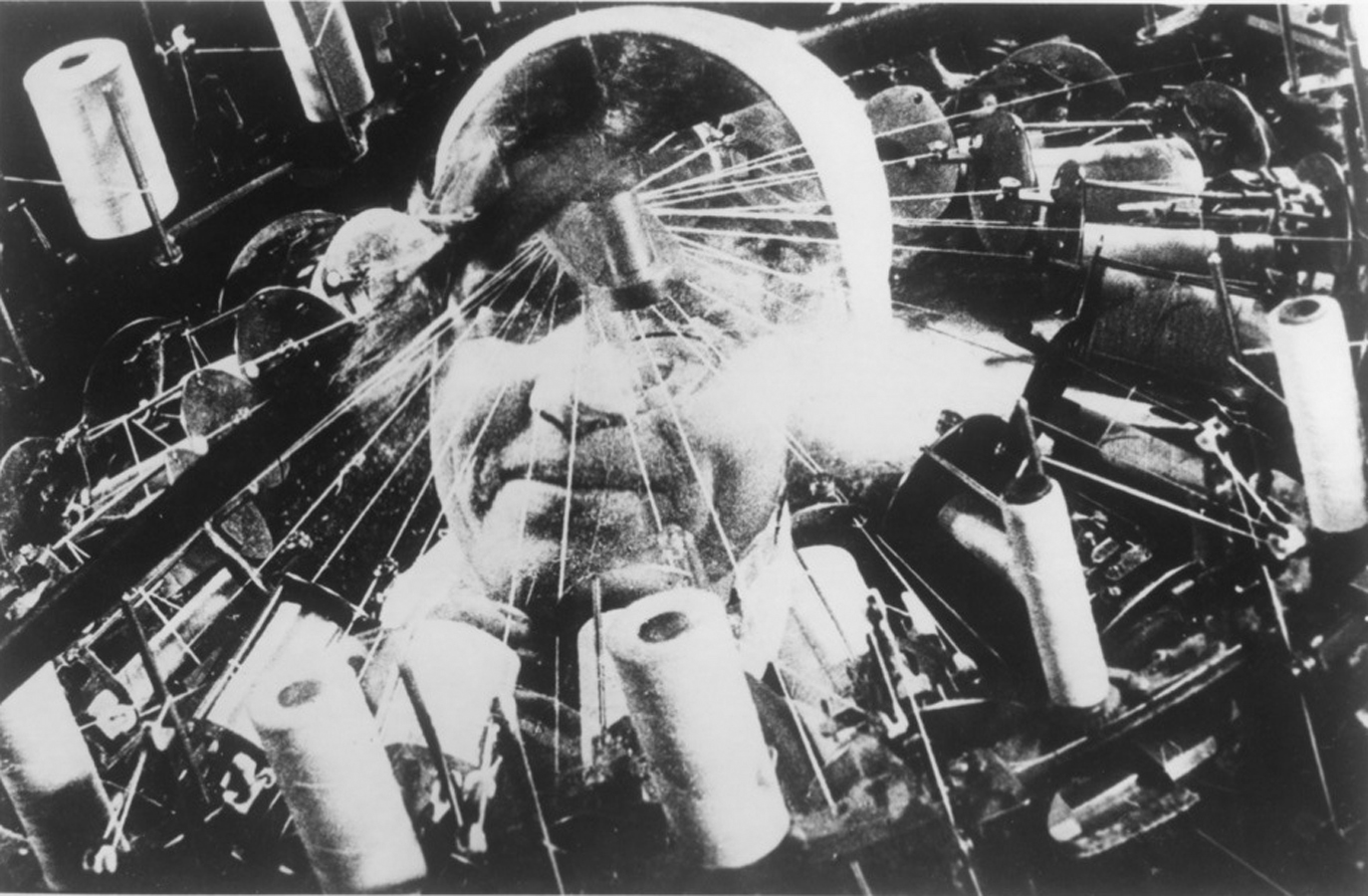
The eyes have it: an image from 'Man With a Movie Camera' (1929).
 

MONDAY, SEPT. 14, 2020 / FOR IMMEDIATE RELEASE
Contact Jeff Rapsis • (603) 236-9237 • jeffrapsis@gmail.com

'Man With A Movie Camera' with live music on Wednesday, Sept. 30 in Plymouth, N.H.

Feature-length silent documentary about Russian city life regarded as world's first extended music video

PLYMOUTH, N.H.—It has no story, but it tells everyone's story. It's a silent film, but it's the world's first music video. It has no actors because the star is you, the audience.

It's 'Man With A Movie Camera' (1929), Russian director Dziga Vertov's celebration of city life via a dizzying collage of images and kinetic cinematography that's left audiences breathless for nearly a century.

'Man With A Movie Camera' will be shown on Wednesday, Sept. 30 at 6:30 p.m. at the Flying Monkey Moviehouse and Performance Center, 39 S. Main St., Plymouth, N.H. General admission $10 per person.

The screening will feature live accompaniment by Jeff Rapsis, a New Hampshire-based composer who specializes in creating scores for silent films.

Vertov's experimental documentary caused a sensation when it was released at the end of the 1920s, when motion pictures were still a new artistic medium.

Even with no story and no actors, 'Man With A Movie Camera' was filled with eye-popping visuals that anticipate later music/image films such as 'Koyaanisqatsi.'

Although no official score was composed for the silent feature, director Vertov specified the type of music that he wanted played wherever the film was screened. Rapsis will create music that follows those guidelines.

"Vertov wanted a kind of kinetic, energetic music to be played with the film, rather than unobtrusive background music," Rapsis said. "The goal is to create music that acts as an equal partner in conveying a kind of exhilaration that I think Vertov was going for."

Filmed mostly in the bustling city of Odessa in the late 1920s, the film features a wide range of slice-of-life scenes showing everything from streetcars to sports contests. Vertov took his camera everywhere, from a birth hospital to a divorce court.

Most spectacularly, Vertov experimented with filming ordinary scenes (such as a crowded public square) at a very slow frame rate. When run at a normal speed, the result was a speeded-up view of reality that few had ever seen or studied before.

Vertov's wife, Yelizaveta Svilova, was an equal partner in creating 'Man With A Movie Camera,' editing the film. She also appears in the film, editing it as we're watching it.

Editor Yelizaveta Svilov, wife of director Dziga Vertov, is seen editing the film in 'Man With A Movie Camera' (1929).

"It's a film filled with self-referential puzzles and meta moments," Rapsis said. "It also plays like a piece of visual music, with fast sequences followed by slow ones and moods that often change."

"Although 'Man With A Movie Camera' has some dark scenes, ultimately it's a celebration — of life in what was then the fast-changing Soviet Union, but also in a way that speaks to life regardless of time or place," Rapsis said.

"That's what I'll try to capture in the musical score, which will be performed live and largely improvised," Rapsis said.

At the reopened Flying Monkey, accommodations are in place to keep patrons safe in the Covid-19 era.

Face-coverings are required to enter the theater, and should remain on at all times until movie-goers take their seats. Capacity will be limited to 50 percent; audience members are asked to observe social distancing in choosing seats.

"Films from the silent era were designed to be seen with an audience, and it's totally safe to do so," Rapsis said.

'Man With A Movie Camera' continues a monthly series of silent film programs at the Flying Monkey that include comedy, plus drama, horror, and an unusual Russian documentary. On the schedule:

• Wednesday, Oct. 28 at 6:30 p.m.: The original 'Nosferatu' (1922). Celebrate Halloween by experiencing the original silent film adaptation of Bram Stoker's famous 'Dracula' story. Still scary after all these years—in fact, some critics believe this version is the best ever done, and has become creepier with the passage of time.

• Wednesday, Nov. 18 at 6:30 p.m.: 'Broken Blossoms' (1919). Can two outcasts in Edwardian London find peace and happiness in a cruel world? Will Lillian Gish overcome her abusive father? Can Richard Barthelmess find love in a forbidden relationship? Great D.W. Griffith drama, with stellar performance from iconic silent actress Gish.

• Wednesday, Dec. 30 at 6:30 p.m.: Planes, Trains and Monty Banks. Rediscover forgotten silent comedian Monty Banks, born "Mario Bianchi" in Italy. In 'Flying Luck,' (1927), hapless aviator joins the U.S. Army Air Corps, with hilarious results. Preceded by an excerpt from 'Play Safe' (1927), a hair-raising chase sequence set aboard an out-of-control freight train.

‘Man With A Movie Camera’ will be shown with live music on Wednesday, Sept. 30 at 6:30 p.m. at the Flying Monkey Moviehouse and Performance Center, 39 S. Main St., Plymouth, N.H. General admission $10 per person. For more info, visit www.flyingmonkeynh.com or call (603) 536-2551.

Thursday, January 5, 2012

I am in awe of 'Man With A Movie Camera'


I just can't get over it. It's the kind of thing I respond to emotionally. It's real life rearranged into fascinating patterns—something like music, but augmented for the eyes. And it's really gotten to me.

Two days ago, I scored this 1929 film from the Soviet Union, created by Dziga Vertov (see above, with his co-star) in that remarkable era of artistic experimentation before Stalin commandeered the arts for his own purposes. 'Man With A Movie Camera' is a wonderful film to score, with its startling montages and shifting cutting rhythms and so many other elements that lend themselves to music.

Vertov, in demonstrating the possibilities of the movie camera, showed the potential for cinema to reimagine life itself, and releasing an avalanche of raw creativity in the process. 'Man With A Movie Camera' shows us life in ways no one had ever experienced before.

And in doing this, Vertov produced a strutting celebration of life as it is experienced by most people, a piece of art that immortalizes the ordinary all around us by transforming it into something extraordinary. And I find this very moving, especially so in the wild and frentic last five minutes of the picture, the equivalent to the "grand finale." Something about it reaches out and grabs me and makes me feel glad to be alive, and gives me a sense of limitless possibilities.

Of course not everyone will respond to 'Man With A Movie Camera' in this way. So at the conclusion of Tuesday night's screening, I asked our relatively small audience (maybe 15 souls) for reactions. Without hesitating, one of my regular attendees blurted out, "It was AWFUL!" She was, alas, expecting a typical Hollywood story, which 'Man With A Movie Camera' is not.

And so we talked a bit about her response, and it forced me to try to express why I responded so strongly to the film. And I kept coming back to that "music for the eyes" idea. 'Man With A Movie Camera' is really built like a big Mahler symphony, with peaks and valleys, sometimes woven out of the most ordinary material, just like Mahler would sometimes do. (For example: building a funeral march out of a children's nursery song in his Symphony No. 1.)

But it was Mahler who told his pupil Bruno Walter that a symphony must form an entire world, and that's what Vertov accomplished in making 'Man With A Movie Camera.' Vertov used footage of real life to refashion something like a whole new world, or at least a world that would be new to viewers, both then and now.

And I found myself telling our audience that 'Man With A Movie Camera' was one of those silents to which the passage of time has added an important new layer of interest. The film, made more than eight decades ago now, allows us to see what has changed -- and, more importantly, what hasn't. Our gadgets may be different, but the rhythms of life that make up our lives in many ways continue unaltered. We still fall in love, get married or get divorced, grow old, and die. And we know this because Vertov shows it to us.

And in watching this on screen and playing music to support it, I feel connected not just to all those in my own age, but to all those who have gone before me, and who will come after me, too. We're all phrases and notes in a big symphony that started long ago and will not finish for a long time, if ever. Vertov compresses and restructures reality, as captured in 1920s Russia, in a way that helps me sense that even today.

It's enough for me to feel overcome, the same way I remember feeling in the Indian holy city of Varanasi a few years back, when I lit a floating candle for my ancestors and released it on the waters of the Ganges. Circumstances conspired to make me feel truly alive then, and part of something much bigger than myself. And the genius of Vertov's film is that it inspires the same feeling.

Tuesday, January 3, 2012

'Man With a Movie Camera' (1929) in Manchester, N.H.

One reason to show Dziga Vertov's experimental avant-garde film 'Man With A Movie Camera' (1929) is all the incredible posters that were done to promote it. They're from that wonderful period of artistic inventiveness in the then-brand new Soviet Union—chiefly the 1920s, before Stalin took control of things and commandeered the creative arts to serve his own purposes. We're showing 'Man With a Movie Camera' on Tuesday, Jan. 3 at the Manchester (N.H.) Public Library (free admission!), and get a load of some of these eye-popping designs from the original release:


The movie itself is a real trip — a blueprint for the much later film 'Koyaanisqatsi' (1983), although filmed in Odessa and in black-and-white. I had known about 'Man With a Movie Camera' for years but had not had a chance to sit down and watch it until just recently, in preparation for the screening we're doing on Tuesday, Jan. 3. (Yikes! That's tonight!)

A lot has been written about this innovative film. My own take is that it's a great example of a silent film that has become more interesting as time passes, as what Vertov captured receds further and further into the past. Seeing the film today allows us to contemplate not only what Vertov put on the screen, but also how much has changed, and (more importantly) how much hasn't.

I think it can be very rewarding—and grounding and comforting, too—to see how people lived some time ago, before the age of automobiles and gadgets and distractions that we now live in. And I think the rhythms and images that Vertov captured and assembled are perfect for this kind of contemplation.

And I hope the music that I do enchances this experience. I plan to break out my best faux Philip Glass, with the goal of using repetition to create that kind of hypnotic effect that I think works so well with Vertov's idea of cinema needing a new visual language. Just as a sculpture celebrates, say, the human form captured in a moment for us all to appreciate, Vertov's film captures "modern" life in a way that allows us to step back and ponder our own life and how we fit into the crazy quilt that he weaves on screen. And music, ideally, enhances that process, providing I don't screw it up.

And, as I said before, the passage of time has added another layer of richness to this contemplation. How much of what is depicted in Odessa nearly nine decades ago is similar to our own experience today? What perspective can we gain on our own sense of life as it rushes by, day after day, seemingly faster and faster?

Come to think of it, that makes 'Man With A Movie Camera' a great film to show as we pass from one year into yet another. Check your watch, turn the calendar, and sit back and think about the part you've been playing in the symphony of life—and what kind of music will be in the next movement.

Friday, December 30, 2011

Encore screening of 'Metropolis' on Jan. 21 in Concord!

I'm both pleased and sorry to report that as of today (Friday, Dec. 30), our New Year's Eve screening of 'Metropolis' (1927) at Red River Theatres in Concord, N.H. is sold out. Great to see such interest, but I regret we're not going to be able to accommodate everyone who might want to see it that night.

But I've just now spoken to the folks at Red River Theatres and we've scheduled an encore screening for Saturday, Jan. 21 at 7 p.m. Same deal, admission $15. So if you couldn't get in (or couldn't get to) the New Year's Eve screening, there's another chance coming up on the calendar.

In the meantime, if you're itching to welcome in 2012 with some early cinema, we have two other screenings of great silent film coming up in our corner of the world:

• Sunday, Jan. 1, 4:30 p.m.: 'The Circus' (1928) starring Charlie Chaplin, with comedy short films starring Buster Keaton and Laurel & Hardy. Wilton Town Hall Theatre, Main Street, Wilton, N.H.; (603) 654-3456. www.wiltontownhalltheatre.com. Free admission, donations accepted. See one of Chaplin's great silent features (with music by him) and two classic comedies acccompanied by Jeff Rapsis. Fun for the whole family and a great way to ring in 2012.

• Tuesday, Jan. 3, 6 p.m.: 'Man With A Movie Camera' (1929), Carpenter Memorial Auditorium, Manchester Public Library, 405 Pine St., Manchester, N.H.; (603) 624-6550. Soviet director Dziga Vertov's homage to Leningrad, an experimental documentary with no story and no actors, just images. Pure cinema. Monthly series of rarely screened silent films presented with live music in 1913 auditorium. Admission free, donations encouraged.

Thursday, December 8, 2011

Ring in the New Year with 'Metropolis,' 'The Circus'

The silent film calendar is now clear until after Christmas, but then things come back to life in a big way with three screenings in four days. Let's take attendance...

Saturday, Dec. 31, 2011: Doing music for a New Year's Eve screening of 'Metropolis' (1927) at Red River Theatres, an independent cinema at 11 South Main St. in Concord, N.H. Welcome in 2012 with German director Fritz Lang's eye-popping futuristic fantasy, now augmented with a half-hour of additional footage discovered in Argentina in 2008. One of the great cinematic experiences of any era, and featuring an astonishingly athletic performance by actress Brigitte Helm. (That's her above.) Showtime is 7 p.m.; tickets are $15 each and seating is very limited. Call the box office at (603) 224-4600 and reserve your tickets today. Many thanks to Jason Greenleaf at Kino/Lorber for arranging clearance to screen the restored version.

Sunday, Jan. 1, 2011: We're screening 'The Circus' (1928), Chaplin's gag-filled feature, as part of our monthly silent film series at the Wilton Town Hall Theatre at 60 Main St. in Wilton, N.H. Admission is free; the program starts at 4:30 p.m. This film is packed with great routines and set pieces, including the scene where Chaplin walks the tightrope with some friends (see above) along for the ride. I'm always amazed to think that Chaplin actually learned to tightrope walk for this sequence! Also included will be a Buster Keaton silent comedy short (title to be announced) and, just when we've all had quite enough of the Christmas season, our friends Stan Laurel and Oliver Hardy will be on hand to wreak holiday havoc in 'Big Business,' a classic comedy short from 1929. Please note that the Chaplin film will be screened with Chaplin's own recorded score (per the wishes of the Chaplin estate), but I'll do live music for the comedy shorts. And many thanks to Sarah Finklea of Janus Films for arranging permission for us to screen the Chaplin feature!

Tuesday, Jan. 3, 2011: And now for something completely Soviet: 'The Man With A Movie Camera' (1929), an experimental Russian silent film, will be screened at the Manchester (N.H.) Public Library, 405 Pine St., at 6 p.m. Looking forward to doing music for this, a new one for me. It's the latest installment of a monthly silent film series we run in the library's vintage 1913 Carpenter Auditorium; admission is free.