Showing posts with label boxing. Show all posts

Sunday, July 20, 2025

Hitchcock's 'The Ring' (1927) today at 2 p.m.: thoughts on silent film, boxing, and ballet

A scene from Alfred Hitchcock's boxing drama 'The Ring' (1927). 

Today at 2 p.m., the bell rings for the next installment of our mini-series of silent boxing films at the Town Hall Theatre in Wilton, N.H.

This afternoon, it's Alfred Hitchcock's early film 'The Ring' (1927), a drama in which two men do battle over a woman inside the ring and out.

Late this summer, the series conclude son Sunday, Aug. 24 with 'Battling Butler' (1926), Buster Keaton's boxing comedy.

I'm drawn to silent films that feature boxing because they show the enduring fascination a sport that's so basic and elemental.

Boxing: No teams, just two opponents. No fancy equipment. Everything out in the open for once, with no second-guessing what you're there to do.

Also, talking and words aren't important in the ring. So that's something that silent film and boxing share. Sometimes words aren't enough, or sometimes they're too much.

So there's a certain expressive power shared by boxing and silent film.

You could also make the same connection between boxing and ballet. No words there either: just music and movement—telling stories so elemental that words aren't needed.

Yes, kind of like boxing. 

This reminds me that a friend of mine had a T-shirt that said: "Boxing is like ballet except the dancers hit each other."

There's also the time element of boxing and silent film. When the bell rings, the fighters have no choice to face each other until the contest comes to an end one way or another.

Likewise, when the opening titles of a silent film appear on the screen, the accompanist has no choice to stay in the ring until the story is told—in this case, when 'The End' shows up, which is the cinematic equivalent of going the distance.

There may be other connections with silent film and boxing. So far, no one has thrown a punch at me during a screening, but that could happen at any time. 

If it happens this afternoon, be there to see it by getting a ringside seat at the Town Hall Theatre at 2 p.m. 

Here's the press release with a lot more info  about the film and the screening.

*    *    * 

 
A scene from Alfred Hitchcock's 'The Ring' (1927).
 
MONDAY, JUNE 30, 2025 / FOR IMMEDIATE RELEASE
Contact Jeff Rapsis • (603) 236-9237 • jeffrapsis@gmail.com

Early Hitchcock film highlights Town Hall Theatre summer series of vintage boxing movies

'The Ring' (1927), silent drama of two fighters in love with same woman, to be screened on Sunday, July 20 with live musical accompaniment

WILTON, N.H.—An early film directed by Alfred Hitchcock is next up in a summer series of vintage boxing movies at the Town Hall Theatre.

'The Ring' (1927), an intense tale of two fighters battling over the same woman, will be screened with live music on Sunday, July 20 at 2 p.m.

The boxing series is part of the Wilton Town Hall Theatre's monthly silent film program. Admission to the screenings is free; a donation of $10 per person is suggested.

Live accompaniment will be provided by Jeff Rapsis, a New Hampshire-based silent film musician.

'The Ring,' an early Hitchcock effort, was made when the director was still working in his native Great Britain.

The future "master of suspense" was just 28 years old when he helmed this silent drama set in the colorful world of English carnivals and fairgrounds.

'The Ring' is based on Hitchcock's only original screenplay, although he worked extensively alongside other writers throughout his career.

Silent-era boxing dramas are of interest to fans because they're filled with scenes of the sport at the height of its mainstream popularity.

At the time, boxing rivaled baseball as the nation's most popular sport. Neighborhoods, communities, and ethnic groups all rooted for their favorite fighters, and heavyweight champion Jack Dempsey ranked as an international celebrity.

Boxing stories were popular with early movie audiences as well.

"As an elemental contest between two opponents, boxing inspired some great work by early filmmakers," Rapsis said. "It's a visual sport that doesn't require a lot of dialogue or commentary to understand, and so was perfect for silent movies."

The Wilton Town Hall Theatre has been showing films since 1912. The venue's silent series gives local audiences the chance to experience early cinema as it was intended to be seen: on the big screen, with live music, and with an audience.

The silent film boxing series concludes on Sunday, Aug. 24 with 'Battling Butler' (1926), Buster Keaton's uproarious comedy about a pampered millionaire mistaken for a champion fighter.

The Summer Silent Boxing Film Series continues with a screening of Alfred Hitchcock's 'The Ring' (1927) on Sunday, July 20 at 2 p.m. at the Wilton Town Hall Theatre, 40 Main St., Wilton, N.H. Admission is free; a donation of $10 per person is suggested.


Sunday, July 24, 2016

Summertime double-header: Hitchcock's
'The Ring,' then Fairbanks in 'Thief of Bagdad'

An original poster for Alfred Hitchcock's film 'The Ring' (1927)

They do it in baseball. So why not in silent film?

Today is one of those "two screenings in one day" days. A double-header, just like baseball.

Unlike baseball, today's screenings are in two different stadiums—er, theaters. And this being New England, they're in two different states, too.

This afternoon, I'll be at the Wilton (N.H.) Town Hall Theatre for the next installment of our summertime series of silent boxing movies.

This time it's Alfred Hitchcock's early drama 'The Ring' (1927), which I've never done before.

But in terms of music, I've found the Hitchcock silents lend themselves to a sort of reverse-engineered Bernard Herrmann approach. So that's what I'll be taking.

Today happens to be a spectacular mid-summer day (mid-80s, sunny but not humid), so we'll see what kind of turnout we get.

In our favor: the Hitchcock name, plus some good exposure in the local media.

The bell rings at 4:30 p.m. Admission is free, but donations are always welcome.

More details in the press release below.

And after the final punch is thrown in 'The Ring,' I then haul myself and my gear down to the Aeronaut Brewery in Somerville, Mass., where we're running the epic Douglas Fairbanks Sr. film 'The Thief of Bagdad' (1924) at 8 p.m.

It's a great summertime flick: the granddaddy of all fantasy adventure movies. Flying carpets, magical spells, swashbuckling adventure, and more!

Artwork for the original release of 'The Thief of Bagdad.'

Doug was really firing on all cylinders in this big budget spectacular, which I think is the best of his 1920s epics.

I love presenting 'Thief,' in part because it always makes me feel like what a small kid in the 1920s must have felt like when he or she saw it in its original release.

I think of a small kid in some dusty plains town getting to go the moviehouse some hot Saturday afternoon, and seeing this.

I'm not a little kid, but 'The Thief of Bagdad' turns me into one every time.

And seeing it in a brewery with a big screen and a kick-ass sound system ought to be a really fun way to experience the movie.

The only issue is that because I'm a kid, I can't enjoy a few brews during the show, right?

Actually, I find I can't have any alcohol prior to accompanying a film. Even the slightest sip of wine seems to affect my ability to respond to a film musically.

Afterwards, it's another story entirely!

But back to tonight's show: We sometimes sell out screenings at the Aeronaut, which has limited capacity due to their occupancy permit.

But I just checked and it seems like there's room this evening for last-minute drop-ins. So come on down!

More info in the press release, which I'm posting below the one (below) about 'The Ring.'

* * *

A scene from Alfred Hitchcock's 'The Ring' (1927).

MONDAY, JULY 18, 2016 / FOR IMMEDIATE RELEASE
Contact Jeff Rapsis • (603) 236-9237 • jeffrapsis@gmail.com

Early Hitchcock film highlights Wilton (N.H.) Town Hall Theatre summer series of vintage boxing movies


'The Ring' (1927), silent drama of two fighters in love with same woman, to be screened on Sunday, July 24 with live musical accompaniment

WILTON, N.H.—An early film directed by Alfred Hitchcock is next up in a summer series of vintage boxing movies at the Wilton Town Hall Theatre.

'The Ring' (1927), an intense tale of two fighters battling over the same woman, will be screened with live music on Sunday, July 24 at 4:30 p.m.

The boxing series is part of the Wilton Town Hall Theatre's monthly silent film program. Admission to the screenings is free; a donation of $5 per person is suggested.

Live accompaniment will be provided by Jeff Rapsis, a New Hampshire-based silent film musician.

'The Ring,' an early Hitchcock effort, was made when the director was still working in his native Great Britain.

The future "master of suspense" was just 28 years old when he helmed this silent drama set in the colorful world of English carnivals and fairgrounds.

'The Ring' is based on Hitchcock's only original screenplay, although he worked extensively alongside other writers throughout his career.

Silent-era boxing dramas are of interest to sports buffs because they're filled with scenes of the fight game at the height of its mainstream popularity.

At the time, boxing rivaled baseball as the nation's most popular sport. Neighborhoods, communities, and ethnic groups all rooted for their favorite fighters, and heavyweight champion Jack Dempsey ranked as an international celebrity.

Boxing stories were popular with early movie audiences as well.

"As an elemental contest between two opponents, boxing inspired early filmmakers to do some some great work," Rapsis said. "It's a visual sport that doesn't require a lot of dialogue or commentary to understand, and so was perfect for silent movies."

The Wilton Town Hall Theatre has been showing films since 1912. In addition to running current releases on its two screens, the theater remains committed to alternative programming such as its ongoing series of silent films with live music.

The silent series gives local audiences to experience early cinema as it was intended to be seen: on the big screen, with live music, and with an audience.

Keaton in 'Battling Butler,' to be shown in August.

The series concludes on Sunday, Aug. 28 with 'Battling Butler' (1926), Buster Keaton's uproarious boxing comedy about a pampered millionaire mistaken for a champion fighter.

The Summer Silent Boxing Film Series continues with a screening of Alfred Hitchcock's 'The Ring' (1927) on Sunday, July 24 at 4:30 p.m. at the Wilton Town Hall Theatre, 60 Main St., Wilton, N.H. Admission is free; a donation of $5 per person is suggested.

For more info, call (603) 654-3456 or visit www.wiltontownhalltheatre.com. For more info on the music, visit www.jeffrapsis.com.

* * *

Douglas Fairbanks Sr. plays the title role in 'The Thief of Bagdad' (1924).

MONDAY, JULY 11, 2016 / FOR IMMEDIATE RELEASE
Contact Jeff Rapsis • (603) 236-9237 • jeffrapsis@gmail.com

Aeronaut Brewing to screen 'The Thief of Bagdad' (1924) with live music on Sunday, 7/24

Epic silent film fantasy classic starring Douglas Fairbanks set new standards for Hollywood magic

SOMERVILLE, Mass. — Silent film with live music returns to the Aeronaut Brewing Co. this month with a screening of one of early Hollywood's most exciting fantasy adventure movies.

Douglas Fairbanks Sr. stars in 'The Thief of Bagdad' (1924), to be shown on Sunday, July 24 at 7:30 p.m. at the Aeronaut Brewery, 14 Tyler St. (near Union Square), Somerville, Mass.

Live music will be provided by silent film accompanist Jeff Rapsis. Admission is $10 per person.

Tickets are available online at www.eventbrite.com; search on "Aeronaut Brewery."

Or here's a direct link to tickets.

The program is open to the public and is part of the Aeronaut's commitment to showcase local music, art, and performance.

The athletic Fairbanks was the Harrison Ford of his time—a pioneering action hero among the first to entertain movie audiences with thrilling on-screen adventures.

Among his best work is 'The Thief of Bagdad' (1924), a timeless adventure boasting a great story, spectacular sets, and magical special effects.

In 'The Thief of Bagdad,' a bare-chested Fairbanks plays a crafty rogue who easily steals everything his heart desires—everything, that is, except the love of a beautiful princess, daughter of the powerful Caliph of Bagdad.

To win her hand, he must not only change his ways, but also convince her of his worthiness over many other highly placed suitors.

Doug flies carpet class in 'The Thief of Bagdad.'

In making the film, Fairbanks spared no expense for what some critics still regard as the most lavish fantasy movie ever made, a show-stopping adaptation of the traditional "A Thousand and One Nights" story in which a flying carpet is just one of many eye-popping sights that astounded movies audiences at the time.

Fairbanks, swaggering through massive marketplace sets and cavernous throne rooms as an incorrigible pickpocket, scales towering walls (with the help of a magic rope) and leads merry chases through crowded bazaars in his pursuit of loot—until he falls in love with the princess and vows to win her heart.

The jaunty opening is a preamble to the film's spectacular second half, in which the repentant thief embarks on an odyssey through caverns of fire, underwater palaces, and even outer space. Special effects range from a giant smoke-belching dragon to a magical flying horse, and still glow with a timeless sense of wonder from the early days of movies.

William Cameron Menzies's sets were among the largest ever created for a motion picture. Especially noteworthy is his design for a mythical Bagdad, a unique combination of Art Deco and Islamic elements—a dream city inspired by illustrations from story books.

Fairbanks, one of the most popular stars of the 1920s, was the inspiration for the character of George Valentin in the recent Oscar-winning Best Picture 'The Artist' (2011). Fairbanks was known for films that used the then-new medium of motion pictures to transport audiences to historical time periods for grand adventures and athletic stunts. He's often referred to as "Douglas Fairbanks Sr." to avoid confusion with his son, the actor Douglas Fairbanks Jr.

More than 90 years after its premiere, 'The Thief of Bagdad' continues to be held in high regard. In 1996, the film was selected for preservation in the U.S. National Film Registry by the Library of Congress as being "culturally, historically, or aesthetically significant."

Fairbanks himself considered 'The Thief of Bagdad' to be his personal favorite of all of his films.

Live music for 'The Thief of Bagdad' will be provided by silent film accompanist Jeff Rapsis, who uses a digital synthesizer to create a traditional full orchestra "movie score" sound.

The screening continues the Aeronaut's silent film series, which aims to revive big-screen showings of great silent features that first caused audiences to fall in love with the movies.

"If you've never seen a silent film in a theater with live music and an audience, the Fairbanks pictures are a great way to experience the medium at its best," Rapsis said. "When you put all the elements together, silent film has an ability to stir up emotions in a way that no other medium can."

'The Thief of Bagdad' is appropriate for family audiences, although very small children may find some sequences frightening. The film runs 2 hours and 34 minutes.

'The Thief of Bagdad' (1924) starring Douglas Fairbanks will be screened with live music on Sunday, July 24 at 7:30 p.m. at the Aeronaut Brewery, 14 Tyler St. (near Union Square), Somerville, Mass. Admission is $10 per person. Tickets are available online at www.eventbrite.com; search on "Aeronaut Brewery." For more info, visit www.aeronautbrewing.com.

Here's a direct link to tickets.

Thursday, June 30, 2016

Encore screening of Keaton's 'The General'
on Friday, July 1 at Red River Theatres

What's the most expensive shot of the silent era? Here's a hint.

Coming up this Friday, July 1: an encore presentation of Buster Keaton's 'The General' (1926) at Red River Theatres in Concord, N.H.

A screening of 'The General' earlier in June sold out, prompting this reboot. The show starts at 7 p.m. and admission is $10 per person. See you there!

More details in the press release pasted at the end of this post.

And then Sunday, July 3 brings the next installment of our series of silent boxing films at the Wilton (N.H.) Town Hall Theatre.

The 4:30 p.m. show is a double feature of two obscure dramas: 'Battling Bunyan' (1924) and 'The Shock Punch' (1925). Admission is free!

When I mention we're running a series of boxing films, some people crinkle up their nose in disapproval. It's understandable, I suppose.

The sad state of Muhammad Ali's health prior to his recent death has renewed calls to ban the sport outright as too harmful and dangerous.

Boxing: a sport on the canvas.

But films from the 1920s offer a glimpse into a bygone era—a time when boxing was arguably the nation's most popular sport.

Consider: Just today, I came across a review of a book, “Stars in the Ring: Jewish Champions in the Golden Age of Boxing,” by Mike Silver.

Here's the context the reviewer, Robert Cassidy, used in putting boxing in perspective during the 1920s:
The book also states that in the Roaring Twenties, the most famous Jewish person in America was not a scientist, entertainer, author or Supreme Court justice. It was lightweight champion Benny Leonard.

That breakdown provides the historical backdrop for the book. At the time, only baseball and horse racing rivaled boxing in popularity. Not just world champions, but even main-event fighters were considered national sports heroes.
You can see that popularity throughout films of the silent era—and especially in the boxing-specific films we're running this summer.

It's a sub-genre that was definitely a product of its time. And so I think films about boxing are worth focusing on for a series, in the same way we've run past series on trains, sailing ships, and melodramatic romance.

I'm of two minds about boxing. Of course I dislike the idea of any sport where brain injury is the essential aim.

But I have to admit, the idea of two equally matched men or women facing off against each other in a defined space, and not part of any team, is elemental and fascinating.

I guess it speaks to one of the fundamental human paradoxes: of being intelligent enough to know when something isn't good for us or the people involved, but being depraved enough to still want it.

Death by chocolate, anyone? Or, more topically, Brexit? We're not always such rational creatures, are we?

Okay, here's the press release about 'The General' this Friday, July 1 at 7 p.m. at Red River Theatres in Concord, N.H.

* * *

A vintage poster for 'The General.'

FRIDAY, JUNE 24, 2016 / FOR IMMEDIATE RELEASE
Contact Jeff Rapsis • (603) 236-9237 • jeffrapsis@gmail.com

Encore presentation of silent film classic
'The General' at Red River on Friday, July 1


Repeated due to earlier June sell-out: Buster Keaton's comic Civil War masterpiece screened with live music

CONCORD, N.H.—He never smiled on camera, earning him the nickname of "the Great Stone Face." But Buster Keaton's comedies rocked Hollywood's silent era with laughter throughout the 1920s.

Acclaimed for their originality and timeless visual humor, Keaton's films remain popular crowd-pleasers today.

See for yourself with an encore screening of 'The General' (1926), one of Keaton's landmark feature films, at Red River Theatre, 11 South Main St., Concord, N.H. on Friday, July 1 at 7 p.m. Tickets are $10 per person.

The program will be accompanied by live music performed by silent film composer Jeff Rapsis.

The encore screening was scheduled following a sell-out show earlier in June.

Buster and his locomotive co-star, The General.

'The General,' set during the U.S. Civil War, tells the story of a southern locomotive engineer (Keaton) whose engine (named 'The General') is hijacked by Northern spies with his girlfriend onboard.

Keaton, stealing another train, races north in pursuit behind enemy lines. Can he rescue his girl? And can he steal his locomotive and make it back to warn of a coming Northern attack?

Critics call 'The General' Keaton's masterpiece, praising its authentic period detail, ambitious action and battle sequences, and its overall integration of story, drama, and comedy.

It's also regarded as one of Hollywood's great train films, with much of the action occurring on or around moving steam locomotives.

Rapsis, a New Hampshire-based silent film musician who has accompanied shows at venues across New England, said Keaton's films were not made to be shown on television or viewed at home.

In screening 'The General,' Red River will give the public a chance to experience silent film as it was meant to be seen—in a high quality print, on a large screen, with live music, and with an audience.

"All those elements are important parts of the silent film experience," said Rapsis, who improvises the score on the spot as a film screens. "Recreate those conditions, and the classics of early Hollywood leap back to life in ways that can still move audiences today."

Buster readies for his close-up in 'The General.'

Rapsis performs on a digital keyboard that reproduces the texture of the full orchestra and creates a traditional "movie score" sound.

Keaton, along with Charlie Chaplin and Harold Lloyd, stands today as one of the silent screen's three great clowns. Some critics regard Keaton as the best of all; Roger Ebert wrote in 2002 that "in an extraordinary period from 1920 to 1929, (Keaton) worked without interruption on a series of films that make him, arguably, the greatest actor-director in the history of the movies."

As a performer, Keaton was uniquely suited to the demands of silent comedy. Born in 1895, he made his stage debut as a toddler, joining his family's knockabout vaudeville act and learning to take falls and do acrobatic stunts at an early age.

A remarkable pantomime artist, Keaton naturally used his whole body to communicate emotions from sadness to surprise. And in an era with no post-production special effects, Keaton's acrobatic talents enabled him to perform all his own stunts.

Red River Theatres, an independent cinema, is a non-profit 501(c)(3) organization dedicated to screening a diverse program of first-run independent films, cult favorites, classics, local and regional film projects, and foreign films.

The member-supported theater’s mission is to present film and the discussion of film as a way to entertain, broaden horizons and deepen appreciation of life for New Hampshire audiences of all ages.

'The General' is the latest in an monthly series of great silent films with live music at Red River. Upcoming programs include:

• Friday, July 15: 'Bardelys the Magnificent' (1926) starring John Gilbert in a big MGM historical swashbuckling adventure thought lost for decades until a print was found recently in France.

• Friday, Aug. 12: 'The Yankee Clipper' (1927) starring William Boyd. Period drama set in the 19th century; two clipper ships race from China to Boston to compete for a lucrative tea contract.

• Friday, Sept. 16: 'Spies' (1928). Director Fritz Lang followed his futuristic saga 'Metropolis' with this pioneering espionage thriller that created the template for all future James Bond movies.

Critics review 'The General':

"The most insistently moving picture ever made, its climax is the most stunning visual event ever arranged for a film comedy."
—Walter Kerr

"An almost perfect entertainment!"
—Dave Kehr, Chicago Reader

"What makes the film so special is the way the timing, audacity and elegant choreography of its sight gags, acrobatics, pratfalls and dramatic incidents is matched by Buster's directorial artistry, his acute observational skills working alongside the physical élan and sweet subtlety of his own performance."
—Time Out (London)

'The General' (1926) will be shown at Red River Theatres, 11 South Main St., Concord, N.H. on Friday, July 1 at 7 p.m. in the Jaclyn Simchik Screening Room. Admission is $10 per person; for more info, call (603) 224-4600 or visit www.redrivertheatres.org.

For more information about the music, visit www.jeffrapsis.com.

Tuesday, May 31, 2016

This week at Ogunquit's Leavitt Theatre:
Step into the ring with Buster Keaton

A vintage poster for 'Battling Butler' that renders the athletic Keaton as unusually scrawny.

Next up: Buster Keaton's boxing comedy 'Battling Butler' (1926).

I'm doing live music for this film on Thursday, June 2 at the Leavitt Theatre in Ogunquit, Maine.

Details about the screening are in the press release below.

But one thing about this film that has always impressed me is how it shows Keaton's sure instinct for story construction.

The storyline for 'Battling Butler' was taken from a popular stage play about a meek millionaire who must train to fight a champion in the ring.

In the play, the story climaxes in the dressing room just before the fight, when the millionaire finds out he doesn't have to face the champion. Happy ending!

However, in transferring the story to the screen, Keaton knew his character and his audience well enough to know the non-fight ending just wasn't going to work.

To quote Keaton himiself in a late-in-life interview: "But we knew better than to do that to a motion-picture audience. We couldn’t promise ’em for seven reels that I was goin’ to fight in the ring and then not fight. We knew that we had to fight."

So they changed the story accordingly—and the result was Keaton's highest-grossing film of the 1920s.

Keaton in 'Battling Butler' (1926).

How did Keaton know to do this? There was no film school at the time, and Keaton never went to any traditional school, either. He spent his childhood touring in the family vaudeville act.

I suspect that over the years, he absorbed so much about how theater audiences react that his sense of what would work in a story and what wouldn't was instinctual. He just knew.

Same thing with his masterpiece, 'The General' (1926), made right after 'Battling Butler.'

Keaton structured his Civil War story to put his role on the Confederate side, because he said (again, in a late-in-life interview) "You can always make villains out of the Northerners, but you cannot make a villain out of the South."

Why? Because the South lost? I don't know.

By the way, I'm accompanying a screening of 'The General' on Friday, June 10 at Red River Theatres in Concord, N.H. More about later.

For now, I hope you'll join us this Thursday to see Buster Keaton lace up the gloves in 'Battling Butler' (1926).

The press release is below. See you there!

* * *

A vintage poster for 'Battling Butler' (1926).

TUESDAY, MAY 24, 2016 / FOR IMMEDIATE RELEASE
For more info, contact: Jeff Rapsis • (603) 236-9237 • jeffrapsis@gmail.com

Buster Keaton comedy 'Battling Butler' at Leavitt Theatre on Thursday, June 2


Classic silent film farce set in the boxing world to be screened with live music in historic downtown Ogunquit venue

OGUNQUIT, Maine—He never smiled on camera, earning him the nickname of "the Great Stone Face." But Buster Keaton's comedies rocked Hollywood's silent era with laughter throughout the 1920s.

See for yourself with a screening of 'Battling Butler' (1926), one of Keaton's landmark feature films, on Thursday, June 2 at 8 p.m. at the Leavitt Theatre, 259 Main St. Route 1, Ogunquit, Maine

The one-time screening will feature live music performed by Jeff Rapsis. Tickets are $10 per person.

In 'Battling Butler,' Keaton plays Alfred Butler, a pampered millionaire who is mistaken for a boxer with a similar name.

The mix-up gives the meek Butler the chance to pretend he's a prizefighter to impress the family of the woman he loves.

But then Keaton is forced to enter training for a high-stakes championship bout, with surprising results.

The boxing scenes gave Keaton ample opportunity to wring physical comedy out of the fight game, which at the time rivaled baseball in popularity.

Based on a story adapted from a popular stage play, 'Battling Butler' was Keaton's highest-grossing silent feature film and the high point of his 1920s stardom.

Keaton takes a pratfall in 'Battling Butler.'

Today Keaton, along with Charlie Chaplin and Harold Lloyd, stands as one of the three great clowns of the silent screen.

Many critics regard Keaton as the best of all; Roger Ebert wrote in 2002 that "in an extraordinary period from 1920 to 1929, (Keaton) worked without interruption on a series of films that make him, arguably, the greatest actor-director in the history of the movies."

As a performer, Keaton was uniquely suited to the demands of silent comedy. Born in 1895, he made his stage debut as a toddler, joining his family's knockabout vaudeville act and learning to take falls and do acrobatic stunts at an early age. He spent his entire childhood and adolescence on stage, attending school for exactly one day.

A remarkable pantomime artist, Keaton naturally used his whole body to communicate emotions ranging from sadness to surprise. In an era when movies had few special effects, Keaton's acrobatic talents meant he performed all his own stunts.

In reviving 'Battling Butler' and other great films of cinema's early years, organizers of Leavitt's silent film series aim to show classic movies as they were meant to be seen—in high quality prints, on a large screen, with live music, and with an audience.

"These are the films that first made people fall in love with the movies, and we're thrilled to present them again on the big screen," said Peter Clayton, the Leavitt's long-time owner.

The Leavitt, a summer-only moviehouse, opened in 1923 at the height of the silent film era, and has been showing movies to summertime visitors for nine decades.

The silent film series honors the theater's long service as a moviehouse that has entertained generations of Seacoast residents and visitors, in good times and in bad.

Live music for each program will be provided by Jeff Rapsis, a New Hampshire-based performer and composer who specializes in scoring silent films.

In accompanying silent films live, Rapsis uses a digital synthesizer to recreate the texture of the full orchestra. He improvises the music in real time, as the movie is shown.

In scoring a movie, Rapsis creates music to help modern movie-goers accept silent film as a vital art form rather than something antiquated or obsolete.

Other feature films in this year's series include:

• Thursday, June 23 at 8 p.m.: 'Don Q, Son of Zorro' (1925), Douglas Fairbanks Sr. stars in this sequel to his immensely popular 'Mark of Zorro,' which opened this season's silent film series.

• Thursday, July 7 at 8 p.m.: 'A Sailor-Made Man' (1921), uproarious send-up of Navy life helped establish Harold Lloyd as a top-tier silent film comic.

• Thursday, July 21 at 8 p.m.: 'Tess of the Storm Country' (1922), Mary Pickford's intense melodrama with a classic Yuletide finish. Christmas in July!

• Thursday, Aug. 11 at 8 p.m.: 'Tramp Tramp Tramp' (1926); comic Harry Langdon enters a cross-country foot race to impress his dream girl, Joan Crawford!

• Thursday, Aug. 25 at 8 p.m.: 'Son of the Sheik' (1926), final appearance of silent screen icon Rudolph Valentino on the 90th anniversary of his death.

• Thursday, Sept. 15 at 8 p.m.: 'The Winning of Barbara Worth' (1927); Ronald Colman and Gary Cooper compete for a woman's favor in this epic Western filmed on location.

• Saturday, Oct. 29 at 8 p.m.: 'The Man Who Laughs' (1928); celebrate Halloween with this creepy but riveting historical tale about a man forced to go through life with a maniacal grin.

Buster Keaton's comedy 'Battling Butler' (1926) will be shown with live music on Thursday, June 2 at 8 p.m. at the Leavitt Fine Arts Theatre, 259 Main St. Route 1, Ogunquit, Maine; (207) 646-3123; admission is $10 per person, general seating. For more information, visit www.leavittheatre.com. For more info on the music, visit www.jeffrapsis.com.

Friday, May 27, 2016

In this corner—a summer of the 'sweet science'
of boxing on the silent screen in Wilton, N.H.

Buster Keaton in 'Battling Butler' (1926).

Even if boxing isn't your bag, I hope you'll join us for a series of silent films this summer that center on the sweet science.

Heck, even if you're not into silent film, I hope you'll check out this series. :)

It's at the Wilton (N.H.) Town Hall Theatre, where we'll run boxing-related dramas, comedies, and love stories in the coming months.

Several heavyweight filmmakers headline the action, with Alfred Hitchcock and Buster Keaton among them.

But the undercard includes many other hopefuls and wanna-bes, all eager for their shot in the ring.

First up is 'Dress Parade' (1927), a Cecil B. DeMille drama starring William Boyd as a prizefighter who falls for the daughter of a West Point Commandant.


Boyd would later go on to lasting fame as cowboy hero Hopalong Cassidy. "Dress Parade" was filmed on location at West Point, and so doubles as our annual Memorial Day weekend silent film tribute.

Actually, it's more of a military story than a boxing tale, and so it'll serve as a transition into the boxing flicks.

The screening is Sunday, May 29 at 4:30 p.m, at the Town Hall Theatre, 40 Main St., Wilton, N.H. Live music is by me.

Admission is free, with a suggested donation of $5 per person to defray expenses.

A full line-up of the other contenders in our boxing series is found in the press release below.

Taken as a whole, these movies form a time capsule into an era when boxing rivaled baseball as the nation's most popular sport.

That's no longer the case, of course, especially with today's emphasis on safety and injury prevention.

But back in the 1920s, the fight game enjoyed a national popularity that extended right down to the grassroots.

Neighborhoods, ethnic groups, you name it: every town had a fight arena, and just about everyone had a favorite fighter to root for.

And kids idolized champions such as Jack Dempsey, whose "long count" bout with Gene Tunney in 1927 was one of the era's big stories.

This popularity is reflected in the movies of the time. Watch films from the silent era, and you'll find boxing a constant presence.

Consider that all the great silent comedians—Chaplin, Keaton, Lloyd, Langdon—spent time in the prize ring.

Just last night at Red River Theatres in Concord, N.H., I introduced a screening of Chaplin's 'City Lights' (1931).

Judging from audience reaction, the superbly choreographed boxing scene was the highlight of the evening.

So boxing, and the struggle it symbolized, was regarded as part of everyday life.

Moreover, boxing was visual. Words weren't necessary to tell the story of two men pushed to their physical limits and striving to beat each other into submission.

So moviemakers were naturally inclined to use boxing and its world as a setting for their stories.

By the way, I say "men" because at the time, boxing was completely male-dominated. Female boxing, if it occurred at all, was considered a novelty. In an era of sharply defined gender roles, a woman just didn't do such things as fight in the ring.

Surprisingly, female boxing does show up in some silent films, although usually as a gimmick. One example is Clara Bow's 'Roughhouse Rosie' (1927), in which Bow gets her men "by treating them rough!" It's a film that, alas, no longer survives.

Clara Bow in 'Roughhouse Rosie.'

Filmmakers also sometimes used boxing's raw physicality to punch up the visuals, so to speak.

There's a remarkable night club scene in Fritz Lang's film 'Spies' (1928) where two boxers in a makeshift ring beat each other senseless while a glittering society crowd looks on.

From Fritz Lang's 'Spies' (1928).

When one finally succumbs, a band strikes up, and dancing couples immediately crowd onto the floor to foxtrot. Among them are the protagonist and the mysterious woman he is battling, so I can see where Lang was going.

Well, boxing is no longer mainstream. But the elemental nature of the sport retains its fascination, I think, and also its status as a vivid metaphor for—well, everything.

It's sport reduced to its essence: two competitors facing each other in a battle for victory. What could be simpler?

And it was George Foreman who observed that boxing is "the sport to which all other sports aspire."

It continues to inspire writers, including Joyce Carol Oates, whose "On Boxing" is a minor modern classic, I think.

And it's still with us. Even if you've never set foot in a fight arena, you've used the language and imagery of boxing, which pervades everyday conversation.

Consider: a beautiful woman is a knockout. A supportive friend is in your corner.

To persevere is to go the distance. A setback is a body blow. To give up is to throw in the towel.

All these are boxing phrases.

To do something against the rules is hitting below the belt. And if you want to really hurt someone, the gloves come off.

That last phrase is a strange one. In boxing, the gloves actually allow more damage because they protect a fighter's hands.

I once thought to show someone the ropes was a boxing phrase, but it actually comes from sailing.

Well, whatever phrasing you use...I find that in a complex world of uncertainties and interdependencies and compromises, the direct simplicity of boxing can be refreshing.

I'm no fan of violence, and don't wish a concussion on anyone.

But to me, boxing is a way for us to explore and express the aggressive side of our nature. Just as the simplicity of silent film allows us to reconnect with big primal emotions, boxing allows us to experience being alive in a physical way that's intense and riveting and unlike any other.

The bell rings this weekend with 'Dress Parade' on Sunday, May 29 at 4:30 p.m. at the Town Hall Theatre in Wilton, N.H. Below is the press release with info about other films in the series.

On the fight card: Hitchcock's early drama 'The Ring' (1927).

WEDNESDAY, MAY 11, 2016 / FOR IMMEDIATE RELEASE
Contact Jeff Rapsis • (603) 236-9237 • jeffrapsis@gmail.com

Put up your dukes! Wilton (N.H.) Town Hall Theatre to screen series of vintage boxing movies


Bell rings this summer on line-up of silent films spotlighting the fight game; all screened with live musical accompaniment

WILTON, N.H.—Alfred Hitchcock and Buster Keaton are among filmmakers featured in a summer series of vintage boxing movies at the Town Hall Theatre.

The series opens on Memorial Day weekend with a screening on Sunday, May 29 of 'Dress Parade' (1927), a drama filmed on location at the U.S. Military Academy at West Point.

All movies in the series are from the silent film era, and will be presented with live music by Jeff Rapsis, a New Hampshire-based silent film accompanist.

"At the time these films were made, boxing rivaled baseball in mainstream popularity in the United States," Rapsis said. "So early on, filmmakers naturally turned to the boxing world as a great source of drama, action, and visual excitement. In the silent era, it was a popular sub-genre."

The boxing films are part of the Wilton Town Hall Theatre's ongoing monthly silent film series. Admission to the screenings is free; a donation of $5 per person is suggested.

The Town Hall Theatre's "Summer Boxing Series" opens on Sunday, May 29 at 4:30 p.m. with 'Dress Parade' (1927).

Produced by Cecil B. Demille and released by MGM, 'Dress Parade' is the story of an amateur boxer who enrolls in West Point, where he must battle for the affection of the Commandant's daughter.

The film stars a young William Boyd, who would later achieve enduring fame as Hopalong Cassidy in countless Hollywood Westerns.

'Dress Parade' includes scenes filmed on location at West Point, which prompted its screening on Memorial Day weekend.

Other titles in the Summer Boxing Series include Alfred Hitchcock's early boxing drama 'The Ring' (1927) on Sunday, July 24.

A scene from Hitchcock's 'The Ring.'

"Hitchcock's drama of two fighters in love with the same woman shows many of the characteristics that would later earn him the nickname 'The Master of Suspense,' " Rapsis said.

The series concludes on Sunday, Aug. 28 with 'Battling Butler' (1926), Buster Keaton's uproarious boxing comedy about a pampered millionaire mistaken for a champion fighter.

The series will also include several vintage boxing-themed short films.

Silent-era boxing dramas are of particular interest to sports buffs because they're filled with scenes of the fight game at the height of its mainstream popularity.

"As an elemental contest between two people, boxing inspired early filmmakers to do some of their best work," Rapsis said. "It's a very visual sport that lends itself to the movies."

All shows in the silent film series start at 4:30 p.m. The Town Hall Theatre's screenings are free and open to the public; a donation of $5 per person is suggested to help defray expenses.

Each film in the series has been selected for its overall story quality and lasting audience appeal.

"Even if you're not a boxing fan, each of these movies offers a great story told at a fast pace," Rapsis said. "These films were designed to be crowd-pleasers, and they still work today. They're the kind of films that caused audiences to first fall in love with the movies."

The Wilton Town Hall Theatre has been showing films since 1912. In addition to running the best current releases on its two screens, the theater remains committed to alternative programming such as its ongoing series of silent films with live music.

The silent series gives local audiences to experience great work of early cinema as it was intended to be seen: on the big screen, with live music, and with an audience.

The complete line-up of films in this summer's boxing series includes:

• Sunday, May 29, 4:30 p.m.: 'Dress Parade' (1927) starring William Boyd, Bessie Love. An amateur boxing champ visits the U.S. Military Academy and falls for the commandant's daughter. He wins an appointment to the Academy and then begins a rivalry for her affection. Our annual Memorial Day weekend program, filmed on location at West Point!

• Sunday, July 3, 4:30 p.m.: A Boxing Double Feature. A two-fisted pair of vintage silent boxing tales. In 'Battling Bunyan' (1924), a young mechanic turns to the prize ring to earn money to start his auto repair business; in 'The Shock Punch' (1925), a boxer takes a construction job only to find his boss is a former opponent he once defeated in the ring.

ADDITIONAL SHOW! • Sunday, July 17, 4:30 p.m.: Melodramas that Pack a Punch! Up first is 'The Battling Fool' (1924), in which a minister's son takes up boxing. In 'American Pluck' (1925), a cowboy-turned-prizefighter comes to the rescue of a visiting foreign princess.

• Sunday, July 24, 4:30 p.m.: 'The Ring' (1927) directed by Alfred Hitchcock. The master of suspense was very young, and still in England, when he made this silent drama about two boxers in love with the same woman. Who will win the fight for her heart? Full of trademark Hitchcock touches even at this early stage in his career.

• Sunday, Aug. 28, 4:30 p.m.: 'Battling Butler' (1926) starring Buster Keaton. Our series of silent boxing movies concludes with Keaton's riotous comedy. Keaton plays Alfred Butler, a pampered rich idler with the same name as a feared boxing champion. When a girl he fancies thinks he's the fighter, Keaton has no choice but to start training.

The Summer Silent Boxing Film Series will begin with a screening of 'Dress Parade' (1927) on Sunday, May 29 at 4:30 p.m. at the Wilton Town Hall Theatre, 60 Main St., Wilton, N.H. Admission is free; a donation of $5 per person is suggested.

For more info, call (603) 654-3456 or visit www.wiltontownhalltheatre.com. For more info on the music, visit www.jeffrapsis.com.


Monday, January 27, 2014

Silent film accompaniment and boxing:
The importance of staying in shape

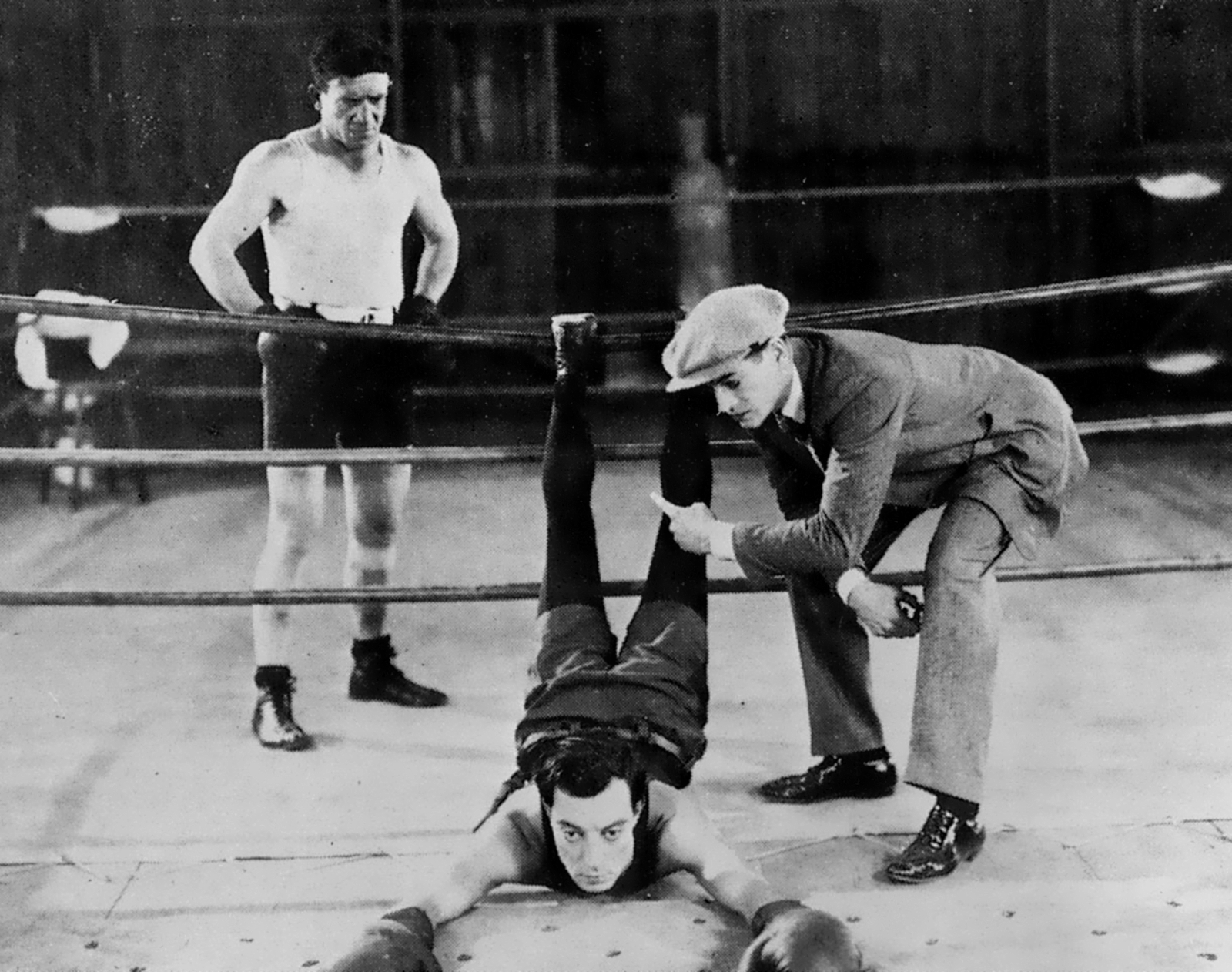
Buster Keaton in the boxing comedy 'Battling Butler' (1926).

What does silent film accompaniment have to do with boxing? Quite a lot, at least the way I approach it.

Not that doing movie scores is some kind of battle or struggle for victory. What I'm thinking about it is the preparation and rituals that go into a successful "main event."

Consider: this past weekend saw a pair of really satisfying silent film screenings.

On Saturday, Jan. 25, Buster Keaton brought down the house (consisting of about 70 people) in Schagticoke, N.Y. with his adventures in the classic comedy 'Steamboat Bill, Jr.' (1928).

And on Sunday, Jan. 26 in Wilton, N.H., Mary Pickford mesmerized an audience of about 100 in the melodrama 'Tess of the Storm County' (1922), a film I'd never done before.

For both shows, the live score came together naturally, and I felt strong and confident throughout the screenings. Everything happened quite fluently.

Even though I improvise, a lot of this was due to preparation that took place before curtain time.

For 'Steamboat Bill,' I drew from material I've been developing for several years over the course of repeated screenings. The score reflected this accumulated effort, I thought.

For 'Tess,' I came up some fresh material, including a hummable innocuous-sounding tune that first appears as a carefree jig, but later grows to play a prominent role in the story's dramatic high points.

In both cases, the result seemed to work well in bringing the film to life. I felt I was "in synch" with each picture and created music that helped it connect with the audience.

And this was good news, because earlier this month I felt otherwise. What happened was I had just returned from a month away from the keyboard (traveling in southern India), and the first few screenings were rough going.

So I guess I'm getting back in the swing of things after a month break.

And just in time, too. Two important gigs are looming: the Kansas Silent Film Festival in Topeka, Kansas at the end of February, and then Cinefest, the vintage film confab held every March in Syracuse, N.Y. For these events, I need to be in shape.

And that got me thinking of how accompanying silent films is a lot like being a boxer in training. You really need to be in the gym (or at the keyboard) pretty regularly to be in the right kind of shape when the main event comes around.

You can't just walk into the arena (or the cinema) and expect to do very well without putting in the time and effort to be prepared, both mentally and physically.

In boxing, that means roadwork and gym time and sparring. In silent film accompaniment, that means taking any opportunity to play before a live audience and immerse yourself in the craft.

(I've actually done some boxing—not competitively, but enough to know what it's like. Hence this line of thought.)

So since coming back from India, I've returned to training for the main events coming up in Kansas and then New York. Thinking of it this way helps keep me focused and compels me to challenge myself to push further.

And another thing about boxing is that once the bell rings, you have no choice but to stay in the moment: to be present in what's actually happening right in front of you, be ready for anything, and go wherever it takes you. Otherwise you risk suffering the consequences, which start at getting punched in the face and go up from there.

That's true in silent film, too. Once the film starts, the accompanist has to stay with it, maintaining concentration no matter what twists and turns the story takes. And if you do a really bad job, I suppose you do risk getting punched in the face, although that hasn't happened to me yet.

Carl Brisson in Hitchcock's 'The Ring' (1927).

There are other similarities. For one thing, at the end of a film, I sometimes feel just like Carl Brisson looks (above) in this still for Alfred Hitchcock's silent drama 'The Ring' (1927). But more often, I feel exhilarated and really alive, which reminds me of what it felt to actually do some sparring at Murphy's Boxing Gym in Manchester, N.H.

And just as boxers find that their sport can be so absorbing that it makes the rest of the world drop away, I find that the same thing happens with creating live music for silent films. After the opening titles, I find myself entering a mental state that some psychologists call "flow," but which I think of as intense concentration.

If it's going right, my critical faculties somehow partner with my creative subconscious, and I find it's possible to follow a film (even if I've never seen it) and improvise original music that fits the scene. At its best, the score can flow quite effortlessly. But it's all a result of complete absorption in the task at hand.

And that doesn't happen if I'm thinking about what's for lunch or about doing my income taxes. I have to be in the moment.

And I find the more I do it, the easier and more natural it becomes. Again, it's just like in boxing, where you repeat drills so all the complex body motions that go into throwing an effective uppercut come naturally, without having to think about them.

And that frees you up for strategy, right there in the ring. What are my opponent's weak spots? Is he leaving himself open? Will he tire before me? Should I work the body or go for the head?

In silent film accompaniment, I find that when the music is coming naturally, I can do a better job strategizing about how to make the overall picture work. Where's the high point of this scene? How does it relate to the climax of the picture? What do I need to hold back in reserve?

And then there's pacing and stamina. In the ring, a big part of success is being able to go the distance. It's not about landing a big punch, especially in amateur boxing. It's about staying focused and using technique and form to pile up points round by round. If you come on too strong, you'll tire early, and that's when you get your clock cleaned.

In silent film accompaniment, you need to pace yourself. You don't want to get too intense too soon, lest you leave yourself with no place to go when the film really does need a big gesture. And you need to be able to stay there, in real time with the film, for sometimes as long as three hours without a break.

And here's an interesting thought: music and fighting are actually combined in Muay Thai boxing as practiced in Thailand. There, the action inside the ring is usually accompanied by musicians who play a form of folk music that speeds up as the end of each round nears. This provides a cue to the fighters that time is running out, and also makes it more exciting to the boisterous fans.

Clara Bow puts up her dukes in 'Rough House Rosie' (1927), a lost film. I wouldn't mind going a few rounds with the 'It' girl.

And how about the notion of catharsis? Boxing allows participants a chance to transcend so-called "civilized" society. Instead, it gives us permission to engage in or witness something brutally physical, within certain limits, that is otherwise forbidden.

Likewise, silent film gives us permission to commune with big emotions that we often don't have a way of confronting or relishing in our own day-to-day living: Love! Fear! Joy! Revenge! Silent film gives permission to throw caution to the wind and let it all out.

You know, I find I like thinking of silent film in terms of boxing, and not just because it makes accompaniment seem just a little more macho than it really is.

But still, you won't find me swilling raw eggs for breakfast a la Sylvester Stallone in 'Rocky.' Among other reasons, my preferred breakfast food is Captain Crunch.