Showing posts with label Leavitt. Show all posts

Tuesday, October 23, 2018

Taking a different approach to Halloween:
this year, no plan or pattern whatsoever!

Let's see. Tomorrow it's Frankenstein. Friday it's Houdini. On Saturday, it's Satan. And Sunday, a Hunchback.

With an appointment calendar like that, Halloween can't be far off. And sure enough, the big day itself arrives Wednesday next week, when I have a date with the Phantom of the Opera.

It's the busiest time of the year for silent film accompaniment. The calendar is packed with screenings for boys and ghouls in search of an other-worldly experience.

Hence I'm keeping appointments with everyone from the Vampire Nosferatu to Mephistopheles, a.k.a. Satan.

This variety is a change for me. For previous Halloweens, I've generally picked one film to concentrate on accompanying, and then taken it around to all the various venues looking for a silent film spook fix.

Also, I tried to focus on films that aren't shown as often as the two biggies: Murnau's 'Nosferatu' (1922) and Lon Chaney's 'Phantom of the Opera' (1925).

So one year it was Alfred Hitchcock's early silent thriller 'The Lodger' (1927). Another year it was 'The Cat and the Canary' (1927), Paul Leni's Gothic haunted house picture. And another year it was Barrymore's 'Dr. Jekyll and Mr. Hyde' (1920).

By concentrating on one film for Halloween and taking it on tour, so to speak, I could really get to know the picture, and so burnish the improv-based accompaniment to a high gloss.

Well, not this year. This time around, it's a different title for nearly every screening. The only repeats: two Phantoms and two Hunchbacks. Otherwise, it's one-offs throughout the season.

Which I don't mind. It's a different kind of challenge to create music for a variety of films, one after another. And I've always felt that for me, the key to doing it well was doing it a lot.

That's what happened last week, which included a four-day stretch of shows in three different states. On Thursday in Massachusetts, it was 'Hunchback of Notre Dame,' followed by 'Wings' (a non-Halloween title!) on Friday up in Maine. Then on Saturday, it was the German thriller 'Der Golem' (1921) over in Vermont then on Sunday 'The Phantom of the Opera' down in Massachusetts again.

And I have to say, but by the time I sat down at the keyboard on Sunday night at the Aeronaut Brewing Co. in Somerville, Mass., I felt I was playing with a fluency and ease that simply wasn't present when I started the four-day run.

So doing it a lot, and mixing up the titles to challenge myself, really seems to work for me.

Does it work for you? Find out by attending one of the upcoming Halloween screenings on my calendar:

• Wednesday, Oct. 24, 2018, 7 p.m.: "Frankenstein program" at the Regent Theatre, 7 Medford St., Arlington, Mass.; (781) 646-4849. A triple feature of Frankenstein films, including the early (and short) silent Thomas Edison version. Tickets $8 per person. For more info: www.regenttheatre.com.

• Friday, Oct. 26, 2018, 8 p.m. "Harry Houdini Celebration"; Regent Theatre, 7 Medford St., Arlington, Mass.; (781) 646-4849. Celebrate the birthday of Harry Houdini, legendary illusionist and escape artist, with an evening that combines live performance with a silent film starring Houdini himself as a James Bond-like action/adventure hero. Silent film with live music in a treasured neighborhood theater and performance space. Tickets $15 in advance, $20 at door. For more info: www.regenttheatre.com.

• Saturday, Oct. 27, 2018, 7 p.m.: "Faust" (1926) directed by F.W. Murnau, starring Emil Jannings; Leavitt Theatre, 259 Main St. Route 1, Ogunquit, Maine; (207) 646-3123; http://www.leavittheatre.com. Join us for another season of vintage cinema at the historic Leavitt Theatre. Emil Jannings stars in F.W. Murnau's terrifying version of the classic tale. A visual tour de force, full of creepy characters and frightening images. See great silent films with live music in a summer-only theater opened in 1923 and barely changed since. Admission $10 per person.

• Sunday, Oct. 28, 2018, 4:30 p.m.: "Hunchback of Notre Dame" (1923) starring Lon Chaney; Wilton Town Hall Theatre, Main Street, Wilton, N.H.; (603) 654-3456; www.wiltontownhalltheatre.com. Just in time for Halloween! Lon Chaney stars in the original screen adaptation of Victor Hugo's classic novel about a deformed bellringer in medieval Paris. A moving and timeless drama filled with classic scenes and capped with a thrilling climax! Monthly series of silent films with live music at a theater where movies have been shown since 1912! Admission free, donations of $5 per person encouraged.

• Wednesday, Oct. 31, 2018, 7 p.m.: "The Phantom of the Opera" (1925) starring Lon Chaney; Colonial Theatre, 95 Main Street, Keene, N.H.; (603) 352-2033; www.thecolonial.org. Celebrate Halloween with one of the all-time classics. Long before Andrew Lloyd Webber created the hit stage musical, this silent film adaptation starring Lon Chaney helped place 'Phantom' firmly in the pantheon of both horror and romance. Silent film with live music in a theater that originally opened as a silent movie house in 1924. Tickets: $6.50 per person, general admission.

Tuesday, September 11, 2018

In this corner, 'Her Sister From Paris,' then later a true heavyweight: 'The Last Laugh'

Ronald Colman proves no match for Constance Talmadge in 'Her Sister From Paris.'

If silent films were classified like boxers, the next two evenings will see action in the lightweight and heavyweight divisions.

• On Wednesday, Sept. 12, I'll accompany a screening of 'Her Sister From Paris' (1925), a frothy society comedy starring Ronald Colman and Constance Talmadge.

Although both stars are in peak form, I'd say the fluffy nature of the story puts the film squarely in the lightweight division.

However, it's often described as a "battle of the sexes" comedy, so expect lots of quick action and fancy footwork—typical of the lighter weight classes.

The screening starts at 7 p.m. at the historic Leavitt Theatre, 259 Main St., Ogunquit, Maine. Admission $10 per person.

For more info, visit the Leavitt Theatre online.

Emil Jannings ponders his fate in 'The Last Laugh' (1924).

• Then, on Thursday, Sept. 13, it's down to Arlington, Mass. for a true heavyweight experience: Emil Jannings in F.W. Murnau's 'The Last Laugh' (1924).

In a silent film "main event," Murnau takes a simple situation and uses the then-new medium of cinema to depict a man's emotional journey with immense power.

I'll accompany Jannings as he does battle with a formidable opponent: his own sense of self-worth.

Showtime is 8 p.m. at the Capitol Theatre, 204 Massachusetts Ave., Arlington, Mass.

An original 'Wings' poster featuring Clara Bow.

• And then this weekend brings me to the Orpheum Theatre in Sioux City, Iowa, where I'll accompany a screening of the great WWI classic 'Wings' (1927) on the Mighty Wurlitzer.

It's part of the annual Sioux City International Film Festival, and I'm thrilled to be going out again to do live music in this incredible venue.

Showtime for this one is Sunday, Sept. 16 at noon. For more info, visit the Sioux City International Film Festival online.

More screenings at the end of the month, including Josef von Sternberg's amazing 'The Last Command' (1928) at the Museum of Russian Icons in Clinton, Mass. and the original silent film version of 'Chicago' (1927).

Stay tuned, or check the schedule: there's a link at the top right of every page!

Monday, October 31, 2016

Wrapping up a silent film Halloween...
...or are the scariest days yet to come?

A pseudo-audience member awaits 'The Man Who Laughs' at the Leavitt Theatre.

Okay, finished the annual Halloween marathon strong with three very intense screenings this past weekend:

• On Friday, Oct. 28, created a live score for 'Nosferatu' (1922) at the Regent Theatre in Arlington, Mass.

• On Saturday, Oct. 29, did music for 'The Man Who Laughs' (1928) at the Leavitt Theatre in Ogunquit, Maine.

• And finally, on Sunday, Oct. 30, accompanied 'The Phantom of the Opera' (1925) at the Town Hall Theatre in Wilton, N.H.

For each of these shows, the music fell together a very satisfying way. I felt I was able to come up with suitably dramatic and/or spooky music when needed, but also stuff that allowed the humor in each film to come out.

Put another way: each of the films was able to breathe.

Pre-show prep at the Leavitt Theatre, with fog and fake attendees.

For 'Nosferatu,' it was the only time this year I played for this film, so it had a freshness and excitement that's sometimes difficult to manage when you've already accompanied a title, say, three times in two weeks.

I know the movie well enough, so I didn't even preview it prior to the screening, which drew a huge crowd to the Regent.

I actually did remember one thing about 'Nosferatu': that I need a musical signature for the images of a rooster crowing, which form an important part of the film's climax.

This time I remembered, and it all worked very effectively. But on the other hand, I muffed one of the two scenes where the clock is striking midnight.

The first time, it's pretty easy: the camera cuts to a clock, which is when I start the chimes: in my case, a small bellhop bell tapped steadily 12 time, if I count right.

But the second time (on the next night), the character of Hutter hears the chimes sounding, and reacts to them, before the scene cuts to the same clock, with the ringing in progress.

On Friday night, poor Hutter reacted quite visibly to chimes that couldn't be heard until the camera cut to them. Ooops!

The perils of trying to time sound effects to on-screen action. But afterwards, a guy said he thought I totally nailed it. So go figure!

The next night, the screening of 'The Man Who Laughs' up at the Leavitt Theatre in Ogunquit, Maine was memorable as much for the atmosphere as for the music.

Patrons of the Leavitt Theatre had to negotiate this display outside the lobby.

As a gay-friendly seaside resort, Ogunquit doesn't hold back at Halloween. The costumes of people bar-hopping downtown are amazing: I saw several men dressed as Las Vegas chorus girls tottering

And at the Leavitt Theatre, the Clayton family had transformed their vintage building (opened in 1923), into a "haunted theater," filling the interior with cobwebs and stage fog.

During the day, visitors brave enough to enter were taken inside, where mannequins sat motionless in the chairs and spirits were liable to pop out from anywhere!

The tours continued past 7 p.m., and all the decorations were left in place, so the theater just sort of morphed into a movie theater at some point prior to our show, with me using a pipe organ patch to play spooky funeral parlor music on my keyboard.

Ian Clayton of the Leavitt on stage above my cob-webby keyboard in the pit.

That night's screening of 'The Man Who Laughs' was the last of four I'd accompanied in the past two weeks. (Strangely, all four were in different stages: Maine, New Hampshire, Vermont, and Massachusetts!)

I had accumulated some good material, I thought, and so was able work it up into something pretty effective for Saturday's final go-round. Very gratifying to help this great film come to life and connect with audiences.

For 'Phantom of the Opera' on Sunday, I was able to once more use the opening line that I developed for this season's screenings: "Nothing is more appropriate for Halloween than a silent film because EVERYONE in this picture is DEAD!"

It produces laughs. What can I say?

Well, in Wilton, I said that until very recently, everyone in 'Phantom' was NOT dead. Carla Laemmle, niece of Universal Studios boss Carl Laemmle, danced in 'Phantom' as a teenager. And by God if she still wasn't with us all the way up until 2014, when she died at age 104.

This earned Carla a spontaneous round of applause!

Carla still going strong in her later years.

I also tried out the "audience participation" approach I've developed with Phantom screenings.

The Wilton crowd, one of the largest we've ever hosted, was into it: they applauded lustily during the on-screen opera house ovations, and shrieked pretty convincingly when the chandelier dropped and you-know-who got unmasked.

And with that we enter November, and with that the calendar lightens up a bit.

But not right away. Tomorrow night, I have a "fire and water" double feature at the Manchester (N.H.) City Library. The two flicks on the program are firefighting drama 'The Third Alarm' (1922) and Coast Guard adventure 'Coast Patrol' (1925).

And then I take a deep breath before tackling 'Wings' on Friday night for the Aviation Museum of N.H., which is screening the film as a benefit in their hanger on the grounds of Manchester-Boston Regional Airport. More on that in a follow-up post.

And then the next morning, I return to the same airport to fly out on my way to San Francisco, where that night I'm accompanying William S. Hart's very first film, 'The Bargain' (1914) at the wonderful Niles Essanay Silent Film Museum.

Ronald Colman matches wits with Constance Talmadge in 'Her Sister From Paris' (1925).

And then I'm doing 'Her Sister From Paris' (1925) on Thursday, Nov. 10 at the Flying Monkey Moviehouse and Performance Center in Plymouth, N.H. And then...

So what was I saying about slowing down?

Maybe I was mistaken. Maybe Halloween isn't really over yet.

After all, with the Presidential election just eight days away, perhaps the scariest times are yet to come!

Wednesday, August 24, 2016

Coming up: A double dose of Rudolph Valentino
— plus composing, scoring a piece for orchestra

Some of our Kilimanjaro team at Karanga Camp, 12,800 feet, six days into the trek and two days before our summit attempt.

A cluster of shows coming up this week, including two screenings of Valentino's 'Son of the Sheik' (1926) in two very different parts of New England.

And then the decks will be cleared to make progress on a project that I'm very excited about—one involving that big mountain pictured above.

But first things first: the Valentino screenings will honor the 90th anniversary of the star's untimely death, which occurred on Aug. 23, 1926.

To mark this occasion, we're running his final film—'Son of the Sheik' (1926)—at the Leavitt Theatre in Ogunquit, Maine on Thursday, Aug. 25, and then again on Saturday, Aug. 27 in Brandon Town Hall up in Brandon, Vt.

Detailed info about either screening can be found by clicking on the "Upcoming Silent Film Screenings" link at the upper right.

Coming to a theater near you—if you live in Maine or Vermont.

Valentino is one of the few silent-era stars whose name still holds sway with the public. So we usually get a good turnout when his name is on the program.

It's a great way to experience the special magic that he brought to the silver screen, so hope to see you there!

And then on Sunday, Aug. 28, it's the final installment of our summer series of silent boxing films at the Wilton (N.H.) Town Hall Theatre.

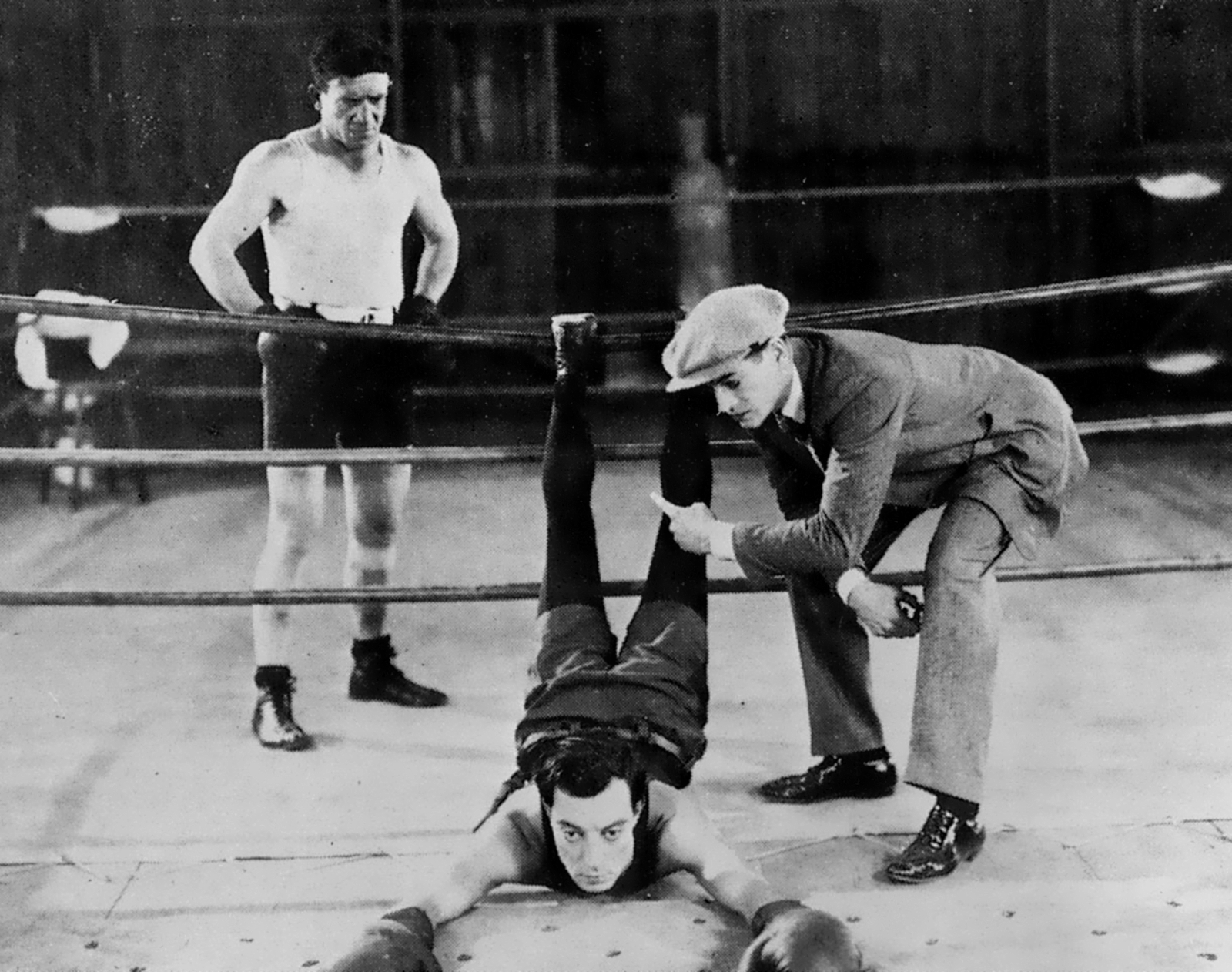
Keaton puts up his dukes in 'Battling Butler.

We're finishing with Buster Keaton's uproarious comedy, 'Battling Butler' (1926). The bell rings at 4:30 p.m.

Though not regarded as one of Buster's timeless classics, 'Butler' was the highest-grossing of any of Keaton's silent features in the 1920s.

In fact, its box office success was one reason that producer Joe Schenck allowed Keaton to go ahead with his ambitious next film, 'The General.'

So if you've enjoyed the Civil War adventure regarded as Buster's masterpiece, you might want to check out 'Butler,' the film that helped make it possible.

Why boxing? Popular in the 1920s, it remains a compelling marriage of civilization and brutality. Read Joyce Carol Oates' 'On Boxing' and you'll see what I mean.

Okay. what about this new project?

This summer, in-between improv-heavy silent film gigs, I've been putting together something completely different: a written-down piece for orchestra.

It's not a film score. It's a concert piece.

Kilimanjaro: the highest and biggest free-standing mountain the world.

Specifically, it's a musical depiction of Mount Kilimanjaro—you know, the big snow-capped peak in East Africa.

And it's scheduled to be played in January, 2017 by the New Hampshire Philharmonic, an orchestra based right here in my home state!

Just today I noticed the piece is listed on the Philharmonic's Web site (www.nhphil.org), so I figured it would be okay to go public.

The thing is, I'm still working on it, and expect to continue to do so for awhile yet. So this might help spur me on.

(Leonard Bernstein wrote music based on 'The Age of Anxiety.' Today, we live in 'The Age of Distraction.')

We negotiate the "Kissing Rock" on a cliff known as the Breakfast Wall above Barranco Camp.

Over the years I've been doing live accompaniment for silent films, I've gradually developed a musical vocabulary or language that I feel works for me.

And now I sense it's time to start using it in ways that are different from the improvised movie scores genre.

I still expect most of my musical energies will go towards creating in-the-moment film music.

But I sense it's time to starting writing some things down and see how that goes.

Why Kilimanjaro? Unexpected forces conspired to make this happen.

For starters, I had the good fortune to be part of a team that successfully reached Kilimanjaro's 19,431-foot summit in January 2015.

Our team on Day 5, coming down from Lava Tower Camp at 15,000 feet.

I didn't sign up for artistic purposes. I just wanted to see if I could do it.

But I was surprised to find the 10-day journey of hauling yourself up and then down the highest peak in Africa is an experience filled with music of various types.

One example: on the final overnight push to the summit, as we slowly ascended a narrow trail through the pre-dawn darkness, Tanzanian guides from several teams spontaneously sang traditional Christian hymns in Swahili. Wow!

Also, not a day goes by on the mountain without people breaking out into "Jambo Bwana," otherwise known as the Kilimanjaro Song.

On a more abstract level, there's the mountain itself. Go there and march all around it, as we did, and you'll find it makes music all its own.

Someone once said that great architecture is music frozen in time. I think that's true with nature, too—or at least that's what I found with Kilimanjaro.

On the summit, dawn, Jan. 10, 2015. Groups generally spend only a half-hour at the top of Kilimanjaro due to lack of oxygen and cold temperatures.

And I felt I wanted to capture some of that: the long trek across the volcanic plains, the drama of scrambling up the "Breakfast Wall," the intense experience of marching one step at a time at high altitude to the frozen summit ridge.

But there's more. It turns out that Mark Latham, the Philharmonic's music director, is from a family of British medical officers with a long history on Kilimanjaro.

Mark's grandfather was the first Englishman to climb to the summit following World War I, after the Germans ceded what was then the colony of "Tanganyika" to the United Kingdom.

Another one of his relatives (I think Mark's great-uncle) was the guy who discovered the frozen leopard on Kilimanjaro's upper slopes that Ernest Hemingway made so much of.

One of the sub peaks is "Latham Peak," and a key spot on the main climbing route is "Stella Point," named after Mark's great aunt, apparently the first woman to ever reach the summit.

Summit photo op. How often do you get to pose with a receding glacier?

And Mark himself was born in Tanzania, and climbed Kilimanjaro some years ago. Prior to our more recent ascent, he let us look through the family's scrapbooks, which was fascinating.

All of this seemed to be drawing us all together and suggesting that we do something musical about Kilimanjaro. And so we are!

So mark your calendars: the Philharmonic has the "Kilimanjaro Suite" on their schedule for Saturday, Jan. 20 and again on Sunday, Jan. 21.

And once this is done, I can start work on that long-awaited Pam Smart opera.

Me at the end of our climb, inspecting the "Tourist Rescue Book."

Tuesday, May 31, 2016

This week at Ogunquit's Leavitt Theatre:
Step into the ring with Buster Keaton

A vintage poster for 'Battling Butler' that renders the athletic Keaton as unusually scrawny.

Next up: Buster Keaton's boxing comedy 'Battling Butler' (1926).

I'm doing live music for this film on Thursday, June 2 at the Leavitt Theatre in Ogunquit, Maine.

Details about the screening are in the press release below.

But one thing about this film that has always impressed me is how it shows Keaton's sure instinct for story construction.

The storyline for 'Battling Butler' was taken from a popular stage play about a meek millionaire who must train to fight a champion in the ring.

In the play, the story climaxes in the dressing room just before the fight, when the millionaire finds out he doesn't have to face the champion. Happy ending!

However, in transferring the story to the screen, Keaton knew his character and his audience well enough to know the non-fight ending just wasn't going to work.

To quote Keaton himiself in a late-in-life interview: "But we knew better than to do that to a motion-picture audience. We couldn’t promise ’em for seven reels that I was goin’ to fight in the ring and then not fight. We knew that we had to fight."

So they changed the story accordingly—and the result was Keaton's highest-grossing film of the 1920s.

Keaton in 'Battling Butler' (1926).

How did Keaton know to do this? There was no film school at the time, and Keaton never went to any traditional school, either. He spent his childhood touring in the family vaudeville act.

I suspect that over the years, he absorbed so much about how theater audiences react that his sense of what would work in a story and what wouldn't was instinctual. He just knew.

Same thing with his masterpiece, 'The General' (1926), made right after 'Battling Butler.'

Keaton structured his Civil War story to put his role on the Confederate side, because he said (again, in a late-in-life interview) "You can always make villains out of the Northerners, but you cannot make a villain out of the South."

Why? Because the South lost? I don't know.

By the way, I'm accompanying a screening of 'The General' on Friday, June 10 at Red River Theatres in Concord, N.H. More about later.

For now, I hope you'll join us this Thursday to see Buster Keaton lace up the gloves in 'Battling Butler' (1926).

The press release is below. See you there!

* * *

A vintage poster for 'Battling Butler' (1926).

TUESDAY, MAY 24, 2016 / FOR IMMEDIATE RELEASE
For more info, contact: Jeff Rapsis • (603) 236-9237 • jeffrapsis@gmail.com

Buster Keaton comedy 'Battling Butler' at Leavitt Theatre on Thursday, June 2


Classic silent film farce set in the boxing world to be screened with live music in historic downtown Ogunquit venue

OGUNQUIT, Maine—He never smiled on camera, earning him the nickname of "the Great Stone Face." But Buster Keaton's comedies rocked Hollywood's silent era with laughter throughout the 1920s.

See for yourself with a screening of 'Battling Butler' (1926), one of Keaton's landmark feature films, on Thursday, June 2 at 8 p.m. at the Leavitt Theatre, 259 Main St. Route 1, Ogunquit, Maine

The one-time screening will feature live music performed by Jeff Rapsis. Tickets are $10 per person.

In 'Battling Butler,' Keaton plays Alfred Butler, a pampered millionaire who is mistaken for a boxer with a similar name.

The mix-up gives the meek Butler the chance to pretend he's a prizefighter to impress the family of the woman he loves.

But then Keaton is forced to enter training for a high-stakes championship bout, with surprising results.

The boxing scenes gave Keaton ample opportunity to wring physical comedy out of the fight game, which at the time rivaled baseball in popularity.

Based on a story adapted from a popular stage play, 'Battling Butler' was Keaton's highest-grossing silent feature film and the high point of his 1920s stardom.

Keaton takes a pratfall in 'Battling Butler.'

Today Keaton, along with Charlie Chaplin and Harold Lloyd, stands as one of the three great clowns of the silent screen.

Many critics regard Keaton as the best of all; Roger Ebert wrote in 2002 that "in an extraordinary period from 1920 to 1929, (Keaton) worked without interruption on a series of films that make him, arguably, the greatest actor-director in the history of the movies."

As a performer, Keaton was uniquely suited to the demands of silent comedy. Born in 1895, he made his stage debut as a toddler, joining his family's knockabout vaudeville act and learning to take falls and do acrobatic stunts at an early age. He spent his entire childhood and adolescence on stage, attending school for exactly one day.

A remarkable pantomime artist, Keaton naturally used his whole body to communicate emotions ranging from sadness to surprise. In an era when movies had few special effects, Keaton's acrobatic talents meant he performed all his own stunts.

In reviving 'Battling Butler' and other great films of cinema's early years, organizers of Leavitt's silent film series aim to show classic movies as they were meant to be seen—in high quality prints, on a large screen, with live music, and with an audience.

"These are the films that first made people fall in love with the movies, and we're thrilled to present them again on the big screen," said Peter Clayton, the Leavitt's long-time owner.

The Leavitt, a summer-only moviehouse, opened in 1923 at the height of the silent film era, and has been showing movies to summertime visitors for nine decades.

The silent film series honors the theater's long service as a moviehouse that has entertained generations of Seacoast residents and visitors, in good times and in bad.

Live music for each program will be provided by Jeff Rapsis, a New Hampshire-based performer and composer who specializes in scoring silent films.

In accompanying silent films live, Rapsis uses a digital synthesizer to recreate the texture of the full orchestra. He improvises the music in real time, as the movie is shown.

In scoring a movie, Rapsis creates music to help modern movie-goers accept silent film as a vital art form rather than something antiquated or obsolete.

Other feature films in this year's series include:

• Thursday, June 23 at 8 p.m.: 'Don Q, Son of Zorro' (1925), Douglas Fairbanks Sr. stars in this sequel to his immensely popular 'Mark of Zorro,' which opened this season's silent film series.

• Thursday, July 7 at 8 p.m.: 'A Sailor-Made Man' (1921), uproarious send-up of Navy life helped establish Harold Lloyd as a top-tier silent film comic.

• Thursday, July 21 at 8 p.m.: 'Tess of the Storm Country' (1922), Mary Pickford's intense melodrama with a classic Yuletide finish. Christmas in July!

• Thursday, Aug. 11 at 8 p.m.: 'Tramp Tramp Tramp' (1926); comic Harry Langdon enters a cross-country foot race to impress his dream girl, Joan Crawford!

• Thursday, Aug. 25 at 8 p.m.: 'Son of the Sheik' (1926), final appearance of silent screen icon Rudolph Valentino on the 90th anniversary of his death.

• Thursday, Sept. 15 at 8 p.m.: 'The Winning of Barbara Worth' (1927); Ronald Colman and Gary Cooper compete for a woman's favor in this epic Western filmed on location.

• Saturday, Oct. 29 at 8 p.m.: 'The Man Who Laughs' (1928); celebrate Halloween with this creepy but riveting historical tale about a man forced to go through life with a maniacal grin.

Buster Keaton's comedy 'Battling Butler' (1926) will be shown with live music on Thursday, June 2 at 8 p.m. at the Leavitt Fine Arts Theatre, 259 Main St. Route 1, Ogunquit, Maine; (207) 646-3123; admission is $10 per person, general seating. For more information, visit www.leavittheatre.com. For more info on the music, visit www.jeffrapsis.com.

Tuesday, May 26, 2015

'Steamboat Bill Jr.' (1928) leads off series
at historic Leavitt Theatre in Ogunquit, Maine

The interior of the Leavitt Theatre in Ogunquit, Maine.

And now for a silent film series where the theater is part of the show!

Really: the Leavitt Theatre in Ogunquit Maine first opened as a moviehouse in 1923, and has remained pretty much unchanged ever since.

Yes, there's upgraded digital projection and sound so first-run films can be run during the summer tourist season.

But the building itself, inside and out, gives you essentially the same movie-going experience as it did in 1923. Same wooden sloping floors, same wooden seats, same plain Maine decor.

Three cheers to longtime owners Peter and Maureen Clayton for keeping the Leavitt going since the mid-1970s. And best of luck to son Ian, who is assuming more responsibility for programming and running the theater this season.

The Leavitt's ticket booth has guarded the theater's entry for decades.

We've been doing silent film with live music at the Leavitt for a few years now, and it's back on the schedule this season—a total of seven film programs from now through Halloween.

I'm grateful to the Clayton family's support of silent film with live music, and we've been getting good crowds, too. So it's a great place to get the "total" silent film experience: the picture and live music, but also the crucial element of seeing a film with a large audience.

First up is Buster Keaton's classic feature comedy 'Steamboat Bill Jr.' (1928), which we're running on Thursday, June 4 at 8 p.m. Admission is $10 per person.

For more information about this year's silent film series at the Leavitt, check out the press release below.

Hope to see you there!

* * *


TUESDAY, MAY 26, 2015 / FOR IMMEDIATE RELEASE
For more info, contact: Jeff Rapsis • (603) 236-9237 • jeffrapsis@gmail.com

Leavitt Theatre to host summer silent film series with live music


Classic comedies, action-packed dramas highlight schedule; featured stars include Chaplin, Keaton, and Clara Bow

OGUNQUIT, Maine—Classics of the silent film era will return to the big screen starting next month at Ogunquit's Leavitt Theatre, which will host a season of vintage cinema with live music in the historic facility.

The series gives area film fans a chance to see great movies from the pioneering days of cinema as they were intended to be shown—on the big screen, with an audience, and accompanied by live music.

Most screenings will be on Thursday evenings and will begin on Thursday, June 4 with the Buster Keaton comedy 'Steamboat Bill, Jr.' (1928). The series runs through October, concluding with a Halloween screening of Alfred Hitchcock's early horror classic 'The Lodger' (1927), to be shown on Saturday, Oct. 31.

Admission is $10 per person.

A total of seven programs will be offered in the series. Films will include comedies by Charlie Chaplin, Harold Lloyd, and Harry Langdon. Dramas include MGM's epic silent version of 'Ben Hur' (1925) as well as 'Wings' (1927), a blockbuster film about World War I aviators that won the first-ever Academy Award for Best Picture.

"These are the films that first made people fall in love with the movies, and we're thrilled to present them again on the big screen," said Peter Clayton, the Leavitt's long-time owner.

The Leavitt, a summer-only moviehouse, opened in 1923 at the height of the silent film era, and has been showing movies to summertime visitors for nine decades.

The silent film series honors the theater's long service as a moviehouse that has entertained generations of Seacoast residents and visitors, in good times and in bad.

"These movies were intended to be shown in this kind of environment, and with live music and with an audience," Clayton said. "Put it all together, and you've got great entertainment that still has a lot of power to move people."

Live music for each program will be provided by Jeff Rapsis, a New Hampshire-based performer and composer who specializes in scoring silent films.

In accompanying silent films live, Rapsis uses a digital synthesizer to recreate the texture of the full orchestra. He improvises the music in real time, as the movie is shown.

In scoring a movie, Rapsis creates music to help modern movie-goers accept silent film as a vital art form rather than something antiquated or obsolete.

"Silent film is a timeless art form that still has a unique emotional power, as the recent success of 'The Artist' has shown," Rapsis said.

Buster Keaton and Ernest Torrence in 'Steamboat Bill Jr.' (1928).

First up in the Leavitt's series is 'Steamboat Bill Jr.' (1928), a classic silent film comedy starring Buster Keaton.

In 'Steamboat Bill Jr.,' Buster plays the bumbling son of a riverboat’s rough-hewn captain. When a rival brings a newer boat to the river, the family is forced to face competition, just as Buster is forced to ride out a cyclone threatening to destroy the community.

Can Buster save the day and win the hand of his girlfriend, who happens to be daughter of his father's business rival?

The film includes the famous shot of an entire building front collapsing on Keaton, who is miraculously spared by a conveniently placed second-story window.

Other feature films in this year's series include:

• Thursday, June 18, 2015, 8 p.m. 'Wings' (1927) starring Clara Bow, Charles "Buddy" Rogers, Richard Arlen; directed by William Wellman. Sweeping drama about fighter pilots in World War I; one of the great achievements of the silent cinema, winner of "Best Picture" at the first-ever Academy Awards. Compelling story, great performances, battle scenes filmed on an immense scale, and in-air aviation sequences that remain thrilling even today.

• Thursday, July 30, 2015, 8 p.m.: 'Silent Comedy with Harold Lloyd.' See why Harold Lloyd was the most popular performer of the silent film era. Instead of getting ahead, his everyone man character (a nice young man with horn-rimmed glasses) had a knack for getting into spectacular trouble, often requiring him to overcome amazing odds to win the day.

• Thursday, Aug. 6, 2015, 8 p.m.: 'The Kid' (1921) starring Charlie Chaplin, Jackie Coogan. Chaplin's landmark comedy/drama about a man who raises an infant against all odds. As the film tells us: "A story with a smile, and perhaps a tear." Highlighted by amazing performance of four-year-old Coogan, who matches Chaplin pratfall for pratfall. Also, two of Charlie's earlier slapstick comedy shorts that helped establish him as a star.

• Thursday, Aug. 20, 2015, 8 p.m.: 'Ben Hur' (1925) starring Ramon Navarro. In the Holy Land, a Jewish prince is enslaved by the occupying Romans; inspired by encounters with Jesus, he lives to seek justice. One of the great religious epics of Hollywood's silent film era, including a legendary chariot race that's lost none of its power to thrill.

• Thursday, Sept. 17, 2015, 8 p.m.: 'Silent Comedy with Harry Langdon' Silent comedy featuring the unique style of Harry Langdon, whose innocent baby-faced character rocketed to fame late in the silent era on the strength of films directed by a very young Frank Capra. Rediscover Harry's quiet genius the way it was intended to be seen: on the big screen and with a live audience.

• Saturday, Oct. 31, 2015, 8 p.m.: 'The Lodger' (1927). A serial killer is on the loose in fog-bound London. Will the murderer be caught before yet another victim is claimed? Just in time for Halloween, suspenseful British thriller directed by a very young Alfred Hitchcock. The program is subtitled 'Chiller Theater' due to the theater's lack of central heating.

Buster Keaton's classic comedy 'Steamboat Bill Jr.' (1928) will lead off this season's silent film series on Thursday, June 4 at 8 p.m. at the Leavitt Fine Arts Theatre, 259 Main St. Route 1, Ogunquit, Maine; (207) 646-3123; admission is $10 per person, general seating. For more information, visit http://www.leavittheatre.com. For more info on the music, visit www.jeffrapsis.com.

Monday, August 22, 2011

Saturday marathon, Sunday with Buster

Just a few notes on films from this past weekend while they're still fresh in my mind.

On Saturday, Aug. 20, played from 10:30 a.m. to 4:30 p.m. for films at the Wilton (N.H.) Town Hall Theatre, with an hour for lunch. Part of our annual Mirthquake festival, the morning was non-stop obscure comedy shorts and fragments, some with intertitles in German or Danish, while the afternoon saw two back-to-back features: Eddie Cantor in 'Special Delivery' (1927) and then the immensely silly 'Cruise of the Jasper B.' Hey, look! There's our name above the doors to the main theater!

Not much of an audience for these films, alas, but playing all the shorts cold (I'd never seen any of them) was a great workout for a silent film accompanist. And I really mean that, because I find it takes awhile for me to get "in the zone," meaning the music comes naturally and without a lot of conscious thought. And the best way for me to achieve that state, it seems, is to just immerse myself in the process and do it until I'm completely absorbed. Then things begin to flow with an ease that's hard to describe, and which sometimes surprises me.

I saw that happen on Saturday in Wilton. After a morning of running through one silent comedy short after another, I was in a state where the music just came naturally. And so I was as astonished and delighted as anybody as a full-fledged and finished-sounding score emerged for 'Special Delivery,' the Eddie Cantor film. I based in mostly on the old "Bye Bye Blackbird" tune by Ray Henderson and Mort Dixon, which a little research reveals was the "#16 song of 1926" and which Eddie sings (and dances to) in the middle of the film.

When a character in a silent film asks street musicians to play "Bye Bye Blackbird," and it's a tune that a lot of people would still recognize, then I think it's wise to come through with the tune rather than anything else. And in this case, it was fortuitous, because the melody is well-suited for Cantor's character: by turns jaunty but also a little wistful. So it became the "theme song" for the whole picture, which means not that I kept playing it over and over again, but that I put it in a blender and used little pieces of it here and there to accompany scenes and interactions. I think I only played the actual complete tune (or actually, the chorus, the part that everyone knows) twice: once at the very beginning over the opening credits, and then when Eddie actually does sing it. I had a few other melodies going for other characters, such as the Jobyna Ralston love interest and the William Powell confidence man, and it all came together very effectively, I thought.

And like a lot of things, this level was hard to sustain. The next feature, 'The Cruise of the Jasper B' (1926), was fun, but I think I peaked for the Cantor film and fatigue was starting to set in. It's a fun film and I had a good time starting out with full-fledged pirate music from the briny sea for the 18th century prologue, and then taking the swashbuckling theme and distorting it to accompany the "modern" action eight generations later. But it's hard to keep up the level of intensity during this kind of a marathon, and but the middle of 'Cruise' I found it more difficult to stay focused. Plus, it's a zany comedy and demands a certain kind of freshness, I think, that's hard to conjure up after playing for nearly six hours. :)

Still, it was fun, and I was surprised at the end when the lights came up to find a small group of people in attendance. Most were apparently early arrivals for the next film at 4:30 p.m., 'Sitting Pretty' (1948), but I'll take any audience I can get. I have to say, though, that if these folks were silent film newbies, the completely silly ending of 'Cruise' (with the entire U.S. military under mobilization to attack a mothballed 200-year-old pirate ship) did not probably make the most coherent impression...

A much better impression was made, I think, the next day (Sunday, Aug. 21), when I trekked out to the Leavitt Theatre in Ogunquit, Maine for my first-ever experience with Blu-ray hi-def silent film transfers. Two nautically flavored Keatons were on the program: the short 'The Boat' (1921) and 'Steamboat Bill, Jr.' (1928), both shown in the new Kino Blu-ray transfers. (For what it's worth, a snapshot of what was onscreen during the pre-show tryout is posted here.) They did look quite sharp, even though the theater's throw lens seemed to have some slight imperfections that caused the edges to ghost.

But no matter -- we had a nice crowd of about 25 people on hand, though it grew smaller when a couple realized that the 2 p.m. matinee was not a screening of 'Crazy Stupid Love' and walked out. Oh well! But here's a shot of the Leavitt's marquee, and I can see how they might have gotten confused...

And as I write this, New England is in the sights of Hurricane Irene, which is scheduled to arrive here this Sunday and go right up the Maine coast. Both those films, with their extended cyclone sequences, would have been perfect! Off by a week. Timing is everything...

Instead of hurricanes, we'll be screening films about love this coming weekend, as we finish off our mini "Summer Love" series at the Wilton (N.H.) Town Hall Theatre with a double feature: 'Flirting with Fate' (1916), an early Douglas Fairbanks; and Norma Talmadge in the restored 'Kiki' (1926). The show will go on, come rain or wind or whatever, so hope to see you there!