Showing posts with label Campton Historical Society. Show all posts

Sunday, February 4, 2024

Warm up for Valentine's Day with Garbo and Gilbert in 'Flesh and the Devil' on Monday, 2/5

Greta Garbo and John Gilbert in 'Flesh and the Devil' (1926).

Next up: it's 'Flesh and the Devil' (1926), a romantic thriller starring Greta Garbo and John Gilbert. I'm accompanying the film on Monday, Feb. 5 at 6:30 p.m. at the Garden Cinemas in Greenfield, Mass.

 A massive success that cemented Garbo's career, the film features love scenes that were not faked, as the two stars were involved in a heated affair during filming. Director Clarence Brown later said he just had to start the cameras and then stand back!

Lots more info in the press release below. But first, a few notes about last night's screening at the Campton (N.H.) Historical Society, an annual event that includes a pot luck supper and a considerable amount of small-town charm.

For example: announcements prior to my introduction included an upcoming Antique Snowmobile Meet sponsored by the local Chamber of Commerce.  

When I got up to speak, I made the usual lame jokes (including one about the peanut brittle on the dessert table, which I said four out of five dentists recommended because it's so good for business), but then I realized something about the evening.

The scene prior to Saturday night's screening at the Campton Historical Society.

I found myself saying that as a silent film accompanist, it's been my privilege to be invited to perform in such far-flung and glamorous show-biz meccas as Topeka, Kansas, where I'll perform later this month at the Kansas Silent Film Festival, and Cleveland, Ohio, where I get to accompany films in March.

But, I said, despite the romance of these exotic places, it was unlikely that any of them would include announcements about the Chamber of Commerce hosting antique snowmobile meets. 

So the annual Pot Luck Supper / Silent Film Screening at the Campton Historical Society, traditionally held in the dead of winter, was special to me because it was home, or at least the small part of the world that was really familiar to me.

Dig in! The 'Pot Luck Supper' portion of last night's program.

Last night's screening was not without its celebrity guests, however. Prior the the show, when I was warming up at the keyboard, a woman came up to me and began chatting.

Her name was Danielle Freund-Buckman, and turn out she was the granddaughter legendary cinematographer Karl Freund's borther! That made her, let's see...Karl Freund's grand-niece, I think. 

So I introduced her to the audience, members of which of course would have no idea who Karl Freund was. I explained he was not related to Sigmund Freud, whose name was different anyway, but he was a cinematographer for many influential films in the 1920s, including F.W. Murnau's 'The Last Laugh' (1924) and Fritz Lang's 'Metropolis' (1927).

I probably would have made a bigger impression by mentioning that Freund photographed 'Dracula' (1931) starring Bela Lugosi, and also directed Boris Karloff in 'The Mummy' (1932), and also an obscure picture called 'Moonlight and Pretzels' (1933) that is my FAVORITE 1930s musical, based on a single screening I saw at a long-ago Cinefest celebration in Syracuse, N.Y. (Another show biz capital!)

Instead, I mentioned the one thing that I knew would hit home: later in his career Freund developed the three-camera system used to shoot episodes of 'I Love Lucy' in the 1950s, and hundreds of sitcoms in the years since. Everyone perked up at that, and Mrs. Freund-Buckman was duly showered with applause.

The film was Chaplin's 'The Gold Rush' (1925), in the original version, which I've been played for multiple times in the past year after not accompanying it all for about a decade. 

In recent screenings, I've learned how to do music for the final cliff-hanging sequence (literally!) in a way that I think heightens the tension and the resulting laughs.

Take innocent music and keep it light and airy, with lots of pauses, as Chaplin and Mack Swain slowly discover their predicament. Only when Chaplin swings out the door do and everything becomes clear to the characters (although the audience has known what's going on all along) do you begin to amp up the music—in this case by taking the same music and boosting the tempo a bit, and maybe putting phrases in a minor key, but still keeping the texture as simple as possible.

In due course, you can ramp things up and get really big, but only right at the end, when Swain has escaped and found his mountain of gold, but Charlie is still trapped in the teetering cabin. 

And even then you have to cut out at the moment Swain finally peers back into the cabin, and a still-trapped Chaplin wiggles his finger to indicate he's still awaiting rescue. Why? Because if the big music continued, it would step on the moment. But with near silence, the moment produces an explosive laugh.

I followed this prescription last night. I'm not sure if the music really had anything to do with it, but audience reaction was huge, with people gasping and shrieking as the sequence unfolded, and then topped with a lusty cheer when Chaplin popped out just in the nick of time.

Less is more!

See you at 'Flesh and the Devil' on Monday night in Greenfield, Mass.—yet another showbiz capital! (By virtue of it being the hometown of Penn Gillette of 'Penn & Teller' fame, and who once worked at the Garden Cinema.)

*    *    *

Original poster art for MGM's 'Flesh and the Devil' (1926).

MONDAY, JAN. 22, 2024 / FOR IMMEDIATE RELEASE
Contact Jeff Rapsis • (603) 236-9237 • jeffrapsis@gmail.com

Garbo, Gilbert heat up the big screen in 'Flesh and the Devil' at Garden Cinemas

Celebrity couple fell passionately in love during filming of legendary silent classic, to be shown with live music on Monday, Feb. 5 in Greenfleld, Mass.

GREENFIELD, Mass. - Rediscover the passionate romance between early superstars Greta Garbo and John Gilbert in 'Flesh and the Devil' (1926), the classic MGM silent melodrama that first brought the legendary Hollywood couple together.

'Flesh and the Devil' will be shown on Monday, Feb. 5 at 6:30 p.m. at the Greenfield Garden Cinemas, 361 Main St., Greenfield.

The screening will feature live accompaniment by Jeff Rapsis, a New Hampshire-based composer who specializes in creating music for silent films.

Admission is $10.50 adults, $8:50 for children, seniors, and students. Tickets are available online or at the door.

Set in Germany, 'Flesh and the Devil' tells the story of a love triangle between two boyhood friends (Gilbert and Lars Hansen) and the amoral seductress (Garbo) who comes between them.

The two men are eventually forced into a violent struggle over the woman, who marries one but carries on an affair with the other.

During the shooting, Garbo and Gilbert developed their own highly charged off-screen romantic affair, the passion of which director Clarence Brown delighted in capturing on camera.

Though Garbo and Gilbert eventually went their separate ways, 'Flesh and the Devil' marked the very public beginning of one of the legendary romances of early Hollywood.
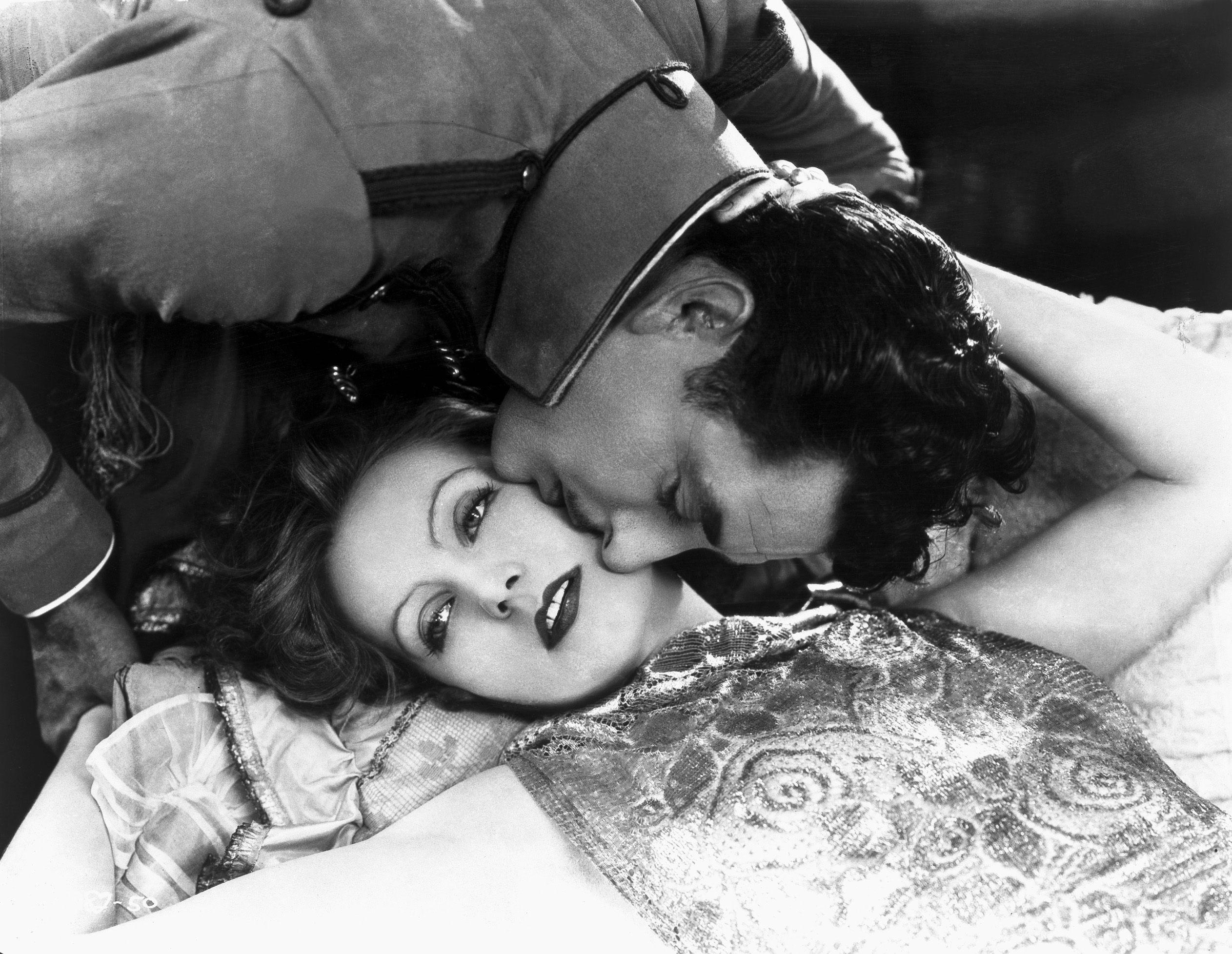
 A close-up in more ways than one: Garbo and Gilbert in 'Flesh and the Devil' (1926).
 
'Flesh and the Devil' is the latest installment of a monthly series of silent film screenings at the Garden Cinemas. 

The series aims to recreate the lost magic of early cinema by bringing crucial elements needed for silent film to work: classic films in best available prints; projection on the big screen; live musical accompaniment; and a live audience.

"These films are still moving and intense experiences if you can show them as they were designed to be screened," said Jeff Rapsis, who provides musical accompaniment for the screenings. 

"There's a reason people first fell in love with the movies. At their best, they were communal experiences in which the presence of a large audience intensifies everyone's reactions."


The appeal of 'Flesh and the Devil' has withstood the test of time. In 2006, the film was selected for preservation in the United States National Film Registry by the Library of Congress as being "culturally, historically, or aesthetically significant."

Reviewers have continued to praise the picture's many good qualities, often singling out Garbo's performance as particularly memorable.

"Pulsatingly romantic, beautifully filmed, probably the best Garbo-Gilbert love match," wrote critic Leonard Maltin, while David Parkinson of Empire Magazine wrote that "Garbo is mesmerizing in this wild and heated romance..." Carol Cling of the Las Vegas Review proclaimed 'Flesh and the Devil' as "Garbo & Gilbert at their steamy, sultry silent peak."

Upcoming titles in the Garden Cinema's silent film series include:

• Monday, March 4 at 6:30 p.m.: 'The Passion of Joan of Arc' (1928). Danish director Carl Dreyer's intense recreation of the trial of Joan of Arc set new standards for cinematography and expanded the language of film in new directions.

• Monday, April 1 at 6:30 p.m.: 'Safety Last' (1923). The iconic image of Harold Lloyd dangling from the hands of a downtown clock is just one scene of a remarkable thrill comedy that has lost none of its power over audiences.

'Flesh and the Devil' will be shown with live music  on Monday, Feb. 5 at 6:30 p.m. at the Greenfield Garden Cinemas, 361 Main St., Greenfield.


Admission is $10.50 adults, $8:50 for children, seniors, and students. Tickets at the door; advance tickets are available at www.gardencinemas.net. For more information, call the box office at (413) 774-4881.

Monday, January 30, 2023

Dinner and a movie: Pot luck supper plus Harold Lloyd's 'The Kid Brother' on Saturday, Feb. 4

Harold Lloyd monkeys around in 'The Kid Brother' (1927).

This weekend brings a triple-header of silent films programs with live music by me. 

On Saturday, Feb. 4, it's Harold Lloyd's 'The Kid Brother' (1927) plus a pot luck supper at the Campton (N.H.) Historical Society. More details on this annual event in the press release below.

Then on Sunday, Feb. 5, the Somerville Theatre in Somerville, Mass. will lauch this year's 'Silents, Please!' series with Oscar Micheaux's 'Within Our Gates' (1920), to be screened in honor of Black History Month.

Then on Monday, Feb. 6, it's Alfred Hitchcock's silent thriller 'The Lodger' (1927) at the Garden Cinema in Greenfield, Mass. By the way, a nice feature on the Garden's silent film series recently ran in the Greenfield Recorder.

First, a tip of the porkpie hat to everyone who attended yesterday's screening of Buster Keaton's 'College' (1927) at the Town Hall Theatre in Wilton, N.H. 

It wasn't quite a full house. But it was close enough to create the kind of energy that helps amps up audience response. That's what turns a silent film screening into a memorable event, which is what happened Sunday afternoon.

I mean, an audience doesn't have to react. But I must say, it was great to hear people roaring at Keaton's antics, first in 'Cops' (1922) and then in 'College,' (1927). Laughter has a way of making everyone happy—accompanist included.

Hope you'll join us on Saturday, Feb. 4 for another great comedy: Harold Lloyd's 'The Kid Brother' (1927), newly in the public domain and served up with a pot luck supper. Details below!

*     *     *

An original release poster for Harold Lloyd's 'The Kid Brother' (1927).

WEDNESDAY, JAN. 25, 2023 / FOR IMMEDIATE RELEASE
Contact Jeff Rapsis • (603) 236-9237 • jeffrapsis@gmail.com

Silent comedy masterpiece 'The Kid Brother' to screen with live music in Campton, N.H. on Saturday, Feb. 4

Dinner and a movie: family-friendly Harold film is featured attraction of local historical society's annual pot luck supper; public welcome

CAMPTON, N.H.—He was the most popular film star of the 1920s, routinely outpacing comic rivals Charlie Chaplin and Buster Keaton at the box office.

He was Harold Lloyd, the boy next door who could wind up hanging from the hands of a clock high atop a skyscraper. Audiences loved Lloyd's mix of visual comedy and thrilling adventures, making him one of the most recognized icons of early Hollywood.

See for yourself when 'The Kid Brother' (1927), a feature-length film regarded as Lloyd's masterpiece, is screened by the Campton Historical Society on Saturday, Feb. 4.

The event, which is free and open to all, takes place at Old Campton Town Hall, 529 Route 175, Campton, N.H.

It starts with a pot luck dinner at 5 p.m., with the film program to begin at 6 p.m.

Those attending the pot luck dinner are asked to bring one of the following: soup, bread, salad, main dish, dessert or beverage.

Music during the pot luck will be played by members of the Fiddlehead Field Kids Orchestra.

Live music for the silent film program will be provided by silent film accompanist Jeff Rapsis.

Harold hangs from an abandoned ship in 'The Kid Brother' (1927).

In 'The Kid Brother,' meek country boy Harold Hickory (Lloyd) looks up to his tough father, but is overshadowed by two burly older brothers. When a traveling circus brings trouble to town and possible disgrace to the Hickory clan, can Harold save the family name?

From that simple situation, Lloyd weaves a roller coaster of a tale that critics and film historians say show him at the height of his powers as a filmmaker and comedian.

"The first silent film I ever saw that made me actually stand up and cheer," wrote critic Steven D. Greydanus of The Decent Films Guide. "As a first introduction to silent film, I would pick 'The Kid Brother' over the best of Chaplin or Keaton every time."

"Unlike Chaplin’s Little Tramp, who was as much defined by his bizarre eccentricities as his bowler and cane, Lloyd’s character, with his trademark spectacles, was an instantly likable, sympathetic boy-next-door type, a figure as winsome and approachable as Jimmy Stewart or Tom Hanks," Greydanus wrote.

The film co-stars Jobyna Ralston, Walter James, Eddie Boland, and Constantine Romanoff.

Harold and costar Jobyna Ralston in 'The Kid Brother' (1927).

Harold Lloyd, along with Chaplin and Keaton, stands as one of the three masters of silent comedy. Though Lloyd's reputation later faded due to unavailability of his movies, the recent re-release of most of his major films on home media has spurred a reawakening of interest in his work and a renewed interest in theatrical screenings.

"Seeing a Harold Lloyd film with live music and an audience is one of the great experiences of the cinema of any era," said Jeff Rapsis, a New Hampshire-based silent film musician who will accompany the film.

"Films such as 'The Kid Brother' were designed for a specific environment. If you can put those conditions together again, you can get a sense of why people first fell in love with the movies," Rapsis said.

'The Kid Brother' will be screened with live music on Saturday, Feb. 4 at 6 p.m. at Old Campton Town Hall, 529 Route 175, Campton, N.H.

The film will follow a pot luck supper that starts at 5 p.m. Those attending the pot luck dinner are asked to bring one of the following: soup, bread, salad, main dish, dessert or beverage.

Music during the pot luck supper will be provided by the Fiddlehead Field Kids Orchestra.

The event is free and open to all, with donations accepted to support the Campton Historical Society.

For more information, visit www.camptonhistorical.org.

Sunday, February 13, 2022

Five screenings in five days, but first: a case of 'Music' turning into 'Magic' in Campton, N.H.

The parking lot will soon be full of cars. Next month, it'll be full of mud!

This week brings an unusual happening—a rare mid-winter stretch of five straight days of silent film screenings in venues across three states.

It's like I'll be in training for the Kansas Silent Film Festival, which is coming up at the end of this month.

But before we look forward, let's look back with a report on last night's showing of 'Straight is the Way' (1921) at the Campton N.H. Historical Society. 

This "Silent Movie Night" screening, which has become an annual event, is highlighted by the community pot luck supper that always precedes it, and this year was no exception.

However, this time we enjoyed a truly special added attraction: an hour's worth of music from young people who are part of the Fiddlehead Field Orchestra. A pot luck supper accompanied by music!

Young people in the Fiddlehead Field Orchestra program wait to go on stage.

This local Fiddlehead program, directed by flat-out amazing folk musician/fiddler and educator Jessye Bartlett, gives young people the chance to learn an instrument and play together in groups. 

That's what they did during Saturday night's pot luck supper, and did marvelously. One ensemble after another took the stage to play through a wide range of music, all of it infused with joy, compassion, and humanity.

I don't know about you, but something about the sight and sound of young kids making music together gives me hope in a way that nothing else does.

Yes, we have problems. But hearing these kids—some of whom are only just starting to learn their instruments—play through pieces, I feel increasingly confident that all will be okay.

And here's something weird: it seems that the more local or homegrown the music, the most intensely I feel this reaction. 

Fiddlehead leader Jessye Bartlett coaxes a performance out of two youngsters in the program.

Really! Compare: two weeks ago I joined about 1,500 people at Symphony Hall to hear the Boston Symphony. The concert was superb. But the great playing, and the presence of so many people gathered together to share music, didn't affect me the way the Fiddlehead players did. 

I was thrilled to learn that the Fiddlehead group is planning a trip to Ireland in 2024. Imagine that! Young musicians traveling to the Emerald Isle to meet other young musicians and play together. Why can't we as a nation do more of that, instead of starting wars in the Mideast?

That's a question for another blog. For now, if you'd like to contribute to the Fiddlehead group, visit them online and get in touch. They're worth your attention and support. 

I got so carried away, I couldn't help but get up and make an announcement, which went something like this:

"If you want hope for the future, don't watch the news. Instead, listen to this. What we're hearing here tonight reminds me that if you take the word 'Music' and change just two of the letter, it becomes 'Magic.' They're that close!"

I don't think I ever heard that "music is close to magic" thought ever before. So I may have invented it right there on the spot. Hey, it happens. 

Saturday night's Fiddlehead performances included some impromptu dancing.

Also invented on the spot: an entire score to 'Straight is the Way,' the Cosmopolitan Pictures comedy/drama set in New Hampshire and rescued from obscurity last year by film historian Ed Lorusso. 

Last night's screening marked on the second known public screening of the film since its original release more than a century ago. (The first was our 'World Repremiere' in Concord, N.H this past December.)

Audience reaction was strong—in fact, a lot stronger than what we got back in December when I accompanied the film in Concord. 

I think one reason was the kids in the audience. The young people (mostly kids in the Fiddlehead program, but also others) found the story and characters surprisingly hilarious. The scenes in which attempts are made to contact Uncle Henry via a Ouija boardprodued gales of laughter.

And that really carried along the rest of the audience, as sometimes happens at a silent film screening. With the young people in effect giving everyone permission to laugh, the intensity of reactions grew as the film progressed.

Further stirring the pot (appropriate for an event featuring a pot luck supper) were my pre-movie comments, which included instructions for people to react openly to what they were seeing. If a character does something bad, feel free to boo—which they did, at times quite lustily.

The Campton audience found the Ouija board scenes unexpectedly hilarious.

The music fell together nicely, I thought, with good contrasting music for the thieves, the innocent locals, and the romance that eventually develops

The one cue I missed was right at the end, when a character tries to summon help by ringing a handbell. Alas, the handbell I always travel with (which belonged to my grandmother) was out of reach in the darkness below me and couldn't be retrieved in time. 

But it didn't seem to hurt the film, which earned a tumultuous ovation. Thanks again to Ed Lorusso for getting 'Straight is the Way' out of the vault and available for people to enjoy, which they certainly did last night in Campton, N.H. 

Funny how some screenings really click. Maybe what it takes is a pot luck supper and several dozen young musicians for the magic to happen. 

Up next: Greta Garbo in 'The Temptress' (1926), which we're showing on Wednesday, Feb. 16 at 6:30 p.m. at the Flying Monkey Moviehouse and Performance Center in Plymouth, N.H. 

The film has two different endings, and we're showing them both. I'll do a separate post on this flick, but wanted to mention it here to whet your appetite. See you at the movies! (And bring your violin if you want to play before the show.)

Sunday, February 9, 2020

A child's laughter = proof of immortality; also, 'The Navigator' on 2/12 in Plymouth, N.H.

Harry Langdon, overgrown child, in 'The Strong Man' (1926).

Harry Langdon's character was essentially that of an overgrown child.

So perhaps it shouldn't come as a surprise that four young kids right behind me responded so strongly to 'The Strong Man' (1926), which we screened last night at the Campton (N.H.) Historical Society.

Really! Harry had them right from the start. I think they were hooked at the early scene where Harry knocks over the Ellis Island benches.

And if it wasn't that, it was definitely the scene where Harry brings his unexpected lady friend up a staircase rear-end first.

There was one girl in particular who could not stop her genuine giggling — you know, the kind that can't be faked.

And that got everyone going. And after that, Harry could do no wrong!

This was for an audience who'd never heard of Langdon prior to the film's opening credits. And yet Harry was able to reach across the years and establish a bond with a child born in the second term of the Obama presidency.

Could you ask for better proof of the enduring appeal of the silent comedy greats?

Coming up next: a screening of Buster Keaton's equally timeless classic 'The Navigator' (1924) on Wednesday, Feb. 12 at the Flying Monkey Moviehouse and Performance Center in Plymouth, N.H. More info and details are included in the press release I've tacked on at the end of this post.

And now back to the news from Campton, N.H. Last night's pot luck supper was one for the ages. I can't name half the dishes I sampled, but it was all just right on an evening where the temperature at sundown was 9 degrees and falling. Hunger is evidently not a problem in rural N.H.

Alas, attendance at this year's annual silent film screening was down due to everyone in town suffering from a nasty mid-winter cold that's been making the rounds. (I had it all through January, so I sympathize!) And not a single presidential candidate showed up!

Even so, the laughter filled the historical society's meeting and exhibit room, which once served as the community's town hall.

To introduce Langdon, and to show people why his slow pace was such a breath of fresh air, I decided to program something beforehand to show 1920s comedy at its most frenetic.

I chose the ending of 'Play Safe' (1927), a Monty Banks feature, which is a surprisingly hair-raising chase and rescue on a runaway railroad train.

Banks is even more obscure than Langdon today. So audiences simply aren't unprepared for the scale and ambition displayed in this sequence, which takes one's breath away.

A full "snow" moon rising at dusk over snow-bound Campton, N.H. Click to enlarge.

But I think it provided the perfect set-up for Langdon, as it highlighted clearly why he stood out at the time. Slower, smaller, more subtle — off the top of my head, I described it as "comedy in a jewelry store," which isn't a bad way of putting it.

Well, whether or not this way of introducing Langdon made a difference, last night's screening showed that audiences can and will respond to his best work.

Why is that a question? Because years ago, in his book 'The Silent Clowns,' author Walter Kerr described running Keaton's 'The General' to appreciative audiences, but Langdon was greeted with utter silence. So I've always felt that Langdon would be a tough sell.

Well, maybe not. Maybe all he needs is a little perspective. And come to think of it, don't we all?

Okay, below is all the info about Keaton's 'The Navigator.' Hope to see you there!

* * *

Buster Keaton prepares to dive deep in 'The Navigator' (1924).

MONDAY, FEB. 3, 2020 / FOR IMMEDIATE RELEASE
Contact Jeff Rapsis • (603) 236-9237 • jeffrapsis@gmail.com

Classic seafaring silent comedy ‘The Navigator’ (1924) in Plymouth on Wednesday, Feb. 12


Buster Keaton's nautical masterpiece to be screened with live music at Flying Monkey Moviehouse and Performance Center

PLYMOUTH, N.H.—He never smiled on camera, earning him the nickname of "the Great Stone Face." But Buster Keaton's comedies rocked Hollywood's silent era with laughter throughout the 1920s.

See for yourself with a screening of 'The Navigator' (1924), one of Keaton's landmark feature films, on Wednesday, Feb. 12 at 6:30 p.m. at the Flying Monkey Moviehouse and Performance Center, 39 S. Main St., Plymouth, N.H.

Live music for the movie will be provided by silent film accompanist Jeff Rapsis. Admission is $10 per person.

'The Navigator' is a comedy that follows the adventures of wealthy nitwit Rollo Treadway (Keaton) and his pampered girlfriend, who find themselves adrift alone on a massive ocean liner. Forced to fend for themselves without servants, the pair attempt to cope with day-to-day life, creating classic comedy in the process.

But when the ship runs aground on a remote island inhabited by cannibals, is Buster's resourcefulness enough to save the day?

Filmed at sea on a real ocean liner that Keaton treated as the largest prop in comedy history, 'The Navigator' has been hailed as one of the most original and distinctive movies to come out of silent film's golden era of comedy.

The film is highlighted by underwater scenes, with Keaton in an oversized antique diving suit, that were revolutionary at the time.

A remarkable pantomime artist, Keaton naturally used his whole body to communicate emotions from sadness to surprise. And in an era with no post-production special effects, Keaton's acrobatic talents enabled him to perform all his own stunts, including some spectacular examples in 'The Navigator.'

The nautical-themed program also includes a Keaton's short comedy, 'The Boat,' as a warm-up to 'The Navigator.'

Rapsis, a New Hampshire-based silent film musician who accompanies shows at venues across New England, said Keaton's films weren't intended to be shown on television or viewed at home.

In reviving 'The Navigator,' the Flying Monkey hopes to show silent film as it was meant to be seen—in high quality prints, on a large screen, with live music, and with an audience.

"All those elements are important parts of the silent film experience," said Rapsis. "Recreate those conditions, and classics of early Hollywood such as 'The Navigator' leap back to life in ways that audiences still find entertaining."

Rapsis performs on a digital synthesizer that reproduces the texture of the full orchestra, creating a traditional "movie score" sound. He improvises the complete score in real time during the screening

"Creating a movie score on the fly is kind of a high-wire act, but it can often make for more excitement than if everything is planned out in advance," Rapsis said.

'The Navigator' is the latest in an monthly series of great silent films with live music at the Flying Monkey. Upcoming programs include:

• Wednesday, March 11, 2020: 'Wild Horse Mesa' (1925). Adaptation of Zane Grey novel about a bankrupt rancher who tries trapping wild horses using barbed wire, with unforeseen consequences.

• Thursday, April 9, 2020: 'Ben Hur' (1925). In the Holy Land, a Jewish prince is enslaved by the occupying Romans; one of the great early Bibical epics, just in time for Easter!

• Thursday, May 7, 2020: 'Why Worry?' (1923). Rich hypochondriac Harold Lloyd gets more than he bargained for on a recuperative visit to a banana republic undergoing revolution.

• Thursday, June 18, 2020: Harry Houdini Double Feature. Rare surviving films from the great illusionist's brief movie career: 'Terror Island' (1920) and 'The Man From Beyond' (1922).

'The Navigator' (1924) starring Buster Keaton will be screened with live music on Wednesday, Feb. 12 at 6:30 p.m. at the Flying Monkey Moviehouse and Performance Center, 39 S. Main St., Plymouth, N.H.

Admission is $10 per person; for more info, call (603) 536-2551 or visit www.flyingmonkeynh.com.

Monday, January 27, 2020

Dinner with a movie, N.H.-style: pot luck supper and silent film on Feb. 8 in Campton

The Town Hall Theatre really IS in Wilton's Town Hall.

First, an update from the present: Great screening of Harold Lloyd's 'Girl Shy' (1924) yesterday at Town Hall Theatre in Wilton, N.H.

About 100 people went along for the wild ride as Harold raced to get to the church on time, and response was phenomenal!

So it was a great way to kick off our 13th year of monthly silent film programs at this terrific venue, named New England's best movie theatre by none other than Yankee Magazine.

As a silent film accompanist, in the next two months I will be privileged to ply my trade in such glamorous locations as Utica, N.Y., Topeka, Kansas, and Columbus Ohio.

But for me, humble Wilton, N.H. will always be considered home base.

So as we start another year, many thanks go out to the theatre's owner-operator Dennis Markevarich, a genuine movie-lover, for allowing this series to continue and flourish!

Looking ahead: if the Town Hall Theatre sounds quirky, then how about a gig that's become one of my favorites: the annual pot-luck-and-silent-movie-screening organized by the Campton (N.H.) Historical Society.

Talk about dinner and a movie, New Hampshire style!

Arrive at the quaint white clapboard Campton Town Hall at about 5 p.m., and you'll find people bringing in steamer trays of pasta, various meatloafs, potato dishes, heaping bowls of salad, and so much more.

We all sit cafeteria-style at long tables in a back room, with everyone trying hard to leave room for the smorgasbord of desserts that are always on hand.

And after all that, we waddle out to the main hall for a silent film program that's free and open to the public.

It's not the largest building, so the place is always packed. The historical society is actually closed from December to April, so this is a big mid-winter gathering that everyone attends.

And with the N.H. Presidential Primary coming just a few days later (on Tuesday, Feb. 11), heck, maybe this year Amy Klobuchar will drop by!

If you think you'll be hungry on Saturday, Feb. 8 (for food or silent film, or both), consider joining in the fun. More details in the press release below:

* * *

Harry Langdon over a barrel, or several barrels, in 'The Strong Man.' (1926).

MONDAY, JAN. 27, 2020 / FOR IMMEDIATE RELEASE
Contact Jeff Rapsis • (603) 236-9237 • jeffrapsis@gmail.com


See Frank Capra's first-ever film at Campton Historical Society on Saturday, Feb. 8


Harry Langdon's classic silent comedy 'The Strong Man,' directed by a very young Capra, to be shown with live music, plus pot luck dinner!

CAMPTON, N.H. — It's dinner with a movie, New Hampshire style: a pot luck dinner followed by a silent film program.

Silent film with live music returns to the big screen at the Campton Historical Society next month with a showing of an uproarious comedy starring Harry Langdon.

The screening, on Saturday, Feb. 8, will feature Langdon's classic picture 'The Strong Man' (1926).

The event, which is free and open to all, takes place at Campton Town Hall, Route 175, Campton, N.H.

It starts with a pot luck dinner at 5 p.m., with the film program to begin at 6 p.m.

Those attending the pot luck dinner are asked to bring one of the following: soup, bread, salad, main dish, dessert or beverage.

Live music for the silent film program will be provided by silent film accompanist Jeff Rapsis.

Helming 'The Strong Man' was young first-time director Frank Capra (at right), who would later go on to create such Hollywood classics as 'Mr. Smith Goes to Washington' (1939) and 'It's a Wonderful Life' (1946).

'The Strong Man' tells the story of a World War I soldier (Langdon) who, following his discharge, finds work as assistant to a circus strong man. As the act travels the United States, Langdon hopes to find a girl he corresponded with while stationed overseas in the military.

The search leads to a town controlled by Prohibition-era gangsters, which forces Harry to test the limits of his own inner strength even as he looks for his beloved. Can Happy triumph over the bad guys? And is love more powerful than brute strength?

The feature-length film showcases the unique child-like personality of Langdon, a comedian who is largely forgotten today. For a brief time in the 1920s, however, he rivaled Charlie Chaplin as Hollywood's top movie clown.

Langdon's popularity, which grew quickly in the last years of the silent era, fizzled as the movie business abruptly switched to talkies starting in 1929.

'The Strong Man,' a family-friendly comedy, was was selected in 2007 for preservation in the U.S. National Film Registry by the Library of Congress as being "culturally, historically, or aesthetically significant."

In recent years, 'The Strong Man' has been recognized as a major achievement of the silent film era—a satisfying and timeless balance of emotion and comedy.

"A little tragedy and a lot of laughs can be seen in 1926's The Strong Man," wrote critic Richard von Busack in 2007. "Director Frank Capra's energy and sturdy plot sense counterpoint Langdon's wonderful strangeness."

Original promotional art for 'The Strong Man.'

'The Strong Man' will be accompanied by live music by Jeff Rapsis, a New Hampshire-based silent film accompanist who performs at venues across the region and beyond.

"These films were created to be shown on the big screen as a sort of communal experience," Rapsis said. "With an audience and live music, they still come to life in the way their makers intended them to.

"So the Campton Historical Society's program is a great chance for people to experience films that first caused people to first fall in love with the movies," he said.

In creating music for silent films, Rapsis performs on a digital synthesizer that reproduces the texture of the full orchestra and creates a traditional "movie score" sound.

'The Strong Man' (1926) will be screened with live music on Saturday, Feb. 8 at at Campton Town Hall, Route 175, Campton, N.H. The program, which is free and open to all, starts with a pot luck dinner at 5 p.m., followed by the film program at 6 p.m.

For more information, visit www.camptonhistorical.org.

Thursday, January 31, 2019

Cheap eats and cheap seats in Keene, N.H., plus Keaton, Valentino screenings coming soon

The marquee last Tuesday night at the Colonial Theatre in downtown Keene, N.H.

I can't wait to tell you all about this week's screening of 'The Hunchback of Notre Dame' (1923) at the Colonial Theatre in Keene, N.H.

But it says a lot about my priorities when I have to say first that I was flat-out amazed by the meal I had just before the show down the street at Lindy's Diner.

Really! Two chicken croquettes, mashed potatoes with gravy, a generous helping of carrots—mind you, all served piping—plus two rolls and butter, and coffee with refills, all for...$8.18!

Can you believe it? I actually took a picture:


On a cold night with snow starting to fall, this was just what the doctor ordered. Really—if prescribed, I believe it would mitigate the symptoms of most afflictions, physical or mental.

In any case, it was great show prep for the on-screen visual feast to come at the Colonial.

And, given my inexpensive meal, would it not seem equally amazing that the admission price for our screening of 'Hunchback' was the sum of...35 cents!

Really? 'Hunchback' on a cold Tuesday night in Keene, N.H., and an absurdly low admission price? What's going on here?

What was going on is that the Colonial's grand opening night was exactly 95 years ago: Jan. 29, 1924. And the opening night attraction, yes, was 'Hunchback,' the Universal blockbuster starring Lon Chaney.

And yes, admission that night was 35 cents per person.

So last Tuesday night in Keene, the audience and I all joined in to recreate not just the early movie-going experience, but also opening night at the Colonial, a terrific medium-sized theater which continues to serve Keene and the surrounding Monadnock Region as a first-class (and now non-profit) performing arts center.

And the comedian in me has to observe that a 35-cent ticket price isn't about to endanger their non-profit status. Har! (Rim shot here, please.)

With a snowstorm looming, no one was sure who might show up, despite the bargain entrance fee. But we got a healthy crowd, and it didn't take long for 'Hunchback' to get everyone absorbed. Reaction was gratifyingly strong throughout.

I think it's a great film for music: lots of scenes that lend themselves to the big lines that I like to spin.

I've done the film quite a few times, but not recently. One element with which I've never been satisfied is the music I create for Esmeralda, the gypsy girl, which always ends up sounding too slow and too much like the Habanara from 'Carmen.'

This time, I deliberately used different material: specifically, a 3/4 riff that I created for action scenes in 'Zorro' (1920) starring Douglas Fairbanks. It worked really well as a theme for Esmeralda! Specifically, it has a modal flavor, and so I could use it to shape some of the big scenes so "her" music was referenced, at least harmonically.

Anyway: another reason to support recycling!

The film got a big ovation, and I had some great conversations afterwards with people who couldn't believe the score was improvised live.

I try to illustrate how it's not all that unusual by pointing out that we're doing it right now: we're having a conversation in real time, and we're not following a script.

The folks at the Colonial were excellent to work with, and there's been enough of an audience interest to merit exploring a regular series of screenings to round out the Colonial's offerings.

I would love to work with them on this, as I love how a venue such as the Colonial are perfect places to exhibit films from a century ago in the way they were intended to be shown.

Plus, these films were designed from the ground up to be experienced by a group of people coming together. And a hundred years later, we need that kind of experience more than ever!

And in the theater world, which faces more and more competition from so many other sources of entertainment (most of it consumed at home), it's important to offer experiences that only a theater can do: such as silent film with live music!

So we'll see what the schedule brings for Keene, N.H. Me—I'd be delighted at the chance to eat regularly at Lindy's. :)

Before that happens, two upcoming screenings might warm you up during this cold spell that's now hit New England. (It's 10 below outside as I write.)

On Saturday, Feb. 2, the good folks at the Campton Historical Society (in Campton N.H.) will hold their now-annual pot luck summer/silent movie night. It's free and the public is welcome, especially if you bring a dish to share at the supper, which starts at 5 p.m. (Here we go with food again, but every year some excellent dishes turn up at this event.)

The movie program, highlighted by Buster Keaton's 'Our Hospitality' (1923), begins at whatever time everyone finished eating. Usually that's about 6:15 p.m. or so.

The post-food attraction in Campton, N.H. on Saturday, Feb. 2.

It'll be interesting this year because I've volunteered to play bass tuba (my other instrument) for a youth concert in Manchester, N.H. that afternoon. It's about an hour and some change up to get to Campton, so if you see a green Subaru Forester bombing up Interstate 93 that afternoon, that'll be me trying to make it to Campton before all the vittles is gone.

More details about this show are on the "Upcoming Screenings" page. Hope to see you there, but make sure you leave some dinner for me, willya?

And then the week after that, it's Rudolph Valentino in 'The Eagle' (1925), a pre-Valentine's Day show on Sunday, Feb. 10 at 4:30 p.m. at the Wilton (N.H.) Town Hall Theatre.

At Wilton, we usually run silents the last Sunday of the month, but that weekend I'm making my annual pilgrimage to the Kansas Silent Film Festival, so we moved the Wilton date up to take advantage of Valentino/Valentine's Day synergy.

Hope to see you at that one as well. For more info, check out the press release below.

* * *

Vilma Banky and Rudy Valentino generate heat in 'The Eagle' (1925).

THURSDAY, JAN. 31, 2019 / FOR IMMEDIATE RELEASE
Contact Jeff Rapsis • (603) 236-9237 • jeffrapsis@gmail.com

Warm up for Valentine's Day with Valentino at the Town Hall Theatre


'The Eagle' (1925), starring silent film icon Rudolph Valentino, to screen in Wilton, N.H. on Sunday, Feb. 10 with live music

WILTON, N.H.—He was the cinema’s first sex symbol, causing hordes of female moviegoers to flock to his pictures throughout the 1920s. He starred in films designed to show off his Latin looks, his smoldering eyes, and his dancer’s body. And his untimely death in 1926 prompted mob scenes at his funeral.

He was Rudolph Valentino, who remains an icon for on-screen passion long after he caused a sensation in the 1920s.

To celebrate Valentine’s Day, one of Valentino’s most acclaimed films will be screened with live music on Sunday, Feb. 10 at 4:30 p.m. at the Town Hall Theatre, 40 Main St., Wilton, N.H.

‘The Eagle’ (1925), a racy story set in Czarist Russia, proved one of his most popular features and marked a peak in his brief career.

Based on the novel Dubrovsky by Alexander Pushkin, ‘The Eagle’ casts Valentino as a lieutenant and expert horseman in the Russian army who catches the eye of Czarina Catherine II. After he rejects her advances and flees, she puts out a warrant for his arrest, dead or alive. When he learns that his father has been persecuted and killed in his hometown, he dons a black mask and becomes an outlaw, finding unexpected romance along the way.

The screening of ‘The Eagle’ will be accompanied by live music by local composer Jeff Rapsis. Admission is free, with a suggested donation of $5 per person to defray expenses.

An Italian immigrant who arrived penniless at Ellis Island in 1913, Valentino rose to superstar status in a series of silent pictures that enflamed the passions of female movie-goers from coast to coast and around the world.

But he was more than a pretty face—during his career, critics praised Valentino as a versatile actor capable of playing a variety of roles; his achievements included popularizing the Argentinian tango in the 1921 drama ‘Four Horsemen of the Apocalypse.’

‘The Eagle’ was Valentino’s next-to-last film, released the year before his unexpected death at age 31 from complications from peritonitis. Valentino's death in August 1926 occurred at the height of his career, inspiring mourning across the globe and a day-long mob scene at the actor’s New York City funeral.

But Valentino's brief stardom was defined by roles that brought a new level of exotic sexuality to the movies, causing a sensation at the time. In theaters, women openly swooned over Valentino’s on-screen image, especially in pictures such as ‘The Eagle,’ which featured foreign locales and elaborate costumes.

At its peak, Valentino's popularity was so immense that it inspired a backlash among many male movie-goers, who decried Valentino’s elegant image and mannerisms as effeminate.

Valentino’s sudden death fueled his status as a legendary romantic icon of the cinema. For years, a mysterious woman dressed in black would visit his grave at the Hollywood Park Cemetery in Los Angeles, leaving only a single red rose.

Valentino was aware of his effect on audiences, saying that “Women are not in love with me, but with the picture of me on the screen. I am merely the canvas upon which the women paint their dreams.”

‘The Eagle’ is the latest in the Town Hall Theatre's series of monthly silent film screenings with live music. The series aims to recreate the lost magic of early cinema by bringing together the elements needed for silent film to be seen at its best: superior films in best available prints; projection on the big screen; live musical accompaniment; and an audience.

“These films are still exciting experiences if you can show them as they were designed to be screened,” said Jeff Rapsis, the accompanist for the screenings. “There’s a reason people first fell in love with the movies, and we hope to recreate that spirit. At their best, silent films were communal experiences in which the presence of a large audience intensifies everyone’s reactions.”

Live music is a key element of each silent film screening, Rapsis said. Silent movies were never shown in silence, but were accompanied by live music made right in each theater. Most films were not released with official scores, so it was up to local musicians to provide the soundtrack, which could vary greatly from theater to theater.

"Because there's no set soundtrack for most silent films, musicians are free to create new music as they see fit, even today," Rapsis said. "In bringing a film to life, I try to create original 'movie score' music that sounds like what you might expect in a theater today, which helps bridge the gap between today's audiences and silent films that are in some cases nearly 100 years old."

For each film, Rapsis improvises a music score using original themes he creates beforehand. None of the the music is written down; instead, the score evolves in real time based on audience reaction and the overall mood as the movie is screened.

‘The Eagle’ will be shown on Sunday, Feb. 10 at 4:30 p.m. at the Town Hall Theatre, 40 Main St., Wilton, N.H.

Upcoming features in the Town Hall Theater's silent film series include:

• Sunday, March 24, 2019, 4:30 p.m.: "Seven Chances" (1925) starring Buster Keaton. In this 1925 farce, Buster is about to be saved from bankruptcy by an unexpected inheritance of $7 million—but only if he gets married by 7 p.m. that very day. One of Keaton's best comedies, climaxed by one of the great chase scenes in all film, silent or otherwise.

The next installment in the Town Hall Theatre's silent film series will be ‘The Eagle’ (1925), to be screened with live music by Jeff Rapsis on Sunday, Feb. 10 at 4:30 p.m. at the Town Hall Theatre, 40 Main St., Wilton, N.H. Admission is free; a donation of $5 per person is suggested to help defray expenses. For more info, visit www.wiltontownhalltheatre.com or call (603) 654-3456.

Friday, February 3, 2017

This weekend: pot luck and Raymond Griffith
in Campton NH, then '7th Heaven' in Wilton NH

Raymond Griffith and Betty Compson in 'Paths to Paradise' (1925), screening this Saturday in Campton, N.H.

Just another weekend here in wintery New Hampshire. The New England Patriots are in the Super Bowl (no news there) and I'm doing music for silent film screenings in the hamlets of Campton, N.H. and Wilton, N.H.

First up; an annual pot-luck-supper-and-silent-movie combo at the Historical Society of Campton, N.H., a picturesque small town in the foothills of New Hampshire's White Mountains.

I'll haul myself up there late Saturday afternoon and set up everything in the small hall. Then it's supper at 5 p.m. followed by movies at whatever time everyone finishes cleaning their plates.

This has become one of my favorite annual gigs mostly because the people are great, but also because the hall really is small, which means everyone has to pack in.

And this creates an energy that leads to explosive audience reactions and a remarkable shared experience, which is one of the great and enduring glories of silent film.

This year's program is a little daring in that it features Raymond Griffith, a star that most people today have never heard of.

But I think the good folks of Campton, after several years of silent film programs, are ready for something out of the ordinary.

We'll see! The screening is open to the public and more info is available in the press release pasted in below.

Then Sunday, Feb. 5 brings the SUPER BOWL, but also a screening of the Frank Borzage-directed drama '7th Heaven' (1927) at the Town Hall Theatre in Wilton, N.H.

Janet Gaynor whips up some revenge in '7th Heaven' (1927).

In Wilton, we usually run silent film with live music at the end of each month.

But this February, I'm in Topeka at the Kansas Silent Film Festival that weekend. And the weekend before that, I'm in Sioux City, Iowa at the Sioux City International Film Festival. And the weekend after the last weekend, I'm in Cleveland at the Cleveland Museum of Art.

Sheesh!

So we rescheduled Wilton for the first weekend in February, and programmed the romantic drama '7th Heaven,' thus turning it into a "Super Bowl Widows" event as well as a pre-Valentine's Day screening.

Well, whatever your reason for attending, '7th Heaven' is worth a look. Not only is it one of the late silent era's big romantic dramas, but it helped Janet Gaynor win Best Actress in the very first Academy Awards. (I say "helped" because at the time the awards was given in recognition of all films a performer made in a given year.)

Showtime in Wilton is Sunday, Feb. 5 at 4:30 p.m. Admission is free, with donations accepted. One tip: bring lots of tissues and hankies!

And here's a secret: whatever your reason for attending, we'll be done in time for you to see the kick-off of the Super Bowl LI!

Okay, here's the press release for the Raymond Griffith screening:

* * *

Original promotional art for 'the Silk Hat' comedian, Raymond Griffith, in 'Paths to Paradise.'

MONDAY, JAN. 23, 2017 / FOR IMMEDIATE RELEASE
Contact Jeff Rapsis • (603) 236-9237 • jeffrapsis@gmail.com

Forgotten comic genius returns to silver screen on Saturday, Feb. 4 at Campton Historical Society

Raymond Griffith, the silent era's 'Silk Hat' comedian, stars in 'Paths to Paradise' (1925), shown with live music

CAMPTON, N.H.—He was a silent film actor who really couldn't talk, thanks to a childhood vocal injury.

He was Raymond Griffith, the 'Silk Hat' comedian, whose popularity in the 1920s rivaled that of Charlie Chaplin and Buster Keaton.

See for yourself on Saturday, Feb. 4, when the Campton Historical Society screens 'Paths to Paradise' (1925), one of Griffith's best surviving titles.

The program also includes a short silent comedy, 'Big Business' (1929), starring Stan Laurel and Oliver Hardy.

The evening begins with a pot luck supper at 5 p.m. The film program, which is free and open to the public, will start at about 6:15 p.m.

In screening 'Paths to Paradise,' the Campton Historical Society hopes to provide a window into a lost era of entertainment.

Most of his starring feature films have since disappeared, causing Griffith to be virtually unknown today.

But the elegantly dressed comic, who as a youngster attended St. Anselm Prep School in Goffstown, N.H., was among the most popular movie actors of the 1920s.

"Griffith's character was that of a quick-thinking gentleman, usually dressed in a top hat and a cape, who enjoyed outwitting con artists and crooks at their own game," said Jeff Rapsis, a New Hampshire-based silent film accompanist who will improvise music for the program.

"It turns out he was very different from Chaplin or Keaton, and so were his films—they seem a bit more cynical and so perhaps more modern. But we've shown them before and they hold up well with a live audience today."

'Paths to Paradise' (1925) stars Griffith as a con man who competes with a feisty female jewel thief to steal a heavily guarded diamond necklace. The film is highlighted by a wild car chase filmed on location in the California desert.

Unfortunately, all existing prints of 'Paths to Paradise' are missing the final 10 minutes. But the film ends at a point that completes the plot and provides a satisfying finish.

"The majority of silent films have disappeared completely, and those that do survive are often missing pieces," Rapsis said. "Many, including 'Paths to Paradise,' have come down to us like the Venus de Milo—the arms are missing, but it's still a work of art worth appreciating."

'Paths to Paradise' was prodcued by Paramount Pictures, where Griffith was under contract in the 1920s as one of the studio's leading stars.

Born in Boston in 1895, Griffith injured his vocal cords at an early age, rendering him unable to speak above the level of a hoarse whisper.

After appearing in circuses and attending at least one year (1905-06) at St. Anselm Preparatory School in Goffstown, N.H., he went on to serve in the U.S. Navy prior to World War I and in 1915 wound up in Hollywood, where the movie business was already booming.

Early on, Griffith worked at Mack Sennett's Keystone studio, where he developed a reputation as an excellent actor and a superb comedy writer and director. He eventually gravitated to behind-the-camera duties, serving as Sennett's right-hand man for a time.

He eventually moved to the then-new Paramount studios in the early 1920s, where he began to appear again in on-camera roles.

Griffith's mastery of character parts made him immediately popular, prompting Paramount to star him in his own movies starting in 1924. Ironically, his ability to speak caused him to develop pantomime abilities just to get through life—excellent training for sielnt film.

In the next few years, Griffith completed a dozen feature films, most of which today are lost due to neglect or improper storage.

Following the arrival of sound pictures in 1929, Griffith's lack of a speaking voice forced a return to behind-the-camera work, with one notable exception: he played a non-talking role as a dying French soldier in Lewis Milestone's World War I classic 'All Quiet on the Western Front,' (1930) which won that year's Academy Award for Best Picture.

As a producer, Griffith's work included the classic family film 'Heidi' (1937) and 'The Mark of Zorro' (1940). He retired in 1940, and died in 1957 at age 62 after choking at a Los Angeles restaurant.

"Though he's not as well known today as Charlie Chaplin or Douglas Fairbanks Sr., Raymond Griffith was doing some really good work during the peak of his career," Rapsis said. "It's great that the public will get a chance to appreciate Griffith films at the Campton Historical Society."

The program at the Campton Historical Society aims to recreate the silent film experience as early movie audiences knew it: on the big screen, with live music, and with an audience.

"When you put the silent film experience back together, it's amazing how the movies jump to life," Rapsis said. "You can really get a sense of why people got so excited about movies when they were new."

Raymond Griffith's 'Paths to Paradise' (1925) will be shown with live music on Saturday, Feb. 4 at 6:15 p.m. at the Campton Historical Society, Campton Town Hall, Route 175, Campton, N.H. The progrm is free and open to the public, and will be preceded by a pot luck supper starting at 5 p.m. For more details, visit www.camptonhistorical.org.

— 30 —

Monday, February 1, 2016

This week: Romance in Manchester,
then double-feature dog adventure up north

Nils Asther and Greta Garbo consider their options in 'Wild Orchids' (1929), a late MGM silent.

It's February, and the calendar brings with it two ways to warm up: screenings for Valentine's Day, and screenings at a small town historical society's annual pot luck supper and movie night.

Not that the occasions are mutually exclusive...

On Tuesday, Feb. 2, our monthly feature at the Manchester (N.H.) City Library is 'Wild Orchids' (1929), a torrid late MGM silent starring Greta Garbo.

Showtime is 6 p.m.; admission is free, with donations accepted and oh-so-appreciated.

And then on Saturday, Feb. 6, I haul myself up to the Campton (again N.H.) Historical Society, where we're running a double feature of Rin Tin Tin adventure films.

Showtime is—well, the annual potluck supper is at 5 p.m., and we usually start the movie program sometime after 6 p.m.

Free admission again, although if you're attending the pot luck it's good manners to bring a dish to share.

Of the two programs, the Garbo film is new to me. And after doing two screenings of Griffith's 'Intolerance' in the past week (plus one of 'Metropolis'), I'm really looking forward to taking it slow and letting the romantic tension build.

I don't generally send out press releases for the Manchester City Library series, in part because I'm just lazy, but also because I tend to program obscure or lesser-known titles that are unlikely to draw a big crowd anyway.

We do have our loyal attendees, but anyone is welcome to pop in. Hope to see you there!

I did, however, send out a release for the program up in Campton, which is about an hour north of home base and in the foothills of the White Mountains.

So if you're interested in joining us on Saturday, Feb. 6, lots of detail below.

And one program note: I had also planned a Valentine's Day silent film screening at the Wilton (N.H.) Town Hall Theatre this month, but the schedule has become impossible.

Originally set for Sunday, Feb. 14, we had to move it to Sunday, Feb. 7. And then I had something come up which takes me out of the area that day. And then I'm booked for the rest of the month and into March, so...

So apologies to regular attendees of the monthly series in Wilton. We'll be back on schedule in March with 'Ben Hur' (1925) Sunday, March 27. (Hey, that's Easter!)

* * *


MONDAY, JAN. 18, 2016 / FOR IMMEDIATE RELEASE
Contact Jeff Rapsis • (603) 236-9237 • jeffrapsis@gmail.com

Rin Tin Tin leaps back into action Saturday, Feb. 6 at Campton Historical Society


Legendary dog star races to the rescue in double feature of rare classic silent adventure films presented with live music

CAMPTON, N.H. — He couldn't speak. But that was no handicap for a star during the silent film era.

He was Rin Tin Tin, the legendary German Shepherd dog whose popularity rivaled that of any human performer when the movies were brand new.

See for yourself on Saturday, Feb. 6, when the Campton Historical Society screens a double feature of vintage Rin Tin Tin silent adventure films with live music.

The evening begins with a pot luck supper at 5 p.m. The film program, which is free and open to the public, will start at about 6:15 p.m.

In 'Clash of the Wolves' (1925), Rin Tin Tin plays a wild wolf who befriends a prospector; together they hunt down a criminal intent on jumping the prospector's claim and stealing his girl.

In 'The Night Cry' (1926), Rin Tin Tin is unjustly accused of killing sheep in ranching country; this forces him to flee for his life and hunt down the true killer on his own.

Both melodramas were produced by then-struggling Warner Bros. Studio. Rin Tin Tin films proved immensely popular around the world, with audiences marvelling at the then-new German Shepherd breed's feats of derring-do as he often out-smarted his human co-stars.

At the time, studio executives referred to Rin Tin Tin as "the mortgage lifter" because the dog's pictures helped rescue the ailing studio from bankruptcy.


Rin Tin Tin was so popular, he was named "Best Actor" at the first-ever Academy Awards in 1929 until ceremony officials decided on a re-vote in favor of human performer Emil Jannings.

Both films at the Campton Historical Society will be accompanied live by silent film musician Jeff Rapsis, who uses a digital synthesizer to recreate the texture of a full orchestra.

"The Rin Tin Tin films are great pictures for audience reaction, even today," Rapsis said. "They're full of fast-paced action, great stunts—and above all, they really move!"

"If you're new to the silent film art form, seeing the Rin Tin Tin pictures in a theater with live music is a terrific way to get acquainted with the enduring power of this kind of movie-making," Rapsis said.

Rin Tin Tin remained popular until his death in 1932, which made headlines around the globe. But his progeny went on to star in later films and TV shows, keeping the name before the public for generations.

Rin Tin Tin's descendants are still bred, continuing the bloodline to the present day. The ongoing Rin Tin Tin phenomenon inspired a recent book, "Rin Tin Tin: The Life and the Legend" by New Yorker writer Susan Orlean.

The Rin Tin Tin double feature at the Campton Historical Society aims to recreate the silent film experience as early movie audiences knew it: on the big screen, with live music, and with an audience.

"When you put the silent film experience back together, it's amazing how the movies jump to life," Rapsis said. "You can really get a sense of why people got so excited about movies when they were new."

A double feature of silent-era Rin Tin Tin adventures will be shown with live music on Saturday, Feb. 6 at 6:15 p.m. at the Campton Historical Society, Campton Town Hall, Route 175, Campton, N.H. The program is free and open to the public, and will be preceded by a pot luck supper starting at 5 p.m. For more details, visit www.camptonhistorical.org. For more info on the music, visit www.jeffrapsis.com.

Monday, February 17, 2014

Remembrance of silent film screenings past:
Road report roundup of shows in three states

To pull together today's sermon, we cite a certain text by Marcel Proust.

Before February completely slips away, let me quickly jot down a few notes about a remarkable run of screenings, if only to serve as an aid to my increasingly faulty memory.

So many people to thank for their encouragement and support! I can't possibly name you all here but I'm grateful for everything that goes into making these screenings happen.

Okay, here's a rap sheet, with brief thoughts about each. I hope these sketches will serve the same function as the "petite madeleines" did for Marcel Proust in 'Remembrance of Things Past,' in case I ever need to relive them in my dotage, which is closer than I expect.

Thursday, Jan. 30, 2014: Mary Pickford program at Red River Theatres, Concord, N.H. Hosted by Christel Schmidt, author and editor of 'Mary Pickford: Queen of the Movies,' a remarkable anthology of writings and images. Music for 'Their First Misunderstanding' (1911), the recently restored Pickford film found in a N.H. barn, and then 'Sparrows' (1926). Off night for me, possibly because of stress of organizing the program and just general rust after a month away in India. Audience of about 50; Christel was thrilled to sell some books! For me, worth it to bring Christel here for the films, and to just hang out some.

Friday, Jan. 31, 2014: Mary Pickford program at Somerville Theatre, Davis Square, Somerville, Mass. Similar program to day before but in 35mm, with prints supplied by Library of Congress. Great time introducing Christel to the Somerville crew; wild time running around Somerville and Cambridge to find a certain cable for her slide show that turned out not to be needed after all! Audience of about 100 enjoyed two shorts ('Misunderstanding' plus 'The Dream') and 'Sparrows.' Highlight for me: text message during performance saying something extremely nice. You know who you are! Afterwards, pizza with Christel and projectionist David Kornfeld. I just sat back and listened. Why can't all evenings be like this?
Saturday, Feb. 1, 2014: 'Way Down East' (1921) in 35mm at Somerville Theatre. Day 2 of a three-day weekend of silents kicking off the Somerville's Centennial Celebration. Somehow nailed a solid intro to the Griffith film by focusing on how he never got enough credit for knowing how an audience would react, something he mastered while working in the theater. Worth examining that in more detail someday. Audience about 100; print ran a little fast at 24fps, but as always, Griffith's narrative swept us along like Lillian Gish on those ice floes. Strong audience reaction, including lusty booing for Lowell Sherman's "Men are supposed to sow their wild oats" character. Strong musical material throughout, and it all came together; the highlight of the Somerville's triple-header, I thought.

Sunday, Feb. 2, 2014: 'Wings' (1927) in 35mm, matinee at Somerville Theatre. Final day of three-day weekend of silent film; matinee to avoid Super Bowl later. Print, newly struck from Paramount's recent restoration, had big problems, requiring heroic efforts from Kornfeld in the booth to make it work on-screen. This kinda distracted me and so took longer than usual to get into the zone, and found the war scenes definitely got away from me. Still, some very powerful moments for the audience of about 75, especially the post-crash embrace near the end and then Buddy Rogers giving back the toy bear. Wow! Audible sobbing from behind me. My post-applause wisecrack: "Anybody got some Kleenex?"

Only casualty of the big weekend: sprained both pinkies due to heavy use of repeated notes in 'Wings.' Before and after 'Wings,' sat for interview on 16mm film in the theater, and just could not put together two coherent thoughts in a row. Rule: no more of these either directly before or after a show. My head's never there and just doesn't work for me. Nice write-up of the whole Somerville weekend from Jay Seaver.)

Tuesday, Feb. 4, 2014: 'The Mysterious Lady' (1928) at Manchester (N.H.) City Library. Nice turnout for pre-Valentine's Day screening of smoky Garbo flick about how romance and espionage don't mix. Saw this months ago but didn't preview as "training" for cold playing at Cinefest in Syracuse next month. I did remember that music played a big role, as Conrad Nagel goes undercover as a "Serbian pianist" and plays music from an opera at a key point in the plot. Confounded by rapid intercutting between Gustav von Seyffertitz's death and shots of dancing at wild party; wish I'd prepared the 'Trepak' dance from Tchaikovsky's 'Nutcracker' for maximum contrast.

The good folks of Campton, N.H. send their best to someone who wished she could be on hand.

Saturday, Feb. 8, 2014: 'Sherlock Jr.' (1924) and 'Steamboat Bill Jr.' (1928) at Campton (N.H.) Historical Society up in the snowbound foothills of the White Mountain. Potluck supper preceded screening of Keaton "Junior" double feature in converted town hall crammed with historical artifacts, including a pair of antique upright pianos. (Wisecrack: "In case the synth dies, we have not one but two back-ups!") One of those screenings where everything clicked: full house roared right from the start and never let up. Afterwards, people complained of laughing so much that their mouths hurt. Pure magic! So glad my colleague Dan Szczesny was on hand to witness. Also glad to hear from Christel Schmidt just before, who sounded like she would like to be there, too, so sent her this photo:

Monday, Feb. 10, 2014: Dziga Vertov's 'Man with a Movie Camera' (1929) for film history course at Southern New Hampshire University taught by friend and collaborator Bill Millios. Pulled out all my Philip Glass moves for this great ride, basing entire score on a major 7th chord with sharped fourth. For this one, Bill had booked the auditorium in Webster Hall, which houses the college's business school. Started extremely quiet, so was surprised when an instructor came in and asked us to "turn it down" because we were disturbing his class. (My thought: "He thinks this is loud?)

Bill mollified the guy, or so we thought, until about a half-hour later when another guy comes in and tells us to stop. It's the dean of the business school; turns out we've been escalated. I tell him I'm in the middle of a performance and won't talk to him; Bill takes him outside and gets told that "academics have to take priority." Screening continues but Bill is apparently banned for life from Webster Hall. Wow! Glad I found out about this later or I would have stopped the screening and given this guy a piece of my mind. As it was, told students after the film that they ought to take a lesson from this: their lives would be filled with encounters with philistines and cretins, and they should always stand their ground and fight back.

That's the quote of the year so far, anyway: "Academics have to take priority." This from a college administrator who ought to have some acquaintance of cinema as the defining art form of the 20th century! But I digress.

Thursday, Feb. 13 and Friday, Feb. 14, 2014:One screening of 'Sunrise' snowed out, while another goes forward. Latest big winter mess caused show scheduled for Thursday, Feb. 13 at Flying Monkey Moviehouse in Plymouth, N.H. had to be moved to Thursday, March 6. But 'Sunrise' happened on schedule on Feb. 14 (Valentine's Day: you can't stop romance) at Red River Theatres in Concord, N.H., where about 30 people attended. "Any first dates tonight?" I asked. (Answer: Nope.) Limited music preparation but held together. Used all string settings; intended to switch to full orchestra for storm sequence on lake but for some reason blanked on how to call up the setting, so storm turned out to be stringy after all.

A 1909 postcard of the part of the Stratford (Conn.) where we screened 'Peter Pan' (1924).

Saturday, Feb. 15, 2014: Hauled myself down to Stratford, Conn. (three hours one way) for screening of 'Peter Pan' (1924) at local library. Postponed from before Christmas due to snow; two months later, snow again, but we went forward. Screening took place in library's stately original building; small turnout (weather?) but enthusiastic response. From the sound of the applause when audience is asked to save Tinker Bell by clapping, you would have thought 200 people were present! A great community for silent film, though, with many people eager to do more screenings around town. I may get to know Interstate 91 very well.

P.S. I just noticed that Proust (on that stamp) was only one year older than I am now when he died. Another reminder that time is marching on.