Showing posts with label Natick Center for the Arts. Show all posts

Sunday, December 7, 2025

Coming up: a slate of pre-holiday silent film screenings, then a road trip to Cleveland

A lobby card for 'So's Your Old Man' (1926), which I'll accompany on Sunday, Jan. 18 at the Cleveland Cinematheque.

Welcome to the holiday preview edition of this blog, in which I try to catch up after several weeks of being just too busy to update it.

First, the big news is that the glamorous showbiz life of a silent film accompanist will take me to Cleveland, Ohio for a pair of screenings in January.

That's right! On Saturday, Jan. 17, I'll accompany the recently restored 'Algol: A Tragedy of Power' (1920) at the 51st Annual Sci-Fi Marathon, staged each year by the Case Western Reserve University Film Society.

Then, on Sunday, Jan. 18, I'll do music at the Cleveland Cinematheque, where they're screening a 35mm print of 'So's Your Old Man' (1926) starring a silent W.C. Fields. 

I encourage my fans in the area to check out both these events. I'm sure we can accommodate all two or three of you. More details of the "Cleveland Mid-Winter Lake Effect Silent Film Victory Tour" (get your T-shirts now!) can be found on my Upcoming Silent Film Screenings page. 

Also, while I'm in Cleveland, I encourage everyone to join me on Saturday, Jan. 17 for an early dinner at 'L'Albatros Brasserie,' my favorite restaurant in the entire Great Lakes basin. It's the not-so-secret reason I'm really making the trip to Cleveland in the dead of winter. 

Not sure of the time but seriously, if anyone would like to join in, email me at jeffrapsis@gmail.com and we'll make it happen.

But before any of that, December brings a bouquet (can you tell I'm already thinking of spring?) of silent film screenings closer to home:

• On Sunday, Dec. 7 (hey, that's today!) at 4 p.m., I'll accompany 'The Man Who Laughs' (1928) at the Natick Center for the Arts in Natick, Mass. More details about that screening are in the press release pasted in below.  

• On Tuesday, Dec. 9 at 7 p.m., I'll do music for a screening of Buster Keaton's great comedy/drama 'Our Hospitality' (1923) at the Coolidge Corner Theatre in Brookline, Mass.

• And on Sunday, Dec. 14 at 2 p.m. it's a holiday-themed program featuring Mary Pickford's 'Tess of the Storm Country' (1922) at the Town Hall Theatre in Wilton, N.H.

Hope you'll be able to make a silent film screening with live music part of your holiday season.

Okay, details of 'The Man Who Laughs' (1928) below. Happy holidays, and to all a 'Silent Night'!

*      *      *

An original lobby card promoting 'The Man Who Laughs' (1928).

MONDAY, DEC. 1, 2025 / FOR IMMEDIATE RELEASE
Contact Jeff Rapsis • (603) 236-9237 • jeffrapsis@gmail.com

'The Man Who Laughs' (1928) to screen with live music on Sunday, Dec. 7 in Natick, Mass.

Creepy silent film thriller anticipated 'Frankenstein' and 'Dracula,' inspired the look of Batman's nemesis 'The Joker'

NATICK, Mass. — Based on a Victor Hugo novel, it paved the way for early horror classics such as 'Dracula' (1931) and 'Frankenstein' (1931).

It was 'The Man Who Laughs' (1928), a silent film thriller that inspired the look of Batman's nemesis 'The Joker.'

The rarely screened film will be shown with live music on Sunday, Dec. 7 at 4 p.m. at TCAN Center for the Arts, 14 Summer St., Natick, Mass.

The screening, the latest in the Center for the Art's silent film series, will feature live accompaniment by Jeff Rapsis, a New Hampshire-based composer who specializes in creating music for silent films.

Admission is $12 per person for members; $14 for non-members. Tickets are available online at www.natickarts.org or at the door.

'The Man Who Laughs,' directed by Paul Leni and starring Conrad Veidt, is a silent thriller about a disfigured man forced to wear an insane grin all his life.

The movie was a popular and ground-breaking silent film adaptation of a sprawling Victor Hugo novel set in 17th century England. 

Veidt stars as Gwynplaine, a child born of English nobility. After his father is executed, a cruel King James II orders a royal surgeon to hideously disfigure young Gwynplaine's face into a permanent smile, so that he may always laugh at his father's foolishness.

Abandoned and shunned, young Gwynplaine is left to make his way on his own. He learns to conceal his face from strangers, befriending Dea, a blind girl who is not aware of his disfigurement.

The pair are then adopted and put to work by a traveling impresario, who makes use of Gwynplaine's startling face in his theatrical productions.

Gwynplaine and Dea grow to adulthood and eventually fall in love, but complications arise when Gwynplaine's noble lineage is revealed, entitling him to his father's estate—provided he marry another woman of noble birth.
 
Conrad Veidt and Olga Baclanova in a scene from 'The Man Who Laughs' (1928).

Veidt, who starred earlier in the German expressionist horror classic 'The Cabinet of Dr. Caligari' (1919), played the role of Gwynplaine by using a prosthetic device inside his mouth to force his face into a hideous grin and display outsized teeth.

This striking look was later adapted by Batman creator Bob Kane as a model for the physical appearance of iconic villain 'The Joker.'

Critics have praised 'The Man Who Laughs' for its dark visual style and daring story content.

"'The Man Who Laughs' is a melodrama, at times even a swashbuckler, but so steeped in Expressionist gloom that it plays like a horror film," wrote Roger Ebert in 2004. "The film is more disturbing than it might have been because of Leni's mastery of visual style."

Director Leni, originally trained as an artist, made ample use of shadows and darkness in 'The Man Who Laughs,' which set the stage for many legendary Universal horror classics soon to follow, including 'Dracula' (1931) and 'Frankenstein' (1931).

'The Man Who Laughs' (1928) will be screened with live music on Sunday, Dec. 7 at 4 p.m. at TCAN Center for the Arts, 14 Summer St., Natick, Mass.

Admission is $12 per person for members; $14 for non-members. Tickets available online at www.natickarts.org or at the door. For more info, call (508) 647-0097.

Saturday, August 2, 2025

Why you should see Emil Jannings in 'The Last Command' (1928) on Sunday, 8/3 in Natick, Mass.

Original poster art promoting 'The Last Command' (1928).

If a person wants to experience a great example of the story-telling power of silent film, I would point said person to 'The Last Command' (1928).

It has everything: an imaginative story, inventive camera-work, intense drama, and a great cast highlighted by a towering performance by Emil Jannings that helped him win the first-ever Academy Award for Best Actor.

'The Last Command' is not an art film—it was a standard-issue drama on Paramount's 1928 release schedule. 

At the same time, it's an example of silent film technique at its height. As directed by Josef von Sternberg, the movie makes fluent use of the vocabulary of visual story-telling.

What's especially impressive to me is how the film uses its specific dramatic material to explore universal questions such as the nature of power, the value of loyalty, the meaning of patriotism, the role of chance, and many other issues people have grappled with throughout human experience.

In doing so, I think 'The Last Command' transcends mere entertainment and becomes timeless art. It's a great example of how the best silent cinema can stand alongside the best literature, paintings, sculpture, drama, and music. 

You may find this surprising due to silent film's limitations as an art form, such as no dialogue. But I think these limitations are what prompted the best silent filmmakers to produce work that "speaks" to us today.

If can't wait to experience this silent masterwork as intended—on the big screen, with live music, and with an audience—then you're in luck. It's screening on Sunday, Aug. 3 at 4 p.m. at the Center for the Arts in Natick, Mass., with me accompanying.

Press release is below with a lot more info about the film and the screening. Hope to see you there!

*    *    *

Emil Jannings romances Evelyn Brent in 'The Last Command' (1928).

TUESDAY, JULY 1, 2025 / FOR IMMEDIATE RELEASE
Contact Jeff Rapsis • (603) 236-9237 • jeffrapsis@gmail.com

Silent epic 'The Last Command' with live music at Natick Center for Arts on Sunday, Aug. 3

Josef von Sternberg's groundbreaking psychological drama won 'Best Actor' for Emil Jannings at first-ever Academy Awards

NATICK, Mass.—'The Last Command' (1928), a silent film drama that won Emil Jannings 'Best Actor' honors at the first-ever Academy Awards, will be screened with live music on Sunday, Aug. 3 at 4 p.m. at TCAN Center for the Arts, 14 Summer St., Natick, Mass.

The screening, the latest in the Center for the Art's silent film series, will feature live accompaniment by Jeff Rapsis, a New Hampshire-based composer who specializes in creating music for silent films.

Admission is $12 per person for members; $14 for non-members. Tickets are available online at www.natickarts.org or at the door.

'The Last Command,' directed by Josef von Sternberg, tells the sweeping story of a powerful general in Czarist Russia (Jannings) forced to flee his homeland during the Bolshevik Revolution. He emigrates to America, where he is reduced to living in poverty.

Finding work as an extra at a Hollywood studio, the former general lands the part of a commanding officer in a movie about the Revolution, causing flashbacks to his traumatic experiences. The conflict leads to a spectacular climax and a towering performance that earned Jannings 'Best Actor' honors.

The film takes audiences on a journey through big emotions as well as issues of history, time, power, and especially a man's duty to his country and to his fellow citizens—and what happens when the two obligations diverge.

'The Last Command' is also one of early Hollywood's most creative and challenging looks at the global conflicts that contributed to World War I.

The film also stars a young William Powell as a Hollywood movie director who crosses paths with the general during the Revolution, and 1920s starlet Evelyn Brent as a seductive Russian revolutionary.

Rapsis, the accompanist, will create the film's score live as the movie is shown.

"Making up the music on the spot is kind of a high wire act," Rapsis said. "But there's nothing like the energy and excitement that comes with improvised live performance, especially when accompanying a silent film."

Critic Leonard Maltin hailed 'The Last Command' as "a stunning silent drama...a fascinating story laced with keen observations of life and work in Hollywood." Time Out of London called it "the first Sternberg masterpiece, expertly poised between satire and 'absurd' melodrama. The cast are fully equal to it; Jannings, in particular, turns the characteristic role of the general into an indelible portrait of arrogance, fervor and dementia."

Director Sternberg, a master of lighting and black-and-white photography, created 'The Last Command' as a visual tour de force. The film is often cited as a prime example of the emotional range and visual accomplishment of silent films at their height, just prior to the coming of pictures with recorded soundtracks.

Rapsis said great silent film dramas such as 'The Last Command' told stories that concentrate on the "big" emotions such as Love, Despair, Anger, and Joy. Because of this, audiences continue to respond to them in the 21st century, especially if they're presented as intended—in a theater on the big screen, with a live audience and live music.

"Dramas such as 'The Last Command' were created to be consumed as a communal experience," Rapsis said. "With an audience and live music, they come to life as their creators intended them to. This screening at TCAN is a great chance to experience films that first caused people to fall in love with the movies."

'The Last Command' (1928) will be screened with live music on Sunday, Aug. 3 at 4 p.m. at TCAN Center for the Arts, 14 Summer St., Natick, Mass.

Admission is $12 per person for members; $14 for non-members. Tickets available online at www.natickarts.org or at the door. For more info, call (508) 647-0097. 

Sunday, December 10, 2023

Two shows to go: 'My Best Girl' on Sunday, Dec. 10, then 'Why Worry?' on Wednesday, Dec. 13

An original lobby card depicting Mary Pickford and Buddy Rogers in 'My Best Girl' (1927).

Just a couple of shows left in 2023 as the year draws to a close.

Today (Sunday, Dec. 10) it's Mary Pickford and Buddy Rogers in 'My Best Girl' (1927), which I'll accompany at 4 p.m. at the Natick Center for the Arts, 14 Summer St., Natick, Mass.

More about the film and the screening are in the press release pasted in below.

After that, the only show left is Harold Lloyd's comedy 'Why Worry?' (1923), which I'm accompanying on Wednesday, Dec. 13 at the Coolidge Theatre in Brookline, Mass.

And that's it. 

I'll be back at it in 2024, but at a reduced pace.

For 15 years, I've pushed myself to be a better accompanist in the only way I know how—by doing it a lot.

By a lot, I mean an average of 120 shows per year, or about two or three each week. That's more than 1,000 shows in the past decade, even factoring in the pandemic, which slowed things down for a time.

It's been a rewarding experience. Through all this time spent in darkened theaters, playing music that's largely improvised on the spot, I think I've developed a musical vocabulary that otherwise wouldn't have emerged, I think. That's important to me. 

Plus, it's just been fun.

But it's also been a lot of work. Most of these screenings have come about by my own efforts—of reaching out, convincing venue managers to take a chance on something different, and then working hard to help build an audience.

That takes time and effort. And then there's travel time. Some venues I work regularly are a three-hour drive one way. Add that in, and you've got a minimum 10-hour commitment for certain gigs. 

So it adds up. Not that I've minded. Keeping a busy schedule is part of my identity—if anyone remarks on my crowded calendar, I usually say something like I'm "the Jake LaMotta of silent film accompaniment—I just keep on coming."

Well, in the coming year, I plan focus more exclusively on my work as executive director of the Aviation Museum of N.H., a non-profit organization that I've had the privilege of leading for the past five years.

The museum has come a long way in the past five years. We now boast a robust youth education effort that includes a high school student plane-building program, a successful aviation summer camp, and more. 

But there's a long way to go, and I've just agreed to a five-year commitment to continue the work.

I'll still do film music—in fact, one of my upcoming gigs is at the Aviation Museum, where I'll accompany 'The Flying Ace' (1926) in February for Black History Month. 

But I'd also like to take my hard-won musical vocabulary and see what I can do with it in terms of music that gets written down.

So some of my musical energies will go into composing, rather than improvising. I'm creating a piece for a concert of works by New Hampshire composers at the Manchester (N.H.) Community Music School, and I hope other works will follow.

I expect there will be some crossover work related to my film accompaniment efforts. 

For example, for the silent version of 'Peter Pan' (1924), which I've accompanied probably two dozen times, I've developed a suite of material that I think would lend itself to some kind of orchestral suite in the manner of the tone poems of Richard Strauss, say. 

We'll see. But in real terms, it means that going forward I'll have to be more selective in my performing gigs as I take time to start writing stuff down.

Okay, here's more info about 'My Best Girl,' which I'll accompany this afternoon down in Natick, Mass. Hope to see you there!

*   *   *

Vintage print ad for 'My Best Girl' (1927). 

MONDAY, NOV. 20, 2023 / FOR IMMEDIATE RELEASE
Contact Jeff Rapsis • (603) 236-9237 • jeffrapsis@gmail.com

Mary Pickford's 'My Best Girl' with live music at Natick Center for Arts on Sunday, Dec. 10

Sparkling romantic comedy showcases talents of movie industry pioneer known as 'America's Sweetheart'

NATICK, Mass.— She was known as 'America's Sweetheart,' but often played assertive take-charge characters that made her a role model to women and movie-goers around the world.

She was Mary Pickford, who ruled the entertainment industry as the Queen of Hollywood during the silent era.

See for yourself with a screening of 'My Best Girl' (1927), one of Pickford's landmark feature films, on Sunday, Dec. 10 at 4 p.m. at TCAN Center for the Arts, 14 Summer St., Natick, Mass.

The screening, the latest in the Center for the Art's silent film series, will feature live accompaniment by Jeff Rapsis, a New Hampshire-based composer who specializes in creating music for silent films.

Admission is $10 per person for members; $12 for non-members. Tickets are available online at www.natickarts.org or at the door.

The show is the latest in TCAN's silent film series, which gives audiences the opportunity to experience early cinema as it was intended: on the big screen, with live music, and with an audience.

Set in a big city department store, 'My Best Girl' explores what happens when romance blossoms between a humble clerk and the wealthy store owner's son?

The result is a sparkling “rich man, poor girl” romantic comedy from 1927 starring Pickford alongside leading man Charles 'Buddy' Rogers, who would later become Pickford's real-life husband.

An industry pioneer who became Hollywood’s first movie star, Pickford enjoyed a cult-like popularity throughout the silent era that made her a national icon and an international celebrity.

Pickford also possessed a business savvy that gave her nearly total control of her creative output, with her own production company and a partnership in a major film distribution company, all before she was 30 years old.

Dubbed "America's Sweetheart" early in her screen career, the nickname was misleading, as Pickford's popularity was rooted in her portrayal of assertive women often forced to battle for justice in a male-dominated world.

After starring in hundreds of short dramas from 1910 to 1915, Pickford's popularity led to starring roles in feature films starting in the mid-1910s.

In 1919, she joined industry icons D.W. Griffith, Charlie Chaplin, and Douglas Fairbanks Sr. in creating the United Artists studio. In 1920, she married Fairbanks, with the pair reigning as Hollywood's royal couple for the remainder of the silent era.

In the 1920s, Pickford reduced her output to one picture per year. 'My Best Girl' was her last silent feature before the industry switched to talking pictures.

Pickford made several successful talking pictures, winning the Academy Award for Best Actress for the film 'Coquette' in 1929.

Pickford, however, chose to retire in 1933. She lived in semi-seclusion until her death in 1979.

Accompanist Jeff Rapsis will improvise an original musical score for 'My Best Girl' live as the movie is shown, as was done during the silent film era.

"When the score gets made up on the spot, it creates a special energy that's an important part of the silent film experience," said Rapsis, who uses a digital synthesizer to recreate the texture of a full orchestra for the accompaniment.

With TCAN's screening of 'My Best Girl,' audiences will get a chance to experience silent film as it was meant to be seen—in a high quality print, on a large screen, with live music, and with an audience.

"All those elements are important parts of the silent film experience," Rapsis said. "Recreate those conditions, and the classics of early Hollywood leap back to life in ways that can still move audiences today."

‘My Best Girl’ (1927) starring Mary Pickford and Charles 'Buddy' Rogers will be shown with live music on Sunday, Dec. 10 at 4 p.m. at TCAN Center for the Arts, 14 Summer St., Natick, Mass.

Admission is $10 per person for members; $12 for non-members. Tickets are available online at www.natickarts.org or at the door.


Thursday, July 20, 2023

This weekend: Keaton and Davies in Rockland, Maine, then Harold Lloyd in Natick, Mass.

Marion Davies (right) in 'Little Old New York' (1923).

It's a silent film kinda weekend, with a double feature on Saturday, July 22 to help the Strand Theatre in Rockland, Maine celebrate its 100th birthday, and then on Sunday, July 23 one of Harold Lloyd's best pictures at the TCAN Center for the Arts in Natick, Mass.

The Lloyd picture is 'The Kid Brother' (1927), which will be screened on Sunday at 4 p.m. in Natick. Lots more info in the press release below. I hope you'll join us to experience this extraordinary motion picture as it was intended—on the big screen, with live music, and with an audience!

With the program at the Strand, I don't have a press release to share, as it was put together only very recently. But still, it should be a hoot, especially as the theater is charging just 25 cents admission as a throwback ticket price in honor of its centennial.

Highlighting Saturday's Strand program will be Marion Davies, whose 'Little Old New York' (1923) was screened at the Strand during its first year of operation. The film, presented in cooperation with Undercrank Productions and the Library of Congress, will be shown at 4:30 p.m. 

The key to all this coming about is Maine resident Ed Lorusso, a film buff who in recent years has organized Kickstarter campaigns to get hard-to-view motion pictures transferred to digital media so that contemporary audiences can enjoy them.

Ed, a Marion Davies fan, has been responsible for more than a few Davies titles getting transferred and making them available to the public via DVD or Blu-ray. One of those is Marion's 1923 hit 'Little Old New York,' for which Ed worked with a 35mm nitrate print held by the U.S. Library of Congress.

When Ed discovered that 'Little Old New York' played at the Strand in its original release, and that the Strand was marking its centennial this summer—well, the opportunity to run the film again as part of the celebrations was just too good to pass up.

Ed contacted the folks at the Strand, making a case for screening the film with live music. And that's  where I came in. When the dust settled, the Strand decided to show not one but TWO pictures from 1923 as part of "Silent Movie Day," which was scheduled for Saturday, July 22.

The Strand Theatre in Rockland, Maine.

First up at 2 p.m. is Buster Keaton's 'Our Hospitality' (1923), followed at 4:30 p.m. by Marion Davies in 'Little Old New York.' As mentioned above, admission is 25 cents per person. 

I notice that the weather forecast calls for a slight chance of rain this Saturday. However, there's a 100 percent chance of great cinema at the Strand. Hope you'll join us for one or both pictures, which were among 1923's top box office champions.

And the next day, it's Harold Lloyd in 'The Kid Brother' (1927) in Natick, Mass. Below is the press release with lots more info. See you there!

*   *   *

Harold Lloyd climbs aboard in 'The Kid Brother' (1927).

TUESDAY, JUNE 20, 2023 / FOR IMMEDIATE RELEASE
Contact Jeff Rapsis • (603) 236-9237 • jeffrapsis@gmail.com

Natick Center for the Arts to screen 'The Kid Brother' on Sunday, July 23

Harold Lloyd's 1927 comedy masterpiece the latest in venue's series of silent films with live accompaniment

NATICK, Mass.—He was the most popular film star of the 1920s, routinely outpacing comic rivals Charlie Chaplin and Buster Keaton at the box office.

He was Harold Lloyd, the boy next door who could wind up hanging from the hands of a clock high atop a skyscraper. Audiences loved Lloyd's mix of visual comedy and thrilling adventures, making him one of the most recognized icons of early Hollywood.

See for yourself when 'The Kid Brother' (1927), a feature-length film regarded as Lloyd's masterpiece, is screened on Sunday, July 23 at 4 p.m. at TCAN Center for the Arts, 14 Summer St., Natick, Mass.

The screening, the latest in the Center for the Art's silent film series, will feature live accompaniment by Jeff Rapsis, a New Hampshire-based composer who specializes in creating music for silent films.

Admission is $10 per person for members; $12 for non-members. Tickets are available online at www.natickarts.org or at the door.

In 'The Kid Brother,' meek country boy Harold Hickory (Lloyd) looks up to his tough father, but is overshadowed by two burly older brothers. When a traveling circus brings trouble to town and possible disgrace to the Hickory clan, can Harold save the family name?

From that simple situation, Lloyd weaves a roller coaster of a tale that critics and film historians say show him at the height of his powers as a filmmaker and comedian.

"The first silent film I ever saw that made me actually stand up and cheer," wrote critic Steven D. Greydanus of The Decent Films Guide. "As a first introduction to silent film, I would pick 'The Kid Brother' over the best of Chaplin or Keaton every time."

"Unlike Chaplin’s Little Tramp, who was as much defined by his bizarre eccentricities as his bowler and cane, Lloyd’s character, with his trademark spectacles, was an instantly likable, sympathetic boy-next-door type, a figure as winsome and approachable as Jimmy Stewart or Tom Hanks," Greydanus wrote.

The film co-stars Jobyna Ralston, Walter James, Eddie Boland, and Constantine Romanoff.

Harold Lloyd, along with Chaplin and Keaton, stands as one of the three masters of silent comedy. Though Lloyd's reputation later faded due to unavailability of his movies, the recent re-release of most of his major films on home media has spurred a reawakening of interest in his work and a renewed interest in theatrical screenings. 

Jobyna Ralston and Harold Lloyd in 'The Kid Brother' (1927).

"Seeing a Harold Lloyd film in a theater with live music and an audience is one of the great experiences of the cinema of any era," said Jeff Rapsis, a New Hampshire-based silent film musician who will accompany the film.

"Films such as 'The Kid Brother' were designed for a specific environment. If you can put those conditions together again, you can get a sense of why people first fell in love with the movies," Rapsis said.

'The Kid Brother' will be screened with live music on Sunday, July 23 at 4 p.m. at TCAN Center for the Arts, 14 Summer St., Natick, Mass.

Admission is $10 per person for members; $12 for non-members. Tickets are available online at www.natickarts.org or at the door.

Thursday, March 30, 2023

Thou shalt not miss 'The Ten Commandments' (1923) on Sunday, April 2 in Natick, Mass.

Promotional poster for Cecil B. DeMille's silent version of 'The Ten Commandments.'

What better time of year than Easter to resurrect an original Hollywood Biblical blockbuster?

That's what we'll do on Sunday, April 2, when I accompany the 1923 silent version of 'The Ten Commandments' at the Center for the Arts in Natick, Mass.

Showtime is 4 p.m., meaning you'll have plenty of time to attend Mass prior to the show. (I've checked with the Archdiocese of Boston and no, the screening does not count as church.)

The film, which is celebrating its 100th anniversary this year, differs significantly from its 1956 remake. For more info, check out the press release pasted in below.

Road report: I've just completed doing live music for a pair of thrillers the past two nights and all went well.

On Tuesday, March 28, I accompanied Alfred Hitchcock's 'The Lodger' (1927) for an appreciative crowd at the Jane Pickens Theater in Newport, R.I. 

And then on Wednesday, March 29, it was music for 'Nosferatu' (1922) at the University of N.H. in Durham, N.H.

The latter was part of this year's touring 'Cinema Ritrovato' program, which the University hosts each spring. Many thanks to the UNH faculty who organize this and who've brought me in for several years now. 

The audience for 'Nosferatu' was predominantly college students, as you'd expect. Interesting: a show of hands afterwards found that it was the first time that virtually everyone had seen the film.

And that's it for the first quarter of 2023. The performance schedule is a little light for April, but that's good, as I'm nursing a pulled muscle deep in my upper right arm that really needs time to heal.

So pray for me. And what better place to do it than at this Sunday's screening of the original silent film version of 'The Ten Commandments'? See you there!

*    *    *

Moses (not Charlton Heston, but Theodore Roberts) prepares to part the waters of the Red Sea in the original silent film version of 'The Ten Commandments' (1923).

MONDAY, MARCH 20, 2023 / FOR IMMEDIATE RELEASE
Contact Jeff Rapsis • (603) 236-9237 • jeffrapsis@gmail.com

Original 'Ten Commandments' movie to screen at Natick Center for the Arts

Silent film Biblical blockbuster to be shown on 100th anniversary with live music on Palm Sunday, April 2

NATICK, Mass.—Decades before he directed Charlton Heston as Moses, filmmaker Cecil B. DeMille's original silent version of 'The Ten Commandments' (1923) wowed audiences the world over during the early years of cinema.

To celebrate the coming Easter season, DeMille's pioneering Biblical blockbuster will be screened on Sunday, April 2 at the TCAN Center for the Arts, 14 Summer St., Natick, Mass.

The 100th anniversary screening, the latest in the Center for the Art's silent film series, will feature live accompaniment by Jeff Rapsis, a New Hampshire-based composer who specializes in creating music for silent films.

Admission is $10 per person for members; $12 for non-members. Tickets are available online at www.natickarts.org or at the door.

DeMille's original 'Ten Commandments' was among the first Hollywood films to tackle stories from scripture on a grand scale. The picture was a popular hit in its original release, and served as a blueprint for DeMille's later remake in 1956.


Despite the silent original's epic scale, the Moses story takes up only about the first third of the film. After that, the tale changes to a modern-day melodrama about living by the lessons of the Commandments. In the McTavish family, two brothers make opposite decisions: one, John, to follow his mother's teaching of the Ten Commandments and become a poor carpenter, and the other, Danny, to break every one of them and rise to the top. The film shows his unchecked immorality to be momentarily gainful, but ultimately disastrous.

A contrast is made between the carpenter brother and his mother. The mother reads the story of Moses and emphasizes strict obedience and fear of God. The carpenter, however, reads from the New Testament story of Jesus' healing of lepers. His emphasis is on a loving and forgiving God. The film also shows the mother's strict lawful morality to be flawed in comparison to her son's version.

The other brother becomes a corrupt contractor who builds a church with shoddy concrete, pocketing the money saved and becoming very rich. One day, his mother comes to visit him at his work site, but the walls are becoming unstable due to the shaking of heavy trucks on nearby roads. One of the walls collapses, with tragic results. This sends the brother on a downward spiral as he attempts to right his wrongs and clear his conscience.

Throughout the film, the visual motif of the tablets of the Commandments appears in the sets, with a particular Commandment appearing on them when it is relevant to the story.

'The Ten Commandments' boasts an all-star cast of 1920s performers, including Theodore Roberts as Moses; Charles de Rochefort as Rameses; Estelle Taylor as Miriam, the Sister of Moses; Edythe Chapman as Mrs. Martha McTavish; Richard Dix as John McTavish, her son; Rod La Rocque as Dan McTavish, her other son; and Leatrice Joy as Mary Leigh.

The Exodus scenes were filmed at Nipomo Dunes, near Pismo Beach, Calif., in San Luis Obispo County, which is now an archaeological site. The film location was originally chosen because its immense sand dunes provided a superficial resemblance to the Egyptian desert. After the filming was complete, the massive sets — which included four 35-foot-tall Pharaoh statues, 21 sphinxes, and gates reaching a height of 110 feet, which were built by an army of 1,600 workers — were dynamited and buried in the sand. However, the burial location at Nipomo Dunes is exposed to relentless northwesterly gales year-round, and much of what was buried is now exposed to the elements, as the covering sand has been blown away.

The visual effect of keeping the walls of water apart while Moses and the Israelites walked through the Red Sea was accomplished with a slab of gelatin that was sliced in two and filmed close up as it jiggled. This shot was then combined with live-action footage of actors walking into the distance, creating a vivid illusion.

Live music is a key element of each silent film screening, said Jeff Rapsis, accompanist for TCAN's silent film screenings. Silent movies were not shown in silence, but were accompanied by live music made right in each theater. Most films were not released with official scores, so it was up to local musicians to provide the soundtrack, which could vary greatly from theater to theater.

"Because there's no set soundtrack for most silent films, musicians are free to create new music as they see fit, even today," Rapsis said. "In bringing a film to life, I try to create original 'movie score' music that sounds like what you might expect in a theater today, which helps bridge the gap between today's audiences and silent films that are in some cases more than 100 years old."

‘The Ten Commandments’ (1923) will be shown with live music by Jeff Rapsis on Sunday, April 2 at the TCAN Center for the Arts, 14 Summer St., Natick, Mass. The 100th anniversary screening, the latest in the Center for the Art's silent film series, will feature live music.

Admission is $10 per person for members; $12 for non-members. Tickets are available online at www.natickarts.org or at the door.

Friday, August 13, 2021

Nosferatu: Not just for Halloween anymore!
(During a pandemic, any time is Nosferatu time)

I'll never travel basic economy again!

Screening 'Nosferatu' with more than two months to Halloween? Really?

Well, consider. It's Friday the 13th. And we're in pandemic. So yes, it's as good a time as any for the original screen adaptation of the plague-infused Dracula tale.

And 'Nosferatu' (1922) is what I'll be accompanying tonight, starting at 8 p.m., on the lawn outside the Custom House Maritime Museum, 25 Water St., Newburyport, Mass. 

(And all the sailing ship action makes it a good fit for the Maritime Museum, too.)

Tickets are $15 each and are still available. And it's outdoors, so the screening may or may not include bats!

I don't actively seek out outdoor screenings to accompany, as just too many things can go wrong: summertime cloudbursts, bugs swarming around the keyboard light, fire trucks responding to a call. (Hopefully not at the screening.)

But outdoors or not, a gig is a gig, and summer is the time they happen in my part of the world. 

And so I'll be playing al fresco again on Tuesday, Aug. 17 up at Alton, N.H. Town Bandstand for a screening of 'Clash of the Wolves' (1925) starring Rin Tin Tin.


I was invited up there to be part of the town's extended "Old Home Days" festival in 2019, the year before the pandemic. We ran Buster Keaton's 'Seven Chances' (1925), and the response was good enough to merit a return this summer.

However, it came with an unusual request: for this year, please run a movie with a lot more action in it. 

Wow! It's a tough audience when Buster Keaton in 'Seven Chances' doesn't offer enough action. 

So this year I went with 'Clash' because it starts off fast (Rinty rescuing his own dog family from a raging forest fire) and then just never stops moving. (Also, the raging forest fire makes it as timely as Nosferatu during the pandemic.

And in between, I'm back indoors on Sunday, Aug. 15 to do music for the early 1916 silent adaptation of Jules Verne's '20,000 Leagues Under the Sea.' The voyage starts at 4 p.m. at the Center for the Arts in Natick, Mass.

Lots more info in the press release below. Hope to see you there, or under the stars (and among the mosquitos) in Newburyport, Mass. tonight or Alton, N.H. next Tuesday!

*    *    *


MONDAY, JULY 26, 2021 / FOR IMMEDIATE RELEASE
Contact: Jeff Rapsis • (603) 236-9237 • jeffrapsis@gmail.com

Natick Center for the Arts to screen original 1916 silent film version of '20,000 Leagues Under the Sea'

Early adaptation of Jules Verne classic pioneered underwater photography; shown with live music on Sunday, Aug. 15

NATICK, Mass.—The original silent film version of the Jules Verne classic '20,000 Leagues Under the Sea' (1916) will be shown with live music on Sunday, Aug. 15 at 4 p.m. at the Center for the Arts, 14 Summer St., Natick, Mass.

Tickets are $18; Center for the Arts members $15.

Live music will be provided by Jeff Rapsis, a New Hampshire-based silent film accompanist.

In production for more than two years by Universal, the original silent film version of '20,000 Leagues Under the Sea' is an epic retelling of the classic Jules Verne novel, and with elements from other Verne stories mixed in.

Allen Holubar stars as the domineering Captain Nemo, who rescues the passengers of an American naval vessel after ramming them with his iron-clad steampunk submarine, The Nautilus.

On board 'The Nautilus' in '20,000 Leagues Under the Sea' (1916).

Incorporating material from Verne’s 'Mysterious Island,' the film also follows the adventures of a group of Civil War soldiers whose hot-air balloon crash lands on an exotic island, where they encounter the untamed “Child of Nature” (Jane Gail).

Calling itself “The First Submarine Photoplay Ever Filmed,” the film is highlighted by pioneering underwater photography, including an underwater funeral and a deep sea diver’s battle with a giant cephalopod.

The film, directed by Stuart Paton, was filmed largely in the Bahamas to take advantage of shallow seas and bright sunshine.

Several methods were devised to capture scenes underwater, including a sort of "reverse periscope lens" that used mirrors in long tubes to enable a camera onboard ship to film below the surface.

The film has little in common with a later adaption released in 1954 by Walt Disney Studios and starring James Mason.

In honor of extraordinary technical and artistic achievement, the silent version of '20,000 Leagues Under the Sea' was added to the National Film Registry by the Library of Congress.

Accompanist Jeff Rapsis will create a musical score for '20,000 Leagues Under the Sea' live during the screening, in the manner of theater organists during the height of silent cinema.

"For most silent films, including '20,000 Leagues Under the Sea,' there was never any sheet music and no official score," Rapsis said. "So creating original music on the spot to help the film's impact is all part of the experience of silent cinema."

"That's one of the special qualities of silent cinema," Rapsis said. "Although the film itself is well over a century old, each screening is a unique experience — a combination of the movie, the music, and the audience reaction."

The original silent film version of '20,000 Leagues Under the Sea' (1916) will be screened with live music on Sunday, Aug. 15 at 4 p.m. at the Center for the Arts, 14 Summer St., Natick, Mass.

Tickets are $18; Center for the Arts members $15. Tickets must be purchased in advance online at www.natickarts.org. For more information, call the Center box office at (508) 647-0097 or visit www.natickarts.org.


Monday, February 22, 2021

On 'Joan of Arc' and why less is more; plus previewing the Kansas Silent Film Festival in N.H.

A poster for Dreyer's 'The Passion of Joan of Arc.'

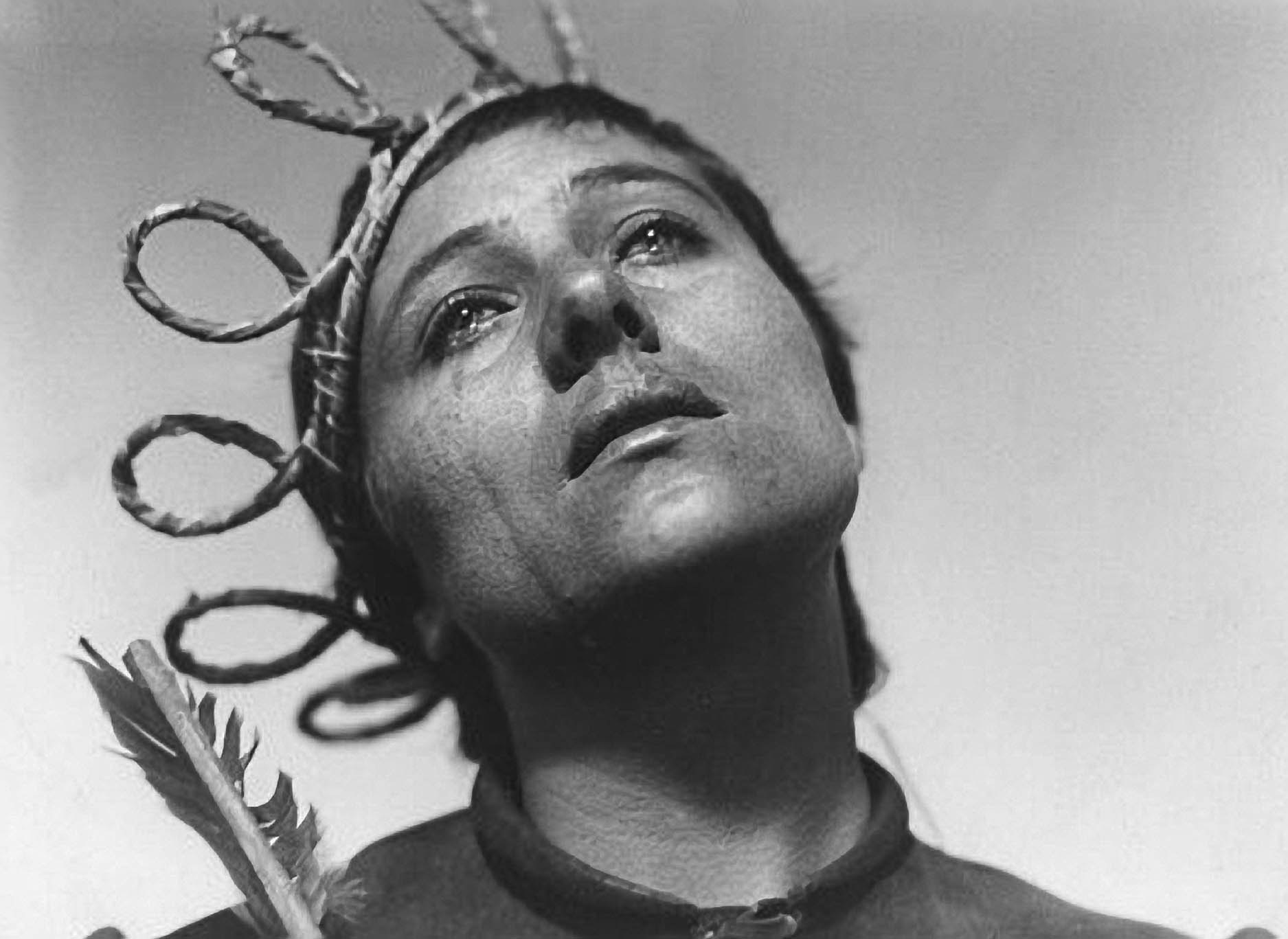
I had forgotten how intense 'The Passion of Joan of Arc' (1928) can be. I was reminded by yesterday's screening of Carl Theodor Dreyer's late silent at the Center of the Arts in Natick, Mass.

The Center for the Arts (referred to as "TCAN," with the N standing for Natick) is housed in a converted firehouse, which is a good thing, as 'Joan' generates quite a bit of heat, and I'm not talking about how she's burned at the stake. 

I'm talking emotional heat, and that's important to keep in mind when considering music for the film.

It's an unusual movie for many reasons—Dreyer's reliance on extreme close-ups, the almost-abstract settings, and the one-of-a-kind performance of actress Renée Falconetti in the title role.

(Literally: this was the only motion picture that Falconetti, an acclaimed stage actress, ever appeared in.)

It's unusual, too, in the role that music can play in the overall effect of this film on an audience, I think. More than most, 'Joan' is the kind of film that benefits from an aggressive, assertive score.

By that I don't mean loud, obnoxious music. I mean a score than minutely follows and brings out the many changes of emotional temperature in the narrative, which unfolds largely in the faces of the performers. (Remember all those close-ups!)

Dreyer's film, as I see it, is an attempt to use the then-new motion picture to bring a specific historical event to life visually. We see that intention clearly at the start of the film, which shows the old record books with the ancient line-by-line questioning and testimony covering the pages. 

But Dreyer's trick, borrowed from the stage (just like Falconetti), was to strip things down to emphasize the human element—hence no elaborate 14th century interiors or other sets to gawk at. And that's an extraordinary choice for the time, as movies were still in the "look what we can do" phase of visual design. 

In Europe, consider what Fritz Lang was doing at roughly the same time with 'Metropolis,' with its sprawling visuals of a futuristic city. And Hollywood was cranking out elaborate costume dramas by the yard, from Douglas Fairbanks on down. 

Yes, movies were a visual art, and the prevailing idea was to give people lots to look at: eye-popping sets, incredible locations, even elaborate title cards.

Renée Falconetti as Joan of Arc.

Not Dreyer. His telling of 'Joan' is simplicity itself. As I see it, his film actually borrows one of the best elements of the live theatre—intensity of focus that comes with actually limiting what an audience sees.

Think about it. Compared to movies, the stage has some real built-in limitations in terms of presentation.

With theatre, all the magic has to come within the narrow confines of a single building and whatever can be conjured by cardboard and paint. On stage, reality is not an option, at least in terms of going on location—say, setting a scene in a real city street crowded with real people.

I believe some of the best theatre happens when directors use that limitation to reduce potential distractions and focus on things such as the human drama and emotional line of a story. 

Think of Thornton Wilder's 'Our Town' (written not far from where I live, by the way, and based on the nearby town of Peterborough), which is staged with the simplest props and furniture. 

Yes, everyone loves a great set. In London, the set itself often gets applause when the curtain goes up. But ultimately, very often less can be more, or it can lead to an emphasis that otherwise wouldn't be present.

Because this is about music, how about 'Amadeus,' the stage play about Mozart and Salieri by Peter Shaffer? Right in the script, the stage directions are very explicit: although set in the palaces of 18th century Vienna, it should be given on a mostly blank stage, with minimal settings. 

Costumes, however, should be "sumptuously of the period," and as originally staged, they were. 

All of this serves to bring out the human element of the drama, which is an intense experience as played out in a theater with an audience. Did Salieri assassinate Mozart? How did it happen? It's gripping stuff to see Salieri's concern about his rival slowly bloom into an all-consuming obsession.

Also, leaving out the bric-a-brac of elaborate set design allows our imaginations to create something more elaborate than any set designer could conjure, and more personal, but that's a whole other topic.

Amadeus: conceived as a stage play, not nearly as effective on screen. 

Then consider what happened when 'Amadeus' got made into a movie. Because movies can go anywhere, in went elaborate location shots: castles and palaces and exteriors bringing to life bustling Vienna in the 18th century. (Director Milos Forman actually filmed a lot of it in Prague, which I guess looked more like 18th century Vienna than Vienna did.)

And the resulting film, laden with visual splendor, won the Oscar for Best Picture in 1984. But I remember being disappointed with it because it somehow lacked the intensity of the evening in the theater. 

It felt flabby. And I realize now that one reason is that the human story was buried by all the rich visuals: the horse-drawn coaches coming and going, the immense interiors, and so on.

It lacked the focus of the stage play. And although it was the same story, it was a completely different experience.

So back to Dreyer's film. By emphasizing extreme close-ups, but by keeping everything else fairly abstract, he greatly enhanced the intensity of the human drama of what on the page was a dry, historical record. 

And so I think he cleared the way for music to make a major contribution to the film's overall impact, then and now. His film, I think, is almost like music already—it's an abstraction (like music) intended to affect us on an emotional level.

As such, 'Joan' has attracted composers from outside the silent film accompaniment world. Richard Einhorn's 'Voices of Light' (1994) is often performed to screenings of the film, with great effect. A glance at Wikipedia bring to mind the old Jimmy Durante line, "Everyone's trying' to get into the act." Scores have been done by everyone from British early music group the Orlando Consort to the Australian rock band 'hazards of swimming naked.'

My own approach, as taken on Sunday in Natick, was to first follow the film's lead and strip the music down to bare essentials. So for the first two-thirds of the movie, I used strings only. No brass. No percussion. Just strings, and heavy on the sustained notes. (Which sound pretty good on the Korg synthesizer that I use.)

This is a bad comparison, but it's similar to what composer Bernard Herrmann (at left) was going for when he used strings only to score Alfred Hitchcock's 'Psycho' (1960). I recall him observing that he wanted "a black and white score for a black and white film." Hey, I steal from the best.

However! Within that limited palette, I felt free to bring out the emotional ups and downs of Joan's interaction with her inquisitors, which varies widely from sympathetic to antagonistic. So it was a score of constantly shifting ground: melodic or harmonic fragments tossed about as the emotional waves rose and fell. 

There really wasn't much action. But still, the visuals inspired at-times rapid shifts in tempo, mood, and character. At times, I felt like I was scoring people's faces rather than a traditional silent film.

But then, when Joan is sent to be executed, things change. Maybe it's because we're now outside, and now Dreyer begins to include hints of Joan's world and all the people in it. It's still very abstract, though. We rarely see anyone in full figure.

So for the final third of the film, I switched to an orchestral setting, knowing that the big "burning at the stake and rampaging mobs" scenes that conclude the film would really benefit from it. 

In switching, though, I kept the texture quite spartan at first, hoping that if I did it effectively, it wouldn't be noticed. And then I gradually amped things up to the point where Joan really does get burned at the stake (still all in close-ups), when it's justified to pull out all the stops, which I did. 

Drums, trumpets, the works!

And that takes us to the next adventure: a three-day tribute to the Kansas Silent Film Festival, which (alas) has gone all-virtual this year due to Covid-19. 

Here in New Hampshire, we're recreating the Kansas festival this weekend with three programs of films featuring performers from the Sunflower State.

Info is in the press release below. But let me note here that I'm especially excited to do music for three films that I've never accompanied before: Fatty Arbuckle's 'The Round-Up' (1920); Louise Brooks in 'The Show-Off' (1926); and Vera Reynolds in 'Risky Business' (1925), which turns out to be a surprisingly effective film. (Even without Tom Cruise.)

We'll even have delicacies imported from Kansas: specifically, legendary hot pickles from Porubsky's Deli in Topeka. In a world: Wow!

The only thing missing is you as part of the audience. So, essential collaborator that you are, get thee to the Town Hall Theatre in Wilton, N.H. this weekend, and let's make some silent film magic together!

*  *  *

 MONDAY, FEB. 15, 2021 / FOR IMMEDIATE RELEASE

Contact: Jeff Rapsis • (603) 236-9237 • jeffrapsis@gmail.com

Upcoming Kansas-themed film festival includes silent-era 'Risky Business' and 'Wizard of Oz'

Relocated due to Covid-19: New Hampshire version of Kansas festival offers three days of silent film with live music, Feb. 26-28

WILTON, N.H.—It's not the 1980s version with Tom Cruise, but a 1926 comedy/drama about a rich socialite in love with a poor country doctor.

It's 'Risky Business,' co-starring Kansas native Zasu Pitts, and it's on the program of the Covid-19-inspired "Kansas Silent Film Festival in New Hampshire" later this month.

With the annual Kansas festival suspended due to coronavirus, the pop-up New Hampshire version is being staged as a tribute 1,500 miles away.

The three-day festival will also feature the rarely screened silent film version of 'The Wizard of Oz' (1925), a slapstick comedy that includes Oliver Hardy as the Tin Man.

The Granite State version of the Kansas Silent Film Festival will run from Friday, Feb. 26 to Sunday, Feb. 28 at the Town Hall Theatre, 40 Main St. Wilton, N.H.

Admission is free, with no reservations required. To support the Town Hall Theatre's silent film programming and the Kansas Silent Film Festival, a donation of $10 per person is suggested.

The Town Hall Theatre has been operating safely since last July by following all state and CDC public health guidelines.

All films will be shown with live music by silent film accompanist Jeff Rapsis, who usually travels to the Kansas festival each year to practice his craft.

"With no in-person event in Kansas this year, I felt we had an opportunity to recreate the festival's special magic here in New Hampshire," Rapsis said.

Video introductions to each feature will be provided by Denise Morrison, a Missouri-based film historian who serves as emcee at the Kansas Silent Film Festival.

During intermissions, movie-goers will be invited to sample imported delicacies such as hot pickles from Porubski's Polish Deli in Topeka, Kansas.

The three days of programming spotlight films with connections to the Sunflower State, which produced a bumper crop of early Hollywood stars.

Kansas-born screen icon Louise Brooks stars in 'The Show Off' (1926); and Buster Keaton (born in Kansas when his parents were in a traveling medicine show) in the classic silent comedy 'The Navigator' (1924.)

The festival also includes a rare screening of 'The Little Church Around the Corner,' a 1923 melodrama featuring Kansas-raised Claire Windsor paired with actor Walter Long, a native of Milford, N.H.

Also on the festival's program: the original silent film version of 'The Wizard of Oz' (1925), with comic actor Oliver Hardy playing the Tin Man. Hardy would later be paired with Stan Laurel to form the immortal comic duo Laurel and Hardy.

"People are surprised to learn that there's a silent 'Wizard of Oz,' " Rapsis said. "But it's completely different from the MGM musical from 1939—it's a slapstick comedy that was created as a vehicle for roughhouse comedian Larry Semon, who plays the scarecrow."

In Kansas, in lieu of live performances this year, the Kansas Silent Film Festival will host a program of virtual screenings for online viewing. For more info, visit www.kssilentfilmfest.org.

In New Hampshire, each day of the relocated tribute festival includes two feature films separated by an intermission:

Friday, Feb. 26, 2021, 7:30 p.m.: Claire Windsor in 'The Little Church Around the Corner' (1923) and Fatty Arbuckle in 'The Round-Up' (1920). Kansas-born star Claire Windsor stars in 'The Little Church Around the Corner' (1923), a labor relations melodrama with a role for Milford, N.H. native Walter Long; followed by 'The Roundup' (1920), a rarely screened feature film starring Roscoe "Fatty" Arbuckle (also from Kansas) that wasn't released in the U.S. following accusations of murder against the comedian, leading to a notorious series of court trials that exonerated Arbuckle, but left his career in ruins.

Saturday, Feb. 27, 2021, 7:30 p.m.: Kansas-born silent screen icon Louise Brooks stars in 'The Show-Off' (1926) and Zasu Pitts (also from Kansas) appears in 'Risky Business' (1926). In 'The Show Off,' Brooks (from Cherryvale, Kansas) stars in the story of a working-class family's reluctance to accept their daughter's suitor. In 'Risky Business,' Zasu Pitts (from Olathe, Kansas) co-stars with Vera Reynolds in a comedy/drama about a rich socialite who falls in love with a poor country doctor—a relationship the girl's family is determined to break up, with unforeseen consquences.

Sunday, Feb. 28, 2021, 2 p.m.: The original silent 'Wizard of Oz' (1925) plus Buster Keaton in 'The Navigator' (1924). In the final program, we're definitely not in Kansas anymore with the original silent version of 'The Wizard of Oz,' starring comedian Larry Semon as the scarecrow and featuring Oliver Hardy as the Tin Man! Then it's the timeless visual comedy of Kansas-born Buster Keaton, often called the most silent of the silent comedians. In 'The Navigator' (1924), Buster sets sail on a deserted ocean liner, riding a high tide of hilarity. Classic silent film comedy!

"Thanks to everyone at the Kansas festival for giving us permission to stage this socially distanced tribute," said Rapsis, who has attended every Kansas Silent Film Festival since 2000. "We may be 1,500 miles away, but our hearts are in the same place."

For more about the Town Hall Theatre in Wilton, N.H., please visit www.wiltontownhalltheatre.com or call (603) 654-3456. For more about the Kansas Silent Film Festival, visit www.kssilentfilmfest.org.

Tuesday, February 16, 2021

Valentine's Day reactions to '7th Heaven' (1927); next up, music for 'Joan of Arc' (1928) on 2/21

The scene in '7th Heaven' that prompted shrieks from our audience.

Pleased to report a terrific Valentine's Day screening of '7th Heaven' (1927), the romantic drama starring Janet Gaynor and Charles Farrell. About 40 people turned out last Sunday for our show at the Town Hall Theatre, and you could tell the audience was buying it throughout. 

Near the beginning, people actually shrieked when Farrell held a troublesome character over an open manhole. And reactions continued all during the showing. It was a lively, engaged audience—an essential part of the silent film experience. So good job, everyone!

Just as the tagline for Farrell's character is "I'm a remarkable fellow," '7th Heaven' is a remarkable movie. Though nominally set in Paris on the eve of World War I, the idealized set design and the emphasis on big human emotions make it essentially timeless—a story that works today without any footnotes or explanations.

The only aspect that might seem a little incredible to a viewer today is Chico's spacious rooftop Paris flat, which doesn't have running water but which does have a generous floor plan and amazing views. How could a sewer worker afford such digs? But then again, it's a romantic fantasy. 

(Clarification: anyone working in the sewer business in a professional capacity cannot be paid enough for what they do.)

Chico's apartment: perhaps the positive side of all those French union strikes.

The thing about '7th Heaven' is that although it's a serious drama, it's also filled with comedy. This is important, not just because it's fun to laugh (and the comedy does still work), but somehow the mix humanizes everything, and I think is a key to getting an audience to truly care about the characters in under two hours—quite an amazing trick when you think about it.

In the music, I aimed to walk this tightrope, keeping things rooted in a sober frame but letting an audience know it's okay to chuckle at antics such as Chico's street-cleaning efforts or the dilapidated state of Eloise the Taxicab.

Although the film is set in Paris, I avoided trying to make the music sound stereotypically "French" in any way—no accordion licks, for instance. The film is visually French enough, and doesn't need any help from the soundtrack for atmosphere.

Rather, as a kind of sonic signature for Chico, I used a lilting 6/8 melody (to capture his optimism) that sounded more like a Scottish bag pipe tune. And for Diane, the weight was carried by a staccato four-note figure introduced when we see her being whipped by her sister.

Both of these figures, and some other tunes and chords I folded in to have material to work with, were able to be developed and transformed as the movie progressed. And after awhile, it became rather like an evolving Strauss tone poem, with scraps of tunes colliding into each other, all floating on a kind of surging harmonic sea, and all in service (I hope) to the movie's emotional line. 

When scoring a picture live, this state of mind doesn't always coalesce. But when it does, it takes on the feeling of a great shared adventure: one that encompasses those who made the film so long ago and also the audience sitting right behind me, with the music somehow creating the matrix that helps yesterday's stories reach out and touch today's hearts.

And when that happens, there's nothing like it. Creating the score in real time, with the movie playing overhead on the big screen, I get so absorbed, I don't know where the music comes from. At the same time, I'm absolutely present and engaged in the process of getting just the right music as a scene unfolds, keeping in mind what we've just done and what's coming next, and where we are in the overall story arc. Heaven, indeed!

In terms of screenings, what's next? The performance schedule continues to fill in, even during the ongoing pandemic.

This weekend, it's 'The Passion of Joan of Arc' (1928) down in Natick, Mass. on Sunday, Feb. 21 at 4 p.m. Another serious film, and this time without comedy. But something about the Natick Center for the Arts brings out the dramatist in me—a year ago, we did 'Pandora's Box' (1929) there, and I felt I hit it out of the park. So I'm looking forward to it.

Please join us! Housed in a converted firehouse, the Natick venue is a great place to take in movies. And not far away is Zaftig's Deli, where I can get my reuben knish fix. (There's nothing better on a cold day! Or any day, really.)

See you there, although with one caveat for all Catholics: I've been informed by the Archdiocese of Boston that the screening does not count as going to Mass. In my book, however, a visit to Zaftig's Deli counts as a religious experience.

*    *    *


Acclaimed stage actress Maria Falconetti in her only film performance, in 'Joan of Arc' (1928).

MONDAY, JAN. 25, 2020 / FOR IMMEDIATE RELEASE

Contact Jeff Rapsis • (603) 236-9237 • jeffrapsis@gmail.com

Rediscovered silent religious drama to be shown at Natick Center for the Arts on Sunday, Feb. 21

'The Passion of Joan of Arc' (1928), long thought lost until a copy was found in Norway, to be screened with live music

NATICK, Mass.—A ground-breaking European feature film—considered lost for decades until a copy surfaced in Oslo, Norway—will return to the big screen in February at the Center for the Arts in Natick.

'The Passion of Joan of Arc' (1928), a film noted for its innovative camera work and an acclaimed performance by actress Maria Falconetti, will be screened on Sunday, Feb. 21 at 4 p.m. as part of the Center for the Arts Silent Film Series.

Live music for the movie will be provided by silent film accompanist Jeff Rapsis.

Tickets are $18; Center for the Arts members $15, with limited seating due to Covid-19 capacity restrictions.

Directed by Denmark's Carl Theodor Dreyer, 'The Passion of Joan of Arc' chronicles the trial of Jeanne d'Arc on charges of heresy, and the efforts of her ecclesiastical jurists to force Jeanne to recant her claims of holy visions.

The film’s courtroom scenes are shot almost exclusively in close-up, situating all the film’s meaning and drama in the slightest movements of its protagonist’s face.

Of Falconetti's performance in the title role, critic Pauline Kael wrote that her portrayal "may be the finest performance ever recorded on film." Her performance was ranked 26th in Premiere Magazine's 100 Greatest Performances of All Time, the highest of any silent performance on the list. Falconetti, a legendary French stage actress, made only two films during her career.

The film has a history of controversy. The premiere of 'The Passion of Joan of Arc' in Paris on Oct. 25, 1928 was delayed because of the longtime efforts of many French nationalists, who objected to the fact that Dreyer was not Catholic and not French and to the then-rumored casting of Lillian Gish as Joan.

Before the premiere, several cuts were made by order of the Archbishop of Paris and by government censors. Dreyer had no say in these cuts and was angry about them. Later that year, a fire at UFA studios in Berlin destroyed the film's original negative and only a few copies of Dreyer's original cut of the film existed. 

Dreyer was able to patch together a new version of his original cut using alternate takes not initially used. This version was also destroyed in a lab fire in 1929. Over the years it became hard to find copies of Dreyer's second version and even harder to find copies of the original version of the film.

It was banned in Britain for its portrayal of crude English soldiers who mock and torment Joan in scenes that mirror biblical accounts of Christ's mocking at the hands of Roman soldiers. The Archbishop of Paris was also critical, demanding changes be made to the film.

'The Passion of Joan of Arc' was released near the end of the silent film era. About 80 percent of all movies made during that time are now lost due to decomposition, carelessness, fire, or neglect. But copies of "missing" films still occasionally turn up in archives and collections around the world, so researchers and archivists continue to make discoveries.

In the case of 'The Passion of Joan of Arc,' the original version of the film was lost for decades after a fire destroyed the master negative. In 1981, an employee of the Kikemark Sykehus mental institution in Oslo, Norway found several film cans in a janitor's closet that were labeled 'The Passion of Joan of Arc.'

The cans were sent to the Norwegian Film Institute where they were first stored for three years until finally being examined. It was then discovered that the prints were of Dreyer's original cut of the film before government or church censorship had taken place. No records exist of the film being shipped to Oslo, but film historians believe that the then-director of the institution may have requested a special copy.

For 'The Passion of Joan of Arc,' Rapsis will improvise a score from original musical material that he creates beforehand, using a digital synthesizer to recreate the sound and texture of a full orchestra.

"What I try to do," Rapsis said, "is create music that bridges the gap between a film that might be 90 or 100 years old, and the musical expectations of today's audiences."

'The Passion of Joan of Arc'  continues another season of silent films presented with live music at the Center for the Arts. The series provides local audiences the opportunity to experience silent film as it was intended to be shown: on the big screen, in good-looking prints, with live music, and with an audience.

“These films are still exciting experiences if you can show them as they were designed to be screened,” said Rapsis, accompanist for the screenings.

'The Passion of Joan of Arc' will be shown on Sunday, Feb. 21 at 4 p.m. at the Natick Center for the Arts, 14 Summer St., Natick, Mass.

Admission is $18, Center for the Arts members $15. Tickets must be purchased in advance online at www.natickarts.org.  For more information, call the Center box office at (508) 647-0097 or visit www.natickarts.org.


Sunday, October 11, 2020

Yesterday, the Moon and UFO Festival; today, 'Caligari' in Natick, Mass., then 'Wings' in Wilton, N.H. later this week

It's not easy being green. For some reason, you just don't fit in.

It's a beautiful Columbus Day weekend here in northern New England. The foliage is at its peak, but there's also spectacular color inside, such as this alien glimpsed as part of the Greater New England UFO Conference in Wilton, N.H. (More on that below.)

First up: this afternoon (Sunday, Oct. 11) it's 'The Cabinet of Dr. Caligari' (1920) at the Center for the Arts, 14 Summer St. in Natick, Mass. Screening time is 6 p.m., so guess it's technically this evening. 

I haven't promoted this one heavily because the Center, like all venues in Massachusetts, is limited to just 25 people due to Covid-19 restrictions. But if you'd like to go, check www.natickarts.org, as tickets are available only online and in advance.

But then we swing back to New Hampshire later this week with a screening of the epic World War I picture 'Wings' (1927) on Thursday, Oct. 15. Showtime is 7:30 p.m. at the Town Hall Theatre in Wilton, N.H., and it's the opening title in a three-day festival of classics brought to you by the Aviation Museum of N.H.

More on 'Wings' and the festival below. Before that, let's tackle the alien. (Not literally, as he may have a raygun, or be sticky.) He/she/it was spotted in the Town Hall Theatre lobby as part of, yes, the Greater New England UFO Conference, which is taking place this weekend.

In fact, it's still going on today: Sunday, Oct. 11. So there's still time to check it out if you're within driving or bicycling distance to Wilton, N.H. Among other attractions, the theater is enforcing social distancing by placing blow-up aliens (similar to the one above) in selected seats.

As an incentive, it's also a confab of "Big Foot" fans, one of whom can make plaster casts for you to take home:

Casting call: Take home your very own big feet!

I wish to apologize to all Bigfoot fans, plus the Native American community in general, for mistakenly referring to Big Foot in my opening remarks as "Sacajawea" instead of "Sasquatch." Wow, I'm turning into my malaprop-prone mother. God rest her soul. (Apologies to her, too, by the way. Just because.)

Anyway: I love doing music for Lang's 'Frau im Mond' (the original German title) because it's such a surprise for audiences, and also because the whole story and treatment are a good fit for the kind of music I make: that of the big gesture. 

Things always start off with a bang due to a flashback near the beginning: Prof. Manfeldt is seen more than three decades earlier, lecturing on his "gold on the moon" theory to fellow academics, who promptly riot. Lang then shows close-ups of a bell being rung and a whistle being blown to quell the fracas: literally, bells and whistles!

And that's what I use: my grandmother's old brass school bell, and a referee's whistle, to kick up a nice sonic riot to go with Lang's visuals. And it's really effective, I think, especially when the flashback ends and Lang dissolves back to Prof. Manfeldt, now impoverished and living in a garret: all the noise dies down and I just leave soft high note sustained, hanging there.

When I accompany 'Woman in the Moon,' the entire score is built out of original motifs for characters and situations. You need material to hold together a nearly three-hour film. But also, in just one instance, I use an identifiable tune that I think helps the film's emotional line.

The tune: 'Gaudeamus igitur,' the classic student anthem. I work it in during Manfeldt's flashback lecture to establish atmosphere, and then we don't hear it again until much later, when he reaches the moon and actually finds, yes, GOLD! 

Lang illustrates the moment visually by showing the Professor's shouts echoing among the lunar caverns, and I add a note of musical triumph by folding in the chords to 'Gaudeamus' on top of the by-then-rhythmic accompaniment in the bass. 

Lot of interesting comments from the 30 or so people who attended the screening. One I'd never heard before: "NASA could use you to add drama to their launches."

By the way, I mentioned bicycling because after yesterday's trip to the moon, I got on my trusty road bike and pedaled a late afternoon loop from the theater into the hills of bucolic Lyndeborough, N.H. (Pronounced "line-boro" for all you flatlanders.) 

And I mean hills. It was all up, up, up to what's called "Lyndeborough Center," with its meetinghouse and parsonage and open fields and views for miles. And then, as dusk gathered, I enjoyed my own rocket ship ride down the road to a place called "Fitch's Corner" in Milford, then back to the theater.

Distance was only about 15 miles, but the uphills made for slow going, while the downhills couldn't be taken advantage of entirely because it was getting dark and you have to be careful on these back roads.

But the air was still warm, even in the growing twilight, so it made for a spectacular communion with this year's foliage, which will be gone soon enough. 

Okay, here's more info about 'Wings' on Thursday and the other classic aviation films we're showing later this week. See you at the theater!

*   *   *

'Wings' to be screened with live music on Thursday, Oct. 15 at the Town Hall Theatre.

WEDNESDAY, SEPT. 30, 2020 / FOR IMMEDIATE RELEASE
Contact Jeff Rapsis • (603) 236-9237 • jrapsis@nhahs.org

Three-day festival of classic aviation adventure films coming to Wilton, N.H.

John Wayne, Jimmy Stewart among stars featured in Academy Award-winning pictures presented by Aviation Museum of N.H.

WILTON, N.H.—Fly off to high-altitude adventure with a festival of classic aviation films at the Town Hall Theatre, 40 Main St., Wilton, N.H.

The three-day event, which runs from Thursday, Oct. 15 through Saturday, Oct. 17, gives local audiences a chance to see timeless aviation movies as they were intended—on the big screen and in a theater.

The festival will include four large-scale features from Hollywood's Golden Age, ranging from the classic World War I aviation drama 'Wings' (1927) to the all-star wide-screen desert survival blockbuster 'The Flight of the Phoenix' (1965).

Other titles include '12 O'Clock High' (1949), an intense thriller about U.S. pilots in World War II, and 'The High and the Mighty' (1954), a ground-breaking airborne drama about a stricken commercial airliner starring John Wayne.

All films in the festival were nominated for multiple Academy Awards. Each captures the public's fascination with flight in a different setting, as pilots and passengers alike face danger in the sky and also on the ground. Aviation buffs will enjoy the vintage aircraft featured in each production.

All screenings are free and open to the public. Donations will be accepted, with all proceeds used to support the education outreach program of the Aviation Museum of N.H.

The Town Hall Theatre is observing procedures to comply with all state and CDC public health guidelines, including reduced seating capacity. For complete information about the venue's safety protocols, visit www.wiltontownhalltheatre.com.


• On Thursday, Oct. 15 at 7:30 p.m., the festival opens with the silent classic 'Wings' (1927), a drama about World War I aviation that won 'Best Picture' at the very first Academy Awards ceremony. The film stars Clara Bow, Charles 'Buddy' Rogers, and Richard Arlen. Live music for 'Wings' will be provided by Jeff Rapsis, a silent film accompanist and also executive director of the Aviation Museum of New Hampshire.


• On Friday, Oct. 16 at 7:30 p.m. brings '12 O'Clock High' (1949), a classic bout aircrews in the United States Army's Eighth Air Force, who flew daylight bombing missions against Nazi Germany and occupied France during the early days of American involvement in World War II. Starring Gregory Peck, '12 O'Clock High' received four Academy Award nominations, winning Best Supporting Actor for co-star Dean Jagger and Best Sound Recording.


• Saturday, Oct. 17 at 2 p.m., it's 'The High and the Mighty' (1954), a drama about a troubled commercial flight starring John Wayne and Robert Stack. With its intertwined stories of passengers on a doomed commercial flight, 'The High and the Mighty' served as a template for the Hollywood 'disaster' genre. The film earned six Academy Award nominations, winning for composer Dmitri Tiomkin's dramatic musical score.


• Saturday, Oct. 17 at 7:30 p.m., the festival concludes with 'The Flight of the Phoenix' (1965), a drama about survivors of a plane crash in the Sahara Desert. Starring Jimmy Stewart, Peter Finch, and Ernest Borgnine, 'The Flight of the Phoenix' was nominated for two Academy Awards: Ian Bannen for Supporting Actor and Michael Luciano for Film Editing.

"These are all terrific pictures with great stories set in the earlier days of aviation, before air travel became commonplace for so many people," said Jeff Rapsis, the Aviation Museum's executive director.

"They're a great way to recapture the romance and excitement of flight, and the Aviation Museum's festival is a rare chance to see them as intended: on a big screen and in a movie theater," Rapsis said.

The Aviation Museum of N.H., located at 27 Navigator Road, Londonderry, N.H., is a non-profit 501(c)3 tax-exempt organization. Housed in the vintage 1937 passenger terminal at Manchester-Boston Regional Airport, the Aviation Museum is dedicated to preserving the Granite State's rich aviation past, and also inspiring today's students to become the aviation pioneers of tomorrow.

For more information about the Aviation Museum, visit www.aviationmuseumofnh.org or call (603) 669-4820. Follow the Aviation Museum on social media at www.facebook.com/nhahs.

For more about the Town Hall Theatre, visit www.wiltontownhalltheatre.com or call (603) 654-3456.