Showing posts with label Joan of Arc. Show all posts

Monday, February 22, 2021

On 'Joan of Arc' and why less is more; plus previewing the Kansas Silent Film Festival in N.H.

A poster for Dreyer's 'The Passion of Joan of Arc.'

I had forgotten how intense 'The Passion of Joan of Arc' (1928) can be. I was reminded by yesterday's screening of Carl Theodor Dreyer's late silent at the Center of the Arts in Natick, Mass.

The Center for the Arts (referred to as "TCAN," with the N standing for Natick) is housed in a converted firehouse, which is a good thing, as 'Joan' generates quite a bit of heat, and I'm not talking about how she's burned at the stake. 

I'm talking emotional heat, and that's important to keep in mind when considering music for the film.

It's an unusual movie for many reasons—Dreyer's reliance on extreme close-ups, the almost-abstract settings, and the one-of-a-kind performance of actress Renée Falconetti in the title role.

(Literally: this was the only motion picture that Falconetti, an acclaimed stage actress, ever appeared in.)

It's unusual, too, in the role that music can play in the overall effect of this film on an audience, I think. More than most, 'Joan' is the kind of film that benefits from an aggressive, assertive score.

By that I don't mean loud, obnoxious music. I mean a score than minutely follows and brings out the many changes of emotional temperature in the narrative, which unfolds largely in the faces of the performers. (Remember all those close-ups!)

Dreyer's film, as I see it, is an attempt to use the then-new motion picture to bring a specific historical event to life visually. We see that intention clearly at the start of the film, which shows the old record books with the ancient line-by-line questioning and testimony covering the pages. 

But Dreyer's trick, borrowed from the stage (just like Falconetti), was to strip things down to emphasize the human element—hence no elaborate 14th century interiors or other sets to gawk at. And that's an extraordinary choice for the time, as movies were still in the "look what we can do" phase of visual design. 

In Europe, consider what Fritz Lang was doing at roughly the same time with 'Metropolis,' with its sprawling visuals of a futuristic city. And Hollywood was cranking out elaborate costume dramas by the yard, from Douglas Fairbanks on down. 

Yes, movies were a visual art, and the prevailing idea was to give people lots to look at: eye-popping sets, incredible locations, even elaborate title cards.
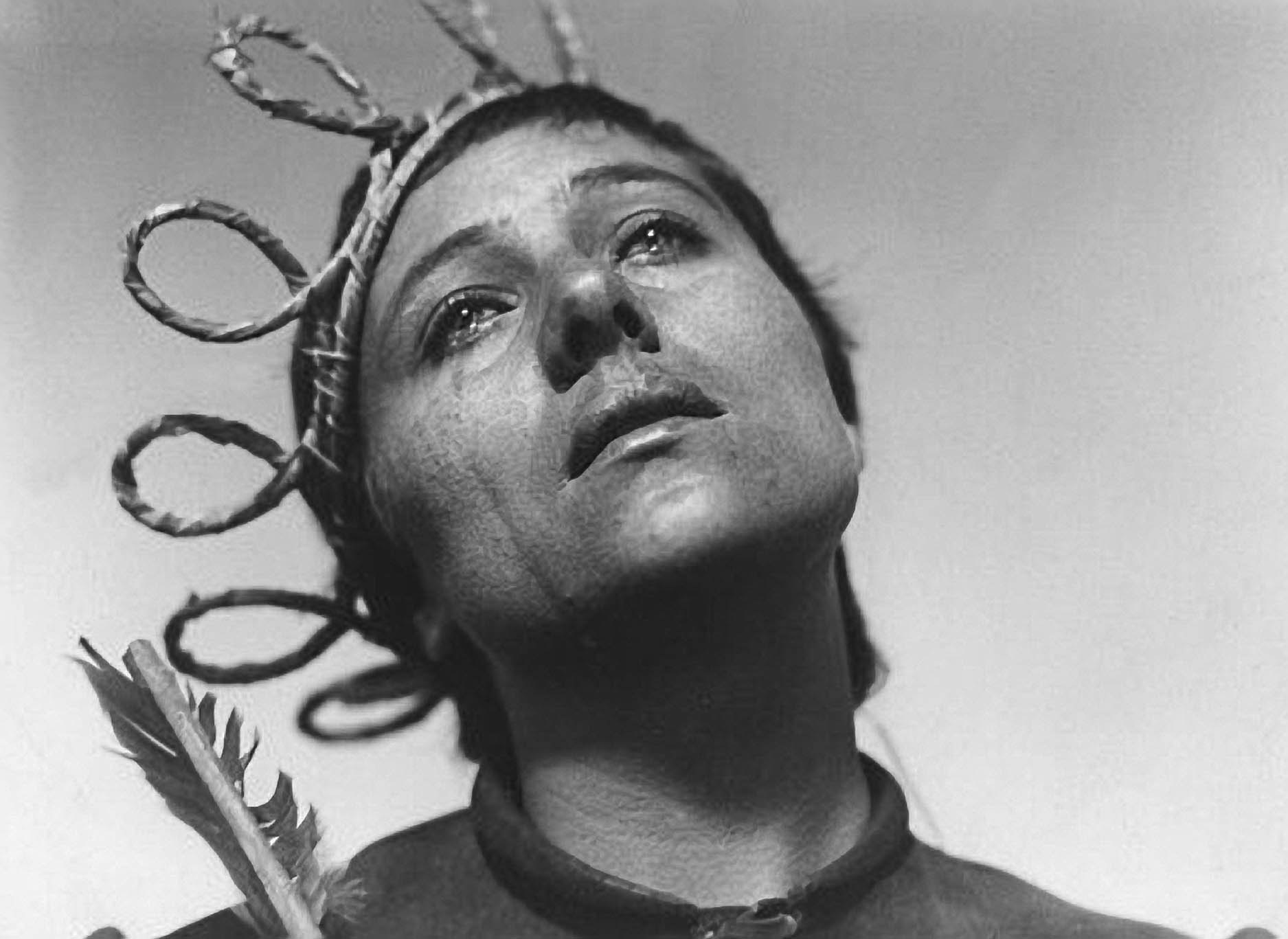
Renée Falconetti as Joan of Arc.

Not Dreyer. His telling of 'Joan' is simplicity itself. As I see it, his film actually borrows one of the best elements of the live theatre—intensity of focus that comes with actually limiting what an audience sees.

Think about it. Compared to movies, the stage has some real built-in limitations in terms of presentation.

With theatre, all the magic has to come within the narrow confines of a single building and whatever can be conjured by cardboard and paint. On stage, reality is not an option, at least in terms of going on location—say, setting a scene in a real city street crowded with real people.

I believe some of the best theatre happens when directors use that limitation to reduce potential distractions and focus on things such as the human drama and emotional line of a story. 

Think of Thornton Wilder's 'Our Town' (written not far from where I live, by the way, and based on the nearby town of Peterborough), which is staged with the simplest props and furniture. 

Yes, everyone loves a great set. In London, the set itself often gets applause when the curtain goes up. But ultimately, very often less can be more, or it can lead to an emphasis that otherwise wouldn't be present.

Because this is about music, how about 'Amadeus,' the stage play about Mozart and Salieri by Peter Shaffer? Right in the script, the stage directions are very explicit: although set in the palaces of 18th century Vienna, it should be given on a mostly blank stage, with minimal settings. 

Costumes, however, should be "sumptuously of the period," and as originally staged, they were. 

All of this serves to bring out the human element of the drama, which is an intense experience as played out in a theater with an audience. Did Salieri assassinate Mozart? How did it happen? It's gripping stuff to see Salieri's concern about his rival slowly bloom into an all-consuming obsession.

Also, leaving out the bric-a-brac of elaborate set design allows our imaginations to create something more elaborate than any set designer could conjure, and more personal, but that's a whole other topic.

Amadeus: conceived as a stage play, not nearly as effective on screen. 

Then consider what happened when 'Amadeus' got made into a movie. Because movies can go anywhere, in went elaborate location shots: castles and palaces and exteriors bringing to life bustling Vienna in the 18th century. (Director Milos Forman actually filmed a lot of it in Prague, which I guess looked more like 18th century Vienna than Vienna did.)

And the resulting film, laden with visual splendor, won the Oscar for Best Picture in 1984. But I remember being disappointed with it because it somehow lacked the intensity of the evening in the theater. 

It felt flabby. And I realize now that one reason is that the human story was buried by all the rich visuals: the horse-drawn coaches coming and going, the immense interiors, and so on.

It lacked the focus of the stage play. And although it was the same story, it was a completely different experience.

So back to Dreyer's film. By emphasizing extreme close-ups, but by keeping everything else fairly abstract, he greatly enhanced the intensity of the human drama of what on the page was a dry, historical record. 

And so I think he cleared the way for music to make a major contribution to the film's overall impact, then and now. His film, I think, is almost like music already—it's an abstraction (like music) intended to affect us on an emotional level.

As such, 'Joan' has attracted composers from outside the silent film accompaniment world. Richard Einhorn's 'Voices of Light' (1994) is often performed to screenings of the film, with great effect. A glance at Wikipedia bring to mind the old Jimmy Durante line, "Everyone's trying' to get into the act." Scores have been done by everyone from British early music group the Orlando Consort to the Australian rock band 'hazards of swimming naked.'

My own approach, as taken on Sunday in Natick, was to first follow the film's lead and strip the music down to bare essentials. So for the first two-thirds of the movie, I used strings only. No brass. No percussion. Just strings, and heavy on the sustained notes. (Which sound pretty good on the Korg synthesizer that I use.)

This is a bad comparison, but it's similar to what composer Bernard Herrmann (at left) was going for when he used strings only to score Alfred Hitchcock's 'Psycho' (1960). I recall him observing that he wanted "a black and white score for a black and white film." Hey, I steal from the best.

However! Within that limited palette, I felt free to bring out the emotional ups and downs of Joan's interaction with her inquisitors, which varies widely from sympathetic to antagonistic. So it was a score of constantly shifting ground: melodic or harmonic fragments tossed about as the emotional waves rose and fell. 

There really wasn't much action. But still, the visuals inspired at-times rapid shifts in tempo, mood, and character. At times, I felt like I was scoring people's faces rather than a traditional silent film.

But then, when Joan is sent to be executed, things change. Maybe it's because we're now outside, and now Dreyer begins to include hints of Joan's world and all the people in it. It's still very abstract, though. We rarely see anyone in full figure.

So for the final third of the film, I switched to an orchestral setting, knowing that the big "burning at the stake and rampaging mobs" scenes that conclude the film would really benefit from it. 

In switching, though, I kept the texture quite spartan at first, hoping that if I did it effectively, it wouldn't be noticed. And then I gradually amped things up to the point where Joan really does get burned at the stake (still all in close-ups), when it's justified to pull out all the stops, which I did. 

Drums, trumpets, the works!

And that takes us to the next adventure: a three-day tribute to the Kansas Silent Film Festival, which (alas) has gone all-virtual this year due to Covid-19. 

Here in New Hampshire, we're recreating the Kansas festival this weekend with three programs of films featuring performers from the Sunflower State.

Info is in the press release below. But let me note here that I'm especially excited to do music for three films that I've never accompanied before: Fatty Arbuckle's 'The Round-Up' (1920); Louise Brooks in 'The Show-Off' (1926); and Vera Reynolds in 'Risky Business' (1925), which turns out to be a surprisingly effective film. (Even without Tom Cruise.)

We'll even have delicacies imported from Kansas: specifically, legendary hot pickles from Porubsky's Deli in Topeka. In a world: Wow!

The only thing missing is you as part of the audience. So, essential collaborator that you are, get thee to the Town Hall Theatre in Wilton, N.H. this weekend, and let's make some silent film magic together!

*  *  *

 MONDAY, FEB. 15, 2021 / FOR IMMEDIATE RELEASE

Contact: Jeff Rapsis • (603) 236-9237 • jeffrapsis@gmail.com

Upcoming Kansas-themed film festival includes silent-era 'Risky Business' and 'Wizard of Oz'

Relocated due to Covid-19: New Hampshire version of Kansas festival offers three days of silent film with live music, Feb. 26-28

WILTON, N.H.—It's not the 1980s version with Tom Cruise, but a 1926 comedy/drama about a rich socialite in love with a poor country doctor.

It's 'Risky Business,' co-starring Kansas native Zasu Pitts, and it's on the program of the Covid-19-inspired "Kansas Silent Film Festival in New Hampshire" later this month.

With the annual Kansas festival suspended due to coronavirus, the pop-up New Hampshire version is being staged as a tribute 1,500 miles away.

The three-day festival will also feature the rarely screened silent film version of 'The Wizard of Oz' (1925), a slapstick comedy that includes Oliver Hardy as the Tin Man.

The Granite State version of the Kansas Silent Film Festival will run from Friday, Feb. 26 to Sunday, Feb. 28 at the Town Hall Theatre, 40 Main St. Wilton, N.H.

Admission is free, with no reservations required. To support the Town Hall Theatre's silent film programming and the Kansas Silent Film Festival, a donation of $10 per person is suggested.

The Town Hall Theatre has been operating safely since last July by following all state and CDC public health guidelines.

All films will be shown with live music by silent film accompanist Jeff Rapsis, who usually travels to the Kansas festival each year to practice his craft.

"With no in-person event in Kansas this year, I felt we had an opportunity to recreate the festival's special magic here in New Hampshire," Rapsis said.

Video introductions to each feature will be provided by Denise Morrison, a Missouri-based film historian who serves as emcee at the Kansas Silent Film Festival.

During intermissions, movie-goers will be invited to sample imported delicacies such as hot pickles from Porubski's Polish Deli in Topeka, Kansas.

The three days of programming spotlight films with connections to the Sunflower State, which produced a bumper crop of early Hollywood stars.

Kansas-born screen icon Louise Brooks stars in 'The Show Off' (1926); and Buster Keaton (born in Kansas when his parents were in a traveling medicine show) in the classic silent comedy 'The Navigator' (1924.)

The festival also includes a rare screening of 'The Little Church Around the Corner,' a 1923 melodrama featuring Kansas-raised Claire Windsor paired with actor Walter Long, a native of Milford, N.H.

Also on the festival's program: the original silent film version of 'The Wizard of Oz' (1925), with comic actor Oliver Hardy playing the Tin Man. Hardy would later be paired with Stan Laurel to form the immortal comic duo Laurel and Hardy.

"People are surprised to learn that there's a silent 'Wizard of Oz,' " Rapsis said. "But it's completely different from the MGM musical from 1939—it's a slapstick comedy that was created as a vehicle for roughhouse comedian Larry Semon, who plays the scarecrow."

In Kansas, in lieu of live performances this year, the Kansas Silent Film Festival will host a program of virtual screenings for online viewing. For more info, visit www.kssilentfilmfest.org.

In New Hampshire, each day of the relocated tribute festival includes two feature films separated by an intermission:

Friday, Feb. 26, 2021, 7:30 p.m.: Claire Windsor in 'The Little Church Around the Corner' (1923) and Fatty Arbuckle in 'The Round-Up' (1920). Kansas-born star Claire Windsor stars in 'The Little Church Around the Corner' (1923), a labor relations melodrama with a role for Milford, N.H. native Walter Long; followed by 'The Roundup' (1920), a rarely screened feature film starring Roscoe "Fatty" Arbuckle (also from Kansas) that wasn't released in the U.S. following accusations of murder against the comedian, leading to a notorious series of court trials that exonerated Arbuckle, but left his career in ruins.

Saturday, Feb. 27, 2021, 7:30 p.m.: Kansas-born silent screen icon Louise Brooks stars in 'The Show-Off' (1926) and Zasu Pitts (also from Kansas) appears in 'Risky Business' (1926). In 'The Show Off,' Brooks (from Cherryvale, Kansas) stars in the story of a working-class family's reluctance to accept their daughter's suitor. In 'Risky Business,' Zasu Pitts (from Olathe, Kansas) co-stars with Vera Reynolds in a comedy/drama about a rich socialite who falls in love with a poor country doctor—a relationship the girl's family is determined to break up, with unforeseen consquences.

Sunday, Feb. 28, 2021, 2 p.m.: The original silent 'Wizard of Oz' (1925) plus Buster Keaton in 'The Navigator' (1924). In the final program, we're definitely not in Kansas anymore with the original silent version of 'The Wizard of Oz,' starring comedian Larry Semon as the scarecrow and featuring Oliver Hardy as the Tin Man! Then it's the timeless visual comedy of Kansas-born Buster Keaton, often called the most silent of the silent comedians. In 'The Navigator' (1924), Buster sets sail on a deserted ocean liner, riding a high tide of hilarity. Classic silent film comedy!

"Thanks to everyone at the Kansas festival for giving us permission to stage this socially distanced tribute," said Rapsis, who has attended every Kansas Silent Film Festival since 2000. "We may be 1,500 miles away, but our hearts are in the same place."

For more about the Town Hall Theatre in Wilton, N.H., please visit www.wiltontownhalltheatre.com or call (603) 654-3456. For more about the Kansas Silent Film Festival, visit www.kssilentfilmfest.org.

Tuesday, February 16, 2021

Valentine's Day reactions to '7th Heaven' (1927); next up, music for 'Joan of Arc' (1928) on 2/21

The scene in '7th Heaven' that prompted shrieks from our audience.

Pleased to report a terrific Valentine's Day screening of '7th Heaven' (1927), the romantic drama starring Janet Gaynor and Charles Farrell. About 40 people turned out last Sunday for our show at the Town Hall Theatre, and you could tell the audience was buying it throughout. 

Near the beginning, people actually shrieked when Farrell held a troublesome character over an open manhole. And reactions continued all during the showing. It was a lively, engaged audience—an essential part of the silent film experience. So good job, everyone!

Just as the tagline for Farrell's character is "I'm a remarkable fellow," '7th Heaven' is a remarkable movie. Though nominally set in Paris on the eve of World War I, the idealized set design and the emphasis on big human emotions make it essentially timeless—a story that works today without any footnotes or explanations.

The only aspect that might seem a little incredible to a viewer today is Chico's spacious rooftop Paris flat, which doesn't have running water but which does have a generous floor plan and amazing views. How could a sewer worker afford such digs? But then again, it's a romantic fantasy. 

(Clarification: anyone working in the sewer business in a professional capacity cannot be paid enough for what they do.)

Chico's apartment: perhaps the positive side of all those French union strikes.

The thing about '7th Heaven' is that although it's a serious drama, it's also filled with comedy. This is important, not just because it's fun to laugh (and the comedy does still work), but somehow the mix humanizes everything, and I think is a key to getting an audience to truly care about the characters in under two hours—quite an amazing trick when you think about it.

In the music, I aimed to walk this tightrope, keeping things rooted in a sober frame but letting an audience know it's okay to chuckle at antics such as Chico's street-cleaning efforts or the dilapidated state of Eloise the Taxicab.

Although the film is set in Paris, I avoided trying to make the music sound stereotypically "French" in any way—no accordion licks, for instance. The film is visually French enough, and doesn't need any help from the soundtrack for atmosphere.

Rather, as a kind of sonic signature for Chico, I used a lilting 6/8 melody (to capture his optimism) that sounded more like a Scottish bag pipe tune. And for Diane, the weight was carried by a staccato four-note figure introduced when we see her being whipped by her sister.

Both of these figures, and some other tunes and chords I folded in to have material to work with, were able to be developed and transformed as the movie progressed. And after awhile, it became rather like an evolving Strauss tone poem, with scraps of tunes colliding into each other, all floating on a kind of surging harmonic sea, and all in service (I hope) to the movie's emotional line. 

When scoring a picture live, this state of mind doesn't always coalesce. But when it does, it takes on the feeling of a great shared adventure: one that encompasses those who made the film so long ago and also the audience sitting right behind me, with the music somehow creating the matrix that helps yesterday's stories reach out and touch today's hearts.

And when that happens, there's nothing like it. Creating the score in real time, with the movie playing overhead on the big screen, I get so absorbed, I don't know where the music comes from. At the same time, I'm absolutely present and engaged in the process of getting just the right music as a scene unfolds, keeping in mind what we've just done and what's coming next, and where we are in the overall story arc. Heaven, indeed!

In terms of screenings, what's next? The performance schedule continues to fill in, even during the ongoing pandemic.

This weekend, it's 'The Passion of Joan of Arc' (1928) down in Natick, Mass. on Sunday, Feb. 21 at 4 p.m. Another serious film, and this time without comedy. But something about the Natick Center for the Arts brings out the dramatist in me—a year ago, we did 'Pandora's Box' (1929) there, and I felt I hit it out of the park. So I'm looking forward to it.

Please join us! Housed in a converted firehouse, the Natick venue is a great place to take in movies. And not far away is Zaftig's Deli, where I can get my reuben knish fix. (There's nothing better on a cold day! Or any day, really.)

See you there, although with one caveat for all Catholics: I've been informed by the Archdiocese of Boston that the screening does not count as going to Mass. In my book, however, a visit to Zaftig's Deli counts as a religious experience.

*    *    *


Acclaimed stage actress Maria Falconetti in her only film performance, in 'Joan of Arc' (1928).

MONDAY, JAN. 25, 2020 / FOR IMMEDIATE RELEASE

Contact Jeff Rapsis • (603) 236-9237 • jeffrapsis@gmail.com

Rediscovered silent religious drama to be shown at Natick Center for the Arts on Sunday, Feb. 21

'The Passion of Joan of Arc' (1928), long thought lost until a copy was found in Norway, to be screened with live music

NATICK, Mass.—A ground-breaking European feature film—considered lost for decades until a copy surfaced in Oslo, Norway—will return to the big screen in February at the Center for the Arts in Natick.

'The Passion of Joan of Arc' (1928), a film noted for its innovative camera work and an acclaimed performance by actress Maria Falconetti, will be screened on Sunday, Feb. 21 at 4 p.m. as part of the Center for the Arts Silent Film Series.

Live music for the movie will be provided by silent film accompanist Jeff Rapsis.

Tickets are $18; Center for the Arts members $15, with limited seating due to Covid-19 capacity restrictions.

Directed by Denmark's Carl Theodor Dreyer, 'The Passion of Joan of Arc' chronicles the trial of Jeanne d'Arc on charges of heresy, and the efforts of her ecclesiastical jurists to force Jeanne to recant her claims of holy visions.

The film’s courtroom scenes are shot almost exclusively in close-up, situating all the film’s meaning and drama in the slightest movements of its protagonist’s face.

Of Falconetti's performance in the title role, critic Pauline Kael wrote that her portrayal "may be the finest performance ever recorded on film." Her performance was ranked 26th in Premiere Magazine's 100 Greatest Performances of All Time, the highest of any silent performance on the list. Falconetti, a legendary French stage actress, made only two films during her career.

The film has a history of controversy. The premiere of 'The Passion of Joan of Arc' in Paris on Oct. 25, 1928 was delayed because of the longtime efforts of many French nationalists, who objected to the fact that Dreyer was not Catholic and not French and to the then-rumored casting of Lillian Gish as Joan.

Before the premiere, several cuts were made by order of the Archbishop of Paris and by government censors. Dreyer had no say in these cuts and was angry about them. Later that year, a fire at UFA studios in Berlin destroyed the film's original negative and only a few copies of Dreyer's original cut of the film existed. 

Dreyer was able to patch together a new version of his original cut using alternate takes not initially used. This version was also destroyed in a lab fire in 1929. Over the years it became hard to find copies of Dreyer's second version and even harder to find copies of the original version of the film.

It was banned in Britain for its portrayal of crude English soldiers who mock and torment Joan in scenes that mirror biblical accounts of Christ's mocking at the hands of Roman soldiers. The Archbishop of Paris was also critical, demanding changes be made to the film.

'The Passion of Joan of Arc' was released near the end of the silent film era. About 80 percent of all movies made during that time are now lost due to decomposition, carelessness, fire, or neglect. But copies of "missing" films still occasionally turn up in archives and collections around the world, so researchers and archivists continue to make discoveries.

In the case of 'The Passion of Joan of Arc,' the original version of the film was lost for decades after a fire destroyed the master negative. In 1981, an employee of the Kikemark Sykehus mental institution in Oslo, Norway found several film cans in a janitor's closet that were labeled 'The Passion of Joan of Arc.'

The cans were sent to the Norwegian Film Institute where they were first stored for three years until finally being examined. It was then discovered that the prints were of Dreyer's original cut of the film before government or church censorship had taken place. No records exist of the film being shipped to Oslo, but film historians believe that the then-director of the institution may have requested a special copy.

For 'The Passion of Joan of Arc,' Rapsis will improvise a score from original musical material that he creates beforehand, using a digital synthesizer to recreate the sound and texture of a full orchestra.

"What I try to do," Rapsis said, "is create music that bridges the gap between a film that might be 90 or 100 years old, and the musical expectations of today's audiences."

'The Passion of Joan of Arc'  continues another season of silent films presented with live music at the Center for the Arts. The series provides local audiences the opportunity to experience silent film as it was intended to be shown: on the big screen, in good-looking prints, with live music, and with an audience.

“These films are still exciting experiences if you can show them as they were designed to be screened,” said Rapsis, accompanist for the screenings.

'The Passion of Joan of Arc' will be shown on Sunday, Feb. 21 at 4 p.m. at the Natick Center for the Arts, 14 Summer St., Natick, Mass.

Admission is $18, Center for the Arts members $15. Tickets must be purchased in advance online at www.natickarts.org.  For more information, call the Center box office at (508) 647-0097 or visit www.natickarts.org.


Thursday, April 7, 2016

On different versions of silent films:
It may have no arms, but it's still a masterpiece

I've recently accompanied two film prints of widely known silent movies that had significant differences from what I expected.

In one case, it was a 35mm print of 'Intolerance' (1916) that was missing dozens of key scenes, often substituted for with frame grabs.

In another case, it was a 16mm print of 'The Passion of Joan of Arc' (1928) that was missing key information in titles, and so didn't make much sense to the audience.

In both examples, I've seen other versions of the films that each had the missing footage or titles. But these prints just didn't have them.

When this happens, I tell people that silent film often has to be considered in the same we the "Venus De Milo" is looked at in sculpture.

Yes, it has no arms. But it's still recognized as a masterpiece.

And the lack of arms is part of the sculpture's greatness, I think, as it shows so visibly the perilous journey of anything from antiquity that has come down to us today.

It also invites us to collaborate, in a way. We can't help but imagine what to us would be the most perfect arms, their position, their placement, and so on.

Like a lot of art, it prompts us to come up with our own visions to complete it. And each person's vision is bound to be unique and different and perhaps more perfect (to you) than any sculptor could have made them.

Franz Schubert, composer of the 'Unfinished' Symphony.

Same thing in music with Schubert's 'Unfinished' Symphony. Okay, it's missing the last two movements of the typical format of a symphony of its time.

But it stands on its own as a satisfying and complete piece of music. And part of its special beauty is that it leaves us wondering what might have been.

And so it is with a lot of silent film, I say.

Many films, including well-known classics like the two mentioned above, exist in different versions, different formats, and sometimes with significant pieces missing: lost arms, so to speak.

This can seem surprising to people because we live in an age where a movie is always expected to be complete, a whole thing, either in a theater or DVD or online or whatever.

No matter how you watched 'Frozen,' it's the same film.

No so with early cinema, where archaeology is a useful frame of mind to have. Often, to assemble a reasonably complete version of even a well-known title requires pulling material from archives all over the world.

And then there's the whole conundrum of European versions vs. American versions; home cut-downs vs. full theatrical releases; prints butchered by local censors and projection booth mishaps.

Even at the time of original release, there was often no one definitive version of a film. After releasing 'Intolerance,' director D.W. Griffith would visit projection booths where the film was running and try to edit the prints on the spot!

Raymond Griffith in 'Paths to Paradise' (1925).

One of the best examples of a film that's missing a big chunk, but still worth watching, is Raymond Griffith's 'Paths to Paradise' (1925), which I'm accompanying next month at the Flying Monkey Moviehouse in Plymouth, N.H. and also the Somerville Theatre in Boston.

In the version that's come down to us, the film ends with a crackerjack cross-country chase worthy of Buster Keaton. In my experience, it never fails to get an audience going.

So afterwards, people are stunned to learn that the film is actually missing its entire last reel!

From what I understand, after a pause for the audience to catch its collective breath, Griffith takes his chase one big step further for the film's real climax.

Does it work? We can't say because no one has ever found a copy of the last reel.

It may still be out there. A century after silent film flourished, reels of original nitrate film turn up in the most unlikely of places.

So keep looking.

And while you're at it, if you happen to spot a pair of marble arms, let me know.

Thursday, April 4, 2013

Joan of Arc to Tillie's Punctured Romance:
From the sublime to the ridiculous


If I start showing symptoms of schizophrenia, blame it on silent film.

This past Sunday, we ran 'The Passion of Joan of Arc' (1928), an intense drama that was emotionally draining for everyone, accompanist included. Then, two nights later, we ran 'Tillie's Punctured Romance' (1914), the slapstick comedy feature starring Marie Dressler and a non-tramp Charlie Chaplin.

About all they had in common was that they were both silent films. Otherwise, it was like they were from different planets. And that dichotomy extended to the musical challenges that each film presented.

'Joan of Arc' in Wilton, N.H. drew an audience of about 50 people on Easter Sunday—an appropriate day for a film, I thought, that attempts parallels with the Passion of Christ. To score it, I stuck with strings only, to go along with director Carl Dreyer's intentionally limited visual palette of mostly close-ups. I thought that alone would help signal to the audience that this was something different, the same way Bernard Herrmann used strings for Hitchcock's 'Psycho' (1960). (I recall somewhere Herrmann described that music as "a black and white score for a black and white film.")

Complicating things was the fact that I had only just returned that day at 2 a.m. from a week in Mexico with my wife's family. So going into it, I hadn't prepared anything elaborate. All I had were two motifs that I thought would be enough: a series of rising chords that alternated between C minor and Eb minor, with added notes on top, and then a little downward cell of three staccato notes in C minor (D, C, G) that could be spun into something rapid or dramatic or whatever the occasion required.

Well, I should probably go to Mexico more often, because it turned out to be one of those times when everything fell into place. Somehow I was in synch with the film's dramatic rhythms right from the start, building up the texture when it was most effective and then backing off at what turned out to be just the right time, and so was able to create music that I felt really enhanced the visuals.


And I got caught up in it. 'Joan of Arc,' with its extreme close-ups and weird angles and stark visuals and abrupt cutting, is a film that really does work best on a big screen in a theater, I think. Seeing it all on a large screen somehow opens up vistas (and emotions) in a way that impossible in other formats. It's like the George Seurat painting, "A Sunday Afternoon on the Island of La Grande Jatte," which in real life is a huge thing. You don't get it by looking at a plate in a book. You have to go to Chicago and see it in person to get it.

So at the end, I was more than a little drained. We seemed to have a higher number of first-timers in the audience for this one, and many approached me afterwards with kind comments. As intense and rewarding as it was, I was left wondering if they thought all silent film was like this!

About the music: By intention, I did not listen to the Richard Einhorn's 'Voices of Light' oratorio that is often used for this film. I wanted to develop my own material and approach without reference to other music, as I feel that helps in the originality department. Now that I've done that, I'm looking forward to watching 'Joan of Arc' with Einhorn's score, which I understand is very effective and moving.

And then, two days later, it was time for 'Tillie's Punctured Romance,' the early slapstick epic from Mack Sennett's Keystone studios. I had never done this film before, but somehow felt that the full orchestral texture that I usually use for features would be too much. So, for our screening at the Manchester (N.H.) City Library, I settled on a harpsichord and strings texture as a way to keep up with the film and not step on the laughs.


It's not an easy film to play for. In fact, it was a lot more difficult than 'Joan of Arc,' in that it was tough to hit the mark and punch up the comedy with just the right kind of music. But then, it's all slapstick, so you can get away with barreling through without missing too many moments. I recall telling people that 'Tillie' is comedy in the sense that in scene after scene, it's just any excuse for someone to kick someone else in the pants or push someone or throw something at someone.

I mean, when a film opens with a woman throwing a brick for her dog to catch, you get a pretty good idea right away of what you're in for. I watched and accompanied Tillie's with the growing sense that the story was not really about people. With everyone always fighting or bickering or finding any excuse to attach each other, it was more like dogs than people.

For Tillie's, I really did show up with nothing in mind, and had only watched the film on fast forward the night before (on my night off after 'Joan of Arc.') So off I went, and the Gods were not too cruel to me, allowing me to spin out a few fun melodic ideas right away and then draw upon them for the rest of the picture.

To my surprise, the audience of about 40 people stayed with the picture and actually laughed out loud at odd moments. I honestly didn't think it would produce any—an hour of slapstick is like eating the same flavor of ice cream every day for a month. But then again, a few moments that I felt sure would produce a reaction fell flat—for instance, the scene in the movie theater when it turns out Charlie and Mabel Normand are sitting next to a guy wearing a badge. It should be a highlight, but Tuesday night produced not a titter.


That man on the right has a surprise under his lapel...

I then did 'The Mask of Zorro' (1920) in North Andover, Mass. last night, which is verging on too much. Three screenings in four nights after being out of town for a week. I need a vacation!

Friday, March 29, 2013

'Joan of Arc' (1928) in Wilton, N.H.
on Easter Sunday, March 31 at 4:30 p.m.


Here's an odd statement about doing music for silent films: no matter what other difficulties exist, there's little chance of running out of new material.

But wait, how can that be? For one thing, they're not making them anymore, other than one-offs like 'The Artist' (2012). And also, about 80 percent of all films released during the silent era (up until about 1929) are lost.

Even so, I've found those that remain form an endless all-you-can-eat buffet of silent cinema that I don't think I'll ever finish consuming -- er, watch. (Can you tell I'm writing this just before dinner?)

Really! I've been doing this for years now, and I continue to encounter films that I never knew existed. At Cinefest (held earlier this month in Syracuse, N.Y.), I had the pleasure of doing music for no less than five different features, all of them worthy, and all of them unknown to me.

In the spirit of exploring this bounty, I've made it a practice to program a certain number of "new" films in the screenings that I do (new to me, that is) rather than rely solely on the tried-and-true warhorses. For one thing, to do the same films again and again would be boring. Also, you never know how a film is going to play until you show it as intended: with live music in a theater, and with an audience.

Because of this, the titles are piling up. As of this month, the list of full-fledged silent feature films I've accompanied with live music has surpassed 135. And it's about to get a little longer with my first-ever presentation of the great French-Danish film 'The Passion of Joan of Arc' (1928) this Sunday in Wilton, N.H.

It should be interesting, as the film is noted for its unusual structure, its cinematography and a world class performance by French stage actress Renee Maria Falconetti. You don't have to take my word for it -- check out what no less than Roger Ebert had to say about her work in 'Joan of Arc':

"You cannot know the history of silent film unless you know the face of Renee Maria Falconetti. In a medium without words, where the filmmakers believed that the camera captured the essence of characters through their faces, to see Falconetti in Dreyer's "The Passion of Joan of Arc'' (1928) is to look into eyes that will never leave you."

That's from Ebert's 1997 assessment of the film as part of his 'Great Movies' write-ups. The 'Dreyer' who Ebert mentioned, by the way, is Carl Theodor Dreyer, a Danish director who helmed this unusual film.

Why is it unusual? I hope Roger doesn't mind if I quote him at length:

"There is a language of shooting and editing that we subconsciously expect at the movies. We assume that if two people are talking, the cuts will make it seem that they are looking at one another. We assume that if a judge is questioning a defendant, the camera placement and editing will make it clear where they stand in relation to one another. If we see three people in a room, we expect to be able to say how they are arranged and which is closest to the camera. Almost all such visual cues are missing from "The Passion of Joan of Arc.''

"Instead Dreyer cuts the film into a series of startling images. The prison guards and the ecclesiastics on the court are seen in high contrast, often from a low angle, and although there are often sharp architectural angles behind them, we are not sure exactly what the scale is (are the windows and walls near or far?). Bordwell's book reproduces a shot of three priests, presumably lined up from front to back, but shot in such a way that their heads seem stacked on top of one another. All of the faces of the inquisitors are shot in bright light, without makeup, so that the crevices and flaws of the skin seem to reflect a diseased inner life.

"Falconetti, by contrast, is shot in softer grays, rather than blacks and whites. Also without makeup, she seems solemn and consumed by inner conviction. Consider an exchange where a judge asks her whether St. Michael actually spoke to her. Her impassive face seems to suggest that whatever happened between Michael and herself was so far beyond the scope of the question that no answer is conceivable.

Okay, that's enough from Roger...

Another reason our screening should be interesting is that I have had absolutely no chance to prepare. In fact, I'm writing this on the west coast of Mexico, in the resort town of Ixtapa, the day before we decamp from a family vacation and return to New Hampshire. We'll be back in the wee hours of Sunday morning, which gives me about 14 hours to come up with something, besides sleeping and eating, etc.

Interested to see how it comes out? Then join us for Sunday's screening as I add one more title to must list of features scored. For more info, here's the press release that was sent out awhile back...

* * *

FRIDAY, MARCH 22, 2013 / FOR IMMEDIATE RELEASE
Contact Jeff Rapsis • (603) 236-9237 • jeffrapsis@gmail.com

Rediscovered French silent religious drama
to be shown in Wilton, N.H. on Sunday, March 31


'The Passion of Joan of Arc' (1928), long thought lost
until a copy was found in Norway, to be screened with live music

WILTON, N.H.—A ground-breaking European feature film—considered lost for decades until a copy surfaced in Oslo, Norway—will soon return to the big screen in Wilton, N.H.

'The Passion of Joan of Arc' (1928), a film noted for its innovative camera work and an acclaimed performance by actress Maria Falconetti, will be screened on Sunday, March 31 at 4:30 p.m. at the Wilton (N.H.) Town Hall Theatre.

Live music for the movie will be provided by silent film accompanist Jeff Rapsis. Admission is free, with donations accepted.

Directed by Denmark's Carl Theodor Dreyer, 'The Passion of Joan of Arc' chronicles the trial of Jeanne d'Arc on charges of heresy, and the efforts of her ecclesiastical jurists to force Jeanne to recant her claims of holy visions.

The film’s courtroom scenes are shot almost exclusively in close-up, situating all the film’s meaning and drama in the slightest movements of its protagonist’s face.

Of Falconetti's performance in the title role, critic Pauline Kael wrote that her portrayal "may be the finest performance ever recorded on film." Her performance was ranked 26th in Premiere Magazine's 100 Greatest Performances of All Time, the highest of any silent performance on the list. Falconetti, a legendary French stage actress, made only two films during her career.

The film has a history of controversy. The premiere of 'The Passion of Joan of Arc' in Paris on Oct. 25, 1928 was delayed because of the longtime efforts of many French nationalists, who objected to the fact that Dreyer was not Catholic and not French and to the then-rumored casting of Lillian Gish as Joan.

Before the premiere, several cuts were made by order of the Archbishop of Paris and by government censors. Dreyer had no say in these cuts and was angry about them. Later that year, a fire at UFA studios in Berlin destroyed the film's original negative and only a few copies of Dreyer's original cut of the film existed. Dreyer was able to patch together a new version of his original cut using alternate takes not initially used. This version was also destroyed in a lab fire in 1929. Over the years it became hard to find copies of Dreyer's second version and even harder to find copies of the original version of the film.

It was banned in Britain for its portrayal of crude English soldiers who mock and torment Joan in scenes that mirror biblical accounts of Christ's mocking at the hands of Roman soldiers. The Archbishop of Paris was also critical, demanding changes be made to the film.

'The Passion of Joan of Arc' was released near the end of the silent film era. About 80 percent of all movies made during that time are now lost due to decomposition, carelessness, fire, or neglect. But copies of "missing" films still occasionally turn up in archives and collections around the world, so researchers and archivists continue to make discoveries.

In the case of 'The Passion of Joan of Arc,' the original version of the film was lost for decades after a fire destroyed the master negative. In 1981, an employee of the Kikemark Sykehus mental institution in Oslo, Norway found several film cans in a janitor's closet that were labeled as being The Passion of Joan of Arc.

The cans were sent to the Norwegian Film Institute where they were first stored for three years until finally being examined. It was then discovered that the prints were of Dreyer's original cut of the film before government or church censorship had taken place. No records exist of the film being shipped to Oslo, but film historians believe that the then-director of the institution may have requested a special copy.

For 'The Passion of Joan of Arc,' Rapsis will improvise a score from original musical material that he creates beforehand, using a digital synthesizer to recreate the sound and texture of a full orchestra.

"What I try to do," Rapsis said, "is create music that bridges the gap between a film that might be 80 or 90 years old, and the musical expectations of today's audiences."

'The Passion of Joan of Arc' is the latest in a monthly series of silent films presented with live music at the Wilton Town Hall Theatre. The series provides local audiences the opportunity to experience silent film as it was intended to be shown: on the big screen, in good-looking prints, with live music, and with an audience.

"If you can put pieces of the experience back together again, it's surprising how these films snap back to life," Rapsis said. "By showing the films under the right conditions, you can really get a sense of why people first fell in love with the movies."

Upcoming silent film screenings at the Wilton Town Hall Theatre include:

• Sunday, April 28, 2013, 4:30 p.m.: 'The Winning of Barbara Worth' (1926). Epic Western starring Ronald Coleman, Vilma Banky about the settling and irrigation of California's Imperial Valley, once a wasteland but now an agricultural paradise. With a young Gary Cooper playing a key role. Visually spectacular story filmed largely on location in Nevada's Black Rock desert.

• Sunday, May 26, 2013, 4:30 p.m.: 'Tell It To The Marines' (1926). In honor of Memorial Day: U.S. Marine Sergeant O'Hara (Lon Chaney) has his hands full training raw recruits, one of whom, 'Skeets' Burns, is a particular thorn in his side...especially when it comes to romancing nurse Nora Dale.

'The Passion of Joan of Arc' will be shown on Sunday, March 31 at 4:30 p.m. at the Wilton Town Hall Theatre, 40 Main St., Wilton, N.H. Admission is free, with donations encouraged to defray expenses. For more information, visit www.wiltontownhalltheatre.com; for more information on the music, visit www.jeffrapsis.com.