Showing posts with label Intolerance. Show all posts

Saturday, January 9, 2021

Next week: 'The Storytellers,' five days of film that pioneered the full-length motion picture

Showing on Tuesday, Jan. 12: D.W. Griffith's 'Intolerance' (1916).

I've known of D.W. Griffith as 'The Father of Film' since at least the 1970s, when I'd eagerly await my monthly Blackhawk Films catalog in the mail.

But for many years, I just didn't understand his work. The films—either the short dramas for Biograph, or the longer features—either weren't interesting, or left me cold. 

Okay, I thought: Griffith is the father of film. But as a teenager, I'd rather run my Super-8 print of Keaton's 'Cops' (1922) for the 80th time rather than sit through 'Way Down East' (1920), the legendary Griffith melodrama. (That's Lillian Gish on the ice floes below, at the climax of 'Way Down East.')

My first sense of what I was missing, however, came thanks to the Kansas Silent Film Festival, which I began attending back in 2000. Every year, they'd run at least one Griffith title (usually one of the Biograph shorts) in honor of his role as an industry pioneer.

So I got to see some of Griffith's work on the big screen, with an audience, and with live music—in other words, the way it was intended to be shown. And I found that under those circumstances, the Griffith films had a certain elemental quality that I hadn't picked up on until then.

By elemental, I mean they could hold a crowd. Through simple, basic stories, they got your attention quickly, and then held it.

Later, when I began accompanying silent film programs, I found a curious thing: the Griffith films—even the famous ones regarding as classics—seemed really lame when viewed in isolation to prepare for a screening. 

But in front of an audience in a theater, they leaped to life. People would hoot and holler at what they saw. They'd stamp their feet, totally engaged in what they were seeing unfold in front of them.

As I learned more about Griffith's background and career, I realized what as going on. Griffith was the father of film, yes, but not for technical innovations such as close-ups and such. It was because of his ability to lay out a story to get an audience's attention right away, and then keep them on the edge of their seats.

That, as demonstrated more or less throughout his work, I feel was Griffith's most valuable contribution to cinema. He showed how full-length feature films could hold an audience's attention throughout an entire evening-long narrative journey.

And he did it so well that the films still work today, if you can show them as intended. 

The big "Ancient Babylon" set for Griffith's 'Intolerance.'

I remember once when we ran 'Birth of a Nation' (1915), Griffith's incredibly racist blockbuster set in post-Civil War America. The film climaxes with the Ku Klux Klan riding to the rescue,  and I remember of friend of mine saying afterwards, "You're like, 'Yes, ride to the rescue,' and then 'But no, it's the Klan!' " Such was (and is) the elemental narrative power of Griffith's tales.

Of course this is evident only if one experiences the films as intended, of which there are precious few opportunities these days. But not next week, when the Town Hall Theatre in Wilton, N.H. presents 'The Storytellers,' a five-day festival of early films that still keep audiences on the edge of their seats.

The festival includes two big Griffith films: 'Intolerance' (1916) and 'Way Down East' (1920). We're also running two early films made in Germany by Fritz Lang: 'Destiny' (1921) and 'The Spiders' (1919).

For details, check out this info sheet for the series. 

Or you can peruse the press release below. Either way, I hope you'll join us for some or all of the series. It's a rare chance to see some terrific cinema that still holds up well if you experience it as intended—in a theater, with live music, and with an audience.

*    *    *


A scene from Fritz Lang's 'Destiny' (1921), being shown Monday, Jan. 11.

MONDAY, JAN. 4, 2021 / FOR IMMEDIATE RELEASE
Contact Jeff Rapsis • (603) 236-9237 • jeffrapsis@gmail.com

Week-long film series at Town Hall Theatre turns spotlight on early directors, great stories

'The Storytellers,' Jan. 11-15, highlights talent of D.W. Griffith, Fritz Lang to mesmerize movie audiences with terrific tales

WILTON, N.H.—Everyone loves a good story.

In early cinema, a talent for story-telling was a key factor in popularizing feature-length movies.

Pioneering directors such as D.W. Griffith in the U.S. and Fritz Lang in Germany helped transform the motion picture from a sideshow novelty into a major art form—and a big business.

See for yourself when the Town Hall Theatre presents a week-long series, 'The Storytellers,' designed to highlight filmmakers who told tales that kept early movie-goers coming back for more.

With programs every evening from Monday, Jan. 11 to Friday, Jan. 15, 'The Storytellers' will showcase five spectacular full-length movies that helped build the audience for feature films.

Two are directed by Griffith: the mega-epic 'Intolerance' (1916) and the melodrama 'Way Down East' (1920). Two are from Lang: the afterlife drama 'Destiny' (1921) and action-adventure film 'The Spiders' (1919).

Although produced in Germany, the Lang films will be shown with titles translated into English.

The series finishes with Wall Street comedy 'The Saphead' (1920), the first feature-length film starring Buster Keaton. (There's a poster at right, although without Buster in it.)

All shows in 'The Storytellers' begin each night at 7:30 p.m. Each screening will be accompanied by live music by Jeff Rapsis, a New Hampshire-based silent film musician.

Admission is free; a donation of $10 per person is suggested to support the Town Hall Theatre's silent film series.


The Town Hall Theatre ordinarily programs the latest first-run feature films. But the ongoing pandemic, plus Hollywood's resistance to releasing new material to theaters, has prompted the highly regarded venue to focus on alternative programming.

The aim of 'The Storytellers' is to highlight a factor in the rapid growth of the movie business that's often overlooked: the power of the narrative.

Early directors such as D.W. Griffith and Fritz Lang are often noted for their technical innovations or sense of visual design, which helped establish the basic grammar of cinema.

But another major factor in audiences returning for more was the story itself.

"In early cinema, the best directors had a knack for laying out a story that could keep people on their edges of their seats for an entire evening," Rapsis said. 

"Up until the mid 1910s, most movies were 10 or 20 minutes long," Rapsis said. "Griffith and Lang were among the directors who led the way to feature-length films, and their stories were the foundation of their success."

'The Storytellers' aims to highlight this enduring quality of the tales that brought cinema from a carnival sideshow attraction to an art form that would dominate the 20th century.

A scene from Fritz Lang's action-adventure 'The Spiders' (1919).

"The films were so well built with audience reaction in mind that they still work when shown as intended: on the big screen, with live music, and in a darkened theatre with other people joining in a shared experience," Rapsis said.

Among early directors, Griffith was uniquely positioned to understand how to engage an audience for an evening of story-telling.

Prior to his motion picture work, Griffith spent two decades directing stage melodramas in small towns across the U.S., where keeping an audience occupied was an essential skill.

"In Griffith's stage experience, if you didn't hook the crowd right away, and keep them hooked, they'd throw things at you—or worse," Rapsis said.

This experience honed his story-telling skills, which became essential when creating movies in studios where no audience was present during the filming and editing.

"Griffith knew in his bones how large crowds would react to a story, and built that into his most popular films," Rapsis said.

"His ability to hold an audience was based on a profound understanding of human nature, and how people react, especially when part of a crowd," Rapsis said. "Because of this, his films still work today when presented as intended, which we'll do at the Town Hall Theatre."

Lang exploited a similar knack for story-telling to expand the scope of full-length movies in his native Germany.

Lang was among the first to exploit the ability of cinema to take viewers to exotic places or to travel in time. This helped him craft stories that showed early audiences the power of cinema. 

A scene from Lang's 'Destiny' (1921), screening on Monday, Jan. 11.

'The Storytellers' will focus on five early feature films. It's a rare chance to experience them as intended: on the big screen, with live music, and in a darkened theater with an audience present:

• Monday, Jan. 11 at 7:30 p.m.: Fritz Lang's 'Destiny' (1921). Years before his classic 'Metropolis,' German director Fritz Lang brought this ground-breaking expressionist fantasy to the big screen. It's a powerful tale in which human lives are each represented by a candle, and a figure representing 'Death' grants a woman three chances to rescue her lover from a premature demise.

• Tuesday, Jan. 12 at 7:30 p.m.: D.W. Griffith's 'Intolerance' (1916). D.W. Griffith's early blockbuster about man's inhumanity to man weaves together four stories spanning four eras of civilization. Filmed on a vast scale, setting a new standard for Hollywood extravagance, and new levels of editing fluency in pulling together four story climaxes simultaneously. A movie made for the big screen.

• Wednesday, Jan. 13 at 7:30 p.m.: Fritz Lang's 'Spiders' (1919). Early Lang opus that anticipates Indiana Jones by three generations. An intrepid explorer looking for an Incan diamond must stay ahead of a criminal syndicate known as 'The Spiders,' which seeks it for nefarious purposes.

• Thursday, Jan. 14 at 7:30 p.m.: Griffith's 'Way Down East' (1920). One of the most popular films of the silent era features Lillian Gish as a wronged woman in old-time New England who can't escape her past. Still-thrilling climax on ice floes heading towards the falls was filmed on location on the Connecticut River.

• Friday, Jan. 15 at 7:30 p.m.: Buster Keaton in 'The Saphead' (1920). Buster Keaton's debut in a feature-length picture, although not a Keaton film. Rather, a stage adaptation in which the comedian was hired to play a role originated by Douglas Fairbanks Sr. A rare chance to see this seldom-screened landmark picture on the big screen.

The Town Hall Theatre continues to observe procedures to comply with all state and CDC public health guidelines, including reduced seating capacity.

For complete information about safety protocols, visit www.wiltontownhalltheatre.com

'The Storytellers,' a five-day series of early motion pictures from directors D.W. Griffith and Fritz Lang, will run from Monday, Jan. 11 through Friday, Jan. 15 at the Town Hall Theatre, 40 Main St., Wilton, N.H. Screenings start at 7:30 p.m.; live music will accompany each film. Admission is free; a donation of $10 per person is suggested to support the Town Hall Theatre's silent film series.

For more info, call (603) 654-3456 or visit www.wiltontownhalltheatre.com.   

Thursday, April 7, 2016

On different versions of silent films:
It may have no arms, but it's still a masterpiece

I've recently accompanied two film prints of widely known silent movies that had significant differences from what I expected.

In one case, it was a 35mm print of 'Intolerance' (1916) that was missing dozens of key scenes, often substituted for with frame grabs.

In another case, it was a 16mm print of 'The Passion of Joan of Arc' (1928) that was missing key information in titles, and so didn't make much sense to the audience.

In both examples, I've seen other versions of the films that each had the missing footage or titles. But these prints just didn't have them.

When this happens, I tell people that silent film often has to be considered in the same we the "Venus De Milo" is looked at in sculpture.

Yes, it has no arms. But it's still recognized as a masterpiece.

And the lack of arms is part of the sculpture's greatness, I think, as it shows so visibly the perilous journey of anything from antiquity that has come down to us today.

It also invites us to collaborate, in a way. We can't help but imagine what to us would be the most perfect arms, their position, their placement, and so on.

Like a lot of art, it prompts us to come up with our own visions to complete it. And each person's vision is bound to be unique and different and perhaps more perfect (to you) than any sculptor could have made them.

Franz Schubert, composer of the 'Unfinished' Symphony.

Same thing in music with Schubert's 'Unfinished' Symphony. Okay, it's missing the last two movements of the typical format of a symphony of its time.

But it stands on its own as a satisfying and complete piece of music. And part of its special beauty is that it leaves us wondering what might have been.

And so it is with a lot of silent film, I say.

Many films, including well-known classics like the two mentioned above, exist in different versions, different formats, and sometimes with significant pieces missing: lost arms, so to speak.

This can seem surprising to people because we live in an age where a movie is always expected to be complete, a whole thing, either in a theater or DVD or online or whatever.

No matter how you watched 'Frozen,' it's the same film.

No so with early cinema, where archaeology is a useful frame of mind to have. Often, to assemble a reasonably complete version of even a well-known title requires pulling material from archives all over the world.

And then there's the whole conundrum of European versions vs. American versions; home cut-downs vs. full theatrical releases; prints butchered by local censors and projection booth mishaps.

Even at the time of original release, there was often no one definitive version of a film. After releasing 'Intolerance,' director D.W. Griffith would visit projection booths where the film was running and try to edit the prints on the spot!

Raymond Griffith in 'Paths to Paradise' (1925).

One of the best examples of a film that's missing a big chunk, but still worth watching, is Raymond Griffith's 'Paths to Paradise' (1925), which I'm accompanying next month at the Flying Monkey Moviehouse in Plymouth, N.H. and also the Somerville Theatre in Boston.

In the version that's come down to us, the film ends with a crackerjack cross-country chase worthy of Buster Keaton. In my experience, it never fails to get an audience going.

So afterwards, people are stunned to learn that the film is actually missing its entire last reel!

From what I understand, after a pause for the audience to catch its collective breath, Griffith takes his chase one big step further for the film's real climax.

Does it work? We can't say because no one has ever found a copy of the last reel.

It may still be out there. A century after silent film flourished, reels of original nitrate film turn up in the most unlikely of places.

So keep looking.

And while you're at it, if you happen to spot a pair of marble arms, let me know.

Tuesday, March 29, 2016

Put some 'Intolerance' into your life
on Sunday, April 3 at Somerville Theatre


Okay, let me try to catch my breath here after a busy stretch of accompaniment gigs.

The past two weeks each brought stretches of back-to-back screenings over consecutive days.

I'm not complaining, as I love creating music that helps old film connect with new audiences.

But after awhile, the improv-heavy method I use begins to take a mental toll. I start to forget things in the microwave—that sort of thing.

But I'm getting a breather just in time, as the next weekend brings a certified biggie: D.W. Griffith's 'Intolerance' (1916), which we're showing in 35mm at the Somerville Theatre in Somerville, Mass. on Sunday, April 2.

Showtime is 2 p.m. Admission is $15 per ticket.

It's the 100th anniversary of this unique movie, which combines tales from four completely separate historic eras and weaves them together the way old J.S. Bach used to stitch together a fugue for organ.

The result was a narrative framework shaped like a four-burner stove, allowing Griffith to bring a quartet of separate stories to a boil simultaneously.

And the result of that was a film in which Griffith could juxtapose happenings from different eras to create a richness of potential meaning that defies easy analysis, I think.

I've done music for the film several times, and each screening gives me more stuff to think about.

For instance, the final outcome of each of the stories, when shown in rapid succession, seems to be hinting at a larger message.

I don't want to give away anything, but three of the stories end one way, but a fourth doesn't.

In structuring his film this way, Griffith amplified the impact as each successive denouement unfolds.

One tale leads you to anticipate what will happen in the next—and when it doesn't, it makes an impact that's hard to create any other way.

I suppose with all the media at our fingertips nowadays, you could try a do-it-yourself version of 'Intolerance' at home. Just take four films and keep swapping through them faster and faster until they all finish at about the same time.

So you could take, for instance, 'Platoon,' 'Full Metal Jacket,' 'Apocalypse Now' and 'Good Morning Vietnam' and run them Intolerance-style, working yourself into a frenzy with the remote.

Or you could just come experience 'Intolerance.' Seen in a theater, with a live audience and live music and if everything else comes together, the effect is mesmerizing.

See for yourself, in the form of a 35mm print from the Museum of Modern Art that we'll be using on Sunday, April 3 at the Somerville Theatre.

More details in the press release below. Hope to see you there!

* * *

Griffith's gi-normous Babylon set.

MONDAY, MARCH 7, 2016 / FOR IMMEDIATE RELEASE
Contact Jeff Rapsis • (603) 236-9237 • jeffrapsis@gmail.com

D.W. Griffith's masterpiece 'Intolerance' to screen on Sunday, April 3 at Somerville Theatre


Landmark 1916 silent film epic to be presented in 35mm with live music to celebrate 100th anniversary of original release

SOMERVILLE, Mass.—It was a cinematic breakthrough that changed the movies forever: a three-hour epic knitting together four sweeping stories spanning 2,500 years, all designed to dramatize mankind's struggles and the redeeming power of love throughout human history.

The film was D.W. Griffith's 'Intolerance' (1916), which stunned the movie-going public 100 years ago with its vast scope, enormous sets, large cast, and revolutionary editing. Often named to lists of the 100 best films of all times, critics continue to point to 'Intolerance' as one of the most influential and important milestones of early cinema.

See for yourself with a rare screening of a 35mm print of 'Intolerance' on Sunday, April 3 at 2 p.m. at the Somerville Theatre, 55 Davis Square, Somerville, Mass. General admission is $15 per person.

The program, the latest in the Somerville Theatre's 'Silents, Please!' series, will be accompanied by live music performed by silent film composer Jeff Rapsis.

In reviving 'Intolerance' and other great films of Hollywood's early years, the Somerville Theatre aims to show silent movies as they were meant to be seen—in 35mm prints, on the big screen, with live music, and with an audience.

"All those elements are important parts of the silent film experience," said Rapsis, who will improvise a live score for 'Intolerance.' "Recreate those conditions, and the classics of early Hollywood leap back to life. They featured great stories with compelling characters and universal appeal, so it's no surprise that they hold up and we still respond to them."

Rapsis performs on a digital synthesizer that reproduces the texture of the full orchestra and creates a traditional "movie score" sound.

Wow—67,000 actors! But who's counting?

'Intolerance,' considered one of the great masterpieces of the silent era, intercuts four parallel story lines, each separated by several centuries: A contemporary melodrama of crime and redemption; a Judean story of Christ’s mission and death; a French story about the events surrounding the St. Bartholomew's Day massacre of 1572; and a story depicting the fall of the Babylonian Empire to Persia in 539 BC.

The scenes are linked by shots of a figure representing Eternal Motherhood, rocking a cradle.

Each of the parallel stories are intercut with increasing frequency as the film builds to a climax. The film sets up moral and psychological connections among the different stories.

'Intolerance' was made partly in response to criticism of Griffith's previous film, 'The Birth of a Nation' (1915), which was criticized by the NAACP and other groups as perpetuating racial stereotypes and glorifying the Ku Klux Klan.

One of the unusual elements of 'Intolerance' is that many of the characters don't have names. Griffith wished them to be emblematic of human types. Thus, the central female character in the modern story is called The Dear One. Her young husband is called The Boy, and the leader of the local Mafia is called The Musketeer of the Slums.

Because of its four intertwined stories, 'Intolerance' does not feature any one performer in a leading role. However, the enormous cast includes many great names from the silent era, including Lillian Gish, Mae Marsh, Constance Talmadge, Walter Long, and a young Douglas Fairbanks Sr. in an uncredited cameo as a drunken soldier with a monkey.

"This movie was made for the big screen, and this screening at the Somerville is a rare chance to see 'Intolerance' the way it was meant to be seen," said Ian Judge, the Somerville Theatre's manager.

Upcoming screenings in the Somerville Theatre's 'Silents Please!' series include:

• Sunday, May 15: 'Paths to Paradise' (1925). Rediscover the beguiling talents of Boston-born silent comic Raymond Griffith, who stars in this jewel-heist caper, one of his best surviving films.

• Sunday, June 5: 'Flesh and the Devil' (1926). The MGM drama that put budding megastars Greta Garbo and John Gilbert on the map as the screen's hottest couple.

• Sunday, July 10: 'So's Your Old Man' (1926) and 'It's the Old Army Game' (1926). A pair of vintage W.C. Fields silent feature comedies; program hosted by the great man's granddaughter, Dr. Harriet Fields.

'Intolerance' will be screened in 35mm on Sunday, April 3 at 2 p.m. at the Somerville Theatre, 55 Davis Square, Somerville, Mass. Admission to the screening is $15 or $12 seniors/students. For more info, call (617) 625-5700 or visit www.somervilletheatreonline.com. For more info on the music, visit www.jeffrapsis.com.

Saturday, February 20, 2016

Somerville's "Silents, Please!" restarts with
Keaton's 'Steamboat'' (1928) on Sunday, 2/21

Pay no attention to the weather—come see 'Steamboat Bill' on Sunday, Feb. 21 at 2 p.m. at the Somerville Theatre.

Of all the regular gigs I hold down, the monthly series at the Somerville Theatre ranks as perhaps the most authentic.

Why? Well, for starters, the films are shown in an actual vintage theater that remains largely unchanged from the 1920s.

Also, the series uses only 35mm prints, with projection handled expertly by David Kornfeld.

Also, because the theater is right in the middle of metro Boston, it's not unusual for more than 100 people to turn up for a screening.

So the experience comes pretty close, I think, to what it was like when these films were in original release.

It's also a bit special for me because it's Boston, after all.
Imagine: me doing film accompaniment in a world-class city that's home to some of most highly regarded music schools and institutions—and musicians—anywhere! Yo-Yo Ma, anyone?

I know—I can't believe it either. I keep thinking some mistake must have been made along the way.

Me at the keyboard (lower left) for 'Himmelskibet' (1918) during this year's Boston Sci-Fi 24-Hour Marathon at the Somerville Theatre.

But until I'm told to stop, I'll continue trekking down to the Somerville each month for a silent film program. And the next one is tomorrow!

Yes, the theater's 'Silents, Please!' series, dormant over the holidays, reboots with 'Steamboat Bill, Jr.' (1928), Buster Keaton's legendary riverboat comedy.

'Steamboat' is so well-known, you almost don't have to include the film's title to get people to turn out.

My accompanist colleague Ben Model in New York, who's also playing for 'Steamboat' this weekend, described it this way on Facebook:
The one where the house falls on him. Tomorrow Sat 2/20 at 7pm w/me on pipe organ in Westchester.
Yes, the one where the house falls on him. Of course!

We're running 'Steamboat' on Sunday, Feb. 21 at 2 p.m. More info in the press release pasted in below.

The thing about 'Steamboat' is that it was Keaton's final independent feature—the last film he made on his own, with financing by his brother-in-law, Joseph Schenk.

With Keaton in charge, it was a team that produced a run of titles that no less a critic than Roger Ebert regarded as some of the best and most courageous filmmaking of any era.

After 'Steamboat,' Keaton signed with MGM, becoming just another MGM superstar, with little control over his films.

In hindsight, Keaton called it the worst mistake of his life. And knowing that, I think, colors my perception of 'Steamboat' just a little.

Buster and Ernest Torrence on deck in 'Steamboat.'

No one knew it when the film was being planned, but 'Steamboat' marked the end of an incredibly fertile kind of filmmaking.

It was a world where Buster, supported by Schenk's money, was free to take his time, improvise, experiment, and just keep trying things until he got what he was after.

Did it work? Well, it was a method that produced great one-of-a-kind films such as 'The Navigator' (1924) and 'The General' (1927).

Other filmmakers of the era, including Chaplin and Harold Lloyd, employed a similar system. So I think it was an essential ingredient in how their movies emerged as they did.

I think there's a lot we could gain by studying how filmmakers of the 1920s went about creating new worlds, both on screen but also in the organization of their studio.

Someone should do a study. Whether or not anyone ever does, we can still enjoy 'Steamboat Bill Jr.', so I hope you'll join us tomorrow (Sunday, Feb. 21) at the Somerville to see it in 35mm!

* * *


SUNDAY, FEB. 14, 2016 / FOR IMMEDIATE RELEASE
Contact Jeff Rapsis • (603) 236-9237 • jeffrapsis@gmail.com

Silent comedy 'Steamboat Bill Jr.' to be shown in 35mm at Somerville Theatre on Sunday, Feb. 21

Somerville's 'Silents Please!' series resumes with Buster Keaton masterpiece screened with live music

SOMERVILLE, Mass.—Silent film with live music returns to the Somerville Theatre this month with 'Steamboat Bill Jr.' (1928), a classic comedy starring Buster Keaton, one of the era's top performers.

'Steamboat Bill Jr.' will be revived for one showing only on Sunday, Feb. 21 at 2 p.m. General admission is $15 per person.

With 'Steamboat Bill Jr.,' the Somerville Theatre resumes its popular 'Silents Please!' series, which gives movie-goers the chance to experience silent film in the way its makers originally intended: on the big screen, using 35mm prints, with live music, and with an audience.

In 'Steamboat Bill Jr.,' Buster plays the bumbling son of a riverboat’s rough captain. When a rival brings a newer boat to the river, the family is forced to face competition, just as Buster is forced to ride out a cyclone threatening to destroy the community.

Can Buster save the day and win the hand of his girlfriend? And will it matter that the girl just happens to be daughter of his father's business rival?

The film includes the famous shot of an entire building front collapsing on Keaton, who is miraculously spared by a conveniently placed second-story window.

The screening of 'Steamboat Bill Jr.' will feature live accompaniment by Jeff Rapsis, a New Hampshire-based performer who specializes in creating music for silent film presentations.

Rapsis will create the accompaniment on the spot, making up the music as the movie unfolds to enhance the action on the screen as well respond to audience reactions. He will perform the music on a digital synthesizer, which is capable of producing a wide range of theatre organ and orchestral textures.

"Live music was an integral part of the silent film experience," Rapsis said. "Because most films at the time weren't released with sheet music or scores, studios depended on local musicians to come up with an effective score that would be different in every theater. At its best, this approach created an energy and a connection that added a great deal to a film's impact. That's what I try to recreate," Rapsis said.

Keaton, who grew up performing with the family vaudeville act, was known for never smiling on camera, an important element of his comic identity. A trained acrobat who learned at an early age how to take a fall, Keaton did all his own stunts on camera in the era before post-production special effects.

Critics continue to hail Keaton’s timeless comedy as well as his intuitive filmmaking genius. In 2002, Roger Ebert wrote of Keaton that “in an extraordinary period from 1920 to 1929, he worked without interruption on a series of films that make him, arguably, the greatest actor-director in the history of the movies.”

Keaton, who never attended school, did not think of himself as an artist but as an entertainer using the new medium of motion pictures to tell stories and create laughter.

Upcoming screenings in the Somerville Theatre's 'Silents Please!' series include:


• Sunday, April 3: 'Intolerance' (1916). Nothing succeeds like excess as D.W. Griffith's massive four-stories-in-one spectacle celebrates its centennial.

• Sunday, May 15: 'Paths to Paradise' (1925). Rediscover the beguiling talents of Boston-born silent comic Raymond Griffith, who stars in this jewel-heist caper, one of his best surviving films.

• Sunday, June 5: 'Flesh and the Devil' (1926). The MGM drama that put budding megastars Greta Garbo and John Gilbert on the map as the screen's hottest couple.

• Sunday, July 10: 'So's Your Old Man' (1926) and 'It's the Old Army Game' (1926). A pair of vintage W.C. Fields silent feature comedies; program hosted by the great man's granddaughter, Dr. Harriet Fields.

'Steamboat Bill Jr.' will be screened in 35mm on Sunday, Feb. 21 at 2 p.m. at the Somerville Theatre, 55 Davis Square, Somerville, Mass. Admission to the screening is $15 or $12 seniors/students. For more info, call (617) 625-5700 or visit www.somervilletheatreonline.com. For more info on the music, visit www.jeffrapsis.com.

Saturday, January 30, 2016

One more time! Griffith's 'Intolerance'
on Sunday, Jan. 31 at Town Hall Theatre


If you missed this week's screening of 'Intolerance' (1916) at Merrimack College in North Andover, Mass., I'm doing it again this weekend.

The film will run on Sunday, Jan. 31 at 4:30 p.m. at the Wilton (N.H.) Town Hall Theatre.

We've had some good publicity for this screening, so I'm hoping a good-sized crowd will be on hand.

For more info, here's the text of the press release that went out earlier this month. See you there!

* * *


MONDAY, JAN. 18, 2016 / FOR IMMEDIATE RELEASE
Contact Jeff Rapsis • (603) 236-9237 • jeffrapsis@gmail.com

D.W. Griffith's masterpiece 'Intolerance' to screen at Wilton (N.H.) Town Hall Theatre


Rarely shown landmark 1916 silent film epic to be presented on 100th anniversary with live music on Sunday, Jan. 31

WILTON, N.H.—It was a cinematic breakthrough that changed the movies forever: a three-hour epic knitting together four sweeping stories spanning 2,500 years, all designed to show mankind's struggles and the redeeming power of love throughout human history.

The film was D.W. Griffith's 'Intolerance' (1916), which stunned the movie-going public 100 years ago with its vast scope, enormous sets, large cast, and revolutionary editing. Often named to lists of the 100 best films of all times, critics continue to point to 'Intolerance' as one of the most influential and important milestones of early cinema.

See for yourself with a rare screening of a restored version of 'Intolerance' at the Town Hall Theatre, 40 Main St., Wilton, N.H. on Sunday, Jan. 31 at 4:30 p.m.

The program, the latest in the Town Hall Theatre's silent film series, will be accompanied by live music performed by silent film composer Jeff Rapsis. Admission is free, with a suggested donation of $5 per person to help defray expenses.

In reviving 'Intolerance' and other great films of Hollywood's early years, the Town Hall Theatre aims to show silent movies as they were meant to be seen—in high quality prints, on a large screen, with live music, and with an audience.

"All those elements are important parts of the silent film experience," said Rapsis, who will improvise a live score for 'Intolerance' on the spot. "Recreate those conditions, and the classics of early Hollywood leap back to life. They featured great stories with compelling characters and universal appeal, so it's no surprise that they hold up and we still respond to them."

Rapsis performs on a digital synthesizer that reproduces the texture of the full orchestra and creates a traditional "movie score" sound.

Original promotional materials for 'Intolerance.'

'Intolerance,' considered one of the great masterpieces of the silent era, intercuts four parallel story lines, each separated by several centuries: A contemporary melodrama of crime and redemption; a Judean story of Christ’s mission and death; a French story about the events surrounding the St. Bartholomew's Day massacre of 1572; and a story depicting the fall of the Babylonian Empire to Persia in 539 BC.

The scenes are linked by shots of a figure representing Eternal Motherhood, rocking a cradle.

Each of the parallel stories are intercut with increasing frequency as the film builds to a climax. The film sets up moral and psychological connections among the different stories.

'Intolerance' was made partly in response to criticism of Griffith's previous film, 'The Birth of a Nation' (1915), which was criticized by the NAACP and other groups as perpetuating racial stereotypes and glorifying the Ku Klux Klan.

One of the unusual characteristics of 'Intolerance' is that many of the characters don't have names. Griffith wished them to be emblematic of human types. Thus, the central female character in the modern story is called The Dear One. Her young husband is called The Boy, and the leader of the local Mafia is called The Musketeer of the Slums.

Because of its four intertwined stories, 'Intolerance' does not feature any one performer in a leading role. However, the enormous cast includes many great names from the silent era, including Lillian Gish, Mae Marsh, Constance Talmadge, Walter Long (a New Hampshire native), and a young Douglas Fairbanks Sr. in an uncredited cameo as a drunken soldier with a monkey.

"This movie was made for the big screen, and this screening at the Town Hall Theatre is a rare chance to see 'Intolerance' the way it was meant to be seen," Rapsis said.

‘Intolerance' will be shown on Sunday, Jan. 31 at 4:30 p.m. at the Town Hall Theatre, 40 Main St., Wilton, N.H. The program is free and open to the public, with a suggested donation of $5 per person to help defray expenses. For more information, call the theater (603) 654-3456 or visit www.wiltontownhalltheatre.com. For more info on the music, visit www.jeffrapsis.com.

Wednesday, January 20, 2016

Happy birthday! 'Intolerance' turns 100;
Celebrate with several upcoming screenings

David Wark Griffith, director of 'Intolerance' (1916).

D.W. Griffith has long enjoyed a reputation as the "father of film."

Example: Each year at the Kansas Silent Film Festival, they show at least one short film of Griffith's to acknowledge his crucial role in motion picture history.

This year, it's no different. For their 20th annual festival next month, the Kansas folks are running 'Those Awful Hats' (1909).

It's a half-reel novelty short, part of Griffith's voluminous Biograph output, when he must have been being paid for his work by the foot.

But it's Griffith, and they have to include at least one title from "the father of film." (And guess who's doing the music?)

So for a long time, I just thought of Griffith as a kind of 'George Washington' of cinema: there at the beginning, as someone had to be.

Yeah, he pioneered some new ideas such as close-ups and telling two stories at once and cutting between them. But others did those things, too. What's the big deal?

And the films themselves seemed hopelessly creaky and old-fashioned. Good enough for their time, perhaps, but cinematic technique rapidly moved on, leaving Griffith epics such as 'Way Down East' (1920) and 'Orphans of the Storm' (1922) as quaint relics from an earlier age.

Well—only recently have I come to really understand the crucial role Griffith played in bringing cinema from a novelty to a fully accepted major art form.

And it wasn't about camera angles and fancy editing, although those played a part.

What it was about was story. Griffith, more than anyone else at the time, really know how to put together a narrative that would grab people's attention and hold it for as long as needed—as much as several hours at a time.

And this, I think, played a huge role in convincing the public and the business community about the power of the motion picture.

How did Griffith learn how to do this? The hard way: by directing third-rate casts in fourth-rate melodramas that toured small town theaters. In these places, you had to be entertaining or you'd risk getting tarred and feathered.

So prior to his film career, Griffith had the best possible training for cinema: a couple of decades of putting on stage plays to extremely unforgiving audiences. By necessity, he became an expert at understanding how to hook an audience and keep it hooked.

This is not easy. It involves understanding the at-times unpredictable nature of how crowds behave, which is very different from how an individual may respond to any given situation. It's part mob psychology, part peer pressure, and a fair helping of intuition, I think.

But little by little, Griffith accumulated an expertise in constructing stories that could and would mesmerize a crowd. He probably came to understand it in his bones: how to structure a story so as to capture the crowd's attention and then manipulate it to a fever-pitch of excitement.

And it was this knowledge, more than anything else, that came in handy when it was time to put together films that went beyond the one-reel dramas that were the mainstay of cinema's early years.

An original poster for 'Intolerance' (1916).

Thanks to his background in theater, Griffith instinctively knew how to lay out a story such as that of 'The Birth of a Nation' so as to work in a crowded theater. He knew how to do this so well, he could do it in the new medium of film, without an audience present.

To his collaborators and to studio executives, it must have seemed like magic. Because for awhile, no one's films sold tickets the way D.W. Griffith's films did. Once he started making "blockbusters" (a term from World War II not in use in Griffith's time), he showed once and for all that it was possible for a motion picture to the be main event of an evening at the theater, rather than just a sideshow novelty.

Today, we can see movies on our own in ways that Griffith wouldn't have imagined: online, on our phones, etc. And. most significantly, alone. And Griffith's work, I think, suffers more than most because his films were designed from the ground up to excite crowds: the bigger the better! It's that very quality that helped make him the "father of film."

Take away that part of the experience, and you rob much of the reason for why Griffith put together his films the way he did.

One of the best examples of Griffith's ability to excite an audience is 'Intolerance' (1916), his four-stories-in-one tour de force. The film turns 100 this year, and I'll be doing music for several upcoming screenings, starting on Wednesday, Jan. 27 at Merrimack College, North Andover, Mass. (Details in the press release below. I'm also doing it in Wilton, N.H. on Sunday, Jan. 31.)

For a long time, I shied away from accompanying this film, intimidated by its length (three hours!) and thinking of its narrative complexity as something of an over-the-top gimmick ripe for satire, which Buster Keaton produced in his 'Three Ages' of 1923. I had better things to do.

But I programmed it for the first time last year, and it turned out to be a highlight of my efforts as an accompanist. Run in front of an audience, the film leaped to life! And the final 30 minutes, in which all four stories are intercut faster and faster, was one of the most exhilarating experiences I've ever had in a theater.

As the pace picked up, everything happened at just the right moment for maximum impact. Griffith's instincts were rock solid, then as now, and the sequence retains its power even to this day. It was incredible. It was inexorable. And I couldn't take my eyes off the screen!

So that's why he's known as the 'Father of Film!'

See for yourself by attending one of our upcoming 100th anniversary screenings of 'Intolerance.' More info below on the Jan. 27th screening at Merrimack College.

* * *

Biggest set ever? Ancient Babylon, as reconstructed in southern California for 'Intolerance.'

MONDAY, JAN. 18, 2016 / FOR IMMEDIATE RELEASE
Contact Jeff Rapsis • (603) 236-9237 • jeffrapsis@gmail.com

At the Rogers Center: With 'Intolerance,'
four stories are better than one


Rarely screened landmark 1916 silent film epic to be shown with live music on Wednesday, Jan. 27 at Merrimack College

ANDOVER, Mass.—It was a breakthrough that changed the movies forever: a three-hour epic knitting together four sweeping stories spanning 2,500 years, all designed to show mankind's struggles and the redeeming power of love throughout human history.

The film was D.W. Griffith's 'Intolerance' (1916), which stunned the movie-going public with its vast scope, enormous sets, large cast, and revolutionary editing. Often named to lists of the 100 best films of all times, critics continue to point to 'Intolerance' as one of the most influential and important milestones of early cinema.

See for yourself with a rare screening of a restored version of 'Intolerance' at the Rogers Center for the Performing Arts at Merrimack College on Wednesday, Jan. 27 at 7 p.m.

The program, the latest in the Rogers Center's silent film series, will be accompanied by live music performed by silent film composer Jeff Rapsis. Admission is free.

In reviving 'Intolerance' and other great films of Hollywood's early years, the Rogers Center aims to show silent movies as they were meant to be seen—in high quality prints, on a large screen, with live music, and with an audience.

"All those elements are important parts of the silent film experience," said Rapsis, who will improvise a live score for 'Intolerance' on the spot. "Recreate those conditions, and the classics of early Hollywood leap back to life. They featured great stories with compelling characters and universal appeal, so it's no surprise that they hold up and we still respond to them."

Rapsis performs on a digital synthesizer that reproduces the texture of the full orchestra and creates a traditional "movie score" sound.

A French poster for a revival of 'Intolerance' (1916).

'Intolerance,' considered one of the great masterpieces of the silent era, intercuts four parallel storylines, each separated by several centuries: A contemporary melodrama of crime and redemption; a Judean story of Christ’s mission and death; a French story about the events surrounding the St. Bartholomew's Day massacre of 1572; and a story depicting the fall of the Babylonian Empire to Persia in 539 BC.

The scenes are linked by shots of a figure representing Eternal Motherhood, rocking a cradle.

Each of the parallel stories are intercut with increasing frequency as the film builds to a climax. The film sets up moral and psychological connections among the different stories.

'Intolerance' was made partly in response to criticism of Griffith's previous film, 'The Birth of a Nation' (1915), which was criticized by the NAACP and other groups as perpetuating racial stereotypes and glorifying the Ku Klux Klan.

One of the unusual characteristics of 'Intolerance' is that many of the characters don't have names. Griffith wished them to be emblematic of human types. Thus, the central female character in the modern story is called The Dear One. Her young husband is called The Boy, and the leader of the local Mafia is called The Musketeer of the Slums.

Because of its four intertwined stories, 'Intolerance' does not feature any one performer in a leading role. However, the enormous cast includes many great names from the silent era, including Lillian Gish, Mae Marsh, Constance Talmadge, Walter Long (a New Hampshire native), and a young Douglas Fairbanks Sr. in an uncredited cameo as a drunken soldier with a monkey.

"This movie was made for the big screen, and this screening at the Rogers Center is a rare chance to see 'Intolerance' the way it was meant to be seen," Rapsis said.

Upcoming feature films in the Rogers Center's silent film series include:

• Wednesday, March 23, 2016, 7 p.m.: 'Ben-Hur: A Tale of the Christ' (1925) starring Ramon Novarro, Francis X. Bushman. Just in time for Easter! In the Holy Land, a Jewish prince is enslaved by the occupying Romans; inspired by encounters with Jesus, he lives to seek justice. One of the great religious epics of Hollywood's silent film era, including a legendary chariot race that's lost none of its power to thrill.

‘Intolerance' will be shown on Wednesday, Jan. 27 at 7 p.m. at the Rogers Center for the Arts, Merrimack College, 315 North Turnpike St., North Andover, Mass. The program is free and open to the public. For more information, call the Rogers box office at (978) 837-5355. For more info on the music, visit www.jeffrapsis.com.

Vintage promotional materials for 'Intolerance.'

Tuesday, May 13, 2014

Road report: In life, as in the movies,
things aren't always what they seem to be

The King Richard Condos in Manchester, N.H. More interesting than silent film?

Get out the Ouija board and the crystal ball, folks. Time for a look back and a look ahead.

First, some notes about three recent performances. And then a preview of some shows to come as the busy summer season begins ramping up.

• Tuesday, May 6, 'Her Night of Romance' (1925) at the Manchester (N.H.) City Library: I need shows like this to keep me humble.

About 15 minutes prior to the screening, two women and one man I've never seen before shuffle into the library's auditorium, where I'm behind the sythesizer keyboard warming up.

"What is that you're playing? Is that a computer?" asks one of the women, as the group wedges themselves into seats near the front.

"Well, it's kind of like a piano that's attached to a computer," I say, playing all the while.

And so we banter back and forth, with me feeling glad that some people who are new to silent film have decided to give it a chance.

But in life, as in the movies, things are not always as they seem.

After a few more minutes of me explaining how I will be improvising music to tonight's film, the three begin to sport puzzled looks.

"Isn't this the King Richard Condo Association meeting?" she asks.

Instantly my bubble is burst. I resist the urge to say yes, this is the King Richard Condo Association meeting, with live music, just to keep them in place. But honesty prevails.

"Ah, this is library's monthly silent film screening," I reply, still playing, "and you should really stay and check it out."

"No, this is supposed to be the King Richard Condo Association meeting."

"Well it isn't... but this will be a lot better than some old condo meeting," I say, with all my regulars in the audience looking on smiling, as if the evening's entertainment has started early.

"I don't think so," the woman says, as the three rise and begin shuffling out.

"Sure it will!" I say, the P.T. Barnum in me rising to the challenge. "It's a night of romance, adventure, and Old World elegance. You'll come away with memories that will last far longer than any condo meeting."

But they depart, with the woman saying something about how I'd have help her if her condo fees went up, or something like that.

Ah, the glamour of show biz!

'Her Night of Romance' (1925) is a good flick overall, with one especially noteworthy sequence: A scene in which Ronald Colman and Constance Talmadge get her father to fall asleep by plying him with too much wine at dinner so they can get to know each other is done without any titles. Instead, it's all closeups and imagery that allow us to follow the action without needing dialogue.

Consider the elements: A close-up of Daddy's hand putting down a wine glass, and then falling limp. Another close-up of Constance's foot pressing the soft pedal of the piano she's playing (so as not to wake Daddy.) A medium shot of Colman's silhouette moving across the sheet music as he approaches Constance. A medium shot of Constance reacting nervously, as only Constance could do.

It's a remarkable example of how fluent silent films had become of telling a story visually. If anyone needs a short excerpt to show how silent film could tell stories without titles or dialogue of any kind, this is a good candidate. Nothing special, just a very natural example of how it was done.


• Thursday, May 8, 'Intolerance' (1916) at the Flying Monkey Moviehouse and Performance Center in Plymouth, N.H.: Big film, small audience. But even with just 16 people on hand, the show must go on. And not long after the opening titles, I lost myself for nearly three hours in D.W. Griffith's over-the-top four-stories-in-one epic, which we ran without a break.

What happened is that I really didn't have time to prepare in advance, although I intended to. But as things worked out, I didn't even have time to preview the film, even on fast forward. So going into it, the second half was all news to me.

However, the day before I worked out a simple "time passing" motif for the scenes of Lillian Gish rocking the cradle that appear throughout the film as a linking device. And I'll be darned if it didn't blossom into the basis for a nearly three-hour-long film score. Sometimes that's how it happens! In general, simple is better.

And I found I had stuff for each of the four settings, which I accompanied with different textures. The "modern" story (1920s California) was straight orchestra; the medieval French story was harpsichord; the Christ story was brass and organ; and the Babylonian tale had an exotic world music patch that I sometimes trot out.

Also, each had their own melodic material that seemed to grow naturally out of the action, and I was somehow able to keep up with it as the film (or films, actually) progressed. Only for the last half-hour, where all four stories reach a climax and the pace of the cutting increases, did things start to blend into each other, but that actually seemed quite natural to me. Anyway, as the pace quickened, I finally had to keep it on just full orchestra, which had the effect of adding a bit to the overall velocity.

And then the film shifts into overdrive, with Griffith taking us to World War I trenches, with characters from the past looking on from above, all preaching a message of peace and tolerance. After nearly three hours of four different stories, this apotheosis, while hopelessly primitive, still comes across as nothing short of mind-blowing in live performance.

Say what you want about Griffith, but 'Intolerance' demonstrated once again that he really did bring the instincts of a master showman to his movies. You simply have to watch. In that sense, it's a distant cousin to a car crash.

A view of the interior of the Niles Essanay Silent Film Museum's Edison theater, stolen from Yelp.

• Saturday, May 10, 'The Little Duchess' (1917) at the Niles Essanay Silent Film Museum in Niles, Calif.: Yes, that California. Mere hours after finishing 'Intolerance,' I strapped myself into a jet-propelled aircraft bound for San Francisco, where I had the chance to sit in as accompanist at the Saturday night silent film series at the Niles Essanay Silent Film Museum.

A word about cross-country flights: When I'm dictator, anyone making a coast-to-coast non-stop flight would first have to read at least one book about the building of the transcontinental railroad. Just sayin'.

A word about Niles: While most of the area around Niles is brand new mint condition Silicon Valley exurbia, Niles itself is an authentic old-time town. Settled more than a century ago, its commercial area was isolated by a river, railroad lines, and later by a freeway.

Shielded from development pressure by virtue of its location, Niles endured long enough to become an attraction in itself, so different than the modern strip mall and condo complexes that now surround it. It's kind of like California version of Brugges, the Belgian trading port that silted up in the middle ages, leaving the small city prefectly preserved.

One of the big attractions of early Niles was an Edison Theatre, which lasted only a short time. The building then became a photo studio, a warehouse, and who-knows-what-else over the years, all the while remaining intact, like a lot of Niles itself. Today, it's a film theater again, which the museum uses to run regular silent film programs.

The film: 'The Little Duchess' (1917), a rarely screened picture starring Madge Evans, then age 6. This title was enough of an attraction to bring several area film folks, including accompanist Jon Mirsalis, who I got to have dinner with as part of the deal. So I got to hear him speak of some of old-timers such as Gaylord Carter who were still active when he was starting out.

Prior to the performance, I felt more pressure than usual, not because of the venue, but because of my brother-in-law. A job at Facebook led him to live in the area. And like a lot of people in my life, he's never really understood the silent film thing. No problem, as most people don't. But for Saturday night's show, he'd taken a deep breath and decided to check it out.

Alas, the first half of the show was two Keystone two-reelers from 1914 in fairly well battered 16mm prints: Chaplin's 'Caught in a Cabaret' and Fatty Arbuckle in 'Fatty and Minnie Hee-Haw.' Not the very best intro to the power of silent film, but you play the hand you're dealt, or the films that are programmed.

Seated at the house piano (a sturdy Hamilton upright) so I found myself taking the "keep it lively" approach to both films. The Chaplin short is no great shakes, but the Arbuckle film has enough rudeness in it to be of interest. At one point, the Injuns—sorry—native Americans, celebrate upcoming nuptuals by eating dog meat!

To my surprise, brother-in-law actually enjoyed the first half! With live accompaniment and something of an audience present (about 40 people), it made a lot more sense. Great!

'The Little Duchess' was a fun film to play cold. It was easy enough to follow, and my stock of material seemed to work well in different situations as the film unfolded. The print was apparently an original Kodascope 16mm reduction dating probably from the 1920s, and so looked really great throughout.

Audience reaction was pretty lively, which was great. I felt I kept up with things pretty well, I thought, but was not prepared for a last-reel plot twist that bordered on the surreal, even for a film from 1917. I'll keep it under my hat because 'The Little Duchess' may get shown at a few upcoming festivals, but it made for a mind-bending end to the evening as only silent film can deliver.

And the verdict from my brother-in-law? Not outright dismissal, which I count as a triumph for the art form.

I'm very grateful to all the folks at the Niles Museum for opening a Saturday night for me on their schedule. The Bay area has a lot of fine accompanists, so it was a real honor to sit in. So thanks to Dorothy Bradley and all the crew for their hospitality, and all the work they do to keep the museum going and to keep silent film in front of today's audiences.

Looking ahead, our annual summer silent film series in Brandon (Vt.) Town Hall starts up this weekend. Opening night features 'The Winning of Barbara Worth' (1926), a rip-roaring Western starring Ronald Colman, Vilma Banky, and a young Gary Cooper. I'll preview that in a separate post, as this one has gone on long enough already. :)

Monday, May 5, 2014

Light as a feather, then heavy as lead:
From 'Her Night Of Romance' to 'Intolerance'

The two lovers-to-be meet in 'Her Night of Romance.' Is that really Constance Talmadge hiding behind those glasses?

What's life without a little contrast?

That's what I'll experience in the next two days, when I do music for a frothy romantic comedy, followed by one of the heaviest, most frothless pieces of silent cinema around.

And then my West Coast debut this weekend! More about which in a bit.

The whipsawing starts with a screening of 'Her Night of Romance' (1925) on Tuesday, May 6 at 6 p.m. at the Manchester (N.H.) City Library, 405 Pine St. This film is so light, it practically needs to be held down with ropes, like one of those big cartoon balloons in the Macy's Thanksgiving Day parade.

But it's full of laughs, too, and also full of the vivacious Constance Talmadge, then at the peak of her career. So there's plenty to look at on screen! (Equal opportunity ogling note: And there's Colman for the ladies, too.)

I never get tired of watching Constance on screen. Though not known as a dramatic (and therefore "serious") actress, to me she has the most expressive face of any silent film actress I know. While Constance rarely overplays, her face gets an amazing workout in every film of hers I've seen.

Her eyes, already huge, carry with us from panic to delight as they roll about in their sockets. She can transform her facial expression from confidence to farcical terror, and back again, in an instant. And on the rare occasions when she gets angry...well, hell hath no fury.

Both Talmadge stars (Constance and her sister Norma) were generally accepted as great beauties, so it's a treat to see Constance disguising herself as a frumpy old maid as 'Her Night' opens. At the time, audiences must have found it especially hilarious. (I don't know what it says about me, but I still find her strangely attractive.)

'Her Night of Romance' is one I've never done before, but in previewing it, there are places where I'm betting the film still gets big laughs. We'll see at the screening, which is tomorrow night as I write this.

Then, two days later, I tackle 'Intolerance' (1916), D.W. Griffith's three-hour heavyweight drama that threads together no less than four separate stories. The "fun" begins on Thursday, May 8 at 6:30 p.m. at the Flying Monkey Moviehouse and Performance Center at 39 South Main St., Plymouth, N.H.

Both films are the result of me trying to challenge myself (and keep up my interest) by programming films that I've never done before. With 'Her Night of Romance,' I've previewed it and I'm pretty sure I know what I'm going to do. But with 'Intolerance,' among the questions I still have to answer are: "Why the heck am I doing this in the first place?"

It's a big film, and yes, contains four different stories. So I'd like the music to reflect these four different epochs so that even if you had your eyes closed, you could tell what time period we're in.

However, with three days to go, I still haven't previewed the film thoroughly, so we'll see what happens. 'Intolerance' is not a film where you want to totally wing it.

If you're interested in seeing this legendary film on the big screen, check out the press release below.

But before that, about my "West Coast Debut." I'll post more on this as it happens, but I wanted to thank all the people associated with the Niles Essanay Silent Film Museum in Niles, Calif. (just across the bay from San Francisco) for inviting me to be guest accompanist for their program on Saturday, May 10. I happen to be heading to San Francisco on a business trip the day before, so it worked out perfectly.

I'll even get to see my brother-in-law, who lives out there and first brought his crazy relative-by-marriage to see the Niles set-up, which is extremely impressive.

More detail on that to come. For now, take a big tall drink of the press release for 'Intolerance,' and hope to see you at the screening!

* * *


FRIDAY, MAY 2, 2014 / FOR IMMEDIATE RELEASE
Contact Jeff Rapsis • (603) 236-9237 • jeffrapsis@gmail.com

With 'Intolerance,' four stories better than one


Rarely screened landmark silent film epic
to be shown with live music on Thursday, May 8

PLYMOUTH, N.H.—It was a breakthrough that changed the movies forever: a three-hour epic knitting together four sweeping stories spanning 2,500 years, all designed to show the struggle for love throughout human history.

The film was D.W. Griffith's 'Intolerance' (1916), which stunned the movie-going public with its vast scope, enormous sets, large cast, and revolutionary editing. Often named to lists of the 100 best films of all times, critics continue to point to 'Intolerance' as one of the most influential and important milestones of early cinema.

See for yourself with a rare screening of a restored version of 'Intolerance' (1916) at the Flying Monkey Moviehouse and Performance Center on Thursday, May 8 at 6:30 p.m. The program, the latest in the theater's silent film series, will be accompanied by live music performed by silent film composer Jeff Rapsis. Admission is $10 per person.

In reviving 'Intolerance' and other great films of Hollywood's early years, the Flying Monkey aims to show silent movies as they were meant to be seen—in high quality prints, on a large screen, with live music, and with an audience.

"All those elements are important parts of the silent film experience," said Rapsis, who will improvise a live score for 'Intolerance' on the spot. "Recreate those conditions, and the classics of early Hollywood leap back to life. They featured great stories with compelling characters and universal appeal, so it's no surprise that they hold up and we still respond to them."

Rapsis performs on a digital synthesizer that reproduces the texture of the full orchestra and creates a traditional "movie score" sound.

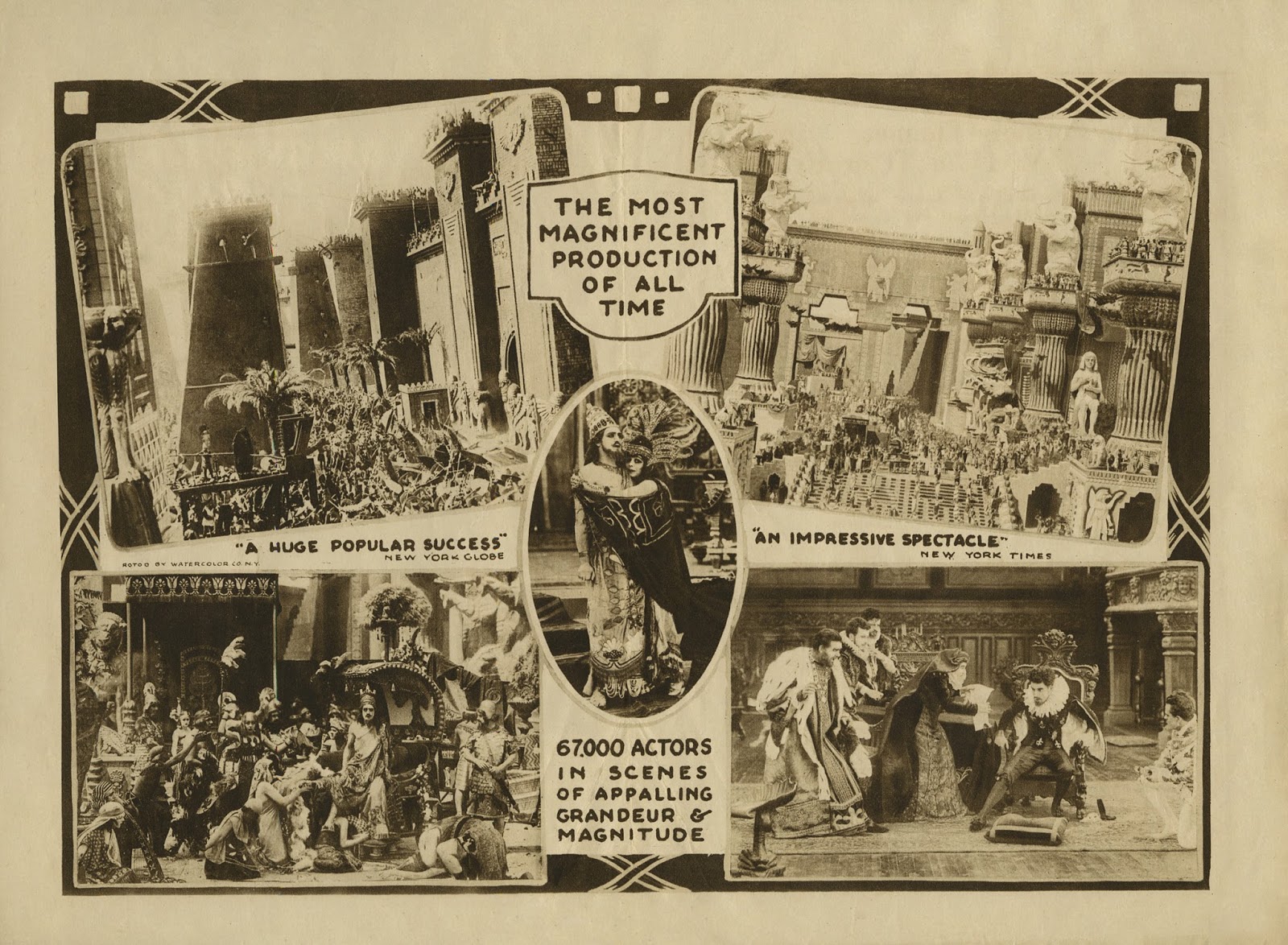
A vintage photo montage promoting the original release of 'Intolerance.'

'Intolerance,' considered one of the great masterpieces of the silent era, intercuts four parallel storylines, each separated by several centuries: A contemporary melodrama of crime and redemption; a Judean story of Christ’s mission and death; a French story about the events surrounding the St. Bartholomew's Day massacre of 1572; and a story depicting the fall of the Babylonian Empire to Persia in 539 BC.

The scenes are linked by shots of a figure representing Eternal Motherhood, rocking a cradle.

Each of the parallel stories are intercut with increasing frequency as the film builds to a climax. The film sets up moral and psychological connections among the different stories.

'Intolerance' was made partly in response to criticism of Griffith's previous film, 'The Birth of a Nation' (1915), which was criticized by the NAACP and other groups as perpetuating racial stereotypes and glorifying the Ku Klux Klan.

One of the unusual characteristics of 'Intolerance' is that many of the characters don't have names. Griffith wished them to be emblematic of human types. Thus, the central female character in the modern story is called The Dear One. Her young husband is called The Boy, and the leader of the local Mafia is called The Musketeer of the Slums.

Because of its four interwined stories, 'Intolerance' does not feature any one performer in a leading role. However, the enormous cast includes many great names from the silent era, including Lillian Gish, Mae Marsh, Constance Talmadge, Walter Long (a New Hampshire native), and a young Douglas Fairbanks Sr. in an uncredited cameo as a drunken soldier with a monkey.

"This movie was made for the big screen, and this screening at the Flying Monkey is a rare chance to see 'Intolerance' the way it was meant to be seen," Rapsis said.

The Flying Monkey shows silent films on the second Thursday of each month. Other upcoming programs in the Flying Monkey's silent series include:

• Thursday, June 12, 6:30 p.m.: "Metropolis" (1927). German director Fritz Lang's amazing epic about a futuristic society where an educated elite enjoys life in a glittering city, all supported by colonies of workers forced to live deep underground. A film that set new standards for visual design and changed movies forever!

‘Intolerance’ will be shown on Thursday, May 8 at 6:30 p.m. at the Flying Monkey Moviehouse and Performance Center, 39 South Main St., Plymouth, N.H. Admission is $10 per person. For more information, visit www.flyingmonkeynh.com or call (603) 536-2551. For more information about the music, visit www.jeffrapsis.com.