Showing posts with label The Birth of a Nation. Show all posts

Wednesday, January 20, 2016

Happy birthday! 'Intolerance' turns 100;
Celebrate with several upcoming screenings

David Wark Griffith, director of 'Intolerance' (1916).

D.W. Griffith has long enjoyed a reputation as the "father of film."

Example: Each year at the Kansas Silent Film Festival, they show at least one short film of Griffith's to acknowledge his crucial role in motion picture history.

This year, it's no different. For their 20th annual festival next month, the Kansas folks are running 'Those Awful Hats' (1909).

It's a half-reel novelty short, part of Griffith's voluminous Biograph output, when he must have been being paid for his work by the foot.

But it's Griffith, and they have to include at least one title from "the father of film." (And guess who's doing the music?)

So for a long time, I just thought of Griffith as a kind of 'George Washington' of cinema: there at the beginning, as someone had to be.

Yeah, he pioneered some new ideas such as close-ups and telling two stories at once and cutting between them. But others did those things, too. What's the big deal?

And the films themselves seemed hopelessly creaky and old-fashioned. Good enough for their time, perhaps, but cinematic technique rapidly moved on, leaving Griffith epics such as 'Way Down East' (1920) and 'Orphans of the Storm' (1922) as quaint relics from an earlier age.

Well—only recently have I come to really understand the crucial role Griffith played in bringing cinema from a novelty to a fully accepted major art form.

And it wasn't about camera angles and fancy editing, although those played a part.

What it was about was story. Griffith, more than anyone else at the time, really know how to put together a narrative that would grab people's attention and hold it for as long as needed—as much as several hours at a time.

And this, I think, played a huge role in convincing the public and the business community about the power of the motion picture.

How did Griffith learn how to do this? The hard way: by directing third-rate casts in fourth-rate melodramas that toured small town theaters. In these places, you had to be entertaining or you'd risk getting tarred and feathered.

So prior to his film career, Griffith had the best possible training for cinema: a couple of decades of putting on stage plays to extremely unforgiving audiences. By necessity, he became an expert at understanding how to hook an audience and keep it hooked.

This is not easy. It involves understanding the at-times unpredictable nature of how crowds behave, which is very different from how an individual may respond to any given situation. It's part mob psychology, part peer pressure, and a fair helping of intuition, I think.

But little by little, Griffith accumulated an expertise in constructing stories that could and would mesmerize a crowd. He probably came to understand it in his bones: how to structure a story so as to capture the crowd's attention and then manipulate it to a fever-pitch of excitement.

And it was this knowledge, more than anything else, that came in handy when it was time to put together films that went beyond the one-reel dramas that were the mainstay of cinema's early years.

An original poster for 'Intolerance' (1916).

Thanks to his background in theater, Griffith instinctively knew how to lay out a story such as that of 'The Birth of a Nation' so as to work in a crowded theater. He knew how to do this so well, he could do it in the new medium of film, without an audience present.

To his collaborators and to studio executives, it must have seemed like magic. Because for awhile, no one's films sold tickets the way D.W. Griffith's films did. Once he started making "blockbusters" (a term from World War II not in use in Griffith's time), he showed once and for all that it was possible for a motion picture to the be main event of an evening at the theater, rather than just a sideshow novelty.

Today, we can see movies on our own in ways that Griffith wouldn't have imagined: online, on our phones, etc. And. most significantly, alone. And Griffith's work, I think, suffers more than most because his films were designed from the ground up to excite crowds: the bigger the better! It's that very quality that helped make him the "father of film."

Take away that part of the experience, and you rob much of the reason for why Griffith put together his films the way he did.

One of the best examples of Griffith's ability to excite an audience is 'Intolerance' (1916), his four-stories-in-one tour de force. The film turns 100 this year, and I'll be doing music for several upcoming screenings, starting on Wednesday, Jan. 27 at Merrimack College, North Andover, Mass. (Details in the press release below. I'm also doing it in Wilton, N.H. on Sunday, Jan. 31.)

For a long time, I shied away from accompanying this film, intimidated by its length (three hours!) and thinking of its narrative complexity as something of an over-the-top gimmick ripe for satire, which Buster Keaton produced in his 'Three Ages' of 1923. I had better things to do.

But I programmed it for the first time last year, and it turned out to be a highlight of my efforts as an accompanist. Run in front of an audience, the film leaped to life! And the final 30 minutes, in which all four stories are intercut faster and faster, was one of the most exhilarating experiences I've ever had in a theater.

As the pace picked up, everything happened at just the right moment for maximum impact. Griffith's instincts were rock solid, then as now, and the sequence retains its power even to this day. It was incredible. It was inexorable. And I couldn't take my eyes off the screen!

So that's why he's known as the 'Father of Film!'

See for yourself by attending one of our upcoming 100th anniversary screenings of 'Intolerance.' More info below on the Jan. 27th screening at Merrimack College.

* * *

Biggest set ever? Ancient Babylon, as reconstructed in southern California for 'Intolerance.'

MONDAY, JAN. 18, 2016 / FOR IMMEDIATE RELEASE
Contact Jeff Rapsis • (603) 236-9237 • jeffrapsis@gmail.com

At the Rogers Center: With 'Intolerance,'
four stories are better than one


Rarely screened landmark 1916 silent film epic to be shown with live music on Wednesday, Jan. 27 at Merrimack College

ANDOVER, Mass.—It was a breakthrough that changed the movies forever: a three-hour epic knitting together four sweeping stories spanning 2,500 years, all designed to show mankind's struggles and the redeeming power of love throughout human history.

The film was D.W. Griffith's 'Intolerance' (1916), which stunned the movie-going public with its vast scope, enormous sets, large cast, and revolutionary editing. Often named to lists of the 100 best films of all times, critics continue to point to 'Intolerance' as one of the most influential and important milestones of early cinema.

See for yourself with a rare screening of a restored version of 'Intolerance' at the Rogers Center for the Performing Arts at Merrimack College on Wednesday, Jan. 27 at 7 p.m.

The program, the latest in the Rogers Center's silent film series, will be accompanied by live music performed by silent film composer Jeff Rapsis. Admission is free.

In reviving 'Intolerance' and other great films of Hollywood's early years, the Rogers Center aims to show silent movies as they were meant to be seen—in high quality prints, on a large screen, with live music, and with an audience.

"All those elements are important parts of the silent film experience," said Rapsis, who will improvise a live score for 'Intolerance' on the spot. "Recreate those conditions, and the classics of early Hollywood leap back to life. They featured great stories with compelling characters and universal appeal, so it's no surprise that they hold up and we still respond to them."

Rapsis performs on a digital synthesizer that reproduces the texture of the full orchestra and creates a traditional "movie score" sound.

A French poster for a revival of 'Intolerance' (1916).

'Intolerance,' considered one of the great masterpieces of the silent era, intercuts four parallel storylines, each separated by several centuries: A contemporary melodrama of crime and redemption; a Judean story of Christ’s mission and death; a French story about the events surrounding the St. Bartholomew's Day massacre of 1572; and a story depicting the fall of the Babylonian Empire to Persia in 539 BC.

The scenes are linked by shots of a figure representing Eternal Motherhood, rocking a cradle.

Each of the parallel stories are intercut with increasing frequency as the film builds to a climax. The film sets up moral and psychological connections among the different stories.

'Intolerance' was made partly in response to criticism of Griffith's previous film, 'The Birth of a Nation' (1915), which was criticized by the NAACP and other groups as perpetuating racial stereotypes and glorifying the Ku Klux Klan.

One of the unusual characteristics of 'Intolerance' is that many of the characters don't have names. Griffith wished them to be emblematic of human types. Thus, the central female character in the modern story is called The Dear One. Her young husband is called The Boy, and the leader of the local Mafia is called The Musketeer of the Slums.

Because of its four intertwined stories, 'Intolerance' does not feature any one performer in a leading role. However, the enormous cast includes many great names from the silent era, including Lillian Gish, Mae Marsh, Constance Talmadge, Walter Long (a New Hampshire native), and a young Douglas Fairbanks Sr. in an uncredited cameo as a drunken soldier with a monkey.

"This movie was made for the big screen, and this screening at the Rogers Center is a rare chance to see 'Intolerance' the way it was meant to be seen," Rapsis said.

Upcoming feature films in the Rogers Center's silent film series include:

• Wednesday, March 23, 2016, 7 p.m.: 'Ben-Hur: A Tale of the Christ' (1925) starring Ramon Novarro, Francis X. Bushman. Just in time for Easter! In the Holy Land, a Jewish prince is enslaved by the occupying Romans; inspired by encounters with Jesus, he lives to seek justice. One of the great religious epics of Hollywood's silent film era, including a legendary chariot race that's lost none of its power to thrill.

‘Intolerance' will be shown on Wednesday, Jan. 27 at 7 p.m. at the Rogers Center for the Arts, Merrimack College, 315 North Turnpike St., North Andover, Mass. The program is free and open to the public. For more information, call the Rogers box office at (978) 837-5355. For more info on the music, visit www.jeffrapsis.com.
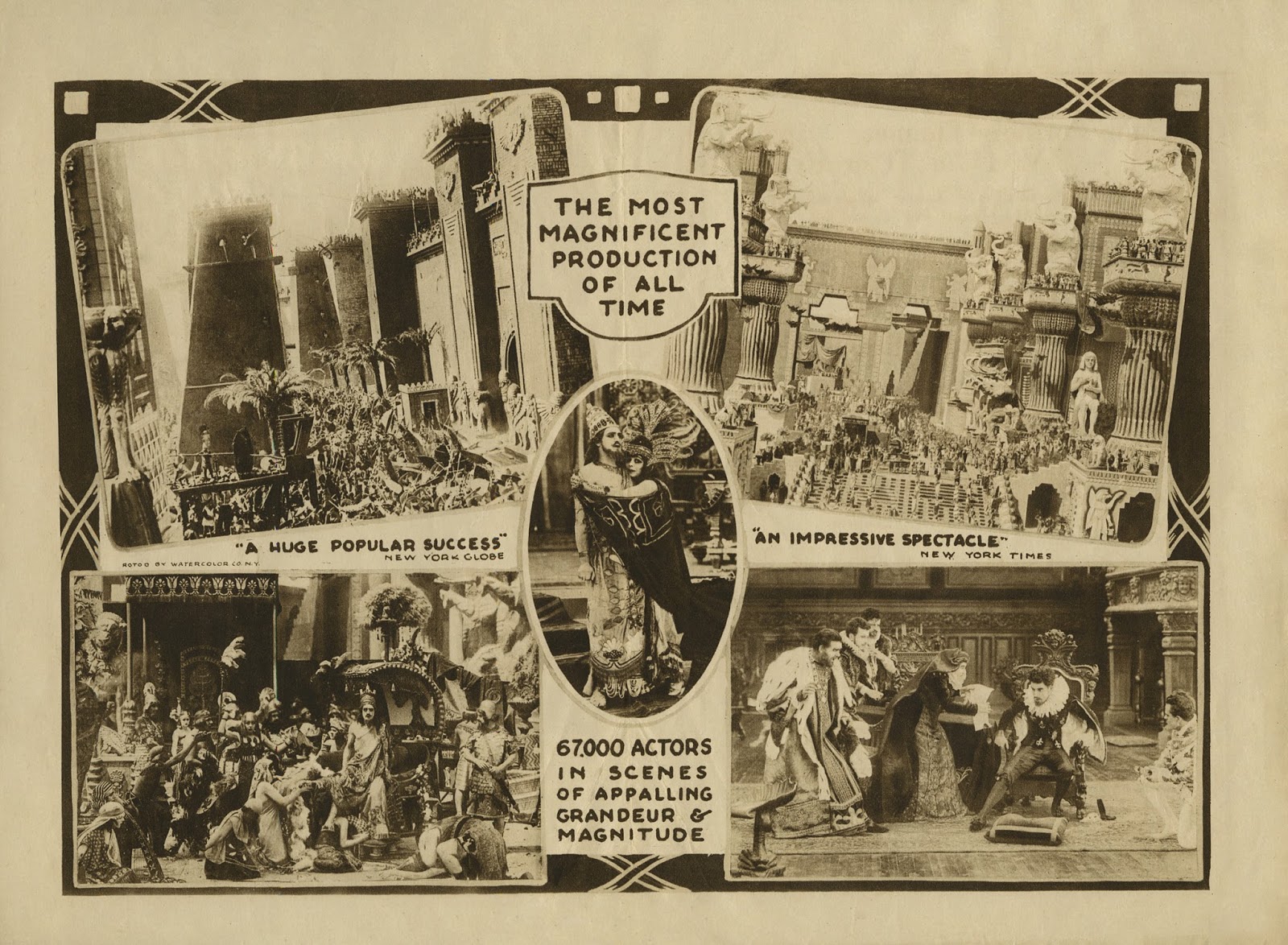
Vintage promotional materials for 'Intolerance.'

Saturday, January 2, 2016

Thursday, Jan. 14: 'Birth of a Nation'
at Flying Monkey in honor of MLK Day

An original poster for 'The Birth of a Nation' (1915), showing the assassination of Abraham Lincoln.

Our first screening of 2016 promises to be a doozey.

It's 'The Birth of a Nation' (1915), to be shown with live music on Thursday, Jan. 14 at 6:30 p.m. at the Flying Monkey Moviehouse and Performance Center in Plymouth, N.H.

This has been controversial, as 'Birth' is a tarnished masterpiece.

Yes, it was a ground-breaking feature film that showed the potential of cinema as an art form.

At the same time, it's an appallingly racist film that glorifies the rise of the Ku Klux Klan.

But this is why I think showing the film is a fitting way to commemorate the work of Dr. King and all who have fought racism in this nation and everywhere.

What better way to honor the efforts of those who have fought for equality than to bear witness to what they were up against?

Isn't it worthwhile to see first-hand how pervasive racism was at one time in this country?

Doesn't it help us appreciate how far we've come, but also put some perspective on how difficult it may be to maintain this progress?

Isn't it worth seeing what was once reality, if only as a way of understanding what we should never allow to happen again?

As the late Roger Ebert wrote in 2003:
“...the film represents how racist a white American could be in 1915 without realizing he was racist at all. That is worth knowing. Blacks already knew that, had known it for a long time, witnessed it painfully again every day, but "The Birth of a Nation" demonstrated it in clear view, and the importance of the film includes the clarity of its demonstration. That it is a mirror of its time is, sadly, one of its values.”
I want to thank Alex Ray, owner of the Flying Monkey, for supporting this screening and embracing the spirit in which it's being run.

And me, I'm glad to address any concerns or questions. Although I'm currently traveling, I do have access to e-mail and can be reached at jeffrapsis@gmail.com.

For now, here's the press release with more info about the film and the screening.

* * *

Klansmen ride into town in 'The Birth of a Nation' (1915).

MONDAY, DEC. 21, 2015 / FOR IMMEDIATE RELEASE
Contact Jeff Rapsis • (603) 236-9237 • jeffrapsis@gmail.com

‘The Birth of a Nation’: Silent film masterpiece or racist artifact?


Controversial movie to be screened with live music on Thursday, Jan. 14 at Flying Monkey in honor of MLK Day

PLYMOUTH, N.H.—What if a movie was acclaimed as a masterpiece, but portrayed the Ku Klux Klan as heroes? What if a movie aimed to show the realities of life during the Civil War, and yet used white actors playing roles in blackface? What does it say if a movie was clearly racist, depicting blacks as an inferior sub-species to whites, but was still a box office smash?

Those are among the questions posed by ‘The Birth of a Nation’ (1915), the ground-breaking epic film from director D.W. Griffith, which continues to inspire controversy a full century after its initial release.

In honor of the film's 100th anniversary, as well as the 150th anniversary of the end of the Civil War, a restored print of the film will be screened in January to honor Martin Luther King Jr. Day at the Flying Monkey Moviehouse and Performance Center, 39 South Main St., Plymouth, N.H. The screening, part of the Flying Monkey’s monthly silent film series, will include live music and take place on Thursday, Jan. 14 at 6:30 p.m.

Admission is $10 per person. The program will be accompanied live by silent film musician Jeff Rapsis.

Rapsis, who programs the Flying Monkey's silent film series, specifically chose the occasion of Martin Luther King Day to screen ‘The Birth of a Nation,’ long regarded as a masterpiece of early cinema but tarnished by racism and prejudice.

“Although ‘The Birth of a Nation’ has been reviled for its blatant and pervasive racism, it had a major impact when it was released and stands as one of the landmarks of early cinema,” said Rapsis, who will perform a live score for the movie.

“Screening this compromised classic to honor Martin Luther King Jr. Day is a chance for today’s audiences to consider first-hand evidence of the obstacles to race equality that existed a century ago, to think about what progress has been made, and to also ponder how many of the prejudices on display in this film that we may still harbor, even unconsciously,” Rapsis said.

As the first-ever Hollywood blockbuster, ‘The Birth of a Nation’ thrilled audiences in 1915 with its large-scale wartime action sequences, its recreation of the assassination of Abraham Lincoln, and spectacular photography by cameraman G.W. "Billy" Bitzer.

Even at the time of its release, the movie was regarded as monumentally insensitive to issues of race, depicting blacks as a sub-race inferior to whites and portraying Ku Klux Klan members as heroes. Conceived by Griffith, a native Southerner, as a saga of two families caught up in the Civil War and its aftermath, many viewers and critics regarded the film as a prolonged statement of cinematic bigotry.

A poster for 'The Birth of a Nation.'

Seen today, the film abounds with offensive racial comments and imagery both overt and implied. To further complicate matters for contemporary audiences, Griffith had all leading roles of black characters played by white actors in blackface; black actors were kept in the background or used only for crowd scenes, which lends the film a surreal quality to modern viewers.

Among the white actors in blackface who played prominent roles is New Hampshire native Walter Long, a popular character actor in Hollywood's early years. Records are unclear about his hometown: Long was born in either Milford or Nashua in 1879.

Despite the racism, the film’s innovative and powerful story-telling techniques, as well as its massive scale, opened Hollywood’s eyes to the full potential of cinema as an art form, exerting a powerful influence on generations of filmmakers to come.

The film’s pervasive influence extended beyond theaters, at times in unfortunate ways. As an unintended consequence, ’The Birth of a Nation’ inspired a revival of the then-dormant Klan, which flourished anew in the south thorough the 1920s, making extensive use of Griffith’s film for propaganda purposes.

The controversy continues today, with ‘Birth of a Nation’ inspiring passions a century after its release.

Has enough time passed for today’s audiences to regard this landmark film as an artifact of its time, or an indication of enduring prejudice? This Martin Luther King Jr. Day, decide for yourself how far we’ve come with a screening of a restored print of this tarnished American classic the way it was intended to be seen: on the big screen, with live music, and with an audience.

Lillian Gish in 'The Birth of a Nation.' (1915)

The film stars Lillian Gish, Mae Marsh, Henry Walthall, and dozens of other silent-era performers. Gish, who died in 1993 at age 99, continued to act in films as late as 1987, when she appeared in ‘The Whales of August.’ Her later work includes an appearance on the TV series ‘The Love Boat’ in 1981.

All movies in Flying Monkey's silent film series were popular when first released, but are rarely screened today in a way that allows them to be seen at their best. They were not made to be shown on television; to revive them, organizers aim to show the films as they were intended—in top quality restored prints, on a large screen, with live music, and with an audience.

‘The Birth of a Nation’ will be shown on Thursday, Jan. 14, at 6:30 p.m. at the Flying Monkey Moviehouse and Performance Center, 39 South Main St., Plymouth, N.H. Admission is $10 per person. For more info, call the box office at 603-536-2551 or visit www.flyingmonkeynh.com. For more info on the music, visit www.jeffrapsis.com.

CRITIC COMMENTS on ‘THE BIRTH OF A NATION’

“If one can put the racial overtones aside, this is quuote probably the most accurate celluloid representation of Civil War times to exist. It was made only 50 years after the Civil War ended, when many people who had actually been through the war were still alive to give first hand accounts.”
—Robert K. Klepper, ‘Silent Films,’ (1999)

“More than a hugely successful spectacle, it was a masterpiece—using Griffith’s trademark cinematic techniques and combining emotional intensity and epic sweep—but it was a deeply tainted one. Its racism—consciously intended by the filmmaker or not—makes parts of ‘Birth’ extremely difficult to watch today.”
—Peter Kobel, ‘Silent Movies,’ (2007)

Wednesday, May 20, 2015

Ninety-nine years after first screening,
'The Birth of a Nation' returns to Wilton, N.H.


Turns out our screening of 'The Birth of a Nation' (1915) on Sunday, May 24 is actually a rerun!

Yes—in the spring of 1916, D.W. Griffith's epic film enjoyed a three-day engagement at the Wilton Town Hall Theatre.

I learned about this just a few days ago courtesy Jeff Klenotic, associate professor of film at the University of New Hampshire.

Jeff, who's studied early movie theaters in our part of the world, sent me this surprising tidbit from his research. ("Dennis," by the way, is current theater owner/operator Dennis Markevarich.)
"I’m not sure if you or Dennis are aware of this, but Wilton Town Hall Theater presented Birth of a Nation for a three day run on May 15, 16 and 17 in 1916. It was shown with a full touring company of musicians known as the “Birth of a Nation Symphony Orchestra” that traveled with the film as it played from city to city and town to town. Tickets were 50c, 75c and $1 and they showed two screenings per day.

The Wilton Town Hall Theatre, where movies have been screened since 1912.
"People traveled for miles to see the film, and a special train was run from Milford to accommodate people from there who wanted to see the film. Originally, Milford wanted to get the film, but the movie theater there was too small (300 seats) and the Town Hall couldn’t get fire insurance that would allow them to screen the picture. Apparently, a heavy dose of rain subdued attendance, but the film was nonetheless hailed as a success."
Wow! It's a pretty safe bet that 'The Birth of a Nation' hasn't run in Wilton since this original engagement, so the resulting 99-year gap must be close to some kind of record among movie theaters.

One thing we have going against us is the weather. The Sunday of the upcoming Memorial Day weekend promises to be spectacular! Unlike the promoters of the 1916 screenings, I'd much prefer rain, as that tends to help attendance.

But rain or shine, our return engagement is one show only: on Sunday, May 24 at 4:30 p.m. Don't miss it, or you might have to wait another 99 years for it to return.

P.S. Jeff Klenotic has asked me to share the Web site for his research project. Jeff writes:

"The website is designed as a public resource and I think some of your silent film followers might be interested in exploring it. The name of the project is "Mapping Movies" and the web address is: http://mappingmovies.unh.edu/maps."

Okay, everyone: check it out! Jeff also sent along an original newspaper ad for the screening, which is below. At the time, the Town Hall Theatre was referred to as the "Wilton Opera House," but it's the same place:

Monday, May 11, 2015

'Birth of a Nation' on Memorial Day weekend?
Well, it actually makes a lot of sense, I think.


Okay, let's face it: 'The Birth of a Nation' (1915) is a film flawed by racism. Just check out that poster above!

That should be obvious to anyone who sees it. But does that mean no one should ever see it?

I deal with this question every time I program 'The Birth of a Nation' or accompany it.

This ancient D.W. Griffith movie basically depicts black people as inferior to white people and makes heroes out of the Ku Klux Klan. How can anyone justify showing it?

Indeed, some people feel strongly that the film should never be shown. Instead, it should just stay locked up and kept out of sight.

Well, I disagree—obviously, as I'm doing music for 'The Birth of a Nation' for a Memorial Day weekend screening on Sunday, May 24 at 4:30 p.m. at the Wilton (N.H.) Town Hall Theatre.

A coupla three of reasons for disagreeing...
• First, I feel the film amounts to a valuable primary source. It vividly shows the pervasiveness of racism in America at the time it was made. As the late Roger Ebert pointed out in remarks I quote below, that's something worth knowing.

• And then there's the undeniable effect that 'The Birth of a Nation' had on the early motion picture industry. In making the film, director D.W. Griffith demonstrated the power of cinema on a grand scale. And Hollywood would never be the same.

• Finally, I think all the big Griffith films ('Birth' included) really do need to be screened in their original environment for their impact to be appreciated. By "original environment," I mean in a theater, with live music, and—most importantly—with an audience. So that means actually running the film.

Still, I've always felt it helped to have a reason or an occasion to justify screening 'The Birth of a Nation.'

For a few years now, I've made a point of scheduling 'Birth' in January in honor of the Martin Luther King Jr. I felt the holiday was a perfect opportunity to showcase what King and so many others had to battle.

But now it occurs to me that Memorial Day weekend is a good time to show the film, too.

It's partly rooted in the history of this solemn holiday. Memorial Day grew out of Decoration Day, which originally arose in the 19th century as a time for communities across the nation to honor their Civil War dead.

Because 'Birth' is all about the Civil War and its aftermath, about because this year marks the 150th anniversary of the Civil War's end, it seemed to me that Memorial Day Weekend was a fitting time to screen this film.

It's also the 100th anniversary of the film's original release, so that counts for something, too.

But even without these anniversary tie-ins, it's still a film worth screening—not to promote racism, but so that we don't forget the extent of it during a time that no one today has any first-hand experience of.

Film (even a fictional tale) as a primary source. I'm not an academic, but I think as more time passes, old cinema will increasingly help illuminate times long past.

Imagine if we had some film from Shakespeare's time? Or from the time of Christ? Imagine how much such film, even it was purely fictional stories, could tell us about the times in which it was made?

I've been working my way through some audio lectures about Western Civilization lately, and it's amazing how excited scholars get over the most mundane of scraps of info that have come down to us. So I can't help but think: wouldn't it be great to find a romantic comedy filmed during, say, the reign of Pharoah Snefru of Ancient Egypt?

While I'm at it, I recently learned that the only major civilization to learn how to read and write, and then totally forget how, were the ancient Greeks prior to the time of Socrates. For about five centuries, during what's called the "sub-Mycenaean" period, there's no trace of any writing. They became illiterate!

We're heading in that direction in this country, so don't think it can't happen, folks.

Okay: if this Memorial Day weekend finds you in New Hampshire, I hope you'll join us. More details of the screening in the press release below:

* * *

An original poster for 'The Birth of a Nation.'

MONDAY, MAY 11, 2015 / FOR IMMEDIATE RELEASE
Contact Jeff Rapsis • (603) 236-9237 • jeffrapsis@gmail.com

‘The Birth of a Nation’: Silent film masterpiece or racist artifact?


Controversial movie to be screened with live music on Sunday, May 24 at Wilton (N.H.) Town Hall Theatre

WILTON, N.H.—What if a movie was acclaimed as a masterpiece, but portrayed the Ku Klux Klan as heroes? What if a movie aimed to show the realities of life during the Civil War, and yet used white actors playing roles in blackface? What does it say if a movie was clearly racist, depicting blacks as an inferior sub-species to whites, but was still a box office smash?

Those are among the questions posed by ‘The Birth of a Nation’ (1915), the ground-breaking epic film from director D.W. Griffith, which continues to inspire controversy a full century after its initial release.

In honor of the film's 100th anniversary, as well as the 150th anniversary of the end of the Civil War, a restored print of the film will be screened on Memorial Day weekend at the Wilton Town Hall Theatre, 60 Main St., Wilton, N.H. The screening, part of the Town Hall Theatre’s silent film series, will include live music and take place on Sunday, May 24 at 4:30 p.m.

Admission is free and the public is welcome. A donation of $5 per person is suggested. The program will be accompanied live by silent film musician Jeff Rapsis.

Although the film is regarded as a masterpiece tarnished by racism and prejudice, Memorial Day weekend was chosen to screen ‘The Birth of a Nation’ because of the recent 150th anniversary of the Civil War's end.

Originally known as Decoration Day, Memorial Day originated in the years following the Civil War and became an official federal holiday in 1971.

“Although ‘The Birth of a Nation’ has been reviled for its blatant and pervasive racism, it was a huge hit in its day and was accepted as one of the landmarks of early cinema,” said Rapsis, a New Hampshire-based silent film accompanist who will perform a live score for the movie.

The year 2015 also marks the 100th anniversary of the original release of 'The Birth of a Nation.'

“Screening this compromised classic is a chance for today’s audiences to consider first-hand evidence of the obstacles to race equality that existed a century ago, to think about what progress has been made, and to also ponder how many of the prejudices on display in this film that we may still harbor, even unconsciously,” Rapsis said.

As the first-ever Hollywood blockbuster, ‘The Birth of a Nation’ thrilled audiences in 1915 with its large-scale wartime action sequences, its recreation of the assassination of Abraham Lincoln, and spectacular photography by cameraman G.W. Bitzer.

Even at the time of its release, the movie was regarded as monumentally insensitive to issues of race, depicting blacks as a sub-race inferior to whites and portraying Ku Klux Klan members as heroes. Conceived by Griffith, a native Southerner, as a saga of two families caught up in the Civil War and its aftermath, many viewers and critics regarded the film as a prolonged statement of cinematic bigotry.


Seen today, the film abounds with offensive racial comments and imagery both overt and implied. To further complicate matters for contemporary audiences, Griffith had all leading roles of black characters played by white actors in blackface; black actors were kept in the background or used only for crowd scenes, which lends the film a surreal quality to modern viewers.

Among the white actors in blackface who played prominent roles is New Hampshire native Walter Long, a popular character actor in Hollywood's early years. Records are unclear about his hometown: Long was born in either Milford or Nashua in 1879.

Despite the racism, the film’s innovative and powerful story-telling techniques, as well as its massive scale, opened Hollywood’s eyes to the full potential of cinema as an art form, exerting a powerful influence on generations of filmmakers to come.

The film’s pervasive influence extended beyond theaters, at times in unfortunate ways. As an unintended consequence, ’The Birth of a Nation’ inspired a revival of the then-dormant Klan, which flourished anew in the south thorough the 1920s, making extensive use of Griffith’s film for propaganda purposes.

The controversy continues today, with ‘Birth of a Nation’ inspiring passions a century after its release.

Has enough time passed for today’s audiences to regard this landmark film as an artifact of its time, or an indication of enduring prejudice? This Memorial Day weekend, decide for yourself how far we’ve come with a screening of a restored print of this tarnished American classic the way it was intended to be seen: on the big screen, with live music, and with an audience.

The film stars Lillian Gish (at right), Mae Marsh, Henry Walthall, and dozens of other silent-era performers. Gish, who died in 1993 at age 99, continued to act in films as late as 1987, when she appeared in ‘The Whales of August.’ Her later work includes an appearance on the TV series ‘The Love Boat’ in 1981.

All movies in Wilton Town Hall Theatre's silent film series were popular when first released, but are rarely screened today in a way that allows them to be seen at their best. They were not made to be shown on television; to revive them, organizers aim to show the films at the Rogers Center as they were intended—in top quality restored prints, on a large screen, with live music, and with an audience.

‘The Birth of a Nation’ will be shown on Sunday, May 24, at 4:30 p.m. at the Wilton Town Hall Theatre, 60 Main St., Wilton, N.H. Admission to the screenings is free; a donation of $5 per person is suggested. For more info, call (603) 654-3456 or visit www.wiltontownhalltheatre.com. For more info on the music, visit www.jeffrapsis.com.

CRITIC COMMENTS on ‘THE BIRTH OF A NATION’

“...the film represents how racist a white American could be in 1915 without realizing he was racist at all. That is worth knowing. Blacks already knew that, had known it for a long time, witnessed it painfully again every day, but "The Birth of a Nation" demonstrated it in clear view, and the importance of the film includes the clarity of its demonstration. That it is a mirror of its time is, sadly, one of its values.”
—Roger Ebert, 2003, The Chicago Sun-Times

“If one can put the racial overtones aside, this is quuote probably the most accurate celluloid representation of Civil War times to exist. It was made only 50 years after the Civil War ended, when many people who had actually been through the war were still alive to give first hand accounts.”
—Robert K. Klepper, ‘Silent Films,’ (1999)

“More than a hugely successful spectacle, it was a masterpiece—using Griffith’s trademark cinematic techniques and combining emotional intensity and epic sweep—but it was a deeply tainted one. Its racism—consciously intended by the filmmaker or not—makes parts of ‘Birth’ extremely difficult to watch today.”
—Peter Kobel, ‘Silent Movies,’ (2007)

Friday, January 24, 2014

I am a 'disgrace,' and other opinions
on screening 'The Birth of a Nation' (1915)

The Klu Klux Klan in a scene from D.W. Griffith's 'The Birth of a Nation' (1915), which I screened to mark Martin Luther King Jr. Day.

Two great screenings in two days: 'The Birth of a Nation' (1915) at Merrimack College in North Andover, Mass. on Wednesday, Jan. 22, and then 'The Hunchback of Notre Dame' (1923) at the Flying Monkey Moviehouse in Plymouth, N.H. on Thursday, Jan. 23.

I'm definitely feeling back in the swing of things after returning from several weeks in the fascinating nation of India.

More screenings coming this weekend, but now it's time to get something off my chest.

'The Birth of a Nation' is a ground-breaking film, but it's also full of racism. Each January, I try to program the picture around Martin Luther King Jr. Day as a way to show how far we've come. And I take pains to explain this in advance in press releases and blog posts and so on.

Most people seem to understand this. But earlier this month, when I sent out a quick e-mail listing upcoming screenings, I did not provide all the necessary context. I thought the links to more info elsewhere online would be enough.

Well, I was mistaken. Almost immediately in response, I received this note from someone on my e-mail list:

I'm sorry Jeff

To pick Birth of a Nation as a tribute to MLK when there are so many positive films? And so many racists that will get encouragement from this- esp in mostly lily white NE?

You can't rationalize this away.

Put yourself in the place of a black person. Or a black parent esp.

You really fucked up. Big Time.

I used to enjoy your presentations

Probably not any more. And I'm forwarding my stance and your amazing lack of humanity to many others.

You are a disgrace with no perspective who doesn't recognize his own inner racist to do this.

Wow! Kinda harsh, don't you think? I didn't know who wrote this, as I don't keep records who gives me their e-mail address.

Still, I was compelled to reply:

Hi there!

Wow, sorry you feel that way!

My two cents: I've actually done 'Birth' as the centerpiece of several MLK tributes in recent years. I've found it works very well as a way to show what Dr. King and others were up against in the struggle for justice. It doesn't promote racism. It celebrates the magnitude of the struggle against it.

That's especially true in New England, where we never had to deal with some of the things shown in the film, even though we're a part of the same nation. So maybe it's more important to show it in "lily white" New England. I grew up here, and never saw Jim Crow in action. But this film helps me understand the context and how it could have persisted for so long, even up into our times.

Perhaps the quick e-mail I sent out gave the wrong impression. I'm not running the film to celebrate racism or to somehow oppose what Dr. King stood for.

I should have included a link to a little more context that has already been on my blog. Here it is:

http://www.silentfilmlivemusic.blogspot.com/2014/01/coming-on-wednesday-jan-22-birth-of_19.html

My error for not doing this in the first place. Hope you'll reconsider, even to the point of joining us on Wednesday to see the film for what it is: a masterpiece flawed by racism, as I point out on the Web site, and which I will explain to people at the screening.

By itself, the film is just a piece of celluloid. But it's up to us to give it meaning and learn what we can from it. It can teach us a lot, as Roger Ebert has pointed out:

http://www.rogerebert.com/reviews/great-movie-the-birth-of-a-nation-1915

Happy to talk more about this, though tone down the "inner racist" rhetoric. Glad you have strong feelings, but benefit of the doubt, please. :)

Jeff R.

And that was that, I thought. You can't please everyone. Some people must imagine they're celebrating Martin Luther King Jr. Day by calling out "inner racists" such as me who need to be exposed. Well, that'll teach me!

But on the day of show, I realized this note would provide a vivid way to show the audience how 'The Birth of a Nation' still creates controversy almost a century after its release.

Also, I felt this was yet another example of someone hiding behind the anonymity of e-mail and the Internet to lob bullshit that serves no constructive purpose.

Time to do a little calling out of my own, I thought.

So here's a follow-up note:

Hi again,

Just a quick follow-up from Jeff Rapsis. I wanted you to know I plan to use your thoughts from yesterday in introducing 'The Birth of a Nation' tomorrow night at Merrimack College. I think reading your note will help people understand how this film can still engender strong feelings even today, nearly a century after its release.

Thanks again for sharing how you felt, although I do think you jumped to some pretty severe and inaccurate conclusions. But that's my fault for not explaining in the newsletter why 'The Birth of a Nation' was chosen and how it's appropriate for MLK Day.

Even so, you may not agree, which is fine.

But I certainly dispute your assertion that I'm some kind of closet racist. We can discuss that in detail any time you'd like to meet for coffee or whatever. I don't keep records of who gives me their e-mail address for silent film news, so I don't know who you are. Therefore, next move on that is up to you.

All the best,

Jeff Rapsis
(603) 236-9237

That night at the theater, I did read the note out loud prior to 'Birth of a Nation.' People were open-mouthed in amazement! And it gave me a chance to invoke the spirit of Jack Benny by getting the end of the tirade, and then pausing just long enough before crying out an exasperated "Well!"

The next morning, I got this from my mystery correspondent:

I'd rather you not. It was a personal message to you.
This movie can perpetuate racism and is better left in the vault.

Too late! But I used the opportunity to further explain why I disagreed, and also how I felt about anonymous name-calling:

Sorry, too late! But it did help everyone appreciate the kind of bigotry that's associated with this picture, so thank you.

Anyway, I wasn't asking for permission. Because you choose to hide behind the anonymity of e-mail to call me racist and decry my "lack of humanity," I don't see why I shouldn't use your comments as I see fit. I'll be using them in a blog post later today, and elsewhere.

To me, they're a good example of the kind of fear that comes from when people don't take the time to understand. Ironically, that's one of the dynamics that fuels bigotry in the first place.

Yes, I should have provided a bit more context in my communication, and I'll try to improve.

But think twice before you hit the Send button when you're calling people racist. And if you do, have the courage to identify yourself and be willing to back up your assertions like any serious person. That might be a better way to honor Dr. King after all.

Jeff Rapsis

To date, I haven't received a response. If I do, I'll let you know. I certainly do hope to continue the conversation, as it might actually bring about the apology that I think I deserve.

But maybe that's just my "lack of humanity" talking again.

Sunday, January 19, 2014

Coming on Wednesday, Jan. 22:
'Birth of a Nation' in North Andover, Mass.


Tomorrow is Martin Luther King Jr. Day, and I'll be spending part of it preparing for a screening of 'The Birth of a Nation' (1915) later this week at Merrimack College in North Andover, Mass.

Showing this film poses problems. It's a landmark piece of cinema, sure. But it also contains a healthy dose of good old racism as it existed in this nation a century ago.

The racism, which in part was responsible for reigniting the Ku Klux Klan, is enough to make 'The Birth of a Nation' permanently damaged goods in the eyes of some. One theater manager whom I greatly respect said he would never, ever run the film, as it would bring an avalanche of protest to his doorstep.

But I think Martin Luther King Day provides a great opportunity for today's audiences to experience 'The Birth of a Nation' in a thoughtful context. This film, which Woodrow Wilson likened to "writing history with lightning," shows in a palpable way how far we've come. Also, it can get us thinking about how far we still have to go.

So I'm pleased to be creating live music for this film on Wednesday, Jan. 22 as part of the this year's silent film series at the Rogers Center for the Performing Arts on the campus of Merrimack College in North Andover, Mass.

Start time is 7 p.m., and it's a long film, so I'll keep opening remarks brief. Admission is free. Don't miss this rare opportunity to see a classic of early Hollywood on the big screen in its full-length version, with live music and an audience.

For more information, here's the text of a press release that went out earlier...

* * *


THURSDAY, DEC. 26, 2013 / FOR IMMEDIATE RELEASE
Contact Jeff Rapsis • (603) 236-9237 • jeffrapsis@gmail.com

‘Birth of a Nation’: Silent film masterpiece or racist artifact?


Controversial movie to be screened with live music for MLK Day on Jan. 22 at Merrimack College

NORTH ANDOVER, Mass.—What if a movie was acclaimed as a masterpiece, but portrayed the Ku Klux Klan as heroes? What if a movie aimed to show the realities of life during the Civil War, and yet used white actors playing roles in blackface? What does it say if a movie was clearly racist, depicting blacks as an inferior sub-species to whites, but was still a box office smash?

Those are among the questions posed by ‘The Birth of a Nation’ (1915), the ground-breaking epic film from director D.W. Griffith, which continues to inspire controversy nearly a century after its initial release.

In honor of Martin Luther King Day this year, a restored print of the film will be screened with live music at the Rogers Center for the Arts, Merrimack College, 315 North Turnpike St., North Andover, Mass. The screening, part of the Rogers Center’s silent film series, will take place on Wednesday, Jan. 22, 2014 at 7 p.m.

Admission to the screening is free and the public is welcome. The program will be accompanied live by silent film musician Jeff Rapsis.

Organizers of the Rogers Center’s film series specifically chose the occasion of Martin Luther King Day to screen ‘The Birth of a Nation,’ long regarded as a masterpiece of early cinema but tarnished by racism and prejudice.

“Although ‘The Birth of a Nation’ has been reviled for its blatant and pervasive racism, it was a huge hit in its day and was accepted as one of the landmarks of early cinema,” said Rapsis, a New Hampshire-based silent film accompanist who will perform a live score for the movie.

“Screening this compromised classic to honor Martin Luther King Day is a chance for today’s audiences to appreciate how far we’ve come, and to also ponder how many of the prejudices on display in this film that we may still harbor, even unconsciously,” Rapsis said.

As the first-ever Hollywood blockbuster, ‘The Birth of a Nation’ thrilled audiences in 1915 with its large-scale wartime action sequences, its recreation of the assassination of Abraham Lincoln, and spectacular photography by cameraman G.W. Bitzer.

Even at the time of its release, the movie was regarded as monumentally insensitive to issues of race, depicting blacks as a sub-race inferior to whites and portraying Ku Klux Klan members as heroes. Conceived by Griffith, a native Southerner, as a saga of two families caught up in the Civil War and its aftermath, many viewers and critics regarded the film as a prolonged statement of cinematic bigotry.

Seen today, the film abounds with offensive racial comments and imagery both overt and implied. To complicate matters for contemporary audiences, Griffith had all leading roles of black characters played by white actors in blackface; black actors were kept in the background or used only for crowd scenes, which lends the film a surreal quality to modern viewers.

Despite the racism, the film’s innovative and powerful story-telling techniques, as well as its massive scale, opened Hollywood’s eyes to the full potential of cinema as an art form, exerting a powerful influence on generations of filmmakers to come.

The film’s pervasive influence extended beyond theaters, at times in unfortunate ways. As an unintended consequence, ’The Birth of a Nation’ inspired a revival of the then-dormant Klan, which flourished anew in the south thorough the 1920s, making extensive use of Griffith’s film for propaganda purposes.

The controversy continues today, with ‘Birth of a Nation’ inspiring passions nearly a century after its release. Has enough time passed for today’s audiences to regard this landmark film as an artifact of its time, or an indication of enduring prejudice? This Martin Luther King’s Day, decide for yourself how far we’ve come with a screening of a restored print of this tarnished American classic the way it was intended to be seen: on the big screen, with live music, and with an audience.

The film stars Lillian Gish (at right), Mae Marsh, Henry Walthall, and dozens of other silent-era performers. Gish, who died in 1993 at age 99, continued to act in films as late as 1987, when she appeared in ‘The Whales of August.’ Her later work includes an appearance on the TV series ‘The Love Boat’ in 1981.

All movies in the Rogers Centers’s silent film series were popular when first released, but are rarely screened today in a way that allows them to be seen at their best. They were not made to be shown on television; to revive them, organizers aim to show the films at the Rogers Center as they were intended—in top quality restored prints, on a large screen, with live music, and with an audience.

‘The Birth of a Nation’ will be shown in honor of Martin Luther King Day on Wednesday, Jan. 22, at 7 p.m. at the Rogers Center for the Arts, Merrimack College, 315 North Turnpike St., North Andover, Mass. Admission to the screenings is free and the public is welcome. For more info on the music, visit www.jeffrapsis.com.

CRITIC COMMENTS on ‘THE BIRTH OF A NATION’


“...the film represents how racist a white American could be in 1915 without realizing he was racist at all. That is worth knowing. Blacks already knew that, had known it for a long time, witnessed it painfully again every day, but "The Birth of a Nation" demonstrated it in clear view, and the importance of the film includes the clarity of its demonstration. That it is a mirror of its time is, sadly, one of its values.”
—Roger Ebert, 2003, The Chicago Sun-Times

“If one can put the racial overtones aside, this is quuote probably the most accurate celluloid representation of Civil War times to exist. It was made only 50 years after the Civil War ended, when many people who had actually been through the war were still alive to give first hand accounts.”
—Robert K. Klepper, ‘Silent Films,’ (1999)

“More than a hugely successful spectacle, it was a masterpiece—using Griffith’s trademark cinematic techniques and combinging emotional intensity and epic sweep—but it was a deeply tainted one. Its racism—consciously intended by the filmmaker or not—makes parts of ‘Birth’ extremely difficult to watch today.”
—Peter Kobel, ‘Silent Movies,’ (2007)


Friday, April 5, 2013

Roger Ebert (1942-2013):
A great friend to silent film


No film critic did more to champion the enduring value of silent cinema than Roger Ebert, who died yesterday at age 70.

Check out his writings. I know of no one else who spoke (or wrote) more eloquently on silent film. In many cases, he's helped me understand things that I otherwise would have missed.

Example: When it was time to show 'The Birth of a Nation,' I was looking for commentary to put the picture's blatant racism in context for screening on Martin Luther King Jr. Day.

Here's what Roger had written in 2003:
"Griffith and "The Birth of a Nation" were no more enlightened than the America which produced them. The film represents how racist a white American could be in 1915 without realizing he was racist at all. That is worth knowing. Blacks already knew that, had known it for a long time, witnessed it painfully again every day, but "The Birth of a Nation" demonstrated it in clear view, and the importance of the film includes the clarity of its demonstration. That it is a mirror of its time is, sadly, one of its values.
But beyond film, Roger had a sensibility that reflected my own, perhaps because we both grew up in the now vanishing world of daily newspapers. And so I find I respond quite readily to other things he's written. His recent blog post pondering at a family funeral, about how he might have been the only living person to have remembered and known an obscure relative in an old family photo, was haunting and beautiful and thought-provoking all at the same time.

There are two books of his I want to read. One is about wandering the streets of London. The other is his recent autobiography, "Life Itself," which contains passages such as this one that I found excerpted, fittingly, at the end of the obituary in the Chicago Sun-Times, his paper:
"“ 'Kindness' covers all of my political beliefs,” he wrote, at the end of his memoirs. “No need to spell them out. I believe that if, at the end, according to our abilities, we have done something to make others a little happier, and something to make ourselves a little happier, that is about the best we can do. To make others less happy is a crime. To make ourselves unhappy is where all crime starts. We must try to contribute joy to the world. That is true no matter what our problems, our health, our circumstances. We must try. I didn't always know this and am happy I lived long enough to find it out.”

Thursday, January 12, 2012

Snowstorm vs. 'Birth of a Nation': Snowstorm wins

There's been a noticeable lack of snow in our part of the world (northern New England, U.S.A.) this year—until today, when about 3 to 6 inches finally fell across New Hampshire. And that led to a noticeable lack of audience for this evening's screening of 'The Birth of a Nation' in Plymouth, N.H.: a grand total of FIVE people showed up, even though the snow had stopped by early afternoon.

We haven't been getting big turnouts for the Plymouth screenings, which take place at a renovated venue called the Flying Monkey Moviehouse and Performing Arts Center. But even so, five people is pretty dismal. It probably was the storm, but other factors entered into it as well: the local college (Plymouth State University) is on winter break; everyone here is still recovering from New Hampshire's first-in-the-nation presidential primary this past Tuesday; race is not exactly a hot-button issue in New Hampshire, which has about 12 black people in it.

Still, the show must go on. Or should it? One thing we emphasize is that for silent films to have their intended impact, they really must be screened with an audience—the larger, the better. Well, five people is better than four or three, I suppose, but still it ain't much to work with.

So we took a poll. Before the screening, I asked our attendees (who all sat way in the back of the 400-seat theater for some reason) if they'd like to agree to come back on another date when we might have a better chance at a bigger turnout. I mean, we sometimes do get sizeable audiences in Plymouth—most recently a healthy crowd of 100+ for a pre-Halloween screening of 'Nosferatu' (1922).

We talked it over, but my sense of the room was that they had ventured out to see 'The Birth of a Nation' and, by gum, that's what they were going to see. So off we went!

I don't mind playing for such a small crowd, really, but with an audience that small, the reactions tended to be non-existent. And because of that, the screening had a kind of "if a tree falls in the forest, does it make a noise?" feeling to it. It really wasn't the same as what happens with a bigger crowd is on hand.

I was also reminded of the importance of using the bathroom prior to embarking on a 2½-hour film. Prior to the screening, I sauntered down the block to the Mandarin Taste Restaurant, where I had Chicken Lo Mein and something like six cups of tea. (I had the whole pot to myself, and I was cold, and the tea was warm. What can I say?) Then, about an hour into 'Birth of a Nation,' it hit me—I had to pee really bad, but we were still fighting the Civil War onscreen, and weren't even close to Lincoln's Assassination. Damn!

So I just coped as best I could, that's all, though the playing might have had a slightly rushed quality to it. While all this was going on, I remember thinking to myself about one consolation: "Well, if I end up wetting myself, at least it'll only be in front of five people."

And now I've just checked my fortune from the fortune cookie I received at the end of the meal. It says this: "Only tears can bring a dreamer back to earth."

Thursday, January 5, 2012

'Birth of a Nation' (1915) on Thursday, Jan. 12 at Flying Monkey Theatre in Plymouth, N.H.

When I tell people that we're screening 'The Birth of a Nation' (1915) in honor of the U.S. holiday honoring Martin Luther King Jr., I am sometimes greeted with raised eyebrows. Why would we screen this film, infamous for its blatant racism, to mark a day honoring the racial tolerance and progress advocated by Dr. King? What kind of tribute to his legacy is a film in which the Ku Klux Klan comes riding to the rescue?

Well, the simple answer is that 'The Birth of Nation' vividly shows how far we've come since it was first released. More specifically, what Dr. King and so many other advocates for racial justice were up against. And as someone with an interest in vintage film, I can't think of a better way to commemorate this holiday. 'The Birth of a Nation' is a great chance for anyone watching it to examine his or her own attitudes about racism. A phrase suggests itself: "Lest We Forget."

Ironically, the phrase is from a poem by Rudyard Kipling, an old-fashioned British imperialist, and not exactly known for his commitment to racial tolerance. For a time in the 1890s, Kipling lived in our corner of the world, on a farm in Brattleboro, Vt., where he started writing the Jungle Books. There he is on the left. But I digress.

Back to 'The Birth of a Nation.' I think the film falls into that category of silent movies that have become more interesting with the passage of time. Why? Because while we've changed, it remains just as it was when it was first shown in 1915. Seeing it now, a hundred years in the future, can provide invaluable insight into where we've come from as a people, what we are today, and what we might possibly become tomorrow. As Roger Ebert wrote about the film (quoted below in the press release) in 2003:
"...the film represents how racist a white American could be in 1915 without realizing he was racist at all. That is worth knowing. ... That it is a mirror of its time is, sadly, one of its values.”
I hadn't been eager to see this film, and so wasn't familiar with it until I did music for a screening last year. I must say I was swept away by Griffith's almost giddy indulgence on a large scale of all the story-telling techniques he'd been developing in much shorter films in the previous decade. Somehow the film still radiates an excitement on this level that even the blatant racism can't totally destroy.

Hope you can join us at the Flying Monkey in Plymouth, N.H. and see for yourself. Speaking of the press release, here it is in all its glory...

* * *

MONDAY, DEC. 26, 2011 / FOR IMMEDIATE RELEASE
Contact Jeff Rapsis • (603) 236-9237 • jeffrapsis@gmail.com

‘Birth of a Nation’: Silent film masterpiece or racist artifact?

Landmark movie to be screened with live music for MLK Day on Jan. 12 in Plymouth, N.H.

PLYMOUTH, N.H.—What if a movie was acclaimed as a masterpiece, but portrayed the Ku Klux Klan as heroes? What if a movie aimed to show the realities of life during the Civil War, and yet used white actors playing roles in blackface? What does it say if a movie was clearly racist, depicting blacks as an inferior sub-species to whites, but was still a box office smash?

Those are among the questions posed by ‘The Birth of a Nation’ (1915), the ground-breaking epic film from director D.W. Griffith, which continues to inspire controversy nearly a century after its initial release.

In honor of Martin Luther King Day this year, a restored print of the film will be screened with live music at the Flying Monkey Moviehouse and Performance Center in Plymouth, N.H. The screening, part of the Flying Monkey’s silent film series, will take place on Thursday, Jan. 12 at 6:30 p.m. General admission tickets are $10 per person.

Organizers of the Flying Monkey’s film series specifically chose the occasion of Martin Luther King Day to screen ‘The Birth of a Nation,’ long regarded as a masterpiece of early cinema but tarnished by racism and prejudice.

“Although ‘The Birth of a Nation’ has been reviled for its blatant and pervasive racism, it was a huge hit in its day and was accepted as one of the landmarks of early cinema,” said Jeff Rapsis, a New Hampshire silent film musician who will perform a live score for the movie.

“Screening this compromised classic to honor Martin Luther King Day is a chance for today’s audiences to appreciate how far we’ve come, and to also ponder how many of the prejudices on display in this film that we may still harbor, even unconsciously,” Rapsis said.

As the first-ever Hollywood blockbuster, ‘The Birth of a Nation’ thrilled audiences in 1915 with its large-scale wartime action sequences, its recreation of the assassination of Abraham Lincoln, and spectacular photography by cameraman G.W. Bitzer.

Even at the time of its release, the movie was regarded as monumentally insensitive to issues of race, depicting blacks as a sub-race inferior to whites and portraying Ku Klux Klan members as heroes. Conceived by Griffith, a native Southerner, as a saga of two families caught up in the Civil War and its aftermath, many viewers and critics regarded the film as a prolonged statement of cinematic bigotry.

Seen today, the film abounds with offensive racial comments and imagery both overt and implied. To complicate matters for contemporary audiences, Griffith had all leading roles of black characters played by white actors in blackface; black actors were kept in the background or used only for crowd scenes, which lends the film a surreal quality to modern viewers.

Despite the racism, the film’s innovative and powerful story-telling techniques, as well as its massive scale, opened Hollywood’s eyes to the full potential of cinema as an art form, exerting a powerful influence on generations of filmmakers to come.

The film’s pervasive influence extended beyond theaters, at times in unfortunate ways. As an unintended consequence, ’The Birth of a Nation’ inspired a revival of the then-dormant Klan, which flourished anew in the south thorough the 1920s, making extensive use of Griffith’s film for propaganda purposes.

The controversy continues today, with ‘Birth of a Nation’ inspiring passions nearly a century after its release. Has enough time passed for today’s audiences to regard this landmark film as an artifact of its time, or an indication of enduring prejudice? This Martin Luther King’s Day, decide for yourself how far we’ve come with a screening of a restored print of this tarnished American classic the way it was intended to be seen: on the big screen, with live music, and with an audience.

The film stars Lillian Gish, Mae Marsh, Henry Walthall, and dozens of other silent-era performers. Gish, who died in 1993 at age 99, continued to act in films as late as 1987, when she appeared in ‘The Whales of August.’ Her later work includes an appearance on the TV series ‘The Love Boat’ in 1981.

All movies in the Flying Monkey’s silent film series were popular when first released, but are rarely screened today in a way that allows them to be seen at their best. They were not made to be shown on television; to revive them, organizers aim to show the films at the Flying Monkey as they were intended—in top quality restored prints, on a large screen, with live music, and with an audience.

‘The Birth of a Nation’ will be shown in honor of Martin Luther King Day on Thursday, Jan. 12, at 6:30 p.m. at the Flying Monkey Moviehouse and Performance Center, 39 South Main St., Plymouth, N.H. Admission is $10 per person, general admission seating. Tickets available at the door or in advance by calling the Flying Monkey box office, (603) 536-2551 or online at www.flyingmonkeynh.com.

CRITIC COMMENTS on ‘THE BIRTH OF A NATION’

“...the film represents how racist a white American could be in 1915 without realizing he was racist at all. That is worth knowing. Blacks already knew that, had known it for a long time, witnessed it painfully again every day, but "The Birth of a Nation" demonstrated it in clear view, and the importance of the film includes the clarity of its demonstration. That it is a mirror of its time is, sadly, one of its values.”
—Roger Ebert, 2003, The Chicago Sun-Times

“If one can put the racial overtones aside, this is quuote probably the most accurate celluloid representation of Civil War times to exist. It was made only 50 years after the Civil War ended, when many people who had actually been through the war were still alive to give first hand accounts.”
—Robert K. Klepper, ‘Silent Films,’ (1999)

“More than a hugely successful spectacle, it was a masterpiece—using Griffith’s trademark cinematic techniques and combinging emotional intensity and epic sweep—but it was a deeply tainted one. Its racism—consciously intended by the filmmaker or not—makes parts of ‘Birth’ extremely difficult to watch today.”
—Peter Kobel, ‘Silent Movies,’ (2007)