Conrad Veidt and Olga Baklanova in 'The Man Who Laughs' (1928).
Last night I attended a rehearsal of the N.H. Philharmonic, a local orchestra which later this season will play through a score I've composed.
More on that as it develops. But for now, the prospect of a world premiere was scary enough to remind me that we're entering the busiest time of the year for silent film musicians: Halloween.
Yes, the remainder of this month is crowded with silent film screenings all over New England, and all designed to put people in a mood macabre.
And it's fitting. One of the lasting images of silent film is Lon Chaney as the Phantom of the Opera, playing subterranean pipe organ.
(And yes, I'm doing 'Phantom' a couple times this cycle, plus a lot of other titles. The full schedule is below.)
It's not just me. Other area accompanists such as Peter Krasinski have heavy schedules of Halloween fare.
So silent film fans, prepare for a scary smorgasbord of spooky silents ("Alliteration, the newsman's poetry!") in locations ranging from rural towns to the big city—in our case, Boston.
You'll notice 'The Man Who Laughs' (1928) is programmed several times. It's this year's example of a worthy movie I believe has been overlooked. And so it's the one "in the rotation," meaning it's the film I play to avoid wearing out known classics such as 'Nosferatu' and 'Phantom.'
Original promotional material for 'The Man Who Laughs' (1928).
Also, two screenings mark the start of new silent film series in the Boston area that I'll be accompanying.
At the Capitol Theatre in Arlington, Mass. a screening of the rarely seen Chaney film 'The Unholy Three' (1925) will launch what's intended to be a monthly program of silent film screenings with live music.
The Capitol is sister theater to the Somerville Theatre in nearby Somerville, Mass., where I also accompany a monthly silent film series. The difference is that the Somerville is committed to showing 35mm prints; the Capitol is where we'll run worthy titles for which 35mm prints simply isn't available.
And at the Regent Theatre, also in Arlington, Mass., I'm pleased to report that last spring's screening of Mary Pickford's early feature 'Rags' (1916) was successful enough for this 100-year-old venue to add periodic silent film screenings to its regular schedule.
First up is on Friday, Oct. 28, when we'll run 'Nosferatu' (1921), a great Halloween film and one which I think gets even creepier as the years go by.
The Regent intends to include silent film with live music on a regular basis for this season, and I hope we'll be able to build a good audience there.
Okay, here's the spooked-up calendar through the end of the month.
And remember: in silent film, no one can hear you scream!
• Tuesday, Oct. 11, 2016, 6 p.m.: "The Leopard Woman" (1920); Carpenter Memorial Auditorium, Manchester Public Library, 405 Pine St., Manchester, N.H.; (603) 624-6550; Manchester Public Library. Battle-of-wits jungle drama about an British explorer and a female spy from a rival goverment ordered to foil his mission. The fun begins when rather than killing the explorer, she falls in love with him—and then he goes blind! Monthly series of rarely screened silent films presented with live music in 1913 auditorium. Admission free, donations encouraged.
• Thursday, Oct. 13, 2016, 6:30 p.m.: "Woman in the Moon" (1929); The Flying Monkey Movie House and Performance Center, 39 South Main St., Plymouth, N.H.; (603) 536-2551; http://www.flyingmonkeynh.com/. The final silent film of director Fritz Lang ('Metropolis') is an amazing epic about mankind's first-ever lunar voyage, complete with espionage, romance, stowaways, and spectacular visual design. Part of a monthly silent film series at a newly restored moviehouse in Plymouth, N.H. Admission, $10 per person.
Actor Tully Marshall is about to meet his end in 'The Cat and the Canary' (1927).
• Friday, Oct. 14, 2016, 7 p.m.: "The Cat and the Canary" (1927) directed by Paul Leni, starring Laura LaPlante; Red River Theatres, 11 South Main St., Concord, N.H.; (603) 224-4600; http://www.redrivertheatres.org/. Can a group of strangers survive the night in a haunted house to learn the secret of a madman's will? Find out in the original Gothic thriller from silent film director Paul Leni. Just in time for Halloween, a movie filled with deep shadows, dark secrets, and a surprisingly timeless mix of humor and horror that will keep you guessing. Remember: in silent film, no one can hear you scream! See if if you dare! Silent film with live music at this popular venue for independent and arthouse cinema in New Hampshire's state capital. Admission $10 per person.
• Saturday, Oct. 15, 2016, 7 p.m.: "The Man Who Laughs" (1928) starring Conrad Veidt; Brandon Town Hall and Community Center, Main Street/Route 7, Brandon, Vt.; http://www.brandontownhall.org. Silent film adaptation of Victor Hugo's historical novel about a man cursed with a permanent carnival-freak-like grin on his face. The make-up job for actor Conrad Veidt inspired the look of Batman's arch-nemesis the Joker. Directed by Paul Leni, who pioneered the visual style used in Universal horror classics such as 1931's 'Dracula' and 'Frankenstein.' See it if you dare! Preceded by spooky comedy short subjects. Join us for a series of silent films and live music in a wonderfully restored town hall in Brandon Vt. that features great acoustics. Admission free, donations accepted, with proceeds to help continuing preservation work.
• Sunday, Oct. 16, 2016, 2 p.m.: "Lon Chaney Double Feature", Charlestown Old Town Hall, 19 Summer St., Charlestown, N.H. Just in time for Halloween: two movies starring Chaney, 'The Phantom of the Opera' (1925) and 'The Unknown' (1927), make up a creepy double feature presented by the Charlestown Historical Society. 'The Phantom of the Opera' (1925) ranks as one of the most revived films of the silent era. With Chaney in the lead role, the original movie adaptation of the story of a deformed musician living beneath the Paris Opera House remains an audience favorite. 'The Unknown' (1927) features Chaney as "Alonzo the Armless," a circus knife-thrower with a dark past who uses his feet to perform his act. The film co-stars a very young Joan Crawford. Admission is free and the public is welcome; donations are encouraged, with proceeds to support Historical Society activities.
• Sunday, Oct. 16, 2016, 8 p.m.: "The Unknown" (1927) starring Lon Chaney; Somerville Theatre, 55 Davis Square, Somerville, Mass.; http://www.somervilletheatreonline.com. Celebrate Halloween with a twisted circus drama starring Lon Chaney as 'Alonzo the Armless' and a very young Joan Crawford as the woman he loves but cannot have. Directed by Tod Browning, who would go on to create the cult classic 'Freaks' (1932). Part of a planned multi-day "TerrorThon" at the Somerville Theatre, a 100-year-old moviehouse committed to keeping alive the experience of 35mm film on the big screen. Featuring outstandingly exacting work of legendary projectionist David Kornfeld. For more info, call the theater box office at (617) 625-5700. Admission is either single ticket or through multi-day pass. Check with theater for details.
Original poster art for the original screen adaptation of 'Dr. Jekyll and Mr. Hyde.' (1921).
•Sunday, Oct. 23, 2016, 1 p.m. "Dr. Jekyll and Mr. Hyde" (1921) starring John Barrymore; Whitingham Free Public Library, 2948 Route 100, Jacksonville, Vt.; (802) 368-7506. Just in time for Halloween! John Barrymore plays both title roles in the original silent film adaptation of the classic novella by Robert Louis Stevenson. A performance that helped establish Barrymore as one of the silent era's top stars. Free and open to the public.
• Sunday, Oct. 23, 2016, 8 p.m. "Phantom of the Opera" (1925) starring Lon Chaney, Mary Philbin; Aeronaut Brewing Co., 14 Tyler St., Somerville, Mass. Admission $10 per person, limited seating. Long before Andrew Lloyd Webber created the hit stage musical, this silent film adaptation starring Lon Chaney helped place 'Phantom' firmly in the pantheon of both horror and romance. Just in time for Halloween! Part of the Aeronaut Brewery's commitment to showcase local music, art, and performance. Limited seating so reserve early; for more details on tickets, visit Aeronaut Brewing online.
• Tuesday, Oct. 25, 2016, 6:30 p.m.: "The Man Who Laughs" (1928) starring Conrad Veidt; The Flying Monkey Movie House and Performance Center, 39 South Main St., Plymouth, N.H.; (603) 536-2551; http://www.flyingmonkeynh.com/. Silent film adaptation of Victor Hugo's historical novel about a man cursed with a permanent carnival-freak-like grin on his face. The make-up job for actor Conrad Veidt inspired the look of Batman's arch-nemesis the Joker. Directed by Paul Leni, who pioneered the visual style used in Universal horror classics such as 1931's 'Dracula' and 'Frankenstein.' See it if you dare! Preceded by spooky comedy short subjects. Part of a monthly silent film series at a newly restored moviehouse in Plymouth, N.H. Admission, $10 per person.
• Wednesday, Oct. 26, 2016, 7 p.m.: "The Man Who Laughs" (1928) starring Conrad Veidt; Rogers Center for the Arts, Merrimack College, 315 North Turnpike St., North Andover, Mass. (978) 837-5355. Creepy and unnerving adaptation of Victor Hugo's historical novel about a man cursed with a permanent carnival-freak-like grin on his face. The make-up job for actor Conrad Veidt inspired the look of Batman's arch-nemesis the Joker. Great Halloween film, set the stage for Universal horror classics such as 'Frankenstein' and 'Dracula.' Silent film with live music on the campus of Merrimack College. Free admission. For more information, visit the Rogers Center online.
• Thursday, Oct. 27, 2016, 8 p.m.: "The Unholy Three" (1925) starring Lon Chaney, directed by Tod Browning; The Capitol Theatre, 204 Massachusetts Ave., Arlington, Mass.; (603) 536-2551; http://capitoltheatreusa.com/. In this hypnotic mix of creepiness and crime, the man of a thousand faces (Chaney) plays a ventriloquist who dons a granny disguise to team with a strongman and a little person in a bizarre robbery scheme that ends in murder. The film is the first collaboration between Chaney and director Browning, who would helm seven more Chaney movies before making sound era horror history with 'Dracula' (1931) and 'Freaks' (1932). A great way to get into the Halloween spirit. See it if you dare!
• Friday, Oct. 28, 2016, 7:30 p.m. "Nosferatu" (1921); Regent Theatre, 7 Medford St., Arlington, Mass; (781) 646-4849, www.regenttheatre.com. Admission $12 in advance, $15 at door. Celebrate Halloween by experiencing the original silent film adaptation of Bram Stoker's famous 'Dracula' story. Still scary after all these years—in fact, some critics believe this version is not only the best ever done, but has actually become creepier with the passage of time. See for yourself, if you dare. Silent film with live music in a theater that's been operating for more than a century!
• Saturday, Oct. 29, 2016, 8 p.m.: "The Man Who Laughs" (1928) starring Conrad Veidt; Leavitt Theatre, 259 Main St. Route 1, Ogunquit, Maine; (207) 646-3123; http://www.leavittheatre.com. Silent film adaptation of Victor Hugo's historical novel about a man cursed with a permanent carnival-freak-like grin on his face. The make-up job for actor Conrad Veidt inspired the look of Batman's arch-nemesis the Joker. Directed by Paul Leni, who pioneered the visual style used in Universal horror classics such as 1931's 'Dracula' and 'Frankenstein.' See it if you dare! Preceded by spooky comedy short subjects. See great silent films with live music in a summer-only theater opened in 1923 and barely changed since. Admission $10 per person.
• Sunday, Oct. 30, 2016, 4:30 p.m.: "Phantom of the Opera" (1925) starring Lon Chaney, Mary Philbin; Wilton Town Hall Theatre, Main Street, Wilton, N.H.; (603) 654-3456; www.wiltontownhalltheatre.com. Long before Andrew Lloyd Webber created the hit stage musical, this silent film adaptation starring Lon Chaney helped place 'Phantom' firmly in the pantheon of both horror and romance. Just in time for Halloween! Part of a series of silent films with live music at a theater where movies have been shown since 1912! Admission free, donations of $5 per person encouraged.
Monday, October 10, 2016
Sunday, October 2, 2016
Today: Music for 'Zorro' in 35mm at the
Somerville—but how much of this is Batman?
An original poster for 'The Mark of Zorro' (1920).
Today at 2 p.m., I'll be accompanying a screening of 'The Mark of Zorro' (1920) at the Somerville Theatre in Davis Square, Somerville, Mass.
It's a terrific movie, highlighted by the visible on-screen joy of Douglas Fairbanks Sr. discovering the swashbuckling formula that would carry him through epic adventures for the rest of the silent era.
And the film is actual film, in the form of a great 35mm print from the Museum of Modern Art. It's a rainy Sunday, so hope you can join us!
For all the details, check out the press release I've pasted in below.
But there's one aspect of 'Zorro' that I would like to know more about. Perhaps you can help.
Do you know the back story of 'Batman'?
I know it includes a Bruce Wayne as a very young boy vowing to become a crime-fighter after witnessing the murder of his parents outside a Gotham City movie theater.
And somewhere along the line, I read where the movie the family was attending that night was 'The Mask of Zorro.'
It made sense because that's how Wayne would have gotten the idea for the masked fighter of crime, and so many other Batman elements that are similar to Zorro.
It also made sense in terms of the timing: Bruce Wayne was born in 1915, which would make him just old enough to be present at 'Zorro,' and also to fuse the trauma of the murder with what he saw in the movie.
But I've just gone to look for more specifics about this, and couldn't find anything online. Well, except for this page from "Batman 459"
Maybe it's just because there's so much material out there about Batman, this part of the story has just been buried under the avalanche of pop culture.
It seems that whatever the Batman backstory was, it was filled in much later.
And if Bruce Wayne was inspired by Zorro, there's some confusion over whether the 'Zorro' connection is between the silent version or with the 1940 remake starring Tyrone Power.
So if anyone knows anything about this backstory, such as when it appeared or even if it's true or not true, that would be great!
For a long time now, I've pointed to the 'Zorro' and 'Batman' connection as a great example about how the DNA of early cinema is part of today's visually oriented culture.
Well, if I'm going keep making the case in this way, it's about time I knew what I was talking about, right?
So if any Batman experts are out there, let me know what the real story is. Send me a note at jeffrapsis@gmail.com.
For now, I hope you'll be able to join us for Douglas Fairbanks Sr. in 'Zorro,' who I still think of as the original Batman.
Here's the press release with all the details!
* * *
Douglas Fairbanks stars in 'The Mark of Zorro' (1920).
WEDNESDAY, SEPT. 14, 2016 — FOR IMMEDIATE RELEASE
For more info, contact: Jeff Rapsis • (603) 236-9237 • jeffrapsis@gmail.com
Prepare to buckle your swash: Silent adventure epic starring Douglas Fairbanks Sr. to be shown on the big screen with live music
SOMERVILLE, Mass.—It was the original swashbuckling blockbuster—the film that first brought 'Zorro' to the big screen, and also turned actor Douglas Fairbanks into Hollywood's first-ever action hero.
'The Mark of Zorro' (1920) will once again fill the silver screen, accompanied by live music on Sunday, Oct. 2 at 2 p.m. at the Somerville Theater, 55 Davis Square, Somerville.
The film will be screened using a 35mm print. General admission to the program is $15 per person/$12 student and seniors.
The screening, the latest in the Somerville's "Silents, Please!" series, will feature live accompaniment by Jeff Rapsis, a New Hampshire-based composer who specializes in creating scores for silent films. Admission is free and open to the public.
'The Mark of Zorro,' a major hit when first released, tells the story of young Don Diego Vega, the son of a wealthy ranch owner in Spanish California of the early 19th century.
Witnessing the mistreatment of the poor by rich landowners and the oppressive colonial government, Don Diego assumes the identity of "Señor Zorro," a masked figure of great cunning and skill, and vows to bring justice to the region.
The film stars Douglas Fairbanks Sr., who until 'Zorro' had focused on playing traditional all-American leading roles in romantic comedies.
Douglas Fairbanks Sr. discovers the joys of historical swashbuckling in 'Zorro.'
The success of 'Zorro' launched Fairbanks on a series of historical adventure films that went on to rank among the most popular spectacles of the silent era, including 'The Three Musketeers' (1921) and 'Robin Hood' (1922).
The original 'Zorro' film was so popular it inspired one of Hollywood's first big-budget sequels, 'Don Q, Son of Zorro' (1925), also starring Fairbanks.
Fairbanks, one of the silent screen's most popular leading men, was the inspiration of the character George Valentin in 'The Artist,' the recent Oscar-winning Best Picture.
Critics have praised 'The Mark of Zorro' for its tight story, fast pace, and exciting action sequences, which include many stunts performed by Fairbanks himself. Steven D. Greydanus of the Decent Films Guide wrote that the silent Zorro "...contains some of the most jaw-dropping stunts I’ve ever seen this side of Jackie Chan."
Film writer Leonard Maltin described 'Zorro' as a "silent classic with Fairbanks as the masked hero...perhaps Doug's best film...nonstop fun!"
This genre-defining swashbuckler was the first movie version of the Zorro legend. The story has since been remade and adapted many times, most recently in 1998 as 'The Mask of Zorro' starring Anthony Hopkins and Antonio Banderas.
'The Mark of Zorro' was the first film released by the newly formed United Artists studio, formed in 1920 by Fairbanks with fellow silent film superstars Mary Pickford, Charlie Chaplin, and director D.W. Griffith.
The silent version of 'Zorro' also played a key role in the formation of the DC Comics Batman character; in the original 1939 story, a young Bruce Wayne sees 'Zorro' on the same night that his parents are later murdered, which leads him to adopt Zorro's mask and cape as a basis for his own transformation into 'Batman.'
The screening will be accompanied by improvisation-based musical score created live by New Hampshire silent film accompanist Jeff Rapsis. Rapsis achieves a traditional "movie score" sound for silent film screenings by using a digital synthesizer to reproduce the texture of the full orchestra.
'The Mark of Zorro' will be screened in 35mm with live music on Sunday, Oct 2 at 2 p.m. at the Somerville Theater, 55 Davis Square, Somerville, Mass. Admission is $15 adults, $12 students/seniors; general admission seating. For more information, call (617) 625-5700 or visit www.somervilletheatre.com. For more info on the music, visit www.jeffrapsis.com.
Today at 2 p.m., I'll be accompanying a screening of 'The Mark of Zorro' (1920) at the Somerville Theatre in Davis Square, Somerville, Mass.
It's a terrific movie, highlighted by the visible on-screen joy of Douglas Fairbanks Sr. discovering the swashbuckling formula that would carry him through epic adventures for the rest of the silent era.
And the film is actual film, in the form of a great 35mm print from the Museum of Modern Art. It's a rainy Sunday, so hope you can join us!
For all the details, check out the press release I've pasted in below.
But there's one aspect of 'Zorro' that I would like to know more about. Perhaps you can help.
Do you know the back story of 'Batman'?
I know it includes a Bruce Wayne as a very young boy vowing to become a crime-fighter after witnessing the murder of his parents outside a Gotham City movie theater.
And somewhere along the line, I read where the movie the family was attending that night was 'The Mask of Zorro.'
It made sense because that's how Wayne would have gotten the idea for the masked fighter of crime, and so many other Batman elements that are similar to Zorro.
It also made sense in terms of the timing: Bruce Wayne was born in 1915, which would make him just old enough to be present at 'Zorro,' and also to fuse the trauma of the murder with what he saw in the movie.
But I've just gone to look for more specifics about this, and couldn't find anything online. Well, except for this page from "Batman 459"
Maybe it's just because there's so much material out there about Batman, this part of the story has just been buried under the avalanche of pop culture.
It seems that whatever the Batman backstory was, it was filled in much later.
And if Bruce Wayne was inspired by Zorro, there's some confusion over whether the 'Zorro' connection is between the silent version or with the 1940 remake starring Tyrone Power.
So if anyone knows anything about this backstory, such as when it appeared or even if it's true or not true, that would be great!
For a long time now, I've pointed to the 'Zorro' and 'Batman' connection as a great example about how the DNA of early cinema is part of today's visually oriented culture.
Well, if I'm going keep making the case in this way, it's about time I knew what I was talking about, right?
So if any Batman experts are out there, let me know what the real story is. Send me a note at jeffrapsis@gmail.com.
For now, I hope you'll be able to join us for Douglas Fairbanks Sr. in 'Zorro,' who I still think of as the original Batman.
Here's the press release with all the details!
Douglas Fairbanks stars in 'The Mark of Zorro' (1920).
WEDNESDAY, SEPT. 14, 2016 — FOR IMMEDIATE RELEASE
For more info, contact: Jeff Rapsis • (603) 236-9237 • jeffrapsis@gmail.com
Original 'Zorro' to screen in 35mm at Somerville Theatre on Sunday, Oct. 2
Prepare to buckle your swash: Silent adventure epic starring Douglas Fairbanks Sr. to be shown on the big screen with live music
SOMERVILLE, Mass.—It was the original swashbuckling blockbuster—the film that first brought 'Zorro' to the big screen, and also turned actor Douglas Fairbanks into Hollywood's first-ever action hero.
'The Mark of Zorro' (1920) will once again fill the silver screen, accompanied by live music on Sunday, Oct. 2 at 2 p.m. at the Somerville Theater, 55 Davis Square, Somerville.
The film will be screened using a 35mm print. General admission to the program is $15 per person/$12 student and seniors.
The screening, the latest in the Somerville's "Silents, Please!" series, will feature live accompaniment by Jeff Rapsis, a New Hampshire-based composer who specializes in creating scores for silent films. Admission is free and open to the public.
'The Mark of Zorro,' a major hit when first released, tells the story of young Don Diego Vega, the son of a wealthy ranch owner in Spanish California of the early 19th century.
Witnessing the mistreatment of the poor by rich landowners and the oppressive colonial government, Don Diego assumes the identity of "Señor Zorro," a masked figure of great cunning and skill, and vows to bring justice to the region.
The film stars Douglas Fairbanks Sr., who until 'Zorro' had focused on playing traditional all-American leading roles in romantic comedies.
Douglas Fairbanks Sr. discovers the joys of historical swashbuckling in 'Zorro.'
The success of 'Zorro' launched Fairbanks on a series of historical adventure films that went on to rank among the most popular spectacles of the silent era, including 'The Three Musketeers' (1921) and 'Robin Hood' (1922).
The original 'Zorro' film was so popular it inspired one of Hollywood's first big-budget sequels, 'Don Q, Son of Zorro' (1925), also starring Fairbanks.
Fairbanks, one of the silent screen's most popular leading men, was the inspiration of the character George Valentin in 'The Artist,' the recent Oscar-winning Best Picture.
Critics have praised 'The Mark of Zorro' for its tight story, fast pace, and exciting action sequences, which include many stunts performed by Fairbanks himself. Steven D. Greydanus of the Decent Films Guide wrote that the silent Zorro "...contains some of the most jaw-dropping stunts I’ve ever seen this side of Jackie Chan."
Film writer Leonard Maltin described 'Zorro' as a "silent classic with Fairbanks as the masked hero...perhaps Doug's best film...nonstop fun!"
This genre-defining swashbuckler was the first movie version of the Zorro legend. The story has since been remade and adapted many times, most recently in 1998 as 'The Mask of Zorro' starring Anthony Hopkins and Antonio Banderas.
'The Mark of Zorro' was the first film released by the newly formed United Artists studio, formed in 1920 by Fairbanks with fellow silent film superstars Mary Pickford, Charlie Chaplin, and director D.W. Griffith.
The silent version of 'Zorro' also played a key role in the formation of the DC Comics Batman character; in the original 1939 story, a young Bruce Wayne sees 'Zorro' on the same night that his parents are later murdered, which leads him to adopt Zorro's mask and cape as a basis for his own transformation into 'Batman.'
The screening will be accompanied by improvisation-based musical score created live by New Hampshire silent film accompanist Jeff Rapsis. Rapsis achieves a traditional "movie score" sound for silent film screenings by using a digital synthesizer to reproduce the texture of the full orchestra.
'The Mark of Zorro' will be screened in 35mm with live music on Sunday, Oct 2 at 2 p.m. at the Somerville Theater, 55 Davis Square, Somerville, Mass. Admission is $15 adults, $12 students/seniors; general admission seating. For more information, call (617) 625-5700 or visit www.somervilletheatre.com. For more info on the music, visit www.jeffrapsis.com.
Monday, September 19, 2016
Being mistaken for a priest, plus Harold Lloyd's 'The Freshman' on 9/22 in Plymouth, N.H.
Harold Lloyd in 'The Freshman' (1925) on Thursday, Sept. 22 at 6:30 p.m. at the Flying Monkey Moviehouse in Plymouth, N.H. But first, a brain dump from the accompanist.
Random scenes from doing live music for five silent film screenings in five days in four different states.
• Last Wednesday, I was mistaken for a Catholic priest. Because I often wear a black shirt for accompanying a film, I'm surprised this doesn't happen more often.
What was really surprising was that this happened in the men's room of the Rogers Center for the Performing Arts at Merrimack College, where I accompanied 'The Lost World' (1925).
"Father, I want to talk to you," said an elderly gentleman as we both went to wash hands.
Before I could explain I wasn't a man of the cloth (if anything, a man of the paper towel at the moment), he had confessed that he hadn't received his college diploma, but instead went on a trek to the North Pole.
"Sounds like you made a great decision," I said, thus making it his turn to be surprised.
• Reading Jan Swafford's biography of Johannes Brahms, I was surprised that the composer's fatal liver illness had a curious side effect: towards the very end of his life, Brahms actually turned a shade of green.
Interesting and somewhat sad, too. But also the cause of this smart remark: "I'd have thought that if any composer was going to turn green, it would be Giuseppe Verdi."
• Another line that just came out of me at the Western New York Film Expo, held earlier this month: "It's fitting that we're running silent film in Buffalo, famous for its wings, because I'll be completely winging the score for this next movie."
• A turnout of 145 people made last Saturday night's screening of Chaplin's 'The Kid' the most-attended show in six seasons of silent film at the Brandon (Vt.) Town Hall and Community Center.
And it almost didn't happen because the old DVD-R disc on which I have Chaplin's original cut of the film would not cooperate with the town hall's fancy new Blu-Ray player.
After we fiddled with it for what seemed like ages, I resigned myself to going out to the car to get a substitute film. (I always carry spares in case this happens.)
So imagine my surprise (and relief) when I came back in the building and the opening title to 'The Kid' was up there filling the big screen.
"How did you do it?" I asked Dennis Marsden, who manages the town hall's events and its ongoing restoration.
"I just kept pressing buttons until finally I saw 'The Kid' up there on the screen."
• The Chaplin screening was one of those magical evenings where audience response is strong right out of the gate.
First up was the First National sort 'A Dog's Life' (1918), and people were laughing just at the sight of Chaplin, asleep next to a drafty fence.
The very first gag—Chaplin plugging a knothole to keep out the chill—produced a belly laugh. And it went on from there.
So with comedies, when everything's clicking, there are times when you hardly have to play at all.
That happened in the lunch counter scene, where Chaplin matches wits with half-brother Syd over stack of griddle cakes.
For this, I played only the slightest wisp of a melody in 3/4 time, and then went totally silent each time Syd turned to catch Charlie stealing food.
I've done this scene before, and it never seems to get the laughs it deserves.
So in Brandon, I went completely silent. And a funny thing happened to the reaction: after a moment of silence, with both Charlie and Syd holding their poses, the laughter came.
It just took that pause to give the audience a chance to react, and to help bring out the comedy.
Sometimes less really is more.
Led into temptation: a scene from Father Sergius.
• I had the pleasure of returning to the Harvard Film Archive on Sunday, Sept. 18 to do music for two rarely screened Russian silent features: 'The Queen of Spades' (1917) and 'Father Sergis' (1918).
What a pleasure to do music in such a first-class venue. And by that, I mean just music: no projection worries, no publicity chores, no light cuing issues, and so on. For what I do, it's a needed glimpse of a better world. Heck, they even had a native Russian speaker on hand to project translated intertitles on screen!
I was unfamiliar with both films, and had only a chance to quickly preview 'Spades' just before the screening. But both dramas lent themselves to the material I chose to work with and my general style of accompaniment.
For 'Spades,' I used a strings-only texture, and was able to stitch together a compelling score (I thought) out of a pair of motives that transformed themselves and evolved as the story progressed.
Most effective, I thought, was a fantasy sequence in which an elderly woman dreams of herself as a young woman being courted by a dashingly handsome man, only to waken (and returned to old age) when a young man actually does arrive.
For that, I was able to use the simple motifs, but add in strange harmonies and use other techniques such as keeping the rhythm but changing the intervals of the melody. It built up to a nice climax.
With 'Father Sergius,' all I knew was that the Czar was in it, and also that the title character would be tempted by lust and at one point would cut off his finger. For contrast and to up the musical ante, I switch to a full orchestra texture, complete with timpani and cymbal crashes when needed.
For the Czar, I figured I could use the old Russian Imperial Anthem, well-known outside Russia mostly because of Tchaikovsky's 1812 Overture. Using a familiar tune is always a question in music for silent film, because you don't want to take an audience out of a film's spell and start having them play 'Name That Tune.'
But in this case, it worked as a way to project the power and authority of the Czar.
Because 'Father Sergius' is set among the Russian aristocracy, a silent film accompanist should expect some kind of gala ball. And sure enough, there it was, right at the start—and with on-screen references to certain specific dances, no less. Before I knew it, I was running through one fake mazurka after another!
And what about that finger slicing? (This has special significance to anyone at the keyboard.) Well, I had no idea how I would handle it, but it helped to know it was coming.
What I felt the music would need to do, ideally, is express three things at once: the on-screen female temptation, the rising feelings of uncontrollable lust in Father Sergius, and also the inevitability of the ongoing collision.
So it was a kind of musical "ménage à trois"—okay, not the best imagery for the on-screen temptation of a Russian Orthodox clergyman.
To my surprise, it all came together in a way that really worked, I felt.
For the on-screen temptation, I used Dominant 7th chords in the mid-range of the keyboard, holding them for a bit and then sliding one half-step either up or down, and then cut.
This would be followed by a simple but ominous "thud" from deep in the bass, representing the clergyman's lust.
For the left hand, the thumb played a steadily repeating single note, while the pinkie held down the same note an octave above to help hold it all together. Hey, presto: inevitability!
So I kept this going, gradually cycling through all 12 notes in the chromatic scale, and being very careful to resist my own temptation to increase the volume (or the tempo) too fast too soon.
And for variety and to make it fit in with the rest of the score, I actually worked in snatches of the other melodies with the right hand.
And it worked!
Something like this doesn't always come together. And you can't plan it in advance because that robs it of the magic and flexibility of spontaneity.
But when it does, there's nothing like it.
So thanks for to the Harvard Film Archive and Prof. Daria Khitrova of the Slavic Language Department for programming these unusual titles. A good time was had by all, except perhaps Father Sergius.
Looking ahead: it can't be football season without a screening of Harold Lloyd's classic gridiron comedy 'The Freshman' (1925).
Get your fix this Thursday, Sept. 22 when we screen the picture (courtesy the Harold Lloyd Trust) at the Flying Monkey Moviehouse and Performance Center in Plymouth, N.H.
Kickoff time is 6:30 p.m. and tickets are $10 per person.
Worth putting this one on your list because there's nothing like a Harold Lloyd film screened as originally intended: in a theater, with live music, and (most importantly) with a large audience.
This means you! More info in the press release below. Hope to see you there as Harold tackles college life, romance, and...well, you know.
* * *
MONDAY, AUG. 22, 2016 / FOR IMMEDIATE RELEASE
Contact: Jeff Rapsis • (603) 236-9237 • jeffrapsis@gmail.com
Celebrate football season with Harold Lloyd's comic masterpiece about college life, with live music
PLYMOUTH, N.H.—What happens when a first-year student's dreams of college collide with the realities of campus life?
The result is Harold Lloyd in 'The Freshman' (1925), one of the most popular comedies of the silent film era. Filled with classic scenes and a great story, 'The Freshman' endures as one of Lloyd's most crowd-pleasing movies.
See for yourself with a screening of 'The Freshman' (1925) on Thursday, Sept. 22 at 6:30 p.m.at the Flying Monkey Moviehouse and Performance Center, 39 South Main St., Plymouth, N.H.
The program will be shown with live music by Jeff Rapsis, a New Hampshire-based silent film accompanist. General admission is $10 per person.
The program is the latest in the Flying Monkey's popular silent film series, which offers audiences a chance to experience silent film as it was intended: on the big screen, with live music, and in a theater with an audience.
"Put the whole experience back together, and you can see why people first fell in love with the movies," Rapsis said.
'The Freshman,' the most successful film of Lloyd's career, was an enormous box office smash. Its release sparked a craze for college films that lasted well beyond the 1920s, and even a popular hit song, the collegiate fox trot "Freshie."
The story follows Lloyd, small town newbie, to Tate College, where he hopes to achieve fame as Big Man on Campus. Instead, his quest to win popularity becomes a humiliating college-wide joke, with Harold getting tricked by upperclassmen into hosting the school's annual "Fall Frolic" at his own expense.
Harold and co-star Jobyna Ralston.
Realizing he's an outcast, Lloyd decides he can make his mark on the college football team, where he holds the lowly position of waterboy and serves as tackling dummy. On the day of the Big Game, can the bespectacled "freshie" somehow save the day and bring gridiron glory to dear old Tate?
For football fans, the film's climactic game sequence was shot on the field at the actual Rose Bowl in 1924. The crowd scenes were shot at halftime at California Memorial Stadium during the November 1924 "Big Game" between UC Berkeley and Stanford University. Other exterior scenes were filmed near the USC campus in Los Angeles.
Beyond its comic appeal, 'The Freshman' today has acquired an additional layer of interest in its depiction of college life in the 1920s—a time of raccoon coats, ukeleles, and many other long-gone fads and fashions.
"It was long before television, the Internet, cellphones, or Facebook," said Rapsis. "To us today, it looks like college on another planet, which I think adds to the appeal of a film like 'The Freshman.' But at its core, 'The Freshman' is still a great story about people, and that's why it remains such an entertaining experience today, especially when shown as Lloyd intended it."
In 1990, 'The Freshman' was selected for preservation in the U.S. National Film Registry by the Library of Congress as being "culturally, historically, or aesthetically significant," named in only the second year of voting and one of the first 50 films to receive such an honor.
Lloyd, along with Charlie Chaplin and Buster Keaton, is recognized as one of the silent screen's three great clowns. Lloyd's character, a young go-getter ready to struggle to win the day, proved hugely popular in the 1920s. While Chaplin and Keaton were always critical favorites, Lloyd's films reigned as the top-grossing comedies throughout the period.
However, Lloyd's public image faded after his retirement in the 1930s, when he turned his energies to charitable causes such as the Shriners. He retained control over his films, refusing to release them for television and only rarely allowing them to be screened at revivals, fearing modern audiences wouldn't know how to respond to his work or to silent films in general. He died in 1971.
In recent years, Lloyd's family has taken steps to restore Harold's reputation and public image. They've released his work on DVD, and arranged for more frequent screenings of his films in the environment for which they were made: in theaters with live music and a large audience.
Despite the passage of time, audiences continue to respond just as strongly as when the films were new, with features such as 'The Freshman' embraced as timeless achievements from the golden era of silent film comedy.
Critics review 'The Freshman':
"Regarded as the quintessential Harold Lloyd vehicle.”
—TV Guide
"Gag for gag, Lloyd was the funniest screen comic of his time. Passionately recommended. "
—Dave Kehr, Chicago Reader
Upcoming programs in the Flying Monkey's silent film series include:
• Thursday, Oct. 13, 6:30 p.m.: 'Woman in the Moon' (1929). The final silent film of director Fritz Lang ('Metropolis') is an amazing sci-fi epic about mankind's first-ever lunar voyage, complete with espionage, romance, stowaways, and spectacular visual design.
• Thursday, Nov. 10, 6:30 p.m.: 'Her Sister From Paris' (1925). The scene: Europe. The cast: Rich people. Get swept off your feet by not one but two privileged ladies, both played by amazing actress Constance Talmadge, who was Buster Keaton's sister-in-law.
• Thursday, Dec. 8, 6:30 p.m.: 'The Kiss' (1929) starring Greta Garbo. Take a break from holiday shopping with this steamy romance and courtroom thriller. Will Garbo resort to murder, risking everything for love? Garbo's last silent role and the final silent film released by MGM.
Head back to school with Harold Lloyd's 'The Freshman' (1925), to be shown on Thursday, Sept. 22 at 6:30 p.m. at the Flying Monkey Moviehouse and Performance Center, 39 South Main St., Plymouth, N.H. General admission $10 per person. For more info, visit www.flyingmonkeynh.com or call (603) 536-2551.
Random scenes from doing live music for five silent film screenings in five days in four different states.
• Last Wednesday, I was mistaken for a Catholic priest. Because I often wear a black shirt for accompanying a film, I'm surprised this doesn't happen more often.
What was really surprising was that this happened in the men's room of the Rogers Center for the Performing Arts at Merrimack College, where I accompanied 'The Lost World' (1925).
"Father, I want to talk to you," said an elderly gentleman as we both went to wash hands.
Before I could explain I wasn't a man of the cloth (if anything, a man of the paper towel at the moment), he had confessed that he hadn't received his college diploma, but instead went on a trek to the North Pole.
"Sounds like you made a great decision," I said, thus making it his turn to be surprised.
• Reading Jan Swafford's biography of Johannes Brahms, I was surprised that the composer's fatal liver illness had a curious side effect: towards the very end of his life, Brahms actually turned a shade of green.
Interesting and somewhat sad, too. But also the cause of this smart remark: "I'd have thought that if any composer was going to turn green, it would be Giuseppe Verdi."
• Another line that just came out of me at the Western New York Film Expo, held earlier this month: "It's fitting that we're running silent film in Buffalo, famous for its wings, because I'll be completely winging the score for this next movie."
• A turnout of 145 people made last Saturday night's screening of Chaplin's 'The Kid' the most-attended show in six seasons of silent film at the Brandon (Vt.) Town Hall and Community Center.
And it almost didn't happen because the old DVD-R disc on which I have Chaplin's original cut of the film would not cooperate with the town hall's fancy new Blu-Ray player.
After we fiddled with it for what seemed like ages, I resigned myself to going out to the car to get a substitute film. (I always carry spares in case this happens.)
So imagine my surprise (and relief) when I came back in the building and the opening title to 'The Kid' was up there filling the big screen.
"How did you do it?" I asked Dennis Marsden, who manages the town hall's events and its ongoing restoration.
"I just kept pressing buttons until finally I saw 'The Kid' up there on the screen."
• The Chaplin screening was one of those magical evenings where audience response is strong right out of the gate.
First up was the First National sort 'A Dog's Life' (1918), and people were laughing just at the sight of Chaplin, asleep next to a drafty fence.
The very first gag—Chaplin plugging a knothole to keep out the chill—produced a belly laugh. And it went on from there.
So with comedies, when everything's clicking, there are times when you hardly have to play at all.
That happened in the lunch counter scene, where Chaplin matches wits with half-brother Syd over stack of griddle cakes.
For this, I played only the slightest wisp of a melody in 3/4 time, and then went totally silent each time Syd turned to catch Charlie stealing food.
I've done this scene before, and it never seems to get the laughs it deserves.
So in Brandon, I went completely silent. And a funny thing happened to the reaction: after a moment of silence, with both Charlie and Syd holding their poses, the laughter came.
It just took that pause to give the audience a chance to react, and to help bring out the comedy.
Sometimes less really is more.
Led into temptation: a scene from Father Sergius.
• I had the pleasure of returning to the Harvard Film Archive on Sunday, Sept. 18 to do music for two rarely screened Russian silent features: 'The Queen of Spades' (1917) and 'Father Sergis' (1918).
What a pleasure to do music in such a first-class venue. And by that, I mean just music: no projection worries, no publicity chores, no light cuing issues, and so on. For what I do, it's a needed glimpse of a better world. Heck, they even had a native Russian speaker on hand to project translated intertitles on screen!
I was unfamiliar with both films, and had only a chance to quickly preview 'Spades' just before the screening. But both dramas lent themselves to the material I chose to work with and my general style of accompaniment.
For 'Spades,' I used a strings-only texture, and was able to stitch together a compelling score (I thought) out of a pair of motives that transformed themselves and evolved as the story progressed.
Most effective, I thought, was a fantasy sequence in which an elderly woman dreams of herself as a young woman being courted by a dashingly handsome man, only to waken (and returned to old age) when a young man actually does arrive.
For that, I was able to use the simple motifs, but add in strange harmonies and use other techniques such as keeping the rhythm but changing the intervals of the melody. It built up to a nice climax.
With 'Father Sergius,' all I knew was that the Czar was in it, and also that the title character would be tempted by lust and at one point would cut off his finger. For contrast and to up the musical ante, I switch to a full orchestra texture, complete with timpani and cymbal crashes when needed.
For the Czar, I figured I could use the old Russian Imperial Anthem, well-known outside Russia mostly because of Tchaikovsky's 1812 Overture. Using a familiar tune is always a question in music for silent film, because you don't want to take an audience out of a film's spell and start having them play 'Name That Tune.'
But in this case, it worked as a way to project the power and authority of the Czar.
Because 'Father Sergius' is set among the Russian aristocracy, a silent film accompanist should expect some kind of gala ball. And sure enough, there it was, right at the start—and with on-screen references to certain specific dances, no less. Before I knew it, I was running through one fake mazurka after another!
And what about that finger slicing? (This has special significance to anyone at the keyboard.) Well, I had no idea how I would handle it, but it helped to know it was coming.
What I felt the music would need to do, ideally, is express three things at once: the on-screen female temptation, the rising feelings of uncontrollable lust in Father Sergius, and also the inevitability of the ongoing collision.
So it was a kind of musical "ménage à trois"—okay, not the best imagery for the on-screen temptation of a Russian Orthodox clergyman.
To my surprise, it all came together in a way that really worked, I felt.
For the on-screen temptation, I used Dominant 7th chords in the mid-range of the keyboard, holding them for a bit and then sliding one half-step either up or down, and then cut.
This would be followed by a simple but ominous "thud" from deep in the bass, representing the clergyman's lust.
For the left hand, the thumb played a steadily repeating single note, while the pinkie held down the same note an octave above to help hold it all together. Hey, presto: inevitability!
So I kept this going, gradually cycling through all 12 notes in the chromatic scale, and being very careful to resist my own temptation to increase the volume (or the tempo) too fast too soon.
And for variety and to make it fit in with the rest of the score, I actually worked in snatches of the other melodies with the right hand.
And it worked!
Something like this doesn't always come together. And you can't plan it in advance because that robs it of the magic and flexibility of spontaneity.
But when it does, there's nothing like it.
So thanks for to the Harvard Film Archive and Prof. Daria Khitrova of the Slavic Language Department for programming these unusual titles. A good time was had by all, except perhaps Father Sergius.
Looking ahead: it can't be football season without a screening of Harold Lloyd's classic gridiron comedy 'The Freshman' (1925).
Get your fix this Thursday, Sept. 22 when we screen the picture (courtesy the Harold Lloyd Trust) at the Flying Monkey Moviehouse and Performance Center in Plymouth, N.H.
Kickoff time is 6:30 p.m. and tickets are $10 per person.
Worth putting this one on your list because there's nothing like a Harold Lloyd film screened as originally intended: in a theater, with live music, and (most importantly) with a large audience.
This means you! More info in the press release below. Hope to see you there as Harold tackles college life, romance, and...well, you know.
MONDAY, AUG. 22, 2016 / FOR IMMEDIATE RELEASE
Contact: Jeff Rapsis • (603) 236-9237 • jeffrapsis@gmail.com
Silent film classic 'The Freshman' on Thursday, Sept. 22 at Flying Monkey in Plymouth, N.H.
Celebrate football season with Harold Lloyd's comic masterpiece about college life, with live music
PLYMOUTH, N.H.—What happens when a first-year student's dreams of college collide with the realities of campus life?
The result is Harold Lloyd in 'The Freshman' (1925), one of the most popular comedies of the silent film era. Filled with classic scenes and a great story, 'The Freshman' endures as one of Lloyd's most crowd-pleasing movies.
See for yourself with a screening of 'The Freshman' (1925) on Thursday, Sept. 22 at 6:30 p.m.at the Flying Monkey Moviehouse and Performance Center, 39 South Main St., Plymouth, N.H.
The program will be shown with live music by Jeff Rapsis, a New Hampshire-based silent film accompanist. General admission is $10 per person.
The program is the latest in the Flying Monkey's popular silent film series, which offers audiences a chance to experience silent film as it was intended: on the big screen, with live music, and in a theater with an audience.
"Put the whole experience back together, and you can see why people first fell in love with the movies," Rapsis said.
'The Freshman,' the most successful film of Lloyd's career, was an enormous box office smash. Its release sparked a craze for college films that lasted well beyond the 1920s, and even a popular hit song, the collegiate fox trot "Freshie."
The story follows Lloyd, small town newbie, to Tate College, where he hopes to achieve fame as Big Man on Campus. Instead, his quest to win popularity becomes a humiliating college-wide joke, with Harold getting tricked by upperclassmen into hosting the school's annual "Fall Frolic" at his own expense.
Harold and co-star Jobyna Ralston.
Realizing he's an outcast, Lloyd decides he can make his mark on the college football team, where he holds the lowly position of waterboy and serves as tackling dummy. On the day of the Big Game, can the bespectacled "freshie" somehow save the day and bring gridiron glory to dear old Tate?
For football fans, the film's climactic game sequence was shot on the field at the actual Rose Bowl in 1924. The crowd scenes were shot at halftime at California Memorial Stadium during the November 1924 "Big Game" between UC Berkeley and Stanford University. Other exterior scenes were filmed near the USC campus in Los Angeles.
Beyond its comic appeal, 'The Freshman' today has acquired an additional layer of interest in its depiction of college life in the 1920s—a time of raccoon coats, ukeleles, and many other long-gone fads and fashions.
"It was long before television, the Internet, cellphones, or Facebook," said Rapsis. "To us today, it looks like college on another planet, which I think adds to the appeal of a film like 'The Freshman.' But at its core, 'The Freshman' is still a great story about people, and that's why it remains such an entertaining experience today, especially when shown as Lloyd intended it."
In 1990, 'The Freshman' was selected for preservation in the U.S. National Film Registry by the Library of Congress as being "culturally, historically, or aesthetically significant," named in only the second year of voting and one of the first 50 films to receive such an honor.
Lloyd, along with Charlie Chaplin and Buster Keaton, is recognized as one of the silent screen's three great clowns. Lloyd's character, a young go-getter ready to struggle to win the day, proved hugely popular in the 1920s. While Chaplin and Keaton were always critical favorites, Lloyd's films reigned as the top-grossing comedies throughout the period.
However, Lloyd's public image faded after his retirement in the 1930s, when he turned his energies to charitable causes such as the Shriners. He retained control over his films, refusing to release them for television and only rarely allowing them to be screened at revivals, fearing modern audiences wouldn't know how to respond to his work or to silent films in general. He died in 1971.
In recent years, Lloyd's family has taken steps to restore Harold's reputation and public image. They've released his work on DVD, and arranged for more frequent screenings of his films in the environment for which they were made: in theaters with live music and a large audience.
Despite the passage of time, audiences continue to respond just as strongly as when the films were new, with features such as 'The Freshman' embraced as timeless achievements from the golden era of silent film comedy.
Critics review 'The Freshman':
"Regarded as the quintessential Harold Lloyd vehicle.”
—TV Guide
"Gag for gag, Lloyd was the funniest screen comic of his time. Passionately recommended. "
—Dave Kehr, Chicago Reader
Upcoming programs in the Flying Monkey's silent film series include:
• Thursday, Oct. 13, 6:30 p.m.: 'Woman in the Moon' (1929). The final silent film of director Fritz Lang ('Metropolis') is an amazing sci-fi epic about mankind's first-ever lunar voyage, complete with espionage, romance, stowaways, and spectacular visual design.
• Thursday, Nov. 10, 6:30 p.m.: 'Her Sister From Paris' (1925). The scene: Europe. The cast: Rich people. Get swept off your feet by not one but two privileged ladies, both played by amazing actress Constance Talmadge, who was Buster Keaton's sister-in-law.
• Thursday, Dec. 8, 6:30 p.m.: 'The Kiss' (1929) starring Greta Garbo. Take a break from holiday shopping with this steamy romance and courtroom thriller. Will Garbo resort to murder, risking everything for love? Garbo's last silent role and the final silent film released by MGM.
Head back to school with Harold Lloyd's 'The Freshman' (1925), to be shown on Thursday, Sept. 22 at 6:30 p.m. at the Flying Monkey Moviehouse and Performance Center, 39 South Main St., Plymouth, N.H. General admission $10 per person. For more info, visit www.flyingmonkeynh.com or call (603) 536-2551.
Tuesday, September 13, 2016
To Buffalo and Boston and back again: The first-ever Western N.Y. Movie Expo and more
The dealer's room at the first-ever Western New York Movie Expo.
Quick report on the first-ever "Western New York Movie Expo and Film Memorabilia Show," held over the past few days in Buffalo, N.Y.
For a first-time event, it was pretty impressive. A large contingent of dealers filled a big hotel banquet center, and two screening rooms ran programs from Thursday through Sunday.
I was on hand to accompany a half-dozen silent features that were part of the offerings, plus some shorter films and oddities.
I'm not sure what total attendance was, but organizer Alex Bartosh said it was a good mix of registrations in advance and walk-in traffic.
The latter was helped by the venue: the huge Adams Mark hotel and convention center in downtown Buffalo, which generates a steady stream of people who just stop to check things out.
For example: on Saturday, the room across the hall from us was being used for an awards dinner organized by the Buffalo Chapter of the Association of Black Social Workers.
Some attendees were curious enough about the film expo to come in and wander the dealer's room. I had a nice conversation with one gentleman about some old radio transcription discs that were on display right at one of the entrances.
If it all felt a little like Cinefest in Syracuse, N.Y, that was intended. Bartosh, a long-time Cinefest attendee, organized the Expo in hopes of keeping the magic going now that Cinefest is no more.
And other than the traditional auction hosted by Leonard Maltin on Sunday morning, it really felt similar to me.
From my perspective, I relished the chance to create scores for obscure silent features that I otherwise would probably never encounter, never mind accompany.
Among the best this time around were 'Stand and Deliver' (1928), a wonderfully goofy adventure yarn starring Rod LaRocque, Lupe Velez, and Warner Oland. Never seen this before, but somehow I found just the right music to fit the film's whimsical tone.
Another strong picture that was new to me was the 1927 version of 'Valley of the Giants,' which featured a great runaway train sequence and a lot of other scenes that lent themselves to music.
Saturday night was highlighted by 'Why Sailors Go Wrong' (1928), a Fox "Mac and Cohen" comedy with Sally Phipps as the female lead.
On hand to introduce the film was Sally's son, Robert L. Harned, who came with copies of the wonderful book he wrote about his mother and which was published two years ago.
More familiar to me was 'The Bells' (1926), a Chesterfield thriller from 1926 with Lionel Barrymore and Boris Karloff. I recorded a score for this surprisingly good film (for Chesterfield, anyway) several years ago for Mark Roth of www.reelclassicdvd.com, and it was fun to revisit it.
In the "unexpected surprises" department, the 16mm print of 'The Bells' was shown with scenes in the wrong order. We stuck with it, though, and the mix-up lent a surreal quality to this already weird tale.
In an attempt to build the audience, Bartosh and his accomplices also made room for a few more mainstream features: Harold Lloyd's 'Safety Last' (1923) and Lon Chaney in 'The Unknown' (1927).
I was thrilled to be on hand to help establish silent film with live music as a key part of this event, just as it was at Cinefest for so many years.
I was especially pleased to see the emphasis on actual film, mostly in the form of 16mm prints. There's something hypnotic about seeing an obscure feature in a darkened room full of people accompanied by the white noise of the projector running in the back.
And for me, it's an atmosphere that's somehow uniquely conducive to creating music, especially for obscure films that never get shown anywhere.
It's one of the things that I grew to really like about Cinefest in Syracuse—and also one of the things I found I missed the most after it ended. Those conditions are not easy to create.
But they were present in spades at the Western New Film Movie Expo, and I got a great big fix that I expect will last me for awhile.
And the community was nothing if not welcoming. Check out this big preview feature that the Buffalo News ran prior to the Expo, complete with image of Joan Crawford embracing an armless Lon Chaney in 'The Unknown,' holding a cigarette in his toes.
One other nice thing was that the Adams Mark is right in downtown Buffalo, an areas that's looking pretty good these days.
Consider: a century ago, Buffalo was a booming manufacturing center, the 15th largest city in the nation.
Things quieted down a lot after World War II, with the city losing a lot of its industrial base and half its population. Today, Buffalo ranks 50th in population in the U.S.
But quite a bit has been done to rehab downtown, which is blessed with a core of grand older buildings that lend the place character.
Just one example: Buffalo's art deco City Hall, which looks like something out of Gotham City:
So Buffalo is coming back.
In the times I was able to wander around, I was surprised to find Buffalo has an actual theater district, a new urban light rail line (with no fares in the downtown), and quite a bit more to explore just within walking distance of the Adams Mark.
And it sprawls outwards, with all kinds of surprises tucked away. Venturing about a half-mile north of downtown, I found myself in "Allentown," a funky neighborhood of solid older homes, art galleries, restaurants, antique shops, and bicycle stores.
Once when I was in the car, I went out the Lake Effect Diner (named after Lake Erie's effect on Buffalo's weather), which turned out to be a stainless steel gem.
So if I go again, I'll try to make time to get out and get to know this more about Buffalo—the only large city in the U.S. East where residents can enjoy sunsets on the waterfront.
I missed out on Sunday's Expo programming because I had to hit the road to get all the way to the Boston area (seven hours or so) in time for another gig: a screening of Buster Keaton's comedy 'College' (1927) at the Aeronaut Brewing Co. in Somerville, Mass.
It's a bit of a challenge to do silent film screenings in the brewery's caverous main space. It's a working brewery and full of distractions that can take away from the focus that helps an audience buy into an older film.
But this isn't a concern with Buster, who I found always holds the Aeronaut screen like a champ.
Last Sunday night was no exception: an enthusiastic crowd of 20-somethings eagerly got into the movie, cheering on Buster and even erupting into spontaneous applause at all the big moments.
It was one of those great screenings where you get a sense that a lot of people were surprised at how compelling a movie from another era can be—especially one without any dialogue or soundtrack.
As I pulled into my New Hampshire driveway late Sunday night, I checked the odometer: 1,038 miles since I hauled out on early Thursday morning.
A long journey, but I'd do it again. And on that note: I've been in touch with Alex since the Expo wrapped, and it sounds like everyone's in agreement that hold it again next September.
So if you enjoy vintage film, I encourage you to put the Western New York Movie Expo and Film Memorabilia Show on your calendar.
Congratulations and thanks to all the volunteers and supporters and everyone who helped make this first-ever get-together a great success.
Hope to see everyone next time, including all my new friends in the Association of Black Social Workers.
Friday, August 26, 2016
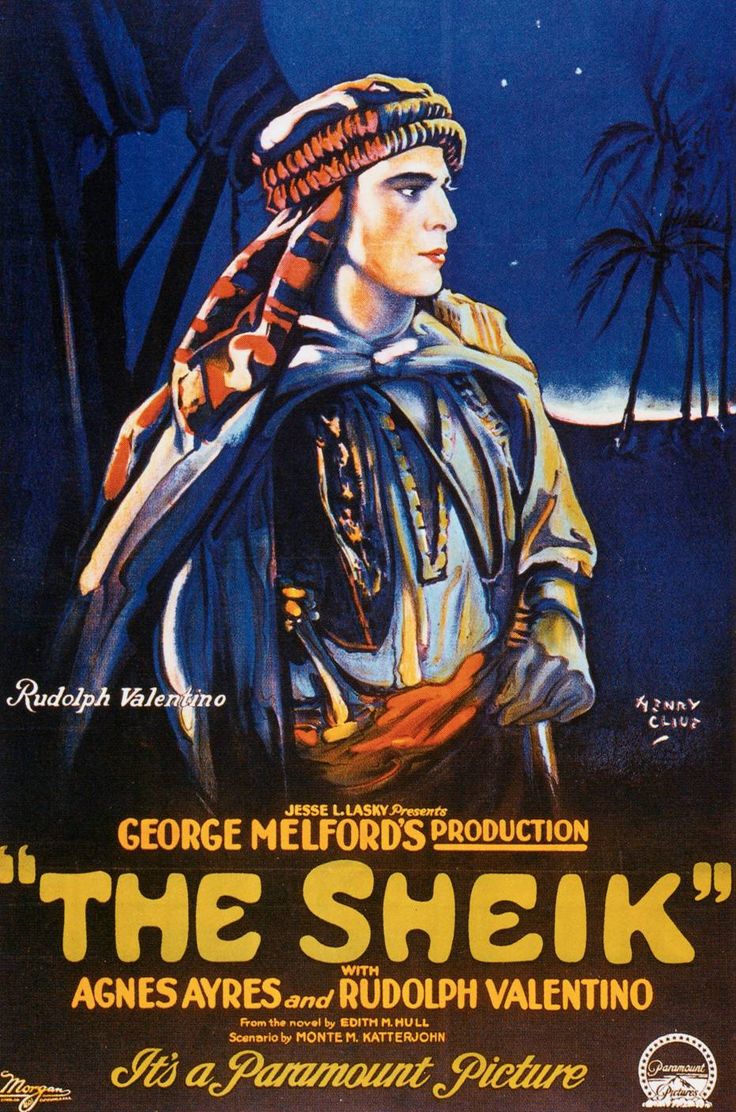
This Saturday: Valentino's 'Son of the Sheik'
with live music at Brandon (Vt.) Town Hall
Valentino in 'Son of the Sheik.' Showtime at Brandon (Vt.) Town Hall is Saturday, Aug. 27 at 7 p.m.
It's been a good month for media attention!
Earlier this month, I got a nice write-up in the Boston Globe. (See the link on the right of this page.)
This week, the Addison Independent, a twice-weekly paper in Middlebury, Vt., published a terrific piece by Charmaine Lam, a young writer on their staff.
What's great about Charlene's piece is not that it's about me. It's great because Charmaine was able to turn a long and rambling phone interview into a piece that covered a lot of ground, is easy to read, and completely and totally accurate. (Even more miraculously, it made me sound something like coherent!)
I've had to do this, and let me tell you: it's not easy, especially if the subject is totally new to you, which was the case with Charmaine.
So congratulations to her on a job well done. I expect it will bring new folks to our next screening in nearby Brandon, Vt., which is coming up this weekend.
For this one, we turn to drama: Rudolph Valentino in 'Son of the Sheik' (1926). Showtime is Saturday, Aug. 27 at 7 p.m. at Brandon Town Hall.
More details in the press release pasted in below. Hope to see you there!
And special thanks to the many sponsors who support the Brandon series, including Pam and Steve Douglass, sponsors of the Valentino program.
* * *
Valentino and Vilma Banky in 'Son of the Sheik' (1926).
WEDNESDAY, JULY 27, 2016 / FOR IMMEDIATE RELEASE
Contact Jeff Rapsis • (603) 236-9237 • jeffrapsis@gmail.com
Silent romantic epic 'Son of the Sheik' to be screened with live music on 90th anniversary of star's tragic early death
BRANDON, Vt.—He was the cinema’s first sex symbol, causing hordes of female moviegoers to flock to his pictures throughout the 1920s.
He starred in films designed to show off his Latin looks, his smoldering eyes, and his dancer’s body. And his untimely death in August, 1926 prompted mob scenes at funeral in New York.
He was Rudolph Valentino, who remains an icon for on-screen passion long after he caused a sensation in the 1920s.
One of Valentino’s most acclaimed films will be screened with live music on Saturday, Aug. 27 at 7 p.m. at Brandon Town Hall and Community Center, Route 7 in Brandon, Vt.
The screening is free and open to the public. Donations are accepted to help support the town hall's ongoing renovation and restoration. The screening is sponsored by Brandon residents Pam and Steve Douglass.
Live music will be provided by accompanist Jeff Rapsis, a New England-based composer who specializes in creating music for silent film presentations.
In 'Son of the Sheik' Valentino tackles two roles, as a father and his son.
Ahmed (Rudolph Valentino), the son of an Arab sheik and a kidnapped English gentlewoman (Agnes Ayres), loves local dancing girl Yasmin (Vilma Banky).
When he slips out of his father's heavily guarded compound to woo her, he is kidnapped and held for ransom by a group of bandits led by Yasmin's father (George Fawcett) and Ghabah (Montagu Love), the Moor to whom she is betrothed.
Can Valentino escape the clutches of his enemies and win the heart of his true love?
'Son of the Sheik' will be preceded by selected short subjects.
'Son of the Sheik' was a sequel to 1921's 'The Sheik,' an immensely popular film that established Valentino as the silent screen's great lover.
Then actor's final film, ‘Son of the Sheik’ was released following his death on Aug. 23, 1926 from complications from peritonitis. Valentino was only 31 years old.
The death took place at the height of his career, inspiring a day-long mob scene at the actor’s New York funeral.
An Italian immigrant who arrived penniless at Ellis Island in 1913, Valentino rose to superstar status in a series of silent pictures that enflamed the passions of female movie-goers from coast to coast and around the world. But he was more than a pretty face—during his career, critics praised Valentino as a versatile actor capable of playing a variety of roles; his achievements included popularizing the Argentinian tango in the 1921 drama ‘Four Horsemen of the Apocalypse.’
But Valentino's brief stardom was defined by the ‘Sheik’ roles, which brought a new level of exotic sexuality to the movies, causing a sensation at the time. In theaters, women openly swooned over Valentino’s on-screen image, especially in roles such as the ‘Sheik,’ which featured elaborate costumes. At its peak, his popularity was so immense that it inspired a backlash among many male movie-goers, who decried Valentino’s elegant image and mannerisms as effeminate.
Valentino’s sudden death fueled his status as a legendary romantic icon of the cinema. For years, a mysterious woman dressed in black would visit his grave at the Hollywood Park Cemetery in Los Angeles, leaving only a single red rose.
Valentino was aware of his effect on audiences, saying that “Women are not in love with me but with the picture of me on the screen. I am merely the canvas upon which the women paint their dreams.”
The Valentino program continues another season of silent films presented with live music at the Brandon Town Hall and Community Center. The series provides local audiences the opportunity to experience silent film as it was intended to be shown: on the big screen, in good-looking prints, with live music, and with an audience.
“These films are still exciting experiences if you can show them as they were designed to be screened,” said Rapsis, accompanist for the screenings. “There’s a reason people first fell in love with the movies, and we hope to recreate that spirit. At their best, silent films were communal experiences in which the presence of a large audience intensifies everyone’s reactions.”
For each film, Rapsis improvises a music score using original themes he creates beforehand. None of the the music is written down; instead, the score evolves in real time based on audience reaction and the overall mood as the movie is screened.
Upcoming events in Brandon Town Hall's 2016 silent film series include:
• Saturday, Sept. 17, 2016: Charlie Chaplin in 'The Kid' (1921). In Chaplin's breakthrough feature, a story with "a smile, and perhaps a tear," the Little Tramp raises an orphan. Sponsored by Bill and Kathy Mathis in memory of Maxine Thurston.
• Saturday, Oct. 15, 2016: Chiller Theatre, 'The Man Who Laughs' (1928). Get into the Halloween spirit with this creepy Gothic thriller starring Conrad Veidt. Sponsored by Omya, Inc.
Rudolph Valentino is 'Son of the Sheik' will be shown on Saturday, Aug. 27 at 7 p.m. at Brandon Town Hall and Community Center, Route 7, in Brandon, Vt.
Admission is free; free will donations are encouraged, with proceeds to support ongoing renovation of the town hall. For more information, visit www.brandontownhall.org. For more info on the music, visit www.jeffrapsis.com.
It's been a good month for media attention!
Earlier this month, I got a nice write-up in the Boston Globe. (See the link on the right of this page.)
This week, the Addison Independent, a twice-weekly paper in Middlebury, Vt., published a terrific piece by Charmaine Lam, a young writer on their staff.
What's great about Charlene's piece is not that it's about me. It's great because Charmaine was able to turn a long and rambling phone interview into a piece that covered a lot of ground, is easy to read, and completely and totally accurate. (Even more miraculously, it made me sound something like coherent!)
I've had to do this, and let me tell you: it's not easy, especially if the subject is totally new to you, which was the case with Charmaine.
So congratulations to her on a job well done. I expect it will bring new folks to our next screening in nearby Brandon, Vt., which is coming up this weekend.
For this one, we turn to drama: Rudolph Valentino in 'Son of the Sheik' (1926). Showtime is Saturday, Aug. 27 at 7 p.m. at Brandon Town Hall.
More details in the press release pasted in below. Hope to see you there!
And special thanks to the many sponsors who support the Brandon series, including Pam and Steve Douglass, sponsors of the Valentino program.
Valentino and Vilma Banky in 'Son of the Sheik' (1926).
WEDNESDAY, JULY 27, 2016 / FOR IMMEDIATE RELEASE
Contact Jeff Rapsis • (603) 236-9237 • jeffrapsis@gmail.com
Iconic screen lover Rudolph Valentino stars at Brandon (Vt.) Town Hall on Saturday, Aug. 27
Silent romantic epic 'Son of the Sheik' to be screened with live music on 90th anniversary of star's tragic early death
BRANDON, Vt.—He was the cinema’s first sex symbol, causing hordes of female moviegoers to flock to his pictures throughout the 1920s.
He starred in films designed to show off his Latin looks, his smoldering eyes, and his dancer’s body. And his untimely death in August, 1926 prompted mob scenes at funeral in New York.
He was Rudolph Valentino, who remains an icon for on-screen passion long after he caused a sensation in the 1920s.
One of Valentino’s most acclaimed films will be screened with live music on Saturday, Aug. 27 at 7 p.m. at Brandon Town Hall and Community Center, Route 7 in Brandon, Vt.
The screening is free and open to the public. Donations are accepted to help support the town hall's ongoing renovation and restoration. The screening is sponsored by Brandon residents Pam and Steve Douglass.
Live music will be provided by accompanist Jeff Rapsis, a New England-based composer who specializes in creating music for silent film presentations.
In 'Son of the Sheik' Valentino tackles two roles, as a father and his son.
Ahmed (Rudolph Valentino), the son of an Arab sheik and a kidnapped English gentlewoman (Agnes Ayres), loves local dancing girl Yasmin (Vilma Banky).
When he slips out of his father's heavily guarded compound to woo her, he is kidnapped and held for ransom by a group of bandits led by Yasmin's father (George Fawcett) and Ghabah (Montagu Love), the Moor to whom she is betrothed.
Can Valentino escape the clutches of his enemies and win the heart of his true love?
'Son of the Sheik' will be preceded by selected short subjects.
'Son of the Sheik' was a sequel to 1921's 'The Sheik,' an immensely popular film that established Valentino as the silent screen's great lover.
Then actor's final film, ‘Son of the Sheik’ was released following his death on Aug. 23, 1926 from complications from peritonitis. Valentino was only 31 years old.
The death took place at the height of his career, inspiring a day-long mob scene at the actor’s New York funeral.
An Italian immigrant who arrived penniless at Ellis Island in 1913, Valentino rose to superstar status in a series of silent pictures that enflamed the passions of female movie-goers from coast to coast and around the world. But he was more than a pretty face—during his career, critics praised Valentino as a versatile actor capable of playing a variety of roles; his achievements included popularizing the Argentinian tango in the 1921 drama ‘Four Horsemen of the Apocalypse.’
But Valentino's brief stardom was defined by the ‘Sheik’ roles, which brought a new level of exotic sexuality to the movies, causing a sensation at the time. In theaters, women openly swooned over Valentino’s on-screen image, especially in roles such as the ‘Sheik,’ which featured elaborate costumes. At its peak, his popularity was so immense that it inspired a backlash among many male movie-goers, who decried Valentino’s elegant image and mannerisms as effeminate.
Valentino’s sudden death fueled his status as a legendary romantic icon of the cinema. For years, a mysterious woman dressed in black would visit his grave at the Hollywood Park Cemetery in Los Angeles, leaving only a single red rose.
Valentino was aware of his effect on audiences, saying that “Women are not in love with me but with the picture of me on the screen. I am merely the canvas upon which the women paint their dreams.”
The Valentino program continues another season of silent films presented with live music at the Brandon Town Hall and Community Center. The series provides local audiences the opportunity to experience silent film as it was intended to be shown: on the big screen, in good-looking prints, with live music, and with an audience.
“These films are still exciting experiences if you can show them as they were designed to be screened,” said Rapsis, accompanist for the screenings. “There’s a reason people first fell in love with the movies, and we hope to recreate that spirit. At their best, silent films were communal experiences in which the presence of a large audience intensifies everyone’s reactions.”
For each film, Rapsis improvises a music score using original themes he creates beforehand. None of the the music is written down; instead, the score evolves in real time based on audience reaction and the overall mood as the movie is screened.
Upcoming events in Brandon Town Hall's 2016 silent film series include:
• Saturday, Sept. 17, 2016: Charlie Chaplin in 'The Kid' (1921). In Chaplin's breakthrough feature, a story with "a smile, and perhaps a tear," the Little Tramp raises an orphan. Sponsored by Bill and Kathy Mathis in memory of Maxine Thurston.
• Saturday, Oct. 15, 2016: Chiller Theatre, 'The Man Who Laughs' (1928). Get into the Halloween spirit with this creepy Gothic thriller starring Conrad Veidt. Sponsored by Omya, Inc.
Rudolph Valentino is 'Son of the Sheik' will be shown on Saturday, Aug. 27 at 7 p.m. at Brandon Town Hall and Community Center, Route 7, in Brandon, Vt.
Admission is free; free will donations are encouraged, with proceeds to support ongoing renovation of the town hall. For more information, visit www.brandontownhall.org. For more info on the music, visit www.jeffrapsis.com.
Wednesday, August 24, 2016
Coming up: A double dose of Rudolph Valentino
— plus composing, scoring a piece for orchestra
Some of our Kilimanjaro team at Karanga Camp, 12,800 feet, six days into the trek and two days before our summit attempt.
A cluster of shows coming up this week, including two screenings of Valentino's 'Son of the Sheik' (1926) in two very different parts of New England.
And then the decks will be cleared to make progress on a project that I'm very excited about—one involving that big mountain pictured above.
But first things first: the Valentino screenings will honor the 90th anniversary of the star's untimely death, which occurred on Aug. 23, 1926.
To mark this occasion, we're running his final film—'Son of the Sheik' (1926)—at the Leavitt Theatre in Ogunquit, Maine on Thursday, Aug. 25, and then again on Saturday, Aug. 27 in Brandon Town Hall up in Brandon, Vt.
Detailed info about either screening can be found by clicking on the "Upcoming Silent Film Screenings" link at the upper right.
Coming to a theater near you—if you live in Maine or Vermont.
Valentino is one of the few silent-era stars whose name still holds sway with the public. So we usually get a good turnout when his name is on the program.
It's a great way to experience the special magic that he brought to the silver screen, so hope to see you there!
And then on Sunday, Aug. 28, it's the final installment of our summer series of silent boxing films at the Wilton (N.H.) Town Hall Theatre.
Keaton puts up his dukes in 'Battling Butler.
We're finishing with Buster Keaton's uproarious comedy, 'Battling Butler' (1926). The bell rings at 4:30 p.m.
Though not regarded as one of Buster's timeless classics, 'Butler' was the highest-grossing of any of Keaton's silent features in the 1920s.
In fact, its box office success was one reason that producer Joe Schenck allowed Keaton to go ahead with his ambitious next film, 'The General.'
So if you've enjoyed the Civil War adventure regarded as Buster's masterpiece, you might want to check out 'Butler,' the film that helped make it possible.
Why boxing? Popular in the 1920s, it remains a compelling marriage of civilization and brutality. Read Joyce Carol Oates' 'On Boxing' and you'll see what I mean.
Okay. what about this new project?
This summer, in-between improv-heavy silent film gigs, I've been putting together something completely different: a written-down piece for orchestra.
It's not a film score. It's a concert piece.
Kilimanjaro: the highest and biggest free-standing mountain the world.
Specifically, it's a musical depiction of Mount Kilimanjaro—you know, the big snow-capped peak in East Africa.
And it's scheduled to be played in January, 2017 by the New Hampshire Philharmonic, an orchestra based right here in my home state!
Just today I noticed the piece is listed on the Philharmonic's Web site (www.nhphil.org), so I figured it would be okay to go public.
The thing is, I'm still working on it, and expect to continue to do so for awhile yet. So this might help spur me on.
(Leonard Bernstein wrote music based on 'The Age of Anxiety.' Today, we live in 'The Age of Distraction.')
We negotiate the "Kissing Rock" on a cliff known as the Breakfast Wall above Barranco Camp.
Over the years I've been doing live accompaniment for silent films, I've gradually developed a musical vocabulary or language that I feel works for me.
And now I sense it's time to start using it in ways that are different from the improvised movie scores genre.
I still expect most of my musical energies will go towards creating in-the-moment film music.
But I sense it's time to starting writing some things down and see how that goes.
Why Kilimanjaro? Unexpected forces conspired to make this happen.
For starters, I had the good fortune to be part of a team that successfully reached Kilimanjaro's 19,431-foot summit in January 2015.
Our team on Day 5, coming down from Lava Tower Camp at 15,000 feet.
I didn't sign up for artistic purposes. I just wanted to see if I could do it.
But I was surprised to find the 10-day journey of hauling yourself up and then down the highest peak in Africa is an experience filled with music of various types.
One example: on the final overnight push to the summit, as we slowly ascended a narrow trail through the pre-dawn darkness, Tanzanian guides from several teams spontaneously sang traditional Christian hymns in Swahili. Wow!
Also, not a day goes by on the mountain without people breaking out into "Jambo Bwana," otherwise known as the Kilimanjaro Song.
On a more abstract level, there's the mountain itself. Go there and march all around it, as we did, and you'll find it makes music all its own.
Someone once said that great architecture is music frozen in time. I think that's true with nature, too—or at least that's what I found with Kilimanjaro.
On the summit, dawn, Jan. 10, 2015. Groups generally spend only a half-hour at the top of Kilimanjaro due to lack of oxygen and cold temperatures.
And I felt I wanted to capture some of that: the long trek across the volcanic plains, the drama of scrambling up the "Breakfast Wall," the intense experience of marching one step at a time at high altitude to the frozen summit ridge.
But there's more. It turns out that Mark Latham, the Philharmonic's music director, is from a family of British medical officers with a long history on Kilimanjaro.
Mark's grandfather was the first Englishman to climb to the summit following World War I, after the Germans ceded what was then the colony of "Tanganyika" to the United Kingdom.
Another one of his relatives (I think Mark's great-uncle) was the guy who discovered the frozen leopard on Kilimanjaro's upper slopes that Ernest Hemingway made so much of.
One of the sub peaks is "Latham Peak," and a key spot on the main climbing route is "Stella Point," named after Mark's great aunt, apparently the first woman to ever reach the summit.
Summit photo op. How often do you get to pose with a receding glacier?
And Mark himself was born in Tanzania, and climbed Kilimanjaro some years ago. Prior to our more recent ascent, he let us look through the family's scrapbooks, which was fascinating.
All of this seemed to be drawing us all together and suggesting that we do something musical about Kilimanjaro. And so we are!
So mark your calendars: the Philharmonic has the "Kilimanjaro Suite" on their schedule for Saturday, Jan. 20 and again on Sunday, Jan. 21.
And once this is done, I can start work on that long-awaited Pam Smart opera.
Me at the end of our climb, inspecting the "Tourist Rescue Book."
Saturday, August 20, 2016
Tonight: scoring 'Metropolis' in Ludlow, Vt.,
plus thoughts about Valentino's "Sheik" films
Working for the man in 'Metropolis' (1927).
Very excited about the chance to do live music tonight (Saturday, Aug. 20) for a screening of 'Metropolis' in Ludlow, Vt.
Showtime is 7 p.m. at the Ludlow Auditorium, which is upstairs from the town offices. It was never designed to be a movie theater, but it's a great place to experience silent film.
Among the reasons: the people are great, and so are the acoustics.
More info about tonight's screening is in the press release below.
For now, a few notes about Rudolph Valentino. His untimely death occurred on Aug. 23, 1926, which means the 90th anniversary is coming up next week.
He's one of the few stars from the silent era who remain a household name. Today, "Valentino" is still a synonym for exotic romance, even among people who've never seen any of his movies.
To help remedy that, I scheduled a spate of Valentino flicks in various places this month, with a special emphasis on 'Son of the Sheik' (1926), Valentino's final film.
Originally, I had intended to run double bills consisting of the original 1921 'The Sheik' as well as 'Son,' which was its sequel.
But a program featuring both titles runs well over three hours. And too much of anything—even Valentino—is not always wise.
So I've pared back most of the screenings to just 'Son of the Sheik,' generally regarded as the better of the two.
Overall, the original 'Sheik' is slower paced and more old-fashioned. The sequel is much zippier, more fun, and technically superior. Movie-making had advanced a lot in just five years.
However, now I'm not so sure. Last week I did run both back-to-back at the Flying Monkey Moviehouse and Performance Center in Plymouth, N.H.
And 'The Sheik' held up better than I expected, while its sequel seemed flat and less focused.
Vilma Banky and Rudy in 'Son of the Sheik.'
Afterwards, I polled the audience (about 40 people), and reaction was split right down the middle. Half preferred 'The Sheik,' while half preferred the sequel.
So we'll see. Maybe it really was just too much all at once, and 'Son of the Shiek' will come into its own when run on its own.
We'll find out next week, when I accompany the film on Thursday, Aug. 25 at the Leavitt Theater in Ogunquit, Maine, and then again on Saturday, Aug. 27 up in Brandon, Vt.
The one reqret I have about not running both films is that I lose the opportunity to create two intersecting scores.
Example: In 'The Sheik,' throughout the film I used a certain bold melodic signature for Valentino's title character and wove it into the score.
Then, for 'Son of the Sheik,' I used a completely different motif for the title character (the Sheik's son), and otherwise completely different material around it as well.
So THEN, when the Sheik's father shows up in the latter film, I brought back the original motif from the first movie, a move I thought was really effective.
But you can't achieve effects like that when you run only one title. Still, I'll do my best to help 'Son' connect with audiences curious about the Valentino appeal.
Poster for the original 'Sheik' film in 1921.
Speaking of which: one thing about 'Son' that's necessary to explain is that Valentino was to some extent making fun of his reputation as the screen's greatest lover.
Watch both Sheik films in succession, it's easy to see this. But without context, some of his moves in 'Son' might get taken the wrong way. "Oh, those primitive silent movies!" So it necessary to say a few works about that.
The good news is that both pictures hold up quite well on their own, so I'm looking forward to presenting more Valentino later this month.
But first, the imagined future beckons. Come up to Ludlow, Vt. tonight and see one of the biggies! More info in the press release below.
* * *
WEDNESDAY, JULY 27, 2016 / FOR IMMEDIATE RELEASE
Contact Jeff Rapsis • (603) 236-9237 • jeffrapsis@gmail.com
Futuristic silent film epic 'Metropolis' (1927)
Landmark early sci-fi fantasy movie, with half-hour of rediscovered footage, to be shown with live music at Ludlow (Vt.) Town Hall Auditorium
LUDLOW, Vt.—A silent film hailed as the granddaddy of all science fiction fantasy movies will be screened with live music on Saturday, Aug. 20 at 7 p.m. at Ludlow Town Hall Auditorium.
The screening, sponsored by FOLA (Friends of the Ludlow Auditorium), will allow audiences to experience silent film in the way its creators originally intended: on the big screen, with live music, and with an audience.
The show, like all movies at the Ludlow Town Hall Auditorium, is free and open to the public. 'Metropolis' will be preceded by a short silent comedy film starring Buster Keaton.
"'Metropolis' is one of the great all-time classics of cinema, and we're thrilled to present it so fans can experience it with an audience and live music," said Ralph Pace, programmer and organizer of the series.
Original music for 'Metropolis' will be performed live by Jeff Rapsis, a New Hampshire-based composer and silent film accompanist who performs at screenings around the nation.
'Metropolis' (1927), regarded as German director Fritz Lang's masterpiece, is set in a futuristic city where a privileged elite pursue lives of leisure while the masses toil on vast machines and live deep underground.
The film, with its visions of futuristic factories and flying cars, set new standards for visual design and inspired generations of dystopian fantasies from Ridley Scott's 'Blade Runner' to Terry Gilliam's 'Brazil.'
In reviving 'Metropolis' and other great films of cinema's early years, FOLA aims to show silent movies as they were meant to be seen—in high quality prints, on a large screen, with live music, and with an audience.
"All those elements are important parts of the silent film experience," said Rapsis, who will improvise an original live score for 'Metropolis' on the spot. "Recreate those conditions, and the classics of early cinema leap back to life."
Brigitte Helm works her triceps in 'Metropolis.'
In 'Metropolis,' the story centers on an upper class young man who falls in love with a woman who works with the poor. The tale encompasses mad scientists, human-like robots, underground spiritual movements, and industrial espionage, all set in a society divided between haves and have-nots.
The version of 'Metropolis' to be screened in Ludlow a newly restored edition that includes nearly a half-hour of missing footage cut following the film's premiere in 1927. The lost footage, discovered in 2008 in an archive in Argentina, has since been added to the existing 'Metropolis,' allowing plot threads and characters to be developed more fully.
After its premiere, the film's distributors (including Paramount in the U.S.) drastically shortened 'Metropolis' to maximize the film's commercial potential. By the time it debuted in the U.S. later that year, the film was only about 90 minutes long.
Evil Scientist! Boo!
Even in its shortened form, 'Metropolis' became a cornerstone of science fiction cinema. Due to its enduring popularity, the film has undergone numerous restorations in the intervening decades in attempts to recover Lang's original vision.
In 1984, the film was reissued with additional footage, color tints, and a pop rock score (but with many of its intertitles removed) by music producer Giorgio Moroder. A more archival restoration was completed in 1987, under the direction of Enno Patalas of the Munich Film Archive, in which missing scenes were represented with title cards and still photographs.
More recently, a 2001 restoration combined footage from four archives and was widely believed that this would be the most complete version of Lang's film that contemporary audiences could ever hope to see. But in the summer of 2008, the curator of the Buenos Aires Museo del Cine discovered a 16mm dupe negative of 'Metropolis' that was considerably longer than any existing print.
It included not merely a few additional snippets, but 25 minutes of "lost" footage, about a fifth of the film, that had not been seen since its Berlin debut.
The discovery of such a significant amount of material called for yet another restoration, which debuted in 2010 to widespread acclaim. It's this fully restored edition that will be screened in Ludlow.
" 'Metropolis' stands as an stunning example of the power of silent film to tell a compelling story without words, and reach across the generations to touch movie-goers from the real future, which means us," said accompanist Jeff Rapsis, who provides live music for silent film screenings throughout New England.
To accompany a silent film, Rapsis uses a digital synthesizer to recreate the texture of the full orchestra. The score is created live in real time as the movie is screened. Rather than focus exclusively on authentic music of the period, Rapsis creates new music for silent films that draws from movie scoring techniques that today's audiences expect from the cinema.
The restored 'Metropolis' will be shown on Saturday, Aug. 20 at 7 p.m. at Ludlow Town Hall Auditorium, 137 Depot St. in Ludlow, Vt. The screening is sponsored by the Friends of Ludlow Auditorium. Admission is free; donations are encouraged. For more information about the FOLA and its events, visit www.fola.us or call (802) 228-7239.
Very excited about the chance to do live music tonight (Saturday, Aug. 20) for a screening of 'Metropolis' in Ludlow, Vt.
Showtime is 7 p.m. at the Ludlow Auditorium, which is upstairs from the town offices. It was never designed to be a movie theater, but it's a great place to experience silent film.
Among the reasons: the people are great, and so are the acoustics.
More info about tonight's screening is in the press release below.
For now, a few notes about Rudolph Valentino. His untimely death occurred on Aug. 23, 1926, which means the 90th anniversary is coming up next week.
He's one of the few stars from the silent era who remain a household name. Today, "Valentino" is still a synonym for exotic romance, even among people who've never seen any of his movies.
To help remedy that, I scheduled a spate of Valentino flicks in various places this month, with a special emphasis on 'Son of the Sheik' (1926), Valentino's final film.
Originally, I had intended to run double bills consisting of the original 1921 'The Sheik' as well as 'Son,' which was its sequel.
But a program featuring both titles runs well over three hours. And too much of anything—even Valentino—is not always wise.
So I've pared back most of the screenings to just 'Son of the Sheik,' generally regarded as the better of the two.
Overall, the original 'Sheik' is slower paced and more old-fashioned. The sequel is much zippier, more fun, and technically superior. Movie-making had advanced a lot in just five years.
However, now I'm not so sure. Last week I did run both back-to-back at the Flying Monkey Moviehouse and Performance Center in Plymouth, N.H.
And 'The Sheik' held up better than I expected, while its sequel seemed flat and less focused.
Vilma Banky and Rudy in 'Son of the Sheik.'
Afterwards, I polled the audience (about 40 people), and reaction was split right down the middle. Half preferred 'The Sheik,' while half preferred the sequel.
So we'll see. Maybe it really was just too much all at once, and 'Son of the Shiek' will come into its own when run on its own.
We'll find out next week, when I accompany the film on Thursday, Aug. 25 at the Leavitt Theater in Ogunquit, Maine, and then again on Saturday, Aug. 27 up in Brandon, Vt.
The one reqret I have about not running both films is that I lose the opportunity to create two intersecting scores.
Example: In 'The Sheik,' throughout the film I used a certain bold melodic signature for Valentino's title character and wove it into the score.
Then, for 'Son of the Sheik,' I used a completely different motif for the title character (the Sheik's son), and otherwise completely different material around it as well.
So THEN, when the Sheik's father shows up in the latter film, I brought back the original motif from the first movie, a move I thought was really effective.
But you can't achieve effects like that when you run only one title. Still, I'll do my best to help 'Son' connect with audiences curious about the Valentino appeal.
Poster for the original 'Sheik' film in 1921.
Speaking of which: one thing about 'Son' that's necessary to explain is that Valentino was to some extent making fun of his reputation as the screen's greatest lover.
Watch both Sheik films in succession, it's easy to see this. But without context, some of his moves in 'Son' might get taken the wrong way. "Oh, those primitive silent movies!" So it necessary to say a few works about that.
The good news is that both pictures hold up quite well on their own, so I'm looking forward to presenting more Valentino later this month.
But first, the imagined future beckons. Come up to Ludlow, Vt. tonight and see one of the biggies! More info in the press release below.
WEDNESDAY, JULY 27, 2016 / FOR IMMEDIATE RELEASE
Contact Jeff Rapsis • (603) 236-9237 • jeffrapsis@gmail.com
Futuristic silent film epic 'Metropolis' (1927)
to be shown in Ludlow on Saturday, Aug. 20
Landmark early sci-fi fantasy movie, with half-hour of rediscovered footage, to be shown with live music at Ludlow (Vt.) Town Hall Auditorium
LUDLOW, Vt.—A silent film hailed as the granddaddy of all science fiction fantasy movies will be screened with live music on Saturday, Aug. 20 at 7 p.m. at Ludlow Town Hall Auditorium.
The screening, sponsored by FOLA (Friends of the Ludlow Auditorium), will allow audiences to experience silent film in the way its creators originally intended: on the big screen, with live music, and with an audience.
The show, like all movies at the Ludlow Town Hall Auditorium, is free and open to the public. 'Metropolis' will be preceded by a short silent comedy film starring Buster Keaton.
"'Metropolis' is one of the great all-time classics of cinema, and we're thrilled to present it so fans can experience it with an audience and live music," said Ralph Pace, programmer and organizer of the series.
Original music for 'Metropolis' will be performed live by Jeff Rapsis, a New Hampshire-based composer and silent film accompanist who performs at screenings around the nation.
'Metropolis' (1927), regarded as German director Fritz Lang's masterpiece, is set in a futuristic city where a privileged elite pursue lives of leisure while the masses toil on vast machines and live deep underground.
The film, with its visions of futuristic factories and flying cars, set new standards for visual design and inspired generations of dystopian fantasies from Ridley Scott's 'Blade Runner' to Terry Gilliam's 'Brazil.'
In reviving 'Metropolis' and other great films of cinema's early years, FOLA aims to show silent movies as they were meant to be seen—in high quality prints, on a large screen, with live music, and with an audience.
"All those elements are important parts of the silent film experience," said Rapsis, who will improvise an original live score for 'Metropolis' on the spot. "Recreate those conditions, and the classics of early cinema leap back to life."
Brigitte Helm works her triceps in 'Metropolis.'
In 'Metropolis,' the story centers on an upper class young man who falls in love with a woman who works with the poor. The tale encompasses mad scientists, human-like robots, underground spiritual movements, and industrial espionage, all set in a society divided between haves and have-nots.
The version of 'Metropolis' to be screened in Ludlow a newly restored edition that includes nearly a half-hour of missing footage cut following the film's premiere in 1927. The lost footage, discovered in 2008 in an archive in Argentina, has since been added to the existing 'Metropolis,' allowing plot threads and characters to be developed more fully.
After its premiere, the film's distributors (including Paramount in the U.S.) drastically shortened 'Metropolis' to maximize the film's commercial potential. By the time it debuted in the U.S. later that year, the film was only about 90 minutes long.
Evil Scientist! Boo!
Even in its shortened form, 'Metropolis' became a cornerstone of science fiction cinema. Due to its enduring popularity, the film has undergone numerous restorations in the intervening decades in attempts to recover Lang's original vision.
In 1984, the film was reissued with additional footage, color tints, and a pop rock score (but with many of its intertitles removed) by music producer Giorgio Moroder. A more archival restoration was completed in 1987, under the direction of Enno Patalas of the Munich Film Archive, in which missing scenes were represented with title cards and still photographs.
More recently, a 2001 restoration combined footage from four archives and was widely believed that this would be the most complete version of Lang's film that contemporary audiences could ever hope to see. But in the summer of 2008, the curator of the Buenos Aires Museo del Cine discovered a 16mm dupe negative of 'Metropolis' that was considerably longer than any existing print.
It included not merely a few additional snippets, but 25 minutes of "lost" footage, about a fifth of the film, that had not been seen since its Berlin debut.
The discovery of such a significant amount of material called for yet another restoration, which debuted in 2010 to widespread acclaim. It's this fully restored edition that will be screened in Ludlow.
" 'Metropolis' stands as an stunning example of the power of silent film to tell a compelling story without words, and reach across the generations to touch movie-goers from the real future, which means us," said accompanist Jeff Rapsis, who provides live music for silent film screenings throughout New England.
To accompany a silent film, Rapsis uses a digital synthesizer to recreate the texture of the full orchestra. The score is created live in real time as the movie is screened. Rather than focus exclusively on authentic music of the period, Rapsis creates new music for silent films that draws from movie scoring techniques that today's audiences expect from the cinema.
The restored 'Metropolis' will be shown on Saturday, Aug. 20 at 7 p.m. at Ludlow Town Hall Auditorium, 137 Depot St. in Ludlow, Vt. The screening is sponsored by the Friends of Ludlow Auditorium. Admission is free; donations are encouraged. For more information about the FOLA and its events, visit www.fola.us or call (802) 228-7239.
Sunday, August 14, 2016
Next up at the Somerville Theatre:
'Stella Maris' in 35mm on Sunday, Aug. 14
Conway Tearle and Mary Pickford in 'Stella Maris' (1918).
Very excited for the Boston Globe (our region's biggest newspaper) to publish a preview about our screening of Mary Pickford's 'Stella Maris' (1918) on Sunday, Aug. 14 at 2 p.m.
Writer Loren King put together a nice piece on the film and on my approach to accompanying it.
It's online here, although you may need to be a subscriber to see the whole thing.
I've also posted it as a separate page under the "More Information" area to the right. Check it out!
I'm behind on postings and previews due to a heavy performance schedule in the past week.
Got back this past Monday from our stay in Rome, Italy, and then it was a silent film screening every single night for the rest of the week!
Tuesday, Aug. 9 was 'Desert Nights' (1929), a late MGM silent with John Gilbert, Mary Nolan, and Ernest Torrance battling to survive in the Kalahari Desert.
I love these end-of-the-road silents because they were generally overlooked when first released, and often contain some really good stuff.
'Desert Nights' was a prime example: a big MGM production with a strong cast and technically quite accomplished, and a film I'd never heard of or accompanied before.
Audience reaction at the Manchester (N.H.) City Library was strong. 'Desert Nights' still holds up. So it's one to file in the "unknown but surprisingly good" category.
The entrance to the Biltmore ballroom, site of a 1925 "world premiere."
Wednesday, Aug. 10 brought an unusual gig at the vintage Biltmore Hotel in downtown Providence, R.I.
I accompanied the great 1925 comedy 'Her Sister From Paris' in a ballroom packed with people dressed as vacationers from the 1890s through the 1920s.
This was part of a week-long "seaside vacation" experience run by "Moments in Time," a Connecticut-based group dedicated to reviving vintage holiday-making, with an emphasis on period dress and dance.
The events attract people from all over the nation: at the pre-show dinner, among my tablemates were a couple from North Carolina who clearly enjoyed the chance to visit a bygone era, sartorially and otherwise.
Showing a silent film with live music was a new wrinkle in this group's activities, and I'm pleased to report it was a smash hit.
Really! You know you're in for a good time when even the open titles generate raucous laughter.
But this turned out to be one of those great, great nights, where the film clicks right from the start and audience response is non-stop.
Constance Talmadge and Ronald Colman and a ballroom full of people dressed in vintage clothing. What's not to like?
Backstage at the Biltmore: what employees see when exiting any of the three service elevators, one of which is reserved exclusively for room service.
Because it was in an upstairs ballroom in an actual working hotel, I myself had the unusual experience of having to load-in not through the lobby, but "back stage" through the loading dock and service elevators.
It being a humid night with temps in the 90s, I have renewed respect and sympathy for the people who delivery room service. And I appreciated the "Smile, You're About to Go On Stage" reminders (in English and Spanish) in the employee elevators.
But everyone could not have been nicer and more helpful. So here's hoping there's room for more silent film screenings in future "Moments in Time" activities.
The Clayton family (owners of the Leavitt Theatre) always outdo themselves in producing large-format "sandwich board" sidewalk placards, even for obscure films.
Thursday, Aug. 11 saw me returning to the historic Leavitt Theatre (opened in 1923 and virtually unchanged since) in Ogunquit, Maine for "Silent Comedy Night" featuring Harry Langdon in 'Tramp Tramp Tramp' (1926).
Prior to the show, I polled the audience to see if any Langdon groupies were on hand. Surprisingly, some were!
With a modest turnout of about 50 people (and another warm night) one took a while to get going.
But no matter what else happens, it always comes to life when Harry winds up literally hanging by a thread over a cliffside. And that's what happened on Thursday night, and it was smooth sailing (and much laughter) from that point on.
A one-sheet promo for 'The Yankee Clipper.'
Friday, Aug. 12 brought me to Concord's Red River Theatres and 'The Yankee Clipper' (1927) starring William Boyd, known today mostly for his later work as "Hopalong Cassidy" in innumerable Westerns.
It was the latest installment of our monthly silent film program.
In summer, turnout for this series is sometimes anemic. But not the case this time: we nearly filled the small screening room with a crowd pumped for adventure on the high seas.
To try to stir up appropriate excitement, I opened my introduction like this:
Me: "Okay, how many Hopalong Cassidy fans do we have here tonight?"
Crowd: Yay!
Me: "And how many people here are fans of those great sailing vessels, the tall ships and the clipper ships?"
Crowd: Bigger Yay!
Me: "And how many fans do we have of U.S. President Zachary Taylor?!"
Crowd: Biggest yay of all, but possibly ironic.
But they really, really enjoyed the flick, a Cecil B. DeMille production that really holds up well. The fact that it's set in the 1840s gives it a timeless quality and a "history comes to life" kind of appeal similar to Buster Keaton's 'The General.'
As an added bonus, 'The Yankee Clipper' cast includes New Hampshire native Walter Long in yet another "tough guy" role, in this case "Ironhead Joe" who meets his requisite end only after having tobacco "chaw" being spit in his face by Junior Coughlin.
Long's appearance shouldn't be a surprise, though, as he seems to have appeared in about 70 percent of all films made during the silent era.
Someone should write a book about this interesting guy, who acted in everything from 'The Birth of a Nation' and 'Intolerance' to Laurel and Hardy comedies.
If they do, here's a working title: "Witness to Hollywood."
And that brings us up to today, when I'll head down to Beantown (otherwise known as Boston) and do music for 'Stella Maris' at the Somerville Theatre.
Not only does the cast include Mary Pickford playing two roles, but also features the legendary actor Gustav Von Seyffertitz (who would later play the evil "baby farm" owner in Pickford's 'Sparrows' in 1926) and Teddy the Dog, on loan from Mack Sennett's studio, where he routinely rescued damsels in distress. (Here he gets to experience more lasting satisfaction.)
Showtime is 2 p.m. The print is 35mm. What are you waiting for?
For more info, check out the press release I've pasted in below.
And for even more info, here's a great write-up from a Pickford blog-a-thon from a few years ago.
And here's a different perspective (and somewhat less charitable) from a paper in Asheville, N.C. prior to a recent screening.
For a film that's nearly a century old, 'Stella Maris' still gets a lot of press!
See you there!
* * *
The wonders of 1918 split-screen photography bring us Mary Pickford and Mary Pickford playing two lead roles in 'Stella Maris.'
WEDNESDAY, JULY 27, 2016 / FOR IMMEDIATE RELEASE
Contact Jeff Rapsis • (603) 236-9237 • jeffrapsis@gmail.com
Intense melodrama 'Stella Maris' (1918) to be screened in 35mm and with live music
SOMERVILLE, Mass.—She was a pioneering figure in early cinema, and all the more remarkable because she worked in an otherwise male-dominated industry.
She was Mary Pickford, one of biggest superstars of the silent film era, as well as a major force behind the cameras during her long career.
Rediscover Pickford's unique appeal with a screening of 'Stella Maris' (1918), a melodrama starring Pickford, which will be shown with live music on Sunday, Aug. 14 at 2 p.m. at the Somerville Theatre, 55 Davis Square, Somerville, Mass.
The film will be screened using a 35mm print from the U.S. Library of Congress. General admission to program is $15 per person.
Pickford was a screen veteran with nearly 10 years of experience and already a major star when she made 'Stella Maris,' a melodrama in which she played two roles.
Stella Maris (Mary Pickford), paralyzed since birth, lives in an opulent mansion and has virtually no knowledge of the outside world. She adores her frequent visitor John Risca (Conway Tearle), a journalist stuck in a loveless marriage to Louise (Marcia Manon).
After Louise viciously beats her maid Unity Blake (also Pickford), she is jailed, and Unity too falls in love with John. The two young women are hopelessly enamored of the same man, and after Louise's release something has to give.
'Stella Maris' is a classic example of the kind of emotionally charged melodrama that was immensely popular during the silent era, and which still holds up today when screened as intended—with live music, in a theater, and with an audience.
The film was directed by Marshall Neilan, a frequent Pickford collaborator.
Pickford, a pioneering film superstar, was a major force in early Hollywood, helping establish the United Artists studio and serving as a founding member of the Academy of Motion Picture Arts and Sciences, which to this day bestows the annual Oscar awards.
However, Pickford's films receive comparatively little attention today, in part due to the myth that Pickford often played wholesome and traditional female characters that conformed with society's expectations at the time.
In truth, Pickford's best movies often featured her in roles that required her to take action, challenge authority, and play strong roles uncommon for a woman of the era.
Pickford would go on to make many successful films throughout the silent period, and further cemented her status as Hollywood royalty by marrying swashbuckling adventure icon Douglas Fairbanks Sr. in 1920.
The Pickford program is the latest installment of the Somerville Theatre's monthly "Silents, Please!" series, designed to showcase the silent era's best feature films the way they were intended to be shown—using actual 35mm film prints projected on the big screen, with live music, and with an audience.
"If you can put all these elements together, the films come to life in a way that's surprising to modern audiences," said Ian Judge, the Somerville's general manager. "Our silent film series has been very successful at attracting an audience, we're thrilled to continue it on a monthly basis."
'Stella Maris' will be accompanied by Jeff Rapsis, a New Hampshire-based musician and composer.
For silent film, Rapsis improvises music in real time, while the film is running, using a digital synthesizer to recreate the "movie score" texture of a full orchestra.
"Making up a score live is a bit of a high-wire act, but it allows me to follow and support the film a lot more effectively than if I was buried in sheet music," Rapsis said. "Instead, I'm free to follow the film right in the moment. Each time it's different, which lends a certain energy and immediacy and excitement to the experience."
'Stella Maris,' a silent melodrama starring Mary Pickford, will be screened in 35mm with live music on Sunday, Aug. 14 at 2 p.m. at the Somerville Theater, 55 Davis Square, Somerville, Mass. Admission is $15 adults, $12 students/seniors; general admission seating. For more information, call (617) 625-5700 or visit http://www.somervilletheatre.com. For more info on the music, visit www.jeffrapsis.com.
Very excited for the Boston Globe (our region's biggest newspaper) to publish a preview about our screening of Mary Pickford's 'Stella Maris' (1918) on Sunday, Aug. 14 at 2 p.m.
Writer Loren King put together a nice piece on the film and on my approach to accompanying it.
It's online here, although you may need to be a subscriber to see the whole thing.
I've also posted it as a separate page under the "More Information" area to the right. Check it out!
I'm behind on postings and previews due to a heavy performance schedule in the past week.
Got back this past Monday from our stay in Rome, Italy, and then it was a silent film screening every single night for the rest of the week!
Tuesday, Aug. 9 was 'Desert Nights' (1929), a late MGM silent with John Gilbert, Mary Nolan, and Ernest Torrance battling to survive in the Kalahari Desert.
I love these end-of-the-road silents because they were generally overlooked when first released, and often contain some really good stuff.
'Desert Nights' was a prime example: a big MGM production with a strong cast and technically quite accomplished, and a film I'd never heard of or accompanied before.
Audience reaction at the Manchester (N.H.) City Library was strong. 'Desert Nights' still holds up. So it's one to file in the "unknown but surprisingly good" category.
The entrance to the Biltmore ballroom, site of a 1925 "world premiere."
Wednesday, Aug. 10 brought an unusual gig at the vintage Biltmore Hotel in downtown Providence, R.I.
I accompanied the great 1925 comedy 'Her Sister From Paris' in a ballroom packed with people dressed as vacationers from the 1890s through the 1920s.
This was part of a week-long "seaside vacation" experience run by "Moments in Time," a Connecticut-based group dedicated to reviving vintage holiday-making, with an emphasis on period dress and dance.
The events attract people from all over the nation: at the pre-show dinner, among my tablemates were a couple from North Carolina who clearly enjoyed the chance to visit a bygone era, sartorially and otherwise.
Showing a silent film with live music was a new wrinkle in this group's activities, and I'm pleased to report it was a smash hit.
Really! You know you're in for a good time when even the open titles generate raucous laughter.
But this turned out to be one of those great, great nights, where the film clicks right from the start and audience response is non-stop.
Constance Talmadge and Ronald Colman and a ballroom full of people dressed in vintage clothing. What's not to like?
Backstage at the Biltmore: what employees see when exiting any of the three service elevators, one of which is reserved exclusively for room service.
Because it was in an upstairs ballroom in an actual working hotel, I myself had the unusual experience of having to load-in not through the lobby, but "back stage" through the loading dock and service elevators.
It being a humid night with temps in the 90s, I have renewed respect and sympathy for the people who delivery room service. And I appreciated the "Smile, You're About to Go On Stage" reminders (in English and Spanish) in the employee elevators.
But everyone could not have been nicer and more helpful. So here's hoping there's room for more silent film screenings in future "Moments in Time" activities.
The Clayton family (owners of the Leavitt Theatre) always outdo themselves in producing large-format "sandwich board" sidewalk placards, even for obscure films.
Thursday, Aug. 11 saw me returning to the historic Leavitt Theatre (opened in 1923 and virtually unchanged since) in Ogunquit, Maine for "Silent Comedy Night" featuring Harry Langdon in 'Tramp Tramp Tramp' (1926).
Prior to the show, I polled the audience to see if any Langdon groupies were on hand. Surprisingly, some were!
With a modest turnout of about 50 people (and another warm night) one took a while to get going.
But no matter what else happens, it always comes to life when Harry winds up literally hanging by a thread over a cliffside. And that's what happened on Thursday night, and it was smooth sailing (and much laughter) from that point on.
A one-sheet promo for 'The Yankee Clipper.'
Friday, Aug. 12 brought me to Concord's Red River Theatres and 'The Yankee Clipper' (1927) starring William Boyd, known today mostly for his later work as "Hopalong Cassidy" in innumerable Westerns.
It was the latest installment of our monthly silent film program.
In summer, turnout for this series is sometimes anemic. But not the case this time: we nearly filled the small screening room with a crowd pumped for adventure on the high seas.
To try to stir up appropriate excitement, I opened my introduction like this:
Me: "Okay, how many Hopalong Cassidy fans do we have here tonight?"
Crowd: Yay!
Me: "And how many people here are fans of those great sailing vessels, the tall ships and the clipper ships?"
Crowd: Bigger Yay!
Me: "And how many fans do we have of U.S. President Zachary Taylor?!"
Crowd: Biggest yay of all, but possibly ironic.
But they really, really enjoyed the flick, a Cecil B. DeMille production that really holds up well. The fact that it's set in the 1840s gives it a timeless quality and a "history comes to life" kind of appeal similar to Buster Keaton's 'The General.'
As an added bonus, 'The Yankee Clipper' cast includes New Hampshire native Walter Long in yet another "tough guy" role, in this case "Ironhead Joe" who meets his requisite end only after having tobacco "chaw" being spit in his face by Junior Coughlin.
Long's appearance shouldn't be a surprise, though, as he seems to have appeared in about 70 percent of all films made during the silent era.
Someone should write a book about this interesting guy, who acted in everything from 'The Birth of a Nation' and 'Intolerance' to Laurel and Hardy comedies.
If they do, here's a working title: "Witness to Hollywood."
And that brings us up to today, when I'll head down to Beantown (otherwise known as Boston) and do music for 'Stella Maris' at the Somerville Theatre.
Not only does the cast include Mary Pickford playing two roles, but also features the legendary actor Gustav Von Seyffertitz (who would later play the evil "baby farm" owner in Pickford's 'Sparrows' in 1926) and Teddy the Dog, on loan from Mack Sennett's studio, where he routinely rescued damsels in distress. (Here he gets to experience more lasting satisfaction.)
Showtime is 2 p.m. The print is 35mm. What are you waiting for?
For more info, check out the press release I've pasted in below.
And for even more info, here's a great write-up from a Pickford blog-a-thon from a few years ago.
And here's a different perspective (and somewhat less charitable) from a paper in Asheville, N.C. prior to a recent screening.
For a film that's nearly a century old, 'Stella Maris' still gets a lot of press!
See you there!
The wonders of 1918 split-screen photography bring us Mary Pickford and Mary Pickford playing two lead roles in 'Stella Maris.'
WEDNESDAY, JULY 27, 2016 / FOR IMMEDIATE RELEASE
Contact Jeff Rapsis • (603) 236-9237 • jeffrapsis@gmail.com
Somerville Theatre to show rare silent feature film starring Mary Pickford
Intense melodrama 'Stella Maris' (1918) to be screened in 35mm and with live music
SOMERVILLE, Mass.—She was a pioneering figure in early cinema, and all the more remarkable because she worked in an otherwise male-dominated industry.
She was Mary Pickford, one of biggest superstars of the silent film era, as well as a major force behind the cameras during her long career.
Rediscover Pickford's unique appeal with a screening of 'Stella Maris' (1918), a melodrama starring Pickford, which will be shown with live music on Sunday, Aug. 14 at 2 p.m. at the Somerville Theatre, 55 Davis Square, Somerville, Mass.
The film will be screened using a 35mm print from the U.S. Library of Congress. General admission to program is $15 per person.
Pickford was a screen veteran with nearly 10 years of experience and already a major star when she made 'Stella Maris,' a melodrama in which she played two roles.
Stella Maris (Mary Pickford), paralyzed since birth, lives in an opulent mansion and has virtually no knowledge of the outside world. She adores her frequent visitor John Risca (Conway Tearle), a journalist stuck in a loveless marriage to Louise (Marcia Manon).
After Louise viciously beats her maid Unity Blake (also Pickford), she is jailed, and Unity too falls in love with John. The two young women are hopelessly enamored of the same man, and after Louise's release something has to give.
'Stella Maris' is a classic example of the kind of emotionally charged melodrama that was immensely popular during the silent era, and which still holds up today when screened as intended—with live music, in a theater, and with an audience.
The film was directed by Marshall Neilan, a frequent Pickford collaborator.
Pickford, a pioneering film superstar, was a major force in early Hollywood, helping establish the United Artists studio and serving as a founding member of the Academy of Motion Picture Arts and Sciences, which to this day bestows the annual Oscar awards.
However, Pickford's films receive comparatively little attention today, in part due to the myth that Pickford often played wholesome and traditional female characters that conformed with society's expectations at the time.
In truth, Pickford's best movies often featured her in roles that required her to take action, challenge authority, and play strong roles uncommon for a woman of the era.
Pickford would go on to make many successful films throughout the silent period, and further cemented her status as Hollywood royalty by marrying swashbuckling adventure icon Douglas Fairbanks Sr. in 1920.
The Pickford program is the latest installment of the Somerville Theatre's monthly "Silents, Please!" series, designed to showcase the silent era's best feature films the way they were intended to be shown—using actual 35mm film prints projected on the big screen, with live music, and with an audience.
"If you can put all these elements together, the films come to life in a way that's surprising to modern audiences," said Ian Judge, the Somerville's general manager. "Our silent film series has been very successful at attracting an audience, we're thrilled to continue it on a monthly basis."
'Stella Maris' will be accompanied by Jeff Rapsis, a New Hampshire-based musician and composer.
For silent film, Rapsis improvises music in real time, while the film is running, using a digital synthesizer to recreate the "movie score" texture of a full orchestra.
"Making up a score live is a bit of a high-wire act, but it allows me to follow and support the film a lot more effectively than if I was buried in sheet music," Rapsis said. "Instead, I'm free to follow the film right in the moment. Each time it's different, which lends a certain energy and immediacy and excitement to the experience."
'Stella Maris,' a silent melodrama starring Mary Pickford, will be screened in 35mm with live music on Sunday, Aug. 14 at 2 p.m. at the Somerville Theater, 55 Davis Square, Somerville, Mass. Admission is $15 adults, $12 students/seniors; general admission seating. For more information, call (617) 625-5700 or visit http://www.somervilletheatre.com. For more info on the music, visit www.jeffrapsis.com.
Subscribe to:
Posts (Atom)