Monday, June 12, 2023

Time again for 'Safety Last' (1923), this time on Wednesday, June 14 at 6 p.m. in Ogunquit, Maine

Harold Lloyd still has his hat, but not for long, in 'Safety Last' (1923).

This summer we're going to party like it's 1923! 

Yes—for this season's silent film series at the historic Leavitt Theatre in Ogunquit, Maine, every title was released in 1923.

There's a reason for that, which I'll get to in a moment.

But first, time to plug opening night, which is coming up on Wednesday, June 14.

To get things started with a bang, or at least a gasp, we're screening Harold Lloyd's iconic thrill comedy 'Safety Last' (1923).

Show time is 6 p.m. Admission is $12 per person. More details in the press release pasted in below.

'Safety Last' is the first of this season's nine-film line-up, which extends all the way to the Saturday before Halloween.

And yes, every film was released 100 years ago, in 1923. 

The reason for this is that last fall, when we planned out the season, the aim was to celebrate a long-awaited milestone: the Leavitt's 100th birthday!

And what better way to pay tribute to a seasonal moviehouse that's endured for a full century than to show movies that were on screen during its first summer? (The photo of the Leavitt's exterior is from Cinema Treasures.)

Well, a funny thing happened on the way to the centennial.

Max Clayton, whose family has owned and operated the Leavitt since the 1970s, last year began looking into local historical records to see if he could unearth photos or other ephemera from the Leavitt's early years.

What he found instead was a surprise: the Leavitt didn't actually start showing movies until 1925!

It turned out the long-assumed 1923 opening date was apparently the year that plans were first announced for a new-fangled moviehouse in Ogunquit, a popular beach resort then as now.

But the sprawling wood-frame building housing the theater wasn't completed and actually showing movies until two years later.

Oops! Well, what to do?

Max decided to hold off on all the 100th-birthday celebration plans until 2025, and rightly so. It'll be quite a season when it finally arrives.

But as for the silent film schedule: I'd already put together a solid all-1923 line-up, including several titles requested by audience members. And if it ain't broke, don't fix it.

What's the line-up? Something for everyone, as you'll see in the press release below. 

And here's the flyer promoting it.

And we'll start things out this Wednesday night (June 14) with 'Safety Last' at 6 p.m. 

If you're in the vicinity, why not come to Ogunquit for some Harold Lloyd—and maybe some gelato at Caffé Prego!

 If my fingers are sticking to the keys (like Harold sticks to the building he's climbing), you'll know why.

*   *   *

Harold Lloyd co-stars with downtown Los Angeles in 'Safety Last' (1923).

MONDAY, MAY 22, 2023 / FOR IMMEDIATE RELEASE
Contact Jeff Rapsis • (603) 236-9237 • jeffrapsis@gmail.com

Hang on! Leavitt Theatre to celebrate 100th anniversary of silent film classic 'Safety Last'

Thrill comedy climaxed by Harold Lloyd's iconic building climb; screening with live music on Wednesday, June 14

OGUNQUIT, Maine—It's a cinematic image so powerful, people who've never seen the movie instantly recognize it.

The vision of Harold Lloyd hanging from the hands of a huge clock, from the climax of his silent comedy 'Safety Last,' (1923), has emerged as a symbol of early Hollywood and movie magic.

Celebrate the 100th anniversary of the film's original release with a screening of 'Safety Last' on Wednesday, June 14 at 6 p.m. at the historic Leavitt Theatre, 259 Main St, Route 1 in Ogunquit, Maine.

(Please note the start time of 6 p.m. is earlier than in prior seasons.)

Admission is $12 per person. Live music will be provided by accompanist Jeff Rapsis, a New Hampshire-based performer who specializes in creating music for silent film presentations.

The show is the latest in the Leavitt Theatre's silent film series, which gives audiences the opportunity to experience early cinema as it was intended: on the big screen, with live music, and with an audience.

'Safety Last' follows young go-getter Lloyd to the big city, where he hopes to make his mark in business, then send for his small town sweetheart.

His career at a downtown department store stalls, however, until he gets a chance to pitch a surefire publicity idea—hire a human fly to climb the building's exterior.

But when the human fly has a last-minute run-in with the law, Harold is forced to make the climb himself, floor by floor, with his sweetheart looking on.

The result is an extended sequence filmed without trick photography that blends comedy and terror, holding viewers spellbound.

Lloyd, along with Charlie Chaplin and Buster Keaton, is regarded as one of the silent screen's three great clowns.

Lloyd's character, an ambitious young man ready to struggle to win the day, proved hugely popular in the 1920s.

While Chaplin and Keaton were always favored by the critics, Lloyd's films reigned as the top-grossing comedies throughout the period.

Silent film at the Leavitt Theatre gives today's audiences the chance to experience early cinema as it was intended: on the big screen, with live music, and with an audience.

"Put the whole experience back together, and you can see why people first fell in love with the movies," said Rapsis, who practices the nearly lost art of live silent film accompaniment.

Rapsis performs on a digital synthesizer that reproduces the texture of the full orchestra, creating a traditional "movie score" sound.

"Seeing 'Safety Last' with an audience is one of the great thrill rides of the cinema of any era, silent or sound," Rapsis said. "Harold's iconic building climb, filmed without trick photography, continues to provoke audience responses nearly 100 years after film was first released."

Tributes to the clock-hanging scene have appeared in several contemporary films, most recently in Martin Scorsese's 'Hugo' (2011), which includes clips from 'Safety Last.'

This season's Leavitt Theatre silent film schedule features movies all celebrating their 100th anniversaries. Upcoming shows include:

• Wednesday, June 21 at 6 p.m.: 'The Covered Wagon' (1923). A pioneering epic of the old West! Two wagon caravans converge at what is now Kansas City, and combine for the push to Oregon.

• Wednesday, July 12 at 6 p.m.: 'Our Hospitality' (1923). Silent comic Buster Keaton's tale about a backwoods feud in the 1830s pokes fun at everything from southern customs to early railroad trains.

• Wednesday, July 26 at 6 p.m.: 'Zaza' (1923) starring Gloria Swanson. Romance set in France in which Swanson plays a hot-tempered provincial actress who gets entangled with a married diplomat.

• Wednesday, Aug. 16 at 6 p.m.: 'The Pilgrim' (1923) starring Charlie Chaplin. As a convict on the lam, Chaplin impersonates a man of the cloth, with unexpected results.

• Wednesday, Aug. 23 at 6 p.m.: 'A Woman of Paris' (1923). Chaplin's drama about a kept woman (Edna Purviance) who runs into her former fiancé and finds herself torn between love and comfort.

Celebrate the 100th anniversary of Harold Lloyd's iconic thrill comedy 'Safety Last' (1923) with a screening on Wednesday, June 14 at 6 p.m. at the historic Leavitt Theatre, 259 Main St, Route 1 in Ogunquit, Maine.

Admission is $12 per person. For more info, call (207) 646-3123 or visit www.leavittheatre.com.

CRITIC COMMENTS ON ‘SAFETY LAST’:

"Impossible to watch without undergoing visitations of vertigo, Safety Last's climactic sequence is all it's reputed to be.”
—TV Guide

"Harold Lloyd manages to make the characters sympathetic enough to carry the audience's concern on his journey of crazy stunts and mishaps. One of the best of this era."
—David Parkinson, Empire Magazine

"The climb has both comic and dramatic weight because it is both a thrilling exercise in physical humor and a thematically rich evocation of the pressures men feel to succeed, lest they be viewed as less than a man."
—James Kendrick, Q Network Film Desk


Friday, June 9, 2023

Lillian Gish and 'The Wind' blowing into Wilton, N.H. on Sunday, June 11 with live music

An original release poster for 'The Wind' (1928).

The weekend forecast calls for 'The Wind' (1928) to be felt on Sunday, June 11 in Wilton, N.H.

There, at the Town Hall Theatre, at 2 p.m., the MGM classic silent drama starring Lillian Gish will be screened with live music by me. 

Lots more info on the press release pasted in below. For now, a few thoughts on recent screenings—and then a confession.

Last Wednesday, I had the privilege of accompanying the original silent version '20,000 Leagues Under the Sea' (1916) at the Flying Monkey Moviehouse and Performance Center in Plymouth, N.H.

The screening attracted a lively crowd of nearly 100 people—quite large by the standards of the monthly screenings I've done there for more than 10 years now.

Pre-show at the Flying Monkey Moviehouse and Performance Center.

By "lively," I mean very reactive to what was on the screen. Because of the somewhat primitive nature of the movie-making to today's eyes, people were prone to laugh at some of the drama—at scenes and sequences that weren't going for laughs, but were getting them.

I remember early on in this adventure of creating music for silent film screenings, it bothered me when accompanying a film intended to be serious, but which audiences treated as hilarious.

Was I doing something wrong?

I specifically remember a screening of 'Phantom of the Opera' around Halloween one year, at which Mary Philbin's broad gestures produced belly laughs worthy of Mack Swain. 

It seemed to spin the whole experience away from the deeply felt communion with big emotions that's one of the great things about silent cinema, I think. And it helped spoil it for everyone else.

What to do? Well, over the years, in speaking before film screenings, I've learned to try to set expectations by not over emphasizing the "audience participation" element of the experience. Feel free to react. But try to let the film in and do what its makers wanted it to do.

Yes, the audience is a crucial element of the silent film experience. However, the show should really be mostly on the screen, and not among your fellow theater-goers. 

But for '20,000 Leagues'—well, it's such a trippy film to modern eyes, I bowed to the inevitable. After making sure everyone know this was NOT the Disney version from the 1950s with James Mason as Captain Nemo, I said it was okay to treat it as a kind of "Mystery Science Theater 3000" experience.

And many did! And in this case, it seemed to be okay. Yes, there was a lot of hooting and hollering at the film's more implausible elements, all the way up to the bizarre flashback ending, described as a story "Jules Verne never told."

But there was also genuine emotion present throughout the film. There was wonder at the primitive underwater photography. (Because the undersea scenes were viewed behind a big glass window in Nemo's 'Nautilus,' I felt justified in playing Philip Glass music during these sequences.)

There was also heartbreak at Nemo's own backstory. It was still there, not washed away by the laughter but somehow still present to be savored. Maybe the laughter helped unlock the way to more tender emotions. Anyway, it worked.

Another interesting experience occurred last week, when I played the same film to two very different audiences. It was Buster Keaton's 'Our Hospitality' (1923), first to a gymnasium filled with 400 middle schoolers, then two days later to an audience of about 40 senior citizens.

The audience at Great Brook Middle School in Antrim, N.H.

In both cases, Keaton killed. The young kids were into it, and the older folks, too. How amazing that a 100-year-old entertainment can still have such broad appeal and speak to such a wide range of people after so much time.

Finally, there was Greta Garbo in 'The Temptress' (1926), a little-regarded drama that I've found has a mesmerizing effect on modern audiences. 

We screened it last Saturday in Brandon, Vt., and it literally stunned the audience into silence. The film ended with mouths agape. Applause seemed to be an afterthought, or somehow inappropriate. 

This might have been because people were waiting for the second "happy" ending, which we showed after a pause to change digital reels, so to speak. After that, applause came forth.

However, a quick post-film poll indicated that virtually everyone present preferred the original "tragic" ending. So much for Louis B. Mayer's faith in Hollywood-style happy endings!

And now, the confession. As a former journalist and editor, I take pride in composing press releases that I think reflect a fairly high standard within the profession. I take time to research and synthesize and write. I put them together to be easy-to-use by harried editors. It's the one useful skill I have!

So it's with some trepidation that I reveal that the press release below was actually composed by generative AI—specifically, the ChatGPT application that's been in the news so much lately.

Not long ago I scoffed at this, vowing to never make use of AI in this fashion. But after experimenting with it for innocuous purposes, such as writing celebratory limericks for co-worker and colleagues, I got curious about what AI could do in the press release department.

The result is below. What it produced is definitely not what I would have written, but it wasn't bad. There was some unnecessary hyperbole that I edited out, but it did a pretty good job capturing the film's importance and why people might want to see it.

It also got the who-what-when correct, prompting me to fill in any missing but necessary information.

So I sent it out, and yes—it was picked up by some of the few remaining local news outlets we have in this part of the country. 

I don't think I'll make a habit out this. But I'm here to say the future is now, even in the arcane field of silent film press releases.

Sounds like another story Jules Verne never wrote!

*   *   *

Classic still of Lillian Gish losing her grip in 'The Wind' (1928).

TUESDAY, MAY 30, 2023 / FOR IMMEDIATE RELEASE
Contact Jeff Rapsis • (603) 236-9237 • jeffrapsis@gmail.com

Lillian Gish stars in silent classic 'The Wind' on Sunday, June 11 at Town Hall Theatre

Screening features live music; rare chance to see renowned MGM drama on big screen

WILTON, N.H.—The Town Hall Theatre is delighted to announce a special screening of the timeless classic silent film, 'The Wind,' starring the legendary Lillian Gish. This remarkable cinematic experience will take place on Sunday, June 11, at 2 p.m. at the Town Hall Theatre, 40 Main St., Wilton, N.H.

Admission is free, with a suggested donation of $10. Attendees will also have the pleasure of enjoying live music accompaniment by Jeff Rapsis.

Directed by Victor Sjöström and released in 1928, 'The Wind' has long been regarded as a masterpiece of early silent cinema.

The film tells the gripping story of a young woman named Letty Mason (Lillian Gish) who moves to a desolate Texas prairie, where she battles against the relentless forces of nature and confronts her own internal demons.

Gish's exceptional performance, coupled with Sjöström's visionary direction, has secured 'The Wind' a place in film history as one of the most significant and haunting films of its time.

Lillian Gish and suitor Montagu Love in 'The Wind' (1928).

The screening of 'The Wind' at the Town Hall Theatre presents a rare opportunity for cinephiles and film enthusiasts to experience the magic of silent cinema in its purest form.

The film's powerful narrative, combined with Gish's mesmerizing acting, will transport the audience to the stark landscapes of the Texas prairie, allowing attendees to feel the turmoil and struggle faced by the characters.

In 1993, the film was selected for preservation in the U.S. National Film Registry by the Library of Congress as being "culturally, historically, or aesthetically significant."

Adding to the enchantment of the event, acclaimed silent film accompanist Jeff Rapsis will provide a live musical score, enriching the viewing experience with his talent for capturing the mood and emotion of each scene.

The Town Hall Theatre invites the community to join them on Sunday, June 11, at 2 p.m., for this unique cinematic event.

While admission is free, a suggested donation of $10 will support the preservation and restoration of classic films and the continuation of such captivating screenings in the future. Don't miss this extraordinary opportunity to witness a silent film masterpiece with live music accompaniment!

For more information contact the theater at (603) 654-3456. 

 Hey! That thing may be loaded!

Sunday, June 4, 2023

On Wednesday, June 7, travel '20,000 Leagues Under the Sea' at Flying Monkey, Plymouth, N.H.

Original poster, complete with giant squid, promoting the 1916 version of '20,000 Leagues Under the Sea.'

For a long time, I thought '20,000 Leagues Under the Sea' was a reference to how deep Captain Nemo's Submarine could go, not how far

I now know better. A league, at least in terms of nautical measurement, is about 3 nautical miles, which translates to about 3.4 land miles. So it's like running a 5K, plus a little more.

There! Now that that's cleared up.

This week brings a rare chance to see the original silent film adaptation of Jules Verne's '20000 Leagues Under the Sea' (1916) on the big screen and with live music. 

I'm accompanying this early epic, the first to make extensive use of underwater photography, on Wednesday, June 7 at 6:30 p.m. at the Flying Monkey Moviehouse and Performance Center, 39 Main St., Plymouth, N.H.

Don't expect anything like the classic Disney classic version from 1954 with James Mason playing Captain Nemo. 

This first-ever version actually weaves together at least two other Verne tales into a strange bouillabaisse (hey, it's French!) that's really something.

On the plus side, the preserved film looks GREAT. But on the down side, several sequences involving Charles Denver are out of the correct order, lending an extra-strange element to an already bizarre movie.

But it's all part of the experience, which you can only have if you join us on Wednesday, June 7 at the Flying Monkey Moviehouse. Come by car, bus, or submarine!

Just watch out for any giant squids!

*   *   *

Capt. Nemo scans the horizon from his submarine, the Nautilus.

MONDAY, MAY 22, 2023 / FOR IMMEDIATE RELEASE
Contact: Jeff Rapsis • (603) 236-9237 • jeffrapsis@gmail.com

Flying Monkey to screen original 1916 silent film version of '20,000 Leagues Under the Sea'

Early adaptation of Jules Verne classic pioneered underwater photography; shown with live music on Wednesday, June 7

PLYMOUTH, N.H.—The original silent film version of the Jules Verne classic '20,000 Leagues Under the Sea' (1916) will be shown with live music on Wednesday, June 7 at 6:30 p.m. at the Flying Monkey Moviehouse and Performance Center, 39 Main St., Plymouth, N.H.

General admission tickets are $10 and available at door or in advance by calling the box office at (603) 536-2551 or online at www.flyingmonkeynh.com.

Live music will be provided by Jeff Rapsis, a New Hampshire-based silent film accompanist.

In production for more than two years by Universal, the original silent film version of '20,000 Leagues Under the Sea' is an epic retelling of the classic Jules Verne novel, and with elements from other Verne stories mixed in.

Allen Holubar stars as the domineering Captain Nemo, who rescues the passengers of an American naval vessel after ramming them with his iron-clad steampunk submarine, The Nautilus.

Incorporating material from Verne’s 'Mysterious Island,' the film also follows the adventures of a group of Civil War soldiers whose hot-air balloon crash lands on an exotic island, where they encounter the untamed “Child of Nature” (Jane Gail).

Calling itself “The First Submarine Photoplay Ever Filmed,” the film is highlighted by pioneering underwater photography, including an underwater funeral and a deep sea diver’s battle with a giant cephalopod.

The film, directed by Stuart Paton, was filmed largely in the Bahamas to take advantage of shallow seas and bright sunshine.

Several methods were devised to capture scenes underwater, including a sort of "reverse periscope lens" that used mirrors in long tubes to enable a camera onboard ship to film below the surface.

The film has little in common with a later adaption released in 1954 by Walt Disney Studios and starring James Mason.

In honor of extraordinary technical and artistic achievement, the silent version of '20,000 Leagues Under the Sea' was added to the National Film Registry by the Library of Congress.

Accompanist Jeff Rapsis will create a musical score for '20,000 Leagues Under the Sea' live during the screening, in the manner of theater organists during the height of silent cinema.

"For most silent films, including '20,000 Leagues Under the Sea,' there was never any sheet music and no official score," Rapsis said. "So creating original music on the spot to help the film's impact is all part of the experience of silent cinema."

"That's one of the special qualities of silent cinema," Rapsis said. "Although the film itself is well over a century old, each screening is a unique experience — a combination of the movie, the music, and the audience reaction."

The original silent film version of '20,000 Leagues Under the Sea' (1916) will be screened with live music on Wednesday, June 7 at 6:30 p.m. at the Flying Monkey Moviehouse and Performance Center, 39 Main St., Plymouth, N.H.

General admission tickets are $10 and available at door or in advance by calling the box office at (603) 536-2551 or online at www.flyingmonkeynh.com.
 

Thursday, June 1, 2023

Garbo in 'The Temptress' (1926) on Saturday, 6/3 in Brandon, Vt.: one film, two different endings

Greta Garbo and Antonio Moreno star in the steamy romantic thriller 'The Temptress' (1926).

Road trip! This weekend it's two shows in northern Vermont, both far enough away to prompt an overnight stay in beautiful downtown Rutland.

On Saturday, June 3, I'll accompany Greta Garbo in 'The Temptress' (1926), an intense MGM drama that's come down to us with two very different endings. We'll show them both in a screening scheduled to start at 7 p.m. 

Lots more info in the press release below.

The next day, it's Buster Keaton in 'Our Hospitality' (1923), which I'll accompany on Sunday, June 4 at 2 p.m. at The Residence at Otter Creek, 350 Lodge Road, Middlebury, Vt. 

It's free and open to the public, so hope to see you there!

And now a couple of words about last night's screening of 'Peter Pan (1924), shown at the Rex Theatre in downtown Manchester, N.H.

With live music, it sometimes it just happens. Everything falls together. You have the right stuff at the right time. Each scene flows smoothly into the next, and you catch all the moments where music can make a difference.

That's what happened last night with 'Peter Pan.' And it's a really good feeling.

I think it's not completely a matter of luck. 'Peter Pan' is one of those titles that I accompany often enough to have developed a suite of material that gives me a head start. 

So there's a theme for Peter Pan, and also for Captain Hook, and Tinkerbell. And there's "at home" music, which turns out to be made out of pieces of the familiar "No Place Like Home" melody, which is handy because that very tune shows up near the film's conclusion. 

So with that as a starting point, and more than an hour of warm-up time, plus adequate sleep, I was able to turn in what I felt was a polished and effective score. 

I don't know what it says about my musical abilities, but I guess you'd have to call it the "slot machine school of live performance." 

Just like the one-armed bandit, if you pull the lever enough times, you're bound to hit the jackpot once in a while!

See you in Vermont this weekend, or back in N.H. next week for a screening of the silent film version of '20,000 Leagues Under the Sea.' More on that later...

*   *    *

Greta Garbo and Antonio Moreno star in the steamy romantic thriller 'The Temptress' (1926).

MONDAY, MAY 22, 2023 / FOR IMMEDIATE RELEASE
Contact: Jeff Rapsis • (603) 236-9237 • jeffrapsis@gmail.com

Greta Garbo stars in 'The Temptress' (1926), a film with two endings, on Saturday, June 3 in Brandon, Vt.

Both conclusions to be shown when steamy silent romantic drama is screened with live music at Brandon Town Hall and Community Center

BRANDON, Vt.—It's a film with two completely different endings: one sad and tragic, and the other uplifting and positive.

It's 'The Temptress' (1926), an MGM romantic drama starring Greta Garbo, then just starting a legendary Hollywood career.

Studio boss Louis B. Mayer found the original ending to 'The Temptress' so depressing, he ordered a second—and much happier—conclusion.

See both endings when 'The Temptress' is screened with live music on Saturday, June 3 at 7 p.m. at the Brandon Town Hall and Community Center, Route 7, in Brandon, Vt.

All are welcome to this family-friendly event. Admission is free, with free will donations accepted in support of ongoing Town Hall renovations.

The screening, the latest in the venue's silent film series, will feature live accompaniment by Jeff Rapsis, a New Hampshire-based composer who specializes in creating music for silent films.

Live music for each silent film program will be provided by Jeff Rapsis, a New Hampshire-based performer and composer who specializes in scoring and presenting silent films.

In 'The Temptress,' Garbo plays Elena, the wife of Monsieur Canterac (Lionel Barrymore) and the mistress of rich Parisian banker Monsieur Fontenoy (Marc MacDermott).

When the banker's friend Robledo (Antonio Moreno), a dynamic young engineer building a massive dam in Argentina, visits Paris, the fickle Elena immediately falls in love with him.

Elena follows Robledo to Argentina, where her presence leads to a whip duel between Robledo and his rival, Manos Duros (Roy D'Arcy).

She then indirectly causes the collapse of Robledo's dam, which is where the two versions of the film diverge.

In the original version, Elena returns to Paris and the movie concludes tragically.

The revised version sees the film end in Argentina on a much happier note.

Both endings will be screened in Brandon: first the original "tragic" conclusion, then the more optimistic ending.

Garbo, who first won notice in her native Sweden, came to Hollywood at age 19. 'The Temptress,' her second film for MGM, helped establish her as a major star.

Initially, the director of 'The Temptress' was Garbo's mentor-lover, the brilliant Mauritz Stiller. But he was replaced halfway through by Fred Niblo, giving 'The Temptress' two different styles.

The screening is sponsored by local residents Gary and Nancy Meffe.

Silent film accompanist Jeff Rapsis will improvise a musical score to 'The Temptress' in real time as the movie is screened.

In creating music for 'The Temptress' and other vintage classics, Rapsis tries to bridge the gap between silent film and modern audiences.

"Live music adds an element of energy to a silent film screening that's really crucial to the experience," Rapsis said.

It's the 13th year of Brandon's popular silent film series, which gives residents and visitors a chance to see great movies from the pioneering days of cinema as they were meant to be shown—on the big screen, with an audience, and accompanied by live music.

Screenings are held once a month, generally on Saturday nights and running through November. Admission is free; donations are encouraged, with proceeds to benefit the Town Hall's ongoing restoration.

Over the years, silent film donations have helped support projects including handicapped access to the 19th century building; renovating the bathrooms; and restoring the structure's original slate roof.

Other films in this year's Brandon Town Hall silent film series include:

• Saturday, July 15, 7 p.m.: 'The General' (1926) starring Buster Keaton. Buster's Civil War-era masterpiece tells the story of a Confederate railroad engineer whose train is hijacked by Northern spies. One of the great movies of any era! Sponsored by Gary and Nancy Meffe; Ben and Claudette Lawton; Bertram D. Coolidge; Frank and Ettie Spezzano; Ronald, Carolyn and Rickly Hayes; and Hayes Pallets.

• Friday, Aug. 18, 7 p.m.: 'The Ten Commandments' (1923) directed by Cecil B. DeMille. Long before Charlton Heston played Moses in Technicolor, director Cecil B. DeMille filmed this silent blockbuster on a grand scale. Many say it surpasses the remake—see for yourself as we celebrate the 100th anniversary of the film's original release. Sponsored by Bruce Ness and Nancy Spaulding-Ness

• Saturday, Sept. 9, 7 p.m.: 'The Freshman' (1925) starring Harold Lloyd, Jobyna Ralston. We welcome football season with Harold Lloyd's blockbuster hit about a college boy who dreams of gridiron greatness. One of Lloyd's all-time best! Sponsored by Frank Mazza and Linda Zaragoza; Kathy and Wayne Rausenberger; Edward Loedding and Dorothy Leysath.

• Saturday, Oct. 7, 7 p.m.: 'My Best Girl' (1926) starring Mary Pickford, Charles 'Buddy' Rogers. In a big city department store, romance blossoms between a humble stockroom clerk and the store owner's son—who is already engaged! A sparkling “rich man, poor girl” romantic comedy from 1927 starring screen icon Mary Pickford and Charles 'Buddy Rogers,' her future real-life husband. Sponsored by Harold and Jean Somerset; Fyles Brothers, Inc.; and Jeanette Devino.

• Friday, Oct. 27, 7 p.m.: 'The Cat and the Canary' (1927). Can a group of distant relatives survive the night in a haunted house to learn the secret of a madman's will? Find out in the original Gothic thriller from silent film director Paul Leni. Just in time for Halloween, a movie filled with deep shadows, dark secrets, and a surprisingly timeless mix of humor and horror that will keep you guessing. Sponsored by Pam and Steve Douglass.

• Saturday, Nov. 11, 7 p.m.: 'The Big Parade' (1925) starring John Gilbert. We salute Veterans Day with this sweeping saga about U.S. doughboys signing up and shipping off to France in 1917, where they face experiences that will change their lives forever—if they return. MGM blockbuster directed by King Vidor; one of the biggest box office triumphs of the silent era. Sponsored by Donald and Dolores Furnari; Jeanette Devino; and Lorrie Byrom.

The romantic drama ‘The Temptress’ starring Greta Garbo will be shown with live music on Saturday, June 3 at 7 p.m. at the Brandon Town Hall and Community Center, Route 7, in Brandon, Vt. All are welcome to this family-friendly event.

Admission is free, with free will donations accepted in support of ongoing Town Hall renovations. For more info, visit www.brandontownhall.com.

Monday, May 29, 2023

Fly to Neverland on Wednesday, May 31 with original silent 'Peter Pan' in Manchester, N.H.

An original release posted promoting 'Peter Pan' (1924).

People are often surprised to find that silent film versions exist of many popular classic films. 

Earlier this month I accompanied the silent version of 'The Ten Commandments' (1923). And in June, I'll accompany the silent film version of '20,000 Leagues Under the Sea.'

Perhaps one of the best silent film versions of a popular story is 'Peter Pan' (1924), which Paramount Pictures produced with involvement of J.M. Barrie, author of the original stage play. 

Yes, it's the same classic story we all know from numerous remakes by Walt Disney and others. It has it all: Captain Hook, Tinkerbell, and pirates and mermaids and crocodiles, too.

You'll get to see this original adaptation on the big screen, with live music by me, on Wednesday, May 31 at the Rex Theatre in downtown Manchester, N.H. Showtime is 7 p.m. More info is in the press release pasted below. 

On a personal note, the silent 'Peter Pan' holds the distinction of being the film that sparked my own return to working with the genre after many years away from it.

As a teenager, I was a fanatical silent film fan, perusing the monthly Blackhawk Films catalog and saving up to buy 8mm prints of great silent-era comedies, which I still have.

But in college, my interests drifted elsewhere, and for a couple of decades I didn't pay much attention to silent cinema or the era that produced it.

Then, on a whim, I attended the Kansas Silent Film Festival in March of 2000. And there, the first movie on the Saturday morning program was Buster Keaton's 'The Cameraman,' with live music by Rodney Sauer and the Mont Alto Motion Picture Orchestra.

I was familiar with the Keaton film, but seeing it with an audience and with live music was a revelation. It was also a great warm-up for the afternoon's featured attraction (you guessed it): the original silent 'Peter Pan,' also with music by Mont Alto, and which I'd never seen before.

From the opening moments, I was hooked. (Not a Peter Pan pun, but there you go. By the way, that's Ernest Torrence as Captain Hook in the original adaptation.) It was a whole different way of telling a familiar story—one with its own characteristics, and with the silence giving it a magical, other-worldly quality unlike anything I'd experienced before. 

I realized: this was what life feels like to me.

And so began a long (but not too long) journey that led to actively accompanying 120 silent film screenings each year now, giving other people a chance to experience what I felt back almost a quarter-century ago in Topeka, Kansas.

That screening, by the way, included a projection mishap still talked about in Kansas. They were using a 16mm print and about 20 minutes in, a reel change produced a flopped image, with everything reversed: what was on the left was on the right, and vice versa.

This wasn't immediately apparent until the first intertitle appeared. Suddenly, with the English text reversed, it looked like the Czech language on the screen. Oops!

What had happened, of course, was that the reel had been rewound incorrectly after a prior showing. And with no soundtrack on the print, no one could tell it was being fed into the projector upside down until the first garbled title flashed onto the screen.

The film was quickly rewound and restarted, this time oriented correctly. Somehow, this added to the magic of the occasion to me.

And it's this magic that I try to keep in mind when doing music for 'Peter Pan,' which continues to be popular with audiences and is one of titles I most frequently accompany.

I do try to think back and remember the effect the film had on me when I first saw it, which was long enough ago now to encompass practically the entire history of silent cinema. I've since accompanied it several dozen times, at least.

None of that matters to anyone attending the May 31 screening in Manchester. So I have to remember: keep it light. Let the film do its thing. Play music that helps people discover the movie the way you did. 

Hope you'll be able to join us on Wednesday, May 31 at the Rex Theatre. If nothing else, your help is needed in the audience participation sequence!

*    *    *

An original release poster promoting 'Peter Pan' (1924).

MONDAY, MAY 22, 2023 / FOR IMMEDIATE RELEASE
For more info, contact: Jeff Rapsis • (603) 236-9237 • jeffrapsis@gmail.com

Rarely seen silent film version of 'Peter Pan' at Rex Theatre on Wednesday, May 31

Original big-screen adaptation of magical fantasy classic, a major 1924 hit, to be shown with live musical score

MANCHESTER, N.H.—It was the film that introduced movie-goers to visions of flying children, magical fairies, human-like animals and menacing pirates.

It was the original silent film adaptation of 'Peter Pan,' a picture personally supervised by author J.M. Barrie. The film was a major hit when released in 1924, with audiences eager to get their first big-screen look at the wonders of Neverland.

Movie fans can see for themselves when the first 'Peter Pan' (1924) is screened on Wednesday, May 31 at 7 p.m. at the Rex Theatre, 23 Amherst St., Manchester, N.H.

The program will feature live music for the movie by silent film accompanist Jeff Rapsis. General admission tickets are $10 per person and available online at www.palacetheatre.org at the door.

Thought lost for many years, and overshadowed by more recent adaptations, the original silent 'Peter Pan' maintains its freshness and charm nearly a century after its original release.

In the story, first presented as a stage play in 1904, three children in London are visited one night by Peter Pan, a youth in search of his shadow. Pan shows his new friends how to fly, and then convinces them to join him in a journey to Neverland.

There they encounter Indians, mermaids, and a band of pirates whose leader, Captain Hook, is Pan's sworn enemy. The children are captured by Hook and taken prisoner aboard his pirate ship, setting the stage for an epic battle, the outcome of which will determine if the children may ever return home.

Though the Peter Pan story is well-known today due to subsequent adaptations (and also merchandising that includes a ubiquitous brand of peanut butter), the tale was virtually new when Hollywood first brought it to film in the early 1920s.

In England, author Barrie gave his blessing to the first-ever screen adaptation, though he retained control over casting and insisted that any written titles in the film be taken directly from his own text.

After a major talent search, Barrie settled on unknown 18-year-old actress Betty Bronson for the title role, and filming began in 1924. The role of Captain Hook was played by noted character actor Ernest Torrence, who invented the now-iconic villainous pirate persona that would become a Hollywood legend.

The film's highlights include special effects that maintain their ability to dazzle even today. The film's memorable images include a group of mermaids entering the sea, a miniature Tinkerbell interacting with full-sized children and adults, and a pirate ship lifting out of the water and taking flight.

'Peter Pan' also includes a cast of animal characters played by humans in costume, including the family dog Nana and an alligator who serves as Hook's nemesis, lending the film a magical quality.

After the film's release, no copies of the original 'Peter Pan' were known to exist, and for many years the film was regarded as lost. However, in the 1950s a single surviving print turned up in the George Eastman Archives in Rochester, N.Y., from which all copies today have descended.

Accompanist Jeff Rapsis specializes in creating live musical scores for films made prior to the introduction of recorded sound. Based in New Hampshire, Rapsis specializes in improvising music for silent film screenings at venues ranging from Harvard University in Cambridge, Mass. to the Niles Essanay Silent Film Museum in San Francisco, Calif.

Rapsis creates film scores in real time, as a movie is running, using a digital synthesizer to reproduce the texture of a full orchestra. He averages about 120 performances per year, and has created music for more than 380 different silent feature films.

"Improvising a movie score is a bit of a high wire act, but it can result in music that fits a film's mood and action better than anything that can be written down in advance," Rapsis said. "It also lends a sense of excitement and adventure to the screening, as no two performances are exactly alike."

'Peter Pan' is the latest in a series of silent films with live music scheduled for this year at the Rex Theatre, a restored venue in downtown Manchester that was reopened in 2019.

The series gives movie-goers a chance to rediscover the experience of silent cinema presented as it was intended: on a big screen, with live music, and with an audience.

"If you can put all the original elements together, the films of early Hollywood still come to life," said Rapsis. "These are the films that caused people to first fall in love with the movies."

‘Peter Pan’ (1924) will be shown on Wednesday, May 31 at 7 p.m. at the Rex Theatre, 23 Amherst St., Manchester, N.H. General admission $10 per person; tickets available online at www.palacetheatre.org or at the door.

Tickets and more information, call (603) 668-5588 or visit www.palacetheatre.org

Tuesday, May 23, 2023

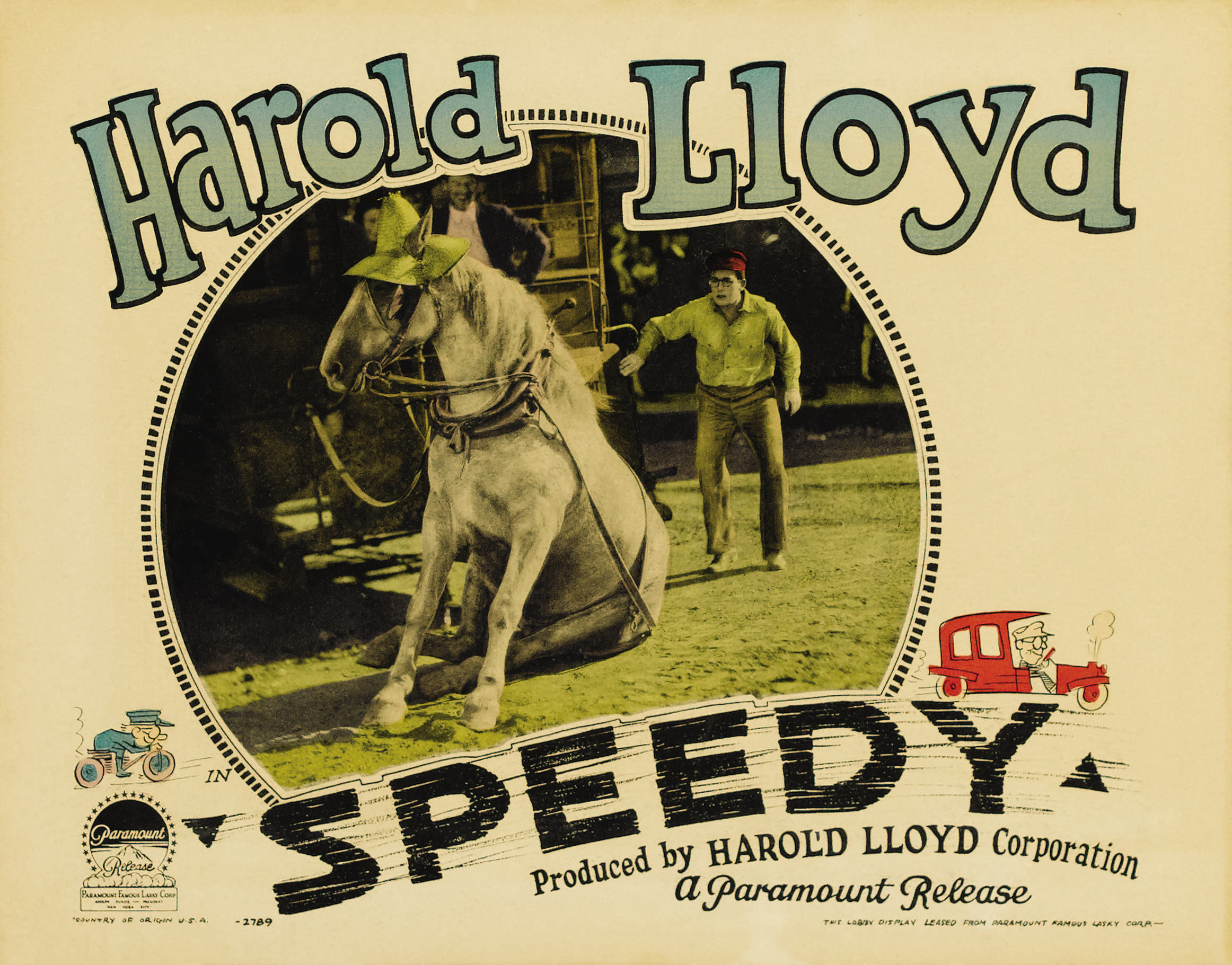
Coming up this weekend: Harold Lloyd (and Babe Ruth!) in 'Speedy' (1928) on Sunday, May 28

Harold Lloyd and Ann Christy visit Coney Island in 'Speedy' (1928).

A few years ago, I was looking for a parking spot in Brooklyn, N.Y. to attend a get-together of my Fordham University friends.

This was in the Williamsburg section of the borough, close to the East River. And I found myself on Kent Avenue.

I'd never been there before, but for some reason I knew that street name. 

Before I found a parking spot, I remembered—Kent Avenue plays a prominent role in 'Speedy' (1928), Harold Lloyd's silent comedy that was shot mostly on location in New York. 

You can see Kent Ave. (street sign and all) and a lot of other New York locations this weekend, when we run 'Speedy' at the Town Hall Theatre in Wilton, N.H.

It's the final installment of our silent tribute to the Big Apple. And in this case, I think you could argue that we've saved the best for last. 

More Coney Island action, shot on location at the height of the Roaring '20s.

Lloyd and his crew made the most of shooting on location, and 'Speedy' is filled with shots of NYC scenes from 100 years ago that add a huge layer of interest to the film, then and even more so now.

See for yourself by attending the screening on Sunday, May 28 at 2 p.m. See you there!

*     *     *

Harold rides the NYC subway in 'Speedy' (1928).

MONDAY, MAY 22, 2023 / FOR IMMEDIATE RELEASE
Contact Jeff Rapsis • (603) 236-9237 • jeffrapsis@gmail.com

Classic Harold Lloyd comedy 'Speedy' on Sunday, May 28 at Town Hall Theatre

Screening features live music; filmed on location in NYC with cameo by Babe Ruth

WILTON, N.H.—He was the bespectacled boy next door whose road to success was often paved with perilous detours.

He was Harold Lloyd, whose fast-paced comedies made him the most popular movie star of Hollywood's silent film era.

See for yourself why Lloyd was the top box office attraction of the 1920s in a revival of 'Speedy' (1928), one of his most popular comedies.

The film, shot on location in New York City, will be shown on Sunday, May 28 at 2 p.m. at the Town Hall Theatre, 40 Main St., Wilton, N.H.

The film will be shown with live music by silent film accompanist Jeff Rapsis.

Admission is free; a donation of $10 per person at each screening is suggested to help defray expenses.

The film is the last installment in the Town Hall Theatre's ongoing 'Silent New York' series.

'Speedy,' Lloyd's final silent feature before the transition to talkies, finds Harold as a baseball-crazed youth who must rescue the city's last horse-drawn streetcar from gangsters bent on running it out of business.

Filmed almost entirely on location in New York, 'Speedy' features remarkable glimpses of the city at the end of the 1920s, including footage of Coney Island and the original Yankee Stadium in the Bronx.

The latter scenes include an extended appearance by Babe Ruth, then at the height of his career during the team's storied 1927 season.

"In 'Speedy,' New York City is practically a part of the cast," Rapsis said. "In filming it on location, Lloyd knew scenes of New York would give the picture added interest to audiences across the nation and around the world.

"But what he didn't anticipate was that today, the location shots now provide a fascinating record of how life was lived in the Big Apple in the 1920s," Rapsis said.

Rapsis will improvise a musical score for 'Speedy' as the film is screened. In creating accompaniment for vintage classics, Rapsis tries to bridge the gap between silent film and modern audiences.

"Creating the music on the spot is a bit of a high-wire act, but it contributes a level of energy that's really crucial to the silent film experience," Rapsis said.

'Speedy' (1928) will be screened on Sunday, May 28 at 2 p.m. at the Town Hall Theatre, 40 Main St., Wilton, N.H.

Admission is free; a donation of $10 per person is suggested to help defray expenses. For more information, call (603) 654-3456.

Monday, May 15, 2023

A busy musical weekend in store: two silent film programs in Vt., then a concert in N.H.

A scene from F.W. Murnau's 'Sunrise' (1927).

This coming weekend, it's two shows in Vermont followed by a concert in N.H. where some of my music is on the program.

First up: F.W. Murnau's acclaimed drama 'Sunrise' (1927) on Friday, May 19 at 8 p.m. at Epsilon Spires in Brattleboro, Vt. 

I'll be playing the venue's original Estey pipe organ to accompany the film. Lots more details in the press release below. 

Then on Saturday, May 20, it's opening night of the 12th season of silent film screenings at Brandon (Vt.) Town Hall. Showtime is at 7 p.m.; featured attraction is Chaplin's 1923 comedy 'The Pilgrim,' his last non-feature-length film and celebrating its 100th anniversary this year.

More on that, and a look at the whole season of silent films that I'll accompany, in a post a bit later this week. For now, you can browse the listings (via the 'Upcoming Silent Film Screenings' link at upper right) and see what's playing.

And then on Sunday, May 21, the N.H. Philharmonic is playing part of my 'Kilimanjaro Suite' for orchestra at its Spring Pops Concert, which is at 2 p.m. at Seifert Performing Arts Center, Salem High School, 44 Geremonty Drive, Salem, N.H.

I've been attending rehearsals during the past couple of weeks, and the orchestra sounds really good. To learn more about the piece, check out the 'Notes for Kilimanjaro Suite' link at upper right. And for tickets and more information, visit www.nhphil.org.

Hope to see you at some or all of these events!

*     *     *

A poster for the original release of 'Sunrise' (1927).

MONDAY, MAY 8, 2023 / FOR IMMEDIATE RELEASE
Contact Jeff Rapsis • (603) 236-9237 • jeffrapsis@gmail.com

Academy Award-winning drama 'Sunrise' to be screened on Friday, May 19 at Epsilon Spires, Brattleboro


Silent film won three honors at first-ever Academy Awards, including 'Best Actress'; show features live musical accompaniment

BRATTLEBORO, Vt.—Silent film on the big screen with live music returns to Epsilon Spires in Brattleboro with the Academy Award-winning romantic drama 'Sunrise' (1927) on Friday, May 19 at 8 p.m.

The screening of 'Sunrise,' starring Janet Gaynor and George O'Brien, will take place at Epsilon Spires, 190 Main St., Brattleboro, Vt.

Admission is $20 per person. Tickets may be purchased in advance at www.epsilonspires.org or at the door.

The screening will feature live accompaniment on the venue's Estey pipe organ by Jeff Rapsis, a New Hampshire-based silent film musician.

Gaynor, a popular female star of the silent film era, won the first-ever Academy Award for Best Actress for her performance in 'Sunrise.' The movie took top honors in cinematography and was also recognized for "Unique and Artistic Production" at the inaugural awards.

'Sunrise' tells the story of a young country couple (played by Gaynor and O'Brien) whose marriage is threatened by the presence of a woman from the city (Margaret Livingston) who convinces the man to abandon his wife. Will the young husband go through with a plan to kill his wife? Will true love overcome the obstacles of temptation and the promise of short-term pleasure?

Janet Gaynor and George O'Brien in 'Sunrise' (1927).

'Sunrise' was directed by F. W. Murnau, a German filmmaker and one of the leading figures in German Expressionism, a style that uses distorted art design for symbolic effect. 'Sunrise' was made when Murnau was invited by studio chief William Fox to make a film in Hollywood.

The resulting movie features enormous stylized sets that create an exaggerated, fairy-tale world. The city street set alone reportedly cost over $200,000 to build, a huge sum at the time. Much of the exterior shooting was done at Lake Arrowhead, Calif.

Full of cinematic innovations, the groundbreaking cinematography (by Charles Rosher and Karl Struss) featured moving cameras and impressive tracking shots. Titles appear sparingly, with long sequences of pure action and most of the story told in Murnau's signature visual style. The extensive use of forced perspective is striking, particularly in a shot of the city with normal-sized people and sets in the foreground and smaller figures in the background by much smaller sets.

The story of 'Sunrise' is told as a visual allegory with few specific details. The characters have no names, and the setting is not named in order to make the tale more universal and symbolic.

With a full title of 'Sunrise: A Song of Two Humans,' the film is regarded as one of the high points of the silent cinema. In 1988, it was selected for preservation in the National Film Registry of the U.S. Library of Congress for films that are "culturally, historically, or aesthetically significant." The Sight and Sound poll of 2012 for the British Film Institute named 'Sunrise' the fifth-best film in the history of motion pictures by critics, and 22nd by directors.

Critics continue to hail 'Sunrise' as one of the best films of all time.

"F.W. Murnau's 'Sunrise' conquered time and gravity with a freedom that was startling to its first audiences," wrote Roger Ebert in 2004. "To see it today is to be astonished by the boldness of its visual experimentation.

Rapsis (at right), who uses original themes to improvise silent film scores, said great silent film dramas such as 'Sunrise' used their lack of dialogue to create stories that concentrated on the "big" emotions such as Love, Despair, Anger, and Joy. 

Because of this, audiences continue to respond to them in the 21st century, especially if they're presented as intended — with a live audience and live music.

"Dramas such as 'Sunrise' were created to be shown on the big screen as a communal experience," Rapsis said. "With an audience and live music, they still come to life as their creators intended them to. So the screenings at Epsilon Spires are a great chance to experience films that first caused people to fall in love with the movies," he said.

'Sunrise' will be shown with live music on Friday, May 19 at 8 p.m. at Epsilon Spires, 190 Main St., Brattleboro, Vt.

Admission is $20 per person. Tickets may be purchased in advance at www.epsilonspires.org or at the door.

Friday, May 12, 2023

Classic drama 'Docks of New York' (1928) at Town Hall Theatre in Wilton, N.H. on Sunday, 5/14

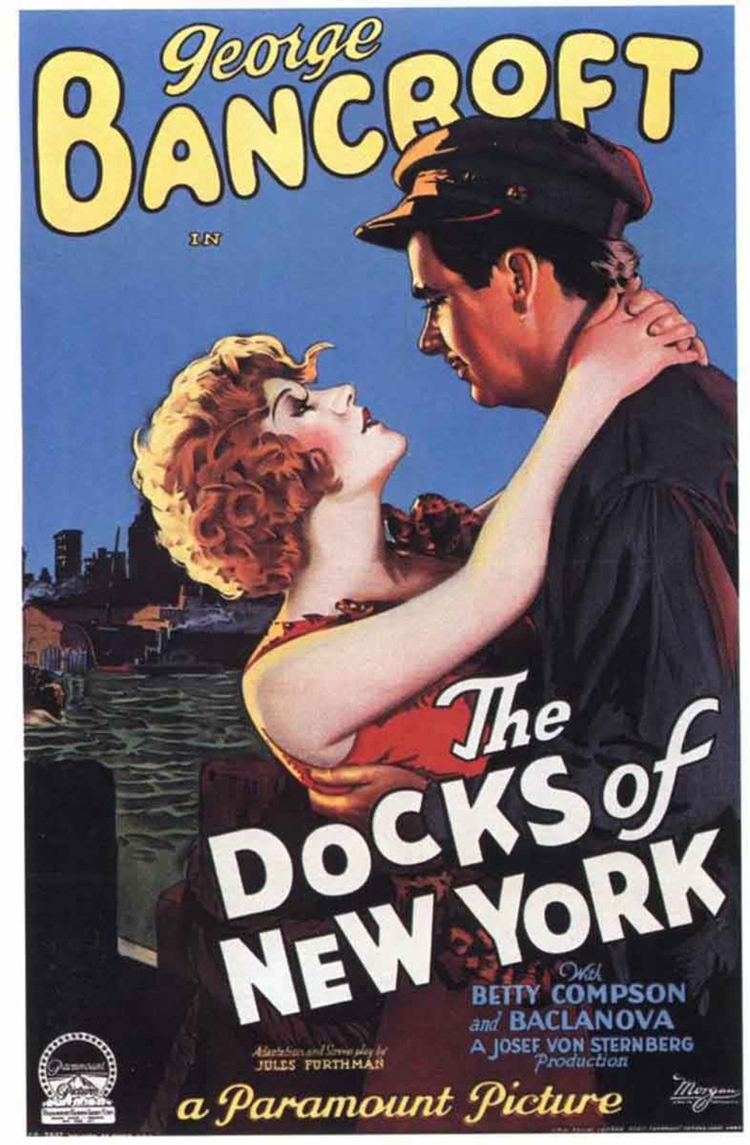
Betty Compson and George Bancroft in 'The Docks of New York' (1928).

This weekend, our "Silent New York' series continues with 'The Docks of New York' (1928) on Sunday, May 14 at 2 p.m.

If you've never seen a silent film on the big screen and with live music, this would be a good one to check out. 

Why? Because it really dispels the myth of silent film being a primitive ancestor of talking pictures. It's a good example of how silent cinema developed a story-telling power that was unique to the medium, and which still works today.

Plus the film stock had improved to the point where all kinds of light and shadow could be used in making a motion picture—something director Josef von Sternberg exploited to great effect.

So, for a different kind of Mother's Day experience, take in 'The Docks of New York' at the Town Hall Theatre in Wilton, N.H. More details in the press release below.

*    *    *

Betty Compson and George Bancroft in 'The Docks of New York' (1928).

TUESDAY, MAY 2, 2023 / FOR IMMEDIATE RELEASE
Contact Jeff Rapsis • (603) 236-9237 • jeffrapsis@gmail.com

Cinematic masterpiece 'Docks of New York' to screen Sunday, May 14 at Town Hall Theatre

Big Apple tribute continues: Josef von Sternberg's silent working class drama to be shown on big screen with live musical accompaniment

WILTON, N.H.—It's a rare chance to see a masterpiece of early cinema presented as intended: on the big screen, with live music and with an audience in a theater.

It's 'The Docks of New York' (1928), a working class drama directed by Josef Von Sternberg, to be shown at the Town Hall Theatre, 40 Main St., Wilton, N.H. on Sunday, May 14 at 2 p.m.

Live music will be provided by silent film accompanist Jeff Rapsis. Admission is free; a donation of $10 per person is suggested to help defray expenses.

The screening is the latest installment of the Town Hall Theatre's 'Silent New York' series, which shows the Big Apple as depicted in movies a century ago.

'The Docks of New York,' one of the last silent films released by Paramount Pictures, explores the lives and loves of lower-class waterfront denizens.

Roughneck stoker Bill Roberts (George Bancroft) falls for Mae (Betty Compson), a wise and weary dance-hall girl. But the relationship changes Roberts' hard-luck life in unexpected ways.

Fog-shrouded cinematography by Harold Rosson ('The Wizard of Oz'), expressionist set design by Hans Dreier ('Sunset Boulevard'), and sensual performances by Bancroft and Compson make this one of the legendary director Joseph von Sternberg’s finest works.

The film was daring for a Hollywood picture at the time for its realism: the unflinching and unromantic portrayal of working class people, and its refusal to rely on traditional story formulas and outcomes.

Unlike many early movie directors, von Sternberg emphasized the visual quality of his pictures, using lighting and scene composition in new and innovative ways.

Working as a studio director for Paramount, the native Austrian was aided by the increasing ability of black-and-white film stock by the mid-1920s to capture light and shadows.

The result was a series of ground-breaking dramas at the very end of the silent era, including 'Underworld' (1927) and 'The Last Command' (1928), the latter which helped Emil Jannings win "Best Actor" at the first-ever Academy Awards ceremony.

After the transition to talking pictures, von Sternberg discovered German actress Marlene Dietrich, inviting her to Hollywood to make a series of highly successful pictures under his direction.

With their moody lighting and extensive use of shadows, von Sternberg's films are widely acknowledged as paving the way for the "film noir" look that took hold in Hollywood in subsequent decades.

Although von Sternberg's directing career faded in the 1950s, his legacy continues today in surprising places—including the field of early rock music.

Between 1959 and 1963, Sternberg taught a course on film aesthetics at the University of California at Los Angeles, based on his own works. His students included Jim Morrison and Ray Manzarek, who went on to form the rock group The Doors.

The group recorded songs referring to Sternberg. Manzarek has described Sternberg as "perhaps the greatest single influence on The Doors."

'Docks of New York' was released at the very end of the silent era, causing it to be overlooked by critics at the time.

Previewed by the New York City press during the same week that saw the fanfare opening of Al Jolson’s 'The Singing Fool,' Sternberg’s film was ignored in the excitement over competing talking pictures.

Film critic Andrew Sarris lamented that Sternberg’s film “quickly vanished in undeserved oblivion...confirm[ing] Chaplin’s observation that the silent movies learned their craft just about the time they went out of business.”

Museum of Modern Art film curator Charles Silver ranked 'The Docks of New York' as “probably the last genuinely great silent film made in Hollywood [rivaling] Chaplin’s masterpieces of the 1930s.”

Upcoming programs in the Town Hall Theatre's 'Silent New York' series include:

• Sunday, May 28, 2023 at 2 p.m.: 'Speedy' (1928) starring Harold Lloyd. Lloyd's final silent feature finds him at the peak of his career playing a baseball-crazed go-getter forced to rescue the business of his girlfriend's father from being destroyed by thugs. Filled with great scenes of 1920s NYC, with notable cameo by baseball's Babe Ruth. ('Speedy' was originally scheduled for Sunday, April 30 but was moved to Sunday, May 28 due to a scheduling conflict.)

‘The Docks of New York' (1928) will be screened on Sunday, May 14 at 2 p.m. at the Town Hall Theatre, 40 Main St., Wilton, N.H.

Admission is free; a donation of $10 per person is suggested to help defray expenses. For more information, call (603) 654-3456.

Tuesday, May 2, 2023

Sunday, May 7 in Somerville, Mass.: Buster Keaton 'Boats and Trains' double feature, 'Steamboat Bill Jr.' (1928) and 'The General' (1926) both in 35mm

Buster perched on a railroad engine's 'cowcatcher' in 'The General' (1926). 

What's better than a Buster Keaton film? How about two Buster Keaton films, both shown on the big screen using 35mm prints?

That's what you'll get at a "Boats and Trains" Buster Keaton double feature on Sunday, May 7 at 2 p.m. at the Somerville Theatre, 55 Davis Square, Somerville, Mass.

Here's the line-up: Keaton's 'Steamboat Bill Jr.' (1928) will screen at 2 p.m., while his masterpiece 'The General' (1926) runs at 3:30 p.m. I'll be doing live musical accompaniment for both films.

You can buy a ticket for one feature at $16 per person, or see both for the bargain price of $20. Lots more information in the press release pasted in below.

For now, a little bit more about the 35mm prints we're using. 

A vintage lobby card promoting 'The General' (1926). 

The Somerville Theatre is among very few first-run moviehouses in our area that maintained their 35mm projectors when the industry converted to digital projection about 10 years ago.

So it has the ability to show 35mm prints, and even augmented its capacity a few years ago to handle 70mm prints, which it occasionally screens.

So when it's time to see a film on actual film (as was done for more than 100 years before the advent of digital projection), the Somerville can still do it. 

Although exhibition of first-run movies is almost exclusively digital now, many cinephiles insist on the authenticity (and in some cases, superiority) of actual film.

In some ways its similar to what's been happening with audio recordings on vinyl records. The format was nearly wiped out by the transition to compact discs in the 1980s, but never quite went away.

And vinyl LP's are now undergoing something of a renaissance, with sales surpassing CDs last year for the first time in decades. (Of course far more music is heard via streaming services these days, but vinyl seems to be winning the battle for physical media.)

Where does one get 35mm prints of films from nearly a century ago? In the case of the Somerville, they often come from the U.S. Library of Congress, which maintains a catalogue of circulating 35mm prints of a wide range of titles.

Booking them for a screening is just like borrowing from your town library: if a print is available, all you do is pay for shipping, and then return it promptly.

So did you recently file your federal income tax return, and are you left wondering what you really get for all that money?

Well, one tangible result is the availability of Buster Keaton's classic comedies in 35mm prints we're showing this weekend. 

Hope you'll be able to join us, as in a small way you already helped make the show possible!

*  *  *

A vintage lobby card promoting 'Steamboat Bill, Jr.' (1928).

MONDAY, APRIL 24, 2023 / FOR IMMEDIATE RELEASE
For more info, contact: Jeff Rapsis • (603) 236-9237 • jeffrapsis@gmail.com

Buster Keaton stars in 'Boats & Trains' comedy double feature at Somerville Theatre

Classic comedies 'Steamboat Bill Jr.' and 'The General' to be shown in 35mm with live music on Sunday, May 7

SOMERVILLE, Mass.— He never smiled on camera, earning him the nickname of 'the Great Stone Face.' But Buster Keaton's comedies rocked Hollywood's silent era with laughter throughout the 1920s.

See for yourself with a 'Boats & Trains' double feature of two of Keaton's best films on Sunday, May 7 at 2 p.m. at the Somerville Theatre, 55 Davis Square, Somerville, Mass.'

First up at 2 p.m. is 'Steamboat Bill, Jr.' (1928), in which Keaton plays the effete college-educated son of a rough-hewn riverboat captain who must help his father fight a domineering businessman.

Then, at 3:30 p.m., it's 'The General' (1926), Buster's Civil War-era masterpiece that tells the story of a Confederate railroad engineer whose train is hijacked by Northern spies.

Tickets for the double feature are $20; tickets for one film only are $16; seniors/children $12.

Both films will be screened with live music by Jeff Rapsis, a New Hampshire-based composer who specializes in accompanying silent films.

Both movies will be shown via 35mm film prints on loan from the Library of Congress.

Buster Keaton plays a Civil War-ear railroad engineer in 'The General' (1926).

'Steamboat Bill Jr.' and 'The General' show Keaton at the peak of his career as a filmmaker and 1920s star. They also highlight his talent for creating large-scale physical comedy with big machines.

"Seeing both these films today, on the big screen and with live music, is a great way to appreciate Keaton's timeless ability to connect with audiences," said Ian Judge, the Somerville Theatre's creative director and general manager.

As a performer, Keaton was uniquely suited to the demands of silent comedy. Born in 1895, he made his stage debut as a toddler, joining his family's knockabout vaudeville act and learning to take falls and do acrobatic stunts at an early age.

A remarkable pantomime artist, Keaton naturally used his whole body to communicate emotions from sadness to surprise. In an era with no post-production special effects, Keaton's acrobatic talents enabled him to perform all his own stunts, including some spectacular examples in both 'Steamboat Bill Jr.' and 'The General.'

'Steamboat Bill Jr.' contains the famous scene in which the front of a two-story building falls directly onto Keaton, who remains unharmed thanks to an open window.

Buster Keaton and Ernest Torrence as son and father in 'Steamboat Bill, Jr.' (1928).

In reviving Keaton's comedies, the Somerville Theatre aims to show silent film as it was meant to be seen—in restored prints, on a large screen, with live music, and with an audience.

"All those elements are important parts of the silent film experience," said Rapsis, who will accompany the film. "Recreate those conditions, and classics of early Hollywood leap back to life in ways that audiences still find entertaining."

Rapsis performs on a digital synthesizer that reproduces the texture of the full orchestra, creating a traditional "movie score" sound. He improvises the complete score in real time during the screening.

"Creating a movie score on the fly is kind of a high-wire act, but it can often make for more excitement than if everything is planned out in advance," Rapsis said.

The Somerville Theatre's ongoing 'Silents, Please!' schedule features a broad range of titles, from well-known classics to obscure films rarely seen since their release, which in some cases was more than a century ago.

Several programs are double bills on a common theme, such as a July program saluting 'Canada Day' with two films set in the Canadian West. All films in the series will be shown using 35mm prints, with most on loan from the U.S. Library of Congress.

A roster of upcoming films in the 'Silents, Please!' series includes:

Sunday, July 9, 2023, 2 p.m.: 'Salute to Canada' Double Feature! To mark "Canada Day" (July 1), we salute our neighbors with a double helping of vintage cinema set north of the border. In 'Mantrap' (1926), silent-era "It" girl Clara Bow stars in a battle-of-the-sexes comedy about a big city divorce lawyer hoping to get away from it all at a Canadian wilderness retreat. 'The Canadian' (1926) stars Thomas Meighan in the tale of a pioneering couple homesteading in Alberta, where they battle bad weather and financial woes.

Sunday, Sept. 10, 2023, 2 p.m.: 'The Fire Brigade' (1926). MGM’s blockbuster production stars Charles Ray as the youngest in a long line of fearless Irish American firefighters. Things get complicated when he falls in love with the daughter (May McEvoy) of a crooked building contractor. Spectacular fire sequences with hand-colored effects included in this recent Library of Congress restoration.

Sunday, Nov. 12, 2023, 2 p.m.: 'The Big Parade' (1925) starring John Gilbert, Renée Adoree. We salute Veterans Day with this sweeping saga about U.S. doughboys signing up and shipping off to France in 1917, where they face experiences that will change their lives forever—if they return. MGM blockbuster directed by King Vidor; one of the biggest box office triumphs of the silent era.

'Steamboat Bill Jr.' (1928), a silent comedy starring Buster Keaton, will be shown on Sunday, May 7 at 2 p.m., followed by Keaton's 'The General' (1926) at 3:30 p.m. at the Somerville Theatre, 55 Davis Square, Somerville, Mass. Both films will be shown in 35mm with live music.

Tickets for the double feature are $20; tickets for one film only are $16; seniors/children $12. For more information and to purchase tickets, visit www.somervilletheatre.com or call the box office at (617) 625-5700.