Showing posts with label Constance Talmadge. Show all posts

Saturday, November 19, 2022

Tonight, 11/19: 'Her Sister from Paris,' final film of season at Brandon (Vt.) Town Hall

A poster promoting Constance Talmadge in 'Her Sister from Paris' (1925).

Tonight, a screening of the hilarious society comedy 'Her Sister from Paris' will mark the final show of the 2022 silent film series at Brandon Town Hall in Brandon, Vt.

Showtime is 7 p.m., admission is free, and yours truly will be at the keyboard. The setting: Vienna, so expect lots of music in 3/4 time.

Lots more about tonight's screening is in the press release attached below. Hope you'll drop by if you're within driving distance. 

For now, a quick report on a screening of 'So's Your Old Man' (1926) the W.C. Fields silent that we screened at the Flying Monkey Moviehouse and Performance Center this past Wednesday night. 
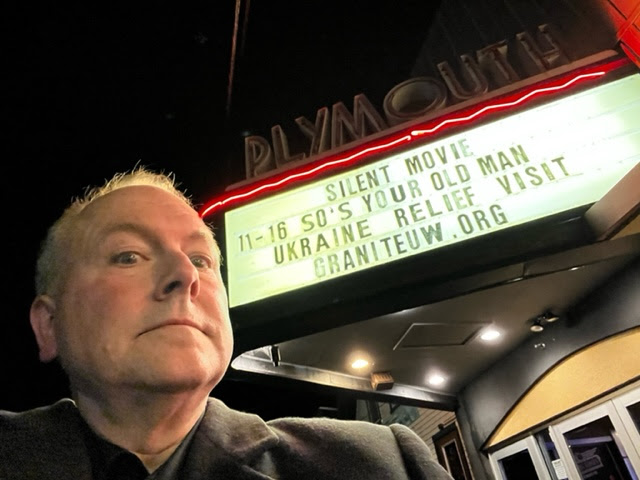
Me under the Flying Monkey marquee.

A special guest was on hand for this event, at least in spirit. Prior to the screening, Harriet Fields (the granddaughter of W.C.) sent me a note to read to the audience.

So I did, and here's what I said:

Thank you for screening "So's Your Old Man" this Wednesday, November 16, the second W.C. Fields film added to the National Film Registry of the Library of Congress (2008). "You're Telling Me" is the talking version filmed in Hollywood in 1934. In both these classic films, W.C. Fields scene on the train with Princess Lescaboura is an arrestingly tender and endearing portrait of the real W.C. Fields-my grandfather and spiritual inspiration. Thank you to the W. C. Fields Facebook Group for alerting us to your most appreciated screening. Warmest regards to all and special hug to our dear Jeff Rapsis, piano accompanist extraordinaire.
Dr. Harriet A. Fields

How nice of Harriet to provide a personal welcome to viewers of one of her grandfather's rarely screened Paramount silents. 

I'm pleased to report our audience enjoyed the film immensely. Perhaps the biggest laugh came when the wife of Fields' character is told he's done something simply marvelous, and her response (via intertitle) is.

"Did he die?"

Well, he didn't, and Fields himself lives on through the films and of course through the efforts of Harriet and her other family members. 

And now it's on to Brandon, Vt., where tonight we'll cavort with Constance Talmadge and Ronald Colman in a very funny comedy, 'Her Sister From Paris.'

Hope to see you there! And here's the press release...

*   *   *

Constance Talmadge and Ronald Colman in 'Her Sister from Paris' (1925).

TUESDAY, NOV. 8, 2022 / FOR IMMEDIATE RELEASE
Contact Jeff Rapsis • (603) 236-9237 • jeffrapsis@gmail.com

'Her Sister From Paris' to screen on Saturday, Nov. 19 at Brandon Town Hall

Uproarious 'battle of the sexes' silent comedy to be presented with live music at historic venue

BRANDON, Vt.—The scene: Europe. The cast: Rich people. Get swept off your feet by not one but two privileged ladies, both played by amazing actress Constance Talmadge, in this effervescent battle-of-the-sexes comedy.

Silent film with live music returns to Brandon Town Hall with a screening of the comedy 'Her Sister from Paris' on Saturday, Nov. 19 at 7 p.m.

The program will be presented with live music by silent film accompanist Jeff Rapsis. The screening is free and open to the public, with donations accepted and refreshments for sale.

In 'Her Sister from Paris,' Ronald Colman and Constance Talmadge play a wealthy American society couple living in Vienna.

Due to an argument, she leaves to stay with her mother. At the railway station she meets her identical twin, a celebrated dancer in Paris (also played by Talmadge), who agrees to trick the husband to help rekindle her sister's marriage.

The fun starts when both the husband and his friend, an official at the British Embassy, fall in love with the sister, leading to a dizzying round of complications.

Among the most popular stars of the silent era, Constance Talmadge specialized in light "society" comedies. However, she had acting and pantomime skills that made her a versatile actress able to tackle any role.

In 'Her Sister From Paris,' Talmadge delivers a virtuoso performance playing both sisters. Although their appearance is identical, each woman is quite different from the other, which Talmadge conveys through body language and on-screen attitude.

Ronald Colman, whose career would go on to span radio and television, was already a popular leading man in films at the time 'Her Sister From Paris' was made. Colman more than holds his own as the two sisters conspire against him.

The screening of 'Her Sister from Paris' provides local audiences the opportunity to experience silent film as it was intended to be shown: on the big screen, in restored prints, with live music, and with an audience.

"If you can put pieces of the experience back together again, it's surprising how these films snap back to life," said Rapsis, a New Hampshire-based silent film accompanist who creates music for silent film screenings at venues around the country.

"By showing the films as they were intended, you can really get a sense of why people first fell in love with the movies."

In creating music for silent films, Rapsis performs on a digital synthesizer that reproduces the texture of the full orchestra and creates a traditional "movie score" sound.

The feature-length 'Her Sister From Paris' will be preceded by a short subject from the silent era.

The screening of 'Her Sister from Paris' at Brandon Town Hall is sponsored by Harold & Jean Somerset.

'Her Sister From Paris' (1925) starring Constance Talmadge and Ronald Colman, will be screened with live music on Saturday, Nov. 19 at 7 p.m. at Brandon Town Hall and Community Center, 1 Conant Square, Route 7 in Brandon, Vt.

Admission is free; donations are welcome to help support ongoing Town Hall renovation efforts.

Tuesday, September 11, 2018

In this corner, 'Her Sister From Paris,' then later a true heavyweight: 'The Last Laugh'

Ronald Colman proves no match for Constance Talmadge in 'Her Sister From Paris.'

If silent films were classified like boxers, the next two evenings will see action in the lightweight and heavyweight divisions.

• On Wednesday, Sept. 12, I'll accompany a screening of 'Her Sister From Paris' (1925), a frothy society comedy starring Ronald Colman and Constance Talmadge.

Although both stars are in peak form, I'd say the fluffy nature of the story puts the film squarely in the lightweight division.

However, it's often described as a "battle of the sexes" comedy, so expect lots of quick action and fancy footwork—typical of the lighter weight classes.

The screening starts at 7 p.m. at the historic Leavitt Theatre, 259 Main St., Ogunquit, Maine. Admission $10 per person.

For more info, visit the Leavitt Theatre online.

Emil Jannings ponders his fate in 'The Last Laugh' (1924).

• Then, on Thursday, Sept. 13, it's down to Arlington, Mass. for a true heavyweight experience: Emil Jannings in F.W. Murnau's 'The Last Laugh' (1924).

In a silent film "main event," Murnau takes a simple situation and uses the then-new medium of cinema to depict a man's emotional journey with immense power.

I'll accompany Jannings as he does battle with a formidable opponent: his own sense of self-worth.

Showtime is 8 p.m. at the Capitol Theatre, 204 Massachusetts Ave., Arlington, Mass.

An original 'Wings' poster featuring Clara Bow.

• And then this weekend brings me to the Orpheum Theatre in Sioux City, Iowa, where I'll accompany a screening of the great WWI classic 'Wings' (1927) on the Mighty Wurlitzer.

It's part of the annual Sioux City International Film Festival, and I'm thrilled to be going out again to do live music in this incredible venue.

Showtime for this one is Sunday, Sept. 16 at noon. For more info, visit the Sioux City International Film Festival online.

More screenings at the end of the month, including Josef von Sternberg's amazing 'The Last Command' (1928) at the Museum of Russian Icons in Clinton, Mass. and the original silent film version of 'Chicago' (1927).

Stay tuned, or check the schedule: there's a link at the top right of every page!

Thursday, August 16, 2018

The problem with ice cream for dinner, plus 'Her Sister' tonight and again Saturday night

Constance Talmadge and Ronald Colman in 'Her Sister from Paris' (1925), which I'm accompanying tonight (Thursday, Aug. 16) at the Capitol Theatre in Arlington and on Saturday, Aug. 18 in Ludlow, Vt.

Maybe it was the heat. Maybe it's changing tastes. Maybe I did a lousy job with the music.

For whatever reason, a program last night of two-reelers from Chaplin's Mutual period failed produce what I would call an abundance of laughter.

People enjoyed it, I thought, and the applause seemed hearty enough after each film.

But while the comedies were running, little evidence of chortles or guffaws or belly laughs reached my ears.

That's unusual, as the Mutuals are when Chaplin really first hit his stride in a big way, I think. And they're proven laugh-getters.

Last night at the Leavitt Theatre, we ran four: 'Behind the Screen,' 'The Rink,' 'Easy Street' and 'The Cure.'

All are what I would consider crackerjack comedies. They're full of classic Chaplin gags and sequences that produce uproarious laughter.

Chaplin and company in 'The Rink.'

So what happened last night? Well, on top of the factors already mentioned, let me add these:

1. We had about 60 people in attendance. And weirdly, everyone sat way in the back of the theater. And the Leavitt now offers a bar and food service up in the "balcony" (actually an area even further back) and a lot of people were up there.

So it might have been the case that me, sitting way down under the stage, wasn't able to hear the laughter. Could be. But I heard enough to know I wasn't hearing enough, if that makes any sense.

2. The "Ice Cream for Dinner" factor. By that I mean it's one thing to watch one 20-minute comedy short. But it's a whole other ballgame when you string four of them together in a row, like cars in a freight train.

Like most short comedies of the period, Chaplin's two-reelers were intended to be just one part of a varied program that would include newsreels, dramas, travelogues, live vaudeville acts, and who-knows-what else.

As such, they functioned quite well, giving audiences a dose of high energy yucks to liven things up. It's a little like how dessert functions as part of a whole meal: a little sweet reward for all the other good stuff we've consumed.

But when you string four comedies together, it's too much. It's like having four ice cream sundaes in a row. After awhile, the appeal can't help but wear thin.

Look! I actually found a picture of four ice creams sundaes!

Yes, I've seen cases where comedies are strung together at film conventions, and they do quite well. But film conventions are often for the hard core, and that's a very different audience than the general public that's not familiar with the silent film idiom.

So last night's Great Laughter Draught of 2018 might be the cause of too much comedy all at once. Something to remember when people ask for a "night of Charlie Chaplin" or similar programs.

Well, onward we go. Tonight finds me accompanying the first of two screenings this week of 'Her Sister From Paris' (1925), a comedy starring Ronald Colman and Constance Talmadge.

On Thursday, Aug. 16, it's at the Capitol Theatre in Arlington, Mass. Showtime is 8 p.m. For information about the show, I've pasted in the press release for this screening below.

Then I'll be repeating it on Saturday, Aug. 18 up in Ludlow, Vt., at the Ludlow Auditorium, as this year's "silent film with live music" event, which is always a pleasure to be a part of.

Coming up: lots of news about screenings in Detroit, Cleveland, Buffalo, and Sioux City, Iowa. Stay tuned!

In the meantime, hope to see you at a screening near or far!

Constance Talmadge in 'Her Sister from Paris' (1925).

TUESDAY, JULY 10, 2018 / FOR IMMEDIATE RELEASE
Contact Jeff Rapsis • (603) 236-9237 • jeffrapsis@gmail.com

'Her Sister From Paris' on Thursday, Aug. 16 at Arlington's Capitol Theatre


Uproarious 'battle of the sexes' silent comedy starring Constance Talmadge, Ronald Colman to be presented with live music

ARLINGTON, Mass.—The scene: Europe. The cast: Rich people. Get swept off your feet by not one but two privileged ladies, both played by amazing actress Constance Talmadge, in this effervescent battle-of-the-sexes comedy.

Silent film with live music returns to the Capitol Theatre, 204 Massachusetts Ave., Arlington, Mass. with the comedy 'Her Sister from Paris' on Thursday, Aug. 16 at 8 p.m.

The special program will be presented with live music by silent film accompanist Jeff Rapsis. Admission is $12 adults, $10 kids and seniors.

In 'Her Sister from Paris,' Ronald Colman and Constance Talmadge play a wealthy American society couple living in Vienna.

Due to an argument, she leaves to stay with her mother. At the railway station she meets her identical twin, a celebrated dancer in Paris (also played by Talmadge), who agrees to trick the husband to help rekindle her sister's marriage.

The fun starts when both the husband and his friend, an official at the British Embassy, fall in love with the sister, leading to a dizzying round of complications.

Among the most popular stars of the silent era, Constance Talmadge specialized in light "society" comedies. However, she had acting and pantomime skills that made her a versatile actress able to tackle any role.

In 'Her Sister From Paris,' Talmadge delivers a virtuoso performance playing both sisters. Although their appearance is identical, each woman is quite different from the other, which Talmadge conveys through body language and on-screen attitude.

Ronald Colman, whose career would go on to span radio and television, was already a popular leading man in films at the time 'Her Sister From Paris' was made. Colman more than holds his own as the two sisters conspire against him.

Ronald Colman and Constance Talmadge in 'Her Sister from Paris.'

The screening of 'Her Sister from Paris' provides local audiences the opportunity to experience silent film as it was intended to be shown: on the big screen, in restored prints, with live music, and with an audience.

"If you can put pieces of the experience back together again, it's surprising how these films snap back to life," said Rapsis, a New Hampshire-based silent film accompanist who creates music for silent film screenings at venues around the country.

"By showing the films as they were intended, you can really get a sense of why people first fell in love with the movies."

In creating music for silent films, Rapsis performs on a digital synthesizer that reproduces the texture of the full orchestra and creates a traditional "movie score" sound.

Upcoming titles in the Capitol's silent film series include:

• Thursday, Sept. 13, 8 p.m.: 'The Last Laugh' (1924). In this ground-breaking character study from director F. W. Murnau, Emil Jannings delivers a tour-de-force performance as a doorman in a swanky Berlin hotel.

• Thursday, Oct 18, 8 p.m.: 'The Hunchback of Notre Dame' (1923). Just in time for Halloween: Lon Chaney stars as Quasimodo in this sprawling silent film adaptation of Victor Hugo's classic story.

'Her Sister From Paris' (1925) starring Constance Talmadge and Ronald Colman, will be screened with live music on Thursday, Aug. 16 at 8 p.m. at the Capitol Theatre, 204 Massachusetts Ave., Arlington, Mass.

Admission is $12 adults, $10 kids and seniors. For more info, call (781) 648-6022 or visit www.capitoltheatreusa.com.

Tuesday, May 13, 2014

Road report: In life, as in the movies,
things aren't always what they seem to be

The King Richard Condos in Manchester, N.H. More interesting than silent film?

Get out the Ouija board and the crystal ball, folks. Time for a look back and a look ahead.

First, some notes about three recent performances. And then a preview of some shows to come as the busy summer season begins ramping up.

• Tuesday, May 6, 'Her Night of Romance' (1925) at the Manchester (N.H.) City Library: I need shows like this to keep me humble.

About 15 minutes prior to the screening, two women and one man I've never seen before shuffle into the library's auditorium, where I'm behind the sythesizer keyboard warming up.

"What is that you're playing? Is that a computer?" asks one of the women, as the group wedges themselves into seats near the front.

"Well, it's kind of like a piano that's attached to a computer," I say, playing all the while.

And so we banter back and forth, with me feeling glad that some people who are new to silent film have decided to give it a chance.

But in life, as in the movies, things are not always as they seem.

After a few more minutes of me explaining how I will be improvising music to tonight's film, the three begin to sport puzzled looks.

"Isn't this the King Richard Condo Association meeting?" she asks.

Instantly my bubble is burst. I resist the urge to say yes, this is the King Richard Condo Association meeting, with live music, just to keep them in place. But honesty prevails.

"Ah, this is library's monthly silent film screening," I reply, still playing, "and you should really stay and check it out."

"No, this is supposed to be the King Richard Condo Association meeting."

"Well it isn't... but this will be a lot better than some old condo meeting," I say, with all my regulars in the audience looking on smiling, as if the evening's entertainment has started early.

"I don't think so," the woman says, as the three rise and begin shuffling out.

"Sure it will!" I say, the P.T. Barnum in me rising to the challenge. "It's a night of romance, adventure, and Old World elegance. You'll come away with memories that will last far longer than any condo meeting."

But they depart, with the woman saying something about how I'd have help her if her condo fees went up, or something like that.

Ah, the glamour of show biz!

'Her Night of Romance' (1925) is a good flick overall, with one especially noteworthy sequence: A scene in which Ronald Colman and Constance Talmadge get her father to fall asleep by plying him with too much wine at dinner so they can get to know each other is done without any titles. Instead, it's all closeups and imagery that allow us to follow the action without needing dialogue.

Consider the elements: A close-up of Daddy's hand putting down a wine glass, and then falling limp. Another close-up of Constance's foot pressing the soft pedal of the piano she's playing (so as not to wake Daddy.) A medium shot of Colman's silhouette moving across the sheet music as he approaches Constance. A medium shot of Constance reacting nervously, as only Constance could do.

It's a remarkable example of how fluent silent films had become of telling a story visually. If anyone needs a short excerpt to show how silent film could tell stories without titles or dialogue of any kind, this is a good candidate. Nothing special, just a very natural example of how it was done.


• Thursday, May 8, 'Intolerance' (1916) at the Flying Monkey Moviehouse and Performance Center in Plymouth, N.H.: Big film, small audience. But even with just 16 people on hand, the show must go on. And not long after the opening titles, I lost myself for nearly three hours in D.W. Griffith's over-the-top four-stories-in-one epic, which we ran without a break.

What happened is that I really didn't have time to prepare in advance, although I intended to. But as things worked out, I didn't even have time to preview the film, even on fast forward. So going into it, the second half was all news to me.

However, the day before I worked out a simple "time passing" motif for the scenes of Lillian Gish rocking the cradle that appear throughout the film as a linking device. And I'll be darned if it didn't blossom into the basis for a nearly three-hour-long film score. Sometimes that's how it happens! In general, simple is better.

And I found I had stuff for each of the four settings, which I accompanied with different textures. The "modern" story (1920s California) was straight orchestra; the medieval French story was harpsichord; the Christ story was brass and organ; and the Babylonian tale had an exotic world music patch that I sometimes trot out.

Also, each had their own melodic material that seemed to grow naturally out of the action, and I was somehow able to keep up with it as the film (or films, actually) progressed. Only for the last half-hour, where all four stories reach a climax and the pace of the cutting increases, did things start to blend into each other, but that actually seemed quite natural to me. Anyway, as the pace quickened, I finally had to keep it on just full orchestra, which had the effect of adding a bit to the overall velocity.

And then the film shifts into overdrive, with Griffith taking us to World War I trenches, with characters from the past looking on from above, all preaching a message of peace and tolerance. After nearly three hours of four different stories, this apotheosis, while hopelessly primitive, still comes across as nothing short of mind-blowing in live performance.

Say what you want about Griffith, but 'Intolerance' demonstrated once again that he really did bring the instincts of a master showman to his movies. You simply have to watch. In that sense, it's a distant cousin to a car crash.

A view of the interior of the Niles Essanay Silent Film Museum's Edison theater, stolen from Yelp.

• Saturday, May 10, 'The Little Duchess' (1917) at the Niles Essanay Silent Film Museum in Niles, Calif.: Yes, that California. Mere hours after finishing 'Intolerance,' I strapped myself into a jet-propelled aircraft bound for San Francisco, where I had the chance to sit in as accompanist at the Saturday night silent film series at the Niles Essanay Silent Film Museum.

A word about cross-country flights: When I'm dictator, anyone making a coast-to-coast non-stop flight would first have to read at least one book about the building of the transcontinental railroad. Just sayin'.

A word about Niles: While most of the area around Niles is brand new mint condition Silicon Valley exurbia, Niles itself is an authentic old-time town. Settled more than a century ago, its commercial area was isolated by a river, railroad lines, and later by a freeway.

Shielded from development pressure by virtue of its location, Niles endured long enough to become an attraction in itself, so different than the modern strip mall and condo complexes that now surround it. It's kind of like California version of Brugges, the Belgian trading port that silted up in the middle ages, leaving the small city prefectly preserved.

One of the big attractions of early Niles was an Edison Theatre, which lasted only a short time. The building then became a photo studio, a warehouse, and who-knows-what-else over the years, all the while remaining intact, like a lot of Niles itself. Today, it's a film theater again, which the museum uses to run regular silent film programs.

The film: 'The Little Duchess' (1917), a rarely screened picture starring Madge Evans, then age 6. This title was enough of an attraction to bring several area film folks, including accompanist Jon Mirsalis, who I got to have dinner with as part of the deal. So I got to hear him speak of some of old-timers such as Gaylord Carter who were still active when he was starting out.

Prior to the performance, I felt more pressure than usual, not because of the venue, but because of my brother-in-law. A job at Facebook led him to live in the area. And like a lot of people in my life, he's never really understood the silent film thing. No problem, as most people don't. But for Saturday night's show, he'd taken a deep breath and decided to check it out.

Alas, the first half of the show was two Keystone two-reelers from 1914 in fairly well battered 16mm prints: Chaplin's 'Caught in a Cabaret' and Fatty Arbuckle in 'Fatty and Minnie Hee-Haw.' Not the very best intro to the power of silent film, but you play the hand you're dealt, or the films that are programmed.

Seated at the house piano (a sturdy Hamilton upright) so I found myself taking the "keep it lively" approach to both films. The Chaplin short is no great shakes, but the Arbuckle film has enough rudeness in it to be of interest. At one point, the Injuns—sorry—native Americans, celebrate upcoming nuptuals by eating dog meat!

To my surprise, brother-in-law actually enjoyed the first half! With live accompaniment and something of an audience present (about 40 people), it made a lot more sense. Great!

'The Little Duchess' was a fun film to play cold. It was easy enough to follow, and my stock of material seemed to work well in different situations as the film unfolded. The print was apparently an original Kodascope 16mm reduction dating probably from the 1920s, and so looked really great throughout.

Audience reaction was pretty lively, which was great. I felt I kept up with things pretty well, I thought, but was not prepared for a last-reel plot twist that bordered on the surreal, even for a film from 1917. I'll keep it under my hat because 'The Little Duchess' may get shown at a few upcoming festivals, but it made for a mind-bending end to the evening as only silent film can deliver.

And the verdict from my brother-in-law? Not outright dismissal, which I count as a triumph for the art form.

I'm very grateful to all the folks at the Niles Museum for opening a Saturday night for me on their schedule. The Bay area has a lot of fine accompanists, so it was a real honor to sit in. So thanks to Dorothy Bradley and all the crew for their hospitality, and all the work they do to keep the museum going and to keep silent film in front of today's audiences.

Looking ahead, our annual summer silent film series in Brandon (Vt.) Town Hall starts up this weekend. Opening night features 'The Winning of Barbara Worth' (1926), a rip-roaring Western starring Ronald Colman, Vilma Banky, and a young Gary Cooper. I'll preview that in a separate post, as this one has gone on long enough already. :)

Monday, May 5, 2014

Light as a feather, then heavy as lead:
From 'Her Night Of Romance' to 'Intolerance'

The two lovers-to-be meet in 'Her Night of Romance.' Is that really Constance Talmadge hiding behind those glasses?

What's life without a little contrast?

That's what I'll experience in the next two days, when I do music for a frothy romantic comedy, followed by one of the heaviest, most frothless pieces of silent cinema around.

And then my West Coast debut this weekend! More about which in a bit.

The whipsawing starts with a screening of 'Her Night of Romance' (1925) on Tuesday, May 6 at 6 p.m. at the Manchester (N.H.) City Library, 405 Pine St. This film is so light, it practically needs to be held down with ropes, like one of those big cartoon balloons in the Macy's Thanksgiving Day parade.

But it's full of laughs, too, and also full of the vivacious Constance Talmadge, then at the peak of her career. So there's plenty to look at on screen! (Equal opportunity ogling note: And there's Colman for the ladies, too.)

I never get tired of watching Constance on screen. Though not known as a dramatic (and therefore "serious") actress, to me she has the most expressive face of any silent film actress I know. While Constance rarely overplays, her face gets an amazing workout in every film of hers I've seen.

Her eyes, already huge, carry with us from panic to delight as they roll about in their sockets. She can transform her facial expression from confidence to farcical terror, and back again, in an instant. And on the rare occasions when she gets angry...well, hell hath no fury.

Both Talmadge stars (Constance and her sister Norma) were generally accepted as great beauties, so it's a treat to see Constance disguising herself as a frumpy old maid as 'Her Night' opens. At the time, audiences must have found it especially hilarious. (I don't know what it says about me, but I still find her strangely attractive.)

'Her Night of Romance' is one I've never done before, but in previewing it, there are places where I'm betting the film still gets big laughs. We'll see at the screening, which is tomorrow night as I write this.

Then, two days later, I tackle 'Intolerance' (1916), D.W. Griffith's three-hour heavyweight drama that threads together no less than four separate stories. The "fun" begins on Thursday, May 8 at 6:30 p.m. at the Flying Monkey Moviehouse and Performance Center at 39 South Main St., Plymouth, N.H.

Both films are the result of me trying to challenge myself (and keep up my interest) by programming films that I've never done before. With 'Her Night of Romance,' I've previewed it and I'm pretty sure I know what I'm going to do. But with 'Intolerance,' among the questions I still have to answer are: "Why the heck am I doing this in the first place?"

It's a big film, and yes, contains four different stories. So I'd like the music to reflect these four different epochs so that even if you had your eyes closed, you could tell what time period we're in.

However, with three days to go, I still haven't previewed the film thoroughly, so we'll see what happens. 'Intolerance' is not a film where you want to totally wing it.

If you're interested in seeing this legendary film on the big screen, check out the press release below.

But before that, about my "West Coast Debut." I'll post more on this as it happens, but I wanted to thank all the people associated with the Niles Essanay Silent Film Museum in Niles, Calif. (just across the bay from San Francisco) for inviting me to be guest accompanist for their program on Saturday, May 10. I happen to be heading to San Francisco on a business trip the day before, so it worked out perfectly.

I'll even get to see my brother-in-law, who lives out there and first brought his crazy relative-by-marriage to see the Niles set-up, which is extremely impressive.

More detail on that to come. For now, take a big tall drink of the press release for 'Intolerance,' and hope to see you at the screening!

* * *


FRIDAY, MAY 2, 2014 / FOR IMMEDIATE RELEASE
Contact Jeff Rapsis • (603) 236-9237 • jeffrapsis@gmail.com

With 'Intolerance,' four stories better than one


Rarely screened landmark silent film epic
to be shown with live music on Thursday, May 8

PLYMOUTH, N.H.—It was a breakthrough that changed the movies forever: a three-hour epic knitting together four sweeping stories spanning 2,500 years, all designed to show the struggle for love throughout human history.

The film was D.W. Griffith's 'Intolerance' (1916), which stunned the movie-going public with its vast scope, enormous sets, large cast, and revolutionary editing. Often named to lists of the 100 best films of all times, critics continue to point to 'Intolerance' as one of the most influential and important milestones of early cinema.

See for yourself with a rare screening of a restored version of 'Intolerance' (1916) at the Flying Monkey Moviehouse and Performance Center on Thursday, May 8 at 6:30 p.m. The program, the latest in the theater's silent film series, will be accompanied by live music performed by silent film composer Jeff Rapsis. Admission is $10 per person.

In reviving 'Intolerance' and other great films of Hollywood's early years, the Flying Monkey aims to show silent movies as they were meant to be seen—in high quality prints, on a large screen, with live music, and with an audience.

"All those elements are important parts of the silent film experience," said Rapsis, who will improvise a live score for 'Intolerance' on the spot. "Recreate those conditions, and the classics of early Hollywood leap back to life. They featured great stories with compelling characters and universal appeal, so it's no surprise that they hold up and we still respond to them."

Rapsis performs on a digital synthesizer that reproduces the texture of the full orchestra and creates a traditional "movie score" sound.

A vintage photo montage promoting the original release of 'Intolerance.'

'Intolerance,' considered one of the great masterpieces of the silent era, intercuts four parallel storylines, each separated by several centuries: A contemporary melodrama of crime and redemption; a Judean story of Christ’s mission and death; a French story about the events surrounding the St. Bartholomew's Day massacre of 1572; and a story depicting the fall of the Babylonian Empire to Persia in 539 BC.

The scenes are linked by shots of a figure representing Eternal Motherhood, rocking a cradle.

Each of the parallel stories are intercut with increasing frequency as the film builds to a climax. The film sets up moral and psychological connections among the different stories.

'Intolerance' was made partly in response to criticism of Griffith's previous film, 'The Birth of a Nation' (1915), which was criticized by the NAACP and other groups as perpetuating racial stereotypes and glorifying the Ku Klux Klan.

One of the unusual characteristics of 'Intolerance' is that many of the characters don't have names. Griffith wished them to be emblematic of human types. Thus, the central female character in the modern story is called The Dear One. Her young husband is called The Boy, and the leader of the local Mafia is called The Musketeer of the Slums.

Because of its four interwined stories, 'Intolerance' does not feature any one performer in a leading role. However, the enormous cast includes many great names from the silent era, including Lillian Gish, Mae Marsh, Constance Talmadge, Walter Long (a New Hampshire native), and a young Douglas Fairbanks Sr. in an uncredited cameo as a drunken soldier with a monkey.

"This movie was made for the big screen, and this screening at the Flying Monkey is a rare chance to see 'Intolerance' the way it was meant to be seen," Rapsis said.

The Flying Monkey shows silent films on the second Thursday of each month. Other upcoming programs in the Flying Monkey's silent series include:

• Thursday, June 12, 6:30 p.m.: "Metropolis" (1927). German director Fritz Lang's amazing epic about a futuristic society where an educated elite enjoys life in a glittering city, all supported by colonies of workers forced to live deep underground. A film that set new standards for visual design and changed movies forever!

‘Intolerance’ will be shown on Thursday, May 8 at 6:30 p.m. at the Flying Monkey Moviehouse and Performance Center, 39 South Main St., Plymouth, N.H. Admission is $10 per person. For more information, visit www.flyingmonkeynh.com or call (603) 536-2551. For more information about the music, visit www.jeffrapsis.com.

Sunday, September 29, 2013

Saturday, Sept. 28, 2013:
Day 5 on the road / Iola, Kansas

That's me flanked by Barbara Talmadge (Buster Keaton's daughter-in-law) and Melissa Talmadge Cox, Buster's granddaugther, after accompanying a screening of 'Seven Chances' (1925).

Heavy lifting today: live music for two feature films plus a good amount of impromptu fill-in. At daybreak, torrential rains as thunderstorms moved through. Worked all morning, then attended the afternoon Keaton Celebration sessions at the Bowlus Center.

First up was Kate Guyonvarch of the Chaplin Office with archive materials about Chaplin's film 'Limelight' (1952), a presentation highlighted by a clip of the scene with Keaton and Chaplin performing together.

Then came an on-stage conversation with Melissa Talmadge Cox (Buster's granddaughter) and Buster's daughter-in-law Barbara Talmadge, who played tennis on Charlie Chaplin's court and is still going strong as she closes in on 90.

Barbara tells a good story, and I hope someone sits down and thoroughly interviews her at some point. Both ladies had stories not only of Buster, but also the two "aunts," Norma Talmadge and Constance "Dutch" Talmadge.

And then I was up with music for 'Her Sister From Paris' (1925), a funny battle-of-the-sexes romantic comedy starring Dutch and Ronald Colman. It's set in Vienna, and includes a couple specific references to "The Blue Danube" waltz, so I had to get that under my fingers and ready to go.

Things fell together quite naturally, helped by the excellent condition of the Bowlus Center's 1911 Steinway grand. What a joy to skip among those keys! It really makes a difference in terms of what kind of music you can do.

The highlight for me was a sequence where a sidekick character is asked to go play a piano to cover the noise of Talmadge and Colman stealing away. He indulges in some kind of intense romantic ballad (to express his own longing for Connie), and that's what I played, even though most of the footage was devoted to the two would-be lovers.

And then, after the plot threads were tied up, I brought back the romantic ballad music for real underneath the closing scenes, which I felt lent a really effective touch. Sometimes that happens!

Near the end, I began to get that feeling that I was in fact nailing it, which is always a rush. Response was very generous, and folks afterwards had some very kind words to say about the music.

Then dinner at El Charro, a Mexican place in downtown Iola, and then back to the Bowlus for 'Seven Chances' (1925) preceded by a mixed bag of short subjects and other material.

Got laughs when Bill Shaffer announced that they'd try to keep on schedule, and I snuck in with the opening bar of Handel's 'Hallelujah' chorus. Also when Kate Guyonvarch came up to translate the French titles in the rediscovered footage from Keaton's 'Blacksmith' and I launched into the opening bars of "La Marseille."

We saw a few minutes of newly rediscovered footage of Keaton and Joe Roberts in 'The Blacksmith' that was quite good. And I had a good time doing music for Chaplin's 'One a.m.,' which I didn't realize I'd be doing and hadn't seen in years.

Also on the program: improvised music for a nice video tribute to festival co-founder Fred Krebs, who passed away last December. There was also music to go with the announcement of next year's festival, or so I thought.

For this, I plunged in with all keys blazing in my best 20th Century Fox fanfare style, only to see the on screen text announcing that there would in fact be NO Keaton Celebration next year.

What? Was this a joke? Continue the fanfare? Change to funeral music? What was going on?

I then remembered an announcement for the 50th anniversary celebration of the Bowlus Fine Arts Center for Sept. 26 & 27, 2014, and I wondered what dates the Keaton Celebration would be. Now I had my answer, and it was no joke, so I did morph the music into something a little more somber but hopeful, as organizers promise to come back in 2015.

We'll see. Not every vintage film festival has to continue forever. This same weekend, my colleagues Ben Model and Phil Carli did music for what is apparently the last "Fall Cinesation" festival in Massillon, Ohio. Rats! Never got to that one.

But these things are a lot of work, and if the same people have to keep doing it year after year, the glow eventually wears off.

The best argument for keeping the Keaton Celebration going is the reaction to 'Seven Chances,' the main event feature. Roars of laughter from a large crowd, and it somehow seems so correct that it's taking place just down the road from Buster's birthplace. People turn up wearing Buster-style porkpie hats and even in complete Buster outfits!

I feel really fortunate to have had the chance to do my own style of music at this event, and for this audience, and especially for 'Seven Chances,' and so I'm grateful to Bill Shaffer and Frank Scheide for bringing me in to help out.

At "The End," for some reason the house lights didn't come up, and I've never had so many flashbulbs go off in my face at once. But most gratifying of all were the very kind words from Barbara and Melissa, who made a point of approaching me afterwards to offer thanks for helping bring the films to life. High praise!

An afterglow followed at a nice house in Iola, followed by modest after-afterglow in the parking lot of the motel where we were staying at, featuring many very funny jokes that I will have to leave up to your imagination, or I'd have to click the "Adult Content" setting. :)

Tuesday, June 4, 2013

Showing tonight: Constance Talmadge
in 'The Duchess of Buffalo' (1926)

Constance Talmadge all kitted out, and fashionably so, for the Russian winter in 'The Duchess of Buffalo.'

The more I see of Constance Talmadge, the more I like her.

It's not that my opinion was ever low. It's just that most of her films have been unavailable until recent years. And as I've gotten familiar with them, I've discovered an actress with a charm and a flair that comes through quite strongly, even after all these years.

Until the past few years, all I knew of Constance was that she specialized in light romantic comedies, and was the younger sister of the great dramatic actress Norma Talmadge, who tended to overshadow everyone around her. (She was also Buster Keaton's sister-in-law.) But most of Constance's films were lost or just not available for casual viewing.

My acquaintance with Connie began in 2009, when I did music for 'Lessons in Love' (1921), a feature long unavailable but which had recently been restored. The screening, at the now-closed Donnell Library on West 53rd St. in Manhattan, really opened my eyes to an actress whose name I knew, but whose work I didn't. (Many thanks to Joe Yranski of the New York Public Library for bringing me in for this project.)

Then, in 2011, I got a chance to do music for 'Her Sister From Paris' (1925), another Constance Talmadge feature that had been restored and re-released. While I enjoyed 'Lessons in Love,' this one really impressed me: Constance played both a housewife and her nearly identical (but very aristocratic) sister. and you could instantly tell them apart by the slightly different ways she carried herself in either role.

If that wasn't enough, the plot required each to impersonate the other, and Talmadge was able to carry the differing traits through that fun house. Add to this her ability to act "natural" and seem perfectly at home in front of the camera, and I came away with quite a high regard for Connie's talents. (And it didn't hurt that she was quite easy on the eyes.)

And now it's 'The Duchess of Buffalo' (1926), one of Constance's last big pictures and another title that isn't readily available. Some time ago, however, a collector provided me with a digital transfer of a 16mm print of the film. And so tonight (Tuesday, June 4) we get to bring the whole thing back to life during a screening at the Manchester (N.H.) City Library.

Hope to see you there! For more info, here's the press release that went out a little while ago...

TUESDAY, MAY 28, 2013 / FOR IMMEDIATE RELEASE
Contact Jeff Rapsis • (603) 236-9237 • jeffrapsis@gmail.com

Romantic comedy 'The Duchess of Buffalo' 
(1926) at Manchester (N.H.) City Library 
on Tuesday, June 4

Constance Talmadge stars in rarely screened silent movie feature; film accompanied by live music

MANCHESTER, N.H.—One of Hollywood's most popular actresses of the 1920s returns to the big screen when Constance Talmadge stars in 'The Duchess of Buffalo' (1926). The romantic comedy will be screened on Tuesday, June 4 at 6 p.m. in historic Carpenter Auditorium at Manchester City Library, 405 Pine St. in downtown Manchester, N.H.

Admission is free; donations are encouraged to defray expenses. The program will be accompanied by live music performed by New Hampshire composer Jeff Rapsis.

The picture follows the misadventures of an American dancer (Talmadge) on tour in Imperial Russia, where she falls in love with Vladimir Orloff, a young Army officer (Tullio Carminati). However, the officer's father is the Grand Duke of Russia, and despite being married, he has designs on the girl himself, and refuses to let his son marry her.

'The Duchess of Buffalo' is a prime example of the kind of escapist entertainment that Hollywood was turning out as the silent film era reached its peak in the 1920s: exotic locations, fancy costumes, and a plot filled with equal helpings of romance, adventure, and light comedy.

Actress Constance Talmadge excelled at such roles, and at the time was among the most popular stars in the Hollywood firmament. Her starring role in 'The Duchess of Buffalo' was a high point in her career, so much so that afterwards among family members she often went by the nickname 'Dutch.'

And hers was not just any old family. Talmadge was member of a clan that made up a big part of Hollywood royalty at the time.

Talmadge was sister of Norma Talmadge, a popular dramatic actress in silent films, who was married to Joe Schenck, the powerful producer responsible for Constance's films, including 'The Duchess of Buffalo.' Another Talmadge sister, Natalie, was married to movie comedian Buster Keaton and had appeared as his leading lady in Keaton's 'Our Hospitality' (1923).

Along with her sister Norma, Mary Pickford, and Douglas Fairbanks, Constance Talmadge inaugurated the tradition of placing her footprints in cement outside Grauman's Chinese Theater. She left a trail of five footprints in her slab.

Talmadge retired from the screen in the late 1920s, when Hollywood made the transition to pictures with recorded sound and dialogue. Though still popular, she opted to focus on business investments for the balance of her life. She died in 1973 at age 75.

Jeff Rapsis, a New Hampshire-based silent film musician, said silent movies such as the Constance Talmadge comedies were not made to be shown on television or viewed on home entertainment centers. In reviving them at the Manchester City Library, organizers aim to show silent film as they were meant to be seen—in high quality prints, on a large screen, with live music, and with an audience.

"All those elements are important parts of the silent film experience," said Rapsis, who improvises accompaniment as a film is screened. "Recreate those conditions, and films of early Hollywood leap back to life in ways that can still move audiences today. They all featured great stories with compelling characters and universal appeal, so it's no surprise that they hold up and we still respond to them."

Rapsis performs on a digital synthesizer that reproduces the texture of the full orchestra and creates a traditional "movie score" sound.

Upcoming silent films at the Manchester City Library include:

• Tuesday, July 9, 6 p.m.: 'Burn 'Em Up Barnes' (1921) starring Johnny Hines. Son of a wealthy auto manufacturer would rather race cars than join the family business, so leaves home to make his own way. After being robbed, he befriends a group of hobos who show him their carefree lifestyle.

• Tuesday, Aug. 6 at 6 p.m.: 'The Clinging Vine' (1926) starring Leatrice Joy, Tom Moore, Snitz Edwards. Gender-bending comedy in which a high-powered female executive yearns to become more feminine. Surprisingly androgynous performance by Joy, wife of MGM megastar John Gilbert.

• Tuesday, Sept. 10 at 6 p.m.: 'The Tempest' (1928) starring John Barrymore, Camilla Horn. Epic drama in which an officer in the Czar's army (Barrymore) falls hard for a haughty princess (Horn), who spurns him and causes him to be stripped of rank. But the tables are turned with the Russian revolution, which upends the aristocracy and puts the soldier and the princess at the mercy of forces that no one can control.

• Tuesday, Oct. 1 at 6 p.m.: 'The Crackerjack' (1925) starring Johnny Hines. A pickle salesman finds himself in the middle of a South American revolution, impersonating a rebel general and falling for the general's daughter.

Constance Talmadge's romantic comedy ‘The Duchess of Buffalo’ (1925) will be shown on Tuesday, June 4 at 6 p.m. in Carpenter Memorial Auditorium, Manchester City Library, 405 Pine St., Manchester, N.H.; (603) 624-6550. Admission is free. For more info on the music, visit www.jeffrapsis.com.
