Showing posts with label Cabinet of Dr. Caligari. Show all posts

Tuesday, October 28, 2025

Up next: 'Cabinet of Dr. Caligari' on Wednesday, Oct. 29 at Derry (N.H.) Opera House

A scene from 'The Cabinet of Dr. Caligari' (1920).

It's gonna be one crowded cabinet!

This morning I got word that more than 130 people have pre-registered for a screening of 'The Cabinet of Dr. Caligari' (1920), which I'll accompany on Wednesday, Oct. 29 at 7 p.m. at the Derry (N.H.) Opera House.

Wow! Unless a lot of people ghost us (it IS the Halloween season, after all), that's a big turnout, which always adds to the excitement.

But there's still room for more. Check out the press release below, which has info about the film plus how to register for the screening. 

For now, I'm pleased to report that last night's screening of 'Phantom of the Opera' (1925) attracted more than 100 spooks to what the final silent film program for the 100th anniversary season of the Leavitt Theatre in Ogunquit, Maine.

If it seemed even more crowded than that, it's because for the Halloween season the Leavitt Theatre populates is main screening room with stuffed scarecrow-like goblins that occupy a fair number of seats.

Such as:


Here's an overview...

Great crowd full of people willing to shriek at the famous "unmasking" scene—and which continued to shriek at all of Chaney's big moments afterwards. This might have had something to do with the Leavitt now offering bar service, but who can say?

I'll do 'Phantom' again this afternoon at the Mattapoisett Free Library in Mattapoisett, Mass. (showtime is 5:30 p.m.) and then once more on Saturday, Nov. 1 at the recently reopened Crandell Theatre in Chatham, N.Y. 

They're both new venues for me and I look forward to spreading the silent film gospel to newcomers and diehard fans alike. 

Boris Karloff makes a friend, sort of, in 'Frankenstein' (1931), an early talkie with no musical score. 

In addition, on Thursday, Oct. 30 at the Jane Pickens Theatre in Newport, R.I., I'm doing a live score for 'Frankenstein' (1931) starring Boris Karloff.

Wait, isn't that a talking picture? It is, but like many early sound films, studios hadn't quite gotten into the habit of creating recorded soundtracks as we know them today.

The Bela Lugosi' Dracula' (1931) is the same way—very eerie and atmospheric visuals, but not a scrap of dramatic music. 

With 'Frankenstein,' I've found adding music in certain places can—well, help bring the film to life.

It's alive! It's alive! 

To see what a difference music makes with 'Frankenstein' (especially in the laboratory sequences), check out a screening of this vintage horror classic on Thursday, Oct. 30 at 6 p.m. at the Jane Pickens Theatre in Newport, R.I.

And for now, here's all the details on 'The Cabinet of Dr. Caligari' on Wednesday, Oct. 29 at the Derry (N.H.) Opera House. 

*     *     *

A scene from 'The Cabinet of Dr. Caligari' (1920).

MONDAY, OCT. 20, 2025 / FOR IMMEDIATE RELEASE
Contact Jeff Rapsis • (603) 236-9237 • jeffrapsis@gmail.com

Halloween special! 'Cabinet of Dr. Caligari' on Wednesday, Oct. 29 at Derry Opera House

Screening of breakthrough silent thriller to feature live musical accompaniment

DERRY, N.H.—This halloween, a creepy silent film regarded as the forerunner of all horror movies is coming to haunt southern N.H.

'The Cabinet of Dr. Caligari' (1920) will be shown live music on Wednesday, Oct. 29 at 7 p.m. at the Derry Opera House, 29 West Broadway, Derry, N.H.

The screening will feature live accompaniment by Jeff Rapsis, a New Hampshire-based composer who specializes in creating music for silent films.

The event is organized by the Derry Public Library, the Taylor Library, and the Greater Derry Arts Council.

Admission is free; advance registration is requested. To register, visit the Derry Public Library's website at derrypl.org and click on the online 'Events' calendar.

Set in an insane asylum, 'The Cabinet of Dr. Caligari,' is considered a landmark in early cinema. Nearly a century after its release, the film still has the capacity to creep out audiences.

"A case can be made that 'Caligari' was the first true horror film, critic Roger Ebert wrote in 2007.

Actor Conrad Veidt in the actual cabinet from 'The Cabinet of Dr. Caligari' (1920).

'Caligari,' made in Germany after World War I and directed in expressionist style by Robert Wiene, stars Werner Krauss and Conrad Veidt.

The film employs stylized sets, with abstract, jagged buildings painted on canvas backdrops and flats.

To add to its strange visual design, the actors used an exaggerated technique that employed jerky and dancelike movements.

The movie is also cited as having introduced the surprise "twist" ending to cinema.

"Silents such as 'Dr. Caligari' are films that first caused people to fall in love with the movies," Rapsis said. "The aim is to present them as they were originally intended to be shown: in a theater, on a big screen, with live music, and with an audience. If you can put all those elements together, these films leap to life."

In scoring 'The Cabinet of Dr. Caligari,' Rapsis plans to augment the traditional orchestral sound with the vocabulary of film music from later eras.

"Because I improvise the music, it's hard to know what will happen until the film actually starts running," Rapsis said.

'Caligari,' a forerunner of the 'film noir' genre, has influenced generations of movie-makers.

A sequel of sorts was released in the 1980s with the film 'Dr. Caligari,' which dealt with the granddaughter of the original Dr. Caligari and her illegal experiments on her patients in an asylum.

'The Cabinet of Dr. Caligari' (1920) will be shown with live music on Wednesday, Oct. 29 at 7 p.m. at the Derry Opera House, 29 West Broadway, Derry, N.H. 

Admission is free; advance registration is requested. To register, visit the Derry Public Library's website at derrypl.org and click on the online 'Events' calendar.

Wednesday, August 3, 2022

This Friday, 'Safety Last' in Newport R.I.; last Saturday, 'Caligari' in Brookline, Mass.

Accompanying a midnight screening of 'The Cabinet of Dr. Caligari' (1920) at the Coolidge Corner Theatre.

It's down to Rhode Island this Friday to accompany a screening of 'Safety Last' (1923) at the Jane Pickens Theatre in downtown Newport. 

Showtime is 7 p.m.; lots more detail in the press release below.

But before going onward to the Ocean State, let us go backward to the Bay State, where this past weekend I accompanied a midnight screening of 'The Cabinet of Dr. Caligari' (1920). 

It was at the Coolidge Corner Theatre in Brookline, Mass. (right outside of Boston), and to everyone's surprise, attendance was strong—something like 150 people, most of whom had never seen the film before.

I had a few simple motifs in mind, and enjoyed playing with them to help support the film. I don't "Mickey Mouse" the action, but I do tend to track pretty closely to the film's changing moods, which I think helps a modern audience stay with the film.

The film is divided into six "acts," which give the accompanist a chance to reset the music and signal that something different is coming. I don't know 'Caligari' that well, but I managed to reach some kind finality at the end of each act, and then went off in a total different direction, even if I wasn't sure what was coming next. It worked!

One thing no one expected was my big brass handbell, which I use exactly three times during the movie, when Caligari uses one to summon spectators. 

Great comments afterwards, which mean it was 2 a.m. and I'm not sure how coherent I was. (I'm never that coherent right after a film. Or before.) But I was delighted to find out that the sequence I picked to really build the music to a big climax—when Caligari hears voices saying he "must be Caligari"—was enough to send shivers up the spine of one attendee. Nice!

Shivers of a different kind are in store for those who attend Harold Lloyd's 'Safety Last' on Friday in Newport, R.I. Hope to see you there! If you're in California, an early morning flight into Providence, R.I. will get you there in plenty of time. 

So there's no excuse. What are you waiting for?

*    *    *

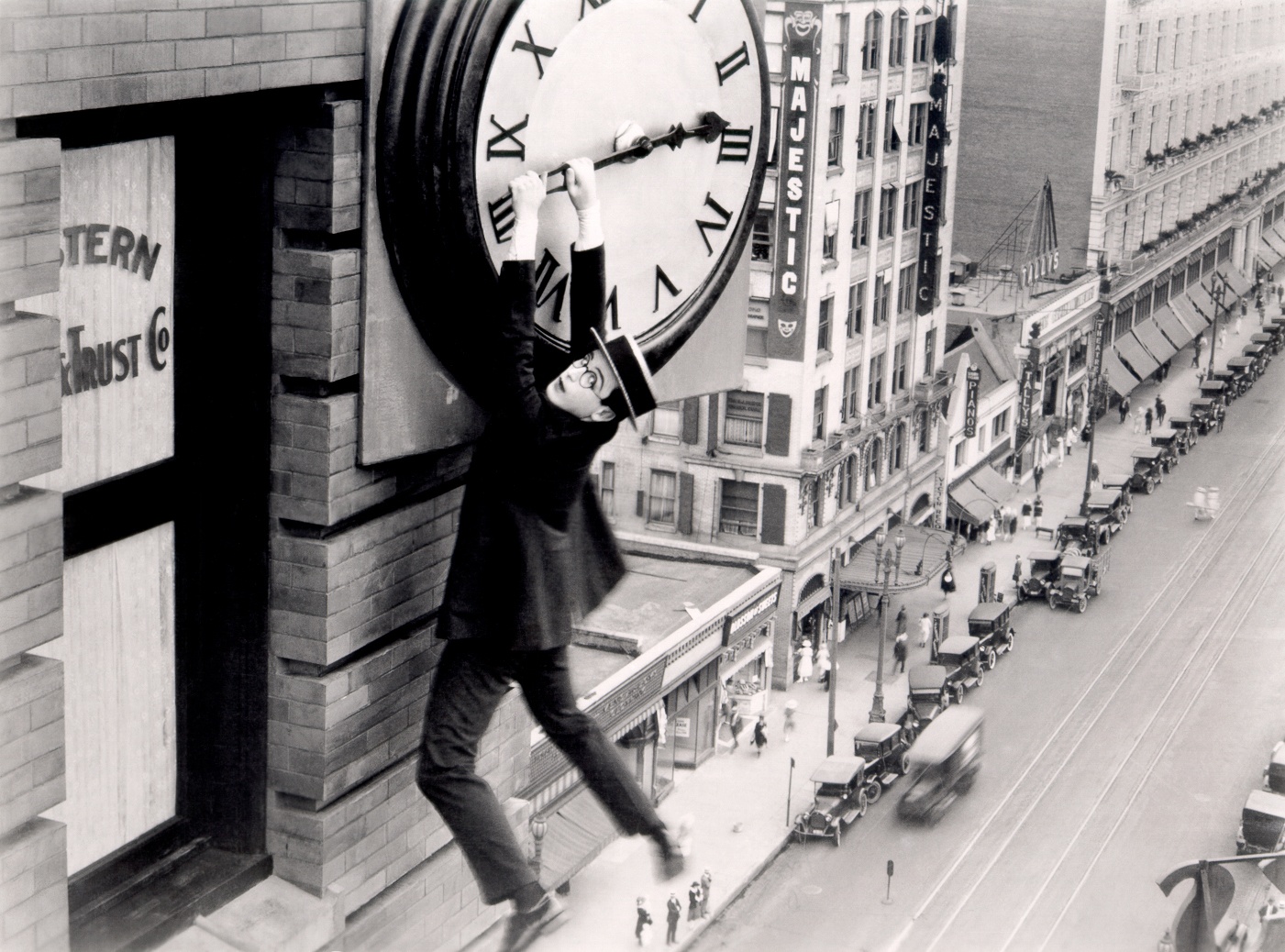
From 'Safety Last': the image everyone remembers.

MONDAY, JULY 11, 2022 / FOR IMMEDIATE RELEASE
Contact Jeff Rapsis • (603) 236-9237 • jeffrapsis@gmail.com

Silent film classic 'Safety Last' on Friday, Aug. 5 at Jane Pickens Theatre

Thrill comedy climaxed by Harold Lloyd's iconic building climb; shown with live music

NEWPORT, R.I.—It's a cinematic image so powerful, people who've never seen the movie instantly recognize it.

The vision of Harold Lloyd hanging from the hands of a huge clock, from the climax of his silent comedy 'Safety Last,' (1923), has emerged as a symbol of early Hollywood and movie magic.

See how Harold gets into his high-altitude predicament with a screening of 'Safety Last,' one of Lloyd's classic comedies, on Friday, Aug. 5 at 7:30 p.m. at the Jane Pickens Theatre and Event Center, 49 Touro St., Newport.

General admission $15; members $13. Tickets available online or at the door.

The screening will feature live musical accompaniment by Jeff Rapsis, a New Hampshire-based silent film musician.

'Safety Last' follows young go-getter Lloyd to the big city, where he hopes to make his mark in business and send for his small town sweetheart.

His career at a downtown department store stalls, however, until he gets a chance to pitch a surefire publicity idea—hire a human fly to climb the building's exterior.

However, when the human fly has a last-minute run-in with the law, Harold is forced to make the climb himself, floor by floor, with his sweetheart looking on.

The result is an extended sequence blending comedy and terror that holds viewers spellbound.

Lloyd, along with Charlie Chaplin and Buster Keaton, is regarded as one of the silent screen's three great clowns.

Lloyd's character, a young go-getter ready to struggle to win the day, proved hugely popular in the 1920s.

While Chaplin and Keaton were always favored by the critics, Lloyd's films reigned as the top-grossing comedies throughout the period.

Silent film at the Jane Pickens Theatre gives today's audiences the chance to experience early cinema as it was intended: on the big screen, with live music, and with an audience.

"Put the whole experience back together, and you can see why people first fell in love with the movies," said Rapsis, who practices the nearly lost art of silent film accompaniment.

Rapsis performs on a digital synthesizer that reproduces the texture of the full orchestra, creating a traditional "movie score" sound.

"Seeing 'Safety Last' with an audience is one of the great thrill rides of the cinema of any era, silent or sound," Rapsis said. "Harold's iconic building climb, filmed without trick photography, continues to provoke audience responses nearly 100 years after film was first released."

Tributes to the clock-hanging scene have appeared in several contemporary films, most recently in Martin Scorsese's 'Hugo' (2011), which includes clips from 'Safety Last.'

See Harold Lloyd's iconic thrill comedy 'Safety Last' (1923) on Friday, Aug. 5 at 7:30 p.m. at the Jane Pickens Theatre and Event Center, 49 Touro St., Newport.

General admission $15; members $13. Tickets available online at www.janepickens.com or at the door. For more information about the JPT Film & Event Center, call (401) 846-5474.

Nearing the top.

CRITIC COMMENTS ON ‘SAFETY LAST’:

"Impossible to watch without undergoing visitations of vertigo, Safety Last's climactic sequence is all it's reputed to be.”
—TV Guide

"Harold Lloyd manages to make the characters sympathetic enough to carry the audience's concern on his journey of crazy stunts and mishaps. One of the best of this era."
—David Parkinson, Empire Magazine

"The climb has both comic and dramatic weight because it is both a thrilling exercise in physical humor and a thematically rich evocation of the pressures men feel to succeed, lest they be viewed as less than a man."
—James Kendrick, Q Network Film Desk

Thursday, July 28, 2022

Stay up late this Saturday, July 30 for midnight screening of 'Dr. Caligari' at Coolidge Corner

Stay awake to see Cesar the Somnambulist in 'The Cabinet of Dr. Caligari' (1920)

I'm looking forward to this weekend's midnight screening of 'The Cabinet of Dr. Caligari' (1920) at the Coolidge Corner Theater in Brookline, Mass.

For those who've never experienced this very important (and very strange) piece of early cinema, I can't think of a better environment in which to do so.

In a theater? Check! With live music? Check! With an audience? Check! 

And finally, the middle of the night? Check and double check!

Really: semi-drowsiness might be the ideal state to appreciate the dream-like visual world in which 'Caligari' takes place. 

So hope to see you at the Coolidge on Saturday, July 30 when the clock strikes 12! More details in the press release below...

*     *     *

'Caligari' takes place entirely in a dream-like visual world.

MONDAY, JULY 25, 2022 / FOR IMMEDIATE RELEASE
Contact Jeff Rapsis • (603) 236-9237 • jeffrapsis@gmail.com

Coolidge to unleash late night silent film horror classic on Saturday, July 30

Midnight screening of breakthrough thriller 'Cabinet of Dr. Caligari' to feature live musical accompaniment

BROOKLINE, Mass.—A creepy silent film regarded as the forerunner of all horror movies will be shown at a midnight screening at the Coolidge Corner Theatre, 290 Harvard St., Brookline, Mass.

'The Cabinet of Dr. Caligari' (1920) will be shown at midnight on Saturday, July 30 as part of the Coolidge's ongoing 'Carnival of Horror' series.

The screening will feature live music by silent film accompanist Jeff Rapsis. General admission is $15.50 per person.
 
Set in an insane asylum, 'The Cabinet of Dr. Caligari,' is considered a landmark in early cinema. Nearly a century after its release, the film still has the capacity to creep out audiences.

"A case can be made that 'Caligari' was the first true horror film, critic Roger Ebert wrote in 2007.

'Caligari,' made in Germany after World War I and directed in expressionist style by Robert Wiene, stars Werner Krauss and Conrad Veidt.

The film employs stylized sets, with abstract, jagged buildings painted on canvas backdrops and flats.

To add to its strange visual design, the actors used an exaggerated technique that employed jerky and dancelike movements.

The movie is also cited as having introduced the surprise "twist" ending to cinema.
 
Conrad Veidt and Werner Krauss, two big names of early German cinema, star in 'Cabinet.'
 
"Silents such as 'Dr. Caligari' are films that first caused people to fall in love with the movies," Rapsis said. "The aim is to present them as they were originally intended to be shown: in a theater, on a big screen, with live music, and with an audience. If you can put all those elements together, these films leap to life."

In scoring 'The Cabinet of Dr. Caligari,' Rapsis plans to augment the traditional orchestral sound with the vocabulary of film music from later eras.

"Because I improvise the music, it's hard to know what will happen until the film actually starts running," Rapsis said.

'Caligari,' a forerunner of the 'film noir' genre, has influenced generations of movie-makers.

A sequel of sorts was released in the 1980s with the film 'Dr. Caligari,' which dealt with the granddaughter of the original Dr. Caligari and her illegal experiments on her patients in an asylum.

The Coolidge Corner Theatre is an independent, nonprofit cinema and cultural institution. Since 1933, audiences in the greater Boston area have relied on the Coolidge for contemporary independent film, repertory, and educational programming.

'The Cabinet of Dr. Caligari' (1920) will be shown with live music at midnight on Saturday, July 30 as part of an ongoing "Carnival of Horror" series at the Coolidge Corner Theatre, 290 Harvard St., Brookline, Mass. General admission $15.50; for more info and to buy tickets, visit www.coolidge.org or call (617) 734-2500.

Sunday, October 11, 2020

Yesterday, the Moon and UFO Festival; today, 'Caligari' in Natick, Mass., then 'Wings' in Wilton, N.H. later this week

It's not easy being green. For some reason, you just don't fit in.

It's a beautiful Columbus Day weekend here in northern New England. The foliage is at its peak, but there's also spectacular color inside, such as this alien glimpsed as part of the Greater New England UFO Conference in Wilton, N.H. (More on that below.)

First up: this afternoon (Sunday, Oct. 11) it's 'The Cabinet of Dr. Caligari' (1920) at the Center for the Arts, 14 Summer St. in Natick, Mass. Screening time is 6 p.m., so guess it's technically this evening. 

I haven't promoted this one heavily because the Center, like all venues in Massachusetts, is limited to just 25 people due to Covid-19 restrictions. But if you'd like to go, check www.natickarts.org, as tickets are available only online and in advance.

But then we swing back to New Hampshire later this week with a screening of the epic World War I picture 'Wings' (1927) on Thursday, Oct. 15. Showtime is 7:30 p.m. at the Town Hall Theatre in Wilton, N.H., and it's the opening title in a three-day festival of classics brought to you by the Aviation Museum of N.H.

More on 'Wings' and the festival below. Before that, let's tackle the alien. (Not literally, as he may have a raygun, or be sticky.) He/she/it was spotted in the Town Hall Theatre lobby as part of, yes, the Greater New England UFO Conference, which is taking place this weekend.

In fact, it's still going on today: Sunday, Oct. 11. So there's still time to check it out if you're within driving or bicycling distance to Wilton, N.H. Among other attractions, the theater is enforcing social distancing by placing blow-up aliens (similar to the one above) in selected seats.

As an incentive, it's also a confab of "Big Foot" fans, one of whom can make plaster casts for you to take home:

Casting call: Take home your very own big feet!

I wish to apologize to all Bigfoot fans, plus the Native American community in general, for mistakenly referring to Big Foot in my opening remarks as "Sacajawea" instead of "Sasquatch." Wow, I'm turning into my malaprop-prone mother. God rest her soul. (Apologies to her, too, by the way. Just because.)

Anyway: I love doing music for Lang's 'Frau im Mond' (the original German title) because it's such a surprise for audiences, and also because the whole story and treatment are a good fit for the kind of music I make: that of the big gesture. 

Things always start off with a bang due to a flashback near the beginning: Prof. Manfeldt is seen more than three decades earlier, lecturing on his "gold on the moon" theory to fellow academics, who promptly riot. Lang then shows close-ups of a bell being rung and a whistle being blown to quell the fracas: literally, bells and whistles!

And that's what I use: my grandmother's old brass school bell, and a referee's whistle, to kick up a nice sonic riot to go with Lang's visuals. And it's really effective, I think, especially when the flashback ends and Lang dissolves back to Prof. Manfeldt, now impoverished and living in a garret: all the noise dies down and I just leave soft high note sustained, hanging there.

When I accompany 'Woman in the Moon,' the entire score is built out of original motifs for characters and situations. You need material to hold together a nearly three-hour film. But also, in just one instance, I use an identifiable tune that I think helps the film's emotional line.

The tune: 'Gaudeamus igitur,' the classic student anthem. I work it in during Manfeldt's flashback lecture to establish atmosphere, and then we don't hear it again until much later, when he reaches the moon and actually finds, yes, GOLD! 

Lang illustrates the moment visually by showing the Professor's shouts echoing among the lunar caverns, and I add a note of musical triumph by folding in the chords to 'Gaudeamus' on top of the by-then-rhythmic accompaniment in the bass. 

Lot of interesting comments from the 30 or so people who attended the screening. One I'd never heard before: "NASA could use you to add drama to their launches."

By the way, I mentioned bicycling because after yesterday's trip to the moon, I got on my trusty road bike and pedaled a late afternoon loop from the theater into the hills of bucolic Lyndeborough, N.H. (Pronounced "line-boro" for all you flatlanders.) 

And I mean hills. It was all up, up, up to what's called "Lyndeborough Center," with its meetinghouse and parsonage and open fields and views for miles. And then, as dusk gathered, I enjoyed my own rocket ship ride down the road to a place called "Fitch's Corner" in Milford, then back to the theater.

Distance was only about 15 miles, but the uphills made for slow going, while the downhills couldn't be taken advantage of entirely because it was getting dark and you have to be careful on these back roads.

But the air was still warm, even in the growing twilight, so it made for a spectacular communion with this year's foliage, which will be gone soon enough. 

Okay, here's more info about 'Wings' on Thursday and the other classic aviation films we're showing later this week. See you at the theater!

*   *   *

'Wings' to be screened with live music on Thursday, Oct. 15 at the Town Hall Theatre.

WEDNESDAY, SEPT. 30, 2020 / FOR IMMEDIATE RELEASE
Contact Jeff Rapsis • (603) 236-9237 • jrapsis@nhahs.org

Three-day festival of classic aviation adventure films coming to Wilton, N.H.

John Wayne, Jimmy Stewart among stars featured in Academy Award-winning pictures presented by Aviation Museum of N.H.

WILTON, N.H.—Fly off to high-altitude adventure with a festival of classic aviation films at the Town Hall Theatre, 40 Main St., Wilton, N.H.

The three-day event, which runs from Thursday, Oct. 15 through Saturday, Oct. 17, gives local audiences a chance to see timeless aviation movies as they were intended—on the big screen and in a theater.

The festival will include four large-scale features from Hollywood's Golden Age, ranging from the classic World War I aviation drama 'Wings' (1927) to the all-star wide-screen desert survival blockbuster 'The Flight of the Phoenix' (1965).

Other titles include '12 O'Clock High' (1949), an intense thriller about U.S. pilots in World War II, and 'The High and the Mighty' (1954), a ground-breaking airborne drama about a stricken commercial airliner starring John Wayne.

All films in the festival were nominated for multiple Academy Awards. Each captures the public's fascination with flight in a different setting, as pilots and passengers alike face danger in the sky and also on the ground. Aviation buffs will enjoy the vintage aircraft featured in each production.

All screenings are free and open to the public. Donations will be accepted, with all proceeds used to support the education outreach program of the Aviation Museum of N.H.

The Town Hall Theatre is observing procedures to comply with all state and CDC public health guidelines, including reduced seating capacity. For complete information about the venue's safety protocols, visit www.wiltontownhalltheatre.com.


• On Thursday, Oct. 15 at 7:30 p.m., the festival opens with the silent classic 'Wings' (1927), a drama about World War I aviation that won 'Best Picture' at the very first Academy Awards ceremony. The film stars Clara Bow, Charles 'Buddy' Rogers, and Richard Arlen. Live music for 'Wings' will be provided by Jeff Rapsis, a silent film accompanist and also executive director of the Aviation Museum of New Hampshire.


• On Friday, Oct. 16 at 7:30 p.m. brings '12 O'Clock High' (1949), a classic bout aircrews in the United States Army's Eighth Air Force, who flew daylight bombing missions against Nazi Germany and occupied France during the early days of American involvement in World War II. Starring Gregory Peck, '12 O'Clock High' received four Academy Award nominations, winning Best Supporting Actor for co-star Dean Jagger and Best Sound Recording.


• Saturday, Oct. 17 at 2 p.m., it's 'The High and the Mighty' (1954), a drama about a troubled commercial flight starring John Wayne and Robert Stack. With its intertwined stories of passengers on a doomed commercial flight, 'The High and the Mighty' served as a template for the Hollywood 'disaster' genre. The film earned six Academy Award nominations, winning for composer Dmitri Tiomkin's dramatic musical score.


• Saturday, Oct. 17 at 7:30 p.m., the festival concludes with 'The Flight of the Phoenix' (1965), a drama about survivors of a plane crash in the Sahara Desert. Starring Jimmy Stewart, Peter Finch, and Ernest Borgnine, 'The Flight of the Phoenix' was nominated for two Academy Awards: Ian Bannen for Supporting Actor and Michael Luciano for Film Editing.

"These are all terrific pictures with great stories set in the earlier days of aviation, before air travel became commonplace for so many people," said Jeff Rapsis, the Aviation Museum's executive director.

"They're a great way to recapture the romance and excitement of flight, and the Aviation Museum's festival is a rare chance to see them as intended: on a big screen and in a movie theater," Rapsis said.

The Aviation Museum of N.H., located at 27 Navigator Road, Londonderry, N.H., is a non-profit 501(c)3 tax-exempt organization. Housed in the vintage 1937 passenger terminal at Manchester-Boston Regional Airport, the Aviation Museum is dedicated to preserving the Granite State's rich aviation past, and also inspiring today's students to become the aviation pioneers of tomorrow.

For more information about the Aviation Museum, visit www.aviationmuseumofnh.org or call (603) 669-4820. Follow the Aviation Museum on social media at www.facebook.com/nhahs.

For more about the Town Hall Theatre, visit www.wiltontownhalltheatre.com or call (603) 654-3456.

Wednesday, October 28, 2015

The Halloween home stretch: 'Caligari,'
'The Lodger,' and Chaney in 'West of Zanzibar'

Lon Chaney as 'Phroso the Magician' and companion in 'West of Zanzibar' (1928).

Coming up: one final long weekend of Halloween-themed silent film screenings.

Highlights include accompanying a 35mm print of 'West of Zanzibar' (1928), the lurid Chaney/Browning thriller, on Saturday, Oct. 31, and no less than three screenings of Hitchcock's 'The Lodger' (1927).

But the spooky fun starts tonight with 'The Cabinet of Dr. Caligari' (1920) at Wellesley College, just outside Boston. Screening is at 6:30 p.m. at Collins Cinema in the Davis Museum Complex.

Admission is free; the film is part of retrospective on film-making of Weimar-era Germany. 'Cabinet' is a good choice this close to Halloween—the proto-Tim Burton set design alone is worth seeing this film, which probably seems more creepy today than it did when first released.

The twisted visual landscape of 'Caligari.'

One of the challenges of 'Caligari' is that the film has several instances of the title character ringing a sizable (and seemingly very loud) hand bell to attract attention from passersby in a carnival midway.

So for an accompanist, the question becomes: "Should I try to match the obvious on-screen action by ringing a real bell right there during the screening?"

In the case of Caligari, I do actually ring a bell. Specifically, it's a large clangy brass bell that once belonged to my grandmother. It makes quite a racket, and the cues in Caligari are easy to match, so I go for it.

Likewise in the case of the Keaton short 'The Haunted House,' where the ghost traffic is so heavy, Buster ends up playing traffic cop to control a busy hallway. To do this, he uses a whistle to signal stop and go, and blowing an actual whistle (while keeping the music going) helps punch up the gag, I think.

But if I'm unsure of where the cues might be, or if a sound effect might distract from the on-screen moment, I hold off on matching what are often literally the "bells and whistles."

Why? Because if you're even just a little bit off, it breaks the spell that a successful silent movie screening creates. Or if it's a key dramatic moment, you don't want to rob it of any significance by doing something unexpected in the accompaniment.

Anyway, it's my only screening of 'Caligari' this Halloween season, so come to Wellesley College tonight if you're hankering for a Halloween helping of German Expressionism.

Ivor Novello dressed to kill (really?) in Hitchcock's 'The Lodger.'

Then follows three screenings of Alfred Hitchcock's 'The Lodger' (1927), the title I've focused on for this Halloween cycle, having played for it twice already this month.

Let's see. The schedule looks like this:

• Thursday, Oct. 29, 2015, 7 p.m.: 'The Lodger'; Putnam Arts Lecture Hall, Keene State College, Keene, N.H. There's usually an admission charge for these screenings but I just checked and apparently this one is free and open to the public.

• Friday, Oct. 30, 2015, 7 p.m.: 'The Lodger'; Red River Theatres, 11 South Main St., Concord, N.H.; (603) 224-4600; http://www.redrivertheatres.org/. Great small non-profit venue that specializes in offbeat and independent films that otherwise wouldn't get shown in this part of the world. Admission $10 per person.

• Saturday, Oct. 31, 2015, 8 p.m.: 'The Lodger'; Leavitt Theatre, 259 Main St. Route 1, Ogunquit, Maine; (207) 646-3123; http://www.leavittheatre.com. The season-ending show in a vintage seaside resort one-screen theater that opened in 1923 and has barely changed since. Admission $10 per person.

That's a whole lot of Lodgers. But I think I have some good material in the style of Bernard Herrmann that helps bring out the "Hitchcock" qualities of the film, which can be found throughout this early feature from the director.

For more specifics about each screening, check the "Upcoming Silent Film Screenings" link at upper right.

But there's one more: 'West of Zanzibar' (1928), also on Saturday, Oct. 31.

A screening of the Chaney/Browning silent MGM thriller will open a 12-hour Halloween marathon of feature films, all shown in 35mm, at the Somerville Theatre, 55 Davis Square, Somerville, Mass. The marathon is on Halloween Day and runs from noon to midnight.

From what I understand, the 35mm print of 'Zanzibar' is exceptionally well struck and in great shape. Also, it's very difficult to source 35mm prints of any of the MGM/Chaney/Browning pictures, so this is an extremely rare chance to see 'Zanzibar' in its native film format, projected on the enormous screen of the Somerville Theater's vintage 1914 main house.

It's quite a privilege to do live music for a film as bizarre as 'Zanzibar,' with Chaney playing a magician paralyzed from the waist down and bent on revenge against the man who crippled him and stole his beloved—a 20-year quest that leads to a showdown in the remote jungles of Africa. Classic Tod Browning madness, with no less than Lionel Barrymore in a key role.

Lurid, twisted, dark—and perfect for Halloween.

The marathon program begins at noon with 'West of Zanzibar'; other titles (all in 35mm) include 'Dracula' (1931), 'The Monster That Challenged the World' (1957); 'Seconds' (1966); 'Aliens' (1986); and 'The Lost Boys' (1987). Admission is one price for the whole 12-hour program, with tickets $30 per person.

I urge any classic film buffs in the Boston or New England area to consider making a pilgrimage to the Somerville to experience 'West of Zanzibar' on the big screen in 35mm, as well as the other marathon titles, all under the watchful eye and legendarily exacting standards of head projectionist David Kornfeld. It's an event not to be missed.

And then comes November, which brings silent film gigs in California and Virginia, among other places. More on that after Halloween!

One other thought: I'm always eager for new ways to attract audiences to silent cinema. So the other day, a friend suggested promoting the Chaney film as an inspirational tale for the disabled.

Being differently abled didn't prevent him from realizing his dreams of revenge!

Er—still thinking about that one.

Tuesday, February 17, 2015

A little snow can't slow down
the silent film juggernaut of romance

Not even snowpiles like these in the Boston area could stop silent film!

Pleased to report that we went three for three this weekend.

Despite the latest in a series of snowstorms that are collectively burying New England, all three silent film screenings went on as scheduled.

The Aeronaut on a crowded night. We staged the silent film in the area way in the back.

• A Valentine's Day program at the Aeronaut Brewery in Somerville, Mass. attracted a hardy band of the curious (average age maybe half that of mine) who reacted explosively to Buster Keaton in 'Seven Chances' (1925).

We were set up in an unimproved industrial space off to one side of the brewery/bar, and the choice for screen was a large bedsheet or a blank white wall. (I went with the wall.)

Alas, the Saturday night brewery crowd was noticeably thinner compared to my first visit. Blizzard conditions had taken their toll.

But still, there was a good vibe in the place, which features an eclectic line-up of live entertainment. When I arrived, a small combo (I think it included a sousaphone) was playing an arrangement of one of the Gershwin piano preludes while a young woman did interpretive dance on the brewery floor.

And this was followed by some silent film thing!

But come showtime, people began moving over to where I'd set up the keyboard, speakers, and projector, packing in around it in chairs and tables.

By the time we started, it was a good-sized audience. And, as I soon found out, a very responsive one!

You know it's going to be a fun ride when even the opening sequence (in which Keaton repeatedly fails to propose to his beloved) produces gales of laughter.

And after that, it just never let up. People were really into it. And I didn't ask, but I have to think that most people there had never experienced a silent film that way: with live music, and as part of an audience.

So, as we all discovered, what's old can be new again. And it was very gratifying to see it all come together so successfully.

I have to say, it ranked as one of the best silent film experiences I've had in all the years I've been doing this.

My thanks to Christine Platzek, Ben Holmes, and everyone at the Aeronaut Brewery for taking a chance on silent film. Even in the midst of a blizzard, it worked out great!


• Alas, only about a dozen people showed up for a matinee screening of MGM's 'Love' (1927) on Sunday, Feb. 15 at the Wilton Town Hall Theatre.

And that wasn't surprising, as the region was still digging out from another foot of snow, plus contending with Arctic temperatures and winds of 50 mph.

Theatre owner Dennis Markaverich didn't run his usual Sunday shows at 2 p.m., as no one showed up and he was too busy unburying the theater.

But we went ahead with 'Love' at 4:30 p.m., and it seemed especially fitting that the film starts in a howling blizzard!

This isn't one of the immortal silent classics, which I confided in the small group on hand.

MGM basically took a steamroller to Tolstoy's sprawling novel 'Anna Karenina,' boiling it down to a series of scenes that would give maximum face time to Greta Garbo and John Gilbert.

The fact that they threw out just about all of the novel, and then also changed the conclusion to a happy ending, wasn't a concern to the studio. It was designed with one aim: to sell tickets, which it did.

However, 'Love' was produced at the very height of the silent film era. Also, it was made by MGM, at the time the most technically slick studio in Hollywood.

So despite some shortcomings, it contains a lot of interest—sequences that show silent film at the peak of its eloquence.

In previewing the film, I was struck how several intense "dialogue" scenes (where Garbo and Gilbert speak passionately to each other, at some length) are presented utterly without any intertitles.

It's not like 'Love' avoids intertitles. They're used frequently elsewhere.

But in some places, we're left to just watch the faces and the expressions, even as quite a lot is being said, sometimes quite passionately.

I think this is one key to the unique power of silent film. By not getting the details, we're left to imagine what's being said. And that leaves us free to imagine something more intense and personal, perhaps, than could be concocted by any title writer.

By letting us do the work, if we care to, the film absorbs us and draws us in more closely to the characters and the story.

That this is done in a fairly routine (if high profile) release such as 'Love; shows how pervasive this method of presenting a story had become. As the motion picture matured, filmmakers were pushing the technique of visual story-telling in surprisingly abstract directions.

We followed 'Love' with this. Seems fitting, somehow.

• After 'Love,' I raced down snow-covered highways to the Somerville Theatre (just outside Boston, Mass.) to do live music for 'The Cabinet of Dr. Caligari' (1920).

This screening was part of the annual Boston Sci-Fi Marathon, held every President's Day weekend and now in its 40th year. For 24 hours (yes, straight without a break), about 500 hard-core fans take in a continuous diet of big screen sci-fi flicks of all types—the good, the bad, the very bad, with sometimes even a silent thrown in.

I'd been here before, in 2011, when I did live music for the 1916 version of '20,000 Leagues Under the Sea.' Not sure how 'Caligari' qualifies as sci-fi, but I was thrilled at a chance to do live music for it at the "'Thon," as attendees call it.

One reason is that it's a chance to bring a silent film to life for a large audience that's quite separate from the usual silent film crowd.

Somerville was absolutely buried in snow. But despite a parking ban and no public transit, the "Thon" went on as planned, although the start was pushed back from noon to 4 p.m.

Attendance was strong: I arrived just as the main theater's doors burst open at the intermission of '2001: A Space Odyssey,' and was surprised that the place was packed!

Set-up required me to gingerly step around people who'd camped out (sleeping bags and all) in the area below the stage, but everyone was really nice about it.

'Caligari' was preceded by a Thon tradition: the alien tinfoil hat contest.

And after that, we went right into Caligari, shown in DCP. Projectionist David Kornfeld thought the transfer was too slow, but it seems to flow all right in terms of the music.

By this time, I had been sitting at a keyboard so much in the past couple of days that I carried over a certain fluency I had accumulated. So things went well, even though I had nothing specific prepared for 'Caligari.'

The only special effect was that I brought my grandmother's old brass school bell to ring during the three times that Caligari is seen ringing a bell to get attention for his carnival act.

Great ovation at the end! Hope to do it again in years to come.

And then I went out in the cold to start my car, and the Thon moved on without me.


• Last-minute addition to the schedule: I'm doing music for Abel Gance's 'J'Accuse' (1919) on Sunday, Feb. 22 at 7 p.m. at the Harvard Film Archive, 24 Quincy St., Cambridge, Mass. For more info, please click the link.

I just was asked to do this, so haven't had a chance to prepare much. And I'm leaving for London tonight, returning to Boston the afternoon of the screening.

Cutting it close, I suppose, but I'm game.

And then after that, it's off to the Kansas Silent Film Festival on Feb. 27 & 28 in Topeka, Kansas.

More to come on that!

Friday, February 13, 2015

An unusual Valentine's Day weekend
...complete with impending blizzard

Not even Greta Garbo and John Gilbert in 'Love' (1927), to be screened on Sunday, Feb. 15 in Wilton, N.H., will create enough heat to rescue us from yet another impending snowstorm.

What better day than Friday the 13th to ponder the fate of three separate screenings this Valentine's Day weekend, what with a severe blizzard expected to blow through our part of the world.

Sounds like Old Man Winter and Mother Nature are having a little tiff.

Well, as of now, all three screenings are still a go. I'll post updates if anything changes.

The three screenings are:

• Saturday, Feb. 14, 2015, 9 p.m. 'Seven Chances' (1925) starring Buster Keaton; Aeronaut Brewing Co., 14 Tyler St., Somerville, Mass. Special Valentine's Day program at popular brew-pub in Somerville, Mass. Admission $10 per person. For details, check out their Facebook page at: https://www.facebook.com/events/845007065561871. Please note you have to be logged into Facebook to see this page.

• Sunday, Feb. 15, 2015, 4:30 p.m.: 'Love' (1927) starring Greta Garbo, John Gilbert; Wilton Town Hall Theatre, Main Street, Wilton, N.H.; (603) 654-3456; www.wiltontownhalltheatre.com. Silent-era mega-stars (and off-screen lovers) Greta Garbo and John Gilbert heat up the screen in this 1927 adaptation of Tolstoy's novel 'Anna Karenina.' (Great if you forgot to do anything special on Valentine's Day.) Admission free, donations of $5 per person encouraged.

• Sunday, Feb. 15, 2015, 10 p.m. or thereabouts, 'The Cabinet of Dr. Caligari' (1920); Somerville Theatre, 55 Davis Square, Somerville, Mass.; (617) 625-5700; Somerville Theatre. Nearly a century after its release, the German expressionist film widely regarded as the world's first horror movie still has capacity to creep out audiences. Screened as part of the 40th Annual Boston Sci-Fi Film Festival's annual 24-hour science fiction film marathon, which runs noon on Sunday, Feb. 15 to noon on Monday, Feb. 16. Admission charged. For more info, visit the festival's Facebook page at https://www.facebook.com/BostonSciFi.

So, about the blizzard: it's expected to roar into New England starting Saturday night, and then peak during the day Sunday before departing that evening.

Hardest hit will be coastal areas, which includes the Boston area, where two of the three screenings are. Winds of 70 mph are expected, and maybe a foot to 18 inches of blowing, drifting snow.

But of the two in Beantown, the Feb. 14 show at the Aeronaut Brewery takes place before the brunt of the storm moves through.

And the screening of 'Caligari' at the Sci-Fi Marathon isn't until late at night on Sunday, when the storm will be outta here. (I understand the Marathon is still a go no matter what, even though it starts on Sunday morning, when the storm will be at its worst.)

As for 'Love' on Sunday at the Wilton Town Hall Theatre, I'd be surprised if that one doesn't happen, as interior New Hampshire will see a little less of the snow. And you can't stop love, right?

Still, this could change. And that leaves us all in as much suspense as if we're watching a frozen Lillian Gish stranded on an ice floe heading for the falls.

Will Old Man Winter or Mother Nature (or whoever is in charge of the weather) cause any of this weekend's screenings to be cancelled?

I'll keep you posted. For now, here's the press release on the Valentine's Day screening of 'Seven Chances' (1925) at the Aeronaut Brewery in Somerville, Mass. I'll include info about 'Love' and 'Caligari' in separate posts.

* * *

Buster checks the time, but he should also check the weather prior to a Valentine's Day screening of 'Seven Chances' (1925) on Saturday, Feb. 14 at 9 p.m. at the Aeronaut Brewery in Somerville, Mass.

MONDAY, FEB. 2, 2015 / FOR IMMEDIATE RELEASE
Contact: Jeff Rapsis • (603) 236-9237 • jeffrapsis@gmail.com

Silent film comedy 'Seven Chances' (1925) on Saturday, Feb. 14 at Aeronaut Brewery


Buster Keaton's classic romantic farce to be screened on Valentine's Day with live music

SOMERVILLE, Mass.—When words aren't enough to express those romantic feelings, why not let a silent movie do the talking?

That's the thinking behind a Valentine's Day silent film program to be presented on Saturday, Feb. 14 at 9 p.m. at the Aeronaut Brewery, 14 Tyler St., Somerville.

'Seven Chances' (1925), a classic Buster Keaton romantic comedy, will be shown at the brewery with live music by silent film accompanist Jeff Rapsis.

Admission to the screening is $15 per person. The program includes two shorter Keaton comedies in addition to 'Seven Chances,' one of Keaton's classic full-length feature comedies.

"We envision our Valentine's Day event as a throwback to marvelous days of wonderment celebrating times together with friends and community," said Christine Platzek of Aeronaut, a craft brewery that opened in 2014.

Just as beer aficionados appreciate a good hand-crafted brew, movie-goers are rediscovering the joys of silent cinema presented as it was intended: on a big screen, with live music, and with an audience.

"If you can put all the original elements together, the films of early Hollywood still come to life," said Rapsis. "These are the films that caused people to first fall in love with the movies."

Acclaimed for their originality and clever visual gags, Keaton's films remain popular crowd-pleasers even today.

Keaton never smiled on camera, earning him the nickname of "the Great Stone Face." But his comedies rocked Hollywood's silent era with laughter throughout the 1920s.

In 'Seven Chances,' adapted from a stage play, the story finds Buster learning that he'll inherit $7 million if he's married by 7 p.m. on his 27th birthday—that very day!

Buster's hurried attempts to tie the knot on his own go awry, but then a newspaper story changes the game, creating an avalanche of would-be brides who relentlessly pursue Buster as he searches for his one true love before the deadline.

Buster and his would-be brides in 'Seven Chances' (1925).

'Seven Chances' was the first screen adaptation of the now-familiar story, since used in movies ranging from the Three Stooges in 'Brideless Groom' (1947) to Gary Sinyor's 'The Bachelor' (1999), a romantic comedy starring Chris O'Donnell and Renee Zellwinger.

Keaton, along with Charlie Chaplin and Harold Lloyd, stands today as one of the silent screen's three great clowns. Some critics regard Keaton as the best of all; Roger Ebert wrote in 2002 that "in an extraordinary period from 1920 to 1929, (Keaton) worked without interruption on a series of films that make him, arguably, the greatest actor-director in the history of the movies."

As a performer, Keaton was uniquely suited to the demands of silent comedy. Born in 1895, he made his stage debut as a toddler, joining his family's knockabout vaudeville act and learning to take falls and do acrobatic stunts at an early age.

A remarkable pantomime artist, Keaton naturally used his whole body to communicate emotions from sadness to surprise. And in an era with no post-production special effects, Keaton's acrobatic talents enabled him to perform all his own stunts, including some spectacular examples in 'Seven Chances.'

"We felt a vintage silent film program with live music would be a great way to create Valentine's Day memories that last a lifetime," Platzek said. "We encourage everyone to join us, whether you're on a date or on your own. We'll all end up laughing together!"

The Aeronaut is also hosting a beer and cheese tasting event on Saturday, Feb. 14 at 5 p.m.

'Seven Chances' (1925) starring Buster Keaton will be shown on Saturday, Feb. 14 at 9 p.m. at the Aeronaut Brewing Co., 14 Tyler St., Somerville, Mass. Admission $15 per person. For more information, call (617) 987-4236 or visit the Aeronaut Brewing Co.'s Facebook page at https://www.facebook.com/aeronautbrewing/events. For more information about the music, visit www.jeffrapsis.com.


Monday, October 14, 2013

Scoring Pickford's 'Their First Misunderstanding'
and joining in the first-ever 'Terror-Thon'

My God, what a weekend for silent film in my part of the world! Not one but two special (and high profile) events to which I had the privilege of contributing music.

So, before we begin sprinting to Halloween with multiple screenings of 'Nosferatu' (1922) all over New England, let me take a moment to set down the highlights.

This run of good silent film karma actually began on Sunday, Oct. 5 with a packed screening of 'Safety Last' (1923) in 35mm at the Somerville Theatre just outside Boston. Here's a photo borrowed from Raquel Stecher, who blogs about vintage film at www.outofthepastblog.com.

The Somerville's main house prior to 'Safety Last.' Hey, is the accompanist (at far left) sporting a bald spot?

Look at that turnout! I was especially impressed because we had gotten a big goose egg in term of local publicity for this screening. So perhaps we've built up the series to the point where it has critical mass to continue on its own, more or less. We'll see.

Raquel was kind enough to write a detailed blog post that had a lot of nice things to say about the experience. I'm grateful for people who have such a passion for cinema as it should be experienced. Without them and their enthusiasm, none of this would be possible: the big screen, the live music, and (most importantly to me) the shared experience of silent cinema.

Also on hand was Annette D'Agostino Lloyd, who helped out with a brief introduction and had some Harold books for sale afterwards. Her willingness to join in on these escapades at the Somerville Theatre adds a nice touch of respectability to our efforts.

A follow-up screening of 'Safety Last' on Thursday, Oct. 10 at one of my monthly series (in this case, the Flying Monkey Moviehouse and Performance Center in Plymouth, N.H.) drew a much smaller but no less enthusiastic crowd.

I was especially psyched by an older couple from Meredith, N.H., first-timers who brought a friend to the screening on a "mystery ride." The friend was a keyboard player and church organist from the old school, and they all came down afterwards to swap stories, ask questions, and just plain revel in that now-familiar 'Safety Last' afterglow.

This takes us to Friday, Oct. 11, and the first-ever modern-day screening of 'Their First Misunderstanding' (1911), an early one-reel drama starring Mary Pickford thought lost until a print surfaced in a New Hampshire barn back in 2006.

The film has since been restored, and Friday's re-premiere at Keene State College in Keene, N.H. (which is shepherding all the discovered films through restoration) was an evening-long event featuring Pickford and also author Christel Schmidt, who hosted the program.

I'd never met Christel before but I'm glad our paths crossed. She's a worthy keeper of the Pickford flame, and perhaps just as much of a hot ticket as Pickford herself must have been.

Our schedules didn't allow for much social time, and she was there to sell books, not chat with yet another silent film musician.

But I stole a few moments with her after the crowds had dispersed, and found a woman with a wonderfully wry sense of humor. And, once she gets talking, she displays the rare gift of being able to take a "tell it like it is" approach to everything and everyone, but somehow make it seem refreshing and even endearing.

Sometimes I think that working in the vintage film community, with its out-sized personalities and fragile egos and no shortage of passionate people with any number of agendas, would make good training for the diplomatic corps. If that were true, then Christel might just be our next Secretary of State.

She did a great job introducing Pickford and her achievements, and from what I see on Facebook, she sold out of copies of her book, "Mary Pickford: Queen of the Movies." It's an excellent piece of work and I encourage you to check it out—meaning actually buy it, although checking it out from a library is a worthy alternative.

Christel also gave me another nudge to try swimming more in the Facebook ocean. We'll see.

The program was, for me, one of the highlights of the year. Big crowd, lots of newbies, nice facility, all crackling with the special kind of electricity you get at a one-of-a-kind event. I'm so grateful to Ben Model (the New York-based accompanist who works a lot with Christel) for recommending me for this one. It was a great chance to do my stuff in front of a lot of big names right in my home state, all in the service of making silent film come alive —and silent film with a Granite State connection at that!

Congrats to Larry Benaquist and Peter Condon and everyone at Keene State who played a role in rescuing this film, preserving it, and arranging this event.

The program opened with not one but two Pickford one-reelers from 1911: the long-lost 'Their First Misunderstanding' as well as 'The Dream.' Knowing that we had the heavyweight feature 'Sparrows' (1926) still to come in the second half, I went with straight piano accompaniment for the shorts.

The more I do this, the more I find that shorter silent films of any kind (comedies, dramas, whatever) really don't lend themselves to the palette of the full orchestra. It bogs them down, makes them fraught with consequence, sets expectations maybe a little too high for modern audiences.

Piano for 'Their First Misunderstanding' was light and breezy: starting with scale-like figures drawn from the old Hanon technical exercises to show we're just starting out, and a brief explosion of Mendelssohn's wedding march to set the tone for the couple's departure.

And then there were scenes with a poet/pianist playing grandly away, for which I kept my foot down on the sustain pedal and worked through some portentious arpeggios of the type that I hoped would make Mary swoon. (It worked!)

And the action just went from there. Before I knew it, Mary was alone in a dark room, a fairly daring scene in terms of the technical limitations of early cinema, and which seemed to call for a delicate touch to round things out. Less is more.

So an emerging rule for my approach: save the big stuff for the bigger films—in this case, 'Sparrows.'

'Sparrows' is a GREAT film for music because it's loaded with atmosphere as well as a variety of scenes (including a lot of comedy) that lend themselves to musical settings that can build underneath to create some powerful stuff if it all works.

A great example is the 'baby death' scene, in which the wall of a grim barn attic disappears to reveal Christ tending a flock of sheep in a sunny pasture. Christ enters the barn, takes the expired child, then steps back and the barn wall reappears.

Okay, it's pretty simple-minded imagery. But my job as accompanist, I think, is to help connect the scene to Mary Pickford's character, teenage Molly, who is experiencing (or hallucinating) it. By that point in the film, we've seen enough of Pickford's character to know how important her faith his, even if she gets a lot of the details comically garbled.

But comic details be damned. The core belief underpinning everything, and how important it is and how central it is to her character, comes through so strongly and powerfully in that scene, in one sense it can be regarded as the film's climax, at least spiritually.

And so the music has to show reverence, awe, and respect, but not in a way that parodies religious music, with all trumpets blaring like the opening titles in a Monty Python sequence. Instead, it has to show the strength of Pickford's character, which to me transcends any particular religious iconography.

As Molly, Mary Pickford comically garbles the scriptures, but her underlying beliefs are dead serious.

She could be a Buddhist or a Unitarian Universalist or a complete atheist, but the moment would still be the same. It's not about religion. It's about her own personal experience of witnessing life moving from the now into the eternal.

Am I overthinking this? Maybe while I sit here typing, but not at the time the film was being screened.

During the film, my sense of what works just happens naturally. I felt the need to switch from full orchestra to just low brass to underscore that this was a special moment, and then built up some chords that lent weight to the scene. And yes, there was a bit of a blaze of glory when Christ receded and the wall was restored, but I immediately drew back to give Mary (and the audience) space to let it all sink in.

What follows is about 20 seconds of just Pickford's face (the baby, still in her arms, is out of camera range) reacting to what's happened. I almost didn't want to play any music at all here, because she communicates so much with the smallest gestures: the tilt of her head, her eventual glance upwards.

Is she grateful that the child has been delivered from a terrible situation, that the suffering is ceased? Is it the basis for the resolve she needs to engineer the escape? Something else? Whatever an audience takes away, it's a key moment, and a rich one, and too much music would sufficate it, I think.

So just an example of what goes on underneath the surface of playing music along a silent film, at least in the way I do it. I also had a lot of fun with a special effect: in this case, using an old brass school bell that belonged to my grandmother to make the sound of the bell used to gain entry to the dismal Grimes homestead.

Judging from comments afterwards, the bell was a memorable addition. Usually I wouldn't want to draw that much attention to the "soundtrack," such as it is. But the bell happens only twice, and early in the film, so I felt it was worth doing, especially because the synthesizer just wouldn't have been able to do as good a job, and I knew I wanted underscoring at the same time as the bell. So what the heck?

What was really satisfying for me was the feeling that I'd paced it right, holding back for most of the film and only getting truly frantic for the climactic post-swamps gun fight and then boat chase. It was a fun ride, with things amping up at just the right time, I felt.

And in the final scenes, I even managed to switch back to the low brass for the brief appearance of the hymn 'Shall We Gather at the River,' complete with sheet music on screen! No faking allowed on that one, as it's right at the end and anything else would have spoiled the moment.

I was gratified to find that the blogger (bloggess?) known as "Nitrate Diva" was on hand for the event. I continue to be impressed by her observations, which often give me fresh insight into films that I've known for years. I encourage you to check out her account of the Pickford program.

And then, after all this, come next morning, it was time for me to hightail it down to Somerville, Mass. for a noon-time screening of 'The Cabinet of Dr. Caligari' (1920) at the Somerville Theatre. Too much of a good thing? Well, you know what Mae West said about that. :)

'Cabinet' was the opening flick of the inaugural 'Terror-Thon,' a 12-hour marathon of vintage sci/fi horror flicks, one from each decade from the 1920s to the 1990s, all screened in 35mm in the Somerville's main theater.

This first-ever event, held Saturday, Oct. 12, coincided with 'Honkfest,' a sprawling festival of activist street bands in progress all around Davis Square. So it was quite a different environment from that of the Pickford program the night before.

And the audience was different, too. Rather than the usual silent film fans, it was more of a crowd of hard-core sci-fi geeks, which is another species altogether.

A face only a somnambulist could love.

And 'Caligari,' though a famous and ground-breaking picture, is not an easy go in terms of pacing or story-telling or many other things that die-hard sci-fi fans expect or demand when they're paying $35 per ticket. (One ticket for the whole marathon.)

So I had to really work to hold them and to help this film connect. What I came up with was more bombastic that I usually do, and more angular and arhythmic, in keeping with the film's visual design. Apologies to Mr. Igor Stravinsky for the shameless borrowing of figures and scraps from his immortal ballet score 'Le Sacre du Printemps.' And also to Mr. Bernard Herrmann for any number of purloined film music innovations.

Hey, if you're going to steal, steal from the best!

But I think it worked. I could tell the audience was into the picture, and it got a big hand at the end. So mission accomplished.

By the way, I got to use that same bell in 'Caligari,' as early in the movie, the Dr. rings just such a bell to attract attention to his carnival act. It happens three times, so it wasn't too much to be annoying.

This is similar to 'Sparrows,' a film that was supposedly created with the school of German Expressionism in mind. Up until now, I don't think anyone has identified the "bell" angle. Doctoral thesis, anyone? (I will resist the urge to make some pun about how this should ring a bell.)

Now I get to resume my regular life for a short while, at least until this Saturday, which brings the first of five (count 'em) screenings of 'Nosferatu' (1922) in various venues around New England.

Well, I often joke that I collaborate with dead people. So it shouldn't be surprising that things get especially busy around Halloween.


Thursday, November 1, 2012

Postponed: 'The Last Command' (1928)
on Thursday, Nov. 8 at Molloy College


NOTE: Due to continuing recovery efforts following Hurricane Sandy, our screening of 'The Last Command' on Thursday, Nov. 8 at Molloy College in Rockville Center, Long Island has been postponed. I'll update this when we get rescheduling details.

With Halloween over, things quiet down a bit on the silent film music front for the next couple of months. Relatively light duty until we get through the holidays, but still some good gigs coming up.

Of special interest is 'The Last Command' (1928) on Thursday, Nov. 8 at Molloy College in Rockville Center, N.Y. If you're in the area, come by and check it out! (There's more info on the "Upcoming Screenings" page at right.)

One of the great scenes in all silent cinema is in this picture, when Emil Jannings finally goes berserk. (It was enough to get him the "Best Actor" at the first-ever Academy Awards.)

Let's hope the good folks of Molloy College are okay after the recent storm that battered Long Island. For now, let me round up a few thoughts from the recent busy run-up to Halloween, culminating in three films in the past four days.

• 'The Hands of Orlac' (1924) is not one of those films that leaps to life on the big screen. At least that's what we found at a screening in Wilton, N.H. on Sunday, Oct. 28.

Because the main character is a concert pianist losing his mind, it's a fun film to do music for. One of the main themes turned out to be a weirdly harmonized version of the melody of an "easy listening" pop tune from the 1960s—one I can't remember the name of but goes "DAH DAH DAH...da-da-da-da-da, da-da-da-da-da: DAH DAH DAH da-da-da-da-da-, da-da-da-da-da. (I know that's not too effective written out in a blog like this.) It turned out to be versatile figure that lent itself to being stripped down to just its rhythm, or even weirder alternate harmonies as the film progressed.

But overall, 'The Hands of Orlac' moves at too slow a pace to cast any kind of a spell. One comment from a regular: "There was nothing you could have done to save that film." So sorry, Robert Wiene and Conrad Veidt! Probably won't be scheduling that one anytime soon again.

• However, 'The Cabinet of Dr. Caligari' (1920) is one of those films that seems to gain a certain energy and presence on the big screen. At our screening in Manchester, N.H. on Tuesday, Oct. 30, it seemed to move right along, and the audience stayed with it the whole way.

Somehow the music fell together, too, with scraps of the "Dies Irae" mixed in with little cells borrowed from Stravinsky's 'Rite of Spring.' It all contributed to a powerful experience. I'd love do the film again, especially as it's one of the most frequently requested of all silent movie titles.

• Our Halloween screening of 'Phantom of the Opera' at Merrimack College in North Andover, Mass. was a hoot. However, for future screenings, I've got to get there earlier to set things up. It's my own fault, but once again I wound up without enough light on the keyboard, so didn't have the flexibility (or accuracy) that I usually have at my disposal. End result is the folks got a slightly-more-atonal-than-intended score, which was okay for a picture like 'Phantom,' but would have been a problem for, say, Rin Tin Tin in 'Clash of the Wolves.' (also 1925).

• And speaking of 'Phantom,' I've just learned of an excellent blog post describing our screening of that film at the Somerville Theatre in Somerville, Mass. on Sunday, Oct. 21. Raquel Stecher writes about classic film on her blog, "From Out of the Past," and she really did a nice job recounting what the Somerville experience was like in this post. Thanks, Raquel!

• Okay, that's about it. Next local screening will be a program of Chaplin short comedies on Thursday, Nov. 15 at the Flying Monkey Moviehouse in Plymouth, N.H. Hope to see you there!

Monday, October 29, 2012

Opening 'The Cabinet of Dr. Caligari'
on Tuesday, Oct. 30 in Manchester, N.H.


We're in for some scary weather as I write this (Monday, Oct. 29), but as of now it looks like our part of the world will be spared the worst of Hurricane Sandy as it plows into the U.S. East Coast far to the south of here. Just a lot of rain and wind, I think.

So it's all systems go for our screening of 'The Cabinet of Dr. Caligari' (1920) tomorrow night at the Manchester (N.H.) City Library. It's the first time I've done this flick and I'm looking forward to creating music to help bring it to life.

As a kind of warm-up, yesterday we screened 'The Hands of Orlac' (1924), a lesser-known picture from the same director, Robert Wiene. Turnout for the show at the Wilton (N.H.) Town Hall Theatre was a bit light, again because of the impending storm, and also because it's not one of the big "name brand" silent features, I think.

But it sounded creepy enough, so I programmed it and hoped for the best, thinking it might be one of those undiscovered classics that still works well on the big screen and in a theater. Well, the verdict was: nope!

People I talked to afterwards generally felt that the silent 'Hands of Orlac' was one they definitely didn't need to see again. Complaints were that it was too slow (one attendee described it as "maddeningly slow paced"), and also that the plot didn't really make a lot of sense.

Well, we tried! Let's hope 'Cabinet' lives up to its reputation as a picture worth seeing in a theater. We'll find out tomorrow night, unless the storm does hit us hard enough for the city to close the library. I'll update here as needed but for now, the show must go on!

For specifics, here's the text of the press release...

* * *


MONDAY, OCT. 22, 2012 / FOR IMMEDIATE RELEASE
Contact Jeff Rapsis • (603) 236-9237 • jeffrapsis@gmail.com

'Cabinet of Dr. Caligari' to screen Tuesday, Oct. 30 in Manchester (N.H.)


Classic silent horror film to be shown the night before Halloween with live music at public library; free admission

MANCHESTER, N.H.—A creepy silent film regarded as the forerunner of all horror movies will be shown on the night before Halloween in downtown Manchester. 'The Cabinet of Dr. Caligari' (1920) will be screened with live music on Tuesday, Oct. 30 at 6 p.m. at the Manchester City Library, 405 Pine St., Manchester.

The showing of 'The Cabinet of Dr. Caligari' is free and open to the public, with live music by New Hampshire silent film accompanist Jeff Rapsis. The screening takes place in the library's historic Carpenter Auditorium, on the library's lower level.

Set in an insane asylum, 'The Cabinet of Dr. Caligari,' is considered a landmark in early cinema. Nearly a century after its release, the film still has capacity to creep out audiences. "A case can be made that 'Caligari' was the first true horror film, critic Roger Ebert wrote in 2007.

'Caligari,' made in Germany after World War I and directed in expressionist style by Robert Wiene, stars Werner Krauss and Conrad Veidt. The film used stylized sets, with abstract, jagged buildings painted on canvas backdrops and flats. To add to its strange visual design, the actors used an unrealistic technique that exhibited jerky and dancelike movements. The movie is also cited as having introduced the "twist" ending in cinema.


'Caligari,' a forerunner of the 'film noir' genre, has influenced generations of movie-makers. A sequel of sorts was released in the 1980s with the film 'Dr. Caligari,' which dealt with the granddaughter of the original Dr. Caligari and her illegal experiments on her patients in an asylum. Its tone, look, and feel held similarities to the original film, but was more influenced by the works of David Lynch and David Cronenberg than of the German Expressionists.

The screening is the latest in the library's ongoing series of silent film presentations with live music.

"These are the films that first caused people to fall in love with the movies," said Rapsis, a Bedford, N.H. resident. "The aim is to present them as they were originally intended to be shown: in a theater, on a big screen, with live music, and with an audience. If you can put all those elements together, these films leap to life."

Upcoming silent films scheduled at the Manchester City Library include:

• Tuesday, Dec. 4 at 6 p.m. 'The Trail of '98' (1928); outdoorsy silent drama on a grand scale. Fortune hunters from all over the country rush to the Klondike in 1897 to seek gold are tested by hardships of the journey. Directed by Clarence Brown, the film stars Dolores Del Rio, Harry Carey, and Karl Dane. Del Rio's stunts were performed by a young Lou Costello long before he teamed with partner Bud Abbott and achieved comedy fame.

• Tuesday, Jan. 15 at 6 p.m. 'Battling Butler' (1926); silent film funnyman Buster Keaton's rarely screened boxing comedy gives the star a chance to be even more physical than usual. Rich and pampered Buster reluctantly takes up the Sweet Science to impress his girl, leading to knockout comedy both in and outside the ring.

Admission to all screenings are free, with donations accepted to help defray costs.

The next installment in the library's silent film series will be 'The Cabinet of Dr. Caligari' (1920), to be screened on Tuesday, Oct. 30 at 6 p.m. in the Carpenter Auditorium of the Manchester City Library, 405 Pine St., Manchester, N.H. For more information, call (603) 624-6550. For more information about the music, visit www.jeffrapsis.com.