Our team greets the sunrise on the summit of Mount Kilimanjaro on January 10, 2015. I'm kneeling in front, mostly due to exhaustion.
Heading into a quiet stretch for silent film accompaniment: no shows until a four-day stretch in late June that includes a return gig at the wonderful Revue Cinema in Toronto, Canada.
But I'm thankful for the break because it'll give me a chance to make progress on another musical project I'm pursuing: an orchestral piece about Mount Kilimanjaro.
I got a chance to climb Mount Kilimanjaro last year as part of a group of 12 people. Our nine-day trek, climaxed by an overnight slog to reach the summit at sunrise, was an awesome experience.
It was also an unexpectedly musical experience. Singing of all types takes place on the slopes of Africa's highest mountain: folk songs, spirituals, hymns, and so much more.
And I found the snow-capped mountain makes its own kind of music, too.
So now I find myself pulling together an orchestral score that captures something, I hope, of the Kilimanjaro experience.
Our team and some of our guides on the way up. Still a ways to go!
And just as Kilimanjaro looms over the countryside, a read-through of my score-in-progress looms over my own day-to-day activities. Sometime this fall, members of the New Hampshire Philharmonic expect to play through it in preparation for a performance during their 2016-17 season.
I'm very excited by this opportunity, and grateful to music director Mark Latham and the orchestra for their willingness to encourage new music.
How did this happen? It's one of those "it was meant to be" series of events, I guess.
Prior to departing for Africa, I was contacted by the Philharmonic to be involved with a program of film music they were planning.
Alas, I couldn't join in because the concert date was when I would be on Kilimanjaro. (Now there's an excuse you don't get to use very often.)
After leaving Barranco Camp, our team negotiates the "Breakfast Wall" on Day 6.
Well, it turned out that music director Latham has extensive family ties to the legendary mountain, which is Africa's highest and also the tallest free-standing mountain in the world.
Mark comes from a family of medical officers who were among the first British officials to settle in Tanzania after Germany ceded control of its African territories following World War I.
So Mark's immediate ancestors were among the first English settlers to explore the slopes and summit of Kilimanjaro. Mark's grandfather was actually the first Englishmen to summit the mountain, back in 1926. (Germans had been on the peak before that, but prior to European settlement, there's no record of anyone venturing to the top.)
Today, several features on the mountain carry the name of Latham family members. For example: a spot we passed on the summit rim, Stella Point, is named in honor of Mark's great aunt, the first woman to reach the summit.
And Mark's grandfather was the guy who came across (and photographed) the leopard carcass high on the peak, which inspired Ernest Hemingway's 'The Snows of Kilimanjaro.'
I learned all this because prior to our trip, Mark graciously sat down and showed some of us his Kilimanjaro photo album and other priceless heirlooms from the family's days in what was then British East Africa.
He also shared his own experiences of climbing the mountain with his father back in 1976, on the 50th anniversary of his grandfather's first ascent.
We were stunned and grateful to get this insider's perspective on Kilimanjaro prior to departing. (Mark was actually born in Tanzania.) Imagine climbing a world-famous peak with a number of features named after family members of someone you had dinner with!
There's even a book about the family's experiences. It's called Kilimanjaro Tales: The Saga of a Medical Family in Africa.
After we scaled the peak in January of last year, Mark and I talked about the mountain, and he was willing to take a chance on Kilimanjaro made into music.
So I've been sketching out some notions in the hopes of capturing some of the experience in score.
As I understand it, the Phil (as it's called by its close friends) plans to include it in a concert that features visual elements: in this case, images of Kilimanjaro projected on a screen while the music gets played.
Me, I'm thrilled at the opportunity to work on music that's getting written down.
Most of my silent film work is improv-based, which is the best way for me to work in that field. For quite some time now, I've been developing my own musical idiom, such as it is.
But I'm at a point where I have a sense of what kind of music I want to write down, and to try to get performed.
Our guide Elly Anase, who got us all to the summit safely, with the help of a lot of Diamox.
So I've been refining some ideas and also recently updated my Finale scoring software. Last time I used it was in creating the score for 'Dangerous Crosswinds' (2005), a feature-length drama directed by New Hampshire filmmaker Bill Millios.
And in another coincidence, back then the film's cues were played by members of...The New Hampshire Philharmonic. So we go way back, this orchestra and me. :)
So I have a stretch of time coming up to push ahead with the Kilimanjaro score. And I think going public with it will help me stay focused and ensure that I'm motivated to get it done, rather than keep thinking I'll get to it when I have that most elusive object, "more time."
For me, getting anything done is very similar to how we got to the top of Kilimanjaro: one step at a time.
More updates to come.
Tuesday, June 14, 2016
Friday, June 10, 2016
This weekend, it's Mozart and Beethoven
...I mean, Charlie Chaplin and Buster Keaton
Buster Keaton and his co-star in 'The General' (1926), showing on Friday, June 10 at Red River Theatres in Concord, N.H.
Back to basics this weekend with two well-known classics: Keaton's 'The General' on Friday night in Concord, N.H., and then Chaplin's 'The Kid' (1921) in Somerville, Mass.
More details below in press releases I've attached to this post.
But accompanying these titles reminds me: I have this theory that the silent films that have come down to us will at some point attain the same cultural status as other forms of fine art: sculpture, paintings, theatre, literature.
All of these forms are interesting to us today in part because of their timeless beauty, but also because of what they say about the cultures that produced them.
Motion pictures made during the silent era aren't any different. Presented properly, they maintain their ability to entertain and inspire audiences. And they say tons about the culture that produced them, sometimes intentionally but often by accident.
They're just not old enough to be seen as "fine art" just yet, I think. In time, that will happen—as long as we preserve the films and keep showing them.
Mozart and Beethoven = Chaplin and Keaton?
So in that sense, I sometimes think of how Chaplin is kind of like the Mozart of silent film comedy—a miraculous wunderkind whose 'Tramp' character allowed him to create material in his own distinctive comic language.
Although a lot of hard work went on behind the scenes, what Chaplin brought to the screen always seemed graceful and effortless.
So, much as Mozart took the existing harmonic language and structure of music of his time and vastly enlarged its possibilities, so did Chaplin with cinema.
Keaton, on the other head, is more like Beethoven. Each was an innovator who worked largely on instinct to build large structures. And each pushed their art to new levels of expression.
It's an interesting way to look at silent film comedy. Taking it further, I guess that means Harold Lloyd would be Josef Haydn?
And does that mean an obscure performer such as Johnny Hines would be...say, Friedrich Kalkbrenner?
But the comparison starts to break down, I think, when you consider Mack Sennett, legendary slapstick comedy pioneer and father of Keystone Studios. He'd have to Johann Sebastian Back, and I somehow don't think Sennett and Bach operated on quite the same level.
Chaplin, Keaton, and...Sennett?
And now that I think of it, I've already compared Raymond Griffith's 'Paths to Paradise' (1925) with the Venus de Milo due to its missing final reel.
Well, whatever your tastes in film or music, I hope you'll join us for screenings of Keaton's 'The General' on Friday and Chaplin's 'The Kid' on Sunday. More info below!
* * *
WEDNESDAY, JUNE 1, 2016 / FOR IMMEDIATE RELEASE
Contact Jeff Rapsis • (603) 236-9237 • jeffrapsis@gmail.com
Buster Keaton's comic Civil War masterpiece set to be screened with live music
CONCORD, N.H.—He never smiled on camera, earning him the nickname of "the Great Stone Face." But Buster Keaton's comedies rocked Hollywood's silent era with laughter throughout the 1920s.
Acclaimed for their originality and timeless visual humor, Keaton's films remain popular crowd-pleasers today.
See for yourself with a screening of 'The General' (1926), one of Keaton's landmark feature films, at Red River Theatre, 11 South Main St., Concord, N.H. on Friday, June 10 at 7 p.m. Tickets are $10 per person.
The program will be accompanied by live music performed by silent film composer Jeff Rapsis.
'The General,' set during the U.S. Civil War, tells the story of a southern locomotive engineer (Keaton) whose engine (named 'The General') is hijacked by Northern spies with his girlfriend onboard.
Keaton, stealing another train, races north in pursuit behind enemy lines. Can he rescue his girl? And can he steal his locomotive and make it back to warn of a coming Northern attack?
Critics call 'The General' Keaton's masterpiece, praising its authentic period detail, ambitious action and battle sequences, and its overall integration of story, drama, and comedy.
It's also regarded as one of Hollywood's great train films, with much of the action occurring on or around moving steam locomotives.
Rapsis, a New Hampshire-based silent film musician who has accompanied shows at venues across New England, said Keaton's films were not made to be shown on television or viewed at home.
In screening 'The General,' Red River will give the public a chance to experience silent film as it was meant to be seen—in a high quality print, on a large screen, with live music, and with an audience.
"All those elements are important parts of the silent film experience," said Rapsis, who improvises the score on the spot as a film screens. "Recreate those conditions, and the classics of early Hollywood leap back to life in ways that can still move audiences today."
Rapsis performs on a digital keyboard that reproduces the texture of the full orchestra and creates a traditional "movie score" sound.
Keaton, along with Charlie Chaplin and Harold Lloyd, stands today as one of the silent screen's three great clowns. Some critics regard Keaton as the best of all; Roger Ebert wrote in 2002 that "in an extraordinary period from 1920 to 1929, (Keaton) worked without interruption on a series of films that make him, arguably, the greatest actor-director in the history of the movies."
As a performer, Keaton was uniquely suited to the demands of silent comedy. Born in 1895, he made his stage debut as a toddler, joining his family's knockabout vaudeville act and learning to take falls and do acrobatic stunts at an early age.
A remarkable pantomime artist, Keaton naturally used his whole body to communicate emotions from sadness to surprise. And in an era with no post-production special effects, Keaton's acrobatic talents enabled him to perform all his own stunts.
Red River Theatres, an independent cinema, is a non-profit 501(c)(3) organization dedicated to screening a diverse program of first-run independent films, cult favorites, classics, local and regional film projects, and foreign films.
The member-supported theater’s mission is to present film and the discussion of film as a way to entertain, broaden horizons and deepen appreciation of life for New Hampshire audiences of all ages.
'The General' is the latest in an monthly series of great silent films with live music at Red River. Upcoming programs include:
• Friday, July 15: 'Bardelys the Magnificent' (1926) starring John Gilbert in a big MGM historical swashbuckling adventure thought lost for decades until a print was found recently in France.
• Friday, Aug. 12: 'The Yankee Clipper' (1927) starring William Boyd. Period drama set in the 19th century; two clipper ships race from China to Boston to compete for a lucrative tea contract.
• Friday, Sept. 16: 'Spies' (1928). Director Fritz Lang followed his futuristic saga 'Metropolis' with this pioneering espionage thriller that created the template for all future James Bond movies.
Critics review 'The General':
"The most insistently moving picture ever made, its climax is the most stunning visual event ever arranged for a film comedy."
—Walter Kerr
"An almost perfect entertainment!"
—Dave Kehr, Chicago Reader
"What makes the film so special is the way the timing, audacity and elegant choreography of its sight gags, acrobatics, pratfalls and dramatic incidents is matched by Buster's directorial artistry, his acute observational skills working alongside the physical élan and sweet subtlety of his own performance."
—Time Out (London)
'The General' (1926) will be shown at Red River Theatres, 11 South Main St., Concord, N.H. on Friday, June 10 at 7 p.m. in the Jaclyn Simchik Screening Room. Admission is $10 per person; for more info, call (603) 224-4600 or visit www.redrivertheatres.org.
And....
FRIDAY, MAY 20, 2016 / FOR IMMEDIATE RELEASE
Contact Jeff Rapsis • (603) 236-9237 • jeffrapsis@gmail.com
Landmark silent film comedy/drama to be presented with live music on Sunday, June 12
SOMERVILLE, Mass.—Silent film with live music returns to the Aeronaut Brewery with a screening of Charlie Chaplin's classic comedy/drama 'The Kid' (1921) on Sunday, June 12 at 8 p.m.
The special pre-Father's Day program, which also includes several Chaplin short comedies, with be presented with live music by Jeff Rapsis, a composer who specializes in creating live silent film accompaniment.
Admission is $10 per person. Tickets are available online at www.eventbrite.com; search on "Aeronaut Brewery."
The program of silent film with live music is open to the public and is part of the Aeronaut's commitment to showcase local music, art, and performance.
Chaplin was already the world's most popular comedian and filmmaker when he produced 'The Kid,' his first feature-length project.
The movie, with its daring mix of intense drama and slapstick comedy, proved an instant sensation and marked one of the high points of Chaplin's long career.
Chaplin and Coogan in 'The Kid.'
'The Kid' follows the story of a tramp (Chaplin) who attempts to raise an orphaned boy on his own. It includes several classic scenes, and is highlighted by a sequence in which Chaplin battles authorities attempting to return the child to an orphanage.
Co-starring with Chaplin in 'The Kid' was five-year-old Jackie Coogan, who turned in what many critics rank as the best child performance of the entire silent film era. Chaplin himself worked closely with the young Coogan for more than a year to develop the youngster's acting abilities.
Coogan went on to a long career that much later included the role of "Uncle Fester" (left) in the popular 1960s Addams Family television show.
The Chaplin program continues the series of silent films presented with live music at the Aeronaut. The series provides local audiences the opportunity to experience silent film as it was intended to be shown: on the big screen, in restored prints, with live music, and with an audience.
"If you can put pieces of the experience back together again, it's surprising how these films snap back to life," Rapsis said. "By showing the films under the right conditions, you can really get a sense of why people first fell in love with the movies."
In creating music for silent films, Rapsis performs on a digital synthesizer that reproduces the texture of the full orchestra and creates a traditional "movie score" sound.
'The Kid' will be preceded by shorter Chaplin comedies made earlier in his career that helped establish his worldwide popularity.
Upcoming programs of silent film with live music at the Aeronaut include:
• Sunday, July 17 at 8 p.m., 'The Thief of Bagdad' (1924) starring Douglas Fairbanks Sr. Eye-popping fantasy based on stories from 1001 Arabian Nights; a film that brought cinematic story-telling and visual design to new heights.
Charlie Chaplin's 'The Kid' (1921) will be shown on Sunday, June 12 at 8 p.m. at the Aeronaut Brewery, 14 Tyler St. (near Union Square), Somerville, Mass. Admission is $10 per person. Tickets are available online at www.eventbrite.com; search on "Aeronaut Brewery." For more info, visit www.aeronautbrewing.com.
For more information on the music, visit www.jeffrapsis.com.
Back to basics this weekend with two well-known classics: Keaton's 'The General' on Friday night in Concord, N.H., and then Chaplin's 'The Kid' (1921) in Somerville, Mass.
More details below in press releases I've attached to this post.
But accompanying these titles reminds me: I have this theory that the silent films that have come down to us will at some point attain the same cultural status as other forms of fine art: sculpture, paintings, theatre, literature.
All of these forms are interesting to us today in part because of their timeless beauty, but also because of what they say about the cultures that produced them.
Motion pictures made during the silent era aren't any different. Presented properly, they maintain their ability to entertain and inspire audiences. And they say tons about the culture that produced them, sometimes intentionally but often by accident.
They're just not old enough to be seen as "fine art" just yet, I think. In time, that will happen—as long as we preserve the films and keep showing them.
Mozart and Beethoven = Chaplin and Keaton?
So in that sense, I sometimes think of how Chaplin is kind of like the Mozart of silent film comedy—a miraculous wunderkind whose 'Tramp' character allowed him to create material in his own distinctive comic language.
Although a lot of hard work went on behind the scenes, what Chaplin brought to the screen always seemed graceful and effortless.
So, much as Mozart took the existing harmonic language and structure of music of his time and vastly enlarged its possibilities, so did Chaplin with cinema.
Keaton, on the other head, is more like Beethoven. Each was an innovator who worked largely on instinct to build large structures. And each pushed their art to new levels of expression.
It's an interesting way to look at silent film comedy. Taking it further, I guess that means Harold Lloyd would be Josef Haydn?
And does that mean an obscure performer such as Johnny Hines would be...say, Friedrich Kalkbrenner?
But the comparison starts to break down, I think, when you consider Mack Sennett, legendary slapstick comedy pioneer and father of Keystone Studios. He'd have to Johann Sebastian Back, and I somehow don't think Sennett and Bach operated on quite the same level.
Chaplin, Keaton, and...Sennett?
And now that I think of it, I've already compared Raymond Griffith's 'Paths to Paradise' (1925) with the Venus de Milo due to its missing final reel.
Well, whatever your tastes in film or music, I hope you'll join us for screenings of Keaton's 'The General' on Friday and Chaplin's 'The Kid' on Sunday. More info below!
WEDNESDAY, JUNE 1, 2016 / FOR IMMEDIATE RELEASE
Contact Jeff Rapsis • (603) 236-9237 • jeffrapsis@gmail.com
Silent film classic 'The General' at Red River on Friday, June 10
Buster Keaton's comic Civil War masterpiece set to be screened with live music
CONCORD, N.H.—He never smiled on camera, earning him the nickname of "the Great Stone Face." But Buster Keaton's comedies rocked Hollywood's silent era with laughter throughout the 1920s.
Acclaimed for their originality and timeless visual humor, Keaton's films remain popular crowd-pleasers today.
See for yourself with a screening of 'The General' (1926), one of Keaton's landmark feature films, at Red River Theatre, 11 South Main St., Concord, N.H. on Friday, June 10 at 7 p.m. Tickets are $10 per person.
The program will be accompanied by live music performed by silent film composer Jeff Rapsis.
'The General,' set during the U.S. Civil War, tells the story of a southern locomotive engineer (Keaton) whose engine (named 'The General') is hijacked by Northern spies with his girlfriend onboard.
Keaton, stealing another train, races north in pursuit behind enemy lines. Can he rescue his girl? And can he steal his locomotive and make it back to warn of a coming Northern attack?
Critics call 'The General' Keaton's masterpiece, praising its authentic period detail, ambitious action and battle sequences, and its overall integration of story, drama, and comedy.
It's also regarded as one of Hollywood's great train films, with much of the action occurring on or around moving steam locomotives.
Rapsis, a New Hampshire-based silent film musician who has accompanied shows at venues across New England, said Keaton's films were not made to be shown on television or viewed at home.
In screening 'The General,' Red River will give the public a chance to experience silent film as it was meant to be seen—in a high quality print, on a large screen, with live music, and with an audience.
"All those elements are important parts of the silent film experience," said Rapsis, who improvises the score on the spot as a film screens. "Recreate those conditions, and the classics of early Hollywood leap back to life in ways that can still move audiences today."
Rapsis performs on a digital keyboard that reproduces the texture of the full orchestra and creates a traditional "movie score" sound.
Keaton, along with Charlie Chaplin and Harold Lloyd, stands today as one of the silent screen's three great clowns. Some critics regard Keaton as the best of all; Roger Ebert wrote in 2002 that "in an extraordinary period from 1920 to 1929, (Keaton) worked without interruption on a series of films that make him, arguably, the greatest actor-director in the history of the movies."
As a performer, Keaton was uniquely suited to the demands of silent comedy. Born in 1895, he made his stage debut as a toddler, joining his family's knockabout vaudeville act and learning to take falls and do acrobatic stunts at an early age.
A remarkable pantomime artist, Keaton naturally used his whole body to communicate emotions from sadness to surprise. And in an era with no post-production special effects, Keaton's acrobatic talents enabled him to perform all his own stunts.
Red River Theatres, an independent cinema, is a non-profit 501(c)(3) organization dedicated to screening a diverse program of first-run independent films, cult favorites, classics, local and regional film projects, and foreign films.
The member-supported theater’s mission is to present film and the discussion of film as a way to entertain, broaden horizons and deepen appreciation of life for New Hampshire audiences of all ages.
'The General' is the latest in an monthly series of great silent films with live music at Red River. Upcoming programs include:
• Friday, July 15: 'Bardelys the Magnificent' (1926) starring John Gilbert in a big MGM historical swashbuckling adventure thought lost for decades until a print was found recently in France.
• Friday, Aug. 12: 'The Yankee Clipper' (1927) starring William Boyd. Period drama set in the 19th century; two clipper ships race from China to Boston to compete for a lucrative tea contract.
• Friday, Sept. 16: 'Spies' (1928). Director Fritz Lang followed his futuristic saga 'Metropolis' with this pioneering espionage thriller that created the template for all future James Bond movies.
Critics review 'The General':
"The most insistently moving picture ever made, its climax is the most stunning visual event ever arranged for a film comedy."
—Walter Kerr
"An almost perfect entertainment!"
—Dave Kehr, Chicago Reader
"What makes the film so special is the way the timing, audacity and elegant choreography of its sight gags, acrobatics, pratfalls and dramatic incidents is matched by Buster's directorial artistry, his acute observational skills working alongside the physical élan and sweet subtlety of his own performance."
—Time Out (London)
'The General' (1926) will be shown at Red River Theatres, 11 South Main St., Concord, N.H. on Friday, June 10 at 7 p.m. in the Jaclyn Simchik Screening Room. Admission is $10 per person; for more info, call (603) 224-4600 or visit www.redrivertheatres.org.
And....
FRIDAY, MAY 20, 2016 / FOR IMMEDIATE RELEASE
Contact Jeff Rapsis • (603) 236-9237 • jeffrapsis@gmail.com
Chaplin's 'The Kid' (1921) to screen for Father's Day at Aeronaut Brewing Co.
Landmark silent film comedy/drama to be presented with live music on Sunday, June 12
SOMERVILLE, Mass.—Silent film with live music returns to the Aeronaut Brewery with a screening of Charlie Chaplin's classic comedy/drama 'The Kid' (1921) on Sunday, June 12 at 8 p.m.
The special pre-Father's Day program, which also includes several Chaplin short comedies, with be presented with live music by Jeff Rapsis, a composer who specializes in creating live silent film accompaniment.
Admission is $10 per person. Tickets are available online at www.eventbrite.com; search on "Aeronaut Brewery."
The program of silent film with live music is open to the public and is part of the Aeronaut's commitment to showcase local music, art, and performance.
Chaplin was already the world's most popular comedian and filmmaker when he produced 'The Kid,' his first feature-length project.
The movie, with its daring mix of intense drama and slapstick comedy, proved an instant sensation and marked one of the high points of Chaplin's long career.
Chaplin and Coogan in 'The Kid.'
'The Kid' follows the story of a tramp (Chaplin) who attempts to raise an orphaned boy on his own. It includes several classic scenes, and is highlighted by a sequence in which Chaplin battles authorities attempting to return the child to an orphanage.
Co-starring with Chaplin in 'The Kid' was five-year-old Jackie Coogan, who turned in what many critics rank as the best child performance of the entire silent film era. Chaplin himself worked closely with the young Coogan for more than a year to develop the youngster's acting abilities.
Coogan went on to a long career that much later included the role of "Uncle Fester" (left) in the popular 1960s Addams Family television show.
The Chaplin program continues the series of silent films presented with live music at the Aeronaut. The series provides local audiences the opportunity to experience silent film as it was intended to be shown: on the big screen, in restored prints, with live music, and with an audience.
"If you can put pieces of the experience back together again, it's surprising how these films snap back to life," Rapsis said. "By showing the films under the right conditions, you can really get a sense of why people first fell in love with the movies."
In creating music for silent films, Rapsis performs on a digital synthesizer that reproduces the texture of the full orchestra and creates a traditional "movie score" sound.
'The Kid' will be preceded by shorter Chaplin comedies made earlier in his career that helped establish his worldwide popularity.
Upcoming programs of silent film with live music at the Aeronaut include:
• Sunday, July 17 at 8 p.m., 'The Thief of Bagdad' (1924) starring Douglas Fairbanks Sr. Eye-popping fantasy based on stories from 1001 Arabian Nights; a film that brought cinematic story-telling and visual design to new heights.
Charlie Chaplin's 'The Kid' (1921) will be shown on Sunday, June 12 at 8 p.m. at the Aeronaut Brewery, 14 Tyler St. (near Union Square), Somerville, Mass. Admission is $10 per person. Tickets are available online at www.eventbrite.com; search on "Aeronaut Brewery." For more info, visit www.aeronautbrewing.com.
For more information on the music, visit www.jeffrapsis.com.
Monday, June 6, 2016
Great movie, unfortunate title: 'The Winning
of Barbara Worth' on Thursday, June 9
When I first heard the title of the movie 'The Winning of Barbara Worth,' I thought it must be something about auctioning off women to the highest bidder.
And when I learned it was actually a drama that centered on irrigation, it moved further down my list of "must-see" films.
Well, yes, it's a terrible title. And yes, it is about irrigation.
But all that disguises a terrific silent film with a whole lot going for it:
• A cast led by Ronald Colman, Vilma Banky, and a very young Gary Cooper.
• Great location shooting in Nevada's Black Rock Desert.
• Direction by Henry King at the height of his powers.
• Great cinematography from Greg Toland, who would later shoot 'Citizen Kane' for Orson Welles.
• A spectacular flood sequence that never fails to mesmerize an audience.
I first saw parts of this film thanks to Kevin Brownlow, who included sequence from it in his "Hollywood" documentary series about the silent film era.
Brownlow, the legendary British film preservationist and advocate, included the material in a presentation he gave a few years ago at the University of Arkansas, for which I was privileged to supply musical accompaniment.
I was amazed at the flooding sequence, and so sought out the whole picture.
'The Winning of Barbara Worth' (1926) turned out to be one of the many forgotten gems from the silent era—pictures never get included in the list of timeless classics or studied in film class, but which nevertheless achieve excellence on their own terms and hold up very well when screened today.
Well, you have a chance to discover this great flick this week. I'll be accompanying a screening of it on Thursday, June 9 at the Flying Monkey Moviehouse and Performance Center in Plymouth, N.H.
Showtime is 6:30 p.m. More details about the film and the screening are in the press release below this.
After that, it's two "unforgotten" gems.
• On Friday, June 10 at 7 p.m., it's Buster Keaton in 'The General' (1926) at Red River Theatres in Concord, N.H.
• And on Sunday, June 12 at 8 p.m., it's Charlie Chaplin and Jackie Coogan in 'The Kid' (1921) at the Aeronaut Brewery in Somerville, Mass.
But first up is 'Barbara Worth' (1926), and below is more info. Hope to see you there!
* * *
Vilma Banky and Gary Cooper in 'The Winning of Barbara Worth' (1926).
TUESDAY, MAY 17, 2016 / FOR IMMEDIATE RELEASE
Contact Jeff Rapsis • (603) 236-9237 • jeffrapsis@gmail.com
'The Winning of Barbara Worth,' starring Ronald Colman and Gary Cooper, to be screened with live music in Plymouth, N.H.
PLYMOUTH, N.H.—A film that helped set the stage for Hollywood's love affair with the American West will be shown next month at The Flying Monkey Moviehouse and Performance Center.
'The Winning of Barbara Worth' (1926), a silent drama starring Gary Cooper, Ronald Colman, and Vilma Banky, will be screened on Thursday, June 9 at 6:30 p.m. at 39 South Main St., Plymouth, N.H.
Live music for the movie will be provided by silent film accompanist Jeff Rapsis. Admission is $10 per person.
Directed by Henry King, 'The Winning of Barbara Worth' chronicles the epic story of pioneer settlers who dreamed of irrigating California's parched Imperial Valley in the early 20th century. Filmed on location in Nevada's Black Rock desert, the movie is noted for its extensive use of vast open spaces and wild scenery.
The story centers on a rivalry for the affections of Barbara Worth (Vilma Banky), adopted daughter of a powerful rancher. A local cowboy (Gary Cooper) finds himself competing with a newly arrived engineer (Ronald Colman), who has come to the rural valley to work on plans to harness the Colorado River for irrigation.
Will the local ranch-hand prevail over the city slicker engineer? Can citizens of the parched region prevail over nature and transform their lands into an agricultural paradise? Will rumors of shortcuts taken in constructing a massive dam lead to disaster?
All these questions combine to create a film that showed Hollywood and movie-goers the power of a drama set in the rural American west. The film is also noted for its camerawork by Greg Toland, who would later go on to do principal photography for 'Citizen Kane' in 1941.
For 'The Winning of Barbara Worth,' Rapsis will improvise a score from original musical material that he composes beforehand, using a digital synthesizer to recreate the sound and texture of a full orchestra.
"What I try to do," Rapsis said, "is create a score that bridges the gap between a film that might be 80 or 90 years old, and the musical expectations of today's audiences."
'The Winning of Barbara Worth' is the latest in a monthly series of silent films presented with live music at the Flying Monkey. The series provides local audiences the opportunity to experience silent film as it was intended to be shown: on the big screen, in good-looking prints, with live music, and with an audience.
"If you can put pieces of the experience back together again, it's surprising how these films snap back to life," Rapsis said. "By showing the films under the right conditions, you can get a sense of why people first fell in love with the movies."
Upcoming programs in the Flying Monkey's silent film series include:
• Thursday, July 14, 2016, 6:30 p.m.: 'Spite Marriage' (1929). Buster Keaton's final silent film finds the stone-faced comic so in love with a stage actress that he joins the cast of her hit play to be close to her. What could go wrong?
• Thursday, Aug. 18, 2016, 6:30 p.m.: Rudolph Valentino Double Feature! On the 90th anniversary of the hearthrob's shocking and untimely death, we pay tribute with 'The Sheik' (1921) and 'Son of the Sheik' (1926). Bring tissues!
'The Winning of Barbara Worth' (1926) will be screened with live music on Thursday, June 9 at 6:30 p.m. at the Flying Monkey Moviehouse and Performance Center, 39 South Main St., Plymouth, N.H. Admission is $10 per person. For more info, call (603) 536-2551 or visit www.flyingmonkeynh.com. For more info on the music, visit www.jeffrapsis.com.
And when I learned it was actually a drama that centered on irrigation, it moved further down my list of "must-see" films.
Well, yes, it's a terrible title. And yes, it is about irrigation.
But all that disguises a terrific silent film with a whole lot going for it:
• A cast led by Ronald Colman, Vilma Banky, and a very young Gary Cooper.
• Great location shooting in Nevada's Black Rock Desert.
• Direction by Henry King at the height of his powers.
• Great cinematography from Greg Toland, who would later shoot 'Citizen Kane' for Orson Welles.
• A spectacular flood sequence that never fails to mesmerize an audience.
I first saw parts of this film thanks to Kevin Brownlow, who included sequence from it in his "Hollywood" documentary series about the silent film era.
Brownlow, the legendary British film preservationist and advocate, included the material in a presentation he gave a few years ago at the University of Arkansas, for which I was privileged to supply musical accompaniment.
I was amazed at the flooding sequence, and so sought out the whole picture.
'The Winning of Barbara Worth' (1926) turned out to be one of the many forgotten gems from the silent era—pictures never get included in the list of timeless classics or studied in film class, but which nevertheless achieve excellence on their own terms and hold up very well when screened today.
Well, you have a chance to discover this great flick this week. I'll be accompanying a screening of it on Thursday, June 9 at the Flying Monkey Moviehouse and Performance Center in Plymouth, N.H.
Showtime is 6:30 p.m. More details about the film and the screening are in the press release below this.
After that, it's two "unforgotten" gems.
• On Friday, June 10 at 7 p.m., it's Buster Keaton in 'The General' (1926) at Red River Theatres in Concord, N.H.
• And on Sunday, June 12 at 8 p.m., it's Charlie Chaplin and Jackie Coogan in 'The Kid' (1921) at the Aeronaut Brewery in Somerville, Mass.
But first up is 'Barbara Worth' (1926), and below is more info. Hope to see you there!
Vilma Banky and Gary Cooper in 'The Winning of Barbara Worth' (1926).
TUESDAY, MAY 17, 2016 / FOR IMMEDIATE RELEASE
Contact Jeff Rapsis • (603) 236-9237 • jeffrapsis@gmail.com
Rip-roaring epic silent Western to be shown at Flying Monkey on Thursday, June 9
'The Winning of Barbara Worth,' starring Ronald Colman and Gary Cooper, to be screened with live music in Plymouth, N.H.
PLYMOUTH, N.H.—A film that helped set the stage for Hollywood's love affair with the American West will be shown next month at The Flying Monkey Moviehouse and Performance Center.
'The Winning of Barbara Worth' (1926), a silent drama starring Gary Cooper, Ronald Colman, and Vilma Banky, will be screened on Thursday, June 9 at 6:30 p.m. at 39 South Main St., Plymouth, N.H.
Live music for the movie will be provided by silent film accompanist Jeff Rapsis. Admission is $10 per person.
Directed by Henry King, 'The Winning of Barbara Worth' chronicles the epic story of pioneer settlers who dreamed of irrigating California's parched Imperial Valley in the early 20th century. Filmed on location in Nevada's Black Rock desert, the movie is noted for its extensive use of vast open spaces and wild scenery.
The story centers on a rivalry for the affections of Barbara Worth (Vilma Banky), adopted daughter of a powerful rancher. A local cowboy (Gary Cooper) finds himself competing with a newly arrived engineer (Ronald Colman), who has come to the rural valley to work on plans to harness the Colorado River for irrigation.
Will the local ranch-hand prevail over the city slicker engineer? Can citizens of the parched region prevail over nature and transform their lands into an agricultural paradise? Will rumors of shortcuts taken in constructing a massive dam lead to disaster?
All these questions combine to create a film that showed Hollywood and movie-goers the power of a drama set in the rural American west. The film is also noted for its camerawork by Greg Toland, who would later go on to do principal photography for 'Citizen Kane' in 1941.
For 'The Winning of Barbara Worth,' Rapsis will improvise a score from original musical material that he composes beforehand, using a digital synthesizer to recreate the sound and texture of a full orchestra.
"What I try to do," Rapsis said, "is create a score that bridges the gap between a film that might be 80 or 90 years old, and the musical expectations of today's audiences."
'The Winning of Barbara Worth' is the latest in a monthly series of silent films presented with live music at the Flying Monkey. The series provides local audiences the opportunity to experience silent film as it was intended to be shown: on the big screen, in good-looking prints, with live music, and with an audience.
"If you can put pieces of the experience back together again, it's surprising how these films snap back to life," Rapsis said. "By showing the films under the right conditions, you can get a sense of why people first fell in love with the movies."
Upcoming programs in the Flying Monkey's silent film series include:
• Thursday, July 14, 2016, 6:30 p.m.: 'Spite Marriage' (1929). Buster Keaton's final silent film finds the stone-faced comic so in love with a stage actress that he joins the cast of her hit play to be close to her. What could go wrong?
• Thursday, Aug. 18, 2016, 6:30 p.m.: Rudolph Valentino Double Feature! On the 90th anniversary of the hearthrob's shocking and untimely death, we pay tribute with 'The Sheik' (1921) and 'Son of the Sheik' (1926). Bring tissues!
'The Winning of Barbara Worth' (1926) will be screened with live music on Thursday, June 9 at 6:30 p.m. at the Flying Monkey Moviehouse and Performance Center, 39 South Main St., Plymouth, N.H. Admission is $10 per person. For more info, call (603) 536-2551 or visit www.flyingmonkeynh.com. For more info on the music, visit www.jeffrapsis.com.
Friday, June 3, 2016
Next up: 'Flesh and the Devil' in 35mm
on Sunday, June 5 at Somerville Theatre
Greta Garbo and John Gilbert get close in 'Flesh and the Devil.'
Great screening coming up on Sunday, June 5.
But first: this morning (Friday, June 3) saw one of my favorite events on the calendar.
Each year about this time, I haul myself out to the Antrim (N.H.) Town Hall and do a silent film program for maybe 80 kids from Great Brook Middle School.
It's set up as a "reward" for the good work that students do year round.
So on movie day, they march down the hill from the school and then climb up the bell tower stairs and into the second-floor auditorium.
This morning it was Buster Keaton: the short 'One Week' and then the full-length 'The Cameraman.'
Why Buster? In the five or six years I've been doing this, we've tried other comedians. But for some reason the Great Brook Middle Schoolers have bonded with Buster.
About half the students on hand had attended in earlier years, and Mrs. Cullinan said it was pretty much unanimous: More Buster!
And the good news is that Buster can hold the attention of a room full of middle school students before 9 a.m. on a warm June morning.
Wow! I've taught middle school, and so let me tell you how impressive and amazing that is. Congrats, Buster!
What's more, they always come up with interested comments and questions.
This morning, before the screening I forgot to mention that there's footage of famous aviator Charles Lindbergh in 'The Cameraman,' just in case they didn't recognize him.
So afterwards, we asked: can anyone name who the guy in the parade waving to the crowd?
Hands shot up. First guess: "John F. Kennedy!"
Not a bad guess—after all, it was a younger guy waving from a limo in old film footage.
Thanks to Maryanne Cullinan and the other faculty and staff from Great Brook for keeping this program going. You're the best!
And the kids—always a great audience. Thanks for the opportunity to get together each year and bring Buster's films to life.
Okay, and now for completely different.
No, not Monty Python. It's Greta Garbo and John Gilbert in 'Flesh and the Devil' (1926), which I'm accompanying on Sunday, June 5 at 2 p.m. at the Somerville Theatre.
More details in the press release below.
But I'm told the 35mm print is complete and looks pretty good. Also, in case anyone's wondering, it has the "traditional" ending, not the "happy" ending that MGM allegedly filmed to make the film more commercial.
I've never seen the alternate ending, but I asked to have the print looked at just to be prepared in case it had it.
Well, it doesn't. But it has everything else you'd want in this kind of picture: exotic settings, some light comedy, great atmosphere, and acres and acres of Garbo and Gilbert in close-up.
See you there! Bring tissues!
* * *
FRIDAY, MAY 20, 2016 / FOR IMMEDIATE RELEASE
Contact Jeff Rapsis • (603) 236-9237 • jeffrapsis@gmail.com
Celebrity couple fell passionately in love during filming of legendary silent classic, to be shown in 35mm and with live music on Sunday, June 5
SOMERVILLE, Mass. - Rediscover the passionate romance between early superstars Greta Garbo and John Gilbert in 'Flesh and the Devil' (1926), the classic MGM silent melodrama that first brought the legendary Hollywood couple together.
'Flesh and the Devil' will be shown on Sunday, June 5 at 2 p.m. at the Somerville Theatre, 55 Davis Square, Somerville, Mass. Admission is $15 per person or $12 seniors/students.
The film will be shown using a 35mm print. Live music will be provided by Jeff Rapsis, a New Hampshire-based silent film accompanist.
Set in Germany, 'Flesh and the Devil' tells the story of a love triangle between two boyhood friends (Gilbert and Lars Hansen) and the amoral seductress (Garbo) who comes between them.
The two men are eventually forced into a violent struggle over the woman, who marries one but carries on an affair with the other.
A kinda scary original poster. Faust, anyone?
During the shooting, Garbo and Gilbert developed their own highly charged off-screen romantic affair, the passion of which director Clarence Brown delighted in capturing on camera.
Though Garbo and Gilbert eventually went their separate ways, 'Flesh and the Devil' marked the very public beginning of of one of the legendary romances of early Hollywood.
He's perfect—but he doesn't speak any Swedish!
'Flesh and the Devil' is the latest installment of 'Silents, Please!'. a monthly series silent film screenings at the Somerville Theatre. The series aims to recreate the lost magic of early cinema by bringing crucial elements needed for silent film to work: classic films in best available 35mm prints; projection on the big screen; live musical accompaniment; and a live audience.
"These films are still moving and intense experiences if you can show them as they were designed to be screened," said Jeff Rapsis, who provides musical accompaniment for the screenings. "There's a reason people first fell in love with the movies. At their best, they were communal experiences in which the presence of a large audience intensifies everyone's reactions."
The appeal of 'Flesh and the Devil' has withstood the test of time. In 2006, the film was selected for preservation in the United States National Film Registry by the Library of Congress as being "culturally, historically, or aesthetically significant."
Reviewers have continued to praise the picture's many good qualities, often singling out Garbo's performance as particularly memorable.
"Pulsatingly romantic, beautifully filmed, probably the best Garbo-Gilbert love match," wrote critic Leonard Maltin, while David Parkinson of Empire Magazine wrote that "Garbo is mesmerizing in this wild and heated romance..." Carol Cling of the Las Vegas Review proclaimed 'Flesh and the Devil' as "Garbo & Gilbert at their steamy, sultry silent peak."
Upcoming screenings in the Somerville Theatre's 'Silents Please!' series include:
• Sunday, July 10: 'So's Your Old Man' (1926) and 'It's the Old Army Game' (1926). A pair of vintage W.C. Fields silent feature comedies; program hosted by the great man's granddaughter, Dr. Harriet Fields.
• Sunday, Aug. 14: 'Stella Maris' (1924) starring Mary Pickford. A beautiful but disabled girl, cared for by a rich family that shields her from the world's harsh realities falls in love with a married man.
'Flesh and the Devil' will be shown in 35mm and with live music on Sunday, June 5 at 2 p.m. at the Somerville Theatre, 55 Davis Square, Somerville, Mass. Admission to the screening is $15 or $12 seniors/students. For more info, call (617) 625-5700 or visit www.somervilletheatreonline.com. For more info on the music, visit www.jeffrapsis.com.
Great screening coming up on Sunday, June 5.
But first: this morning (Friday, June 3) saw one of my favorite events on the calendar.
Each year about this time, I haul myself out to the Antrim (N.H.) Town Hall and do a silent film program for maybe 80 kids from Great Brook Middle School.
It's set up as a "reward" for the good work that students do year round.
So on movie day, they march down the hill from the school and then climb up the bell tower stairs and into the second-floor auditorium.
This morning it was Buster Keaton: the short 'One Week' and then the full-length 'The Cameraman.'
Why Buster? In the five or six years I've been doing this, we've tried other comedians. But for some reason the Great Brook Middle Schoolers have bonded with Buster.
About half the students on hand had attended in earlier years, and Mrs. Cullinan said it was pretty much unanimous: More Buster!
And the good news is that Buster can hold the attention of a room full of middle school students before 9 a.m. on a warm June morning.
Wow! I've taught middle school, and so let me tell you how impressive and amazing that is. Congrats, Buster!
What's more, they always come up with interested comments and questions.
This morning, before the screening I forgot to mention that there's footage of famous aviator Charles Lindbergh in 'The Cameraman,' just in case they didn't recognize him.
So afterwards, we asked: can anyone name who the guy in the parade waving to the crowd?
Hands shot up. First guess: "John F. Kennedy!"
Not a bad guess—after all, it was a younger guy waving from a limo in old film footage.
Thanks to Maryanne Cullinan and the other faculty and staff from Great Brook for keeping this program going. You're the best!
And the kids—always a great audience. Thanks for the opportunity to get together each year and bring Buster's films to life.
Okay, and now for completely different.
No, not Monty Python. It's Greta Garbo and John Gilbert in 'Flesh and the Devil' (1926), which I'm accompanying on Sunday, June 5 at 2 p.m. at the Somerville Theatre.
More details in the press release below.
But I'm told the 35mm print is complete and looks pretty good. Also, in case anyone's wondering, it has the "traditional" ending, not the "happy" ending that MGM allegedly filmed to make the film more commercial.
I've never seen the alternate ending, but I asked to have the print looked at just to be prepared in case it had it.
Well, it doesn't. But it has everything else you'd want in this kind of picture: exotic settings, some light comedy, great atmosphere, and acres and acres of Garbo and Gilbert in close-up.
See you there! Bring tissues!
FRIDAY, MAY 20, 2016 / FOR IMMEDIATE RELEASE
Contact Jeff Rapsis • (603) 236-9237 • jeffrapsis@gmail.com
Garbo, Gilbert heat up the big screen in 'Flesh and the Devil' at Somerville Theatre
Celebrity couple fell passionately in love during filming of legendary silent classic, to be shown in 35mm and with live music on Sunday, June 5
SOMERVILLE, Mass. - Rediscover the passionate romance between early superstars Greta Garbo and John Gilbert in 'Flesh and the Devil' (1926), the classic MGM silent melodrama that first brought the legendary Hollywood couple together.
'Flesh and the Devil' will be shown on Sunday, June 5 at 2 p.m. at the Somerville Theatre, 55 Davis Square, Somerville, Mass. Admission is $15 per person or $12 seniors/students.
The film will be shown using a 35mm print. Live music will be provided by Jeff Rapsis, a New Hampshire-based silent film accompanist.
Set in Germany, 'Flesh and the Devil' tells the story of a love triangle between two boyhood friends (Gilbert and Lars Hansen) and the amoral seductress (Garbo) who comes between them.
The two men are eventually forced into a violent struggle over the woman, who marries one but carries on an affair with the other.
A kinda scary original poster. Faust, anyone?
During the shooting, Garbo and Gilbert developed their own highly charged off-screen romantic affair, the passion of which director Clarence Brown delighted in capturing on camera.
Though Garbo and Gilbert eventually went their separate ways, 'Flesh and the Devil' marked the very public beginning of of one of the legendary romances of early Hollywood.
He's perfect—but he doesn't speak any Swedish!
'Flesh and the Devil' is the latest installment of 'Silents, Please!'. a monthly series silent film screenings at the Somerville Theatre. The series aims to recreate the lost magic of early cinema by bringing crucial elements needed for silent film to work: classic films in best available 35mm prints; projection on the big screen; live musical accompaniment; and a live audience.
"These films are still moving and intense experiences if you can show them as they were designed to be screened," said Jeff Rapsis, who provides musical accompaniment for the screenings. "There's a reason people first fell in love with the movies. At their best, they were communal experiences in which the presence of a large audience intensifies everyone's reactions."
The appeal of 'Flesh and the Devil' has withstood the test of time. In 2006, the film was selected for preservation in the United States National Film Registry by the Library of Congress as being "culturally, historically, or aesthetically significant."
Reviewers have continued to praise the picture's many good qualities, often singling out Garbo's performance as particularly memorable.
"Pulsatingly romantic, beautifully filmed, probably the best Garbo-Gilbert love match," wrote critic Leonard Maltin, while David Parkinson of Empire Magazine wrote that "Garbo is mesmerizing in this wild and heated romance..." Carol Cling of the Las Vegas Review proclaimed 'Flesh and the Devil' as "Garbo & Gilbert at their steamy, sultry silent peak."
Upcoming screenings in the Somerville Theatre's 'Silents Please!' series include:
• Sunday, July 10: 'So's Your Old Man' (1926) and 'It's the Old Army Game' (1926). A pair of vintage W.C. Fields silent feature comedies; program hosted by the great man's granddaughter, Dr. Harriet Fields.
• Sunday, Aug. 14: 'Stella Maris' (1924) starring Mary Pickford. A beautiful but disabled girl, cared for by a rich family that shields her from the world's harsh realities falls in love with a married man.
'Flesh and the Devil' will be shown in 35mm and with live music on Sunday, June 5 at 2 p.m. at the Somerville Theatre, 55 Davis Square, Somerville, Mass. Admission to the screening is $15 or $12 seniors/students. For more info, call (617) 625-5700 or visit www.somervilletheatreonline.com. For more info on the music, visit www.jeffrapsis.com.
Tuesday, May 31, 2016
This week at Ogunquit's Leavitt Theatre:
Step into the ring with Buster Keaton
A vintage poster for 'Battling Butler' that renders the athletic Keaton as unusually scrawny.
Next up: Buster Keaton's boxing comedy 'Battling Butler' (1926).
I'm doing live music for this film on Thursday, June 2 at the Leavitt Theatre in Ogunquit, Maine.
Details about the screening are in the press release below.
But one thing about this film that has always impressed me is how it shows Keaton's sure instinct for story construction.
The storyline for 'Battling Butler' was taken from a popular stage play about a meek millionaire who must train to fight a champion in the ring.
In the play, the story climaxes in the dressing room just before the fight, when the millionaire finds out he doesn't have to face the champion. Happy ending!
However, in transferring the story to the screen, Keaton knew his character and his audience well enough to know the non-fight ending just wasn't going to work.
To quote Keaton himiself in a late-in-life interview: "But we knew better than to do that to a motion-picture audience. We couldn’t promise ’em for seven reels that I was goin’ to fight in the ring and then not fight. We knew that we had to fight."
So they changed the story accordingly—and the result was Keaton's highest-grossing film of the 1920s.
Keaton in 'Battling Butler' (1926).
How did Keaton know to do this? There was no film school at the time, and Keaton never went to any traditional school, either. He spent his childhood touring in the family vaudeville act.
I suspect that over the years, he absorbed so much about how theater audiences react that his sense of what would work in a story and what wouldn't was instinctual. He just knew.
Same thing with his masterpiece, 'The General' (1926), made right after 'Battling Butler.'
Keaton structured his Civil War story to put his role on the Confederate side, because he said (again, in a late-in-life interview) "You can always make villains out of the Northerners, but you cannot make a villain out of the South."
Why? Because the South lost? I don't know.
By the way, I'm accompanying a screening of 'The General' on Friday, June 10 at Red River Theatres in Concord, N.H. More about later.
For now, I hope you'll join us this Thursday to see Buster Keaton lace up the gloves in 'Battling Butler' (1926).
The press release is below. See you there!
* * *
A vintage poster for 'Battling Butler' (1926).
TUESDAY, MAY 24, 2016 / FOR IMMEDIATE RELEASE
For more info, contact: Jeff Rapsis • (603) 236-9237 • jeffrapsis@gmail.com
Classic silent film farce set in the boxing world to be screened with live music in historic downtown Ogunquit venue
OGUNQUIT, Maine—He never smiled on camera, earning him the nickname of "the Great Stone Face." But Buster Keaton's comedies rocked Hollywood's silent era with laughter throughout the 1920s.
See for yourself with a screening of 'Battling Butler' (1926), one of Keaton's landmark feature films, on Thursday, June 2 at 8 p.m. at the Leavitt Theatre, 259 Main St. Route 1, Ogunquit, Maine
The one-time screening will feature live music performed by Jeff Rapsis. Tickets are $10 per person.
In 'Battling Butler,' Keaton plays Alfred Butler, a pampered millionaire who is mistaken for a boxer with a similar name.
The mix-up gives the meek Butler the chance to pretend he's a prizefighter to impress the family of the woman he loves.
But then Keaton is forced to enter training for a high-stakes championship bout, with surprising results.
The boxing scenes gave Keaton ample opportunity to wring physical comedy out of the fight game, which at the time rivaled baseball in popularity.
Based on a story adapted from a popular stage play, 'Battling Butler' was Keaton's highest-grossing silent feature film and the high point of his 1920s stardom.
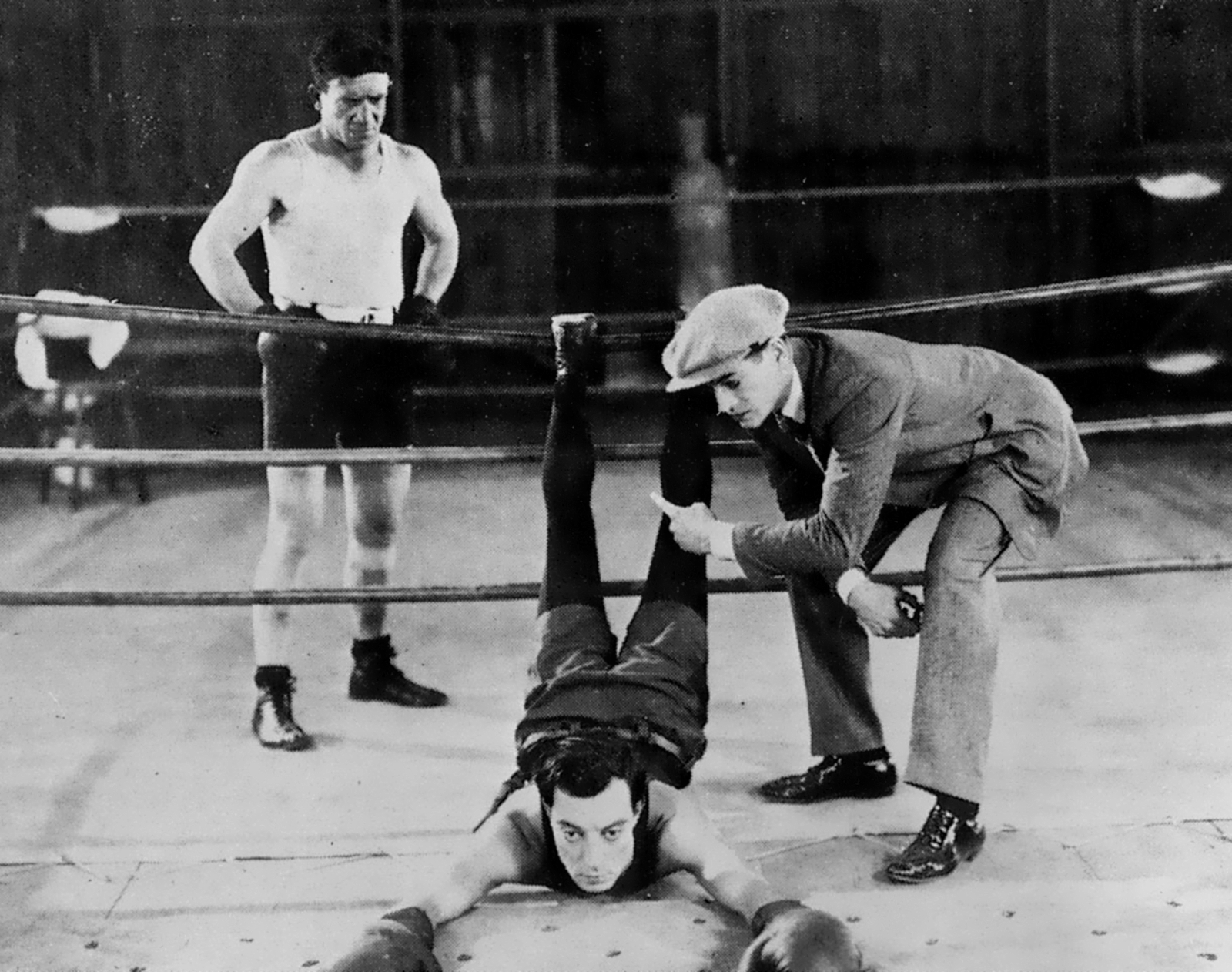
Keaton takes a pratfall in 'Battling Butler.'
Today Keaton, along with Charlie Chaplin and Harold Lloyd, stands as one of the three great clowns of the silent screen.
Many critics regard Keaton as the best of all; Roger Ebert wrote in 2002 that "in an extraordinary period from 1920 to 1929, (Keaton) worked without interruption on a series of films that make him, arguably, the greatest actor-director in the history of the movies."
As a performer, Keaton was uniquely suited to the demands of silent comedy. Born in 1895, he made his stage debut as a toddler, joining his family's knockabout vaudeville act and learning to take falls and do acrobatic stunts at an early age. He spent his entire childhood and adolescence on stage, attending school for exactly one day.
A remarkable pantomime artist, Keaton naturally used his whole body to communicate emotions ranging from sadness to surprise. In an era when movies had few special effects, Keaton's acrobatic talents meant he performed all his own stunts.
In reviving 'Battling Butler' and other great films of cinema's early years, organizers of Leavitt's silent film series aim to show classic movies as they were meant to be seen—in high quality prints, on a large screen, with live music, and with an audience.
"These are the films that first made people fall in love with the movies, and we're thrilled to present them again on the big screen," said Peter Clayton, the Leavitt's long-time owner.
The Leavitt, a summer-only moviehouse, opened in 1923 at the height of the silent film era, and has been showing movies to summertime visitors for nine decades.
The silent film series honors the theater's long service as a moviehouse that has entertained generations of Seacoast residents and visitors, in good times and in bad.
Live music for each program will be provided by Jeff Rapsis, a New Hampshire-based performer and composer who specializes in scoring silent films.
In accompanying silent films live, Rapsis uses a digital synthesizer to recreate the texture of the full orchestra. He improvises the music in real time, as the movie is shown.
In scoring a movie, Rapsis creates music to help modern movie-goers accept silent film as a vital art form rather than something antiquated or obsolete.
Other feature films in this year's series include:
• Thursday, June 23 at 8 p.m.: 'Don Q, Son of Zorro' (1925), Douglas Fairbanks Sr. stars in this sequel to his immensely popular 'Mark of Zorro,' which opened this season's silent film series.
• Thursday, July 7 at 8 p.m.: 'A Sailor-Made Man' (1921), uproarious send-up of Navy life helped establish Harold Lloyd as a top-tier silent film comic.
• Thursday, July 21 at 8 p.m.: 'Tess of the Storm Country' (1922), Mary Pickford's intense melodrama with a classic Yuletide finish. Christmas in July!
• Thursday, Aug. 11 at 8 p.m.: 'Tramp Tramp Tramp' (1926); comic Harry Langdon enters a cross-country foot race to impress his dream girl, Joan Crawford!
• Thursday, Aug. 25 at 8 p.m.: 'Son of the Sheik' (1926), final appearance of silent screen icon Rudolph Valentino on the 90th anniversary of his death.
• Thursday, Sept. 15 at 8 p.m.: 'The Winning of Barbara Worth' (1927); Ronald Colman and Gary Cooper compete for a woman's favor in this epic Western filmed on location.
• Saturday, Oct. 29 at 8 p.m.: 'The Man Who Laughs' (1928); celebrate Halloween with this creepy but riveting historical tale about a man forced to go through life with a maniacal grin.
Buster Keaton's comedy 'Battling Butler' (1926) will be shown with live music on Thursday, June 2 at 8 p.m. at the Leavitt Fine Arts Theatre, 259 Main St. Route 1, Ogunquit, Maine; (207) 646-3123; admission is $10 per person, general seating. For more information, visit www.leavittheatre.com. For more info on the music, visit www.jeffrapsis.com.
Next up: Buster Keaton's boxing comedy 'Battling Butler' (1926).
I'm doing live music for this film on Thursday, June 2 at the Leavitt Theatre in Ogunquit, Maine.
Details about the screening are in the press release below.
But one thing about this film that has always impressed me is how it shows Keaton's sure instinct for story construction.
The storyline for 'Battling Butler' was taken from a popular stage play about a meek millionaire who must train to fight a champion in the ring.
In the play, the story climaxes in the dressing room just before the fight, when the millionaire finds out he doesn't have to face the champion. Happy ending!
However, in transferring the story to the screen, Keaton knew his character and his audience well enough to know the non-fight ending just wasn't going to work.
To quote Keaton himiself in a late-in-life interview: "But we knew better than to do that to a motion-picture audience. We couldn’t promise ’em for seven reels that I was goin’ to fight in the ring and then not fight. We knew that we had to fight."
So they changed the story accordingly—and the result was Keaton's highest-grossing film of the 1920s.
Keaton in 'Battling Butler' (1926).
How did Keaton know to do this? There was no film school at the time, and Keaton never went to any traditional school, either. He spent his childhood touring in the family vaudeville act.
I suspect that over the years, he absorbed so much about how theater audiences react that his sense of what would work in a story and what wouldn't was instinctual. He just knew.
Same thing with his masterpiece, 'The General' (1926), made right after 'Battling Butler.'
Keaton structured his Civil War story to put his role on the Confederate side, because he said (again, in a late-in-life interview) "You can always make villains out of the Northerners, but you cannot make a villain out of the South."
Why? Because the South lost? I don't know.
By the way, I'm accompanying a screening of 'The General' on Friday, June 10 at Red River Theatres in Concord, N.H. More about later.
For now, I hope you'll join us this Thursday to see Buster Keaton lace up the gloves in 'Battling Butler' (1926).
The press release is below. See you there!
A vintage poster for 'Battling Butler' (1926).
TUESDAY, MAY 24, 2016 / FOR IMMEDIATE RELEASE
For more info, contact: Jeff Rapsis • (603) 236-9237 • jeffrapsis@gmail.com
Buster Keaton comedy 'Battling Butler' at Leavitt Theatre on Thursday, June 2
Classic silent film farce set in the boxing world to be screened with live music in historic downtown Ogunquit venue
OGUNQUIT, Maine—He never smiled on camera, earning him the nickname of "the Great Stone Face." But Buster Keaton's comedies rocked Hollywood's silent era with laughter throughout the 1920s.
See for yourself with a screening of 'Battling Butler' (1926), one of Keaton's landmark feature films, on Thursday, June 2 at 8 p.m. at the Leavitt Theatre, 259 Main St. Route 1, Ogunquit, Maine
The one-time screening will feature live music performed by Jeff Rapsis. Tickets are $10 per person.
In 'Battling Butler,' Keaton plays Alfred Butler, a pampered millionaire who is mistaken for a boxer with a similar name.
The mix-up gives the meek Butler the chance to pretend he's a prizefighter to impress the family of the woman he loves.
But then Keaton is forced to enter training for a high-stakes championship bout, with surprising results.
The boxing scenes gave Keaton ample opportunity to wring physical comedy out of the fight game, which at the time rivaled baseball in popularity.
Based on a story adapted from a popular stage play, 'Battling Butler' was Keaton's highest-grossing silent feature film and the high point of his 1920s stardom.
Keaton takes a pratfall in 'Battling Butler.'
Today Keaton, along with Charlie Chaplin and Harold Lloyd, stands as one of the three great clowns of the silent screen.
Many critics regard Keaton as the best of all; Roger Ebert wrote in 2002 that "in an extraordinary period from 1920 to 1929, (Keaton) worked without interruption on a series of films that make him, arguably, the greatest actor-director in the history of the movies."
As a performer, Keaton was uniquely suited to the demands of silent comedy. Born in 1895, he made his stage debut as a toddler, joining his family's knockabout vaudeville act and learning to take falls and do acrobatic stunts at an early age. He spent his entire childhood and adolescence on stage, attending school for exactly one day.
A remarkable pantomime artist, Keaton naturally used his whole body to communicate emotions ranging from sadness to surprise. In an era when movies had few special effects, Keaton's acrobatic talents meant he performed all his own stunts.
In reviving 'Battling Butler' and other great films of cinema's early years, organizers of Leavitt's silent film series aim to show classic movies as they were meant to be seen—in high quality prints, on a large screen, with live music, and with an audience.
"These are the films that first made people fall in love with the movies, and we're thrilled to present them again on the big screen," said Peter Clayton, the Leavitt's long-time owner.
The Leavitt, a summer-only moviehouse, opened in 1923 at the height of the silent film era, and has been showing movies to summertime visitors for nine decades.
The silent film series honors the theater's long service as a moviehouse that has entertained generations of Seacoast residents and visitors, in good times and in bad.
Live music for each program will be provided by Jeff Rapsis, a New Hampshire-based performer and composer who specializes in scoring silent films.
In accompanying silent films live, Rapsis uses a digital synthesizer to recreate the texture of the full orchestra. He improvises the music in real time, as the movie is shown.
In scoring a movie, Rapsis creates music to help modern movie-goers accept silent film as a vital art form rather than something antiquated or obsolete.
Other feature films in this year's series include:
• Thursday, June 23 at 8 p.m.: 'Don Q, Son of Zorro' (1925), Douglas Fairbanks Sr. stars in this sequel to his immensely popular 'Mark of Zorro,' which opened this season's silent film series.
• Thursday, July 7 at 8 p.m.: 'A Sailor-Made Man' (1921), uproarious send-up of Navy life helped establish Harold Lloyd as a top-tier silent film comic.
• Thursday, July 21 at 8 p.m.: 'Tess of the Storm Country' (1922), Mary Pickford's intense melodrama with a classic Yuletide finish. Christmas in July!
• Thursday, Aug. 11 at 8 p.m.: 'Tramp Tramp Tramp' (1926); comic Harry Langdon enters a cross-country foot race to impress his dream girl, Joan Crawford!
• Thursday, Aug. 25 at 8 p.m.: 'Son of the Sheik' (1926), final appearance of silent screen icon Rudolph Valentino on the 90th anniversary of his death.
• Thursday, Sept. 15 at 8 p.m.: 'The Winning of Barbara Worth' (1927); Ronald Colman and Gary Cooper compete for a woman's favor in this epic Western filmed on location.
• Saturday, Oct. 29 at 8 p.m.: 'The Man Who Laughs' (1928); celebrate Halloween with this creepy but riveting historical tale about a man forced to go through life with a maniacal grin.
Buster Keaton's comedy 'Battling Butler' (1926) will be shown with live music on Thursday, June 2 at 8 p.m. at the Leavitt Fine Arts Theatre, 259 Main St. Route 1, Ogunquit, Maine; (207) 646-3123; admission is $10 per person, general seating. For more information, visit www.leavittheatre.com. For more info on the music, visit www.jeffrapsis.com.
Labels:
Battling Butler,
boxing,
Buster,
Buster Keaton,
Jeff Rapsis,
Leavitt,
Leavitt Theatre,
silent film
Friday, May 27, 2016
In this corner—a summer of the 'sweet science'
of boxing on the silent screen in Wilton, N.H.
Buster Keaton in 'Battling Butler' (1926).
Even if boxing isn't your bag, I hope you'll join us for a series of silent films this summer that center on the sweet science.
Heck, even if you're not into silent film, I hope you'll check out this series. :)
It's at the Wilton (N.H.) Town Hall Theatre, where we'll run boxing-related dramas, comedies, and love stories in the coming months.
Several heavyweight filmmakers headline the action, with Alfred Hitchcock and Buster Keaton among them.
But the undercard includes many other hopefuls and wanna-bes, all eager for their shot in the ring.
First up is 'Dress Parade' (1927), a Cecil B. DeMille drama starring William Boyd as a prizefighter who falls for the daughter of a West Point Commandant.
Boyd would later go on to lasting fame as cowboy hero Hopalong Cassidy. "Dress Parade" was filmed on location at West Point, and so doubles as our annual Memorial Day weekend silent film tribute.
Actually, it's more of a military story than a boxing tale, and so it'll serve as a transition into the boxing flicks.
The screening is Sunday, May 29 at 4:30 p.m, at the Town Hall Theatre, 40 Main St., Wilton, N.H. Live music is by me.
Admission is free, with a suggested donation of $5 per person to defray expenses.
A full line-up of the other contenders in our boxing series is found in the press release below.
Taken as a whole, these movies form a time capsule into an era when boxing rivaled baseball as the nation's most popular sport.
That's no longer the case, of course, especially with today's emphasis on safety and injury prevention.
But back in the 1920s, the fight game enjoyed a national popularity that extended right down to the grassroots.
Neighborhoods, ethnic groups, you name it: every town had a fight arena, and just about everyone had a favorite fighter to root for.
And kids idolized champions such as Jack Dempsey, whose "long count" bout with Gene Tunney in 1927 was one of the era's big stories.
This popularity is reflected in the movies of the time. Watch films from the silent era, and you'll find boxing a constant presence.
Consider that all the great silent comedians—Chaplin, Keaton, Lloyd, Langdon—spent time in the prize ring.
Just last night at Red River Theatres in Concord, N.H., I introduced a screening of Chaplin's 'City Lights' (1931).
Judging from audience reaction, the superbly choreographed boxing scene was the highlight of the evening.
So boxing, and the struggle it symbolized, was regarded as part of everyday life.
Moreover, boxing was visual. Words weren't necessary to tell the story of two men pushed to their physical limits and striving to beat each other into submission.
So moviemakers were naturally inclined to use boxing and its world as a setting for their stories.
By the way, I say "men" because at the time, boxing was completely male-dominated. Female boxing, if it occurred at all, was considered a novelty. In an era of sharply defined gender roles, a woman just didn't do such things as fight in the ring.
Surprisingly, female boxing does show up in some silent films, although usually as a gimmick. One example is Clara Bow's 'Roughhouse Rosie' (1927), in which Bow gets her men "by treating them rough!" It's a film that, alas, no longer survives.
Clara Bow in 'Roughhouse Rosie.'
Filmmakers also sometimes used boxing's raw physicality to punch up the visuals, so to speak.
There's a remarkable night club scene in Fritz Lang's film 'Spies' (1928) where two boxers in a makeshift ring beat each other senseless while a glittering society crowd looks on.
From Fritz Lang's 'Spies' (1928).
When one finally succumbs, a band strikes up, and dancing couples immediately crowd onto the floor to foxtrot. Among them are the protagonist and the mysterious woman he is battling, so I can see where Lang was going.
Well, boxing is no longer mainstream. But the elemental nature of the sport retains its fascination, I think, and also its status as a vivid metaphor for—well, everything.
It's sport reduced to its essence: two competitors facing each other in a battle for victory. What could be simpler?
And it was George Foreman who observed that boxing is "the sport to which all other sports aspire."
It continues to inspire writers, including Joyce Carol Oates, whose "On Boxing" is a minor modern classic, I think.
And it's still with us. Even if you've never set foot in a fight arena, you've used the language and imagery of boxing, which pervades everyday conversation.
Consider: a beautiful woman is a knockout. A supportive friend is in your corner.
To persevere is to go the distance. A setback is a body blow. To give up is to throw in the towel.
All these are boxing phrases.
To do something against the rules is hitting below the belt. And if you want to really hurt someone, the gloves come off.
That last phrase is a strange one. In boxing, the gloves actually allow more damage because they protect a fighter's hands.
I once thought to show someone the ropes was a boxing phrase, but it actually comes from sailing.
Well, whatever phrasing you use...I find that in a complex world of uncertainties and interdependencies and compromises, the direct simplicity of boxing can be refreshing.
I'm no fan of violence, and don't wish a concussion on anyone.
But to me, boxing is a way for us to explore and express the aggressive side of our nature. Just as the simplicity of silent film allows us to reconnect with big primal emotions, boxing allows us to experience being alive in a physical way that's intense and riveting and unlike any other.
The bell rings this weekend with 'Dress Parade' on Sunday, May 29 at 4:30 p.m. at the Town Hall Theatre in Wilton, N.H. Below is the press release with info about other films in the series.
On the fight card: Hitchcock's early drama 'The Ring' (1927).
WEDNESDAY, MAY 11, 2016 / FOR IMMEDIATE RELEASE
Contact Jeff Rapsis • (603) 236-9237 • jeffrapsis@gmail.com
Bell rings this summer on line-up of silent films spotlighting the fight game; all screened with live musical accompaniment
WILTON, N.H.—Alfred Hitchcock and Buster Keaton are among filmmakers featured in a summer series of vintage boxing movies at the Town Hall Theatre.
The series opens on Memorial Day weekend with a screening on Sunday, May 29 of 'Dress Parade' (1927), a drama filmed on location at the U.S. Military Academy at West Point.
All movies in the series are from the silent film era, and will be presented with live music by Jeff Rapsis, a New Hampshire-based silent film accompanist.
"At the time these films were made, boxing rivaled baseball in mainstream popularity in the United States," Rapsis said. "So early on, filmmakers naturally turned to the boxing world as a great source of drama, action, and visual excitement. In the silent era, it was a popular sub-genre."
The boxing films are part of the Wilton Town Hall Theatre's ongoing monthly silent film series. Admission to the screenings is free; a donation of $5 per person is suggested.
The Town Hall Theatre's "Summer Boxing Series" opens on Sunday, May 29 at 4:30 p.m. with 'Dress Parade' (1927).
Produced by Cecil B. Demille and released by MGM, 'Dress Parade' is the story of an amateur boxer who enrolls in West Point, where he must battle for the affection of the Commandant's daughter.
The film stars a young William Boyd, who would later achieve enduring fame as Hopalong Cassidy in countless Hollywood Westerns.
'Dress Parade' includes scenes filmed on location at West Point, which prompted its screening on Memorial Day weekend.
Other titles in the Summer Boxing Series include Alfred Hitchcock's early boxing drama 'The Ring' (1927) on Sunday, July 24.
A scene from Hitchcock's 'The Ring.'
"Hitchcock's drama of two fighters in love with the same woman shows many of the characteristics that would later earn him the nickname 'The Master of Suspense,' " Rapsis said.
The series concludes on Sunday, Aug. 28 with 'Battling Butler' (1926), Buster Keaton's uproarious boxing comedy about a pampered millionaire mistaken for a champion fighter.
The series will also include several vintage boxing-themed short films.
Silent-era boxing dramas are of particular interest to sports buffs because they're filled with scenes of the fight game at the height of its mainstream popularity.
"As an elemental contest between two people, boxing inspired early filmmakers to do some of their best work," Rapsis said. "It's a very visual sport that lends itself to the movies."
All shows in the silent film series start at 4:30 p.m. The Town Hall Theatre's screenings are free and open to the public; a donation of $5 per person is suggested to help defray expenses.
Each film in the series has been selected for its overall story quality and lasting audience appeal.
"Even if you're not a boxing fan, each of these movies offers a great story told at a fast pace," Rapsis said. "These films were designed to be crowd-pleasers, and they still work today. They're the kind of films that caused audiences to first fall in love with the movies."
The Wilton Town Hall Theatre has been showing films since 1912. In addition to running the best current releases on its two screens, the theater remains committed to alternative programming such as its ongoing series of silent films with live music.
The silent series gives local audiences to experience great work of early cinema as it was intended to be seen: on the big screen, with live music, and with an audience.
The complete line-up of films in this summer's boxing series includes:
• Sunday, May 29, 4:30 p.m.: 'Dress Parade' (1927) starring William Boyd, Bessie Love. An amateur boxing champ visits the U.S. Military Academy and falls for the commandant's daughter. He wins an appointment to the Academy and then begins a rivalry for her affection. Our annual Memorial Day weekend program, filmed on location at West Point!
• Sunday, July 3, 4:30 p.m.: A Boxing Double Feature. A two-fisted pair of vintage silent boxing tales. In 'Battling Bunyan' (1924), a young mechanic turns to the prize ring to earn money to start his auto repair business; in 'The Shock Punch' (1925), a boxer takes a construction job only to find his boss is a former opponent he once defeated in the ring.
ADDITIONAL SHOW! • Sunday, July 17, 4:30 p.m.: Melodramas that Pack a Punch! Up first is 'The Battling Fool' (1924), in which a minister's son takes up boxing. In 'American Pluck' (1925), a cowboy-turned-prizefighter comes to the rescue of a visiting foreign princess.
• Sunday, July 24, 4:30 p.m.: 'The Ring' (1927) directed by Alfred Hitchcock. The master of suspense was very young, and still in England, when he made this silent drama about two boxers in love with the same woman. Who will win the fight for her heart? Full of trademark Hitchcock touches even at this early stage in his career.
• Sunday, Aug. 28, 4:30 p.m.: 'Battling Butler' (1926) starring Buster Keaton. Our series of silent boxing movies concludes with Keaton's riotous comedy. Keaton plays Alfred Butler, a pampered rich idler with the same name as a feared boxing champion. When a girl he fancies thinks he's the fighter, Keaton has no choice but to start training.
The Summer Silent Boxing Film Series will begin with a screening of 'Dress Parade' (1927) on Sunday, May 29 at 4:30 p.m. at the Wilton Town Hall Theatre, 60 Main St., Wilton, N.H. Admission is free; a donation of $5 per person is suggested.
For more info, call (603) 654-3456 or visit www.wiltontownhalltheatre.com. For more info on the music, visit www.jeffrapsis.com.
Even if boxing isn't your bag, I hope you'll join us for a series of silent films this summer that center on the sweet science.
Heck, even if you're not into silent film, I hope you'll check out this series. :)
It's at the Wilton (N.H.) Town Hall Theatre, where we'll run boxing-related dramas, comedies, and love stories in the coming months.
Several heavyweight filmmakers headline the action, with Alfred Hitchcock and Buster Keaton among them.
But the undercard includes many other hopefuls and wanna-bes, all eager for their shot in the ring.
First up is 'Dress Parade' (1927), a Cecil B. DeMille drama starring William Boyd as a prizefighter who falls for the daughter of a West Point Commandant.
Boyd would later go on to lasting fame as cowboy hero Hopalong Cassidy. "Dress Parade" was filmed on location at West Point, and so doubles as our annual Memorial Day weekend silent film tribute.
Actually, it's more of a military story than a boxing tale, and so it'll serve as a transition into the boxing flicks.
The screening is Sunday, May 29 at 4:30 p.m, at the Town Hall Theatre, 40 Main St., Wilton, N.H. Live music is by me.
Admission is free, with a suggested donation of $5 per person to defray expenses.
A full line-up of the other contenders in our boxing series is found in the press release below.
Taken as a whole, these movies form a time capsule into an era when boxing rivaled baseball as the nation's most popular sport.
That's no longer the case, of course, especially with today's emphasis on safety and injury prevention.
But back in the 1920s, the fight game enjoyed a national popularity that extended right down to the grassroots.
Neighborhoods, ethnic groups, you name it: every town had a fight arena, and just about everyone had a favorite fighter to root for.
And kids idolized champions such as Jack Dempsey, whose "long count" bout with Gene Tunney in 1927 was one of the era's big stories.
This popularity is reflected in the movies of the time. Watch films from the silent era, and you'll find boxing a constant presence.
Consider that all the great silent comedians—Chaplin, Keaton, Lloyd, Langdon—spent time in the prize ring.
Just last night at Red River Theatres in Concord, N.H., I introduced a screening of Chaplin's 'City Lights' (1931).
Judging from audience reaction, the superbly choreographed boxing scene was the highlight of the evening.
So boxing, and the struggle it symbolized, was regarded as part of everyday life.
Moreover, boxing was visual. Words weren't necessary to tell the story of two men pushed to their physical limits and striving to beat each other into submission.
So moviemakers were naturally inclined to use boxing and its world as a setting for their stories.
By the way, I say "men" because at the time, boxing was completely male-dominated. Female boxing, if it occurred at all, was considered a novelty. In an era of sharply defined gender roles, a woman just didn't do such things as fight in the ring.
Surprisingly, female boxing does show up in some silent films, although usually as a gimmick. One example is Clara Bow's 'Roughhouse Rosie' (1927), in which Bow gets her men "by treating them rough!" It's a film that, alas, no longer survives.
Clara Bow in 'Roughhouse Rosie.'
Filmmakers also sometimes used boxing's raw physicality to punch up the visuals, so to speak.
There's a remarkable night club scene in Fritz Lang's film 'Spies' (1928) where two boxers in a makeshift ring beat each other senseless while a glittering society crowd looks on.
From Fritz Lang's 'Spies' (1928).
When one finally succumbs, a band strikes up, and dancing couples immediately crowd onto the floor to foxtrot. Among them are the protagonist and the mysterious woman he is battling, so I can see where Lang was going.
Well, boxing is no longer mainstream. But the elemental nature of the sport retains its fascination, I think, and also its status as a vivid metaphor for—well, everything.
It's sport reduced to its essence: two competitors facing each other in a battle for victory. What could be simpler?
And it was George Foreman who observed that boxing is "the sport to which all other sports aspire."
It continues to inspire writers, including Joyce Carol Oates, whose "On Boxing" is a minor modern classic, I think.
And it's still with us. Even if you've never set foot in a fight arena, you've used the language and imagery of boxing, which pervades everyday conversation.
Consider: a beautiful woman is a knockout. A supportive friend is in your corner.
To persevere is to go the distance. A setback is a body blow. To give up is to throw in the towel.
All these are boxing phrases.
To do something against the rules is hitting below the belt. And if you want to really hurt someone, the gloves come off.
That last phrase is a strange one. In boxing, the gloves actually allow more damage because they protect a fighter's hands.
I once thought to show someone the ropes was a boxing phrase, but it actually comes from sailing.
Well, whatever phrasing you use...I find that in a complex world of uncertainties and interdependencies and compromises, the direct simplicity of boxing can be refreshing.
I'm no fan of violence, and don't wish a concussion on anyone.
But to me, boxing is a way for us to explore and express the aggressive side of our nature. Just as the simplicity of silent film allows us to reconnect with big primal emotions, boxing allows us to experience being alive in a physical way that's intense and riveting and unlike any other.
The bell rings this weekend with 'Dress Parade' on Sunday, May 29 at 4:30 p.m. at the Town Hall Theatre in Wilton, N.H. Below is the press release with info about other films in the series.
On the fight card: Hitchcock's early drama 'The Ring' (1927).
WEDNESDAY, MAY 11, 2016 / FOR IMMEDIATE RELEASE
Contact Jeff Rapsis • (603) 236-9237 • jeffrapsis@gmail.com
Put up your dukes! Wilton (N.H.) Town Hall Theatre to screen series of vintage boxing movies
Bell rings this summer on line-up of silent films spotlighting the fight game; all screened with live musical accompaniment
WILTON, N.H.—Alfred Hitchcock and Buster Keaton are among filmmakers featured in a summer series of vintage boxing movies at the Town Hall Theatre.
The series opens on Memorial Day weekend with a screening on Sunday, May 29 of 'Dress Parade' (1927), a drama filmed on location at the U.S. Military Academy at West Point.
All movies in the series are from the silent film era, and will be presented with live music by Jeff Rapsis, a New Hampshire-based silent film accompanist.
"At the time these films were made, boxing rivaled baseball in mainstream popularity in the United States," Rapsis said. "So early on, filmmakers naturally turned to the boxing world as a great source of drama, action, and visual excitement. In the silent era, it was a popular sub-genre."
The boxing films are part of the Wilton Town Hall Theatre's ongoing monthly silent film series. Admission to the screenings is free; a donation of $5 per person is suggested.
The Town Hall Theatre's "Summer Boxing Series" opens on Sunday, May 29 at 4:30 p.m. with 'Dress Parade' (1927).
Produced by Cecil B. Demille and released by MGM, 'Dress Parade' is the story of an amateur boxer who enrolls in West Point, where he must battle for the affection of the Commandant's daughter.
The film stars a young William Boyd, who would later achieve enduring fame as Hopalong Cassidy in countless Hollywood Westerns.
'Dress Parade' includes scenes filmed on location at West Point, which prompted its screening on Memorial Day weekend.
Other titles in the Summer Boxing Series include Alfred Hitchcock's early boxing drama 'The Ring' (1927) on Sunday, July 24.
A scene from Hitchcock's 'The Ring.'
"Hitchcock's drama of two fighters in love with the same woman shows many of the characteristics that would later earn him the nickname 'The Master of Suspense,' " Rapsis said.
The series concludes on Sunday, Aug. 28 with 'Battling Butler' (1926), Buster Keaton's uproarious boxing comedy about a pampered millionaire mistaken for a champion fighter.
The series will also include several vintage boxing-themed short films.
Silent-era boxing dramas are of particular interest to sports buffs because they're filled with scenes of the fight game at the height of its mainstream popularity.
"As an elemental contest between two people, boxing inspired early filmmakers to do some of their best work," Rapsis said. "It's a very visual sport that lends itself to the movies."
All shows in the silent film series start at 4:30 p.m. The Town Hall Theatre's screenings are free and open to the public; a donation of $5 per person is suggested to help defray expenses.
Each film in the series has been selected for its overall story quality and lasting audience appeal.
"Even if you're not a boxing fan, each of these movies offers a great story told at a fast pace," Rapsis said. "These films were designed to be crowd-pleasers, and they still work today. They're the kind of films that caused audiences to first fall in love with the movies."
The Wilton Town Hall Theatre has been showing films since 1912. In addition to running the best current releases on its two screens, the theater remains committed to alternative programming such as its ongoing series of silent films with live music.
The silent series gives local audiences to experience great work of early cinema as it was intended to be seen: on the big screen, with live music, and with an audience.
The complete line-up of films in this summer's boxing series includes:
• Sunday, May 29, 4:30 p.m.: 'Dress Parade' (1927) starring William Boyd, Bessie Love. An amateur boxing champ visits the U.S. Military Academy and falls for the commandant's daughter. He wins an appointment to the Academy and then begins a rivalry for her affection. Our annual Memorial Day weekend program, filmed on location at West Point!
• Sunday, July 3, 4:30 p.m.: A Boxing Double Feature. A two-fisted pair of vintage silent boxing tales. In 'Battling Bunyan' (1924), a young mechanic turns to the prize ring to earn money to start his auto repair business; in 'The Shock Punch' (1925), a boxer takes a construction job only to find his boss is a former opponent he once defeated in the ring.
ADDITIONAL SHOW! • Sunday, July 17, 4:30 p.m.: Melodramas that Pack a Punch! Up first is 'The Battling Fool' (1924), in which a minister's son takes up boxing. In 'American Pluck' (1925), a cowboy-turned-prizefighter comes to the rescue of a visiting foreign princess.
• Sunday, July 24, 4:30 p.m.: 'The Ring' (1927) directed by Alfred Hitchcock. The master of suspense was very young, and still in England, when he made this silent drama about two boxers in love with the same woman. Who will win the fight for her heart? Full of trademark Hitchcock touches even at this early stage in his career.
• Sunday, Aug. 28, 4:30 p.m.: 'Battling Butler' (1926) starring Buster Keaton. Our series of silent boxing movies concludes with Keaton's riotous comedy. Keaton plays Alfred Butler, a pampered rich idler with the same name as a feared boxing champion. When a girl he fancies thinks he's the fighter, Keaton has no choice but to start training.
The Summer Silent Boxing Film Series will begin with a screening of 'Dress Parade' (1927) on Sunday, May 29 at 4:30 p.m. at the Wilton Town Hall Theatre, 60 Main St., Wilton, N.H. Admission is free; a donation of $5 per person is suggested.
For more info, call (603) 654-3456 or visit www.wiltontownhalltheatre.com. For more info on the music, visit www.jeffrapsis.com.
Tuesday, May 24, 2016
Finding a brass band with wings while en route
to the Library of Congress Packard Campus
Hey! There's a brass band in my gate area!
Getting my shoes shined this past weekend led to an unexpectedly moving experience—partly musical, and entirely human.
It was Saturday, 7:30 a.m. at National Airport in Washington, D.C. I had just flown in, on my way to do silent film accompaniment at the Library of Congress that day.
My dress shoes were looking pretty shabby. Why hadn't I shined them? Because the C Concourse at National Airport boasts one of one of the best shoe-shine operations around, and I was saving myself if they were open.
They were! And no line. So I walked in, climbed up on the raised chair, and the age-old ritual commenced.
While sitting there, the usual airline terminal white noise washed up against my ears: the murmur of passengers, the shrill boarding calls, the pre-recorded security announcements. Background noise you don't even notice.
But then I heard something that caught my attention because it didn't fit in at all. It sounded like the rat-a-tat-tat of a snare drum!
And not from a speaker, either. From an actual snare drum that wasn't too far away, from the sound of it.
Rented a tent! Rented a tent! Rented a rented a tent!
This was followed by the brassy tones of a trombone warming up, and then a clarinet, and other instruments that brought me back to my own band days.
It felt like we were getting ready for Circus Night with the American Legion Post 48 Band in the parking lot of Simoneau Plaza in Nashua, N.H. Where was my tuba?
Being still in mid-shine, I couldn't see what was going on. But it sure sounded to me like an ensemble tuning up prior to, say, a football game or parade.
In an airport concourse?
And it all somehow seemed fitting, as I've recently been rereading the Charles Ives biography by Jan Swafford, and other stuff on Ives. He's a composer close to my heart since I did a research paper on him in 10th grade.
Ives had the same small town New England background I did—one full of marching bands and church hymns and music lessons. (He didn't have Warners Bros. cartoons, though.)
Later, Ives wrote: "In 'thinking up' music I usually have some kind of a brass band with wings on it."
That's the sound I was hearing out in the corridor, coming from somewhere: the racket of a band warming up. Why? How come?
As soon as my shoes were shiny, I went to find out.
Across the corridor, packed into most of the space for Gate 36, was a full concert band, music stands and all. And it looked they were about to play!
And so they did: a medley of World War II songs in big band style. Tunes included 'White Cliffs of Dover' and 'Thanks for the Memories.'
I still didn't get what was going on. What would prompt a band to crowd itself into an airport gate on a rainy Saturday morning? How did the bass tuba clear security?
But the sheer unlikeliness of it all appealed to me, so I figured I'd stick around to hear some music.
What was going on, of course, was that they were there to welcome the impending arrival of an "Honor Flight" of U.S. veterans due in soon from Fort Myers, Fla.
The Honor Flight program brings veterans to the nation's capital at no charge to visit the monuments to their service. I'd heard of it, but never seen it in action.
That was about to change. Soon an honor guard of active duty military personnel assembled in the gate area, flags included. Joining them were several dozen civilians holding WELCOME and THANK YOU signs, and even a passel of cheerleaders carrying pom poms.
And the band? Turns out it was the Main Street Community Band from Fairfax, Va., under the capable leadership of Geoffrey K. Steffens. Even in a challenging acoustical environment, they sounded great.
The warm-up session was cut short by the need to get passengers on a flight to Minneapolis out of Gate 36. But that set the stage for the arrival of the Honor Flight, an American Airlines jet carrying 150 vets not only from World War II, but also Korea and Vietnam.
With the gate clear, the band resumed playing. P.A. announcements that the Honor Flight had landed further swelled the crowd. I found myself getting caught up in the moment. It was really quite moving to see all this being done to welcome vets to the nation's capital.
It's always a joy to see things done well, and this was a class act all the way!
The flight then pulled up. And the vets themselves didn't disappoint.
Emerging from the jetway, many in wheelchairs, each was greeted by a crush of well-wishers as the band kept playing patriotic marches and all of us applauded continuously. You couldn't ask for a warmer welcome—a hero's welcome, really.
Some of the vets laughed. Some posed for pictures. And a few just began flat-out sobbing. All the time that had passed, all the people that never made it, either back then or who were lost along the way—all of it carried forward to this moment of getting off a plane and being honored for what you and so many others did, in some cases so long ago.
What a panorama of emotions on parade—and all on a Saturday before 9 a.m.!
I couldn't help but think of how my father (himself a World War II vet) was famous for choking up at the sound of a Sousa march. There's a little of that in me, I think.
It all made for great theater, not just because of the veterans but because of everyone who was part of the scene. For a little while, a bunch of passing strangers, plus the Main Street Community Band of Fairfax, Va., all came together to bring about one of those shared experiences that are a big part of what life is all about.
A brass band with wings, indeed!
And to me, the sheer randomness of it was exactly what life has always felt like. One minute you're getting your shoes shined. The next, you're applauding members of the Greatest Generation as a band in an airport gate area plays the Guadalcanal March.
And to think I'd have missed it if I'd worn sneakers.
After a half-hour, veterans were still emerging from the plane. I lingered as long as I could, but then had to get on my way to Culpeper, Va. and the Packard Campus, home to the National Audio Visual Conservation Center of the Library of Congress.
The public entrance to the Packard Center.
It was a rainy day: a good one to spend the afternoon in a darkened theater. I was there to do music for two programs honoring Dennis R. Atkinson, donor of more than 350 films to the LOC since 1969.
Asked what title of his he most wanted to see, Atkinson had replied with one word: "Mawas," the first film he turned over to the LOC. So a private screening of it was arranged at noon for Dennis and his family.
There was absolutely no information available on this film from any source I checked, so I was curious what it could be.
I arrived about 11:30 a.m. to find the order of the reels being sorted out by running them on screen: scenes of jungle explorers stalking a leopard, or possibly vice versa.
Turns out 'Mawas' was something of a stock footage festival. Someone had shot about ten minutes of guys sitting around a campfire somewhere out in the American West, swapping tales of far-off jungle lands. And the rest of the film was footage taken from other sources.
I swear some of the footage was from 'Chang' (1927), a much more well known "jungle" picture that earned an Academy Award for "Unique and Artistic Production" at the first-ever Oscars, and which fueled the demand for lesser efforts such as 'Mawas.'
Still, the print looked great, and it was fun to create music as the "drama" unfolded. Once I recognized the flashback structure and episodic nature of the film, it wasn't hard gauge the music to help make it work.
I actually got kinda lost in the film, and worked up some big stuff as it built to something of a climax. So it was a little weird for the film to end, the lights to come up—and to have just four people in the theater.
Many more turned out for the "public" program at 2 p.m.: three obscure comedy shorts and 'Twisted Triggers' (1926), a melodramatic Western.
Having had the chance to warm up and get comfortable at the keyboard with 'Mawas,' I found myself more than ready for the rapid-fire comedy shorts, which were quite good.
Notable was 'Ko Koo Kids,' which turned out to be a satire on the Ku Klux Klan, with members of a KKK-like group attempting to lynch the local schoolmaster for alleged hanky-panky with a young girl.
Lots of alarming stuff in this one, but I had the presence of mind to swing into 'Ride of the Valkyries' when the townsfolk began donning white robes and hoods and jumping on horses.
Speaking of horses: I really got into 'Twisted Triggers,' the featured attraction. Released by "Action Pictures," it lived up to its name, packed with one thrilling scene after another.
This posses a challenge for the accompanist, in the sense that usually any movie has at least a few slower-paced scenes, which help you pace yourself and provide contrast to the action sequences.
Not 'Twisted Triggers!' Any time things slowed down for what seemed to be a quiet scene, someone jumped on a horse and rode off to take care of some life-or-death situation.
A rare scene without a horse in 'Twisted Triggers.'
So I did my best to keep up, always holding back at least a little so I'd still have somewhere to go. It was only when the good guy and the bad guy wound up off their horses to fight one-on-one in a river that I felt we were at the true climax, which was my green light to go all out.
This time there were people when the lights came up, and response was generous.
While in mid-film, I'm often not sure how what I do comes across. But at the Atkinson screenings, I did feel I gave it my all, and that's a good feeling to have when the lights come up.
Afterwards, Mr. Atkinson seemed delighted by the whole afternoon. It was a treat to talk with him and thank him for his donations over such a long span.
Thanks to everyone at the Library of Congress for bringing me down to help with this one, especially Rob Stone, George Willeman, and Mike Mashon. Looking forward to being down there next month for 'Mostly Lost.'
Getting my shoes shined this past weekend led to an unexpectedly moving experience—partly musical, and entirely human.
It was Saturday, 7:30 a.m. at National Airport in Washington, D.C. I had just flown in, on my way to do silent film accompaniment at the Library of Congress that day.
My dress shoes were looking pretty shabby. Why hadn't I shined them? Because the C Concourse at National Airport boasts one of one of the best shoe-shine operations around, and I was saving myself if they were open.
They were! And no line. So I walked in, climbed up on the raised chair, and the age-old ritual commenced.
While sitting there, the usual airline terminal white noise washed up against my ears: the murmur of passengers, the shrill boarding calls, the pre-recorded security announcements. Background noise you don't even notice.
But then I heard something that caught my attention because it didn't fit in at all. It sounded like the rat-a-tat-tat of a snare drum!
And not from a speaker, either. From an actual snare drum that wasn't too far away, from the sound of it.
Rented a tent! Rented a tent! Rented a rented a tent!
This was followed by the brassy tones of a trombone warming up, and then a clarinet, and other instruments that brought me back to my own band days.
It felt like we were getting ready for Circus Night with the American Legion Post 48 Band in the parking lot of Simoneau Plaza in Nashua, N.H. Where was my tuba?
Being still in mid-shine, I couldn't see what was going on. But it sure sounded to me like an ensemble tuning up prior to, say, a football game or parade.
In an airport concourse?
And it all somehow seemed fitting, as I've recently been rereading the Charles Ives biography by Jan Swafford, and other stuff on Ives. He's a composer close to my heart since I did a research paper on him in 10th grade.
Ives had the same small town New England background I did—one full of marching bands and church hymns and music lessons. (He didn't have Warners Bros. cartoons, though.)
Later, Ives wrote: "In 'thinking up' music I usually have some kind of a brass band with wings on it."
That's the sound I was hearing out in the corridor, coming from somewhere: the racket of a band warming up. Why? How come?
As soon as my shoes were shiny, I went to find out.
Across the corridor, packed into most of the space for Gate 36, was a full concert band, music stands and all. And it looked they were about to play!
And so they did: a medley of World War II songs in big band style. Tunes included 'White Cliffs of Dover' and 'Thanks for the Memories.'
I still didn't get what was going on. What would prompt a band to crowd itself into an airport gate on a rainy Saturday morning? How did the bass tuba clear security?
But the sheer unlikeliness of it all appealed to me, so I figured I'd stick around to hear some music.
What was going on, of course, was that they were there to welcome the impending arrival of an "Honor Flight" of U.S. veterans due in soon from Fort Myers, Fla.
The Honor Flight program brings veterans to the nation's capital at no charge to visit the monuments to their service. I'd heard of it, but never seen it in action.
That was about to change. Soon an honor guard of active duty military personnel assembled in the gate area, flags included. Joining them were several dozen civilians holding WELCOME and THANK YOU signs, and even a passel of cheerleaders carrying pom poms.
And the band? Turns out it was the Main Street Community Band from Fairfax, Va., under the capable leadership of Geoffrey K. Steffens. Even in a challenging acoustical environment, they sounded great.
The warm-up session was cut short by the need to get passengers on a flight to Minneapolis out of Gate 36. But that set the stage for the arrival of the Honor Flight, an American Airlines jet carrying 150 vets not only from World War II, but also Korea and Vietnam.
With the gate clear, the band resumed playing. P.A. announcements that the Honor Flight had landed further swelled the crowd. I found myself getting caught up in the moment. It was really quite moving to see all this being done to welcome vets to the nation's capital.
It's always a joy to see things done well, and this was a class act all the way!
The flight then pulled up. And the vets themselves didn't disappoint.
Emerging from the jetway, many in wheelchairs, each was greeted by a crush of well-wishers as the band kept playing patriotic marches and all of us applauded continuously. You couldn't ask for a warmer welcome—a hero's welcome, really.
Some of the vets laughed. Some posed for pictures. And a few just began flat-out sobbing. All the time that had passed, all the people that never made it, either back then or who were lost along the way—all of it carried forward to this moment of getting off a plane and being honored for what you and so many others did, in some cases so long ago.
What a panorama of emotions on parade—and all on a Saturday before 9 a.m.!
I couldn't help but think of how my father (himself a World War II vet) was famous for choking up at the sound of a Sousa march. There's a little of that in me, I think.
It all made for great theater, not just because of the veterans but because of everyone who was part of the scene. For a little while, a bunch of passing strangers, plus the Main Street Community Band of Fairfax, Va., all came together to bring about one of those shared experiences that are a big part of what life is all about.
A brass band with wings, indeed!
And to me, the sheer randomness of it was exactly what life has always felt like. One minute you're getting your shoes shined. The next, you're applauding members of the Greatest Generation as a band in an airport gate area plays the Guadalcanal March.
And to think I'd have missed it if I'd worn sneakers.
After a half-hour, veterans were still emerging from the plane. I lingered as long as I could, but then had to get on my way to Culpeper, Va. and the Packard Campus, home to the National Audio Visual Conservation Center of the Library of Congress.
The public entrance to the Packard Center.
It was a rainy day: a good one to spend the afternoon in a darkened theater. I was there to do music for two programs honoring Dennis R. Atkinson, donor of more than 350 films to the LOC since 1969.
Asked what title of his he most wanted to see, Atkinson had replied with one word: "Mawas," the first film he turned over to the LOC. So a private screening of it was arranged at noon for Dennis and his family.
There was absolutely no information available on this film from any source I checked, so I was curious what it could be.
I arrived about 11:30 a.m. to find the order of the reels being sorted out by running them on screen: scenes of jungle explorers stalking a leopard, or possibly vice versa.
Turns out 'Mawas' was something of a stock footage festival. Someone had shot about ten minutes of guys sitting around a campfire somewhere out in the American West, swapping tales of far-off jungle lands. And the rest of the film was footage taken from other sources.
I swear some of the footage was from 'Chang' (1927), a much more well known "jungle" picture that earned an Academy Award for "Unique and Artistic Production" at the first-ever Oscars, and which fueled the demand for lesser efforts such as 'Mawas.'
Still, the print looked great, and it was fun to create music as the "drama" unfolded. Once I recognized the flashback structure and episodic nature of the film, it wasn't hard gauge the music to help make it work.
I actually got kinda lost in the film, and worked up some big stuff as it built to something of a climax. So it was a little weird for the film to end, the lights to come up—and to have just four people in the theater.
Many more turned out for the "public" program at 2 p.m.: three obscure comedy shorts and 'Twisted Triggers' (1926), a melodramatic Western.
Having had the chance to warm up and get comfortable at the keyboard with 'Mawas,' I found myself more than ready for the rapid-fire comedy shorts, which were quite good.
Notable was 'Ko Koo Kids,' which turned out to be a satire on the Ku Klux Klan, with members of a KKK-like group attempting to lynch the local schoolmaster for alleged hanky-panky with a young girl.
Lots of alarming stuff in this one, but I had the presence of mind to swing into 'Ride of the Valkyries' when the townsfolk began donning white robes and hoods and jumping on horses.
Speaking of horses: I really got into 'Twisted Triggers,' the featured attraction. Released by "Action Pictures," it lived up to its name, packed with one thrilling scene after another.
This posses a challenge for the accompanist, in the sense that usually any movie has at least a few slower-paced scenes, which help you pace yourself and provide contrast to the action sequences.
Not 'Twisted Triggers!' Any time things slowed down for what seemed to be a quiet scene, someone jumped on a horse and rode off to take care of some life-or-death situation.
A rare scene without a horse in 'Twisted Triggers.'
So I did my best to keep up, always holding back at least a little so I'd still have somewhere to go. It was only when the good guy and the bad guy wound up off their horses to fight one-on-one in a river that I felt we were at the true climax, which was my green light to go all out.
This time there were people when the lights came up, and response was generous.
While in mid-film, I'm often not sure how what I do comes across. But at the Atkinson screenings, I did feel I gave it my all, and that's a good feeling to have when the lights come up.
Afterwards, Mr. Atkinson seemed delighted by the whole afternoon. It was a treat to talk with him and thank him for his donations over such a long span.
Thanks to everyone at the Library of Congress for bringing me down to help with this one, especially Rob Stone, George Willeman, and Mike Mashon. Looking forward to being down there next month for 'Mostly Lost.'
Wednesday, May 11, 2016
Accompanying 'The Square Deal Man'
at ... wait, where is this place again?
Show yer cards, stranger!
Had a great time out in Niles, Calif. this weekend doing music for 'The Square Deal Man' (1917), a typically grim William S. Hart western.
The show was Saturday, May 7 at the venerable Niles Essanay Silent Film Museum.
That afternoon, I stopped by the museum to find myself pressed into service manning the front counter while a tour was given to a visiting group.
I was there long enough to give a phone caller bad info about using public transportation to reach the Museum. But he called back later, and all was sorted out.
I usually confine my damage to the keyboard, thank you very much.
As is often the case at Niles, the evening program opened with a pair of short comedies.
First up was 'Two-Gun Gussie' (1918), an early Lloyd "glasses character" one-reeler notable for its beginning.
The film opens with a close-up of hands on a piano keyboard in the midst of playing something devilishly complicated.
We discover it's Harold, a concert pianist. In full Paderewski mode, he wows the ladies by flinging himself at the keyboard, pausing for drama, and displaying a technique worthy of Chico Marx.
Harold tickles the ivories in 'Two-Gun Gussie.'
For this, I basically improvised a dissonant farrago on the opening theme of Beethoven's 5th Symphony, doing my best to match Lloyd's flamboyant gestures.
But I have to wonder how musicians handled this when the film was brand new, almost a century ago now. Probably the same way: not so much music but some kind of concert-hall sonic chaos to help the humor come across.
More challenging was 'Curses' (1925) a two-reel Al St. John parody of dramatic serials that even then were seen as full of clichés and conventions.
In scoring a film, I usually steer clear of what the general public might think of as "silent film music"—you know, that over-dramatic jangly piano sound.
But in this case, the goofy satire cried out for exactly that. So off I went, channeling all the Dudley Do-right music I recall absorbing as a child.
The best thing about this frantic parody (directed by no less than Roscoe 'Fatty' Arbuckle under the pseudonym William Goodrich) is how it's broken into several chapters, just like a real serial.
Although instead of waiting until next week, we just have to wait a few seconds for the film to resume. It's very well done and lends a meta-air to the film that comes across as knowing and snarky even today.
I'm familiar with this film in a DVD version produced by Paul Gierucki, which comes with intertitles that really punch up the comedy, I think.
However, Niles showed an older 16mm print with intertitles that lacked the same impact, I felt.
I don't believe either set of intertitles was original to 'Curses.'
But it's a good example of how a sensitive restoration can make a difference in how a film plays. 'Curses' was enjoyed by all last Saturday night, but I felt the Gierucki titles would have made it click even more.
The Hart film, which I'd never seen, turned out to be just as over-the-top as the Al St. John comedy. But in Hart's case, he really meant it.
So I played it straight, building the score out of a pair melodic lines I brought with me: a "masculine" modal-sounding signature for Hart, and a "feminine" motif for more tender moments.
(There I go gender-stereotyping again.)
A third unplanned melody, for the Mexican antagonist, added some Latin flavor to the scoring. So it all came together nicely.
Although Hart films come across as a bit austere, I think people slowly became absorbed as the story unfolded.
By the end, I think the audience was with 'The Square Deal Man,' and deservedly so. Although it's no 'Hell's Hinges,' it's one I'd certainly program and run again.
Hart, by the way, is one of those performers I've yet to fully discover and appreciate.
I've never done 'Tumbleweeds' (1925), his final film, which is supposed to be good. And although many titles are lost, enough survive so that there's plenty to explore.
But you know Hart's one of the biggies because he and his middle initial show up in lyrics to 'Movies Were Movies,' the opening number of Jerry Herman's musical 'Mack and Mabel.'
By the way, kudos to my brother-in-law, who managed to get not one but two of his Facebook colleagues to attend the screening and check out the Niles Essanay Silent Film Museum.
Employer-matched contributions can't be far behind, right?
Looking forward to possibly being out there again in the fall: the first week of November seems to be my time.
Depending on who gets elected, I may be in the process of fleeing. We'll have to see.
Had a great time out in Niles, Calif. this weekend doing music for 'The Square Deal Man' (1917), a typically grim William S. Hart western.
The show was Saturday, May 7 at the venerable Niles Essanay Silent Film Museum.
That afternoon, I stopped by the museum to find myself pressed into service manning the front counter while a tour was given to a visiting group.
I was there long enough to give a phone caller bad info about using public transportation to reach the Museum. But he called back later, and all was sorted out.
I usually confine my damage to the keyboard, thank you very much.
As is often the case at Niles, the evening program opened with a pair of short comedies.
First up was 'Two-Gun Gussie' (1918), an early Lloyd "glasses character" one-reeler notable for its beginning.
The film opens with a close-up of hands on a piano keyboard in the midst of playing something devilishly complicated.
We discover it's Harold, a concert pianist. In full Paderewski mode, he wows the ladies by flinging himself at the keyboard, pausing for drama, and displaying a technique worthy of Chico Marx.
Harold tickles the ivories in 'Two-Gun Gussie.'
For this, I basically improvised a dissonant farrago on the opening theme of Beethoven's 5th Symphony, doing my best to match Lloyd's flamboyant gestures.
But I have to wonder how musicians handled this when the film was brand new, almost a century ago now. Probably the same way: not so much music but some kind of concert-hall sonic chaos to help the humor come across.
More challenging was 'Curses' (1925) a two-reel Al St. John parody of dramatic serials that even then were seen as full of clichés and conventions.
In scoring a film, I usually steer clear of what the general public might think of as "silent film music"—you know, that over-dramatic jangly piano sound.
But in this case, the goofy satire cried out for exactly that. So off I went, channeling all the Dudley Do-right music I recall absorbing as a child.
The best thing about this frantic parody (directed by no less than Roscoe 'Fatty' Arbuckle under the pseudonym William Goodrich) is how it's broken into several chapters, just like a real serial.
Although instead of waiting until next week, we just have to wait a few seconds for the film to resume. It's very well done and lends a meta-air to the film that comes across as knowing and snarky even today.
I'm familiar with this film in a DVD version produced by Paul Gierucki, which comes with intertitles that really punch up the comedy, I think.
However, Niles showed an older 16mm print with intertitles that lacked the same impact, I felt.
I don't believe either set of intertitles was original to 'Curses.'
But it's a good example of how a sensitive restoration can make a difference in how a film plays. 'Curses' was enjoyed by all last Saturday night, but I felt the Gierucki titles would have made it click even more.
The Hart film, which I'd never seen, turned out to be just as over-the-top as the Al St. John comedy. But in Hart's case, he really meant it.
So I played it straight, building the score out of a pair melodic lines I brought with me: a "masculine" modal-sounding signature for Hart, and a "feminine" motif for more tender moments.
(There I go gender-stereotyping again.)
A third unplanned melody, for the Mexican antagonist, added some Latin flavor to the scoring. So it all came together nicely.
Although Hart films come across as a bit austere, I think people slowly became absorbed as the story unfolded.
By the end, I think the audience was with 'The Square Deal Man,' and deservedly so. Although it's no 'Hell's Hinges,' it's one I'd certainly program and run again.
Hart, by the way, is one of those performers I've yet to fully discover and appreciate.
I've never done 'Tumbleweeds' (1925), his final film, which is supposed to be good. And although many titles are lost, enough survive so that there's plenty to explore.
But you know Hart's one of the biggies because he and his middle initial show up in lyrics to 'Movies Were Movies,' the opening number of Jerry Herman's musical 'Mack and Mabel.'
And Swanson and Keaton and Dressler and William S. Hart!Let me tell you, I can relate to that.
No one pretended that what we were doing was art!
By the way, kudos to my brother-in-law, who managed to get not one but two of his Facebook colleagues to attend the screening and check out the Niles Essanay Silent Film Museum.
Employer-matched contributions can't be far behind, right?
Looking forward to possibly being out there again in the fall: the first week of November seems to be my time.
Depending on who gets elected, I may be in the process of fleeing. We'll have to see.
Thursday, May 5, 2016
Off to the Niles Essanay Silent Film Museum, then it's back for 10 screenings in 11 days
Vintage viewing: the 1913 Edison theater where films are screened at the Essenay Silent Film Museum.
I'm heading West, young man (or whoever is reading this) to accompany a program this weekend at the venerable Niles Essanay Silent Film Museum out in the San Francisco Bay area.
The Niles Museum is special in part because they're one of the few venues anywhere that runs silent film shows every week on a year-round basis.
This gives them the chance to screen a wide variety of at-time obscure titles seldom shown elsewhere.
A good example is the program I'm accompanying on Saturday, May 7: the main attraction is 'The Square Deal Man,' a 1917 western starring William S. Hart as a professional gambler with the amazing name of Jack O. Diamonds.
Geez, I wonder if he's ever been in a card game before?
Deal me in!
A pair of comedies round out the bill: 'Two-Gun Gussie,' an early Lloyd "glasses character" one-reeler from 1918, and 'Curses!' an Al St. John two-reeler from 1925 directed by Roscoe 'Fatty' Arbuckle in exile.
Like I said: running silent films every week, you can't rely on 'Metropolis' or 'The General.' Niles gives all the other films a chance to be experienced as originally intended: on the big screen, with live music, and in a theater with an audience.
I want to thank Dorothy Fields and all the other great folks at Niles for giving me the chance to do music there.
I enjoy it so much, I almost feel guilty for programming 'Old San Francisco' (1927) earlier this year, a film which climaxes with a recreation of the 1906 earthquake that destroyed San Francisco.
As an accompanist, what I like about Niles is that when I'm there, I get a sense I'm part of an ongoing tradition.
For one thing, the town is where the Essanay company produced a lot of film in the 1910s, Also, the nickelodeon-style Edison theater itself (separate from the studio) was opened in 1913.
And because silent film is run so regularly (as opposed to it being a special or "unusual" event), the place to me feels different from any other space in which I've accompanied silent film.
I don't know. It might be the continuity of weekly programming causes some kind of silent film karma to build up over time.
But sitting before the sturdy upright house piano, I find it amazingly easy to forget myself and slip into "silent film accompaniment" mode.
Who knows? It might be the floor wax they use. But there's something special about the place, and I feel privileged to be able to return for another spell on the bench.
By the way, the only week the Niles theater suspends its silent schedule is the weekend of the big San Francisco Silent Film Festival, which this year is June 2-5.
So any board members or others connected with this prestigious event: come check out the show in Niles this weekend. It's just a short ride across the Bay.
Hey, an accompanist can dream, can't he?
And there's this guy from the backwoods of New Hampshire who would love a chance to be considered for accompanist slots that open up for any future festivals.
Hint! Hint!
Hey, I'm accompanying William S. Hart this weekend. You're expecting subtlety?
After I head back East, a glance at the calendar finds I'm accompanying pretty much a show every day from Thursday, May 12 through Saturday, May 21.
Wow. I'm not sure how this happened, but I'm booked for nine separate performances during those 11 days, including two on Sunday, May 15.
They're spread across four states: Maine, New Hampshire, Vermont, and Massachusetts.
And the run culminates with a quick trip to the Packard Center of the Library of Congress in Culpeper, Va., where I'm doing music for an afternoon program on Saturday, May 21.
So there goes May!
But seriously—I'm delighted at the prospect of settling into a series of shows, as I find I gain fluency and confidence as the run wears on.
Or at least I think so, anyway.
And yes, you do get punchy. Sometimes, in the midst of a heavy accompaniment cycle, I find the reflex is hard to turn off.
I find myself coming up with music as I go through daily life. Walking to the car in the parking lot: pesante octaves in the bass. Getting in the car: F major triad with a B natural to add a glint of light.
But then again, it might be the floor wax.
I'm heading West, young man (or whoever is reading this) to accompany a program this weekend at the venerable Niles Essanay Silent Film Museum out in the San Francisco Bay area.
The Niles Museum is special in part because they're one of the few venues anywhere that runs silent film shows every week on a year-round basis.
This gives them the chance to screen a wide variety of at-time obscure titles seldom shown elsewhere.
A good example is the program I'm accompanying on Saturday, May 7: the main attraction is 'The Square Deal Man,' a 1917 western starring William S. Hart as a professional gambler with the amazing name of Jack O. Diamonds.
Geez, I wonder if he's ever been in a card game before?
Deal me in!
A pair of comedies round out the bill: 'Two-Gun Gussie,' an early Lloyd "glasses character" one-reeler from 1918, and 'Curses!' an Al St. John two-reeler from 1925 directed by Roscoe 'Fatty' Arbuckle in exile.
Like I said: running silent films every week, you can't rely on 'Metropolis' or 'The General.' Niles gives all the other films a chance to be experienced as originally intended: on the big screen, with live music, and in a theater with an audience.
I want to thank Dorothy Fields and all the other great folks at Niles for giving me the chance to do music there.
I enjoy it so much, I almost feel guilty for programming 'Old San Francisco' (1927) earlier this year, a film which climaxes with a recreation of the 1906 earthquake that destroyed San Francisco.
As an accompanist, what I like about Niles is that when I'm there, I get a sense I'm part of an ongoing tradition.
For one thing, the town is where the Essanay company produced a lot of film in the 1910s, Also, the nickelodeon-style Edison theater itself (separate from the studio) was opened in 1913.
And because silent film is run so regularly (as opposed to it being a special or "unusual" event), the place to me feels different from any other space in which I've accompanied silent film.
I don't know. It might be the continuity of weekly programming causes some kind of silent film karma to build up over time.
But sitting before the sturdy upright house piano, I find it amazingly easy to forget myself and slip into "silent film accompaniment" mode.
Who knows? It might be the floor wax they use. But there's something special about the place, and I feel privileged to be able to return for another spell on the bench.
By the way, the only week the Niles theater suspends its silent schedule is the weekend of the big San Francisco Silent Film Festival, which this year is June 2-5.
So any board members or others connected with this prestigious event: come check out the show in Niles this weekend. It's just a short ride across the Bay.
Hey, an accompanist can dream, can't he?
And there's this guy from the backwoods of New Hampshire who would love a chance to be considered for accompanist slots that open up for any future festivals.
Hint! Hint!
Hey, I'm accompanying William S. Hart this weekend. You're expecting subtlety?
After I head back East, a glance at the calendar finds I'm accompanying pretty much a show every day from Thursday, May 12 through Saturday, May 21.
Wow. I'm not sure how this happened, but I'm booked for nine separate performances during those 11 days, including two on Sunday, May 15.
They're spread across four states: Maine, New Hampshire, Vermont, and Massachusetts.
And the run culminates with a quick trip to the Packard Center of the Library of Congress in Culpeper, Va., where I'm doing music for an afternoon program on Saturday, May 21.
So there goes May!
But seriously—I'm delighted at the prospect of settling into a series of shows, as I find I gain fluency and confidence as the run wears on.
Or at least I think so, anyway.
And yes, you do get punchy. Sometimes, in the midst of a heavy accompaniment cycle, I find the reflex is hard to turn off.
I find myself coming up with music as I go through daily life. Walking to the car in the parking lot: pesante octaves in the bass. Getting in the car: F major triad with a B natural to add a glint of light.
But then again, it might be the floor wax.
Subscribe to:
Posts (Atom)