Friday, September 23, 2022

New on the schedule: 'Dr. Mabuse' epic on Wednesday, Sept. 28 at the Brattle Cinema

Rudolf Klein-Rogge stars as the title character in Frtiz Lang's 'Dr. Mabuse, The Gambler' (1922).

Greetings from Iola, Kansas, where I'm looking forward to this weekend's 'Buster Keaton Celebration.' More about that in just a bit.

Right now, I'm super-excited to announce that a last-minute addition turned this year's 'Silent Film Day' (coming up on Thursday, Sept. 29) into something of an event for this accompanist. 

Just yesterday, the venerable Brattle Cinema in Cambridge gave the go-ahead to add live music (by me) to their planned screening of 'Dr. Mabuse, the Gambler' (1922) on Wednesday, Sept. 28.

Yes! I was hoping they would, as Fritz Lang's first 'Mabuse' is rarely programmed (one reason: it's 4½ hours long!) and the chance to do live music for it is a rare opportunity for an accompanist.

But the call has come, and thus I'm spreading the word to one and all: join us on Wednesday, Sept. 28 at 6 p.m. (note the early start time) for a cinematic experience you will not forget. 

The full press release for the 'Dr. Mabuse' screening is pasted in below. There's a lot about this film that I find fascinating, and I hope you'll be on hand at the Brattle to experience it as intended: in a theater, on the big screen, with live music, and (most importantly!) an audience. 

 And 'Dr. Mabuse' is added to a 'Silent Movie Day' performance schedule that finds me at Cinema Detroit the very next day to do live music for another great Lang epic: 'Woman in the Moon' (1929). It's known as 'Frau im Mond' in German, as in the poster at right.

And at just 2¾ hours, it's a relative trifle compared to 'Mabuse.' 

Actually, it's another terrifically ambitious movie that will blow the minds of people who have not yet seen it. And it's full of wonderful opportunities for music to augment the story and add to the experience. The screening starts at 7 p.m.

And after that, on Friday, Sept. 30, I'm at the Cleveland Cinematheque to do music for Erich von Stroheim's legendary epic 'Greed' (1924), which the director planned to run 8 hours before the studio took control and cut it down to a more manageable 2½ hours. 

(Various edits and reconstructions of 'Greed' have been produced over the years. The version being shown in Cleveland runs a tight 109 minutes.)

Gilbert Gowland (center) stars in 'Greed' (1924).

The Cinematheque screening also includes a local curiosity: 'The Heart of Cleveland, a recently rediscovered silent promotional film in which some 1920s farm children living without modern conveniences outside of Cleveland travel to the big city to learn what electricity can do.

The Cleveland "re-premiere" of 'The Heart of Cleveland' starts at 6:30 p.m., with 'Greed' to follow at 7 p.m. 

You know your doing your part to honor Silent Film Day when, over three days, the shortest film you're accompanying is von Stroheim's 'Greed.'

So that's the news from Iola, where tomorrow I'll accompany two Keaton features: 'The Cameraman' (1928) and 'Steamboat Bill, Jr. (1928). If you're in the southeastern Kansas area, stop by! If you're anywhere else, you have a whole day to get here!

Here's the press release for the screening of 'Dr. Mabuse, Der Spieler' (1922) on Wednesday, Sept. 28, at 6 p.m. at the Brattle:

*   *   *

Pick a disguise: the many faces of Dr. Mabuse.

FRIDAY, SEPT. 23, 2022 / FOR IMMEDIATE RELEASE
Contact Jeff Rapsis • (603) 236-9237 • jeffrapsis@gmail.com

Live music added to Brattle Cinema's 9/28 screening of early epic thriller 'Dr. Mabuse'

Pioneering four-hour silent drama about criminal mastermind to run on Wednesday, Sept. 28 in honor of 'Silent Film Day'

CAMBRIDGE, Mass.—It's a story so big, it takes more than four hours to tell.

It's 'Dr. Mabuse, the Gambler,' a landmark crime thriller that pushed the boundaries of cinema and story-telling when it hit theaters in 1922.

The rarely screened early masterpiece from German director Fritz Lang will be presented at the Brattle Cinema on Wednesday, Sept. 28 starting at 6 p.m.

Admission is $14 per person; $12 for members, seniors, children, and students.

An original improvised musical score for 'Dr. Mabuse' will be performed by silent film accompanist Jeff Rapsis of Bedford, N.H.

"Live music makes any screening of a silent film a one-of-a-kind event," said Rapsis, who will play continuously during the four-hour-plus epic.

Rapsis aims to use music to bring out the story's many shifts and turns, and also enhance the dark atmosphere that permeates Lang's sprawling film.

The Brattle has scheduled 'Dr. Mabuse' as part of a three-day observance of this year's Silent Film Day, which falls on Thursday, Sept. 29.

Other screenings include a program of short comedies starring Buster Keaton on Thursday, Sept. 29 and the early horror classic 'Nosferatu' (1922) on Friday, Sept. 30.


'Dr. Mabuse' was a daring project by director Fritz Lang, who would later helm 'Metropolis' (1927) and a host of early screen classics, including two sequels to the Mabuse story.

Based on a contemporary novel by Norbert Jacques, 'Dr. Mabuse' (pronounced "ma-BOO-seh") tells the story of a criminal mastermind who uses disguises and hypnosis to defraud and control his wealthy victims.

Set in Germany after World War I, the movie aimed to capture the chaotic and unreal nature of life in Berlin at the time.

It also became the template for the criminal espionage film genre, with its atmosphere of intrigue, treachery and deceit among sophisticated high society.

'Dr. Mabuse' was created at a time when European cinema was not subject to now-accepted constraints of length or scope.

Lang's completed film runs an extraordinary 4½ hours and is divided into two parts.

The first part, 'The Great Gambler: A Picture of the Time,' introduces Dr. Mabuse and his criminal enterprises, which include extortion, stock market manipulation, and swindling the wealthy elite.

The second part, 'Inferno: A Game for the People of our Age,' continues the story, which includes assassination, a scene of mass hypnosis in a theater, a daring escape through sewers, and a melodramatic climax.

"This is filmmaking on a grand scale," said Rapsis, who will improvise a musical score using new material he's composed for the Brattle screening. .

"For movie fans, the rare chance to see Lang's ground-breaking film on the big screen with live music is not to be missed."

'Dr. Mabuse' stars actor Rudolf Klein-Rogge in the title role. Klein-Rogge frequently collaborated with Lang, playing the iconic role of scientist Rotwang in 'Metropolis' and criminal mastermind Haghi in Lang's 'Spies' (1928).

During production, 'Dr. Mabuse' had its share of behind-the-scenes drama. Lang began an affair with screenwriter Thea von Harbou, who at the time was married to Klein-Rogge. Her separation from Klein-Rogge was amicable, however, and did not interfere with the film. Ultimately, Lang married von Harbou; the three then worked on several subsequent films.

Upon its release, critics hailed 'Dr. Mabuse' as an example of cinema's story-telling and artistic potential.

The Berliner Zeitung called the first part "the attempt to create an image of our chaotic times" and went on to state that it "will give people fifty or one hundred years from now an idea of an age that they could hardly comprehend without such a document."

Film-Kurier praised Klein-Rogge's "brilliant performance" and Lang's "sensitive yet experienced" direction.

'Dr. Mabuse' wasn't released in the United States until 1927, and then only in an edited-down two-hour version that proved unsuccessful.

Today, contemporary critics recognize the original 'Dr. Mabuse' as Lang's earliest masterpiece and a lasting achievement.

"Mabuse remains memorable for the darkly brooding atmosphere that Lang creates, a disturbing compound of hysteria and fatalistic passivity.”
– John Wakeman, World Film Directors Volume 1.

Both parts of 'Dr. Mabuse, The Gambler' (1922) will be shown on Wednesday, Sept. 28 at 6 p.m. at the Brattle Cinema, 40 Brattle St., Cambridge, Mass. (Please note the early start time.)

Admission is $14 per person; $12 for members, seniors, children, and students. To buy tickets online, visit www.brattlefilm.org or contact the box office at (617) 876-6837.


Monday, September 19, 2022

Up next: Mary Pickford's 'Sparrows' on 9/21; also, thoughts on doing live music for a 7½-hour film

Mary Pickford stars in 'Sparrows' (1926).

This week it's Mary Pickford's great drama 'Sparrows' (1926), which I'll accompany as part of a series of films that recently entered the public domain.

'Sparrows' will be screened on Wednesday, Sept. 21 at 6:30 p.m. at the Flying Monkey Moviehouse and Performance Center in Plymouth, N.H.

A lot more details in the press release pasted in below. 

But now, a few thoughts on what I did this weekend, which was play live music for a movie 7½ hours long.

It's Louis Feuillade's sprawling crime thriller 'Les Vampires' (1915), which we showed this past Saturday and Sunday afternoon at the Town Hall Theatre in Wilton, N.H.

First, let's get the name spelled correctly. When I arrived Saturday, I found the theater marquee looked like this:

I thought the French spelling (which we were using because of 'LES') was 'VampYres' with a Y. 

So I asked Dennis Markevarich, long-time owner/operator of the Town Hall Theatre, to adjust it, which he obediently did:

But then further input (including the on-screen title of the film itself) by the end of Saturday afternoon confirmed that the correct spelling is with an I, not a Y. So Dennis changed it back. 

At least it was correct on the sandwich boards outside the theater:

So much for my liguistic "savoir faire."

I've read reviews warning that 'Les Vampires,' which is divided into 10 chapters of varying length, should not be seen all in one big gulp. Each chapter was released about a month apart, which is how people experienced it in its original release.

But knowing what it was, I felt this was the only way to do it—to immerse one's self into Feuillade's world of criminals and police in early 20th century Paris. 

My argument: rather than a Hollywood-style serial with short chapters and cliff-hanger "find out next week" endings, 'Les Vampires' is more like a Dickens novel. 

Most of the larger works of Dickens were also created, written, and released in parts: serialized for periodicals of the day. 

It was only after all the parts were written and published separately that the whole of, say, 'Our Mutual Friend' would be brought out as a single novel.

For better or worse, that's the model Feuillade was following, I think. So by showing 'Les Vampires' all at once (over two days), we were doing the equivalent of tackling a big novel on that beach vacation I've never actually taken but hear so much about. 

And so off we went! Back-to-back afternoons, each filled with nearly four hours of cinema.

I'm sorry, but not surprised, to report that the screenings attracted only a handful of diehard film buffs. 

Maybe it was the temporary marquee misspelling. For shame!

One real reason was the weather. This past weekend, the last of summer, was blessed with sunny skies and pleasantly low humidity. So we lacked the dreary or oppressive conditions that make people say, "Gee, I'd like to spend a good part of the day immersed in the world of French criminal syndicates of 1915."

But then again, I chose to tackle 'Les Vampires' mostly for myself. 

For one thing, it was kind of a test, or a way of stretching myself. Was I up to it? I've been doing improvised live scores for silent films for 15 years now, and feel ready to handle pretty much anything. 

I guess I'm trying to become the Marc-André Hamelin of silent film accompaniment, in terms of a willingness to tackle the big rarely played works in the repertoire.

Or, to use another analogy, I told attendees on Saturday afternoon that the music they were about to hear may not be brilliant, but it would keep on coming. 

So in that respect, I'm more of the Jake LaMotta (left) of silent film accompaniment, which actually feels about right to me.

Also, I wanted to see what would happen to the music as the hours went by and the story tumbled on and on. 

The good news is that it seemed to flow pretty naturally for the entire length of 'Les Vampires.' I started with just three or four themes to work with, but that turned out to be enough to cover any situation on screen. 

Also, I did not get tired, either physically or mentally. A couple of times I felt I was "going dry," as accompanists say, which is when you're sitting at the keyboard (usually after a lot of playing) and simply nothing is coming to you, even as a film plays on screen.

But each time I was able to kick on the after-burners and power through. Both days, I made it to the finish line pretty much okay, although after each session I stood up and simply said, "Thank you very much for watching 'Les Vampires.' Now I'm going to go lie down."


Alas, I didn't get into such a trance that any surprising new melodies burbled up from my subconscious, which I hoped would be the case. 

I guess the style of 'Les Vampires' lent itself to those moments—few extended scenes flow very smoothly, and there's always the chance of a gun being pulled at any moment, so you just don't get into that state. 

And perhaps the sheer quantity of material has a way of intimidating the place where new music comes from, at least with me. 

Surprises? Well, besides a large quantity of hard-to-anticipate fast gunshots, I wasn't prepared for the many scenes of music and dance that occur throughout 'Les Vampires.' Pretty much every chapter has a scene in a nightclub or dance hall.

I did okay for the most part, even when the criminals' nightclub hangout featured a pair of what seemed to be Celtic dancers on screen for an extended time. (How do you make that menacing?)

And I really just couldn't figure out the scenes near the end that show the Vampires gang celebrating with a party highlighted by some pretty wild dancing. Maybe after seven hours of playing, I was just played out. 

But I did it. And for every scene that took an unexpected turn, there were many sequences that held together nicely, and in which I felt the music helped bring Feuillade's at-times bizarre creation to life all these years later. 

Merci, M. Feuillade, from the 21st century!

Okay, details on 'Sparrows' below. Hope to see you at the Flying Monkey in Plymouth this Wednesday night!

*    *    * 


MONDAY, SEPT. 12, 2022 / FOR IMMEDIATE RELEASE
Contact Jeff Rapsis • (603) 236-9237 • jeffrapsis@gmail.com

Flying Monkey to screen 'Sparrows,' Mary Pickford's masterpiece, on Wednesday, Sept. 21

Classic silent thriller about orphans who flee evil caretaker in swamp to be shown with live musical accompaniment

PLYMOUTH, N.H. — A landmark thriller starring the most popular actress of the silent era will return to the big screen this month.

'Sparrows' (1926) starring Mary Pickford will be screened on Wednesday, Sept. 21 at 6:30 p.m. at the Flying Monkey Moviehouse and Performance Center, 39 Main St., Plymouth, N.H.

Tickets are $10 in advance at www.flyingmonkeynh.com or at the door.

The screening will feature musical accompaniment by Jeff Rapsis, a New Hampshire-based composer who specializes in creating live music for silent film screenings.

In 'Sparrows,' Pickford plays Molly, the eldest resident of a prison-like orphanage run by the abusive Mr. Grimes (Gustave von Seyffertitz), his neglectful wife (Charlotte Mineau) and their diabolical son, Ambrose ("Spec" O'Donnell).

When Mr. Grimes becomes involved in a kidnapping plot, Molly realizes she must somehow escape, and struggles to lead the younger children to freedom through the treacherous swamps that surround the orphanage where they have all been enslaved.


The film is highlighted by dramatic scenes of Pickford and the orphans edging their way across tree branches while alligators snap at them in waters below.

During the silent film era, Mary Pickford reigned as the most famous and powerful woman in the film business.

An industry pioneer who became Hollywood’s first movie star, Pickford enjoyed a cult-like popularity that made her a national icon and an international celebrity.

Pickford also possessed a business savvy that gave her nearly total control of her creative output, with her own production company and a partnership in a major film distribution company, all before she was 30 years old.

Dubbed "America's Sweetheart" early in her screen career, the nickname was misleading, as Pickford's popularity was rooted in her portrayal of assertive women often forced to battle for justice in a male-dominated world.

After starring in hundreds of short dramas from 1910 to 1915, Pickford's popularity led to starring roles in feature films starting in the mid-1910s.

In 1919, she joined industry icons D.W. Griffith, Charlie Chaplin, and Douglas Fairbanks Sr. in creating the United Artists studio. In 1920, she married Fairbanks, with the pair reigning as Hollywood's royal couple for the remainder of the silent era.

In the 1920s, Pickford reduced her output to one picture per year. Following 'Sparrows,' she made only one more silent, 'My Best Girl' before the industry switched to talking pictures.

Pickford made several successful talking pictures, winning the Academy Award for Best Actress for the film 'Coquette' in 1929.

Pickford, however, chose to retire in 1933. She lived in semi-seclusion until her death in 1979.

Author Jeffrey Vance, writing about 'Sparrows' in 2008, called the film Pickford's "masterpiece."

“Sparrows is her most fully realized and timeless work of art," Vance wrote. "The film’s superb performances, gothic production design, and cinematography all serve a suspenseful, emotionally compelling story anchored by a central performance by Pickford herself imbued with pathos, humor, and charm.”

'Sparrows' starring Mary Pickford will be shown on Wednesday, Sept. 21 at 6:30 p.m. at the Flying Monkey Moviehouse and Performance Center, 39 Main St., Plymouth, N.H.

Admission is $10 per person. For more info, call (603) 536-2551 or visit www.flyingmonkeynh.com.

Friday, September 16, 2022

Binge viewing, silent film style: accompanying 'Les Vampyres' (1915) over two days this weekend

Alternate tagline: "You'll go just BATTY for 'Les Vampyres'!

It's a bit of a stunt.

Tomorrow, I'll sit down and do music for the single longest silent movie I've ever accompanied.

It's 'Les Vampyres' (1915), a French crime thriller that clocks in at more than seven hours in total. 

Divided into 10 chapters, we'll screen the first six parts on Saturday, Sept. 17 starting at 2 p.m.

We'll then finish the job by running the final four parts on Sunday, Sept. 18, again starting at 2 p.m.

Screenings are at the Town Hall Theatre in Wilton, N.H. Admission is free, but a donation of $10 per person is suggested to defray expenses. 

No! Not seven hours of silent film! I'll never talk!

It's a chance to see this rarely screened classic as intended: on the big screen, with live music, and with a live audience. That's where you come in. (Actually, you come in through a door. Sorry, but I couldn't resist.) 

More info in the press release below about 'Les Vampyres,' which was made in Paris during World War I and influenced future generations of filmmakers.

Many thanks to Dennis Markevarich, the Town Hall Theatre's long-time owner/operator, for green-lighting what amounts to a two-day marathon of obscure-but-important French cinema. 

How will it go? I'll report back here after it's done. 

Either that, or you'll need to check your local obituaries.

*    *    *

French actress Musidora plays 'Irma Vep' in 'Les Vampyres' (1915).

MONDAY, SEPT. 12, 2022 / FOR IMMEDIATE RELEASE
Contact Jeff Rapsis • (603) 236-9237 • jeffrapsis@gmail.com

Epic early French crime thriller to be screened over two days at Town Hall Theatre

Complete 'Les Vampyres,' featuring French actress/acrobat Musidora as 'Irma Vep,' to run with live music on Saturday, Sept. 17 and Sunday, Sept. 18

WILTON, N.H.—It's a cinematic achievement so big, it takes two days to show.

It's 'Les Vampyres,' an early French crime thriller produced in 1915. Running more than seven hours, it's considered one of the longest films ever made.

The complete epic, consisting of 10 chapters ranging from 15 minutes to an hour in length, will be shown with live music over two days at the Town Hall Theatre in Wilton, N.H.

Chapters 1 through 6, beginning with "Episode 1: The Severed Head," will be shown on Saturday, Sept. 17 starting at 2 p.m.

Chapters 7 through 10, finishing with "Episode 10: The Terrible Wedding," will be shown on Sunday, Sept. 18 starting at 2 p.m.

Each day will feature about 3½ hours of 'Les Vampyres,' a drama about a bizarre underground crime syndicate in Paris.

The marathon screenings will be accompanied by silent film musician Jeff Rapsis, who will improvise a live score for the entire seven-hour epic.

"If you're looking to immerse yourself in a forgotten world, there's no better way than to give yourself up to 'Les Vampyres,' " Rapsis said. "It's a movie-going experience you'll never forget."

'Les Vampyres' was directed by Louis Feuillade, a popular French crime novelist in the pre-World War I era who began making films in 1906.

The film features French actress/acrobat Musidora in a black body stocking as "Irma Vep," the syndicate's anagramized criminal mastermind.

Set in Paris, the main characters of 'The Vampyres' are a journalist and his friend who investigate a bizarre underground crime gang known as The Vampires.

Feuillade made the film quickly and inexpensively with very little written script, usually writing the premise and relying on the actors to fill in the details.

Upon its initial release, "Les Vampyres" was a massive success, making Musidora a star of French cinema.

Much of the film's success was due to Musidora's performance as the antagonist Irma Vep, who fit well with the archetypes of "vamp" and "femme fatale," often being compared to Theda Bara.

The film is considered by many to be Feuillade's magnum opus and a cinematic masterpiece. It's recognised for developing thriller techniques adopted by Alfred Hitchcock and Fritz Lang, and for its influence on the avant-garde cinema directors such as Luis Buñuel and Henri Langlois.

'Les Vampyres' is included in the book '1001 Movies You Must See Before You Die.'

The idea of the criminal gang was possibly inspired by the Bonnot Gang, a highly advanced anarchist group who went on a high-profile crime spree in Paris during 1911–1912.

The style of 'Les Vampyres' has been compared to that of a pulp magazine. None of the episodes employ the "cliffhanger" mechanic as popularised by such multi-chapter serials as 'The Perils of Pauline.'

Despite World War I limiting the audience for the film, it was a huge success in France.

French police, however, condemned the series for its glorification of crime and dubious morality. Some of the episodes were temporarily banned, but these bans were retracted after a personal appeal from Musidora.

Overlooked for a half-century, 'Les Vampyres' was rediscovered by modern audiences at a 1965 New York Film Festival screening.

In recent years, critics have praised 'Les Vampyres' for the sheer strangeness of writer/director Feuillade's vision.

"Like the pulp novels and magazine serializations it grew out of, 'Les Vampyres' has some of the logic of a fever dream." wrote a critic for the Austin (Texas) Chronicle in a 2014 reappraisal.

"It seems to come from the same steadily-encroaching dementia that intrudes upon a penny-a-word pulp author as he falls under the rhythmic spell of his own typewriter keys at 4 in the morning and lets his dreams take over for a page or two."

Sean Axmaker, writing for Turner Classic Movies called it "a strange and wonderful masterpiece of elegant beauty and cinematic surprises."

Rianne Hill Soriano of Yahoo! Movies said that "for its historical and cinematic contexts as one of the most instrumental works in the evolution of filmmaking both as an art form and an industry, 'Les Vampyres' is a valuable addition to a cinephile's movie collection."

All 10 parts of ‘Les Vampyres’ (1915) will be shown with live music over two days, on Saturday, Sept. 17 and Sunday, Sept. 18 at the Town Hall Theatre, 40 Main St., Wilton, N.H.

Screenings on both days will start at 2 p.m.

Admission is free; a donation of $10 per person at each screening is suggested to help defray expenses.

For more info, visit www.wiltontownhalltheatre.com or call (603) 654-3456.


Sunday, September 11, 2022

Coming up: 'The Flying Ace,' then 'Les Vampyres' complete, then off to Kansas, Detroit, Cleveland

Brandon Town Hall in Brandon, Vt., where I accompanied 'The Flying Ace' yesterday. The film will also be screened on Wednesday, Sept. 14 in Ogunquit, Maine.

A bit of a lull in screenings around Labor Day weekend. But things pick up in a big way with screenings hither and thither, near and far, as we approach Silent Movie Day (Thursday, Sept. 29) and then the mad steeplechase of Halloween.

Coming up next is 'The Flying Ace' (1926), a crime thriller that was named last year to the National Film Registry. It's a rare surviving all-Black "race" film produced for segregated theaters. 

It's Wednesday, Sept. 14 at 7 p.m. at the Leavitt Theatre in Ogunquit, Maine. More details in the press release below. 

This coming weekend, I tackle something fairly ambitious: the entire series of films known as 'Les Vampyres,' which run over 7 hours and which were produced in France in 1915 by Louis Feuillade. 

They'll be shown at the Town Hall Theatre in Wilton, N.H. in two gulps: the first six films on Saturday, Sept. 17, and then the final four on Sunday, Sept. 18. Both programs start at 2 p.m.

This is a rare chance to see the series in its entirety on the big screen and with live music. I'm looking forward to seeing what kind of audience we get, and also what the cumulative effect of the films will be.

Later this month, I head out to Iola, Kansas from Sept. 22 to Sept. 25 for the latest iteration of the long-running Keaton Celebration, held annually in honor of Buster's nearby birthplace of Piqua, Kansas.

The original Keaton Celebration, which had an academic focus, faded out in recent years, but the folks at the Bowlus Center for the Arts (the Celebration's longtime venue) have decided to reinvent it as a more community-minded event.

So this year's event will be highlighted by a local filmmaker competition, a window display content among local businesses, and more. 

One carryover from the original Keaton Celebration is a theme linking Keaton with other entertainment luminaries. This year's theme is one that's been discussed before and is now finally happening: Keaton and Hollywood dance icon Gene Kelley.

Subtitled "Gotta Dance," the program will bring Kelly's widow, Patricia Kelly, to town for a talk about her late husband, plus an exploration of the Keaton/Kelly connection, which is more substantial than you might think.

A highlight for me will be on Saturday, Sept. 24, when fellow silent film accompanist Ben Model will explore (via video link) similarities between Keaton's wistful walk in the rain in 'The Cameraman' (1928) and Kelly's famous scene in 'Singin' in the Rain' (1952). 

I'll get to accompany 'The Cameraman' as well as 'Steamboat Bill Jr.' (1928) live, plus a few shorts. Also on the bill is author Dana Stevens, who's coming to Iola to discuss her book "Camera Man," published earlier this year. 

The week after that, I head out to Cinema Detroit, where they're celebrating Silent Film Day (and also the Artemis project) with Fritz Lang's silent sci-fi epic 'Woman in the Moon' (1929). The next day, it's 'Greed' (1924) at the Cleveland Cinematheque.

So lots to look forward to. But first, it's 'The Flying Ace' (1926) this Wednesday, Sept. 14 at the Leavitt Theatre in Ogunquit, Maine. For more details, check out the press release below. 

 *   *   *

An original release poster promoting 'The Flying Ace' (1926).

MONDAY, SEPT. 5, 2022 / FOR IMMEDIATE RELEASE
Contact Jeff Rapsis • (603) 236-9237 • jeffrapsis@gmail.com

Leavitt Theatre to screen rare vintage crime melodrama with all-Black cast

'The Flying Ace' (1926), recently added to U.S. National Film Registry, to be shown with live music on Wednesday, Sept. 14

OGUNQUIT, Maine — Can discrimination exist in an America where everyone is Black?

That's among the questions posted by 'The Flying Ace' (1926), a rare surviving example of movies produced early in the 20th century for Black audiences in segregated cinemas.

'The Flying Ace,' recently named to the U.S. National Film Registry, will be screened on Wednesday, Sept. 14 at 7 p.m. at the historic Leavitt Theatre, 259 Main St., Route 1, in Ogunquit, Maine.

General admission is $12 per person.

The rarely screened movie will be shown with live music by silent film accompanist Jeff Rapsis, a New Hampshire-based performer and composer who specializes in scoring and presenting silent films.

'The Flying Ace' was produced by Norman Studios in Jacksonville, Fla., using professionals such as Laurence Criner, a veteran of Harlem’s prestigious all-Black theater troupe the Lafayette Players, but also many non-professionals for minor roles.

Laurence Criner and Kathryn Boyd star in 'The Flying Ace' (1926).

In 'The Flying Ace,' Criner plays Capt. Billy Stokes, a World War I fighter pilot known as "The Flying Ace" because of his downing of seven enemy aircraft in France.

Returning home to resume his former job as a railroad detective, he's assigned to locate a stationmaster who's gone missing along with the $25,000 company payroll.

While investigating, Stokes begins romancing the stationmaster's daughter Ruth (Kathryn Boyd), causing a rivalry with another suitor which leads to a break in the case.

With Ruth's safety now at risk, Stokes' dogged pursuit of the suspects leads to climax highlighted by a dramatic airborne chase which calls upon his piloting prowess.

Films such as 'The Flying Ace' were shown specifically to African-American audiences in areas of the U.S. where theaters were segregated.

Norman Studios was among the nation's top film production companies making feature length and short films for this market from the 1920s to the 1940s.

Featuring all-Black casts in stories meant to inspire and uplift, such films were popular with African-American audiences at the time. In Norman Studios films, the stories often took place in a world without the racial barriers that existed at the time.

In 'The Flying Ace,' Capt. Stokes is a pilot returning home from serving honorably in World War I—but Blacks were not allowed to fly aircraft in the U.S. military until 1940.

In an essay for the San Francisco Silent Film Festival, critic Megan Pugh wrote that Capt. Billy Stokes "...is a model for the ideals of racial uplift, fulfilling aspirations that Black Americans were not yet allowed to achieve."

"At a time when Hollywood employed white actors in blackface to play shuffling servants and mammies, the Norman Film Manufacturing Company...hired all-Black casts to play dignified roles."

"Instead of tackling discrimination head-on in his films, Norman created a kind of segregated dream world where whites—and consequently, racism—didn’t even exist," Pugh wrote.

"While it’s impossible to measure the influence The Flying Ace had on its viewers, it is reasonable to assume that audiences found its lead character inspirational. Billy Stokes was a black male hero who would have never made it onscreen in a Hollywood movie of the time," Pugh wrote.

Filmed in the Arlington area of Jacksonville, Fla., 'The Flying Ace' is a unique aviation melodrama in that no airplanes actually leave the ground. The mid-air scenes were filmed in a studio in front of neutral backdrops.

A scene from 'The Flying Ace.'

Although 'The Flying Ace' may appear crudely made to modern audiences, in 2021 the movie was named to the U.S. National Film Registry by the Library of Congress as being "culturally, historically, or aesthetically significant."

Of films produced for Black-only audiences in segregated theaters, very few survive. 'The Flying Ace' is unusual in that it survives complete, and in pristine condition. The film was included in 'Pioneers of African American Cinema," a DVD collection released in 2016 by Kino-Lorber.

A live musical score for 'The Flying Ace' will be created by accompanist Jeff Rapsis, a New Hampshire-based performer who specializes in music for silent film presentations.

Rapsis said the Leavitt Theatre screening is a rare chance to see the film as it was meant to be experienced—on the big screen, with live music, and with an audience.

The Leavitt, a summer-only moviehouse, opened in 1923 at the height of the silent film era, and has been showing movies for nearly a century.

The silent film series honors the theater's long service as a moviehouse that has entertained generations of Seacoast residents and visitors, in good times and in bad.

Following 'The Flying Ace' on Wednesday, Sept. 14 at 7 p.m., other programs in this year's Leavitt silent film series include:

• Saturday, Oct. 29 at 7 p.m.: 'Der Golem' (1920). Prepare for Halloween with one very weird flick! In 16th-century Prague, a rabbi creates a giant creature from clay, called the Golem. Using sorcery, he brings the creature to life in order to protect the Jews of Prague from persecution.

The all-Black crime melodrama 'The Flying Ace' will be shown on Wednesday, Sept. 14 at 7 p.m. at the historic Leavitt Theatre, 259 Main St, Route 1 in Ogunquit, Maine.

Admission is $12 per person, general seating. For more info, call (207) 646-3123 or visit www.leavittheatre.com.

Thursday, August 11, 2022

Six days, five screenings, three states: a busy stretch of silent film accompaniment beckons

I guess if you're going to show a silent film to open a new festival, 'Sherlock Jr.' (1924) is a better choice than most.

Well, at least I get Monday off. 

Starting tomorrow (Friday, Aug. 12), I embark on a mini-marathon of silent film accompaniment that will take me to five venues in three states, including three former town halls.

All in a week's work of actively practicing the craft of creating live music for silent film screenings. The way I do it—mostly improv and without significant advance preparation—means iteration is most important.

Thus do I traipse about the landscape of my native northern New England, and sometimes farther afield, to maintain the fluency needed to perform at what I consider an acceptable level. 

I'm not a naturally gifted performer. So I have to work at it, which I'm willing to do, when opportunities present themselves.


The next opportunity comes tomorrow afternoon, where I am, improbably, the opening act in the first annual Manchester (N.H.) International Film Festival. I get to say a few words, and then do music for Buster Keaton's 'Sherlock Jr.' (1924) for my home city's most recent attempt to cultivate a cinema culture. 

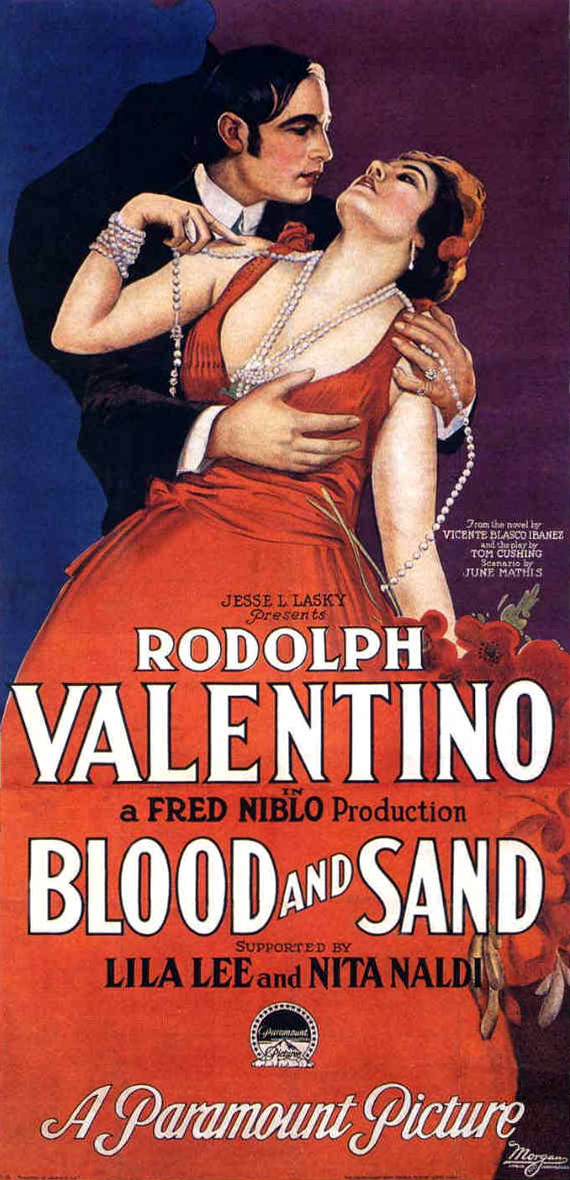
Then it's Valentino's 'Blood and Sand' (1922) on Saturday, Aug. 13 in Brandon, Vt.; Marion Davies in 'Beverly of Graustark' (1926) on Sunday, Aug. 14 in Wilton, N.H.; Buster again in 'Steamboat Bill Jr.' (1928) on Tuesday, Aug. 16 in Alton, N.H.; and then 'Blood and Sand' again on Wednesday, Aug. 17 in Ogunquit, Maine.

If you're Somewhere North of Boston (capitalized because it's the name of another local film festival that is no longer active), please join me for one or two or all. 

I didn't do a separate press release for the Manchester International Film Festival, but here's a link to all the action.

Below, I'm pasting in the release for 'Blood and Sand' on Saturday night up in Brandon, Vt., which also works for the screening on Wednesday, Aug. 17 in Ogunquit, Maine except it's at the Leavitt Theatre and admission is $12 per person.

See you in a darkened theater—at least before the lights go down...

*    *    *


MONDAY, AUG. 8, 2022 / FOR IMMEDIATE RELEASE
Contact Jeff Rapsis • (603) 236-9237 • jeffrapsis@gmail.com

Valentino's bullfighting epic  'Blood and Sand' to screen at Brandon Town Hall

Top-grossing silent film to be shown with live music on Saturday, Aug. 13 to celebrate 100th anniversary of box office hit

BRANDON, Vt.—It's an intense romantic drama that helped catapult actor Rudolph Valentino to worldwide fame.

It's 'Blood and Sand' (1922), a bullfighting epic to be screened on Saturday, Aug. 8 at 7 p.m. at the Brandon Town Hall and Community Center, 1 Conant Square, Route 7 in Brandon, Vt.

Admission is free; donations are welcome to help support ongoing Town Hall renovation efforts.

The classic drama will be shown with live music by silent film accompanist Jeff Rapsis, a New Hampshire-based performer and composer who specializes in scoring and presenting silent films.

The No. 3 box office hit of 1922, 'Blood and Sand' combined exotic Spanish locales with Valentino's iconic performance as a bullfighter.

The film tells the story of Juan Gallardo (Valentino), a village boy born into poverty who grows up to become one of Spain's greatest matadors.

Gallardo marries a friend from his childhood, the beautiful and virtuous Carmen. But after achieving fame and fortune, he finds himself drawn to Doña Sol (Naldi), a wealthy, seductive widow.

They embark on a torrid affair. But then Gallardo, feeling guilty over his betrayal of Carmen, tries to free himself of Doña Sol.

Gallardo's troubles spill over to the bullfighting arena, where he becomes reckless.

Can he cope with the gravest challenges of his young life—both in romance, and in the arena?

The movie's immense popularity helped establish Valentino as one of the megastars of the silent film era.

Directed for Paramount Pictures by Fred Niblo, the cast includes leading ladies Lila Lee as Carmen and Nita Naldi as Doña Sol.

'Blood and Sand' was based on the 1909 Spanish novel "Sangre y arena" (Blood and Sand) by Vicente Blasco Ibáñez and the play version of the book by Thomas Cushing.

Unusual for Hollywood at the time, women played key roles in the production of 'Blood and Sand.'

The story was adapted by June Mathis, the screenwriter credited with first recognizing Valentino's appeal, and edited by future director Dorothy Arzner.

The film inspired the 'Blood and Sand' cocktail, a Prohibition-era mixed drink.

The screening is part of the Brandon Town Hall's ongoing silent film series.

"Putting 'Blood and Sand' back on the big screen is a great way to celebrate this classic movie's 100th anniversary," said Rapsis, the silent film accompanist who creates live music for all screenings.

The screening of 'Blood and Sand' is sponsored by Edward Loedding and Dorothy Leysath, the Hanson Family in memory of Pat Hanson, and Sally Wood.

Other films in this year's Brandon Town Hall silent film series include:

• Saturday, Sept. 10, 7 p.m.: 'The Flying Ace' (1926), rare example of movies produced for black-only theaters in segregated parts of the nation; added to the National Film Registry in 2021. Sponsored by Nancy and Gary Meffe.

• Saturday, Oct. 22, 7 p.m.: 'Nosferatu' (1922) Just in time for Halloween! Celebrate the 100th anniversary of F.W. Murnau's original adaptation of Bram Stoker's 'Dracula' story. Sponsored by Bar Harbor Bank and Trust.

• Saturday, Nov. 19, 7 p.m.: 'Her Sister from Paris' (1925) starring Constance Talmadge, Ronald Colman. The scene: Europe. The cast: Rich people. Effervescent battle-of-the-sexes comedy. Sponsored by Harold & Jean Somerset.

"These are the films that set the standard for Hollywood, and still retain their power to entertain, especially when shown in a theater with live music and an audience," Rapsis said.

'Blood and Sand' starring Rudolph Valentino will be screened with live music on Saturday, Aug. 13 at 7 p.m. at the Brandon Town Hall and Community Center, Route 7, in Brandon, Vt.

All are welcome to this family-friendly event. Admission is free, with free will donations accepted in support of ongoing Town Hall renovations.

Saturday, August 6, 2022

Up to Vermont to score Keaton's 'Battling Butler,' but first a note of thanks to Guitar Center

Buster in training: a scene from Battling Butler (1926).

Today it's up to Brandon, Vt. for a screening of Buster Keaton's 'Battling Butler' (1926).

But first, a note of thanks to the staff at the Guitar Center in North Attleboro, Mass.

I wasn't planning a visit there yesterday until I was about a half-hour from Newport, R.I. 

That was when I realized (during a raging electrical storm dumping pellet-sized hail) that I did not have the two Roland speakers I use for venues without house sound. 

And the Jane Pickens Theatre in Newport, R.I., where I was to accompany Harold Lloyd's 'Safety Last' (1923) at 7 p.m., does not have house sound.

What to do? I figured there had to be a Guitar Center somewhere (they've become kind of like a public utility) and there was, but in North Attleboro, Mass.—not exactly on my way, but beggars can't be choosers.

So I set a course for North Attleboro, then called the venue, saying I was running late but would try to make the start time of 7 p.m.

To my great relief, Guitar Center fixed me up with a powered speaker. And then the fastest way to Newport was a big loop around Providence and over the Claiborne Pell suspension bridge—the longest in New England.

The way I drove to get there on time—well, 'Safety Last' could not have been a more appropriate title. 

So I pulled up to the theater at 6:55 p.m. and get the parking space right in front (a minor miracle), and then see the marquee promoting SAFETY LAST 7:30 P.M.

Well, better early than later. But there would not have been a show at all without Guitar Center renting me a speaker, which turned out to be perfect for the job. 

One weird note: loading out after the show, a ghost tour in progress in a park across the street. They were excited about something, which turned out to be a rabbit that had unexpectedly turned up.

A ghost tour and bunny wrangling on the streets of Newport, R.I.

I'll take that as a sign of good luck, as the drive home was uneventful—no electrical storms, anyway.

Now it's up to Brandon, Vt., for 'Battling Butler,' Buster's boxing comedy. The bell rings at 7 p.m. (NOT 7:30 p.m.) See you there! Press release with more info is below.

*      *      *

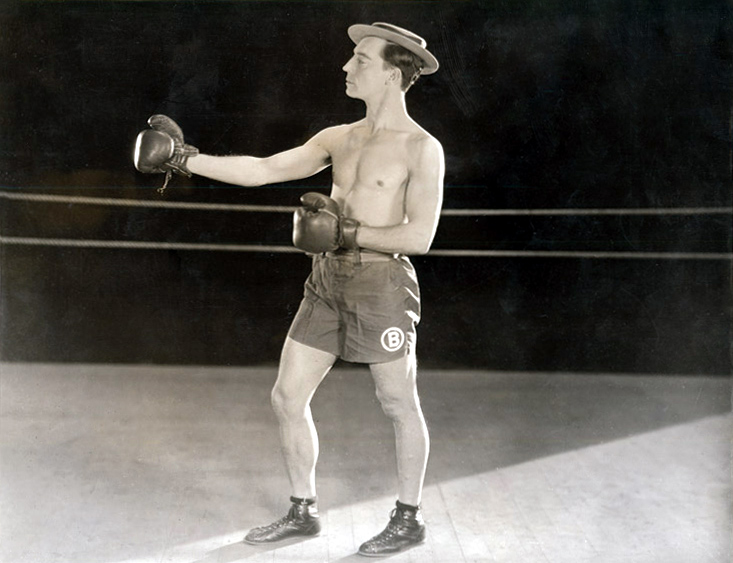
Buster geared up for pugilism in 'Battling Butler.'

MONDAY, JULY 25, 2022 / FOR IMMEDIATE RELEASE
Contact Jeff Rapsis • (603) 236-9237 • jeffrapsis@gmail.com

Buster Keaton's 'Battling Butler' at Brandon Town Hall on Saturday, Aug. 6

Silent film program postponed from July 23 due to excessive heat; film to be screened with live musical accompaniment

BRANDON, Vt.—He never smiled on camera, earning him the nickname of "the Great Stone Face." But Buster Keaton's comedies rocked Hollywood's silent era with laughter throughout the 1920s.

Acclaimed for their originality, clever visual gags, and amazing stunts, Keaton's films remain popular crowd-pleasers today.

See for yourself with a screening of 'Battling Butler' (1926), one of Keaton's landmark feature films, on Saturday, Aug. 6 at 7 p.m. at the Brandon Town Hall and Community Center, 1 Conant Square, Route 7 in Brandon, Vt.

The program was originally planned for Saturday, July 23, but was postponed to Saturday, Aug. 6 due to excessive heat.

Admission is free; donations are welcome to help support ongoing Town Hall renovation efforts.

Live music for the 'Battling Butler' and a companion Keaton feature, 'Sherlock Jr.' (1924) will be provided by Jeff Rapsis, a New Hampshire-based performer and composer who specializes in scoring and presenting silent films.

'Battling Butler' tells the story of pampered millionaire Alfred Butler (Keaton) who tries to impress the girl of his dreams (Sally O'Neil) by pretending to be a championship boxer with the same name.

The masquerade leads to knockout comedy both in and outside the ring, giving Keaton ample opportunity to display his gifts for physical and visual comedy.

In the 1920s, boxing rivaled baseball as the nation's most popular sport. Neighborhoods, communities, and ethnic groups all rooted for their favorite fighters, and heavyweight champion Jack Dempsey ranked as an international celebrity.

Because of this, boxing stories were popular with early movie audiences as well.

"As an elemental contest between two opponents, boxing inspired early filmmakers to do some great work," Rapsis said. "It's a visual sport that doesn't require a lot of dialogue or commentary to understand, and so was perfect for silent movies."

Keaton, along with Charlie Chaplin and Harold Lloyd, stands as one of the silent screen's three great clowns.

Many critics regard Keaton as the best of all; Roger Ebert wrote in 2002 that "in an extraordinary period from 1920 to 1929, (Keaton) worked without interruption on a series of films that make him, arguably, the greatest actor-director in the history of the movies." But while making films, Keaton never thought he was an artist, but an entertainer trying to use the then-new art of motion pictures to tell stories and create laughter.

All those talents are on display in 'Battling Butler,' which holds the distinction of being the top-grossing title of Keaton's silent features.

The program will open with another Keaton comedy, 'Sherlock Jr.' (1924), in which Keaton plays a movie projectionist who dreams of being a detective.

The screening of 'Battling Butler' and 'Sherlock Jr.' is sponsored by Kathy and Bill Mathis in memory of Maxine Thurston.

Buster is shown the ropes in 'Battling Butler' (1926). (Showing someone the ropes is actually a phrase taken from the world of sailing ships, not boxing, which I didn't realize for a long time.)

Other films in this year's Brandon Town Hall silent film series include:

• Saturday, Aug. 13, 7 p.m.: 'Blood and Sand' (1922) starring Rudolph Valentino in his first starring role, as a sexy bullfighter in this romantic thriller. Celebrating its 100th anniversary! Sponsored by Edward Loedding and Dorothy Leysath, the Hanson Family in memory of Pat Hanson, and Sally Wood.

• Saturday, Sept. 10, 7 p.m.: 'The Flying Ace' (1926), rare example of movies produced for black-only theaters in segregated parts of the nation; added to the National Film Registry in 2021. Sponsored by Nancy and Gary Meffe.

• Saturday, Oct. 22, 7 p.m.: 'Nosferatu' (1922) Just in time for Halloween! Celebrate the 100th anniversary of F.W. Murnau's original adaptation of Bram Stoker's 'Dracula' story. Sponsored by Bar Harbor Bank and Trust.

• Saturday, Nov. 19, 7 p.m.: 'Her Sister from Paris' (1925) starring Constance Talmadge, Ronald Colman. The scene: Europe. The cast: Rich people. Effervescent battle-of-the-sexes comedy. Sponsored by Harold & Jean Somerset.

'Battling Butler' (1926) and 'Sherlock Jr.' starring Buster Keaton will be screened with live music on Saturday, Aug. 6 at 7 p.m. at the Brandon Town Hall and Community Center, Route 7, in Brandon, Vt.

All are welcome to this family-friendly event. Admission is free, with free will donations accepted in support of ongoing Town Hall renovations.

Wednesday, August 3, 2022

This Friday, 'Safety Last' in Newport R.I.; last Saturday, 'Caligari' in Brookline, Mass.

Accompanying a midnight screening of 'The Cabinet of Dr. Caligari' (1920) at the Coolidge Corner Theatre.

It's down to Rhode Island this Friday to accompany a screening of 'Safety Last' (1923) at the Jane Pickens Theatre in downtown Newport. 

Showtime is 7 p.m.; lots more detail in the press release below.

But before going onward to the Ocean State, let us go backward to the Bay State, where this past weekend I accompanied a midnight screening of 'The Cabinet of Dr. Caligari' (1920). 

It was at the Coolidge Corner Theatre in Brookline, Mass. (right outside of Boston), and to everyone's surprise, attendance was strong—something like 150 people, most of whom had never seen the film before.

I had a few simple motifs in mind, and enjoyed playing with them to help support the film. I don't "Mickey Mouse" the action, but I do tend to track pretty closely to the film's changing moods, which I think helps a modern audience stay with the film.

The film is divided into six "acts," which give the accompanist a chance to reset the music and signal that something different is coming. I don't know 'Caligari' that well, but I managed to reach some kind finality at the end of each act, and then went off in a total different direction, even if I wasn't sure what was coming next. It worked!

One thing no one expected was my big brass handbell, which I use exactly three times during the movie, when Caligari uses one to summon spectators. 

Great comments afterwards, which mean it was 2 a.m. and I'm not sure how coherent I was. (I'm never that coherent right after a film. Or before.) But I was delighted to find out that the sequence I picked to really build the music to a big climax—when Caligari hears voices saying he "must be Caligari"—was enough to send shivers up the spine of one attendee. Nice!

Shivers of a different kind are in store for those who attend Harold Lloyd's 'Safety Last' on Friday in Newport, R.I. Hope to see you there! If you're in California, an early morning flight into Providence, R.I. will get you there in plenty of time. 

So there's no excuse. What are you waiting for?

*    *    *

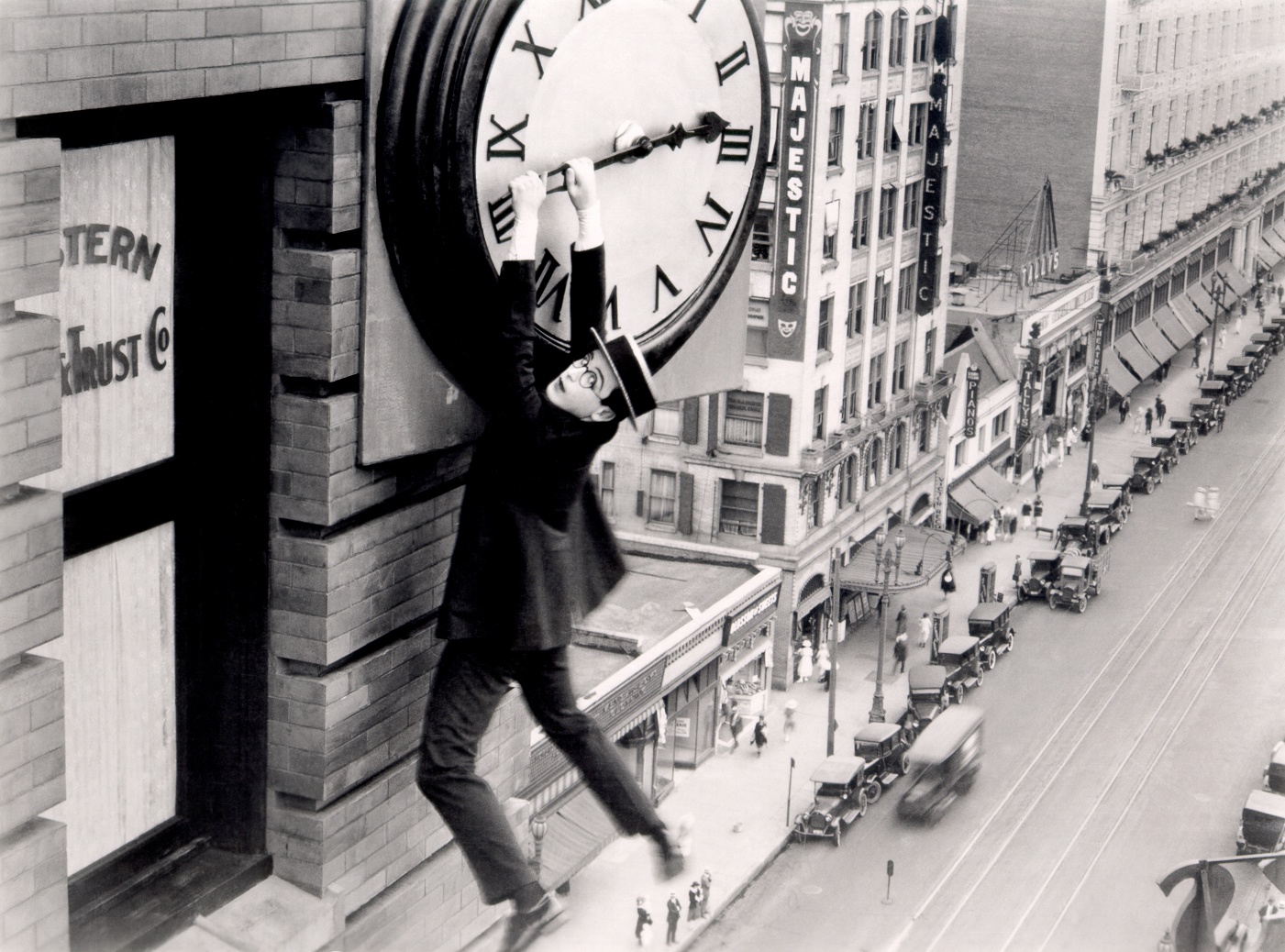
From 'Safety Last': the image everyone remembers.

MONDAY, JULY 11, 2022 / FOR IMMEDIATE RELEASE
Contact Jeff Rapsis • (603) 236-9237 • jeffrapsis@gmail.com

Silent film classic 'Safety Last' on Friday, Aug. 5 at Jane Pickens Theatre

Thrill comedy climaxed by Harold Lloyd's iconic building climb; shown with live music

NEWPORT, R.I.—It's a cinematic image so powerful, people who've never seen the movie instantly recognize it.

The vision of Harold Lloyd hanging from the hands of a huge clock, from the climax of his silent comedy 'Safety Last,' (1923), has emerged as a symbol of early Hollywood and movie magic.

See how Harold gets into his high-altitude predicament with a screening of 'Safety Last,' one of Lloyd's classic comedies, on Friday, Aug. 5 at 7:30 p.m. at the Jane Pickens Theatre and Event Center, 49 Touro St., Newport.

General admission $15; members $13. Tickets available online or at the door.

The screening will feature live musical accompaniment by Jeff Rapsis, a New Hampshire-based silent film musician.

'Safety Last' follows young go-getter Lloyd to the big city, where he hopes to make his mark in business and send for his small town sweetheart.

His career at a downtown department store stalls, however, until he gets a chance to pitch a surefire publicity idea—hire a human fly to climb the building's exterior.

However, when the human fly has a last-minute run-in with the law, Harold is forced to make the climb himself, floor by floor, with his sweetheart looking on.

The result is an extended sequence blending comedy and terror that holds viewers spellbound.

Lloyd, along with Charlie Chaplin and Buster Keaton, is regarded as one of the silent screen's three great clowns.

Lloyd's character, a young go-getter ready to struggle to win the day, proved hugely popular in the 1920s.

While Chaplin and Keaton were always favored by the critics, Lloyd's films reigned as the top-grossing comedies throughout the period.

Silent film at the Jane Pickens Theatre gives today's audiences the chance to experience early cinema as it was intended: on the big screen, with live music, and with an audience.

"Put the whole experience back together, and you can see why people first fell in love with the movies," said Rapsis, who practices the nearly lost art of silent film accompaniment.

Rapsis performs on a digital synthesizer that reproduces the texture of the full orchestra, creating a traditional "movie score" sound.

"Seeing 'Safety Last' with an audience is one of the great thrill rides of the cinema of any era, silent or sound," Rapsis said. "Harold's iconic building climb, filmed without trick photography, continues to provoke audience responses nearly 100 years after film was first released."

Tributes to the clock-hanging scene have appeared in several contemporary films, most recently in Martin Scorsese's 'Hugo' (2011), which includes clips from 'Safety Last.'

See Harold Lloyd's iconic thrill comedy 'Safety Last' (1923) on Friday, Aug. 5 at 7:30 p.m. at the Jane Pickens Theatre and Event Center, 49 Touro St., Newport.

General admission $15; members $13. Tickets available online at www.janepickens.com or at the door. For more information about the JPT Film & Event Center, call (401) 846-5474.

Nearing the top.

CRITIC COMMENTS ON ‘SAFETY LAST’:

"Impossible to watch without undergoing visitations of vertigo, Safety Last's climactic sequence is all it's reputed to be.”
—TV Guide

"Harold Lloyd manages to make the characters sympathetic enough to carry the audience's concern on his journey of crazy stunts and mishaps. One of the best of this era."
—David Parkinson, Empire Magazine

"The climb has both comic and dramatic weight because it is both a thrilling exercise in physical humor and a thematically rich evocation of the pressures men feel to succeed, lest they be viewed as less than a man."
—James Kendrick, Q Network Film Desk

Thursday, July 28, 2022

Stay up late this Saturday, July 30 for midnight screening of 'Dr. Caligari' at Coolidge Corner

Stay awake to see Cesar the Somnambulist in 'The Cabinet of Dr. Caligari' (1920)

I'm looking forward to this weekend's midnight screening of 'The Cabinet of Dr. Caligari' (1920) at the Coolidge Corner Theater in Brookline, Mass.

For those who've never experienced this very important (and very strange) piece of early cinema, I can't think of a better environment in which to do so.

In a theater? Check! With live music? Check! With an audience? Check! 

And finally, the middle of the night? Check and double check!

Really: semi-drowsiness might be the ideal state to appreciate the dream-like visual world in which 'Caligari' takes place. 

So hope to see you at the Coolidge on Saturday, July 30 when the clock strikes 12! More details in the press release below...

*     *     *

'Caligari' takes place entirely in a dream-like visual world.

MONDAY, JULY 25, 2022 / FOR IMMEDIATE RELEASE
Contact Jeff Rapsis • (603) 236-9237 • jeffrapsis@gmail.com

Coolidge to unleash late night silent film horror classic on Saturday, July 30

Midnight screening of breakthrough thriller 'Cabinet of Dr. Caligari' to feature live musical accompaniment

BROOKLINE, Mass.—A creepy silent film regarded as the forerunner of all horror movies will be shown at a midnight screening at the Coolidge Corner Theatre, 290 Harvard St., Brookline, Mass.

'The Cabinet of Dr. Caligari' (1920) will be shown at midnight on Saturday, July 30 as part of the Coolidge's ongoing 'Carnival of Horror' series.

The screening will feature live music by silent film accompanist Jeff Rapsis. General admission is $15.50 per person.
 
Set in an insane asylum, 'The Cabinet of Dr. Caligari,' is considered a landmark in early cinema. Nearly a century after its release, the film still has the capacity to creep out audiences.

"A case can be made that 'Caligari' was the first true horror film, critic Roger Ebert wrote in 2007.

'Caligari,' made in Germany after World War I and directed in expressionist style by Robert Wiene, stars Werner Krauss and Conrad Veidt.

The film employs stylized sets, with abstract, jagged buildings painted on canvas backdrops and flats.

To add to its strange visual design, the actors used an exaggerated technique that employed jerky and dancelike movements.

The movie is also cited as having introduced the surprise "twist" ending to cinema.
 
Conrad Veidt and Werner Krauss, two big names of early German cinema, star in 'Cabinet.'
 
"Silents such as 'Dr. Caligari' are films that first caused people to fall in love with the movies," Rapsis said. "The aim is to present them as they were originally intended to be shown: in a theater, on a big screen, with live music, and with an audience. If you can put all those elements together, these films leap to life."

In scoring 'The Cabinet of Dr. Caligari,' Rapsis plans to augment the traditional orchestral sound with the vocabulary of film music from later eras.

"Because I improvise the music, it's hard to know what will happen until the film actually starts running," Rapsis said.

'Caligari,' a forerunner of the 'film noir' genre, has influenced generations of movie-makers.

A sequel of sorts was released in the 1980s with the film 'Dr. Caligari,' which dealt with the granddaughter of the original Dr. Caligari and her illegal experiments on her patients in an asylum.

The Coolidge Corner Theatre is an independent, nonprofit cinema and cultural institution. Since 1933, audiences in the greater Boston area have relied on the Coolidge for contemporary independent film, repertory, and educational programming.

'The Cabinet of Dr. Caligari' (1920) will be shown with live music at midnight on Saturday, July 30 as part of an ongoing "Carnival of Horror" series at the Coolidge Corner Theatre, 290 Harvard St., Brookline, Mass. General admission $15.50; for more info and to buy tickets, visit www.coolidge.org or call (617) 734-2500.

Sunday, July 24, 2022

A single film, but two very different endings: Greta Garbo in 'The Temptress' (1926) on Wednesday, July 27 in Ogunquit, Maine

Greta Garbo and Antonio Moreno in 'The Temptress' (1926).

It's a film with one great star—but with two different endings!

The star: Greta Garbo. The endings: one is happy, the other sad.

It's 'The Temptress' (1926), one of Garbo's first pictures after coming to Hollywood from her native Sweden at the height of the silent era.

The film, with live music by me, will be shown on Wednesday, July 27 at 7 p.m. at the Leavitt Theatre in Ogunquit, Maine.

Which ending work better? Decide for yourself, as we plan to show them both.

Details in the press release below. See you at the Leavitt on Wednesday night.

Whether you're in the mood for happy or sad, hey—we've got you covered.

*   *   *

Greta Garbo stars in 'The Temptress' (1926).

MONDAY, JULY 25, 2022 / FOR IMMEDIATE RELEASE
Contact Jeff Rapsis at (603) 236-9237 • e-mail jeffrapsis@gmail.com

Greta Garbo stars in 'The Temptress' (1926), a film with two endings, on Wednesday, July 27 at Leavitt Theatre

Both conclusions to be shown when steamy silent romantic drama is screened with live musical accompaniment

OGUNQUIT, Me. — It's a film with two completely different endings: one sad and tragic, and the other uplifting and positive.

It's 'The Temptress' (1926), an MGM romantic drama starring Greta Garbo, then just starting a legendary Hollywood career.

Studio boss Louis B. Mayer found the original ending to 'The Temptress' so depressing, he ordered a second—and much happier—conclusion.

Theaters were then allowed to choose which ending to show to audiences.

See both conclusions when 'The Temptress' is screened with live music on Wednesday, July 27 at 7 p.m. at the historic Leavitt Theatre, 259 Main St, Route 1 in Ogunquit, Maine.

Admission is $12 per person. Live music will be provided by accompanist Jeff Rapsis, a New Hampshire-based performer who specializes in creating music for silent film presentations.

In 'The Temptress,' Garbo plays Elena, the wife of Monsieur Canterac (Lionel Barrymore) and the mistress of rich Parisian banker Monsieur Fontenoy (Marc MacDermott).

When the banker's friend Robledo (Antonio Moreno), a dynamic young engineer building a massive dam in Argentina, pays a visit to Paris, the fickle Elena immediately falls in love with him.

Elena follows Robledo to Argentina, where her presence leads to a whip duel between Robledo and his rival, Manos Duros (Roy D'Arcy).

She then indirectly causes the collapse of Robledo's dam, which is where the two versions of the film diverge.

In the original version, Elena returns to Paris and the movie concludes tragically.

The revised version sees the film end in Argentina on a much happier note.

Both endings will be screened at the Leavitt Theatre: first the original "tragic" conclusion, then the more optimistic ending.

Garbo, who first won notice in her native Sweden, came to Hollywood at age 19. 'The Temptress,' her second film for MGM, helped establish her as a major star.

Initially, the director of 'The Temptress' was Garbo's mentor-lover, the brilliant Mauritz Stiller. But he was replaced halfway through by Fred Niblo, giving 'The Temptress' two different styles.

Silent film accompanist Jeff Rapsis will improvise a musical score to 'The Temptress' in real time as the movie is screened.

In creating music for 'The Temptress' and other vintage classics, Rapsis tries to bridge the gap between silent film and modern audiences.

"Live music adds an element of energy to a silent film screening that's really crucial to the experience," Rapsis said.

The Leavitt Theatre's silent film screenings provide local audiences the opportunity to experience silent film as it was intended to be shown: on the big screen, in restored prints, with live music, and with an audience.

“These films are still exciting experiences if you can watch them as they were designed to be shown,” said Rapsis, accompanist for the screenings.

“There’s a reason people first fell in love with the movies, and we hope to recreate that spirit. At their best, silent films were communal experiences in which the presence of a large audience intensifies everyone’s reactions.”

The Leavitt, a summer-only moviehouse, opened in 1923 at the height of the silent film era, and has been showing movies to summertime visitors for nearly a century.

The silent film series honors the theater's long service as a moviehouse that has entertained generations of Seacoast residents and visitors, in good times and in bad.

Following 'The Temptress' on Wednesday, July 27 at 7 p.m., other programs in this year's Leavitt silent film series include:

• Wednesday, Aug. 10 at 7 p.m.: Clara Bow stars in 'Mantrap' (1926). Battle-of-the-sexes comedy; city boy Richard Dix tries to win his girlfriend by taking up the rugged cowboy life, only to find it not so rugged. Rarely screened comedic gem from the height of the silent era.

• Wednesday, Aug. 17 at 7 p.m.: 'Blood and Sand' (1922). Rudolph Valentino in his first starring role, as a sexy bullfighter in this romantic thriller. Will Rudy choose the pure love of Carmen, or the sinister charms of the exotic Doña Sol? And will he survive the choice?

• Wednesday, Sept. 14 at 7 p.m.: Rare race drama: 'The Flying Ace' (1926). All-Black motion picture added to the National Film Registry last year. Rare example of 'race' cinema, produced for audiences in Black-only theaters commonly found in segregated parts of the nation.

• Wednesday, Sept. 28 at 7 p.m.: F.W. Murnau's 'The Last Laugh' (1924). Towering performance by Emil Jannings as aging doorman at posh city hotel whose unexpected change of jobs robs him of self-respect and identity. Directed by Murnau as a purely visual tale, no dialogue intertitles.

• Saturday, Oct. 29 at 7 p.m.: 'Der Golem' (1920). Prepare for Halloween with one very weird flick! In 16th-century Prague, a rabbi creates a giant creature from clay, called the Golem. Using sorcery, he brings the creature to life in order to protect the Jews of Prague from persecution.

The romantic drama ‘The Temptress’ starring Greta Garbo will be shown with live music on Wednesday, July 27 at 7 p.m. at the historic Leavitt Theatre, 259 Main St, Route 1 in Ogunquit, Maine.

Admission is $12 per person, general seating. For more info, call (207) 646-3123 or visit www.leavittheatre.com.