Monday, April 18, 2022

On Thursday, 4/21: 'Ben Hur' in Manchester, N.H., plus giving Shakespeare 'the silent treatment'

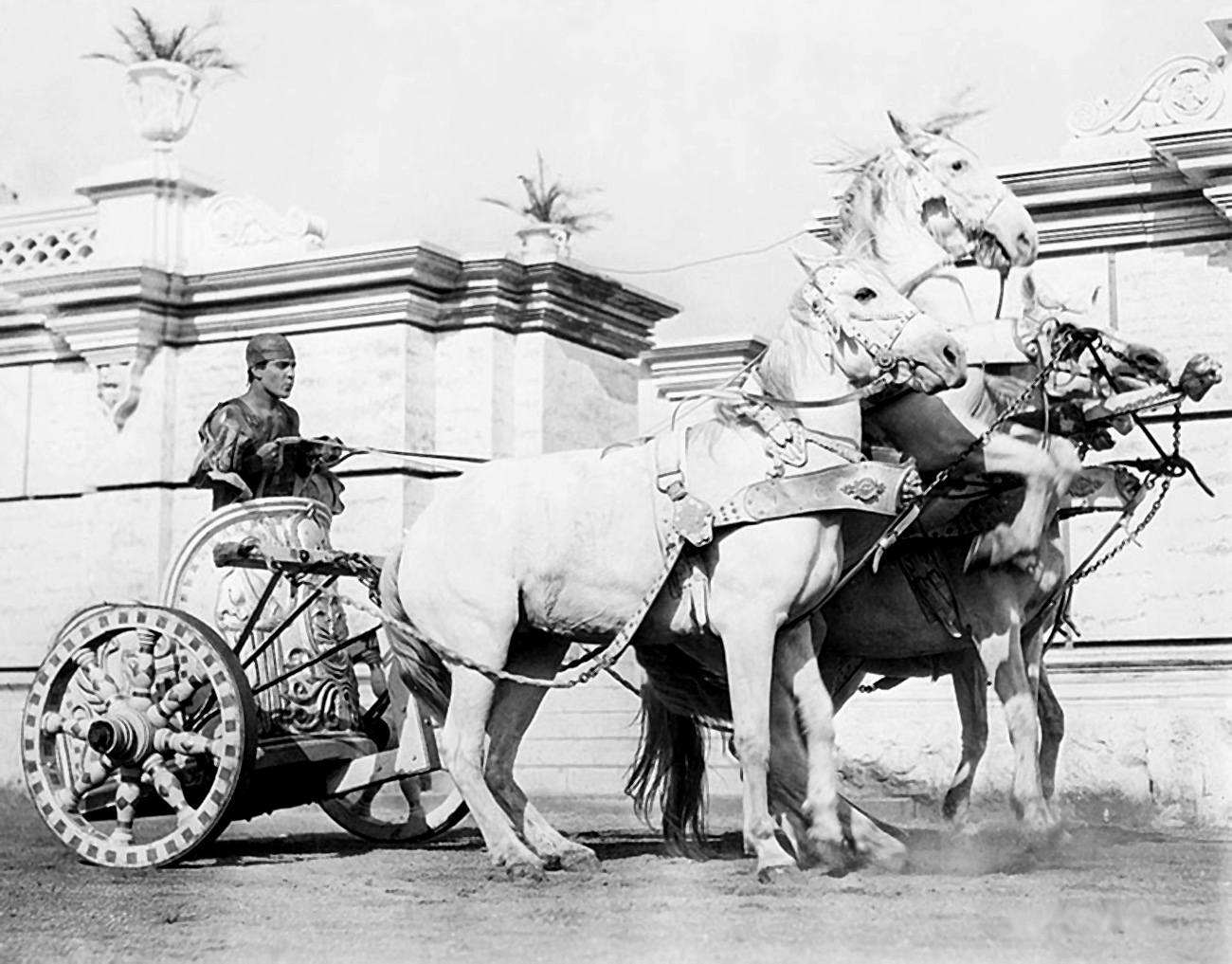
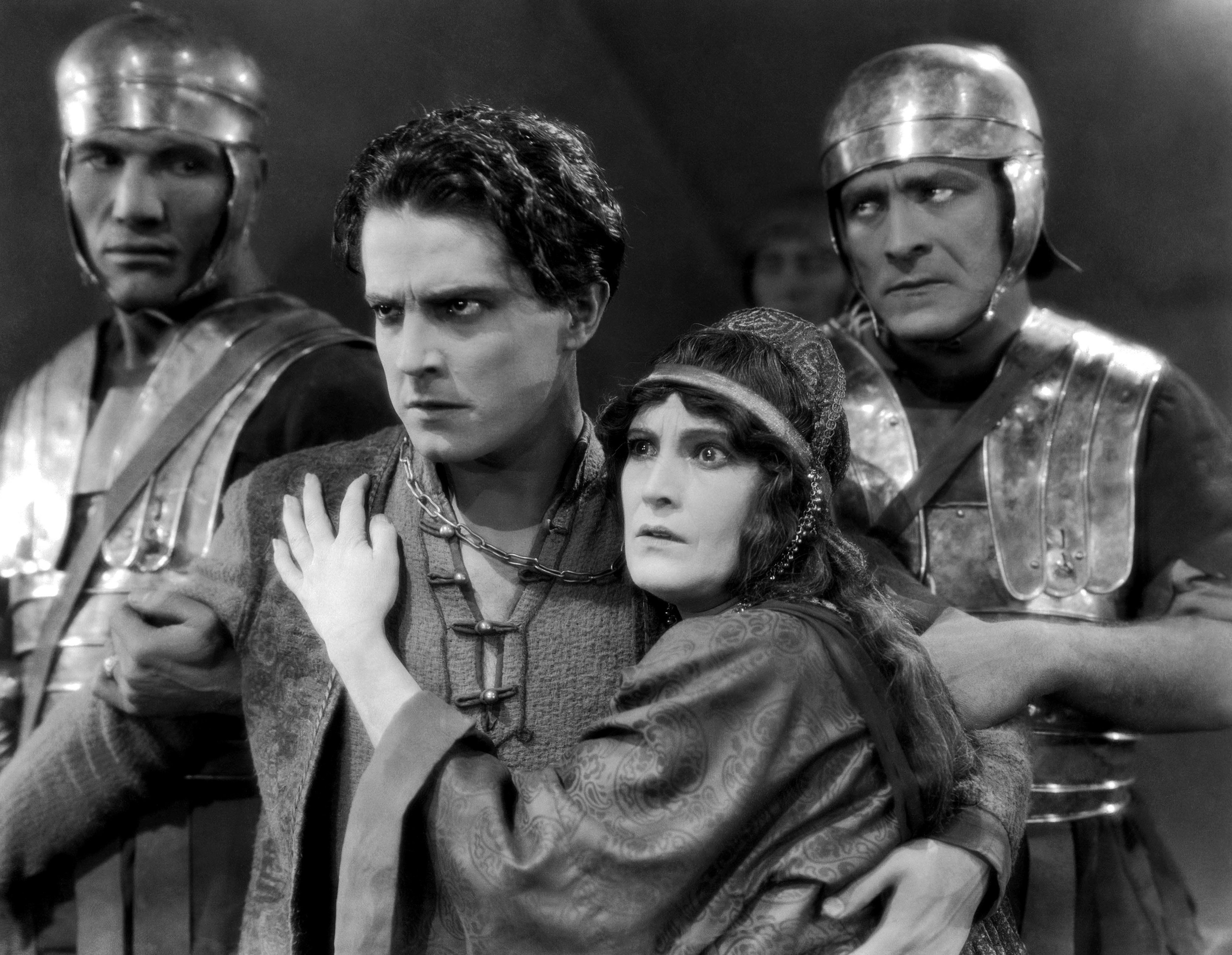
Ramon Novarro in the original silent film version of 'Ben Hur' (1925).

Next up: I'm doing music for a screening of 'Ben Hur' (1925) on Thursday, April 21 at the Rex Theatre in downtown Manchester.

Hop into your chariot and join us! Showtime is 7:30 p.m. and a ton more info in the press release attached below.

For now, a few thoughts about yesterday's screening of the silent film version of 'Othello' (1922) starring Emil Jannings in the title role.

Yes, Shakepeare without all those spoken words getting in the way!

It being Easter Sunday, the smaller-than-usual turnout was to be expected for our screening at the Town Hall Theatre in Wilton, N.H.

But what wasn't expected was for the film to have such an impact, which it did.

This was one reason for programming the film in the first place: I've found that even the most unlikely film can somehow leap to life when presented as intended: on a big screen, in a good print, with live music, and in a theater with an audience.

This, however, was different. We were about to give Shakespeare "the silent treatment."

A poster promoting the original German release of 'Othello' (1922).

Prior to the screening, the last in our four-month celebration of films celebrating their 100th birthday,  I laid out the challenge before us.

I observed that Shakespeare is known primarily for the language of his playwriting. And here we are, proposing to take one of his most well-known tragedies, and present it without that key element of language.

Yes, there would be some words, presented in intertitles where needed. But only a tiny fraction of the 3,560 lines Shakespeare composed for his play would be used.

And to make it more of a challenge, the film was produced in Germany. So the text would have been originally in German, then translated back to English for a "foreign" release in English-speaking lands.

Also, Shakespeare's play can take 2½ to 3 hours to perform. The silent 'Othello' clocks in at about 75 minutes. So there's another thing to consider: without all those words to get through, the story might flow quite differently.

What's going on here, I said, is something of a test of the actual story that underlies Shakespeare's play. How much of the power of Shakespeare's 'Othello' rests in the Bard's cadences, and how much comes from the tale itself?

Stripping away all the words and telling the story visually—which is what silent film does—could be a good way to tell.  

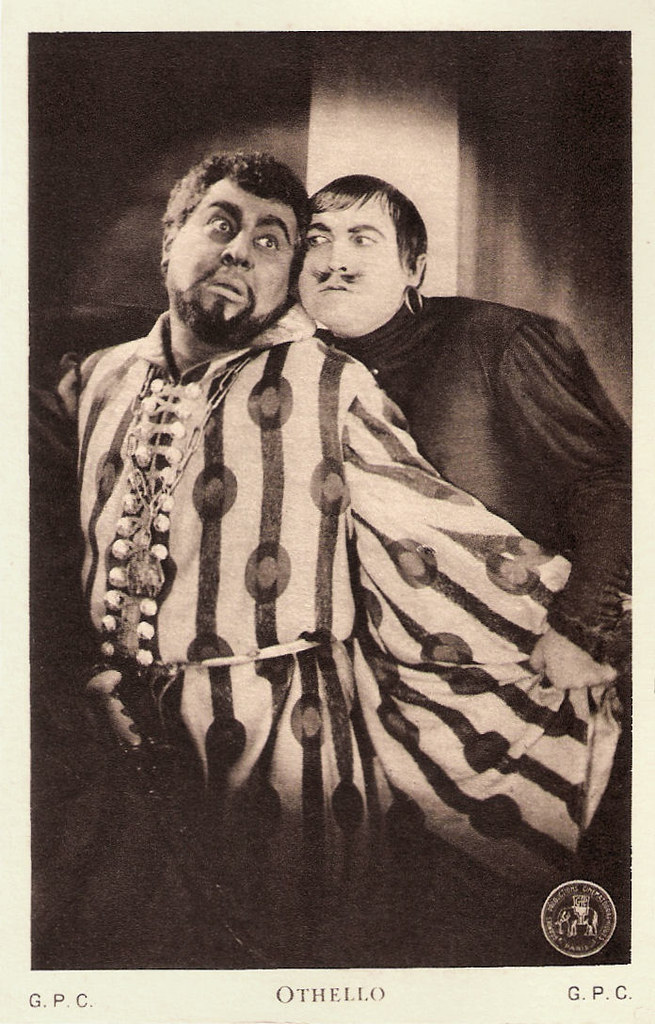
Emil Jannings and Werner Krauss in 'Othello' (1922).

It's worth remembering, I said, that Shakespeare based nearly all of his writing on stories that already existed. He didn't so much write his plays from scratch as he did adapt stories for the stage.  

In the case of Othello, his source was something called the "Hecatommithi," a collection of tales published in 1565 by Giraldi Cinthio, an Italian novelist and poet. 

Odds are that there's something powerful in this tale, as evidenced by other adaptations of Othello—most notably, the big opera 'Otello' by Giuseppe Verdi, first staged in 1887, and which involved Shakespeare's play being rewritten as an opera libretto by Arrigo Boito.

But still—how well did Shakespeare choose his story? Seeing the silent 'Othello' might be a good way to tell.

Prior to the screening, I was asked what my strategy was as accompanist. I said it was really no different than any other silent drama: to try to come up with music that helped the film work, both on its own terms but also so that it would meet today's audience expectations.

Coming into it, for some reason I had in mind Beethoven's 'Coriolan Overture,' which I had heard recently on the radio, and which was written not for Shakespeare's play 'Coriolanus' but for a contemporary drama by Heinrich Joseph von Collins.

Still, that was what I was going for: a kind of taut classical texture capable of drama, but within certain restraints and limits. 

I came up with two main motifs: a staccato four-note motto that proved very versatile, and a legato four-note "down the scale" phrase that was equally useful. These became the basic building blocks that helped it all come together. 

So in the end, if our test had any validity, Shakespeare's tale passed with flying colors. He chose well.

Afterwards, a woman came up to me who said she was a Shakespeare buff who had helped start a "Shakespeare in the Park" program in Kentucky.

She'd come to the screening "out of curiosity" and not expecting much, but found she really enjoyed the film and found it true to the Bard's spirit, even with most of his words were missing. 

Also, she confirmed that much of the language that did survive (via title cards) was indeed Shakepeare's own. (The only thing I could identify was Iago's famous "Put money in thy purse" exhortation.) 

So it was enough to satisfy even a serious aficionado. Good show!

A similar challenge awaits next Sunday (April 24), when I create music for MGM's silent film version of 'La Bohème' (1926), screening at 2 p.m. at the Somerville Theatre.

For the music, I don't intend on channeling Puccini, but will do my own stuff to support the film as best as I can. Will the story (and the star power of Lillian Gish and John Gilbert, at left) be enough to carry the day without the famous score? 

Well—the tale was strong enough to support the contemporary hit musical 'Rent.' So that's encouraging.

But can it survive the test of the silent treatment? Come and find out!

Okay, here's the long-promised press release about 'Ben Hur' (1925) on Thursday, April 21 at the Rex Theatre in Manchester, N.H. 

Vidi ibi an quadratus sit! (That's Latin for "See you there or be square!")

*    *    *

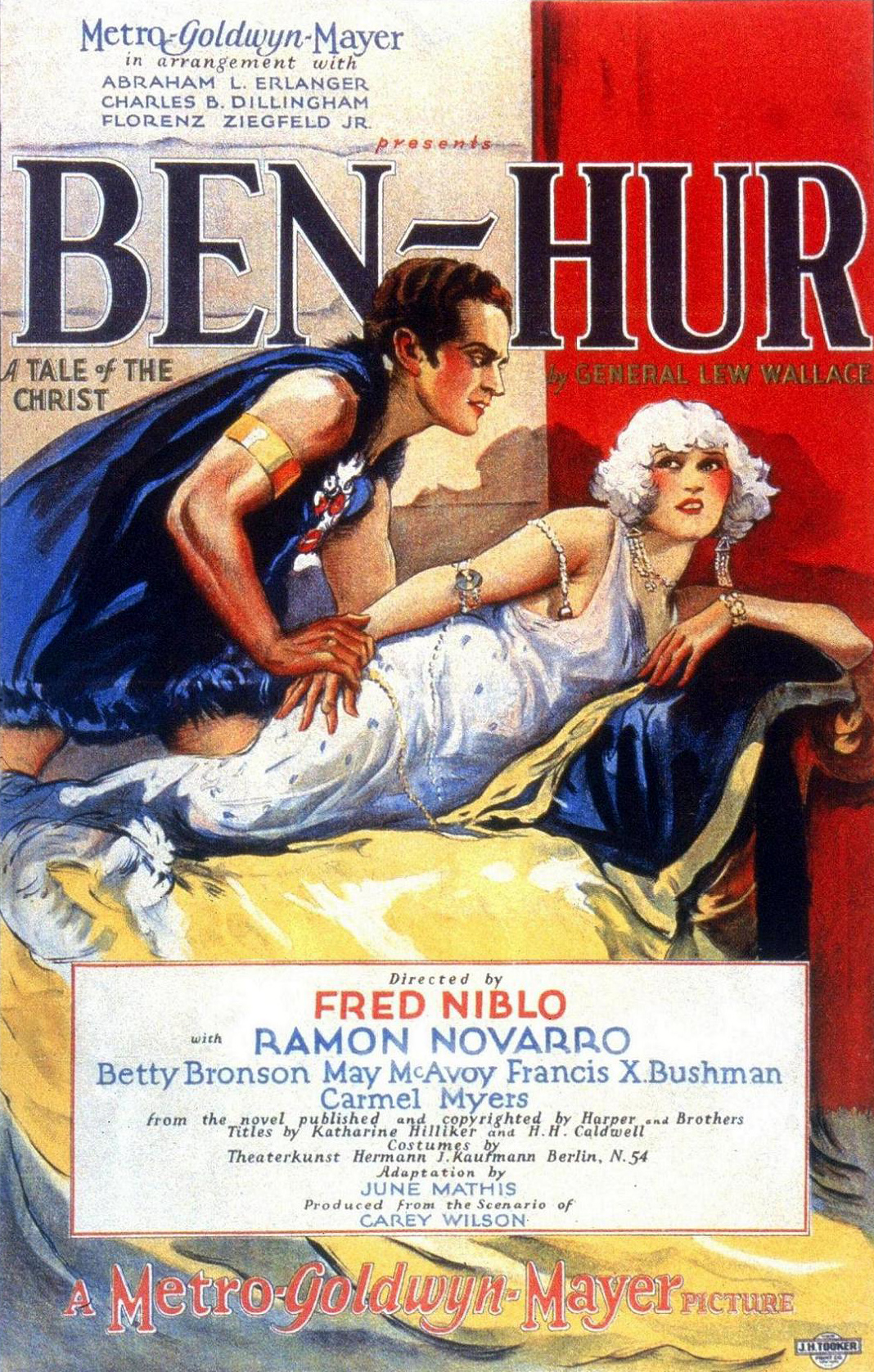
Colorful original release poster for 'Ben Hur; (1925).

TUESDAY, APRIL 12, 2022 / FOR IMMEDIATE RELEASE
Contact Jeff Rapsis • (603) 236-9237 • jeffrapsis@gmail.com

Silent film epic ‘Ben Hur’ (1925) coming to Manchester's Rex Theatre on Thursday, 4/21

Celebrating Easter: Hollywood's original Biblical-era blockbuster to be screened with live music at newly resurrected venue

MANCHESTER, N.H.—One of early Hollywood's greatest epics returns to the big screen with a showing of 'Ben Hur, A Tale of The Christ' (1925) on Thursday, April 21 at 7:30 p.m. at the Rex Theatre, 23 Amherst St., Manchester, N.H.

The screening will feature live accompaniment by Jeff Rapsis, a New Hampshire-based composer who specializes in creating music for silent films.

Admission is $10 per person, general admission. Tickets are available online at www.palacetheatre.org or at the door.

'Ben Hur,' starring Ramon Novarro and Francis X. Bushman, was among the first Hollywood motion pictures to tell a Biblical-era story on a large scale.

The film, which helped establish MGM as a leading studio, employed a cast of thousands and boasted action sequences including a large-scale sea battle.

The film is highlighted by a spell-binding chariot race that still leaves audiences breathless.

Set in the Holy Land at the time of Christ's birth, 'Ben Hur' tells the story of a Jewish family in Jerusalem whose fortune is confiscated by the Romans and its members jailed.

The enslaved family heir, Judah Ben Hur (played by Novarro, a leading silent-era heartthrob) is inspired by encounters with Christ to pursue justice. This leads him to a series of epic adventures in his quest to find his mother and sister and restore his family fortune.

The film is particularly appropriate for the season of Easter, which is celebrated on Sunday, April 17. (Orthodox Easter falls on Sunday, April 24 in 2022.)

'Ben Hur,' directed by Fred Niblo, was among the most expensive films of the silent era, taking two years to make and costing between $4 million and $6 million. When released in 1925, it became a huge hit for the newly formed Metro-Goldwyn-Mayer studio.

The chariot race scene in 'Ben Hur,' with Novarro and other cast members driving teams of horses at high speed on a mammoth dirt racetrack in a gigantic replica of a Roman stadium, was among the most complicated and dangerous sequences filmed in the silent era. It remains noted for its tight editing, dramatic sweep, and sheer cinematic excitement.

The chariot race was re-created virtually shot for shot in MGM's 1959 remake, and more recently imitated in the pod race scene in 'Star Wars Episode I: The Phantom Menace.'

Besides Novarro in the title role, the film stars Francis X. Bushman as Messala, the Roman soldier who imprisons the Hur family; Betty Bronson as Mary, mother of Jesus; May McAvoy as Ben Hur's sister Esther; and Claire McDowell as Ben Hur's mother.

'Ben Hur' was based on the best-selling 1880 novel by General Lew Wallace, which interwove the story of Christ's life with the Ben Hur clan, a fictional Jewish merchant family.

Celebrity "extras" in the chariot race scene included stars such as Douglas Fairbanks, Harold Lloyd, Lionel Barrymore, John Gilbert, Joan Crawford, Lillian Gish, Mary Pickford, and a very young Clark Gable.

The film was remade by MGM in the 1950s in a color and wide-screen version starring Charlton Heston that garnered 11 Academy Awards. Some critics believe the original 1925 version offers superior drama and story-telling.

In creating music for silent films, accompanist Jeff Rapsis performs on a digital synthesizer that reproduces the texture of the full orchestra and creates a traditional "movie score" sound.

For each film, Rapsis improvises accompaniment using original themes created beforehand. No music is written down; instead, the score evolves in real time based on audience reaction and the overall mood as the movie is screened.

'Ben Hur, A Tale of The Christ' (1925) will be shown on Thursday, April 21 at 7:30 p.m. at the Rex Theatre, 23 Amherst St., Manchester, N.H.

General admission is $10 per person. Tickets available online at www.palacetheatre.org or at the door. For more information, call the Rex box office at (603) 668-5588.


Saturday, April 16, 2022

This Sunday: Silent Shakespeare! And then 'Ben Hur,' then Cleveland, and then back to Boston!

The moor, the not-so-merrier: Emil Jannings as 'Othello' (1922).

This weekend, things take a turn towards the literary—after which I take a turn to Ohio!

Up first: music for an early silent screen adaptation of Shakespeare's 'Othello' (1922), made in Germany and starring Emil Jannings in the title role. 

Yes, silent Shakespeare! See what you think: the screening is Sunday, April 17 at 2 p.m. at the Town Hall Theatre in Wilton, N.H. More detail in the press release below.

After that, it's music for big bad 'Ben Hur' (1925), screening on Thursday, April 21 at 7:30 p.m. at the Rex Theatre, 23 Amherst St., Manchester, N.H. 

And the next day finds me swinging out to Cleveland, Ohio, where I'll accompany two films at the Cleveland Cinematheque on Friday, April 22 and then join the fun at the annual 36-hour sci-fi marathon at nearby Case Western University.

At the Cinematheque, it's 'Nanook of the North' (1922) and then the recently reissued 'Straight is the Way' (1921), a curiosity set in my own home state of New Hampshire. 

At the sci-fi marathon, it's 'Der Golem' (1920), which will be screened about 20 hours into the big show. Looking forward to the reaction!

And then I scoot back to Boston to do music for the big MGM silent film version of 'La Bohéme' (1926) starring Lillian Gish and John Gilbert. Screening is Sunday, April 24 at 2 p.m. at the Somerville Theatre, and marks the restart of the venue's 'Silents, Please!' series.

But before any of that, it's time to brush up our Shakespeare this Sunday afternoon. Here's the press release. Happy Easter weekend and hope to see you at the movies!

*  *  * 

Actor Emil Jannings has a hard time competing with Werner Krauss' mustache in 'Othello' (1922).

MONDAY, APRIL 4, 2022 / FOR IMMEDIATE RELEASE
Contact Jeff Rapsis • (603) 236-9237 • jeffrapsis@gmail.com

Silent Shakespeare! Early film version of 'Othello' to screen on Sunday, April 17 in Wilton, N.H.

First-ever feature adaptation of Bard's classic tale to be screened with live music at Town Hall Theatre

WILTON, N.H.—His tales have been adapted for the big screen since the beginning of the movies.

He was playwright William Shakespeare, whose tragedy 'Othello' first appeared as a feature film via a movie made in Germany in 1922.

The silent 'Othello' will be shown with live music on Sunday, April 17 at 2 p.m. at the Town Hall Theatre, 40 Main St., Wilton, N.H.

Admission is free; a donation of $10 per person is suggested to help defray expenses.

The screening will be accompanied with live music by Jeff Rapsis.

The silent 'Othello' takes Shakespeare's dialogue-driven drama and transforms it into a story told visually.

'Othello' boasts two of the most celebrated German actors of the era: Emil Jannings in the title role, and Werner Krauss as his nemesis, Iago.

Jannings would relocate to Hollywood later in the 1920s, winning the first-ever Best Actor honors at the inaugural Academy Awards in 1929.

Krauss, a noted German stage actor, is best remembered for playing the title role in the film 'The Cabinet of Dr. Caligari' (1920).

The film closely follows Shakespeare's story of Othello, a Moorish general provoked to jealousy regarding his wife Desdemona.

The story opens with Othello choosing the loyal Cassio as his lieutenant. This arouses bitter jealousy in Iago, another soldier, who vows to scheme against his general.

Othello is soon sent to Cyprus to repel a Turkish invasion, and he arranges for Iago and his wife to bring Desdemona with them to Cyprus.

When Iago's wife learns of a treasured handkerchief that Othello gave to Desdemona, Iago hatches a plan that he hopes will destroy Othello by provoking him to jealousy.

The film, directed by Russian-born Dmitri Buchowetzki, is widely regarded as a successful adaptation of the Bard's story to the silent screen.

"Produced on an elaborate scale, Othello may not be true to the letter of Shakespeare, but is undeniably a smorgasbord of visual delights," according to a review on LetterboxDVD.com.

Live music for 'Othello' will be provided by silent film accompanist Jeff Rapsis, who uses a digital synthesizer to create a traditional full orchestra "movie score" sound.

Rapsis emphasized the unique value of seeing early cinema as it was originally presented.

"These films were designed for the big screen, live music, and large audiences. Put it all together, and you can get a sense of why people first fell in love with the movies," Rapsis said.

The screening of 'Othello' will precede the 458th anniversary of Shakespeare's birthday, which scholars believe to be April 23, 1564.

"It may seem counterintuitive for a Shakespearean play to be made into a silent film," Rapsis said.

"But stage dramas were a huge source of material for early cinema, and Shakespeare's stories were popular enough to warrant the attention of filmmakers right from the beginning," Rapsis said.

The screening is part of the Town Hall Theatre's ongoing series honoring the 100th anniversary of significant motion pictures from 1922.

Programs have included all of 1922's five highest-grossing titles, each shown on the big screen with live music, as well as century-old oddities, short films, cartoons, and more.

The silent 'Othello' will be shown with live music on Sunday, April 17 at 2 p.m. at the Town Hall Theatre, 40 Main St., Wilton, N.H.

Admission is free; a donation of $10 per person is suggested to help defray expenses.

For more info, visit www.wiltontownhalltheatre.com or call (603) 654-3456.

Monday, April 11, 2022

Keaton's 'The General' at Coolidge Corner on Wednesday, 4/13, plus a question of volume

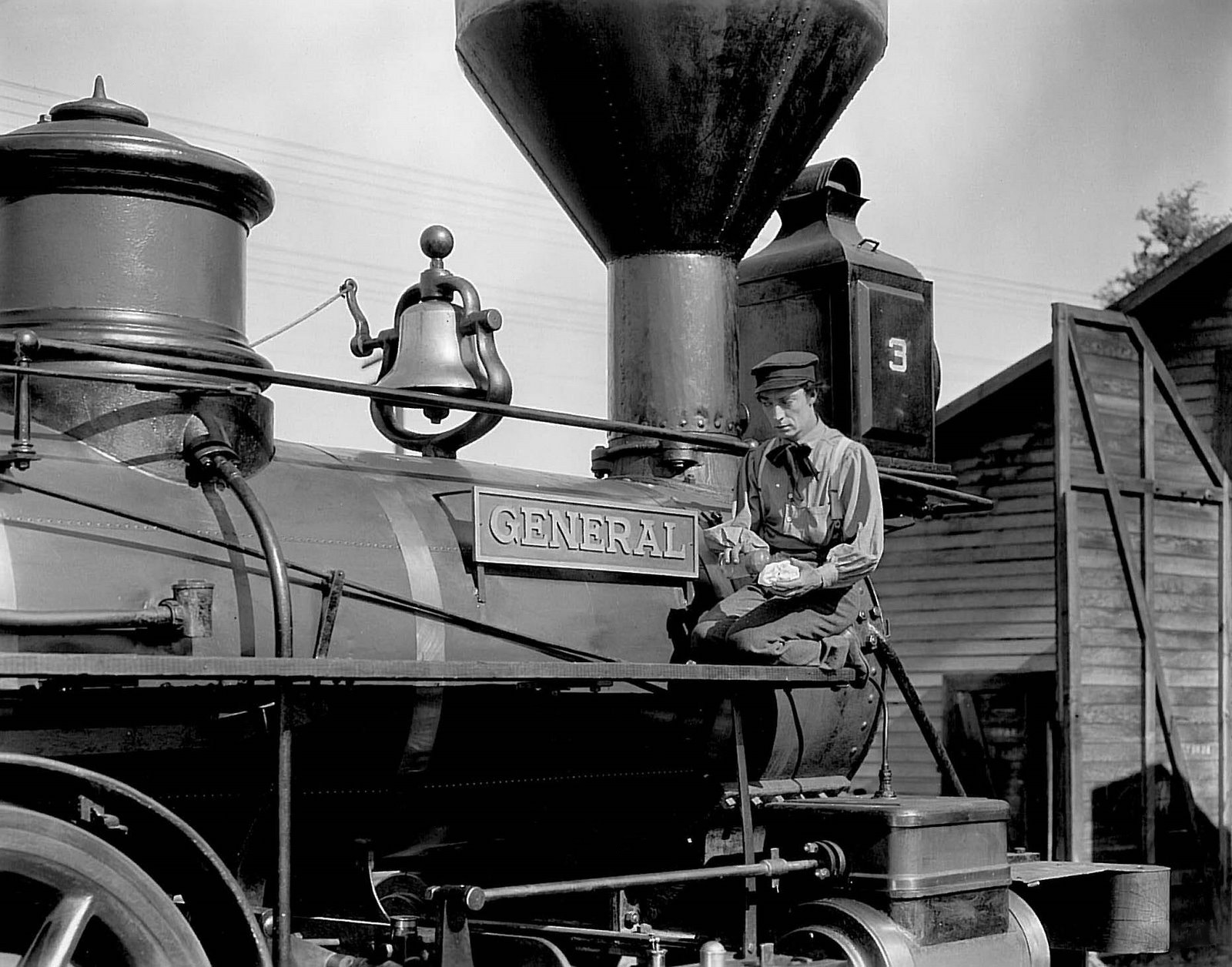
Buster and co-star in 'The General' (1926).

Coming up: I'll be doing live music for a screening of Buster Keaton's 'The General' (1926) at the Coolidge Corner Theatre on Wednesday, April 13. 

It's a special occasion because Slate film critic Dana Stevens, author of a new book on Keaton, will be on hand for a Q & A after the show. It'll be moderated by local film guru Ty Burr.

'Camera Man,' which came out a few months ago, has been rapturously received, and has led to a host of Keaton screenings this year. (I had the privilege of doing an earlier one with Stevens in Newport, R.I. this past February.)

So march on down to the Coolidge Corner to see Keaton's masterpiece on the big screen, and meet the author of a brand new book that puts Keaton's work in the context of his early-20th-century times.

More details in the press release below. 

For now, a few thoughts about volume inspired by yesterday's screening of 'Ben Hur' (1925) at the new Showroom venue of the Colonial Theatre in Keene, N.H.

This is a surprisingly touchy subject, as there's apparently a vast range of perceptions of what's appropriate volume for silent film accompaniment.

Yesterday, I arrived early to set up and work with the house tech to set the sound levels. Each house is different, and the Showroom is a venue I've only played once before, so it's important to take time to set up the audio.

Keeping my keyboard volume output at mid-range, we worked out the levels, checking each of my synth settings to make sure everything was acceptable in the house. I felt it sounded a bit dry, so just a touch of reverb was added to the main orchestral setting I planned to use. Great!

(The reason to keep my synth output at mid-range is because I need that level to make use of the various volume levels the touch-sensitive keyboard is capable of producing. I find I can't do that effectively if the output is below mid-range: level 5 out of 10.)

We also have to account for the fact that in most places with house sound (such as the Showroom), a good amount of sound volume passes over my head (down at front) and so audiences can sometimes receive significantly more volume than I hear.

Okay, fine. Because I work primarily in improv and create the accompaniment live and in the moment, it's my preference to sit at the keyboard for at least a half-hour before a show: warming up, working through material, and just getting into the zone. For me, it's hard to start a film just cold—it's not like pressing a button.

But because people are filing into the theater, during this time I've found it's helpful to temporarily take my volume output down to about 2 out of 10 as a courtesy. That way people can hear each other talking, while I can still do my thing, even though it's not the volume I'll be working with for the film.

The Colonial Theatre's new "Showroom" venue, set up for silent film.

So this is what I was doing yesterday when I noticed it was 10 minutes to showtime, and I hadn't thought to yet use the bathroom. (Very important in advance of a 2½-hour film.) So I switched to some synth-generated pattern music and got up to take care of business.

That's when someone from the theater came up to me with a concerned look on her face. People were complaining, she said, that the music was much too loud and that we needed to take the volume down somewhat.

Really? I've gotta tell you, I like to think I'm easy-going and welcome feedback and would do whatever it takes to accommodate an audience. But right in front of creating live music for a challenging and marathon-length film, this is not the thing to hear. 

(Even worse: a few years ago, someone came down to the keyboard in the middle of a show in progress at the Leavitt Theatre in Ogunquit, Maine and placed a folded-up note on the keyboard, for Pete's sake. Using one hand, I opened it to read "MUSIC TOO LOUD!")

Maybe it's a weakness on my part, but I find this kind of thing really throws me when it comes right before I'm about to commit to an improv accompaniment journey of some length, and which will require some concentration—especially after we've taken time to set levels that everyone agreed were acceptable. 

And it's especially discouraging when I've deliberately been playing at a quiet level as a courtesy, and then to be told it's still too loud

Would people stop a tightrope walker just before he or she steps out on the wire above Niagara Falls to tell them they don't approve of the type of wood being used in the balance pole?

I strive not to be the temperamental artist type, but jeez. This is me, baring my soul in music in hopes of bringing to life a worthy cinematic experience, and I'm being told to keep it down lest it interfere with someone's enjoyment of the film?

Well, why don't I just stop playing altogether? Maybe then everyone will be happy? 

Of course I didn't speak those words. I told the theater woman we'd see what we could do. In introducing the film, I addressed it openly: we'd had some complaints, but here's the situation. This is a BIG film, I said, and at times the music will be BIG as well. 

However, it's still a new venue to me, I said, so I'll do my best to keep things at a level we can all find generally acceptable. But people have to understand: this is not background music. At its best (if I'm doing it effectively) it's a crucial part of the experience.

I think I run into trouble when people new to the experience expect the accompaniment to be background music, or (even worse) something that's optional or just decoration.

Well, no. In silent film, although music generally shouldn't be noticed on its own, it's often a full player in the overall experience. That was true then, and it's still true now. 

So while it shouldn't gratuitously call attention to itself, the music should have a presence. And in some cases, it really should be pretty darned big and bold.

Take 'Ben Hur.' You really can't play quiet stuff during the sea battle scene or the famous chariot race. So if I'm at the keyboard, it's going to be loud, exciting, dramatic, and all that.

In the end, I was able to pull it together yesterday. No one covered their ears or walked out that I'm aware of, anyway. When it was over, we had nice comments and good questions. I made my usual joke about checking with the Diocese of Manchester to confirm that attending a screening of 'Ben Hur' did not count as attending Mass. Thank you and have a good night!

I don't know. Maybe I'm looking at this wrong way. Maybe I should really amp up the volume, and then supplement my income by selling over-priced ear plugs. Or possibly sell stationery so people can write me letters to be delivered in the middle of a performance.

Even if I go ahead with those ideas, they won't be ready in time for Wednesday's screening of 'The General' at the Coolidge Corner. Here's the promised press release with all the details!

*   *   *

Buster Keaton in 'The General.' 

MONDAY, APRIL 4, 2022 / FOR IMMEDIATE RELEASE
Contact Jeff Rapsis • (603) 236-9237 • jeffrapsis@gmail.com

Buster Keaton's 'The General' with live music at Coolidge Corner on Wednesday, April 13

Civil War railroading comedy/adventure film lauded as stone-faced comic moviemaker's masterpiece

Screening includes Q & A with Dana Stevens, author of 'Camera Man,' newly published Keaton book.

BROOKLINE, Mass.— He never smiled on camera, earning him the nickname of "the Great Stone Face." But Buster Keaton's comedies rocked Hollywood's silent era with laughter throughout the 1920s.

See for yourself with a screening of 'The General' (1926), one of Keaton's landmark feature films, on Wednesday, April 13 at 7 p.m. at the Coolidge Corner Theatre, 290 Harvard St., Brookline, Mass.

The screening will feature live music for the movie by silent film accompanist Jeff Rapsis. General admission is $23 per person.

The show is the latest in the Coolidge Corner's acclaimed 'Sounds of Silents' series, which gives audiences the opportunity to experience early cinema as it was intended: on the big screen, with live music, and with an audience.

The screening will be followed by a Q & A with Slate film critic Dana Stevens, author of 'Camera Man,' a newly published book exploring Keaton's work in the context of 20th century history.

Stevens’s book will be for sale after the screening, courtesy of Brookline Booksmith. The Q & A will be moderated by Boston-based critic Ty Burr.

'The General,' set during the U.S. Civil War, tells the story of a southern locomotive engineer (Keaton) whose engine (named 'The General') is hijacked by Northern spies with his girlfriend onboard.

Keaton, commandeering another train, races north in pursuit behind enemy lines. Can he rescue his girl? And can he recapture his locomotive and make it back to warn of a coming Northern attack?

Critics call 'The General' Keaton's masterpiece, praising its authentic period detail, ambitious action and battle sequences, and its overall integration of story, drama, and comedy.

It's also regarded as one of Hollywood's great railroad films, with much of the action occurring on or around moving steam locomotives.

Accompanist Jeff Rapsis will improvise an original musical score for 'The General' live as the film is shown.

"When the score gets made up on the spot, it creates a special energy that's an important part of the silent film experience," said Rapsis, who uses a digital synthesizer to recreate the texture of a full orchestra for the accompaniment.

With Center for the Art's screening of 'The General,' audiences will get a chance to experience silent film as it was meant to be seen—in a high quality print, on a large screen, with live music, and with an audience.

"All those elements are important parts of the silent film experience," Rapsis said. "Recreate those conditions, and the classics of early Hollywood leap back to life in ways that can still move audiences today."

Rapsis performs on a digital keyboard that reproduces the texture of the full orchestra and creates a traditional "movie score" sound.

Keaton, along with Charlie Chaplin and Harold Lloyd, stands today as one of the silent screen's three great clowns. Some critics regard Keaton as the best of all; Roger Ebert wrote in 2002 that "in an extraordinary period from 1920 to 1929, (Keaton) worked without interruption on a series of films that make him, arguably, the greatest actor-director in the history of the movies."

A remarkable pantomime artist, Keaton naturally used his whole body to communicate emotions from sadness to surprise. And in an era with no post-production special effects, Keaton's acrobatic talents enabled him to perform all his own stunts.

Critics review 'The General':

"The most insistently moving picture ever made, its climax is the most stunning visual event ever arranged for a film comedy."
—Walter Kerr, author of 'The Silent Clowns'

"An almost perfect entertainment!"
—Dave Kehr, Chicago Reader

"What makes the film so special is the way the timing, audacity and elegant choreography of its sight gags, acrobatics, pratfalls and dramatic incidents is matched by Buster's directorial artistry, his acute observational skills working alongside the physical élan and sweet subtlety of his own performance."
—Time Out (London)

‘The General’ (1926) starring Buster Keaton will be shown with live music on Wednesday, April 13 at 7 p.m. at the Coolidge Corner Theatre, 290 Harvard St., Brookline, Mass. as part of the theater's 'Sounds of Silents' series. Admission is $23 per person. For more info and to buy tickets, visit www.coolidge.org or call (617) 734-2500. For more about the music, visit www.jeffrapsis.com.

Wednesday, April 6, 2022

Up next: the original silent 'Ben Hur' (1925) on Sunday, April 10 at the Showroom in Keene, N.H.

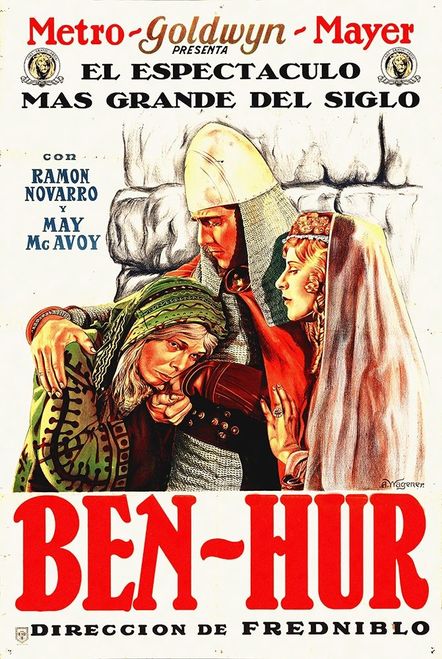
A Spanish language poster for MGM's 'Ben Hur' (1925).

Easter must be on its way, as this month's silent film schedule is thick with Biblical epics.

Coming up next: the original silent version of 'Ben Hur' (1925) on Sunday, April 10 in Keene, N.H. If there's a film you should try to see on the big screen, this is it. More details in the press release below.

For now, let me report that we enjoyed a healthy turnout for last Sunday's unusual double bill: Lon Chaney in 'Flesh and Blood' and Harry Houdini in 'The Man From Beyond,' both films from 1922.

The Chaney film, which I'd never done before, held up pretty well, with an escaped-prisoner-seeking-justice storyline that kept our audience engaged throughout. Large chunks of it are set in Chinatown, but I resisted the temptation to play pentatonic-scale-"Oriental"-sounding music.

Instead, I kept mostly to a piano & strings texture, except for a scene where a harmonium gets played, and then also when Chaney performs a sentimental tune on a solo violin. One wonders how musicians of the 1920s would have matched the on-screen action in this film.

The Houdini picture is a mind-bending affair about reincarnation that left most people scratching their heads. How can a guy become frozen in 1820, then thawed out 100 years later, to the point where he's riding around in automobiles and attending a wedding, and not realize it was a century later?

But the rousing waterfall rescue sequence that concludes the film, which was actually filmed at Niagara Falls, was enough to leave everyone satisfied.

Okay, here's the press release on 'Ben Hur.' Hope to see you this Sunday at 2 p.m. at the Colonial Theatre's new "Showroom" venue in Keene, N.H.!

*    *    *

An original release poster for MGM's silent epic 'Ben Hur' (1925).

MONDAY, APRIL 4, 2022 / FOR IMMEDIATE RELEASE
Contact Jeff Rapsis • (603) 236-9237 • jeffrapsis@gmail.com

Silent film epic ‘Ben Hur’ (1925) coming to Showroom in Keene on Sunday, April 10

Prelude to Easter: Hollywood's original Biblical-era blockbuster to be screened with live music at Colonial Theatre's new venue

KEENE, N.H.—One of early Hollywood's greatest epics returns to the big screen with a showing of 'Ben Hur, A Tale of The Christ' (1925) on Sunday, April 10 at 2 p.m. at the Colonial Theatre's Showroom, 20 Commercial St., Keene.

The screening will feature live accompaniment by Jeff Rapsis, a New Hampshire-based composer who specializes in creating music for silent films.

Admission is $15 per person, general admission. Tickets are available online at www.thecolonial.org or at the door.

'Ben Hur,' starring Ramon Novarro and Francis X. Bushman, was among the first Hollywood motion pictures to tell a Biblical-era story on a large scale.

The film, which helped establish MGM as a leading studio, employed a cast of thousands and boasted action sequences including a large-scale sea battle.

The film is highlighted by a spell-binding chariot race that still leaves audiences breathless.

Set in the Holy Land at the time of Christ's birth, 'Ben Hur' tells the story of a Jewish family in Jerusalem whose fortune is confiscated by the Romans and its members jailed.

The enslaved family heir, Judah Ben Hur (played by Novarro, a leading silent-era heartthrob) is inspired by encounters with Christ to pursue justice. This leads him to a series of epic adventures in his quest to find his mother and sister and restore his family fortune.

The film is particularly appropriate for the weeks leading up to Easter, which is celebrated on Sunday, April 17. (Orthodox Easter falls on Sunday, April 24 in 2022.)


'Ben Hur,' directed by Fred Niblo, was among the most expensive films of the silent era, taking two years to make and costing between $4 million and $6 million. When released in 1925, it became a huge hit for the newly formed Metro-Goldwyn-Mayer studio.

The chariot race scene in 'Ben Hur,' with Novarro and other cast members driving teams of horses at high speed on a mammoth dirt racetrack in a gigantic replica of a Roman stadium, was among the most complicated and dangerous sequences filmed in the silent era. It remains noted for its tight editing, dramatic sweep, and sheer cinematic excitement.

The chariot race was re-created virtually shot for shot in MGM's 1959 remake, and more recently imitated in the pod race scene in 'Star Wars Episode I: The Phantom Menace.'


Besides Novarro in the title role, the film stars Francis X. Bushman as Messala, the Roman soldier who imprisons the Hur family; Betty Bronson as Mary, mother of Jesus; May McAvoy as Ben Hur's sister Esther; and Claire McDowell as Ben Hur's mother.

'Ben Hur' was based on the best-selling 1880 novel by General Lew Wallace, which interwove the story of Christ's life with the Ben Hur clan, a fictional Jewish merchant family.

Celebrity "extras" in the chariot race scene included stars such as Douglas Fairbanks, Harold Lloyd, Lionel Barrymore, John Gilbert, Joan Crawford, Lillian Gish, Mary Pickford, and a very young Clark Gable.

The film was remade by MGM in the 1950s in a color and wide-screen version starring Charleton Heston that garnered 11 Academy Awards. Some critics believe the original 1925 version offers superior drama and story-telling.

In creating music for silent films, accompanist Jeff Rapsis performs on a digital synthesizer that reproduces the texture of the full orchestra and creates a traditional "movie score" sound.

For each film, Rapsis improvises accompaniment using original themes created beforehand. No music is written down; instead, the score evolves in real time based on audience reaction and the overall mood as the movie is screened.

'Ben Hur, A Tale of The Christ' (1925) will be shown on Sunday, April 10 at 2 p.m. at the Colonial Theatre's Showroom, 20 Commercial St., Keene.

General admission is $15 per person. Tickets are available online at www.thecolonial.org or at the door. For more information, call the Colonial box office at (603) 352-2033.

Wednesday, March 30, 2022

Chaney and Houdini in double feature at Town Hall Theatre in Wilton, N.H. on Sunday, 4/3

Harry Houdini and company on location at Niagara Falls shooting 'The Man From Beyond' (1922).

If two heads are better than one, then two famous people from the 1920s whose names are still recognized a full century later must really something. 

The two people: actor Lon Chaney and illusionist Harry Houdini. They're both performers who, alas, died at relatively young ages, but whose names live on today in the 21st century.

On Sunday, April 3 at 2 p.m., I'll accompany films starring Chaney and Houdini at the Town Hall Theatre in Wilton, N.H. 

For Chaney, it's 'Flesh and Blood' (1922), a rarely screened crime drama made just before he tackled the title role in 'The Hunchback of Notre Dame' the next year. 

For for Houdini, it's 'The Man From Beyond' (1922), a very strange film about a man frozen in the Arctic ice for 100 years who's revived and brought back to civilization. 

More info about both films is in the press release below. You may notice they're both from 1922, as they're part of an ongoing series at the Town Hall Theatre celebrating the 100th anniversary pictures from that year.

Starting last January, we've already screened the year's top five box office hits, culminating in last week's showing of Douglas Fairbanks Sr. in 'Robin Hood' (1922) the year's top attraction.

Speaking of 'Robin Hood': the Fairbanks swashbucklers are often singled out for their lavish sets and production values, with Doug himself noted for his on-screen athleticism and forceful personality. 

All of that's true. But I think Fairbanks doesn't get nearly enough credit for the true strength underpinning his most successful pictures, including 'Robin Hood': story construction.

Really! The sets and stunts are great. But no one would care if there wasn't a powerful story at work to pull an audience forward, then and now. 

Fairbanks (who co-wrote 'Robin Hood' under the pseudonym 'Elton Thomas') had a knack for spinning a great yarn—one that hooks you right away, and which you just can't stop following until the inevitably satisfying conclusion. 

Original poster art promoting 'Robin Hood' (1922) starring Douglas Fairbanks Sr.

With 'Robin Hood,' I can attest to the strength of the story because 100 years later, it still mesmerized our audience at the Town Hall Theater. 

Here it was 2022, and people were cheering Fairbanks as he robbed from the rich to steal from the poor, and spontaneously hissing Prince John, the movie's principle villain. 

That's engagement at a powerful level—enough to cause people to fall in love with the movies, then and now. 

Just look at how the opening scenes in 'Robin Hood' establish the characters: we must root for Fairbanks as Lord Huntingdon for his prowess in jousting, his loyalty to King Richard, but most of all his disarmingly charming fear of...women!

For the bad guys, there's Sir Guy, clearly a sourpuss, already attempting to cheat at jousting and forcing himself on Lady Marian. And Prince John with his evil falcon—one look and you just know there's going to be trouble.

King Richard (in one of the better roles of the ubiquitous Wallace Beery) is firmly established as a life-loving and beloved ruler of his people, plus we meet Huntingdon's loyal squire and get to see Lady Marian in the most positive possible light.

There! In an opening scene of less than 10 minutes, Fairbanks establishes the relationships that will carry us through the next two hours. It worked in 1922, and it still works in 2022, and I imagine it will continue to work in 2122 and beyond.

Will audience response for Chaney and Houdini match that of Fairbanks? Only one way to find out—come join us on Sunday, April 3 and see for yourself. 

*     *     *

An original release poster for 'Flesh and Blood' (1922) starring Lon Chaney.

 MONDAY, MARCH 28, 2022 / FOR IMMEDIATE RELEASE
Contact Jeff Rapsis • (603) 236-9237 • jeffrapsis@gmail.com

Films starring Lon Chaney and Harry Houdini at Town Hall Theatre on Sunday, April 3

Legendary performers return to the silver screen in double bill celebrating 100th anniversary of 1922 releases, with live music.

WILTON, N.H.—A century after their heyday, 'Houdini' and 'Chaney' are still known as the names of legendary entertainers.

See them both on the big screen again on Sunday, April 3 at 2 p.m. at the Town Hall Theatre, 40 Main St., Wilton, N.H.

Admission is free; a donation of $10 per person is suggested to help defray expenses.

The screenings will be accompanied with live music by Jeff Rapsis.

The double bill features Lon Chaney in the crime drama 'Flesh and Blood,' while Houdini stars in the adventure film 'The Man From Beyond.'

Released in 1922, both films celebrate their 100th anniversaries this year.

In 'Flesh and Blood,' a rarely screened crime drama, Chaney plays an escaped convict who hides out in Chinatown and plots revenge.

Chaney, known as the "Man of a Thousand Faces" due to his versatility with make-up, was a major star during Hollywood's silent era.

Iconic performances included the title roles in the blockbuster silent versions of 'The Hunchback of Notre Dame' (1923) and 'The Phantom of the Opera' (1925).

A lobby card promoting Harry Houdini's 'The Man From Beyond' (1922).

In 'The Man From Beyond,' illusionist and escape artist Harry Houdini plays an Arctic adventurer frozen for 100 years. Discovered and thawed out, he searches for his reincarnated lost love.

Houdini was a Hungarian-born, American-Jewish illusionist and stunt performer noted for his sensational escape acts.  

His repertoire included escaping from ropes slung from skyscrapers, from straitjackets under water, and from inside a sealed milk can with water in it.

Chaney began as a stage actor, but moved exclusively to films in the mid-1910s and remained before the cameras for the balance of his career.

Houdini, at the height of his fame, starred in a series of adventure films in the early 1920s, but continued to focus on live performance.

Both men died relatively young: Chaney from throat cancer in 1930 at age 47; Houdini from a ruptured appendix in 1926 at age 52.

A scene from 'Flesh and Blood' (1922) starring Lon Chaney.

Live music for both films will be provided by silent film accompanist Jeff Rapsis, who uses a digital synthesizer to create a traditional full orchestra "movie score" sound.

Rapsis emphasized the unique value of seeing early cinema as it was originally presented.

"These films were designed for the big screen, live music, and large audiences. Put it all together, and you can get a sense of why people first fell in love with the movies," Rapsis said.

The double feature is part of the Town Hall Theatre's ongoing series honoring the 100th anniversary of significant motion pictures that debuted in 1922.

Programs have included all of 1922's five highest-grossing titles, each shown on the big screen with live music, as well as century-old oddities, short films, cartoons, and more.

The Town Hall's 100th anniversary series will conclude with 'Othello' (1922) on Sunday, April 17 at 2 p.m.

The Bard's immortal tragedy is brought to the screen in this early German version starring legendary actor Emil Jannings. Silent Shakespeare in honor of the author's 458th birthday.

'Flesh and Blood' starring Lon Chaney and 'The Man From Beyond' starring Harry Houdini will be shown with live music on Sunday, April 3 at 2 p.m. at the Town Hall Theatre, 40 Main St., Wilton, N.H. Admission is free; a donation of $10 per person is suggested to defray expenses.

For more info, visit www.wiltontownhalltheatre.com or call (603) 654-3456


Tuesday, March 22, 2022

Up next: Cinema Ritrovato 'L'Inferno' on 3/25 in Portsmouth, then 'Robin Hood' on 3/27 in Wilton

A big film means a big megaphone: Alan Dwan directing 'Robin Hood' with star Douglas Fairbanks Sr. observing. 

This Sunday, it's 'Robin Hood' (1922), the culmination of a series of 100th anniversary screenings at the Town Hall Theatre in Wilton, N.H.

But first, on Friday we venture to the underworld, as I accompany a screening of 'L'Inferno' (1911), an early adaptation of Dante's iconic work and a landmark early feature film from Italy.

'L'Inferno' is part of "Il Cinema Ritrovato on Tour in New Hampshire," a program brought to the Granite State each year by foreign language department staffers at the University of New Hampshire. (It's where I earned my MBA, and also taught as an adjunct for many years.)

Friday being opening night, the screening will take place at the prestigious Music Hall in Portsmouth, N.H. Showtime is at 7 p.m. Complete info can be found at the program's website.

Screenings continue at the Music Hall through Sunday, after which the program moves to the UNH campus in Durham for more films through March 31.

It's quite a privilege to be asked to create live music for a film in the touring "Ritrovato" program. Three cheers to organizers for recognizing the value of live music for pictures from the silent era.

And it's also a thrill to be performing in the Music Hall, a legendary venue in my home state. 

Although they don't run much silent film with live music, it's where I first took in the Alloy Orchestra doing their thing to Buster Keaton's 'Steamboat Bill Jr.' back in about 1991 or so, which helped rekindle my interest in early cinema.

It's also where I saw (and heard) Philip Glass perform in person, and where I first experienced the John Adams opera 'Nixon in China' via simulcast. (Small world: Adams grew up in New Hampshire not far from my home base.) 

Looking forward to hearing what my digital synthesizer sounds like in the storied old hall, which dates from the 1870s. I usually do pretty well with halls built in the era when acoustics were a priority, so I'm hopeful.

Okay, and now off to Sherwood Forest!

As the year's top box office hit, 'Robin Hood' forms  the culmination of our series of screenings celebrating the 100th anniversary of movies released in 1922.

In a silent film version of Casey Kasem's Top 40 countdown (remember that?), since January we've been showing the year's top five grossing pictures more or less in reverse order, starting Harold Lloyd's 'Grandma's Boy' (No. 5) in January.

Since then, we've run Valentino's 'Blood and Sand' (No. 4), Norma Talmadge in 'Smilin' Through' (No. 3), and Marion Davies in 'When Knighthood Was in Flower' (No. 2), with occasional detours for special titles such as 'Nanook of the North,' which also hit screens in 1922.

But as 1922's box office champ, 'Robin Hood' topped them all. And then as now, this big-time historical swashbuckler is best experienced on the big screen with live music and an audience. 

This means you! So I invite all to join us Sunday afternoon to escape with Robin Hood and his Merry Men, even if just for the afternoon. 

Lots more info in the press release below. Hope to see you this Sunday in Sherwood Forest—er, I mean the Town Hall Theatre in Wilton, N.H.!

*    *    *

Original artwork promoting 'The Adventures of Robin Hood' (1922).

MONDAY, MARCH 14, 2022 / FOR IMMEDIATE RELEASE
Contact Jeff Rapsis • (603) 236-9237 • jeffrapsis@gmail.com

'Robin Hood' leaps into action at Town Hall Theatre on Sunday, March 27

It's off to Sherwood Forest for the 100th anniversary of legendary silent blockbuster, screened with live music

WILTON, N.H.—He robbed from the rich, gave to the poor, and was the top box office attraction of 1922.

He was Douglas Fairbanks Sr. starring in 'Robin Hood,' the original movie adaptation of the legendary tale.

See it for yourself on the big screen on Sunday, March 27 at 2 p.m. at the Town Hall Theatre in Wilton, N.H., 40 Main St., Wilton, N.H.

Admission is free; a donation of $10 per person is suggested to help defray expenses.

The screening will be accompanied with live music by Jeff Rapsis.

Set in medieval England, 'Robin Hood' tells the tale of the Earl of Huntingdon (Fairbanks, at right), a dashing nobleman who joins King Richard the Lion-Hearted (Wallace Beery) on a Crusade to the Holy Land.

Huntingdon later returns to England to find Richard's cruel brother, Prince John (Sam De Grasse), falsely claiming the throne, enriching his aristocratic cronies and tyrannizing the citizenry.

Huntingdon takes to the woods and becomes 'Robin Hood,' soon joined by a band of merry men who undermine Prince John's reign by robbing from the rich and giving to the poor.

Can Robin Hood and his men vanquish their enemy, the High Sheriff of Nottingham (William Lowery)? And can they rescue Lady Marian Fitzwalter (Enid Bennett), Huntingdon's betrothed, from the evil clutches of Prince John?

Along the way, Fairbanks has ample opportunity to demonstrate his skills in archery, fencing, and acrobatics.

Directed by Allan Dwan, 'Robin Hood' amazed audiences with its enormous sets that recreated in full scale the castles and villages of medieval England.

At a time when $200,000 was a hefty movie budget, 'Robin Hood' cost $1 million to produce.

But the film proved an enormous hit, becoming the top box office attraction of 1922 and earning $2.5 million in its initial release through United Artists, the distribution company Fairbanks formed with fellow stars Charlie Chaplin, D.W. Griffith, and his wife, Mary Pickford.

Douglas Fairbanks as Robin Hood romances Lady Marian Fitzwalter (Enid Bennett).

Fairbanks, among the most popular stars of the 1920s, was the inspiration for the character of George Valentin in the Oscar-winning Best Picture 'The Artist' (2011). Fairbanks was known for films that used the then-new medium of motion pictures to transport audiences to historical time periods for grand adventures and athletic stunts.

He's often referred to as "Douglas Fairbanks Sr." to avoid confusion with his son, the actor Douglas Fairbanks Jr.

Also in the cast for 'Robin Hood' is Alan Hale Sr., who made such an impression at Little John that he was cast in the same role in the 1938 remake starring Errol Flynn. (Hale's son, Alan Hale Jr., played the role of the Skipper on the 1960s television series "Gilligan's Island.")

Live music for 'Robin Hood' will be provided by silent film accompanist Jeff Rapsis, who uses a digital synthesizer to create a traditional full orchestra "movie score" sound.

"Seeing a Fairbanks picture in a theater with live music and an audience is a classic movie experience," Rapsis said.

Rapsis (at right) emphasized the unique value of seeing early cinema as it was originally presented.

"These films were designed for the big screen, live music, and large audiences. Put it all together again, and you get a sense of why people first fell in love with the movies," Rapsis said.

The screening of 'Robin Hood' is part of the Town Hall Theatre's ongoing series honoring the 100th anniversary of significant motion pictures that debuted in 1922.

Programs will include all of 1922's five highest-grossing titles, each shown on the big screen with live music, as well as century-old oddities, short films, cartoons, and more.

Upcoming programs in the Town Hall's 100th anniversary series include:

• Sunday, April 3, 2022 at 2 p.m.: Chaney/Houdini Double Feature. In 'Flesh and Blood' (1922), escaped convict Lon Chaney hides out in Chinatown and plots revenge. In 'The Man From Beyond' (1922) illusionist Harry Houdini plays an Arctic adventurer frozen for 100 years!

• Sunday, April 17, 2022 at 2 p.m.: Emil Jannings in 'Othello' (1922). The Bard's immortal tragedy brought to the screen in this early German version. Silent Shakespeare in honor of the author's 458th birthday.

'Robin Hood' (1922) starring Douglas Fairbanks Sr., will be screened with live music on Sunday, March 27 at 2 p.m. at the Town Hall Theatre, 40 Main St., Wilton, N.H. Admission is free; a donation of $10 per person is suggested to defray expenses.

For more info, visit www.wiltontownhalltheatre.com or call (603) 654-3456.


Monday, March 14, 2022

Today's puzzler: What happens when you promote 'Smilin' Through' (1922) for St. Patrick's Day but then find out the film is not set in Ireland?

A poster for 'Smilin' Through,' a top box office attraction of 1922.

A few months ago, I scheduled the Norma Talmadge drama 'Smilin' Through' (1922) for this past Sunday in honor of St. Patrick's Day later this week. 

After all, what better way to mark the occasion, and honor my heritage (I'm one quarter Irish!) than a film set in the Emerald Isle?

And that was all great, except there was one little problem—it turned out the film wasn't set in Ireland!

To quote unsuccessful presidential candidate Rick Perry: Oops! 

Yes, a short flashback near the beginning of the film takes place in Ireland. But the bulk of the story happens in Dunstable, England, just north of London. 

I discovered this only after all the press releases had been out, and we'd gotten some nice exposure in the local media, promising everyone a fun and memorable way to mark St. Patrick's Day.

Faith and begorrah—I was off by only a couple of hundred miles!

What to do? Of course I fessed up to yesterday's audience, which was understanding and found the mix-up amusing. No pitchforks or lighted torches were evident. Whew!

But how to make up for this? The screening of 'Smilin' Through' was part of a series we're running celebrating the 100th anniversary of pictures released in 1922. ('Smilin' Through' was the No. 3 box office attraction that year.)

And for some programs, we liven things up with short films, newsreels, and other oddities from the same year.

So for Sunday's program, I took an "All in the Family" approach, inserting a short comedy starring Norma Talmadge's brother-in-law, Buster Keaton.

Lucky for me, one of Keaton's 1922 comedies was 'My Wife's Relations,' which contains a significant quotient of what I would call "Irish ethnic humor," which was fairly common at the time. 

So THAT was how we made good on the St. Patrick's Day crisis: Buster to the rescue!

'Smilin' Through,' although complete sentimental hogwash, proved to be very effective on the big screen. 

You can see why people bought tickets in such quantity in 1922: it's very well put together and has a great multi-hankie uplifting ending.

Ultimately, the film's message is quite dark: for many of us, the only real happiness we will ever experience is in the afterlife. Until then, we have to go "Smilin' Through" our earthly existence, knowing that a better time awaits in the great beyond.

Thinking about it, I'm not so sure I can buy into that whole idea.

Norma Talmadge, one of the silent era's most popular stars—and sister-in-law of Buster Keaton.

But to its credit, 'Smilin' Through' never really asks us to think. It's all about feeling. It's a 90-minute warm bath in emotion and sentiment—and a century after its release, maybe that's something we now need more than ever.

Alas, the film hasn't been reissued or ever been given a decent transfer. Of 1922's top five movies, 'Smilin' Through' proved to be the most difficult to source.

But because the film is public domain, leave it to low budget purveyor Alpha Video to have released the film on DVD as part of their "Lost Silent Classics" series. 

Surprisingly, Alpha's version looked pretty good on the big screen. In the print they used, two stretches showed evidence of serious decomposition, and whites were really blown out in some parts of the transfer. 

But way better than other Alphas I've seen, so we were fortunate it came out so well.

Next up in our 100th anniversary series: starring Douglas Fairbanks Sr., it's 1922 box office champ 'The Adventures of Robin Hood,' which will screen on Sunday, March 27 at the Town Hall Theatre.

Press release below. And with this one, I know it's set in England (mostly), so no geographic slip-ups expected.

*    *    *

Original poster art for 'The Adventures of Robin Hood,' the top-grossing film of 1922.

MONDAY, MARCH 14, 2022 / FOR IMMEDIATE RELEASE
Contact Jeff Rapsis • (603) 236-9237 • jeffrapsis@gmail.com

'Robin Hood' leaps into action at Town Hall Theatre on Sunday, March 27

It's off to Sherwood Forest for the 100th anniversary of legendary silent blockbuster, screened with live music

WILTON, N.H.—He robbed from the rich, gave to the poor, and was the top box office attraction of 1922.

He was Douglas Fairbanks Sr. starring in 'Robin Hood,' the original movie adaptation of the legendary tale.

See it for yourself on the big screen on Sunday, March 27 at 2 p.m. at the Town Hall Theatre in Wilton, N.H., 40 Main St., Wilton, N.H.

Admission is free; a donation of $10 per person is suggested to help defray expenses.

The screening will be accompanied with live music by Jeff Rapsis.

Set in medieval England, 'Robin Hood' tells the tale of the Earl of Huntingdon (Fairbanks), a dashing nobleman who joins King Richard the Lion-Hearted (Wallace Beery) on a Crusade to the Holy Land.

Huntingdon later returns to England to find Richard's cruel brother, Prince John (Sam De Grasse), falsely claiming the throne, enriching his aristocratic cronies and tyrannizing the citizenry.

Huntingdon takes to the woods and becomes 'Robin Hood,' soon joined by a band of merry men who undermine Prince John's reign by robbing from the rich and giving to the poor.

Douglas Fairbanks Sr. in the title role as 'Robin Hood.'

Can Robin Hood and his men vanquish their enemy, the High Sheriff of Nottingham (William Lowery)? And can they rescue Lady Marian Fitzwalter (Enid Bennett), Huntingdon's betrothed, from the evil clutches of Prince John?

Along the way, Fairbanks has ample opportunity to demonstrate his skills in archery, fencing, and acrobatics.

Directed by Allan Dwan, 'Robin Hood' amazed audiences with its enormous sets that recreated in full scale the castles and villages of medieval England.

At a time when $200,000 was a hefty movie budget, 'Robin Hood' cost $1 million to produce.

Directing 'Robin Hood': a big megaphone for a big production.

But the film proved an enormous hit, becoming the top box office attraction of 1922 and earning $2.5 million in its initial release through United Artists, the distribution company Fairbanks formed with fellow stars Charlie Chaplin, D.W. Griffith, and his wife, Mary Pickford.

Fairbanks, among the most popular stars of the 1920s, was the inspiration for the character of George Valentin in the Oscar-winning Best Picture 'The Artist' (2011). Fairbanks was known for films that used the then-new medium of motion pictures to transport audiences to historical time periods for grand adventures and athletic stunts.

He's often referred to as "Douglas Fairbanks Sr." to avoid confusion with his son, the actor Douglas Fairbanks Jr.

Also in the cast for 'Robin Hood' is Alan Hale Sr., who made such an impression at Little John that he was cast in the same role in the 1938 remake starring Errol Flynn. (Hale's son, Alan Hale Jr., played the role of the Skipper on the 1960s television series "Gilligan's Island.")

Live music for 'Robin Hood' will be provided by silent film accompanist Jeff Rapsis, who uses a digital synthesizer to create a traditional full orchestra "movie score" sound.

"Seeing a Fairbanks picture in a theater with live music and an audience is a classic movie experience," Rapsis said.

Rapsis emphasized the value of seeing early cinema as it was originally presented.

"These films were designed for the big screen, live music, and large audiences. Put it all together again, and you get a sense of why people first fell in love with the movies," Rapsis said.

The screening of 'Robin Hood' is part of the Town Hall Theatre's ongoing series honoring the 100th anniversary of significant motion pictures that debuted in 1922.

Programs will include 1922's five highest-grossing titles, each shown on the big screen with live music, as well as century-old oddities, short films, cartoons, and more.

Upcoming programs in the Town Hall's 100th anniversary series include:

• Sunday, April 3, 2022 at 2 p.m.: Chaney/Houdini Double Feature. In 'Flesh and Blood' (1922), escaped convict Lon Chaney hides out in Chinatown and plots revenge. In 'The Man From Beyond' (1922) illusionist Harry Houdini plays an Arctic adventurer frozen for 100 years!

• Sunday, April 17, 2022 at 2 p.m.: Emil Jannings in 'Othello' (1922). The Bard's immortal tragedy brought to the screen in this early German version. Silent Shakespeare in honor of the author's 458th birthday.

'Robin Hood' (1922) starring Douglas Fairbanks Sr., will be screened with live music on Sunday, March 27 at 2 p.m. at the Town Hall Theatre, 40 Main St., Wilton, N.H. Admission is free; a donation of $10 per person is suggested to defray expenses.

For more info, visit www.wiltontownhalltheatre.com or call (603) 654-3456. 

Thursday, March 10, 2022

Coming Sunday, March 13 for St. Paddy's Day: silent drama 'Smilin' Through' set in Ireland

An original release poster for 'Smilin' Through' (1922), the year's No. 3 box office attraction.

If you can't make it to Ireland for St. Patrick's Day, consider visiting Wilton, N.H.

That's where we'll present 'Smilin' Through' (1922), a silent drama starring Norma Talmadge, at the Town Hall Theatre on Sunday, March 13 at 2 p.m.

Set in the Emerald Isle, 'Smilin' Through' is a sentimental tale of love lost and then found across the generations. I'll provide live music.

Please join us to celebrate St. Patrick's Day just a little early by taking in one of the most popular movies of 1922 on the occasion of its 100th birthday. 

Sure'n we'll see you at the movies then!

*  *  *

Norma Talmadge in 'Smilin' Through' (1922).

MONDAY, MARCH 7, 2022 / FOR IMMEDIATE RELEASE
Contact Jeff Rapsis • (603) 236-9237 • jeffrapsis@gmail.com

Rarely screened silent drama set in Ireland returns to big screen for St. Paddy's Day

'Smilin' Through,' 1922 box office hit, to be shown with live music on Sunday, March 13 at Town Hall Theatre to celebrate film's 100th anniversary

WILTON, N.H.—Just in time for St. Patrick's Day, a classic film set in Ireland full of romance, drama, and the haunting atmosphere of the Emerald Isle.

It's 'Smilin' Through' (1922), starring legendary actress Norma Talmadge, whose legions of fans made the movie the No. 3 box office attraction of 1922. 

See what made 'Smilin' Through' so popular when the picture returns to the big screen to celebrate the 100th anniversary of its release.

'Smilin' Through' will be shown on Sunday, March 13 at 2 p.m. at the Town Hall Theatre, 40 Main St., Wilton, N.H.

Admission is free, with a suggested donation of $10 per person to help support the theater's silent film series.

The classic drama, set in the years before and after World War I, will be shown with live music by silent film accompanist Jeff Rapsis.
 
Norma Talmadge, then at the peak of her career, plays the dual role of Kathleen, a young Irish woman, and Moonyean, Kathleen's aunt who died many years ago under tragic circumstances.

Kathleen is in love with Kenneth Wayne, but is prevented from marrying him by her guardian John Carteret, who remains haunted by memories of his thwarted love for Mooneyan.

In a drama that combines romance with the world of spirits, can the tragic fate of Moonyean point the way for Kathleen to find true love at last?

The story, based on a 1919 stage play, was filmed twice more by MGM: in 1932 with Norma Shearer and 1941 with Jeanette MacDonald.

The film was strongly associated with the song 'Smilin' Through,' a sentimental 1919 ballad with lyrics and music by Arthur A. Penn.

The song, inspired by the stage play, remained popular for several decades, recorded by performers ranging from Judy Garland to Bing Crosby.

The screening of 'Smilin' Through' is part of the Town Hall Theatre's ongoing series honoring the 100th anniversary of significant motion pictures that debuted in 1922.

Programs will include all of 1922's five highest-grossing titles, each shown on the big screen with live music, as well as century-old oddities, short films, cartoons, and more.

"Putting these films back on the big screen is a great way to celebrate the 100th anniversaries of some terrific motion pictures," said Rapsis, the silent film accompanist who will create live music for all screenings.

"These are films that set the standard for Hollywood, and still retain their power to entertain, especially when shown in a theater with live music and an audience," Rapsis said.

Upcoming programs in the Town Hall's 100th anniversary series include:

• Sunday, March 27, 2022 at 2 p.m.: Douglas Fairbanks in 'Robin Hood' Celebrate the 100th anniversary of this blockbuster adaptation. Massive sets, great action, and Doug Fairbanks in the lead made this the top grossing film of 1922!

• Sunday, April 3, 2022 at 2 p.m.: Chaney/Houdini Double Feature. In 'Flesh and Blood' (1922), escaped convict Lon Chaney hides out in Chinatown and plots revenge. In 'The Man From Beyond' (1922) illusionist Harry Houdini plays an Arctic adventurer frozen for 100 years!

• Sunday, April 17, 2022 at 2 p.m.: Emil Jannings in 'Othello' The Bard's immortal tragedy brought to the screen in this early German version. Silent Shakespeare in honor of the author's 458th birthday.

‘Smilin' Through' (1922) will be shown live music on Sunday, March 13 at 2 p.m. at the Town Hall Theatre, 40 Main St., Wilton, N.H.

Admission is free, with a suggested donation of $10 per person to help defray expenses. For more info, call (603) 654-3456 or visit www.wiltontownhalltheatre.com.

Monday, March 7, 2022

Neither snow, nor kidney stones, nor talking cars, kept me from the 2022 Kansas Silent Film Festival

After more than two decades, I remain a big fan of the "biohazard" pattern of the carpeting in the White Concert Hall at Washburn University.

This year's Kansas Silent Film Festival was memorable in part for a few things I hope to soon forget.

For me, it was two things in particular: a pair of kidney stones, which made their unexpected presence known the day before I planned to depart for Kansas.

The announcement came in the form of intense pain coming from the lower right part of my abdomen. Ouch!

I thought it was my appendix. Whatever it was, the pain quickly grew to where I just wanted it to stop.

So instead of heading for the airport to fly out to Kansas, I went to the emergency room. Tests and a scan revealed the culprits: two stones making their way from kidney to bladder.

In no condition to travel, I reached out to festival director Bill Shaffer and let him know I'd be unable to make it this year.

Although really disappointed in myself for not being able to honor a commitment, I knew that the other accompanists there could cover the films I'd been assigned.

It wouldn't be the first time this happened—in 2013, members of the Mont Alto group made it only about half way across Kansas before a blizzard forced them to turn back to their Colorado home.

So the rest of us divvied up their films and the festival went on as scheduled.

How is this possible at the last minute? Well, live film accompaniment encompasses a lot of approaches, and that includes the “I hadn't planned on playing for this title but I'll give it a go” school of music.

At this year's Kansas festival, I knew that my fellow accompanist Ben Model would be on hand. (He'd bring both his hands, actually. Har!) I was hoping Ben would be willing to cover for me, and was glad to hear that he would. 


Accompanists Marvin Faulwell, Bill Beningfield, and Ben Model at the console of the White Concert Hall's organ.

The festival is blessed with other musicians who would fill in as well: longtime music director and organist Marvin Faulwell and his sidekick, percussionist Bob Keckeisen; organist Bill Beningfield; and Rodney Sauer, director of the Mont Alto Motion Picture Orchestra.

So I stayed home that Thursday, dosed with Toredal to numb the pain, and also ameliorate the unhappiness of missing my first Kansas Silent Film Festival since first attending in 2000.

But then Thursday turned into Friday, and I felt much better. The pain was gone. It snowed all day in New Hampshire, making travel difficult. But by late afternoon I felt well enough to make a break for it. Turned out Southwest Airlines was still running flights out of Manchester, and I could get the last out of the day (to Chicago Midway, connecting to Kansas City) at 6:30 p.m.

That would put me in Topeka really late Friday night, but at least I'd be on hand for the whole day Saturday, when the bulk of my films (and the one feature) were scheduled to screen.

Proud of myself for making the effort, we were about a half-hour from landing at Midway when the pain happened again. It put me on the floor of an airport gate area, pretending to stretch but actually trying to find a position to lessen the agony.

Here I was, 800 miles from home and writhing in pain. I'd taken the opioid they'd given me in case the pain came back, but it didn't seem to be working. What to do? There was a flight back to Manchester at a nearby gate, so I went over to find that boarding had completed and the plane was already pushing back.

I was close to calling my in-laws (who live in Chicago) to get me to an emergency room (no way was I paying for an ambulance—that would cause a different and more lasting kind of pain) when the boarding announcement was made for the Kansas City flight.

Rising up, I felt a little better, so decided to board. (What I would do when I got there, I had no idea.) Once seated, the pain returned with a vengeance. A song lyric started going through my mind: "Should I stay or should I go?"

I finally just had to get up, as sitting was intolerable, and made my way to the rear of the plane. I explained what was going on to two flight attendants, who could not have been more sympathetic. They said we had about a half-hour before departure, so a decision didn't have to be made right away.

They let me walk up and down the aisle, which helped, although I'm sure my fellow passengers concluded they were flying to Kansas City with a lunatic. Even the captain got involved, wanting to know what drugs I'd taken and making sure I wasn't an in-flight medical liability, which of course is his job. (I passed—although the kidney stones hadn't.)

Finally it came time to leave, and I chose to tough it out. Once the door closed, there was no turning back. "Prepare to build some character," I thought to myself, as we pushed back from the gate. At least I was next to an empty seat, enabling me to writhe and contort myself within the limits of a seat belt.

How long would this last? Well, I guess the opioid finally kicked in, as the pain began to lessen during the flight. By the time we landed it had mostly subsided. Maybe I would make it after all. 

But what would I do when I got there? What if this happened during a film? Well, we'd find out.

As I sat on the bus to the rental car center, I contemplated one remaining challenge: it was after midnight, and I still had to drive an hour to Topeka, opioids and all.

And then I dodged a bullet. It was so late that all the rental car desks were shut except one: Avis—by some stroke of divine magic, the company I'd booked with. They gave me a brand new (less than 300 miles) Kia Soul, which was equipped with nanny software that bings at you if it doesn't like how you change lanes.

"Consider taking a break!" read a dashboard display panel, with a coffee cup icon complete with little heat lines rising above it.

"Mind your own business," I responded, looking for the switch to disable this annoying feature.

Bing bing bing! "32 degrees! Watch for ice ahead!" said the display, which included pictures of snowflakes falling.  

"Stop hounding me!," I shot back. "How do I turn you off?"


My ride. I never did figure out how to turn off the nanny function.

I got on the Kansas Turnpike (I-70) and headed west to Topeka, being extra careful to keep at the speed limit. The last thing the Kansas Silent Film Festival needed was a headline like:

VISITING MUSICIAN JAILED FOR OPIOID POSSESSION AND YELLING AT CAR

Why am I telling you all this? Maybe it's a window into the ups and downs of the glamorous life of a silent film accompanist. Maybe it'll prompt you to take better care of yourself: drink more water, don't lapse into winter inactivity, and cut down on the cheese!

But I made it, and by the time I pulled into the parking lot of the Hyatt in Topeka, the pain was gone. For now. That's the thing. I'd had two episodes of intense pain. When might it happen again?

Next thing I knew, it was the next morning and I was downstairs at breakfast chatting with Rodney Sauer of Mont Alto and greeting all the familiar folks who are such a huge part of why even malfunctioning kidneys can't keep me from coming back to this festival.

And I found that I my problems were minor indeed when compared to what others had faced or were facing. 

Like how? Rodney's house in Colorado just missed being burned to the ground last year in a wildfire. (A cellist he knows lost everything.) Long-time festival supporter Paul Post had been severely injured in a bicycle accident earlier that week and was hospitalized. (He continues to recover.) Festival attendee Jim Reid made it all the way up from Texas (in an ice storm) only to slip on the hotel walkway, landing on his face. (He seemed to be doing okay.)

So Saturday's festival activities started up, and I was able to get through each film I'd been assigned. Ben Model later mentioned the syndrome of how the body seems to somehow postpone problems during a performance, and I've found that to be true. 


From Oscar Micheaux's drama 'Within Our Gates' (1920).

My big film was the one feature I'd been assigned: The Oscar Micheaux drama 'Within Our Gates' (1921), a 90-minute drama that closed the afternoon program. I asked Ben to stand by, or at least be in the hall somewhere, during this screening in case I wasn't able to get through it.

But the film started, and I pressed a big "C" in four octaves on the White Concert Hall's wonderful Steinway grand, and off we went. Before long, I'd become completely engaged—it's actually a tough film to score and requires concentration to bring it off.

Because of that, I completely forgot that less than 24 hours ago I was face down on the carpeted floor of a gate area in Chicago. Another example of how silent film can transport a viewer to an alternate (and pain-free) state of mind.

(For an excellent essay on 'Within Our Gates,' check out this piece by Shari Kizirian from the San Francisco Silent Film Festival.)

Well—if you'd like a run-down of this year's Kansas Silent Film Festival, attendee and adviser Bruce Calvert always posts a write-up of what screened. It's posted on Nitrateville and I encourage you to check it out.

Many thanks to festival director Bill Shaffer for putting up with my last-minute plan changes. We joke that at the Kansas Silent Film Festival, sometimes there's more drama off-screen than on.

And thanks to everyone at the festival for their kind comments and wishes of good health—too many folks to mention by name for fear of leaving someone out, but all very much appreciated.

As Stan says to Ollie in 'Blockheads' (1938): I'm better now. Truth is, although my two stones are still "in transit," I haven't had any more severe attacks since this year's visit to Topeka.

So we can add that to the many reasons the Kansas Silent Film Festival is worth attending: "Known to Reduce Kidney Stone Pain."

Now—if only I could have gotten that car to shut up.